Study of Static Vs Dynamics Methods for Study of
High Pressure Behaviour of Solids
Dr. Alka Singh1, Dr. Navin Kumar 2
1Assistant Professor, Department of Pure and Applied Physics, Guru Ghasi das Central University, Bilaspur, Chhatisgarh, India 2Centre Coordinator, IGNOU Centre for Engineering, Muzaffarpur, Bihar, India
Abstract: There has been considerable interest in the study of structural phase-transition and high pressure behavior of solids due to their technological and geophysical importance. Therefore, a number of experimental and theoretical workers have devoted their efforts to study the nature of these interactions, which are considered as a function of nearest and next nearest neighbour distance. Based on this concept, several attempts have been made to understand the crystal interactions and some important properties like, lattice constant, elastic, phase transitions and several other properties by developing number of models (based on phenomenological and microscopic theories). One of the most fundamental problems in the condensed matter theory is study the binding energy of materials. A survey of literature reveals that very scant attention has so far been paid for the detailed analysis of relative structural stability, structural phase transition, mechanical and thermo physical properties in mixed compound semiconductors. In the present paper comparative study of static and dynamic experimental method is made and detailed report is been found and mentioned in conclusion section of this paper.
I. INTRODUCTION
The Experimental Technique used for these regions are different but techniques have some degree of overlapping in two consecutive regions. In the field of phase transition many physicists have investigated phase transition phenomena by using many experimental and theoretical techniques. The range of pressure can be classified in different regions as normal, high and ultra high pressure. High pressure generating apparatus or pressure measurements techniques may be divided into two major categories, viz. Static and Dynamic. Static methods are the piston cylinder (P.C.) the tungsten carbide (WC) and the diamond anvil cell (DAC)[27] methods, and cubic press method. Amongst the dynamic methods, the shock wave methods are most commonly used in the laboratory for the study of high pressure behaviour of solids.
The dynamic method includes ultrasonic and shock wave techniques which are mostly used in the laboratory for the study of high-pressure behaviour of solid. The study of high- high-pressure behaviour of material is the recent progress in the refinements in the diamond anvil cell (DAC) technique. In recent past high-pressure physical has been subject of great interest for experiments as well as for the theoreticians experimental high pressure techniques have been improved from time to time.
A. Experimental Setup
High pressure science has experienced tremendous growth, particularly in the last few years. With recent developments in static and dynamic compression techniques, extreme pressure and temperature conditions can now be produced and carefully controlled over a wide range. Moreover, a new generation of analytical probes, many based on third-generation synchrotron radiation sources, has been developed and can now be applied for accurate determination of the structural, dynamical and electronic properties of matter under extreme conditions. Finally, developments in computational techniques and advances in fundamental theory tested against bountiful new experimental results are both deepening our understanding of materials as a whole guiding subsequent experimental
work with new predictions 3.
The static methods allow the measurements to be carried out under purely hydrostatic conditions. Sufficient time to attain thermodynamic equilibrium under isothermal condition in available for static measurements for which the conditions assessment in the theoretical calculations are experimentally achieved in these methods. With the advent of the diamond anvil cell and high pressure diffractrometer techniques the range of the range of pressure in static experiments has been increased up to 60 GPa.
B. Piston Cylinder Methods
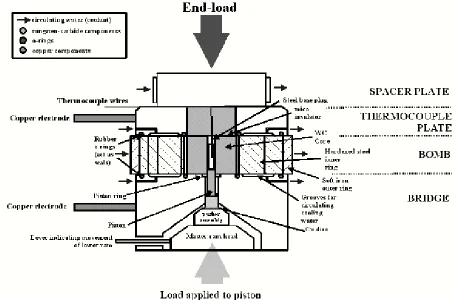
out by Bridgman [40, 39]. The apparatus [42, 17] as shown in Fig. 2.1 consists of a laterally supported tungsten carbide (WC) cylindrical chamber, which is further strengthened by application of axial load (also called the end load). The specimen confined in the cylindrical chamber, is pressurized by a ram driven tungsten carbide (WC) piston. While simple single stage pump is adequate for generating pressures up to a few thousand atmospheres, Higher pressures require some form of pressure multiplying device
[image:3.612.81.534.233.533.2]which may be called as press or an intensifier. The P.C. consists of two reciprocating hydraulic rams and the specimen confined in the pressure plate is pressurized by a WC piston driven by lower ram. The design of the higher pressure equipment becomes more difficult as the working pressure is increased. The limiting working pressure is reached when the stress on the inner surface of the vessel exceeds the yield strength of the vessel material. A non viscous fluid is used as a pressure transmitting medium up to 3 GPa and for higher pressures up to -10 GPa the sample is enclosed in a thin sheet of indium or some other soft material which act like a pseudo liquid to create approximately hydrostatic pressures [42, 17].
Fig 1. Piston Cylinder Apparatus
C. Diamond Anvil Cell Methods (DAC)
In recent years, the high pressure limits of the static methods have been extended up to- 15 GPa with the use of Tungsten Carbide (WC) anvil and - 100 GPa using the Diamond anvil cells for generating high pressures. The later [8] is the most powerful ultrahigh pressure device used in present day high pressures research and is described in brief in the following paragraph.
and anvil alignment mechanisms.
Fig.2.2. Diamond anvil cell
Energy Depressive and Angular Dispersive X-Ray Differaction(EDXRD & ADXRD) Technique
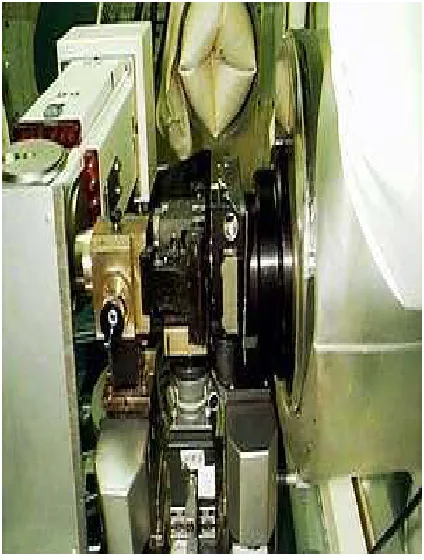
Two experimental set-ups are commonly being used in the laboratory. Energy depressive (EDXRD) studies on active samples are performed as shown below and features a Syassen Holzapfel type pressure cell integrated into an energy depressive X-ray system.Double conical slits placed between the pressure cell and the Ge detector allow only diffracted radiation at two fixed Bragg angles to pass. The entire apparatus as shown in fig. 3 is enclosed in a glove box to allow the handling and study of radioactive materials.
Angular dispersive (ADXRD) studied may also be carried out under pressure using a rotating anode X-ray generator equipped with a molybdenum anode and multilayer focusing optics. This produces an intense 100 micron diameter monochromatic x-ray beam a shown in fig. 3. Full powder diffraction patterns are collected using a CCD camera.
[image:4.612.200.412.425.705.2]\Fig .3(b). ADXRD In-house Setup
High pressure X-ray diffraction technique offers the most direct method for studying the variation of the lattice parameter with pressure and hence to detect pressure induced structural phase transition in crystals. In this method a fine beam of X-ray is produced and directed towards a small area at the center of the sample between the diamond anvils as shown in (Fig. 2.2). The diffracted X-ray beam recorded on a cylindrical film, which is coaxial with the axis of the anvils or measured with a scintillation counter. It has become customary to mix an internal standard (called “maker”) and to observe it affection pattern. For pressures below 30 GPa, NaCl is used as “Marker”. Alternatively for high pressure with diamond anvils the ruby fluorescence scale is used for pressure calibration. A tiny chip of ruby 5-10 m in dimension is placed in the pressures medium along with the samples and fluorescence is excited by either He-Cd laser line or any other strong source of light. The R lines (6927A and 6942 A) observed at atmospheric pressure are found to shift linearly with pressure. Bell [7] have generated static pressure of about 17.2 Gpa, with gasketed diamond
assembly. They have developed low temperature technique 24 for operation at liquid He temperature. Recently attempts have also been made to use synchrotron sources for crystal structure analysis and it is expected to be used in a new era for high pressure crystallography with DAC [10].
II. DYNAMIC METHODS
Ultrasonic and shockwave methods are the dynamic methods which are of interest for the study of high pressure elastic behavior and phase transitions of solids. Since the experimental results of these techniques are utilized in the present thesis, a brief description of this is useful for the critical comparison of our theoretical predictions.
A. Ultrasonic Techniques
Research concerning to the elastic properties of single crystal offers a direct means of obtaining useful information on the bonding relationships. Both ultrasonic and static compression methods are used to study the high pressure elastic behavior. Ultrasonic method has the advantage that it gives all the elastic constants of the crystal and their variation with pressure more accurately than the bulk methods.
In this method ultrasonic pulse [10 to 20 MHz is generated by a quartz piezoelectric transducer and is transmitted through the test crystal. The reflected pulse from the rear surface of the crystal reaches back to the transducer and makes successive reflections and detected each time. The actual physical measurement takes too much time by standard electronic instruments. For measurements of pressure effects, the small pressure induced changes in ultrasonic pulse transit time can be measured by an automatic gated carrier
pulse superposition equipment with a resolution of better than 107. The experimental details concerning the ultrasonic methods have been given elsewhere [19]. Velocities of the longitudinal and transverse waves propagated in the specific crystallographic directions are functions of the second order elastic constants or their combinations. Chang and Graham 25 have used this method to study elastic properties of oxides in the NaCl type phase.
B. Shock Wave Technique
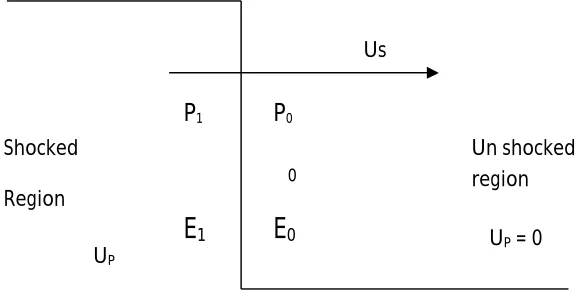
of the sample. The ideal case of a steady shockwave where the shock front connects an undisturbed state with a uniform shocked state is shown in Figure 2.4. Under such conditions the shock front velocity us the particle velocity up and the specific internal energy E are related to the pressure, volume and density of the material through the following relation[33].
0 s 1
[
s p]
P U
P U
U
[1]1 2 0 s p
P
P
PU U
[2]1 0
1 [
2
0] [
0 1]
E
E
P
P
V
V
[3]Where the suffixes 1 and 0 represent the quantities in the shocked and unshocked regions, respectively.
Using the equation of state E= [PV] locus of all states
[
PV
]
which is obtained by a single shock from an initial state0 0
[
PV
]
represent Huguenots curve. Several Huguenots can this be obtained for a given material by changing either initial temperature or density or both. In most of the experiments the quantities measured are Us and Up. A horizontal line in the Us vs. Up curve indicates a phase transition. [image:6.612.154.443.360.508.2]In a special shock wave, the sample should be maintained in a state of uniaxial strain for sufficient time for measurements to be completed. This is achieved by different loading systems, which are designed to apply loads over large plane areas of samples. Some important loading systems [26] are described below, and shown schematically in Fig. 2.4.
Fig 4 Ideal shock front
C. Contact Explosives
The first quantitative scientific shock loading experiments were made possible by fabrication of high explosive lenses that produce plane shock waves over diameters, up to about 0.3 meter. These plane wave generators, with various explosive pads produces pressure in the range of 10 to 40 GPa under relatively routine conditions. Pressure imparted to the sample depends upon the particular explosive material and mechanical impedance of the sample. In these methods it is difficult to vary input pressure in small increments and there is also lack of control on pressure release. These drawbacks are removed in other techniques which utilizes flyer plates or projectile impact technique.
D. Flyer Plates Technique
Schematically the plane wave generators with explosive pads accelerate flyer plates to high velocities. A separation of the explosive from the flyer plate by a thin plastic insert or a thin air space protects the flyer plate from damage. Typical impact velocities achieved by this technique range from 1 to 7 Km/s and produce 10 to 100 GPa pressure in Aluminum systems 30 of this type have been already described.
Shocked
Region
Un shocked region Us
E. Projectile Impact Technique
In this method a precisely dimensioned projectile is faced with the desired impacting material. It is smoothly accelerated in vacuum through a distance of many projectile lengths and allowed to strike its target in a plane impact with precise alignment of impacting surface. Compressed gases or propellants are used to accelerate projectiles to the desired velocities. In a two stage gas gun, hot gases from a gun powder detonation drives the piston which compresses hydrogen gas in the pump tube. The high pressure hydrogen them breaks the rupture valve and accelerates a 20g metal impactor against a target sample of velocities up to 8 km/s. impact velocity is directly measured by flast X-ray methods. Nearly 100 GPa pressure is produced when the impactor (Al. Projectile) strikes stationary aluminum target [12].
Fig.5. Projectile Impact Technique
There are several other techniques for producing very high pressure such as pulsed reaction from lasers underground nuclear explosion, electric rail gups and magnetic compression etc [11]. In the principle of the pulsed radiation technique, when intense radiation pulses from lasers or electron beams are directed on a target, they are absorbed and a thin layer of the target material is obtained which drives a shock into the material producing large stresses and high temperatures. Recently Godwal et. al [11] has reviewed the methods of producing high pressures up to 10 TPa but some of these methods are not suitable for laboratory experiments.
Fig.6. Two stage gas gun
III. SUMMARY AND CONCLUSION
have not yet been explored.
In many cases of phase transformation under static pressure conditions, the time required for appreciable conversions in found to be much longer in a shock experiment. In addition to time, the increase in temperature for the shock compressions also seems to play an important role. The magnitudes of the calculated shock temperatures depend primarily on specific heats compressibility. In a
typical case, the calculated temperatures from the Hugoniot for NaCl range from 180° C at 10 GPa to 8730oC at 100 Gpa [34]. Thus for 100 GPa range of pressures the temperature effects may become a dominant factor in deciding the time duration of a shock induced transformation. Kinetics of the transformation is therefore crucial for the comparison of the static and dynamic results. However it was observed that the transition pressures obtained by shock wave techniques are not always higher than static experiments, for example Alder [38] has observed an opposite effect in which the shock induced transition occurs at a lower pressure than statically observed transition pressure.
The experimental techniques described in this paper have proceeded to a body of precise information and have proved an enormous asset in construction of an adequate theory of the high pressure behavior of condensed matter. The critical comparison and limitations of different techniques discussed in this chapter will be useful for the assessment of our theoretical predictions in the cases of mixed Chalcogenide Semiconductor Compounds(ChSCs).
REFERENCES
[1] Chandra Shekar, N.; Sahu, P. Springer: Resonance, Volume 12, Number & pp. 49-64(16). 2007. [2] New materials from high-pressure experiments, Paul F. McMillan, Nature Material 1.19-25, 2002.
[3] International School of Physics Enrico Fermi Volume 147, 720 pp., hardcover ISBN: 978-1-58603-269-2, 2002. [4] Jog K. N., S. P. Sanyal and R.K. Singh Phy. Rev. B 35 5235, and references there in, 1987.
[5] Jayaraman A., Proc. Second Asia Pasific Physics Conference Bangalore, 1986.
[6] Samara G. A. physics 139 & 140 B (1986) 3-15. Cohen, L. H. W. Klement Jr. and G. S. Kennedy J. Phys. Chem. Solids 27. 179, 1986. [7] Mao H. K. KA. Geottel and P. M. Bell Solid State Physics under Pressure, (S.Minomura) Terra Scientific Publishing Company, Tokyo 1985. [8] Chang K. J. and M. L. Cohen Phy. Rev. B30, 4774, 1984.
[9] Jayaraman, A. Rev. Mod. Phys. 55,65,1983.
[10] Godwal, B. K. S. K. Sikka and R. Chidambaram - Equation of state Theories of Condensed master up to about 10 TPa “Physics Reports (Review Section of Physics letters) 102 No. 3, 121-197 North Holland Amsterdam, 1983.
[11] Nellis, W.J. A. C. Mitchell, M. Van Thief, G. J. Devine and R. J. Trainor, I. Chem. Phy. 79, 1480-1486, 1983 [12] Singh R. K. and S. P. Sanyal, Physics stat. So. (b) 113, K23, 1982.
[13] Schilling J. S. and R. N. Shelton (Eds.) Physics of Solids under high pressure North- Holland, New York, 1981. [14] Samara G.A. and P.S. peercy “Soft mode Trans, at high pressure” in solid state Phy. Vol. 36, 1981.
[15] Sato Y, and R Jeanloz, Geophys, Ref. 86, 11773 to 11778, 1981. [16] Vidya, S.N. V. Vijaykumar and C. Karunakaran BARC, 1-652, 1981.
[17] Sikka, S. K. High Pressure X-ray Sutides Transactions of the Indian institute of Metals, Vol. 34, No. 5 Oct. 1981. [18] Yogurteu, Y. K. A. J. Miller and G. A. saunders Phys., Chem. Solids 42, 49, 1981.
[19] Jeanloz, R. And T. J. Ahrens, Geophy J. R. Astr. Soc. 62,505, 1980.
[20] Timmerhans K.D. and M.S. Barber (Eds.) High Pressure Science and Technology plenum Pros. New York, 1979. [21] Lifshitz, N. and R. G. Maines, Rev. Instrum, 50,678, 1979.
[22] Mao, H. K. and P.M. Bell, Science 200, 1145, 1978.
[23] Mao, H. K. and Bell, P. M. Carnegic Institution of Washington year book 78, 659, 1978. [24] Chang Z.P. and E. K. Grahann I Phys. Chem. Solids, 38, 1355-62-1977.
[25] Duvall, G. E. R. A. Graham Reviews of Modern phy. 49,523-579, 1977. [26] Ramesh T. G. A. S. Reshamwala and S. Ramaseshan Pramana 2 (1974) 171.
[27] Fowles, G. R. in Dynamic Response of Materials to intense impulsive loading” edited by P.C. Chou and A. S. Hopkins (Air Force Materials Laboratory, Ohio P. 405,1973.
[28] Vaidya, S. N. and G. C. Kennedy, J. Phys. Chem. Solids. 31, 2329, 1970.