Technology (IJRASET)
QUADCOPTER: Four Rotor Copter
Dwivesh Kumar Dubey1, Surya Ved Prakash Yadav2, Dibya Tripathi3, Meeraj Ahmad4 1,4
Faculty, Rajkiya Engineering Colleges, Azamgarh 3
Faculty, Madan Mohan Malaviya University of Technology, Gorakhpur 2
Student, Madan Mohan Malaviya University of Technology, Gorakhpur
Abstract- Recently, many studies are being done for providing a proper detecting method which can track the persons in different situations with high efficiency. Although, several studies have been done for detect and tracking human either from a fixed camera station or from a camera which has motion, there is limited contributions for real-time human track or detect from camera which is installed on a real quad copter. The aim of this research is developing a real-time system for detect as well as tracking of the humans by a quad copter. In this regards we applied edge detection approach. The system is under implementation experimentally. The main object of this work was employing quad copter as a safety and security robot at the wide range areas.
Keywords - Quadcopter, Motors, Microcontroller etc.
I. INTRODUCTION
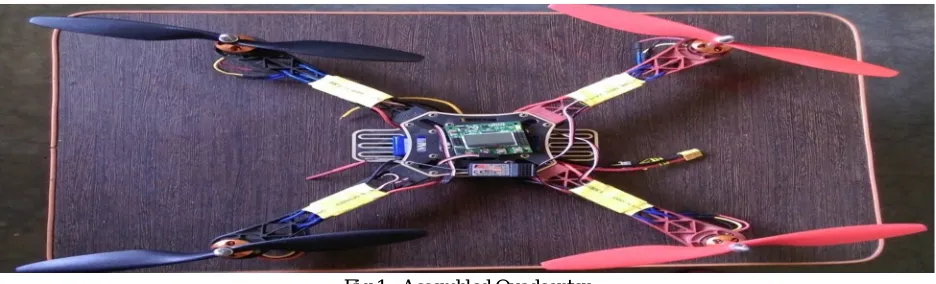
Quad copter also known as quadrotor copter or four rotor copter is a vehicle that moves upward with the help of its four propeller powered by four electric motors. These four vertically upward rotors help in any maneuver in its flying region. Since the quad copter is classified as unmanned aerial vehicle (UAV), it is believed that by the increasing demand for autonomous UAVs, quad copters are going to be developed in autonomous control system. Regarding their complicate structure, relate to the issue.[1][2][3] The quadcopter in these days taken into consideration by many of the robotics researches and its complication causes special abilities which can be used in broad range of usages.[4][5]Quad copter unmanned aerial vehicles (UAV) are used for supervision and reconnaissance by military and law enforcement agencies, as well as search and rescue missions in urban environments, which is a small UAV that can quietly hover in place and use camera to tracking people on the ground.
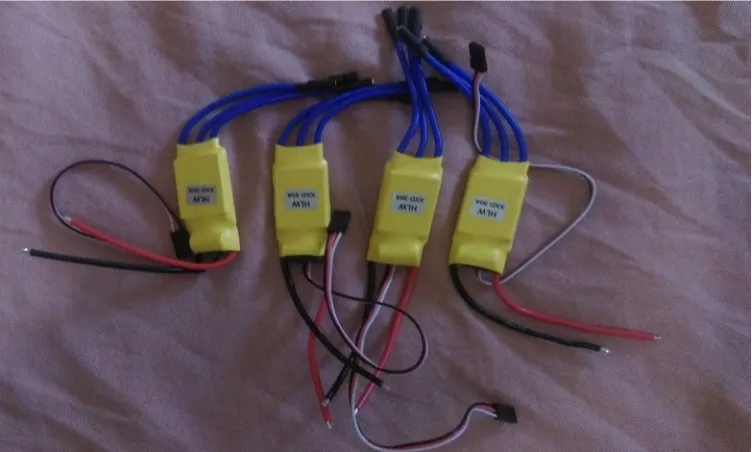
The basic design of quad copter consist of two pairs of propellers one is clockwise(CW) and another one is anti-clockwise(ACW), four 1400kV BLDC motors, four 30amp ESCs four motors, and the most important thing is KK2.1 microcontroller which consist of one accelerometer and gyroscopic sensor which will help the copter during its flight, and for modification we used a small solar panel which will help to give power to quad copter during sunlight, and the battery used is Li-Po 3 Cell, 11.1V, 5000mAh, 20C discharge Battery.
[image:2.612.73.541.496.638.2]A. Microcontroller
[image:3.612.112.524.151.279.2]Microcontroller consists of 3-axis gyroscope and 3-axis accelerometer. An accelerometer is a device measures acceleration forces. A gyroscope is a device used primarily for navigation and measurement of angular velocity. 3 axis gyroscopes are often implemented with 3-axis accelerometer to provide a full 6 degree of freedom [DOF] motion tracking system.
Fig 2: Microcontroller
B. Dc Brushless Motor
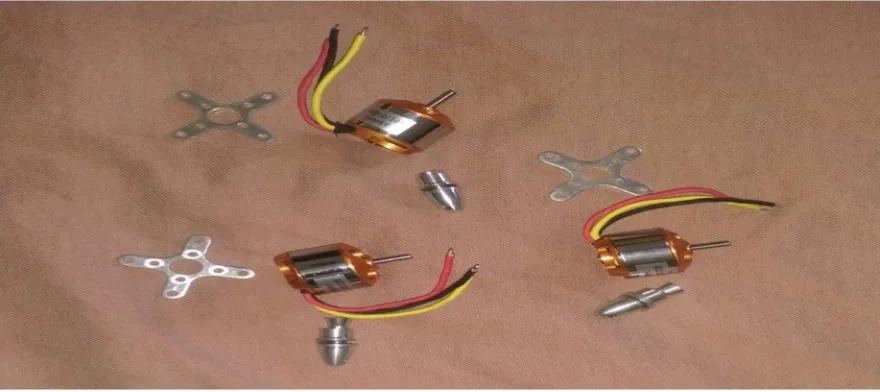
Brushless motors has more advantage compare to brushed motor, force motor and servo motor in terms of comparatively more efficiency, reliability, longer life span, more power, high torque per weight, reduced noise factor, elimination of ionizing sparks from commutator and overall reduction of electromagnetic interface.
Fig 3: Motors
C. Propellers
[image:3.612.96.536.348.544.2]Technology (IJRASET)
Fig 4: Propellers
D. Electronic Speed Controller (ESC’S)
[image:4.612.128.504.385.611.2]Fig 6:Battery Fig 7: Charger
F. Li-Po Alarm
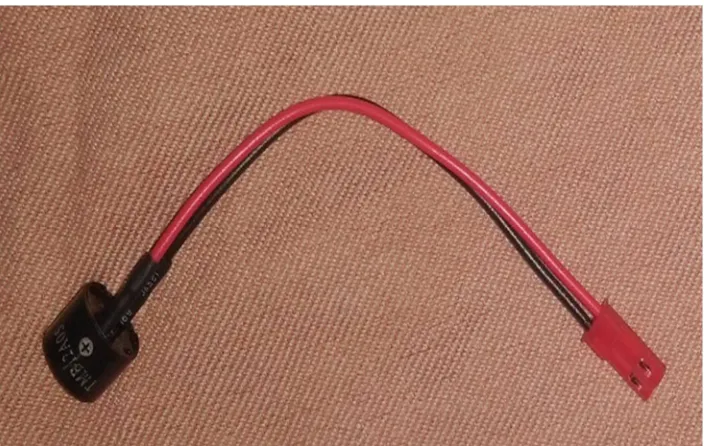
[image:5.612.141.493.380.603.2]A Li-Po alarm is an audible and visual alarm that plugs into battery to provide a voltage warning during flight to land the quadrotor prior to failure due to low voltage.
Fig 8: Li-Po Alarm
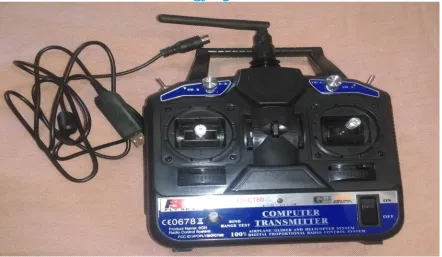
G. Remote Controller (RC)
Technology (IJRASET)
Fig 9: Remote Controller
III. WORKING PRINCIPLE
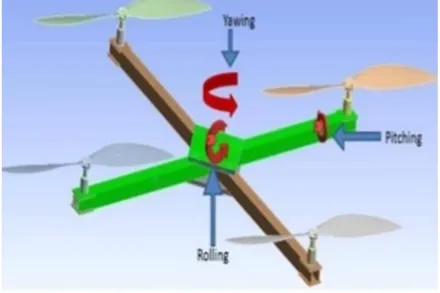
All DC brushless motor attached by parallel connection with other motors. Power distributed to power distribution board from battery. Further the power distributes equally to four electronic speed controllers and then goes in to each DC brushless motors. Accelerometers will measure the angle of Quadrotor in terms of X, Y and Z axis and accordingly adjust the RPM of each motor in order to self stabilize by it self. The stability is provided by setting the direction of rotation clockwise of one set of opposite motors and counter-clockwise of other set of motors which nullifies the net moment and gyroscopic effects. By using this principle one is able to adjust the speed and can get desired speed of each individual motor in order to get desired yaw, pitch and roll. RPM of the shaft of a motor is a function of voltage provided to that motor. Roll and pitch can be controlled by changing the speed of the appropriate motor, while yaw control involves proper balancing of all four motor results in to change in moment and force applied to take appropriate turn. Controlling of quadrotor involves different four states.
A. Upward motion (Z direction)
The force required for this motion is known as lift force and generated by thrust produced by four propellers rotating at same speed.
B. Yaw Motion (ψ)
This motion is attained by increasing speed of appropriate set of motors. By generating couple of force from two neighbour motors, yawing can be achieved.
C. Pitch Motion (ө)
Technology (IJRASET)
IV. COST ESTIMATION
Name of Component Cost of Unit Component(Rs) No. of Component Total
BLDCMotor 650 4 2600
Frame 1100 1 1100
Esc’s 550 4 2200
Propeller 200 4 800
Battery 3000 1 3000
Microcontroller Board 2000 1 2000
Remote Control 3000 1 3000
Extra Material 300
Total 15000
V. APPLICATIONS
A. Military use (provide necessary materials during war)
B. Covert operations
C. Traffic surveillance
D. For checking the gas levels in industries
E. Unmanned military warfare
F. For construction purpose
G. Geo physical survey
H. Railway track bed inspection
I. Coastal mapping
J. Preventing Diseases
VI. CONCLUSION
The quadcopter is a novel design which can be easily controlled when it is compared to a helicopter. We have fabricated the frame and the arms of the quadcopter in such a way that its weight should be low as possible.We used latest parts on the basis of our research to improve its efficiency.
The knowledge we have gained is valuable but the quad copter is vast topic and the time was not sufficient to calculate all the aspects of the quad copter. We plan to do further research in the future as we now know the various problems faced by the quad copter. It has fixed rotors and their movement can be controlled just by changing the speed of the blades. The applications of the quad copter are numerous and with the requirement and advancement of UAV’s , the scope for its use has increased drastically. However, yet some issues are to be decoded completely such as the short flight time, balancing and the weight carrying capacity which have to be further investigated. But we have showed that the advantages outweigh the disadvantages. A lot of research needs to be done on the quad copter for the best results in the future. Considering the financial aspects in designing the Quad copter initial cost is high as the parts purchased are genuine, but if we manufacture these quad copters in mass cost can be minimized, based upon the type of applications, cost may increase or decrease.
models in automation and robotics, August.
[4] Teppo Luukkonen, “Modelling and control of quadcopter,” Independent research project in appliedmathematics, Espoo, August 22, 2011.
[5] H. Huang, G. M. Hoffmann, S. L. Waslander, and C. J. Tomlin, “Aerodynamics and control of autonomous quadrotor helicopters in aggressive maneuvering,” IEEE International Conference on Robotics and Automation, pp. 3277–3282, May 2009.
[6] J.G.Leisman, Evolution of Helicopter Flight, http:// www.100yearsofflight.com,retrieved December 2006. [7] Wikipedia the free encyclopedia, http//en.wikipedia.org/wiki/Main_Page,retrieved December 2006.
[8] Sandia National Laboratories, SUMMiTTM Technologies, www.mems.sandia.gov, retrieved December 2006. [9] Honeywell documentation, www.honeywell.com, retrieved December 2006.
[10] Memsic Documentation, www.memsic.com, retrieved December 2006.
[11] Silicon Sensing Documentation, www.siliconsensing.com, retrieved December 2006. [12] Analog devices Documentation, www.analog.com, retrieved December 2006. [13] Parallax Documentation, www.parallaxinc.com, retrieved December 2006.
[14] E.Altuğ, Vision based control of unmanned aerial vehicles with applications to an autonomous four rotor helicopter, Quadrotor, PhD thesis, University of
Pennsylvania, 2003.