Technology (IJRASET)
Comparison of Movement Model in DTN using
routing algorithm by varying the Nodes
Priyanka Juneja1, Monika Sharma2
M.Tech. Scholar1, Assistant Professor2, Department of Information Technology , TIT&S Bhiwani
Abstract: Delay Tolerant Networks (DTNs) represent a class of wireless networks that experience frequent and long lasting partitions due to dense distribution of nodes in the network topology. In DTN the routing of packets is made using store-carry-forward method. In this paper, three popular routing protocols in DTN namely; Epidemic , Direct Delivery and First Contact have been measured for performance evaluation. The performance of these routing protocols has been evaluated using three movement models namely Cluster Movement Model and Map Based Movement Model, shortest path map based movement model.
Keywords: Delay Tolerant Network (DTN), The ONE (Opportunistic Network) simulator, Movement Models, Routing protocols, TTL (time to live).
I. INTRODUCTION
A DTN is a network designed to operate effectively in highly-challenged environments. The "D" part in DTN stands both for Delay and for Disruption. By delay we mean the end-to-end latency of data transmission. The network is partitioned into numerous sub-networks in DTN.
Message transmission between different source-destination pair is done using different intermediate nodes and each intermediate node having its own buffer space temporarily store message in it till it comes in the neighborhood of other intermediate node. DTNs
is a class of infrastructure-less wireless systems that maintain the functionality of networks experiencing frequent and long lasting partitions. A challenge for Delay Tolerant Networks is to control the routes through the network without having an end to end connection at any given abrupt of time. In DTN the routing of packets is done using store-carry-forward mechanism [2, 3]. And when encounter occurs the packet is provided to next intermediate node. This procedure is followed until the destination is reached [4, 5]. Routing and forwarding of data packets in DTN is a challenging task because of the uncertainty of mobility and alternating behavior of the nodes [6]. There are several issues in Delay Tolerant Networks that needs to be addressed. The most essential factor is encounter schedule, network capacity, storage capacity, energy etc [7]. DTNs may be characterized by combination of any of the following:
A. Intermittent Connectivity: There is no consistent end-to-end path between the source and destination.
B. Asymmetric data rates: The Internet does support some forms of asymmetric both directional data, as in cable TV or asymmetric DSL access.
C. High error rates: In DTN the link error rates is quite high.
D. Indefinite mobility designs: Unlike the case with public bus services that maintain fixed routes or planetary trajectories, upcoming behavior of a node is not fully recognized for many DTN applications.
The remainder of this paper is organized as follows. Section II represents the background and related work that are important for the understanding of DTN. In Section III, the simulation setup and different assumptions used to simulate different routing protocols of DTN are described. Section IV is devoted to the simulation results. Section V concludes the work and provides some insights on future work.
II. BACKGROUND AND RELATED WORK
In this Section, an overview of three routing protocols for DTN Epidemic[8],Direct Delivery and first contact[10],along with the irrelative pros and cons have been described.
A. Epidemic
Technology (IJRASET)
Time-To-Live (TTL)as well as an expiry time associated with every message for controlled flooding in DTNs.
B. First contact
This is simplest strategy to transmit the data from source to destination in DTN. This convey message immediately as soon as the source and destination come in contact with each other directly. This is likely when the source and destination are one hop apart or immediately neighbor of each other.
C. Direct Delivery Routing
This data delivery scheme is one of the simplest possible where a source transports a packet to a destination when it comes in direct-contact. In other words, the source waits till it comes in radio range of the destination and then straight delivers the packet to the same. This scheme does not consume any supplementary resources and makes no further copies of the data. However, the major limitation is that the delivery delay can be enormously big and in many cases the source and the destination may never come in direct-contact of each other.
III. SIMULATION SETUP
In this work, ONE simulator [12] is used for the simulation. Three different types of movement models present in ONE simulator, namely Cluster movement [13], Map Based Movement [14], Shortest Path Map Based Movement [14], have been used for simulation. In this work, the nodes are assumed mobile in nature. The different simulation parameters taken in this work are given as per below table:
TABLE1: Simulation Parameters
The setting and configurations used for varying the fields are as follows:
A. Varying the number of nodes
The nodes are increased as: 80->120->160->200->240, with an increment of 10 nodes in each group in each simulation. The time to live field is set to 200 seconds and all nodes moves according to their respective group speeds.
B. Varying the Message TTL
The TTL is varied from50->100->150->200->250seconds.The total numbers of nodes are kept fixed at160 and the speed of all group nodes is kept between 2.5-5.0m/s.
The following performance metrics are considered for comparative analysis of the routing protocols:
Sim_time 30000 sec
Sim_area (4500*3400m)Helsinki down town area
Bt_interface-transmit_speed 250kbps
Bt_interface_transmit_range 10kbps
Number of groups 4
Buffer_size 5 MB
TTL 100 sec
Cell_size 5 m
Reports 1
Technology (IJRASET)
1) Throughput: Ratio of number of messages delivered to destination and number of messages produced by source node.
2) Message delivery probability: It is the probability of the messages that are correctly acknowledged by the destination within a given time period.
3) Overhead ratio: It is defined as:
(No. of Relayed Messages–No. of Delivered Messages) No of Delivered Messages
4) Average buffer time: It is the average time for which messages stayed in the buffer at each node.
IV. SIMULATION RESULTS
The results for the proposed work are calculated by varying two fields:
A. Varying the number of nodes
When the number of nodes is varied, the graphs obtained for various performance matrices are given as per below:
[image:4.612.139.477.293.460.2]1) Delivery Probability: The figure 4.6 shows how the delivery probability of the messages varies when the number of nodes is varied for cluster movement model and the proposed movement model. It is clear from the figure that the delivery probability of the packets is higher in proposed movement model.
Figure 4.6: Number of nodes v/s delivery probability
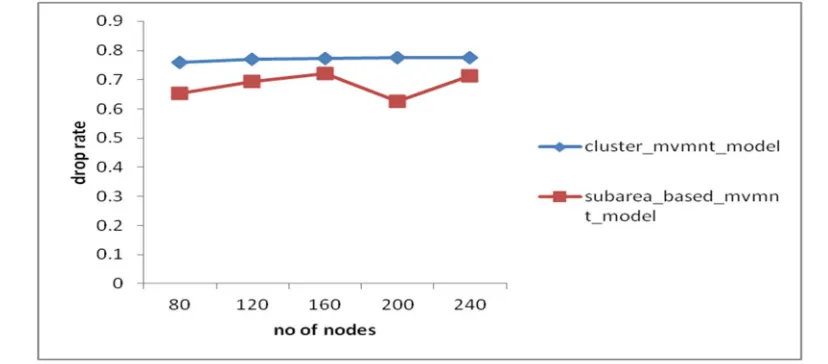
2) Drop Rate of messages: The figure 4.7 shows the graph between drop rate of messages and number of nodes for the cluster movement model and proposed movement model. The figure shows that the drop rate is higher in case of previous movement model and lesser in the proposed work.
[image:4.612.96.510.525.707.2]Technology (IJRASET)
[image:5.612.97.511.106.327.2]3) Throughput: The figure 4.8 shows the graph between throughput and number of nodes. The graph depicts that the throughput is higher in case of the proposed movement model.
Figure 4.8: Number of nodes v/s throughput
4) Overhead ratio
The figure 4.9 shows the graph between the number of nodes and the overhead ratio. The graph shows that the overhead ratio for the proposed subarea based movement model is lesser then the previous cluster movement model.
Figure 4.9: Number of nodes v/s overhead ratio.
V. CONCLUSION AND FUTURE WORK
[image:5.612.97.518.392.618.2]Technology (IJRASET)
simulation results show that the proposed subarea based movement model is better than the previous cluster movement model.
REFERENCES
[1] Haigang Gongand Lingfei Yu .Study on Routing Protocols for Delay To lerant Mobile Networks. Volume2013,ArticleID145727,HindawiPublishingCorporation.
[2] Nelson I. Dopico, Álvaro Gutiérrez and Santiago Zazo. Performance analysis of a delay tolerant application for herd localization. 2011 Elsevier B.V. All rights reserved.
[3] Anders Lindgren and Avri Doria. Probabilistic routing protocol for intermittently connected networks,
[4] Shyam Kapadia, Bhaskar Krishnamachari and Lin Zhang. Data Delivery in Delay Tolerant Networks: A Survey. www.intechopen.com.
[5] Haigang Gong and Lingfei Yu. Study on Routing Protocols for Delay Tolerant Mobile Networks. Volume 2013, Article ID 145727, Hindawi Publishing Corporation.
[6] L. Pelusi, A. Passarella, M. Conti. Opportunistic networking: Data forwarding in disconnected mobile ad hoc networks. IEEE Communications Magazine, vol. 44, pp. 134–141, Nov 2006.
[7] C.-M. Huang, K.-C. Lan, C.-Z. Tsai. A survey of opportunistic networks. Proc. of the 22nd Intl. Conferencekl on Advanced Information Networking and Applications (WAINA), Biopolis, Mar. 25-28, Okinawa, Japan, 2008.
[8] A. Vahdat, D. Becker. Epidemic routing for partially connected ad hoc networks. Technical Report CS-2000-06, Dept. of Computer Science, Duke University, Durham, NC, 2000.
[9] A. Lindgren, A. Doria, and O. Schelen. Probabilistic routing in intermittently connected networks. ACM SIGMOBILE, Mobile Computing and Communications Review, vol. 7, no. 3, pp. 19–20, 2003.
[10] T. Spyropoulos, K. Psounis, C. S. Raghavendra. Spray and wait: An efficient routing scheme for intermittently connected mobile networks. Proc. of ACM SIGCOMM Workshop on Delay-Tolerant Networking (WDTN ’05), pp. 252–259, 2005.
[11] Anders Lindgren and Avri Doria. Probabilistic routing protocol for intermittently connected networks. Internet Draft draft- lindgren-dtnrg-prophet-OO.txt (work in progress), June 2005.
[12] A. Keranen. Opportunistic Network Environment Simulator. Special Assignment Report, Helsinki University of Technology, Dept. Of Communications and Networking, May 2008.
[13] T. Camp, J. Boleng, V. Davies. A survey of mobility models for ad hoc network research. Wireless communications and mobile computing 2(5): pp. 483-502, 2005.
[14] A. Keranen, J. Andott. Opportunistic increasing reality for DTN protocol simulations. Special Technical Report, Helsinki University of Technology, Networking Laboratory, July 2007.
[15] Davis, J., Fagg, A. & Levine, B. (2001). Wearable computers as packet transport mechanisms in highly-partitioned ad-hoc networks. Wearable Computers, 2001. Proceedings. Fifth International Symposium on, pp. 141 –148.
[16] K. Shin S. Kim Department of Computer Science, Korea Advanced Institute of Science and Technology, 335 Gwahak-ro, Yuseong-gu,Daejeon 305-751, Korea (2010). Enhanced buffer management policy that utilizes message properties for delay-tolerant networks ISSN 1751-8628
VI. ACKNOWLEDGEMENTS
I would like to express my sincere appreciation to my thesis supervisor Mr. Sanjeev Indora, Assistant Professor, CSE Department, DCRUST, Murthal, Sonipat for all his invaluable guidance and encouragement. His perpetual energy and Enthusiasm in research had motivated me throughout my research work. In addition, he was always accessible and willing to help his students with their research. As a result, research life became smooth and rewarding for me.
I would also like to thank my whole department for their supportive nature. Whenever I need any kind of help the faculty of my department was always there to help me out. Due to which I was able to complete my dissertation work within time.