Technology (IJRASET)
Evaluating Performance of Proactive and Reactive
Routing Protocols for Wireless Ad-Hoc Networks
Rajani K C1, Dr. Aishwarya P2 1
Assistant Professor, Department of Information Science and Engineering 1
Nagarjuna College of Engineering and Technology, Bangalore. 2
Professor, Department of Computer Science and Engineering, Atria Institute of Technology, Bangalore
Abstract --- Mobile Ad hoc network (MANET) is a rambling collection of wireless mobile nodes that dynamically form a temporary network infrastructure without any support of central coordination. All the nodes in MANET moves arbitrarily forming multi hop network topology to change randomly at unpredictable times .There are several routing protocols like DSDV, DSR AODV etc.. Which have been proposed for providing communication among the nodes in the network? DSDV is a proactive routing protocol whereas DSR and AODV is a reactive routing protocol. This paper evaluates the performance of DSDV, AODV and DSR based on measurements such as packet delivery ratio, Throughput using ns-3 simulator.
Keywords: MANET, DSDV, AODV, DSR, Throughput, Packet Delivery Ratio.
I. INTRODUCTION
Mobile ad hoc network is a collection of wireless mobile nodes that dynamically establishes the network without any fixed infrastructure [1].One important feature of MANET is each node acts
As a host and a router to find out the optimal path to forward packets to neighbor nodes. Due to the mobility of nodes, topology of the network will change continuously. MANET’S provide an emerging technology for civilian, military, distributive and collaborative computing applications. One of the important research areas in MANET establishment and maintenance of ad hoc network by using routing protocols. So many routing protocols are available for ad hoc network out of which DSDV, AODV and DSR are the familiar protocols. So many routing protocols are available for ad hoc network out of which DSDV, AODV and DSR are the familiar protocols.
This paper analyzes these protocols with important metrics such as throughput, packet delivery ratio which has been presented with the simulation results obtained by NS-3 simulator. A number of routing protocols have been proposed and implemented for MANET’S in order to increase bandwidth utilization, higher throughput and lesser overhead per packet, minimum consumption of battery life. All these protocols had their own merits and demerits under certain circumstances. The major requirements of a routing protocol proposed by Zuraida binti [2] that includes minimum route acquisition delay, loop free routing, quick routing, minimum control overhead, overcome link failure due to its mobility support for distributed routing approach and scalability. MANET routing protocols has two properties such as Qualitative properties (distributed operation, loop free, on-demand based routing and security) and quantitative properties (end to end delay, throughput, route discovery time, network recovery time, memory byte requirement).Most of the routing protocols are qualitatively enabled and lot of studies were carried out in paper [3] to review the quantitative properties of routing protocol.
Technology (IJRASET)
II. MOBILE AD HOC NETWORK ROUTING PROTOCOLS
Fig 1: Categorization of ad-hoc routing protocol
Protocol Classifications: Routing protocols are broadly classified into 3 types such as Proactive, Reactive and Hybrid protocols [5].
A. Proactive Routing Protocols
Proactive routing protocols are table driven routing protocols attempt to maintain consistent, up-to-date routing information from each node to every other node in the network. These protocols require each node to maintain one or more tables to store routing information and they respond to changes in network topology by propagating route updates throughout the network to maintain a consistent network .The areas where they differ are the number of necessary routing related tables and the methods by which changes in network structure are broadcast.
B. Reactive Routing Protocols
Reactive Routing protocols are source initiated On-demand routing protocols. This type of routing creates routes only when desired by the source node. When a node requires a route to a destination, it initiates a route to a destination, it initiates a route discovery process with in the network .This process is completed once a route is found or all possible route permutations have been examined. Once a route has been discovered and established, it is maintained by some form of route maintenance procedure until the destination becomes inaccessible along every path from the source or the route is no longer desired.
C. Hybrid Routing Protocols
Hybrid Routing protocols are the combinations of reactive and proactive protocols and takes the advantages of these two protocols as a result routes are found quickly in routing zone.
III. OVERVIEW OF ROUTING PROTOCOLS
A. Destination Sequenced Distance Vector Routing
The Table-driven DSDV protocol is a modified version of the Distributed Bellman-Ford (DBF) Algorithm that was used successfully in many dynamic packet switched networks [7]. The Bellman-Ford method provided a means of calculating the shortest paths from source to destination nodes, if the metrics (distance-vectors) to each link are known. DSDV uses this idea, but overcomes DBF’s tendency to create routing loops by including a parameter called destination-sequence number. In DSDV, each node is required to transmit a sequence number, which is periodically increased by two and transmitted along with any other routing update messages to all neighboring nodes. On reception of these update messages; the neighboring nodes use the following algorithm to decide whether to ignore the update or to make the necessary changes to its routing table:
Step 1: Receive the update message
Technology (IJRASET)
Otherwise, ignore the update message.
Here, Sn and Sp are the Sequence numbers of new message and existing message spectively. When a path becomes invalid, due to movement of nodes, the node that detected the broken link is required to inform the source, which simply erases the old path and searches for a new one for sending data. The advantages are latency for route discovery is low and loop-free path is guaranteed. The disadvantage is the huge volume of control messages.
B. Ad Hoc On-Demand Distance Vector Routing
The Ad Hoc On-demand Distance Vector Routing (AODV) protocol is a reactive unicast routing protocol for mobile ad hoc networks [8]. As a reactive routing protocol, AODV only needs to maintain the routing information about the active paths. In AODV, the routing information is maintained in the routing tables at all the nodes. Every mobile node keeps a nexthop routing table, which contains the destinations to which it currently has a route. A routing table entry expires if it has not been used or reactivated for a pre-specified expiration time. In AODV, when a source node wants to send packets to the destination but no route is available, it initiates a route discovery operation. In the route discovery operation, the source node broadcasts route request (RREQ) packets which includes Destination Sequence Number. When the destination or a node that has a route to the destination receives the RREQ, it checks the destination sequence numbers it currently knows and the one specified in the RREQ. To guarantee the freshness of the routing information, a route reply (RREP) packet is created and forwarded back to the source only if the destination sequence number is equal to or greater than the one specified in RREQ. AODV uses only symmetric links and a RREP follows the reverse path of the respective RREQ. Upon receiving the RREP packet, each intermediate node along the route updates its next-hop table entries with respect to the destination node. The redundant RREP packets or RREP packets with lower destination sequence number will be dropped. The advantage of this protocol is low Connection setup delay and the disadvantage is more number of control overheads due to many route reply messages for single route request.
C. Dynamic Source Routing
The Dynamic Source Routing (DSR) is a reactive unicast routing protocol that utilizes source Routing algorithm [9]. In DSR, each node uses cache technology to maintain route
Formation of all the nodes. There are two major phases in DSR such as: Route discovery & Route maintenance
When a source node wants to send a packet, it first consults its route cache [7]. If the required route is available, the source node sends the packet along the path. Otherwise, the source node initiates a route discovery process by broadcasting route request packets. Receiving a route request packet, a node checks its route cache. If the node doesn’t have routing information for the requested destination, it appends its own address to the route record field of the route request packet. Then, the request packet is forwarded to its neighbors. If the route request packet reaches the destination or an intermediate node has routing information to the destination, a route reply packet is generated. When the route reply packet is generated by the destination, it comprises addresses of nodes that have been traversed by the route request packet.
Otherwise, the route reply packet comprises the addresses of nodes the route request packet has traversed concatenated with the route in the intermediate node’s route cache. Whenever the data link layer detects a link disconnection, a ROUTE_ERROR packet is sent backward to the source in order to maintain the route information. After receiving the ROUTE_ERROR packet, the source node initiates another route discovery operation. Additionally, all routes containing the broken link should be removed from the route caches of the immediate nodes when the ROUTE_ERROR packet is transmitted to the source. The advantage of this protocol is reduction of route discovery control overheads with the use of route cache and the disadvantage is the increasing size of packet header with route length due to source routing.
IV. SIMULATION RESULTS , PERFORMANCE EVALUATION AND ITS COMPARISON
A. Simulation Model
Technology (IJRASET)
Table 1: Parameters considered foe simulation in NS-3 Parameter Value
Radio model Two way ground Protocols DSDV,AODV,DSR Traffic Source Constant bit rate Packet Size 512 bytes Max Speed 12m/s Area 500x500 Number of nodes 50 Application FTP
MAC 802.11
Simulation Time 20 0 60 80 100
1) Throughput: It is the ratio of the total amount of data that reaches a receiver from a sender to the time it takes for the receiver to
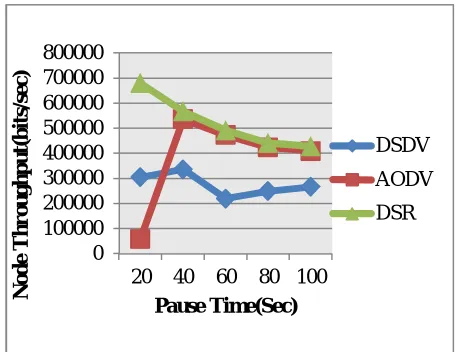
[image:5.612.190.423.345.454.2]get the last packet. When comparing the routing throughput by each of the protocols, DSR has the high throughput. It measures of effectiveness of a routing protocol. The throughput values of DSDV, AODV and DSR Protocols for 50, 75 and 100 Nodes at Pause time 20s, 40s, 60s, 80s and 100s are noted in Table-1 and they are plotted on the different scales to best show the effects of varying throughput of the above routing protocols (Figures 2, 3 & 4).
Table 2: Comparison of Throughput
Based on the simulation results, the throughput value of DSDV increases initially and reduces when the time increases. The throughput value of AODV slowly increases initially and maintains its value when the time increases. AODV performs well than DSDV since AODV is an on-demand protocol. The throughput value of DSR increases at lower pause time and grows as the time increases. Hence, DSR shows better performance with respect to throughput among these three protocols
Pause
Time(Sec) Protocol (No of nodes=50) DSDV AODV DSR 20 40 60 80 100 304933 336862 220359 250288 266990 580851 537095 474272 423994 409988 680597 567319 492096 441614 428177 0 100000 200000 300000 400000 500000 600000 700000 800000
20 40 60 80 100
[image:5.612.204.433.525.701.2]Technology (IJRASET)
Table 3: Comparison of Packet Delivery Ratio
2) Packet Delivery Ratio: Packet Delivery Ratio (PDR) is the ratio between the number of packets transmitted by a traffic source
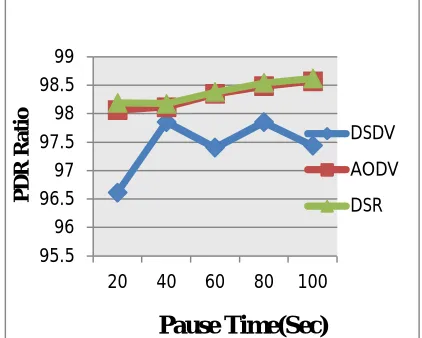
and the number of packets received by a traffic sink. It measures the loss rate as seen by transport protocols and as such, it characterizes both the correctness and efficiency of ad hoc routing protocols. A high packet delivery ratio is desired in any network. The ratio of the Originated applications’ data packets of each protocol which was able to deliver at varying time are shown in Figures 5, 6 & 7 as per Table 2. As packet delivery ratio shows both the completeness and correctness of the routing protocol and also measure of efficiency the PDR value of AODV is higher than all other protocols. The PDR values of DSR and AODV are higher than that of DSDV. The PDR value of DSDV is worse in lower pause time and gradually Grows in higher pause time. From the above study, in view of packet delivery ratio, reliability of AODV and DSR protocols are greater than DSDV protocol.
Fig 2: comparison of Packet Delivery Ratio for 50 Nodes
V. CONCLUSION
This paper evaluates the performance of three routing protocols such as DSDV, AODV and DSR ,Analyzed using NS-3 Simulator. We have done simulation results of Throughput and PDR ratio for 50 nodes over DSDV, DSR and AODV Protocols by varying network size and simulation time. Comparing DSR with DSDV and AODV Protocol, DSR protocol uses source routing and route cache. Hence DSR is preferable for less traffic with less mobility of nodes. AODV Performs better in case of Packet delivery ratio but it performs badly in throughput. DSR outperforms both in PDR and Throughput when nodes have high mobility also.
REFERENCES
[1] C.Sivaram murthy, B.S.Manoj, Adhoc wireless networks: Architectures, and protocols, Pearson Education, 2004.
[2] Zuraida Binti Abdullah Hani and Mohd. Dani Bin Baba, “Designing Routing protocols for Mobile Ad hoc networks”, IEEE 2003. [3] Mohammed Bouhorma, H.Bentaouit and A.Boudhir, “Performance comparison of Ad hoc Routing protocols AODV and DSR”, IEEE 2009. [4] Mehran Abolhasan, Tadeusz Wysoci, Eryk Dutkiewicz, “A review of routing protocols for Mobile ad hoc networks”, ELSEVIER, 2003. [5] Tao Lin, Scott F.Midkiff and Jahng S.Park,”A framework for Wireless Ad hoc Routing Protocols”, IEEE 2003.
[6] Changling Liu, Jorg Kaiser, “A survey of Mobile Ad Hoc Network Routing Protocols”, University of Magdeburg, 2005.
[7] C.P Bhagwat, “Highly Dynamic Destination Sequenced distance Vector Routing (DSDV) for Mobile Computers”, in proceedings of ACM SIGCOMM’, September 1994. 95.5 96 96.5 97 97.5 98 98.5 99
20 40 60 80 100
P D R R ati o
Pause Time(Sec)
DSDV AODV DSR Pause Time(Sec)Protocol (No of nodes=50) DSDV AODV DSR
Technology (IJRASET)
[8] C. Perkins and E. Royer, “Ad-Hoc On Demand Distance vector Routing”, in proceedings of 2nd IEEE Workshop on Mobile Computing systems and Applications, February 1996.