Technology (IJRASET)
Cost Escalation in Construction Projects
S Vaishnavi Devi1, Assistant Professor R Jegan2
1
M.E Student, 2Assistant Professor Department of Civil Engineering, Thiagarajar College of Engineering, Madurai, (T.N), (India)
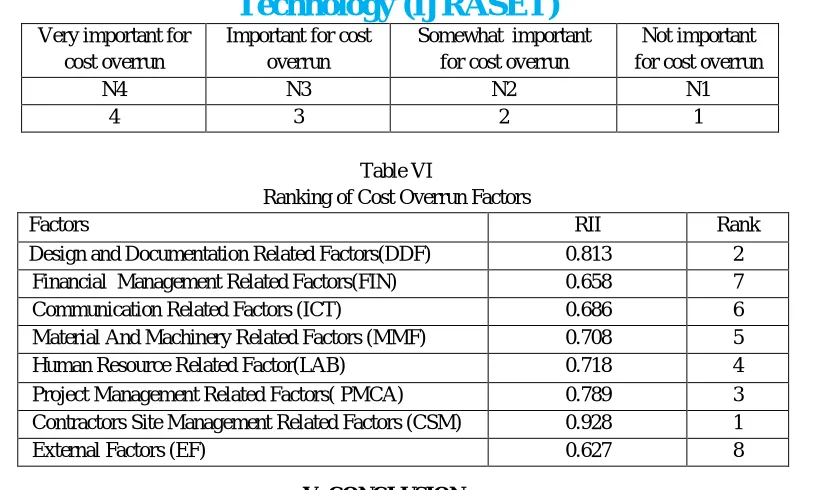
Abstract: The Construction industry is an integral part of a country’s economy, its growth and plays a pivotal role in developing the country’s infrastructure. The current status report published by the Indian Ministry of Statistics and Programme Implementation (MOSPI) highlighted that out of the 951 projects being monitored 309 projects have cost overruns and 474 projects are behind schedule. The scope of this study is to investigate the importance levels of factors causes cost overrun in construction projects undertaken by construction companies. Eight factors named Design and Documentation Related Factors (DDF), Financial Management Related Factors (FIN), Communication Related Factors (ICT), Material and Machinery Related Factors (MMF), Human Resource Related Factors (LAB), Project Management Related Factors (PMCA), Contractors Site Management Related Factors (CSM), External Factors (EF) and their respective sub- factors are found to be responsible for cost escalation. Based on these above factors questionnaire was prepared and distributed 38 respondents. The data received from questionnaire survey was analyzed using Statistical Package of Social Science (SPSS) to carry out reliability test, hypothesis, correlation and ranking. The survey results indicated that Contractors Site Management Related Factors (RII=0.928), which is being most significant among the others that leads to delay in completion of the project and causes overrun.
Keywords: cost overrun factors, Relative Important Index (RII), Statistical Package of Social Science (SPSS)
I. INTRODUCTION
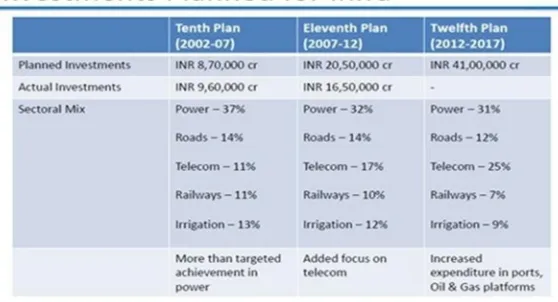
[image:2.612.165.444.502.653.2]The Construction industry is one of the key economic industries in India and is the main motivating force in Indian national economy. Construction sector in India will remain buoyant due to increased demand from real estate and infrastructure projects. An investment of USD 1 Trillion has been projected for the infrastructure sector until 2017, 40% of which is to be funded by the private sector, 45% of infrastructure investment will be funnelled into construction activity and 20% set to modernise the construction industry. But, it suffers from a number of problems that affect time, cost and quality performances. Government data suggest that a majority of projects experience 60 per cent are overwhelmed by cost overruns. If present trends continue over the Eleventh and Twelfth Plan periods (2008 to 2017), McKinsey estimates suggest that India could suffer a GDP loss of US$ 200 billion around 10 per cent of its GDP in financial year 2017.
Figure 1: Investment Planned for Infrastructure
Technology (IJRASET)
II. LITERATURE REVIEW
Olawale, Y.A et al., (2014) [7] stated in their study that significant factors listed below causes delay in project due to time & cost overruns in Indian construction projects. Questionnaire for the survey was developed based on 76 factors of time overruns and 54
factors of cost overruns and grouped into 12 & 8 major groups. Adnan Enshassi et al., (2010) [2] found in his study that
Construction projects located in the Gaza Strip, Palestine suffer from many problems and complex issues such as unavailability of competent staff, late delivery of materials and equipment, material shortage, waste rate of materials, escalation and fluctuation of
material prices. Abdullah et al., (2009) [1] mentioned that 90% of large MARA construction project were suffered delay with
significant effect of time and cost overrun that in 161 completed projects were found to be changes in scope and delays during
construction. Seyed Ali Mousavi Dehmourdi (2014)[8] assessed the objective to apply the principles of engineering economics,
basic economic concepts , finance and quantitative techniques to modelling and analysis of civil engineering projects to overcome cost overrun.
III. METHODOLOGY
The research methodology for present study has adopted questionnaire survey to identify the significant factors influences cost overrun in construction projects. From the literature review, the factors are identified and that was discussed with various construction company project managers, engineers, quantity surveyor and so on. Questionnaire was prepared based on 61 sub factors from 8 major groups of factors that influences cost overrun. Respondents from various construction firm were requested to rate the 4 point scale 1-4 ,for each factors which was to be considered the major reason for cost escalation in construction projects according to their experience and designation in the firm.
A. Factors Identification
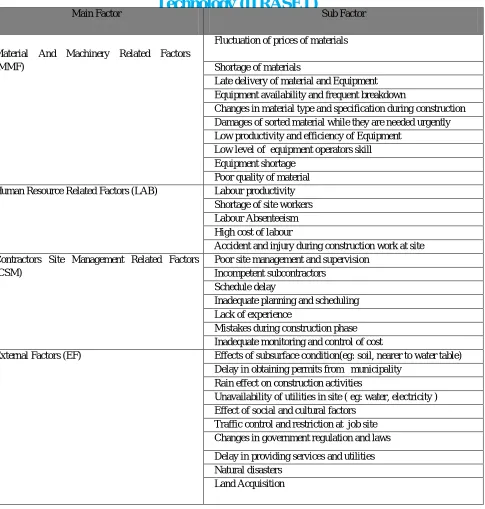
Following factors were identified and categorized into their dependency through literature study
Table I
Main Factor and Sub Factor
Main Factor Sub Factor
Design And Documentation Related Factors (DDF)
Mistakes and discrepancies in design documents Delays in producing design documents
Unclear and inadequate details in drawing Complexity of project design
Insufficient data collection and survey before design
Misunderstanding of owners requirements by design Engineer
Financial Management Factor(FIN) Poor financial control on site
Financial difficulties of owner Delay in progress payment by owners Delay payment to supplier / subcontractors
Contractual claims such as extension of time with cost claims Difficulties in financial project by contractor
Information And Communication Related
Factors (ICT)
Lack of coordination between parties
Slow information flow between parties
Technology (IJRASET)
IV. DATA COLLECTION AND ANALYSIS
A. Respondent Profile
The questionnaires were distributed to the various construction industries. The respondents involved in the study had several years of experience in handling various different types of projects. The respondent’s designation and experience along with type of projects handled are listed out in table II. Table II shows that 36% of respondents are project managers and followed by them project engineers, site engineers, quantity surveyor and planning and costing engineers. All the respondents had experienced in handling large projects with 54% of respondent executed high rise building projects. Among the respondents 28% had experienced in 100 projects
Main Factor Sub Factor
Material And Machinery Related Factors (MMF)
Fluctuation of prices of materials
Shortage of materials
Late delivery of material and Equipment Equipment availability and frequent breakdown
Changes in material type and specification during construction Damages of sorted material while they are needed urgently Low productivity and efficiency of Equipment
Low level of equipment operators skill Equipment shortage
Poor quality of material
Human Resource Related Factors (LAB) Labour productivity
Shortage of site workers Labour Absenteeism High cost of labour
Accident and injury during construction work at site Contractors Site Management Related Factors
(CSM)
Poor site management and supervision Incompetent subcontractors
Schedule delay
Inadequate planning and scheduling Lack of experience
Mistakes during construction phase Inadequate monitoring and control of cost
External Factors (EF) Effects of subsurface condition(eg: soil, nearer to water table)
Delay in obtaining permits from municipality Rain effect on construction activities
Unavailability of utilities in site ( eg: water, electricity ) Effect of social and cultural factors
Traffic control and restriction at job site Changes in government regulation and laws
Delay in providing services and utilities Natural disasters
[image:4.612.70.555.64.573.2]Technology (IJRASET)
Designation
Project Manager 14 36
Project Engineer 4 24
Site Engineer 4 8
Quantity Surveyor 6 12
Planning and costing Engineer 10 20
Types of Project handled
High rise building 12 54
Roads and Bridges 18 17
Industrial projects 6 13
Others 2 16
Year of Experience
>50 22 34
50-75 8 22
75-100 2 16
>100 6 28
B. Reliability Analysis
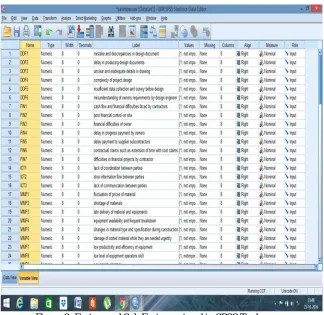
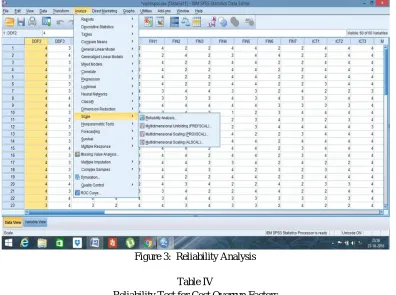
[image:5.612.159.483.362.677.2]The data collected from the questionnaire must be reliable and consistent so that the valuable information can be collected regarding the reason behind the cost escalation in construction industry. For such analysis, cronbach alpha for reliability is calculated using statistical tool SPSS version 21 as shown in table III. When the reliability of the data is less than 0.3, then the collected data will be not reliable and cannot be adopted. Reliability will be at high level only when the cronbach alpha is more than 0.6-0.9.
Technology (IJRASET)
[image:6.612.111.507.77.372.2]Figure 3: Reliability Analysis
Table IV
Reliability Test for Cost Overrun Factors
Factors Cronbach alpha
Design and Documentation Related Factors(DDF) 00 0.6930.693
Financial Management Related Factors(FIN) 0.612
Communication Related Factors (ICT) 0.623
Material And Machinery Related Factors (MMF) 0.643
Human Resource Related Factor(LAB) 0.677
Project Management Related Factors( PMCA) 0.683
Contractors Site Management Related Factors (CSM) 0.726
External Factors (EF) 0.658
Overall cronbach alpha value 0.664
C. Relative Important Index (RII)
Relative Important index (RII) have been employed and calculated for ranking of causes of cost overrun in the construction project. The RII is used to rank the different causes. These rankings make it possible to cross-compare the relative importance of the factors as perceived by the groups of respondents. Each individual cause’s RII perceived by all respondents should be used to assess the general and overall rankings in order to give an overall picture of the causes of construction cost overrun in construction industry.
∑ W
RII =
A X N
W = Weighting given to each factor by the respondents and ranges from 1 to 4 A = Highest weight (i.e. 4 in this case)
Technology (IJRASET)
Very important for cost overrun
Important for cost overrun
Somewhat important for cost overrun
Not important for cost overrun
N4 N3 N2 N1
[image:7.612.108.523.65.310.2]4 3 2 1
Table VI
Ranking of Cost Overrun Factors
Factors RII Rank
Design and Documentation Related Factors(DDF) 0.813 2
Financial Management Related Factors(FIN) 0.658 7
Communication Related Factors (ICT) 0.686 6
Material And Machinery Related Factors (MMF) 0.708 5
Human Resource Related Factor(LAB) 0.718 4
Project Management Related Factors( PMCA) 0.789 3
Contractors Site Management Related Factors (CSM) 0.928 1
External Factors (EF) 0.627 8
V. CONCLUSION
Factors responsible for the cost escalation in construction projects have been identified from Relative Important Index (RII), Hypothesis and Frequency level were determined and subsequently ranked accordingly and as well the overall cronbach value is 0.664 which means, the collected data was reliable. The Contractor’s Site Management Related Factor (CSM) has higher ranking among other factors and contains highest reliable value, which means that the collected data was reliable and that is the significant factor responsible for cost escalation which leads to delay in completion of the project and major reason for cost overrun. Cost overrun problems occur as a result of ineffective construction management and other poorly designed control systems that contribute to delays and complete the project on planned schedule time and cost. A simple and effective monitoring system is essential to identify effective strategic planning, proper project planning and scheduling, proper emphasis on past experience, effective site management, frequent progress meeting, frequent coordination between the parties, use of experience subcontractors and suppliers, use of appropriate construction method and quality based aspect in completion of project reduces the rework problem and enhances the project as per schedule.
[1] Abdullah, G. Otim (2009),“ Significant Factors causing cost overruns in Large construction projects in Malaysia”, Journal of Applied Sciences, Vol 13(2), pp. 286-293.
[2] Adnan Enshassi , Ameh, O.J., A.A. Soyingbe and K.T. Odusami (2010), “Significant factors causing cost overruns in telecommunication projects in Nigeria”, Journal of Science And Management, 15: 49-67.
[3] Aftab, Ismail Abdul Rahman (2012),“Investigation of Significant Factors Influencing Time and Cost Overruns in Indian Construction Projects” International Journal of Emerging Technology and Advanced Engineering Website: www.ijetae.com (ISSN 2250-2459, ISO 9001:2008 Certified Journal,
Volume 3, Issue 10 .
[4] Apolot, Rasche.R (2013), “Significant Factors Causing Cost Overruns in Large Construction Projects in Malaysia” Journal of Applied Sciences 13 (2): 286-293, ISSN 1812-5654 / DOI: 10.3923ljas.2013.286.286-293, Asian Network for Scientific Information.
[5] Le-Hoai, Yakubu Adisa (2008), “Time Overrun and Cost Effectiveness in the Construction Industry”, International Journal of Engineering Research and Applications, ISSN: 2248-9622, Vol. 4, Issue 6(Version 5), pp.111-116.Olawale shayid (2010), “Project Cost Control in the Nigerian Construction Industry” International Journal of Engineering Science Invention ISSN : 2319 – 6734, ISSN (Print): 2319 – 6726, Volume 2 Issue 12 , PP.65-71.
[6] Olawale, Y.A and Ahmad Tarmizi Abd.Karim (2014), “Cost and time control of construction projects: inhibiting factors and mitigating measures in practice”, Construction Management Economic, 28: 509-526.
[7] Seyed Ali Mousavi Dehmourdi (2014), “Factors Causing Cost Overrun In Construction Of Residential Projects”, International Journal of Science and Management. 1(1): 3–12.
[8] Ismail Abdul Rahman, Aftab Hameed Memon and Ahmad Tarmizi Abd.Karim (2013), “Significant Factors causing cost overruns in Large construction projects in Malaysia”, Journal of Applied Sciences, Vol 13(2), pp. 286-293.Nasiru, Zakari Muhammad, Kunya Sani Usman, and Abdurrahman Mutawakkil (2012), “Assessment of Factors that Affect Cost Control by Nigerian Construction Contractors”, Journal of Engineering and Applied Sciences, 4. [9] Sardar Dyrdyev, Siuhaida Isma’il and Nooh Abu Bakr (2012), “Factors Causing Cost Overrun In Construction Of Residential Projects. A Case Study of
Turkey”, International Journal of Science and Management. 1(1): 3–12.
Technology (IJRASET)
[11] Ashwini Arun Salunkhe, Rahul S. Patil (2014),”Effect of construction delays on project time overrun: Indian scenario”, IJRET: International Journal of Research in Engineering and Technology.