5
III
March 2017
Technology (IJRASET)
Implementation on Data Cleaning for RFID and
WSN Integration
Ms. Reshma Mahadule1 ,Ms. Prajakta Deotale2,Ms. Sneha Bhuyarkar3,Ms. Yamini Shinde4, Prof. Veena katanakar5 Department of Computer Science & Engineering
Smt. Rajshree Mulak College Of Engineering For Women, Rashtrasant Tukdoji Maharaj Nagpur University, India
Abstract: Today’s manufacturing environments are very dynamic and turbulent. Wireless Sensor Network (WSN) and Radio Frequency Identification (RFID) integration is a developing innovation which utilizes focal points of the both frameworks making it more solid and productive. The Hybrid network shaped by WSN and RFID integration gives brilliant foundation to secure, prepare and disperse data in element situations which are decentralized. Wireless sensor networks (WSNs) and radio-frequency identification (RFID) systems provide an excellent infrastructure for data acquisition, distribution, and processing. Here some key challenges related to the integration of WSN and RFID technologies are discussed. A five - layer system architecture has been proposed to achieve synergistic performance.
In this Project, an improved data cleaning algorithm has been proposed; its feasibility and effectiveness have been verified via simulation and a comparison with a published algorithm. To illustrate the capacity of developed architecture and new data cleaning algorithm, their application in relief supplies storage management has been discussed.
Keywords: Data cleaning, networks, radio-frequency identification (RFID), system architecture, wireless sensor network (WSN), RFID Reader, RFID Tag.
I. INTRODUCTION
Radio- frequency identification (RFID) is, automatic identification method, relying on remotely retrieving data using devices called transponders or RFID tags. The technology requires some extent of cooperation of an RFID reader and an RFID tag. An object can be applied to a product, called RFID tag that person or animal for the purpose of identification and tracking using radio waves. Some tags can be read from meters away and beyond the line of sight of the reader. Manufacturing systems are very complex networks consisting of numerous objects, decision-making units, materials, and information flows. Therefore, enterprise information systems (EISs) are needed as technology platforms that enable the enterprises to integrate and coordinate their business processes at both intra-organizational and inter-organizational levels. Traditionally, EISs have mostly been developed as centralized systems to ensure that information can be shared across all functional units and management hierarchies. Next-generation EISs must support the global competitiveness, innovation, the introduction of new products, and strong market responsiveness.
As a result, besides the cost and the quality, manufacturing systems need to become more strongly time-driven and time-oriented. Wireless sensor networks (WSNs) and radio-frequency identification (RFID) systems provides an excellent infrastructures to acquire, distribute, and process data in decentralized dynamic environment. With the applications of WSNs, event processing can fit well in EISs to improve the responsiveness. Although WSN and RFID technologies have experienced great achievements in recent years, their applications in actual manufacturing environments are very limited. To develop suitable WSNs for information integration of EISs in a dynamic environment, this project focuses on the adoption of RFID systems in the WSNs and the development of new data cleaning algorithm to eliminate redundancy data effectively.
II. LITERATURE SURVEY
A. RFIDs and WSNs
Technology (IJRASET)
Integrated open-loop services infrastructure and RFID and then applied it to the flood management and traceability system. Used RFID technologies for the collection and sharing of data in a warehouse. Investigated a RFID and aWSN with Zigbee electronic labels were attached to the sensors to integrate the RFID with the WSN. Their systems were developed to monitor the quality of agricultural products.
B. Challenges in Integration of RFIDs and WSNs
RFID and WSNs represents to the complementary technologies. RFID is widely used to identify, detect, or monitorobjects. In comparison with other types of sensors, the low cost the superior advantage of RFID however, RFID in incapable of providing the detailed information about the conditions of objects. On other hand, a WSN can integrate logics into RFID nodes and allows an RFID system to operate in multi-hop fashion and with the detailed oriented information about the nodal conditions, RFID and WSN as an infrastructure for telecommunication.
The tasks involved in the integration of WSN and RFID are to design and select: 1) RFID tag memory 2) WSN association protocols 3) routing and addressing schemes 4) RFID sensor-actuator data integration and management 5) service definition and delivery. Due to space constraints, only the first three challenges are discussed, and the focus is on data cleaning and filtering.
III. PROBLEM ANALYSIS
A. Energy Consumption
Energy efficiency has been crucial problem while combining RFIDs and WSNs. Wireless device has astrict requirement of power consumption sensors or RFIDs in most of existing networks have very limited battery lives. The information is commonly obtained from simulation. The majority of work on energy efficient routing only focused on the efficiency factor rather than the need of achieving reliable and real-time communication. Transmitter for each sensor is simplified to a transistor connected to an antenna, and therefore, the cost for each sensor communicator is negligible, while energy used for wireless communication per sensor is minimized.
B. Time Delay
Just as industrial networks may comprises in a large number of sensors and the delay increases with the increased number of nodes. Meeting time constraints of real-time traffic in WSN is a very hard task. The main reason is that real-time devices must share the same communication medium with timing unconstrained devices. Since data from nodes is used to generate correct commands for a machine in an industrial applications, time delay in data communication will cause the mal-function of the machine. Provided a better understanding of channel interference in the co-located industrial network and proposed the general methodology cross-channel interference conditions. The experiments and simulations have shown that there are alternative strategies which can reduce the rate of the failed nodes, during the periodic window as compared to the other network strategies.
C. Redundant Data
To obtain sufficient data, readers in the WSN interrogate the tags periodically. While the issue of reading rate can be addressed, it leads to a new issue of duplicat readings it can be a severer issues when the sensor nodes are densely distributed to ensure no area is missed between neighbouring nodes. Transmitting duplicate data to the data server causes the waste of energy, time delay and network resources. It is desirable to clean data at the level of sensors and data warehousing to eliminate the redundancy and unreliable data. The objective of eliminating the redundant data is coupled with the reduction of energy consumption and time delay.
D. Data Cleaning Algorithms
Technology (IJRASET)
IV. IMPLEMENTATION
[image:4.612.142.503.111.274.2]The proposed system is basically composed of four modules,
Fig 01: Proposed system with four Module
Proposed system in which we overcome the problem of existing system for that ICRDC algorithm has been implemented to another type of integration of RFID & sensor is to combine RFID reader with trans-receiver.
Users are able to read tag from distance of normal range of the reader through communication.
Micro-controller is used to control the RFID reader & other component to go into sleep mode when they are not busy.
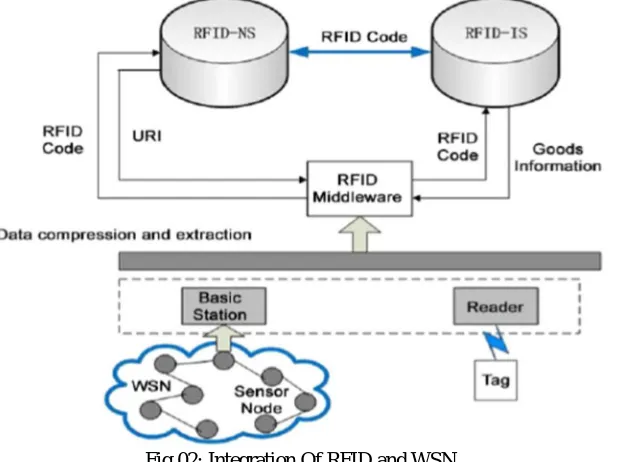
Fig 02: Integration Of RFID and WSN
RFID tags integrated with sensors have limited communication capabilities. In high-end applications, it is possible to add RFID tag’s capabilities to the wireless sensor nodes (WSNs).
These new nodes may be compliant with the existing RFID standards or they can have proprietary protocols.
The integration of RFID technologies into an ad hoc network such that the information can be easily collected from multiple RFID tags spread over a large area has been studied.
The basic idea of integration is to connect the RFID reader to RF transceiver which has the routing function and can forward information to and from other readers.
V. RESULTS ANALYSIS
This chapter focuses on the results of cleaned data method based on integration of RFID and WSN with datacleaning algorithm for redundant data of tags which are read by multiplevalues by temperature sensor as but after applying data cleaning algorithm we are
1. DEPLOYMENT OF NETWORK
BASE
STATION 2. INTEGRATION
OF RFID
3. ICRDC WORKING 4. RESULT
ANALYSIS WITH DIFFERENTPARA
[image:4.612.165.475.342.573.2]Technology (IJRASET)
Features RFID RFID, GSM and ourapplication Data Information Only
RFID
RFID data, Position, Vehicle Information
Control centre NO YES Hardware Cost LOW LOW HardwareImplementation Simple Moderate
Application Specific Wide Data Transmission Slow
within range
Faster
GUI NO YES
Fig 03: Comparison of existing system with proposed system
VI. CONCLUSION
In the Integration of the RFIDs & WSNs the system consists of different modules which are wirelessly linked with GSM modem. SMS service of GSM network is cost effective which is used for the transfer of data between different modules. Thus we have used data cleaning algorithm to clean the redundant data in integration of RFID with WSN network as comparing the results of existing system.
We are implementing integration of WSN with RFID.
In that, RFID reads the data and transfer to the base station using WSN.
ZigBee technology used as communication protocol of WSN, Use in wide areas with low cost.
In this project, we are creating the nodes with sensor. Also we have identified the tags in green color and reader in red color and communication between them is performed.
REFERENCES
[1] S. R. Jeffery, M. J. Franklin, and M. N. Garofalakis, “An adaptive RFID middleware for supporting metaphysical data
[2] T.C.Poon, K.L.Choy, and H.K.H.Chowa,“ARFID case-based logistics resource management system for managing order-picking independence,” in Proc.
Very Large Database, Auckland, New Zealand, 2008, pp. 265–289.
[3] Operations in warehouses,” Expert Syst. Applic., vol. 36, pp. 8277– 8301, 2009.
[4] .-H. Shin, S. Chin, S.-W. Yoon, and S.-W. Kwon, “A service-oriented integrated information framework for RFID/WSN-based intelligent construction supply
chain management,” Autom. Construction, vol. 20, pp. 706– 715, 2011.
[5] T. S. Lopez, D. Kim, G. H. Canepa, and K. Koumad, “Integrating wireless sensors and RFID tags into energy-efficient and dynamic context networks,”
Computer J., vol. 52, no. 2, pp. 240–267, 2009.
[6] L. Zhang and Z. Wang, “Integration of RFID into wireless sensor networks: Architectures, opportunities and challenging problems” in Proc. 5th Int. Conf.