Improvement in Line Efficiency of Assembly Line
by Using Assembly Line Balancing Techniques
Tushar Shah1 Dr. G. S. prakash2
1
M. Tech, Student, Industrial Engineering, Ramaiah Institute of Technology, Banglore. 2
Professor And Head ,IEM department, Ramaiah Institute of Technology, Banglore
Abstract: The focus of this paper is on improvement in the efficiency of assembly line through assembly line balancing techniques. The assembly line balancing is about evenly distribution of the work load among the workstations without violating the precedence and cycle time requirements. The three assembly line balancing techniques namely ranked positional weight technique (RPW) ,largest candidate rule technique (LCR) and kilbridge and wester column technique are utilized to improve the efficiency of assembly line with minimization of number of workstations and thereby reducing balance delay of the assembly line.
I. INTRODUCTION
In this global era assembly lines are important to manufacturing products which are capable of meeting the customer’s demand. Assembly lines are very much important from point of view of manufacturers in more bottleneck competitive world manufacturing the products. Assembly line is flow oriented production systems where the stations performing the productive operations are arrange in serial manner. The work piece moves through stations usually by some means of transportation systems.
Success of the production system is greatly influenced by the balancing of assembly line. Balancing of assembly line means distribution of the work load evenly among the number of workstations so that the precedence and cycle time constraints can be satisfied . The objectives of line balancing includes the maximization of production rate and minimization of number of workstations .Line balancing is about the grouping the workstations in an efficient manner in order to get optimal or most efficient feasible solution for the assembly line balancing problem.
II. ASSEMBLY LINE BALANCING PROBLEM
In assembly line balancing problem one is given with finite set of operation required to be performed , each operation has standard time and precedence requirement of operation which indicates the permissible order or sequence of operations . The problem is to assign operations to number of workstations in such way that satisfies precedence relationships and the cycle time requirement of operation and optimization of some measure of performance like efficiency and balance delay.
III. PROBLEM STATEMENT
One of the main hurdle to produce products and delivering it to the customer at faster response time to customer is inefficiency of the assembly lines. For the purpose of the study the assembly line which is used for assembling xyz product of volvo construction equipment banglore is considered.. The study of xyz product assembly line is taken for this project in order to find the way in which the efficiency of assembly line can be improve thereby helping to volvo construction equipment to deliver the single drum compactor at faster response time along with proper quality to customer.
IV. DATA COLLECTION AND ANALYSIS OF PRESENT ASSEMBLY LINE TECHNIQUE
The data about the sequence or order in which the tasks are performed among the seven main workstations and time required for performing these tasks is collected. And analysis is carried out using following formulae.
=∑
∗ Where
LE = Line efficiency ST = Station time m = Number of stations CT = Cycle time
Where
BD = Balance delay LE = Line efficiency
Collected data for single drum compactor assembly line is as shown in below table
Table 1 Activities time and precedence relationships at present assembly line.
[image:3.612.76.534.493.719.2]Below figure shows the precedence diagram for single drum compactor assembly line
Table 2 Station time at present assembly line
Analysis of single drum assembly line for present method Summary of data
Sum of task time = 1791.7
Cycle time = Largest of station time =486.35 Number of stations = 7
= ∑ ∗ = 0.5262
= 1−
V. HEURISTIC TECHNIQUES OF LINE BALANCING
Heuristics specifies a particular approach for solving the problem , it helps in decision making and control over the situation. These techniques are simple. They serves as thumb rule for solving complex problems. The objective is to provide the ways for solving problems which will help for rigorous logical analysis.
The main heuristic techniques for assembly line balancing problems are as follows
A. Ranke positional weight method.(RPW) 1) Draw the precedence diagram
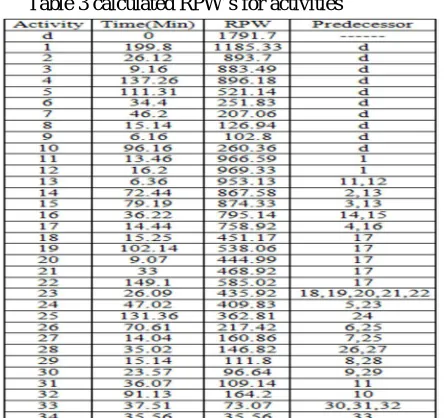
2) Calculate ranked positional weight (RPW). Rank positional weight of task is its own time and duration of all succeeding tasks in precedence diagram.
3) Arrange the task in descending order of ranked positional weights.
4) Assign tasks to the number of work stations. Assignment of task to the workstation should done in such way that satisfies the precedence requirements and without violating cycle time constraints.
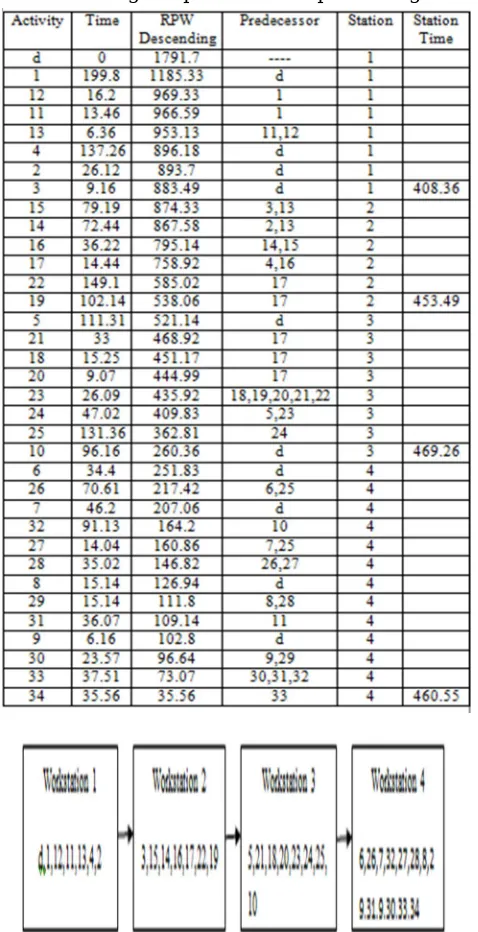
5) Repeat the above step until all tasks in precedence diagram are assign to the number of workstations Analysis of assembly line by the RPW technique is as shown below.
Summary of data
Sum of tasks time = 1791.7 Cycle time = 486.35
Number of Stations as per RPW method = 4
= ∑ ∗ = 0.9209
= 1−
[image:5.612.188.427.228.694.2]= 0.0791
Table 4 Activities arranged as per RPW technique and assigned to stations
B. Largest candidate rule method. (LCR)
1) List all work task elements in descending order of their completion time.
2) Allocate the tasks to the number of workstations such that precedence and cycle time constraints satisfied with the assignment of task to the workstation.
3) Repeat the above step until all tasks have been allocated to the number of workstations. Analysis of assembly line by the application of largest candidate rule technique is as shown below
Table 5 Activities arranged as per LCR technique
Summary of data
Sum of task time = 1797.1 Cycle time = 486.35
Number of Station as per LCR technique = 4
=∑
∗ = 0.9209
= 1−
[image:7.612.197.418.217.266.2]= 0.079
Figure 3 Configuration of assembly line as per LCR technique
C. Kilbridge and wester column method. (KWC) 1) Construct the precedence diagram.
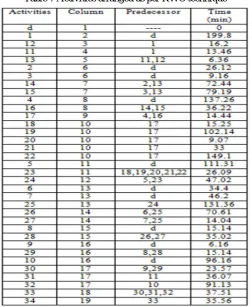
2) Arrange the nodes representing the task into number of columns.
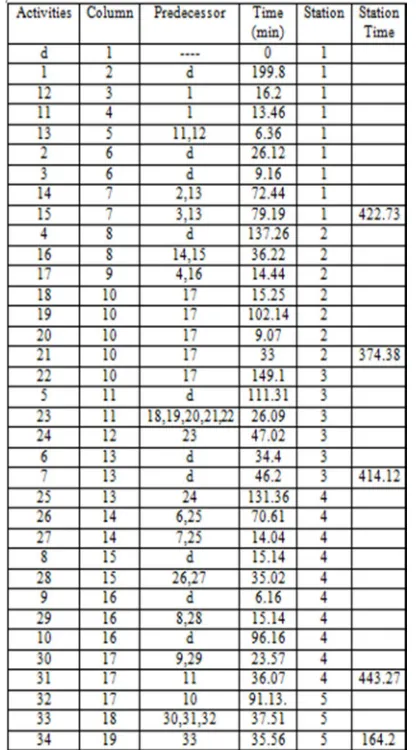
3) Tasks in the column are assigned to workstation in such way that stratifies the cycle time and precedence requirement restrictions.
4) Repeat above step until all task have been assigned to number of workstations.
[image:7.612.181.433.408.715.2]Summary of data
Sum of task time = 1791.7 Cycle time = 486.35
Number of station as per KWC technique =5
= ∑ ∗ = 0.7367
= 1−
= 0.2633
Figure 5 Configuration of assembly line as KWC technique
VI. RESULT AND CONCLUSION
Below table shows the result of xyz product assembly line after analyzing the same through the application of ranked positional weight technique, largest candidate rule technique , kilbridge and wester column technique of assembly line balancing problem
Table 9 Line efficiency, balance delay and number of stations of different techniques
After comparing results of above three techniques it is found that any one of the both rank positional weight technique and largest candidate rule technique applicable for the line balancing as both of these techniques are able to assign the activities to the number of workstations in more efficient manner than kilbridge and wester column technique.
REFERENCES
[1] Boysen, N.; Fliedner, M. & Scholl, A. A classification of assembly line balancing problems. European Journal of Operational Research 183, pp. 674-693, 2007. [2] Becker, C. and Scholl, A. A Survey on Problems and Methods in Generalized Assembly Line Balancing. European Journal of Operational Research. 2006,
Volume 168, Issue 3: pp. 694-715 ,2006.
[3] Naveen Kumar and Dalgobind Mahto, Assembly Line Balancing: A Review of Developments and Trends in Approach to Industrial Application, Global Journal of Researches in Engineering Industrial Engineering,Volume 13 Issue 2 Version 1.0, 2013
[4] P. Sivasankaran and P. Shahabudeen, Literature review of assembly line balancing problems, Int J Adv Manuf Technol 73:1665–1694, 2014
[5] Gourav Kumar and Dr Praveena Gowda, An optimal balancing of assembly line using RPW technique, International Journal of Engineering Research And Advanced Technology (IJERAT) ISSN: 2454-6135 [Special Volume. 02 Issue.01], 2016
[6] Vrittika V Pachghare and R. S. Dalu, Assembly Line Balancing Methods–A Case Study, International Journal of Science and Research (IJSR) ISSN (Online): 2319-7064 Impact Factor : 3.358,2012.