5
XI
November 2017
A Security Based Infrastructure for cloud Storage
system in terms of Public Data
Naga Rani1, Chandra Shekhar2
1
M. Tech Student, Department of CSE, Hyderabad Institute of Technology and Management, Govdavalli, Medchal, Telangana, India.
2
Associate Professor, Department of CSE, Hyderabad Institute of Technology and Management, Govdavalli, Medchal, Telangana, India.
Abstract: The framework cloud (IaaS) benefit demonstrate offers enhanced asset flexibility and accessibility, where occupants – protected from the details of equipment upkeep – lease registering assets to send and work complex frameworks. Substantial scale administrations running on IaaS stages exhibit the practicality of this model; all things considered, numerous associations working on delicate information abstain from moving operations to IaaS stages because of security concerns. In this paper, we portray a system for information and operation security in IaaS, comprising of conventions for a trusted dispatch of virtual machines and space based capacity insurance. We proceed with a broad hypothetical examination with proofs about convention resistance against assaults in the defined risk demonstrate. The conventions enable trust to be set up by remotely bearing witness
to have stage configuration before propelling visitor virtual machines and guarantee confidentiality of information in remote
stockpiling, with encryption keys kept up outside of the IaaS space. Exhibited exploratory outcomes show the legitimacy and efficiency of the proposed conventions. The structure model was executed on a proving ground working an open electronic
wellbeing record framework, demonstrating that the proposed conventions can be incorporated into existing cloud conditions. Index Terms: Security; Cloud Computing; Storage Protection; Trusted Computing.
I. INTRODUCTION
Cloud computing has progressed from a bold vision to massive deployments in different application spaces. Be that as it may, the unpredictability of innovation hidden distributed computing presents novel security dangers and difficulties. Dangers and relief procedures for the IaaS display have been under concentrated investigation lately [1], [2], [3], [4], while the business has put resources into improved security arrangements and issued best practice suggestions [5]. From an end-client perspective the security of cloud framework suggests obvious trust in the cloud supplier, at times verified by reports of outside examiners. While suppliers may offer security improvements, for example, assurance of information very still, end-clients have restricted or no power over such instruments. There is a reasonable requirement for usable and practical cloud stage security components appropriate for associations that depend on cloud framework. One such system is stage honesty verification for figure has that help the virtualized cloud framework. Sever allarge cloud vendors have signal edpractical implementations of this mechanism, primarily to protect the cloud infrastructure from insider threats and advanced persistent threats. We see two major improvement vectors regarding these implementations. First, details of such proprietary solutions are not disclosed and can thus not be implemented and improved by other cloud platforms. Second, to the best of our knowledge, none of the solutions provides cloud tenants a proof regarding the integrity of compute hosts supporting their slice of the cloud infrastructure. To address this,we proposeaset of conventions fortrusted dispatch of virtual machines (VM) in IaaS, which furnish inhabitants with a proof that there quested VM cases were propelled on a host with a normal programming stack. Another significant security instrument is encryption of virtual plate volume, actualized and implemented at register have level. While bolster information encryption very still is offered by a few cloud suppliers and can be
configured by inhabitants in their VM occasions, usefulness and movement capacities of such arrangements are extremely limited.
VM occasions with access to the scrambled information, expanding the likelihood than an assailant in the long run acquires the keys. In this paper we show DBSP (area based capacity insurance), a virtual circle encryption component where encryption of information is done specifically on the figure have, while the key material essential for re-creating encryption keys is put away in the volume metadata. This approach permits simple relocation of encoded information volumes and pulls back the control of the cloud supplier over circle encryption keys. Likewise, DBSP significantly decreases the danger of uncovering encryption keys and keeps a low support overhead for the occupant – in a similar time giving extra control over the decision of the register have in light of its product stack. We concentrate on the Infrastructure-as-a-Service show – in a simplified frame, it opens to its occupants a cognizant stage upheld by register has which work VM visitors that impart through a virtual system. The system model chosen for this paper is based on requirements identified while migrating a currently deployed, distributed electronic health record (EHR) system to an IaaS platform [6].
A. Contribution
We expand past work applying Trusted Computing to reinforce IaaS security, enabling inhabitants to put hard security necessities on the foundation and keep up restrictive control of the security basic resources. We propose a security system comprising of three buiding pieces:
1) Protocols for trusted dispatch of VM cases in IaaS;
2) Key administration and encryption implementation capacities for VMs, giving straightforward encryption of relentless information stockpiling in the cloud;
3) Key administration and security strategy implementation by Trusted Third Party (TTP); We depict a few commitments that upgrade cloud framework with extra security systems:
4) We depict a trusted VM dispatch (TL) convention which permits occupants – alluded to as space chiefs – to dispatch VM examples only on has with a confirmed stage configuration and dependably check this.
5) We present an area based capacity security convention to all space administrators store scrambled information volumes divided by authoritative areas.
6) We present a rundown of assaults material to IaaS situations and utilize them to create conventions with wanted security properties, play out their security examination and demonstrate their resistance against the assaults. 4. We portray the execution of the proposed conventions on an open-source cloud stage and present broad exploratory outcomes that show their common sense and efficiency.
B. Organization
Whatever remains of this paper is composed as takes after. In Section 2 we portray significant related work on trusted virtual machine dispatch and distributed storage insurance. In Section 3 we present the framework demonstrate, and in addition the risk model and issue explanation. In Section 4 we present the convention parts, and the TL and DBSP conventions as formal developments. In Section 5, we give a security investigation and demonstrate the resistance of the conventions against the defined assaults, while usage and execution assessment comes about are portrayed in Section 6. We talk about the convention application area in Section 7 and finish up in Section8.
II. RELATED WORK
We begin with a survey of related work on trusted VM dispatch, trailed by capacity insurance in IaaS.
A. Trusted Launch
Inhabitants assess the cloud verifier trustworthiness, which thus bears witness to the hosts. Once the VM picture has been verified by the host and countersigned by the cloud verifier, the occupant can permit the dispatch. The convention builds the many-sided quality for occupants both by presenting the assessment of trustworthiness confirmation reports of the cloud verifier and have and by adding ventures to the trusted VM dispatch, where the inhabitant must act in light of the information came back from the cloud verifier. Our convention keeps up the VM dispatch traceability and straightforwardness without depending on an intermediary verifier living in the IaaS. Besides, the TL convention does not require extra inhabitant collaboration to dispatch the VM on a put stock in have, past the underlying dispatch contentions. Stage authentication before VM dispatch is additionally connected in [7], which presents two conventions – "TPM-based certification of a Remote Resource" (TCRR) and "VerifyMyVM". With TCRR an inhabitant can confirm the trustworthiness of a remote host and build up a confided in channel for promote correspondence. In "VerifyMyVM", the hypervisor running on a confirmed host utilizes an imitated TPM to check on-request the uprightness of running VMs. Our approach is in numerous viewpoints like the one in [7] specifically with respect to have validation preceding VM example dispatch. In any case, the approach in [7] requires the client to dependably scramble the VM picture before instantiation, hence confusing picture administration. This keeps occupants from utilizing ware VM pictures offered by the cloud supplier for trusted VM dispatches. We conquer this constraint and sum up the arrangement by including a verification token, made by the inhabitant and infused on the file arrangement of the VM case just on the off chance that it is propelled on a validated cloud have. In [8], the creators depicted a convention for trusted VM dispatch on open IaaS utilizing put stock in processing strategies. To guarantee that the asked for VM occasion is propelled on a host with bore witness to respectability, the occupant encodes the VM picture (alongside all infused information) with a symmetric key fixed to a specific configuration of the host reflected in the estimations of the stage configuration registers (PCR) of the TPM put on the host. The proposed arrangement is appropriate in trusted VM dispatch situations for big business inhabitants as it requires that the VM picture is pre-bundled and encoded by the customer preceding IaaS dispatch. In any case, like [7], this keeps occupants from utilizing item VM pictures offered by the cloud supplier to dispatch VM examples on trusted cloud has. Besides, we trust that decreasing the quantity of steps required from the occupant can encourage the appropriation of the trusted IaaS display. We expand a portion of the thoughts proposed in [8], address the above constraints –, for example, extra activities required from inhabitants – and furthermore address the prerequisites towards the propelled VM case and expected changes to cloud stages.
B. Secure Storage
equipment, while compartments impart through verified channels. The creators stretch the verifiability of DPaaS utilizing trusted registering and the utilization of the dynamic base of trust to ensure that calculation is performed on a "safe" stage. The authorspositthatDPaaSfulfillsconfidentialityandprivacyrequirements and encourages upkeep, logging and review;Supplier movement is one of the angles high lit, yet not tended to in [3]. Our answer takes after DPaaS in the utilization of SEE in view of programming authentication systems offered by the TPM, and in the dependence on full plate encryption to ensure information very still and support for flexible get to control administration of the information squares. In any case, the engineering plot in[4] does not address boot lashing the stage (e.g. the VM dispatch) and gives few insights about the key administration instrument for the protected information store. We address the above weaknesses, by depicting in detail and assessing conventions to make and offer confidentiality secured information squares. We depict distributed storage security systems that permit simple information relocation between suppliers without influencing its confidentiality. Graf et al. [2] exhibited an IaaS stockpiling security conspire tending to get to control. The creators break down get to rights administration of shared formed scrambled information on cloud framework for a limited gathering and propose a versatile and flexible key administration conspire. Get to rights are spoken to as a diagram, making a refinement between information encryption keys and scrambled updates on the keys and empowering flexible join/leave customer operations, like properties displayed by the conventions in this paper. Regardless of its favorable circumstances, the prerequisite for customer side encryption confines the materialness of the plan in [2] and presents critical utilitarian restrictions on ordering and inquiry. In our model, every single cryptographic operation are performed on trusted IaaS process has, which can distribute more computational assets than customer gadgets. Santos et al. [3] proposed Excalibur, a framework utilizing trusted processing components to permit decoding customer information solely on hubs that fulfill an occupant specified strategy. Excalibur presents another confided in processing reflection, strategy fixed information to address the way that TPM deliberations are intended to secure information and insider facts on an independent machine, in the meantime finished uncovering the cloud framework by uncovering the personality and programming fingerprint of individual cloud has. The creators stretched out TCCP [1] to address the constraints of twofold based authentication and information fixing by utilizing property-based confirmation [4]. The center of Excalibur is 'the screen', which is a piece of the cloud supplier, which sorts out calculations over a progression of hosts and gives certifications to inhabitants. Occupants first choose an approach and get prove in regards to the status of the screen alongside an open encryption key, and afterward scramble their information and strategy utilizing ciphertext arrangement property based encryption[5]. To unscramble, the put away information has get the decoding key from the screen who guarantees that the relating host has a substantial status and satisfies the arrangement specified by the customer at encryption time. Our answer is like the one in [3], with some critical contrasts:
conversely with [3] our conventions were actualized as a code expansion for Openstack. Besides, the introduced estimations were made after we sent the conventions for a piece of the Swedish electronic wellbeing records administration framework in a foundation cloud. In this manner, our measures are considered as practical since the trials were done under a genuine electronic medicinal services framework;
customer to check that information respectability has not been abused by the server. The ideas displayed in [6] are promising – particularly considering late advance in accessible encryption plans [8]. Undoubtedly, incorporating accessible and characteristic based encryption components into secure capacity arrangements is a critical heading in our future work. In any case, down to earth use of accessible encryption and characteristic based encryption requires extra research. Prior work in [9], [2] portrayed interoperable arrangements towards trusted VM dispatch and capacity assurance in IaaS. We extend them to make a coordinated structure that fabricates a trust chain from the area chief to the VM occurrences and information in their authoritative space, and give extra subtle elements, confirmations and execution assessment.
III. SYSTEM MODEL AND PRELIMINARIES
In this segment we depict the framework and risk display, and in addition show the issue articulation.
A. System Model
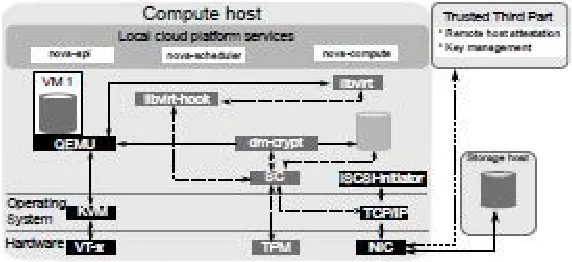
We accept an IaaS framework show (e.g.OpenStack, apopular open-source cloud stage) as in [21]: suppliers uncover a standard of system, calculation and capacity assets to its inhabitants – alluded to as area chiefs (Figure 1). Area administrators use the amount to dispatch and work VMguests. LetDM = {DM1,...,DMn}be the arrangement of all area directors in our IaaS. At that point, VMi = vmi 1,...,vmi n is theset of all VMs claimed by every space administrator DMi. VM visitors worked by DM are gathered into spaces (like ventures in OpenStack) which contain cloud assets comparing to a specific association or regulatory unit. DM make, alter, crush spaces and oversee get to authorizations of VMs to information put away in the areas. We allude to
Fig.1. Abnormal state perspective of the IaaS demonstrate presented in Section 3.
Solicitations for operations on VMs (dispatch, movement, end, and so forth.) got by the IaaS are overseen by a scheduler that distributes (reallocates, deallocates) assets from the pool of accessible register has as per an asset administration calculation. We accept in this work register has that are physical – as opposed to virtual – servers. We signify the arrangement of all figure has as CH = {CH1,...,CHn}.
We signify a VM occurrence vmi l running on a process have CHi by vmi l 7→ CHi
what's more, its one of a kind identifier by idvmi l. The Security Profile (SP) , defined in [9], is an element of the verified and measured arrangement of a trusted figuring base – an accumulation of programming parts quantifiable amid a stage boot. Estimations are kept up in ensured capacity, normally situated on a similar stage. We grow this idea in Section. A few practically comparable configurations may each have an alternate security profile. We signify the arrangement of all process has that offer a similar security profile SPi asCHSPi. VMs intercommunicate through a virtual system overlay, a "product defined organize" (SDN). An area administrator can make self-assertive system topologies in a similar space to interconnect the VMs without influencing system to pologies in different areas. I/Ovirtualization empowers gadget total and permits to join a few physical gadgets into a solitary intelligent gadget (with better properties), exhibited to a VM [2]. Cloud stages utilize this to total dissimilar stockpiling gadgets into profoundly accessible legitimate gadgets with subjective capacity limit (e.g. volumes in OpenStack). VMs are given a coherent gadget through a solitary get to interface, while replication, adaptation to non-critical failure and capacity accumulation are covered up in the lower deliberation layers. We allude to this sensible gadget as capacity asset (SR); as a capacity unit, a SR can be any unit bolstered by the plate encryption subsystem.
B. Threat Model
on the register hosts of the IaaS supplier. This property depends on the shut box execution condition for visitor VMs, as sketched out in Terra [4] and additionally created in [5], [6]. Equipment Integrity: Media disclosures have raised the issue of equipment altering on the way to arrangement locales. We expect that the cloud supplier has taken essential specialized and non-specialized measures to forestall such equipment altering. Physical Security: We accept physical security of the server farms where the IaaS is conveyed. This presumption holds both when the IaaS supplier possesses and deals with the server farm (as on account of Amazon Web Services, Google Compute Engine, Microsoft Azure, and so forth.) and when the supplier uses outsider limit, since physical security can be watched, implemented and verified through known accepted procedures by review associations. This suspicions vital tobuild more elevated amount equipment and programming security ensures for the parts of the IaaS. Low-Level Software Stack: We accept that at establishment time, the IaaS supplier dependably records uprightness estimations of the low-level programming stack: the Core Root of Trust for estimation; BIOS and host expansions; have stage configuration; Option ROM code, configuration and information; Initial Platform Loader code and configuration; state changes and wake occasions, and a negligible hypervisor. We accept the record is continued ensured stockpiling with read-just get to and the enemy can't mess with it. System Infrastructure: The IaaS supplier has physical and managerial control of the system. ADV is in full control of the system configuration, can catch, make, replay and wreck all messages conveyed amongst DM and their assets (VMs, virtual switches, stockpiling deliberation parts) and may endeavor to access different areas or learn confidential data. Cryptographic Security: We expect encryption plans are semantically secure and the ADV can not get the plain content of encoded messages. We likewise expect the mark plot is unforgeable, i.e. the ADV can't overlook the mark of DMi and that the MAC calculation accurately verifies message honesty and genuineness. We accept that the ADV, with a high likelihood, can't anticipate the yield of a pseudorandom work. We expressly avoid denialof-benefit assaults and concentrate on ADV that plan to bargain the confidentiality of information in IaaS.
C. Problem Statement
after. Definition 5 (Successful Domain Violation Attack).Assume DMi has made the areas in the set Di. An enemy ADV prevails to play out an area infringement assault on the off chance that she figures out how to dispatch a discretionary VM, vmjm on a subjective host CHj, i.e. vmjm 7→ CHj, where Djvmjm ∩Di 6= ∅.
IV. PROTOCOL DESCRIPTION
We now portray two conventions that constitute the center of this current paper's commitment. These conventions are progressively connected to convey a cloud framework giving extra client assurances of cloud have respectability and capacity security. For convention purposes, every space chief, secure segment and trusted outsider has an open/private key match (pk/sk). The private key is kept mystery, while people in general key is imparted to the group. We accept that amid the instatement stage, every element gets a certificate by means of a confided in certification expert. We first depict the cryptographic primitives utilized as a part of the proposed conventions, trailed by definiti3ons of the principle convention segments.
A. Cryptographic Primitives
The arrangement of every twofold string of length n is signified by {0,1} n, and the arrangement of all finite parallel strings as {0,1}∗. Given a set U, we allude to the ith component as vi. Moreover, we utilize the accompanying documentations for cryptographic operations all through the paper: For a subjective message m ∈ {0,1}∗, we indicate by c = Enc(K,m) a symmetric encryption of m utilizing the mystery key K ∈ {0,1}∗. The relating symmetric decoding operation is meant by m = Dec(K,c) = Dec(K,Enc(K,m)).
1) We indicate by pk/sk an open/private key match for an open key encryption plot. Encryption of message m under the general population key pk is meant by c = Encpk (m)2 and the comparing unscrambling operation by m = Decsk(c) = Decsk(Encpk(m)).
2) An advanced mark over a message m is indicated by σ = Signsk(m). The relating verification operation for an advanced mark is
meant by b = Verifypk(m,σ), where b = 1 if the mark is legitimate and b = 0 generally.
3) A Message Authentication Code (MAC) utilizing a mystery key K over a message m is signified by µ = MAC(K,m).
4) We signify by τ = RAND(n) an irregular parallel arrangement of length n, where RAND(n) speaks to an arbitrary capacity that
takes a twofold length contention n as information and gives an arbitrary paired succession of this length in return3.
B. Protocol Components
Circle encryption subsystem: a product or equipment segment for information I/O encryption on capacity gadgets, skilled to encode capacity units, for example, hard drives, programming RAID volumes, parcels, files, and so on. We accept a softwarebased subsystem, for example, dm-grave, a plate encryption subsystem utilizing the Linux piece Crypto API. Confided in Platform Module (TPM): an equipment cryptographic co-processor following specifications of the Trusted Computing Group (TCG) [9]; we expect CH are furnished with a TPM v1.2. The alter apparent property encourages observing CH trustworthiness and reinforces the suspicion of physical security. A dynamic TPM records the stage boot time programming state and stores it as a rundown of hashes in stage configuration registers (PCRs). TPM v1.2 has 16 PCRs saved for static estimations (PCR0 - PCR15), cleared upon a hard reboot. Extra runtime resettable registers (PCR16-PCR23) are accessible for dynamic estimations. Underwriting keys are a hilter kilter key match put away inside the TPM in the trusted stage production network, used to make a support accreditation marked by the TPM merchant to affirm the TPM specification consistence. A message scrambled ("bound") utilizing a TPM's open key is decryptable just with the private key of the same TPM. Fixing is a unique instance of restricting – bound messages are just decryptable in the stage state defined by PCR esteems. Stage confirmation enables a remote gathering to verify an objective stage and get an assurance that it – up to a specific level in the boot chain – runs programming that is indistinguishable to the normal one. To do this, an attester demands – joined by a nonce – the objective stage to create a validation cite and the estimation total, or Integrity Measurement List (IML). The TPM produces the validation cite – a marked structure that incorporates the IML and the got nonce – and restores the quote and the IML itself. The verification cite is marked with the TPMs Attestation Identity Key (AIK). The correct IML substance are usage specific, yet ought to contain enough information to permit the verifier to set up the objective stage [30] honesty. We allude to [9] for a portrayal of the TPM, and to [7], [9] for conventions that utilization TPM usefulness.
to stage honesty in view of the trustworthiness verification cites and the substantial AIK certificate from a TPM, and seal information to a trusted host configuration. At last, TTP can check the credibility of DM and perform essential cryptographic operations. In this paper, we regard the TTP as a "black box" with a restricted, very much defined usefulness, and discard its internals. Accessibility of the TTP is basic in the cloud scenario– we allude the peruser to the rich assortment of work on adaptation to internal failure for ways to deal with building very accessible frameworks.
2) Secure Component (SC): this is a verifiable execution module performing confidentiality and honesty assurance operations on VM visitor information. SC is available on all CH and is in charge of authorizing the convention; it goes about as a middle person between the DMand the TTP and advances the solicitations from DMto either the TTP or the plate encryption subsystem. SC must be put in a disconnected execution condition, as in the methodologies displayed.
C. Trusted Launch Construction
We now display our development for the TL, with four taking an interest substances: area chief, secure segment, trusted outsider and cloud supplier (with the "scheduler" as a feature of it). TL contains an open key encryption conspire, a mark plot and a token generator. Figure 2 demonstrates the convention message flow (a few points of interest discarded for lucidity). TL Setup : Each element acquires an open/private key combine and distributes its open key. Underneath we give the rundown of key sets utilized as a part of the accompanying convention:
(pkDMi,skDMi) – open/private key combine for DMi; (pkTTP,skTTP) – open/private key combine for TTP; (pkTPM,skTPM) – TPM tie key combine;
(pkAIK,skAIK) – TPM validation character key match;
1) TL.Token :To dispatch another VM occasion vmi l, DMi produces a token by executing τ = RAND(n) and figures the hash (H1) of the VM picture (vmi l) proposed for dispatch, the hash (H2) of pkDMi, and the required security profile SPi. At last, Divmi l portrays the arrangement of areas that vmi l with the identifier idvmi l should approach; the six components are linked into: m1 =nτ kH1 kH2 kSPikidvmi lkDivmi lo. DMi encodes m1with pkTTP by running c1 = EncpkTTP (m1). Next, DMi produces an arbitrary nonce r and sends the accompanying contentions to start a trusted VM dispatch procedure: hc1,SPi,pkDMi,ri, where c1 is the encoded message created in TL.Token, SPi is the asked for security profile and pkDMi is the general population key of DMi. The message is marked with skDMi, creating σDMi. Upon gathering, the scheduler relegates the VM dispatch to a suitable host with a security profile SPi, e.g. have CHi. In every single further stride, the nonce r and the mark of the message are utilized to check the freshness of the got messages. Upon gathering, SC verifies message honesty and TL.Token freshness by checking separately the mark σDMi andnoncer. At the point when SC first gets a TL. Demand message, it utilizes the nearby TPM to create another match of TPMbased open/private tie keys, (pkTPM,skTPM), which can be reused for future dispatch demands, to keep away from the expensive key era strategy. Keys can be intermittently recovered by a cloud supplier defined strategy. To demonstrate that the quandary keys are non-migratable, PCR-bolted, open/private TPMkeys, SCretrieves the TPM_CERTIFY_INFO structure, marked with the TPM validation character key pkAIK [29] utilizing the
TPM_CERTIFY_KEY TPM charge; we signify this sign edstructure by σTCI. TPM_CERTIFY_INFO contains the quandary
key hash and the PCR esteem required to utilize the key; PCR esteems must not really be in a trusted state to make a trusted tie key combine. This component is clarified in additionally detail in [9].Next, SC sends a verification ask for (TL.AttestRequest) to the TTP, containing the scrambled message (c1) created by DMi in TL.Token, the nonce r and the confirmation information (AttestData), utilized by the TTP to assess the security profile of CHi and produce the relating TPM tie keys. SC additionally asks for the TPM to sign the message with skAIK, delivering σAIK. AttestData incorporates the accompanying: - people in general TPM tie key pkTPM; - the TPM_CERTIFY_INFO structure; - σTCI: signature ofTPM_CERTIFY_INFO utilizing skAIK; - IML, the trustworthiness estimation list; - the TCI-certificate; Upon gathering, TTP verifies the uprightness and
freshness of TL.AttestRequest, checking separately the mark σAIK and nonce r. Next, TTP verifies – as indicated by its ACL –
The contribution of the calculation is the aftereffect of AttestVerify, the message m to be fixed and the CH AttestData. On the off chance that AttestVerify assesses to b = 1, the calculation yields a scrambled message c2. We compose this as c2 ← AttestToken(b,m,AttestData). Something else, if AttestVerify assesses to b = 0, AttestToken returns⊥. In the validation step, TTP first runs AttestVerify to decide the dependability of the objective CHi. In AttestVerify, TTP verifies the mark σTCI and σAIK against a legitimate AIK certificate contained in AttestData and inspects the sections gave in the IML. AttestVerify returns b = 0 and TTP exits the convention if the passages contrast from values expected for the security profile SPi. Something else, AttestVerify returns b = 1 and TTP runs AttestToken to create another encoded validation token for CHi. Having verified that the passages in IML fit in with the security profile SPi, TTP creates a symmetric area encryption key, DKi, to ensure the
correspondence between the SC and TTP in future trades. At last, TTP seals m2 = τkH1kH2kDKikidvmi l to the trusted
plat-frame configuration of CHi, utilizing the key pkTPM got through the validation ask. The scrambled message (c2 ← AttestToken(b,m2,AttestData), r), alongside a mark (σTTP) created utilizing skTTP is come back to SC. Upon gathering, SC checks the message trustworthiness and freshness before unlocking it utilizing the comparing TPM tie key skTPM. The encoded message is unlocked to the
Fig. 2. Message Flow in the Trusted VM Launch Protocol
plain content m2 = τkH1kH2kDKikidvmi lonly if the plat-shape province of CHi has stayed unaltered. SC figures the hash (H0 1) of the VM picture provided for dispatch and verifies that its identifier matches the normal identifier idvmi l; SC additionally ascertains the hash of pkDMi got from the cloud supplier, signified by H0 2. At long last, SC verifies that H1 = H0 1 and just all things considered infuses τ into the VM picture. In like manner, SC verifies that people in general key enrolled by DMi with the cloud supplier in step TL.Setup has not beenaltered,i.e. H2 = H0 2 andonlyinthatcaseinjects pkDMi into the VM picture before propelling it. In the last convention step, DMi verifies that vmi l has been propelled on a trusted stage with security profile SPi, while vmi l verifies the validness of DMi. This is finished by setting up a protected pre-shared key TLS session [3] between vmi l and DMi utilizing τ as the pre-shared mystery.
D. Domain-Based Storage Protection Construction
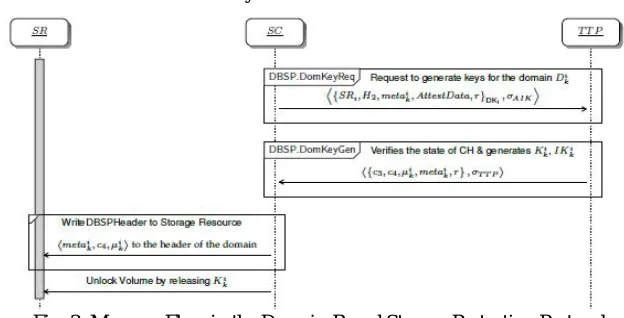
We now proceed with a portrayal of the DBSP convention. Alongside three of the substances officially dynamic in the TL convention – area director, secure segment, the trusted outsider – DBSP utilizes a fourth one: the capacity asset. In thiscase, DMi interfaces with the other convention parts through a VM case vmi l running on CHi. We accept that vmi l has been propelled following the TL convention. The DBSP convention incorporates an open and a private encryption conspire, a pseudorandom work for space key era, a mark plot and an irregular generator. Figure 3 exhibits the DBSP convention mesage flow.
DBSP.Setup: We expect that in TL.Setup, every substance has acquired an open/private key match and distributed pk. Expect DMi asks for access for a specific VM vmi l to a capacity asset SRi inthedomain Di k ∈Divmi l .The ask for is captured by the SC, which continues to recover from TTP a symmetric encryption key for the area Di k. DBSP.DomKeyReq: SC sends to TTP a demand to produce keys for the area Di k. The ask for contains the objective stockpiling asset SRi, hash H2 of pkDMi, the nonce r and metai k, containing the novel space identifier and the security profile required to get to the area Di k, i.e., metai k = Di k,SPi pkTTP; SC utilizes the symmetric key DKi got amid TL.Attestation to ensure message confidentiality, and the nearby TPM to sign the message
with skAIK, delivering σAIK (see DBSP.DomKeyReq ) in Figure this verification succeeds. DBSP.DomKeyGen: A probabilistic
creates a nonce utilizing an irregular message mi ∈ {0,1}n by executing ni = RAND(mi).Next, TTP utilizes a PRF to produce the keys for area Di k, by assessing the accompanying:
Ki k = PRFKTTP,Di kkSPikni , IK i k = PRFKTTP,Di kkni ,
[image:11.612.145.457.140.299.2]where KTTP is an ace key that does not leave the security
Fig. 3. Message Flow in the Domain-Based Storage Protection Protocol.
edge of TTP, Ki k is a symmetric encryption key to confidentiality ensure the information and IKi k a symmetric key to check the uprightness of the put away information. TTP seals Ki k and IKi k to the trusted configuration of CHi by figuring c3 = EncpkTPMKi kkIKi k . TTP encryptsthe created nonce ni and the gave security profile SPi by assessing c4 = EncKTTP (nikSPi) to later utilize it for verification. Next, TTP creates a message validation code µ by assessing µi k = MAC(KTTP,nikSPi). The area key era calculation is indicated by c3,c4,µi k ← DBSP.DomKeyGen(ni,KTTP,skTPM). Having created the space key, TTP reacts to the DBSP.DomKeyReq by sending c3,c4,µi k,metai k,r with the mark σTTP. Upon gathering, SC first verifies message uprightness and freshness, and calls the neighborhood TPM to unlock c3, delivering Ki kkIKi k if and just if CHi stays in the prior put stock in state. Next, SC stores metai k, c4 and µi k in the space header and utilizations Ki k, IKi k as contributions to the plate encryption subsystem on CHi, which decodes and verifies the information respectability of the mounted volume facilitating Di k before giving plain content access to vmi l. To reproduce the encryption and honesty keys for the area Di k, SC sends a demand like DBSP.DomKeyReq, adding to the message the qualities c4 and µi k, which are put away in the space header. Upon gathering, TTP verifies the respectability of the got esteem c4 by computing
µi k = MAC(KTTP,nikSPi). In the event that the respectability verification ofc 4 is sure, TTP unscrambles it to nikSPi = DecskTTP (c4) and figures the area enter as in DBSP.DomKeyGen, utilizing the current token ni as opposed to producing another one4.
E. Suggestion 1 (VM Substitution Soundness).
The TL convention is sound against the VM substitution assault. Evidence: A foe ADV attempting to dispatch vm 6= vmi l on CH can just get vm acknowledged by DMi if the last shared verification venture in the trusted dispatch system is effective. Thusly, this progression just succeeds if no less than one of the accompanying two choices is valid: a. The protected segment SC utilizes an alternate token, τ0 6= τ acknowledged by DMi in the final secure channel foundation. b. The safe segment SC on CH utilizes the extremely same token τ utilized by DMi when propelling vmi l. Alternative a can just succeed ifADV can soften the common verification up the protected channel setting. Given that the chose secure channel conspire is sound and τ is sufficiently long and chosen utilizing a sound irregular era process, theADV neglects to break the last convention step. Henceforth, as long as the safe channel convention is sound, the general convention development is additionally stable against this assault choice. Alternative b can just succeed if the foe either managestoguessavalueτ0 = τ when dispatch in gvmor figures out how to either get τ when DMi dispatches vmi l or supplant the relationship amongst τ and vmi l with a relationship amongst τ and vm when DMi dispatches vmi l, by assaulting any of the convention steps going before the final common verification step. An effective assault for this situation has the likelihood τ0 = τ equivalents to 1/2n, where n is the length of the token esteem and is infeasible if n is sufficiently huge. Underneath, we appear
V. SECURITY ANALYSIS
A. TL.Token Option 1:
A modification must be accomplished by the enemy by either breaking people in general key encryption conspire used to create c1 or attempting to make this modification on c1 by coordinate modification (without first decoding it) and sign the modified c1 with a claim chose private key. The previous alternative bombs because of the presumption of open key encryption conspire soundness and the last because of that adjusting an open encoded structure without learning of the private key is infeasible. - TL.TokenOption2:Directdecryptionofc1 bombs because of the presumption of soundness of people in general key encryption conspire used to create c1. The main staying elective for the foe is handing-off the TL.Token to a stage CH0 ∈ CHSPi, which is under the full control of the foe. Further, ADV takes after the convention and issues the charge TL.AttestRequest utilizing the captured c1, AttestData and σAIK. In any case, this comes up short at the TL.Attestation venture since AttestData does not contain a legitimate AIK certificate unless the foe has figured out how to gain power of a substantial stage in the supplier coordinate with a legitimate certificate or she has figured out how to breakthe AIK certification plot. The previous choice damages the suspicion of physical security of the supplier registering assets while the last alternative abuses the presumption of a sound open key and AIK certification plans.
B. TL.AttestRequest.
The enemy could either endeavor to imitate this message with the objective of acquiring τ or the relationship amongst τ and vmi l. This pantomime endeavor bombs as the entire sent structure is marked with the pkAIK with a safe open key marking plan. Besides, endeavors to resend an old substantial TL.AtttestRequest flop as the H1 verification that the SC gets consequently bombs as it points on the old VM. Thus, any endeavors to adjust TL.Attest Request flop as the entire structure is marked with a safe mark conspire.
C. TL.Attestation.
Any endeavor by the foe to acquire τ would be equivalent to breaking people in general key encryption of TL.Attest Token. Essentially, any endeavor to alter c2 flops because of the way that modification of an open encoded structure without information of the private key is unfeasible if people in general key encryption conspire is sound. Any endeavor by the enemy to supplant an old recorded substantial TL. Bear witness to Token message bombs all things considered messages do contain a VM picture hash H1 unique in relation to the one expected by the SC.
VI. IMPLEMENTATION AND RESULTS
We next depict the usage of the TL and DBSP conventions took after by test assessment comes about.
A. Test bed Architecture
We depict the framework of the model and the engineering of a disseminated EHR framework introduced and configured over different VM occurrences running on the proving ground.
[image:12.612.164.450.581.712.2]1) Infrastructure Description : The proving ground dwells on four Dell PowerEdge R320 has associated on a Cisco Catalyst 2960 switch with 801.2q help. We utilized Linux CentOS, bit rendition 2.6.32358.123.2.openstack.el6.x86 64 and the OpenStack IaaS platform5 (variant Icehouse) utilizing KVM virtualization bolster. The model IaaS incorporates one "controller" running fundamental stage administrations (scheduler, PKI segments, SDNcontrol plane, VM picture stockpiling, and so on.) and three figure has running the VM visitors. The topology of the model SDN
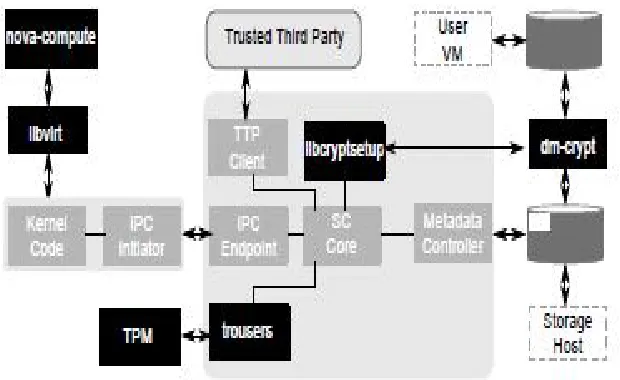
Reflects three bigger spaces of the application-level arrangement (front-end, back-end and database segments) in three virtual LAN (VLAN) systems. The figure has utilize libvirt6 for virtualization usefulness. We modified libvirt 1.0.2 and utilized the "libvirthooks" framework to execute the SC for the TL and DBSP conventions. SC opens the volumes on register has and collaborates with the TPM and TTP (see Figure 4). It utilizes a non specific server engineering where the SC daemon handles each demand in a different procedure. A bury procedure communication(IPC) convention ldefines the sorts of messages prepared by the SC. The IPC convention utilizes sychronous calls with a few sorts of solicitations for the individual SC operations; the reaction contains the exitcode and reaction information. A nitty gritty engineering of SC, including the principle libraries that it depends on, is displayed in Figure 5.
Fig. 5. Close-up view of the secure component implementation architecture, presented as a combination of components and existing libraries.
2) Application Description: The prototype also includes a distributed EHR system deployed over seven VM instances. This system contains one client VM, two front-end VMs, two back-end VMs, a database VM and an auxiliary external database VM. Six of the VM instances operate on Microsoft Windows Server 2012 R2, with one VM running the client application operates on Windows7. The components of the EHR system communicate using statically defined IP addresses on the respective VLANS described in Section 6.1.1. Load balancing functionality provided by the underlying IaaS allots the load among front-end and back-front-end VM pairs. The hosts of the cluster are compatible with the TL protocol, which allows an infrastructure administrator to perform a trusted
TABLE 1: Overhead for unlocking a volume with DBSP (all times in ms)
B. Performance evaluation
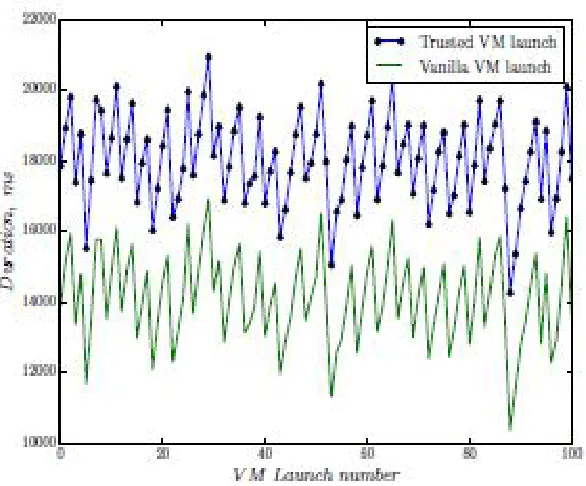
Fig. 6. Overhead induced by the TL protocol during VM instantiations.
Fig.7.Benchmarksresultsonidenticaldrives: plaintext, withDBSP, with DBSP and AES-NI acceleration.
VII. APPLICATION DOMAIN
The exhibited comes about depend on work as a team with a territorial open social insurance specialist to address some of its worries in regards to IaaS security. We have conveyed the model portrayed in Section 6, additionally reached out by coordinating a pharmaceutical database, and assessed it through end-client approval and execution tests. Our outcomes exhibit that it is both conceivable and pragmatic to give solid stage programming uprightness assurances to IaaS inhabitants and efficiently detach their information utilizing built up cryptographic instruments. Stage honesty ensures enable inhabitants to take better choices on both workload movement to the cloud and workload situation inside IaaS. This diverges from the current, "flat" confide in display, where all IaaS has pronounce the same– however unverifiable for the tenant– put stock in level.
A fundamental finish of this down to earth practice is that the extra cost of giving security assurances can be viably balanced by creating cloud administrations from various contending suppliers, without delegating the trust among these suppliers. Hence, in our cloud show the occupant can buy less expensive cloud plate stockpiling with no extra hazard for information confidentiality. Another conclusion is that while associations working on touchy information ,e.g.public social insurance specialists, consider the dangers of moving information to IaaS mists as unsuitable, the dominant part of accessible suppliers utilize business off-the rack (COTS) cloud stages with constrained abilities to improve the security of their arrangements, neglecting to meet the client necessities. This shows the need to fuse uprightness verification and information assurance systems into well known COTS cloud stages naturally. We trust that these essential lessons will move new secure, usable and practical answers for cloud administrations. On the pragmatic side, specifically with respect to the part of the TTP, we imagine two situations. The TTP could either be overseen by the inhabitant itself (for associations with enough assets and skill), or by an outside association (like a certificate specialist). The first situation enables the inhabitant to hold the benefits of cloud benefits alongside extra security ensures. Likewise, in the second situation, little eractor check get the same benefits without the need to put into possess authentication foundation. In the two situations, with a specific end goal to secure the cloud supplier the TTP would just work on a physical cut of the assets (i.e. a subset of process has) that compare to the particular occupant spaces.
VIII. CONCLUSION
of assaults and demonstrated that the conventions hold in the specified danger display. To acquire facilitate confidence in the semantic security properties of the conventions, we have demonstrated and verified them with ProVerif [32]. At long last, our execution tests have demonstrated that the conventions present an insignificant execution overhead. This work has secured just a small amount of the IaaS assault scene. Imperative themes for future work are reinforcing the trust display in cloud organize correspondences, information geolocation [33], and applying accessible encryption plans to make secure distributed storage components. Our outcomes demonstrate that it is conceivable and commonsense to give solid. Stage programming honesty ensures for occupants and efficiently disconnect their information utilizing built up cryptographic instruments. With sensible designing exertion the structure can be incorporated into generation conditions to fortify their security properties.
REFERENCES
[1] N. Santos, K. P. Gummadi, and R. Rodrigues, "Towards trusted distributed computing," in Proceedings of the 2009 Conference on Hot Topics in Cloud Computing, HotCloud'09, (Berkeley, CA, USA), USENIX Association, 2009.
[2] J.Schiffman, T.Moyer, H.Vijayakumar, T.Jaeger,andP.McDaniel, "Seeding Clouds With Trust Anchors," in Proceedings of the 2010 ACM Workshop on Cloud Computing Security, CCSW '10, (New York, NY, USA), pp. 43– 46, ACM, 2010.
[3] N. Paladi, A. Michalas, and C. Gehrmann, "Area based capacity assurance with secure get to control for the cloud," in Proceedings of the 2014 International Workshop on Security in Cloud Computing, ASIACCS '14, (New York, NY, USA), ACM, 2014.
[4] M. Jordon, "Tidying up filthy circles in the cloud," Network Security, vol. 2012, no. 10, pp. 12– 15, 2012. [5] Cloud Security Alliance,"The notoriousnine distributed computing top dangers 2013," February 2013.
[6] A. Michalas, N. Paladi, and C. Gehrmann, "Security parts of e-wellbeing frameworks movement to the cloud," in the sixteenth International Conference on E-wellbeing Networking, Application and Services (Healthcom'14), pp. 228– 232, IEEE, Oct 2014.
[7] B. Bertholon, S. Varrette, and P. Bouvry, "Certicloud: a novel tpm based way to deal with guarantee cloud Iaa Ssecurity,"inCloudComputing, 2011 IEEE International Conference on, pp. 121– 130, IEEE, 2011.
[8] M. Aslam, C. Gehrmann, L. Rasmusson, and M. Bj¨orkman, "Safely propelling virtual machines on dependable stages in an open cloud - a venture's point of view.," in CLOSER, pp. 511– 521, SciTePress, 2012.
[9] A. Cooper and A. Martin, "Towards a protected, carefully designed matrix stage," in Cluster Computing and the Grid, 2006. CCGRID 06. 6th IEEE International Symposium on, vol. 1, pp. 8– pp, IEEE, 2006.
[10] W. Wang, Z. Li, R. Owens, and B. Bhargava, "Secure and efficient access to out sourced data,"in Proceedings of the 2009 ACMworkshop on Cloud registering