Volume 2010, Article ID 404792,22pages doi:10.1155/2010/404792
Research Article
A Class of Two-Person Zero-Sum Matrix Games
with Rough Payoffs
Jiuping Xu and Liming Yao
Uncertainty Decision-Making Laboratory, Sichuan University, Chengdu 610064, China
Correspondence should be addressed to Jiuping Xu,[email protected]
Received 10 July 2009; Accepted 17 January 2010
Academic Editor: Attila Gilanyi
Copyrightq2010 J. Xu and L. Yao. This is an open access article distributed under the Creative Commons Attribution License, which permits unrestricted use, distribution, and reproduction in any medium, provided the original work is properly cited.
We concentrate on discussing a class of two-person zero-sum games with rough payoffs. Based on the expected value operator and the trust measure of rough variables, the expected equilibrium strategy andr-trust maximin equilibrium strategy are defined. Five cases whether the game exists
r-trust maximin equilibrium strategy are discussed, and the technique of genetic algorithm is applied to find the equilibrium strategies. Finally, a numerical example is provided to illustrate the practicality and effectiveness of the proposed technique.
1. Introduction
Game theory is widely applied in many fields, such as, economic and management problems, social policy, and international and national politics since it is proposed by von Neumann and Morgenstern 1. Peski 2 presented the simple necessary and sufficient conditions for the comparison of information structures in zero-sum games and solved an problem, which is how to find the value of information in zero-sum games. Owena and McCormick
3 analyzed a “manhunting” game involving a mobile hider and consider a deductive search game involving a fugitive, then developed a model based on a base-line model. The traditional game theory assumes that all data of a game are known exactly by players. However, there are some games in which players are not able to evaluate exactly some data in our realistic situations. In these games, the imprecision is due to inaccuracy of information and vague comprehension of situations by players. For these uncertain games, many scholars have made contribution and got some techniques to find the equilibrium strategies of these games. Some scholars, such as, Berg and Engel4, Ein-Dor and Kanter
5, Takahashi6, discussed a two-person zero-sum matrix game with random payoffs. Xu
number payoffmatrix. Harsanyi8made a great contribution in treating the imprecision of probabilistic nature in games by developing the theory of Bayesian games. Dhingra et al.9 combined the cooperative game theory with fuzzy set theory to yield a new optimization method to herein as cooperative fuzzy games and proposed a computational technique to solve the multiple objective optimization problems. Then Espin et al.10proposed an innovative fuzzy logic approach to analyzen-person cooperative games and theoretically and experimentally examined the results by analyzing three-case studies.
Although many cooperative and noncooperative games with uncertain payoffs are researched much by many scholars, there is still a kind of games with uncertain payoffs to be discussed little, that is, games with rough payoffs. Since rough set theory is proposed and studied by Pawlak11, 12, it is drastic to be applied into many fields, such as, data mining and neural network. Nurmi et al.13introduced three uncertainty events in social choice such as the impreciseness of a probabilistic, fuzzy, and rough type, further explored difficult issues of how diverse types of impreciseness can be combined, and in particular the combination of roughness with randomness and fuzziness in voting games. Liu 14 proposed a new concept of rough variable which is a measurable function from rough space toR. Based on the concept of rough variable, a game with rough payoffs is studied in this paper.
In game theory, it is an important task to define the concepts of equilibrium strategies and investigate their properties. However, in these games with uncertain payoffs, there are no concepts of equilibrium strategies to be accepted widely. Campos15has proposed several methods to solve fuzzy matrix games based on linear programming but has not defined explicit concepts of equilibrium strategies. As the extension of the idea of Campos 15, Nishizaki and Sakawa16discussed multiobjective matrix game with fuzzy payoffs. Maeda
17has defined Nash equilibrium strategies based on possibility and necessity measures and investigated its properties.
In this paper, based on the concept of rough variable proposed by Liu 14, we discuss a simplest game, namely, the game in which the number of players is two and rough payoffs which one player receives are equal to rough payoffs which the other player loses. We defined two kinds of concepts of maximin equilibrium strategies and investigate their properties. The rest of this paper is organized as follows. InSection 2, we recalls some definitions and properties about two-person zero-sum game and the rough variable. Then two concepts of equilibrium strategies of two-person zero-sum game with rough payoffs are introduced and then their properties are deduced inSection 3. InSection 4, we proposed the technique of GA to solve some complicated game problems with rough payoffs which can be converted into crisp programming problem. Then a numerical example is discussed to show the effectiveness of the prosed theory and algorithm inSection 5. Finally, the conclusion has been made inSection 6.
2. Basic Concepts of Two-Person Zero-Sum Game and Rough Variable
In this section, let us recall the basic definitions of the two-person zero-sum game in18. The concept and properties of rough variable proposed by Liu14is also reviewed.
2.1. Two-Person Zero-Sum Game
much one player receives is equal to how much the other loses. When we assume that both players give pure, mixed strategies see Parthasarathy and Raghavan 19, such a game has been well resolved. But in our realistic world, there are also some noncooperative cases though more cooperation may exist in games. In reality, the non-cooperation between players may be vague. This paper mainly deals with the kind of games with rough payoffs.
In the two-person zero-sum game, what one player receives is equal to how much the other loses which could be illustrated by the followingm×nmatrix:
P ⎡ ⎢ ⎢ ⎢ ⎣
a11 · · · a1n ..
. . .. ...
an1 · · · ann
⎤ ⎥ ⎥ ⎥
⎦, 2.1
where P denotes the payoffmatrix of player I, xij is the payoffof player I when player I proposes the strategy i, and player II proposes the strategy j. Then, the payoff matrix of player II is−P.
Definition 2.1. A vector xin Rm is said to be a mixed strategy of player I if it satisfies the
following condition:
xTem1, 2.2
where the components ofx x1, x2, . . . , xmT are greater than or equal to 0;em is anm×1 vector, whose every component is equal to 1. The mixed strategy of the player II is defined similarly. Particularly, a strategysk 0,0, . . . ,1, . . . ,0is called a pure strategy of player I. Thereinto, thekth component ofskis only equal to 1, the other components are equal to 0.
Definition 2.2. If the mixed strategiesxandyare proposed by players I and II, respectively,
then the expected payoffof player I is defined by
xTP y n
j1
m
i1
aijxiyj. 2.3
According toDefinition 2.2, we have the definition of optimal strategies of players.
Definition 2.3. In one two-person zero-sum game, player I’s mixed strategyx∗and player II’s
mixed strategyy∗are said to be optimal strategies ifxTP y∗≤x∗TP y∗andx∗TP y∗≤x∗TP yfor any mixed strategiesxandy.
2.2. Rough Variable
Definition 2.4Slowinski et al.20. LetUbe a universe andXa set representing a concept. Then its lower approximation is defined by
X x∈U|R−1x⊂X, 2.4
and the upper approximation is defined by
X x∈X
Rx, 2.5
whereRis the similarity relationship onU. Obviously, we haveX⊆X⊆X.
Definition 2.5 Pawlak 11. The collection of all sets having the same lower and upper
approximations is called a rough set, denoted byX, X. Its boundary is defined as follows:
BnRX X−X. 2.6
Liu14also gave a new concept about rough variable. This paper mainly refers to this book. The following results will be used extensively.
Definition 2.6. LetΛbe a nonempty set,Aa σ-algebra of subsets ofΛ,Δan element inA,
andπ a nonnegative, real-valued, additive set function. ThenΛ,Δ,A, πis called a rough space.
Definition 2.7. A rough variableξon the rough spaceΛ,Δ,A, πis a function fromΛto the
real lineRsuch that for every Borel setOofR, we have
{λ∈Λ|ξλ∈O} ∈ A. 2.7
The lower and the upper approximations of the rough variableξare then defined as follows:
ξ{ξλ|λ∈Δ}, ξ{ξλ|λ∈Λ}. 2.8
Liu14also defined the trust measure of eventAby Tr{A} 1/2Tr{A}Tr{A}, where Tr{A}denotes the upper trust measure of event A, defined by Tr{A} π{A}/π{Λ}, and Tr{A}denotes the lower trust measure of eventA, defined by Tr{A} π{A∩Δ}/π{Δ}.
Definition 2.8. Letξbe a rough variable on the rough spaceΛ,Δ,A, π. The expected value ofξis defined by
Eξ
∞
0
Tr{ξ≥r}dr−
0
−∞Tr{ξ≤r}dr. 2.9
Remark 2.9. Letξ a, b,c, dbe a rough variable withc≤a≤b≤d. Then we have
Eξ 1
4abcd. 2.10
Remark 2.10. Assume thatξandηare both variables with finite expected values. Then for any
real numbersaandb, we have
EaξbηaEξ bEη. 2.11
3. Two Kinds of Equilibrium Strategies of Two-Person Zero-Sum Game
with Rough Payoffs
Let consider the following example before defining the two-person zero-sum game with rough payoffs. When playing a Chinese poker, there are two teams which are constructed by two persons. Without loss of generality, we assume that Team A is the dealer, then its rule is as follows.
1If the score Team B gets is less than 40, Team A goes on being a dealer and rises of one grade, denoted as1.
2If the score Team B gets is between 40 and 80, Team B becomes the dealer, denoted as 0.
3If the score Team B gets is more than 80, Team B becomes the dealer and rises of one grade, denoted as−1.
From the description, we know that the rule has determined a kind of classification which is regard as an equivalent relation by Pawlak12on the universe0,100. This means that obtaining 45 or 75 expresses the same meaning, and they are equivalent or indiscernible. Thus, the rough variableξ 40,80,0,100is applied to describe the above process and its trust measure expresses the probability that Team A obtains1, or 0, or−1 in every game. In the following part, we will only consider the rough variable which is combined by the payoff. Let the rough variableξij represent the payoffthat the player I receives or player II loses, then a rough payoffmatrix is presented as follows to denote a two-person zero-sum game:
P ⎡ ⎢ ⎢ ⎢ ⎢ ⎢ ⎢ ⎣
ξ11 ξ12 · · · ξ1n ξ21 ξ22 · · · ξ2n
..
. ... . .. ...
ξm1 ξm2 · · · ξmn
⎤ ⎥ ⎥ ⎥ ⎥ ⎥ ⎥ ⎦
When player I and player II, respectively, choose the mixed strategiesx andy, the rough payoffs of player I are
xTP y n
j1
m
i1
ξijxiyj. 3.2
3.1. Basic Definition of Two Kinds of Equilibrium Strategies
Because of the vagueness of rough payoffs, it is difficult for players to choose the optimal strategy. Naturally, we consider how to maximize players’ or minimize the opponent’s rough expected payoffs. Based on this idea, we propose the following maximin equilibrium strategy.
Definition 3.1. Let rough variableξij i1,2, . . . , m, j 1,2, . . . , nrepresent the payoffs that
the player receives or player II loses when player I gives the strategyiand player II gives the strategyj. Thenx∗, y∗is called a rough expected maximin equilibrium strategy if
ExTP y∗≤Ex∗TP y∗≤Ex∗TP y, 3.3
wherePis defined by3.1.
Remark 3.2. Since the rough variablesξare independent, then for any mixed strategiesxand
y, according toRemark 2.10, we have that
ExTP yE ⎡ ⎣n
j1
m
i1
ξijxiyj
⎤ ⎦n
j1
m
i1
Eξij
xiyj. 3.4
According to the definition of trust measure of rough variable, we can get another way to convert the rough variable into a crisp number. Then we propose another definition of Nash equilibrium to this game.
Definition 3.3. Let rough variableξij i1,2, . . . , m, j 1,2, . . . , nrepresent the payoffs that
the player receives or player II loses when player I gives the pure strategyiand player II gives the pure strategyj. r is the predetermined level of the payoffs,r ∈ R. Thenx∗, y∗is called ther-trust maximin equilibrium strategy if
Tr xTP y∗≥r≤Tr x∗TP y∗≥r≤Tr x∗TP y≥r, 3.5
wherePis defined by3.1.
3.2. The Existence of Two Kinds of Equilibrium Strategies
3.2.1. The Existence of Expected Maximin Equilibrium Strategies
When the players’ payoffs are crisp numbers, we know that the game surely has a mixed Nash equilibrium point. Then we will discuss if there is an expected maximin equilibrium strategy when the payoffsξijare characterized as rough variables.
Lemma 3.4. Letξij (i 1,2, . . . , m, j 1,2, . . . , n) be rough variables with finite expected values.
Then strategyx∗, y∗is an expected maximin equilibrium strategy to the game if and only if for every
pure strategysk(k1,2, . . . , m) of player I andst(t1,2, . . . , n) of player II, one has
EsTkP y∗≤Ex∗TP y∗≤Ex∗TP st
, 3.6
wherePis defined by3.1.
Proof. The necessity is apparent. Now we only consider the sufficiency. According to3.6,
for everyk1,2, . . . , m,
EsTkP y∗≤Ex∗TP y∗. 3.7
Suppose thatx x1, x2, . . . , xmis any one mixed strategy of player I. In3.7, for everyk, we multiplyxkto every inequality. Then
EsTkP y∗xk≤E
x∗TP y∗xk
⇒m k1
EsT kP y∗
xk≤
m
k1
Ex∗TP y∗x k
⇒ExTP y∗≤Ex∗TP y∗ m
k1
xk
⇒ExTP y∗≤Ex∗TP y∗.
3.8
Similarly, we can prove
Ex∗TP y∗≤Ex∗TP y. 3.9
Thus, the strategyx∗, y∗is an expected maximin equilibrium strategy to the game. This completes the proof.
Theorem 3.5. In a two-person zero-sum game, rough variablesξij (i 1,2, . . . , m, j 1,2, . . . , n)
represent the payoffs player I receives or player II loses, and the payoffmatrixP is defined by3.1.
Proof. Suppose thatx x1, x2, . . . , xmis any one mixed strategy of player I. For every pure strategyskk1,2, . . . , mand any strategyy, we define
ρkx max 0, E
sTkP y−ExTP y. 3.10
For everyxkk1,2, . . . , m, we define
fk
xkρkx 1mk1ρkx
. 3.11
Obviously,fk ≥0k 1,2, . . . , m,
m
k1fk1. Thus,f f1, f2, . . . , fmis a mixed strategy of player I and is a continous function aboutx. According to Brouwer’s fixed-point theorem, there exists a pointx∗ x1∗, x2∗, . . . , x∗msatisfying
xk∗ x
∗
kρkx∗ 1mk1ρkx∗
, k1,2, . . . , m. 3.12
Now, we will proveEsT
kP y≤Ex∗TP y. For any mixed strategyx x1, x2, . . . , xm, letEsT
hP y mink∈JEsTkP y,J{1,2, . . . , m}. Then
EsThP yEsThP y m
k1
xk≤ m
k1
xkE
sTkP yExTP y. 3.13
Namely, there exists a pure strategy sh satisfying EsThP y ≤ ExTP y. Thus, for x∗
x∗1, x∗2, . . . , xm∗, there exists a pure strategy sh such that EsThP y ≤ Ex∗TP y. According to3.10, we haveρhx∗ 0.
For the strategyx∗hxh∗>0of playerI, according to3.12, we have
x∗h x
∗
hρhx∗ 1mk1ρkx∗
x∗h
1mk1ρkx∗
⇒m k1
ρkx∗ 0.
3.14
By the definition of ρkx∗, we know that ρkx∗ is nonegative. Therefore, for every k 1,2, . . . , m, ρkx∗ 0. Then
EsTkP y−Ex∗TP y≤0, ⇒EsT
kP y
≤Ex∗TP y, k1,2, . . . , m.
Similarly, we can prove Ex∗TP y∗ ≤ Ex∗TP s
t for every pure strategy stt 1,2, . . . , n of player II. By Lemma 3.4, we know that x∗, y∗ is an expected maximin equilibrium strategy to the game. This completes the proof.
3.3. The Existence of
r
-Trust Maximin Equilibrium Strategies
Through the proof ofTheorem 3.5, we know that there at least exists an expected maximin equilibrium strategy to any two-person zero-sum game with rough payoffs. Now we will discuss the existence ofr-trust maximin equilibrium strategy to this kind of game.
Lemma 3.6. Let rough variableξij (i 1,2, . . . , m, j 1,2, . . . , nrepresent the payoffs that the
player receives or player II loses when player I gives the strategyiand player II gives the strategyj.
Suppose thatris a given number and rough variableξij aij, bij,cij, dij(cij ≤bij ≤aij≤dij),
then one has
Tr xTP y≥r ⎧ ⎪ ⎪ ⎪ ⎪ ⎪ ⎪ ⎪ ⎪ ⎪ ⎪ ⎪ ⎪ ⎪ ⎪ ⎪ ⎪ ⎪ ⎪ ⎪ ⎪ ⎨ ⎪ ⎪ ⎪ ⎪ ⎪ ⎪ ⎪ ⎪ ⎪ ⎪ ⎪ ⎪ ⎪ ⎪ ⎪ ⎪ ⎪ ⎪ ⎪ ⎪ ⎩
0 ifxTDy≤r,
xTDy−r
2xTDy−xTCy ifx
TBy≤r≤xTDy,
1 2
xTDy−r xTDy−xTCy
xTBy−r xTBy−xTAy
ifxTAy≤r≤xTBy,
1 2
xTDy−r xTDy−xTCy1
ifxTCy≤r≤xTAy,
1 ifr≤xTCy,
3.16 where A ⎡ ⎢ ⎢ ⎢ ⎢ ⎢ ⎢ ⎣
a11 a12 · · · a1n a21 a22 · · · a2n
..
. ... . .. ...
am1 am2 · · · amn
⎤ ⎥ ⎥ ⎥ ⎥ ⎥ ⎥ ⎦ , B ⎡ ⎢ ⎢ ⎢ ⎢ ⎢ ⎢ ⎣
b11 b12 · · · b1n b21 b22 · · · b2n
..
. ... . .. ...
bm1 bm2 · · · bmn
⎤ ⎥ ⎥ ⎥ ⎥ ⎥ ⎥ ⎦ , C ⎡ ⎢ ⎢ ⎢ ⎢ ⎢ ⎢ ⎣
c11 c12 · · · c1n c21 c22 · · · c2n
..
. ... . .. ...
cm1 cm2 · · · cmn
⎤ ⎥ ⎥ ⎥ ⎥ ⎥ ⎥ ⎦ , D ⎡ ⎢ ⎢ ⎢ ⎢ ⎢ ⎢ ⎣
d11 d12 · · · d1n d21 d22 · · · d2n
..
. ... . .. ...
dm1 dm2 · · · dmn
Proof. According to14, we have
xTP y m i1 n j1
xiξijyj
m i1 n j1
xiyjaij, xiyjbij
,xiyjcij, xiyjdij
⎛ ⎝ ⎡ ⎣m
i1
n
j1
xiyjaij, m i1 n j1
xiyjbij
⎤ ⎦,
⎡ ⎣m
i1
n
j1
xiyjcij, m i1 n j1
xiyjdij
⎤ ⎦ ⎞ ⎠. 3.18 Suppose that A ⎡ ⎢ ⎢ ⎢ ⎢ ⎢ ⎢ ⎣
a11 a12 · · · a1n a21 a22 · · · a2n
..
. ... . .. ...
am1 am2 · · · amn
⎤ ⎥ ⎥ ⎥ ⎥ ⎥ ⎥ ⎦ , B ⎡ ⎢ ⎢ ⎢ ⎢ ⎢ ⎢ ⎣
b11 b12 · · · b1n b21 b22 · · · b2n
..
. ... . .. ...
bm1 bm2 · · · bmn
⎤ ⎥ ⎥ ⎥ ⎥ ⎥ ⎥ ⎦ , C ⎡ ⎢ ⎢ ⎢ ⎢ ⎢ ⎢ ⎣
c11 c12 · · · c1n c21 c22 · · · c2n
..
. ... . .. ...
cm1 cm2 · · · cmn
⎤ ⎥ ⎥ ⎥ ⎥ ⎥ ⎥ ⎦ , D ⎡ ⎢ ⎢ ⎢ ⎢ ⎢ ⎢ ⎣
d11 d12 · · · d1n d21 d22 · · · d2n
..
. ... . .. ...
dm1 dm2 · · · dmn
⎤ ⎥ ⎥ ⎥ ⎥ ⎥ ⎥ ⎦ , 3.19 then
xTP yxTAy, xTBy,xTCy, xTDy. 3.20
thus we have
Tr xTP y≥r ⎧ ⎪ ⎪ ⎪ ⎪ ⎪ ⎪ ⎪ ⎪ ⎪ ⎪ ⎪ ⎪ ⎪ ⎪ ⎪ ⎪ ⎨ ⎪ ⎪ ⎪ ⎪ ⎪ ⎪ ⎪ ⎪ ⎪ ⎪ ⎪ ⎪ ⎪ ⎪ ⎪ ⎪ ⎩
0 ifxTDy≤r,
xTDy−r
2xTDy−xTCy ifx
TBy≤r≤xTDy, 1
2
xTDy−r xTDy−xTCy
xTBy−r xTBy−xTAy
ifxTAy≤r≤xTBy, 1
2
xTDy−r xTDy−xTCy1
ifxTCy≤r ≤xTAy,
1 ifr ≤xTCy.
3.21
Because ofcij≤bij≤aij≤dij, we can easily havexTCy≤xTAy≤xTBy≤xTDy. Then let us discuss the existence ofr-trust maximin equilibrium strategy and consider two simple cases firstly.
Theorem 3.7. Ifr < min{cij}for alli 1,2. . . , m, j 1,2, . . . , n,then all strategiesx, yare
r-trust maximin equilibrium strategies.
Proof. Supposelmin{cij}, then
xTCy m
i1
n
j1
cijxiyj≥ m
i1
n
j1
lxiyj l. 3.22
Because r < min{cij} l, then all strategies x, y satisfyxTCy ≥ r, according to
Lemma 3.6, we have
Tr xTP y≥r1 ∀x, y. 3.23
We choose any strategyx∗, y∗, for all strategyx, y,
Tr xTP y∗≥rTr x∗TP y∗≥rTr x∗TP y≥r1. 3.24
Thus, all strategiesx, yarer-trust maximin equilibrium strategies. This completes the proof.
Theorem 3.8. Ifr > max{dij}for alli 1,2, . . . , m, j 1,2, . . . , n, then all strategiesx, yare
r-trust maximin equilibrium strategies.
Proof. The proof is similar with that ofTheorem 3.7.
After discussing two particular cases, let us consider the usual case if there existsr -trust maximin equilibrium strategyx, y.
Theorem 3.9. In a two-person zero-sum game, rough variablesξij (i 1,2, . . . , m, j 1,2, . . . , n)
represent the payoffs player I receives or player II loses, and the payoffmatrixP is defined by3.1.
For a predetermined numberr, if for allx, y, they cannot satisfy anyone of the following conditions:
(1)xTDy≤r, (2)xTBy≤r ≤xTDy, (3)xTAy≤r≤xTBy, (4)xTCy≤r ≤xTAy, (5)r≤xTCy,
then there does not exist oner-trust maximin equilibrium strategy.
Proof. Let us only discuss one of five cases, the others are considered similarly. SupposeS
{x, y|xTBy≥r ≥xTAy,m
i1xi 1,jn1yj 1,0≤xi, yj ≤1}andQ{x, y|xTAy≥ r ≥ xTCy,m
i1xi 1,
n
j1yj 1,0 ≤ xi, yj ≤ 1}. If not allx, y ∈ S, then without loss of generality we can suppose otherx, y∈ Q. If there exists ar-trust maximin equilibrium strategyx∗, y∗inS, according toLemma 3.6, we have
Tr x∗TP y∗≥r 1
2
x∗TDy∗−r
x∗TDy∗−x∗TCy∗
x∗TBy∗−r
x∗TBy∗−x∗TAy∗
SinceQ / Φ, then for the strategyy∗, there exists strategyx, y∗∈Qsuch thatxTCy∗< r < xTAy∗, then according toLemma 3.6, we have
Tr xTP y∗≥r 1
2
xTDy∗−r
xTDy∗−xTCy∗ 1
. 3.26
It is apparent that Tr{x∗TP y∗ ≥ r} ≤ Tr{xTCy∗ > r}. Namely, Tr{x∗TP y∗ ≥ r}/>Tr{xTCy∗ > r}. This is in conflict with the definition ofr-trust maximin equilibrium strategy.
Similarly, ifx∗, y∗∈Q, according toLemma 3.6, we have
Tr x∗TP y∗≥r 1
2
x∗TDy∗−r
x∗TDy∗−x∗TCy∗ 1
. 3.27
SinceS / Φ, then for the strategyx∗, there exists strategyx∗, ysuch thatx∗TBy≥r ≥ x∗TAy, then
Tr x∗TP y≥r 1
2
x∗TDy−r x∗TDy−x∗TCy
x∗TBy−r x∗TBy−x∗TAy
. 3.28
It is apparent that Tr{x∗TP y∗ ≥ r} ≥ Tr{xTCy > r}. Namely, Tr{x∗TP y∗ ≥ r}/<Tr{x∗TCy > r}. This is in conflict with the definition of r-trust maximin equilibrium strategy too. Then there does not exist ar-trust maximin equilibrium strategy in this case.
The other cases can be proved in the same way. This completes the proof.
According toTheorem 3.9, we know that this game existsr-trust maximin equilibrium strategyx∗, y∗only if all strategiesx, yare in some section, for example,xTBy≤r≤xTDy. Next let us discuss the following case that all strategiesx, yare in some section.
Theorem 3.10. For all strategiesx, ysatisfying xTBy ≤ r ≤ xTDy, the game exists ar-trust
maximin equilibrium strategy if and only if linear programming problems 3.29 and 3.30have
optimal solutions, where problems3.29and3.30are separately characterized as follows:
max 1
2
qTDy−rp
s.t.
⎧ ⎪ ⎪ ⎪ ⎪ ⎪ ⎪ ⎪ ⎨ ⎪ ⎪ ⎪ ⎪ ⎪ ⎪ ⎪ ⎩
qTBy−rp≤0, qTDy−rp≥0, q1q2· · ·qmp, qi≥0, i1,2, . . . , m,
wherep1/xTDy−xTCy, qTpxT, yis any fixed vector,
min 1
2
xTDt−rs
s.t.
⎧ ⎪ ⎪ ⎪ ⎪ ⎪ ⎪ ⎪ ⎨ ⎪ ⎪ ⎪ ⎪ ⎪ ⎪ ⎪ ⎩
xTBt−rs≤0, xTDt−rs≥0, t1t2· · ·tns, ti≥0, i1,2, . . . , n,
3.30
wheres1/xTDy−xTCy, tpy, xis any fixed vector.
Proof. For all strategies x, y satisfying xTBy ≤ r ≤ xTDy, the trust measure function of
payoffs matrixPis characterized by the following equation:
Tr xTP y≥r x
TDy−r
2xTDy−xTCy. 3.31
SupposeM{x, y|xTBy≤r ≤xTDy,m
i1xi1,nj1yj 1,0≤xi, yj≤1}. According to the definition ofr-trust maximin equilibrium strategy, whether the game equilibrium has an equilibrium strategy inMis equal to the following two problems.
For any fixedy,
max x
TDy−r 2xTDy−xTCy
s.t.
⎧ ⎪ ⎪ ⎪ ⎪ ⎪ ⎪ ⎪ ⎨ ⎪ ⎪ ⎪ ⎪ ⎪ ⎪ ⎪ ⎩
xTBy≤r, xTDy≥r,
x1x2· · ·xm1, 0≤xi≤1, i1,2, . . . , m.
3.32
For any fixedx,
min x
TDy−r 2xTDy−xTCy
s.t.
⎧ ⎪ ⎪ ⎪ ⎪ ⎪ ⎪ ⎪ ⎨ ⎪ ⎪ ⎪ ⎪ ⎪ ⎪ ⎪ ⎩
xTBy≤r, xTDy≥r,
y1y2· · ·yn1, 0≤yi≤1, i1,2, . . . , n.
We know that only if the two problems have optimal solution, the game exists an equilibrium strategy. Because problems3.32and3.33are similar, then let us only discuss problem3.32. For a fixedy, letp 1/2xTDy−xTCy, qT pxT. Then problem3.32is converted into a linear programming problem
max 1
2
qTDy−rp
s.t.
⎧ ⎪ ⎪ ⎪ ⎪ ⎪ ⎪ ⎪ ⎨ ⎪ ⎪ ⎪ ⎪ ⎪ ⎪ ⎪ ⎩
qTBy−rp≤0, qTDy−rp≥0, q1q2· · ·qmp, qi≥0, i1,2, . . . , m.
3.34
Similarly, problem3.33can be converted into the following problem, for any fixedx,
min 1
2
xTDt−rs
s.t.
⎧ ⎪ ⎪ ⎪ ⎪ ⎪ ⎪ ⎪ ⎨ ⎪ ⎪ ⎪ ⎪ ⎪ ⎪ ⎪ ⎩
xTBt−rs≤0, xTDt−rs≥0, t1t2· · ·tns, ti≥0, i1,2, . . . , n,
3.35
wheres1/xTDy−xTCy, tpy.
For problems3.29and3.30, we can make use of MATLAB to get optimal solution of the programming problem by turning them a bi-level programming problem. Here, we do not give the detail description. Then we go on to discuss another case thatxTCy≤r≤xTAy. Similarly, we can get the following conclusion.
Theorem 3.11. For all strategiesx, ysatisfyingxTCy ≤ r ≤ xTAy, the game exists ar-trust
maximin equilibrium strategy if and only if linear programming problems 3.36 and 3.37have
optimal solutions, where problems3.36and3.37are characterized as follows:
max 1
2
qTDy−rp1
s.t.
⎧ ⎪ ⎪ ⎪ ⎪ ⎪ ⎪ ⎪ ⎨ ⎪ ⎪ ⎪ ⎪ ⎪ ⎪ ⎪ ⎩
qTAy−rp≥0, qTCy−rp≤0, q1q2· · ·qmp, qi≥0, i1,2, . . . , m,
wherep1/xTDy−xTCy, qTpxT, yis any fixed vector,
min 1
2
xTDt−rs1
s.t.
⎧ ⎪ ⎪ ⎪ ⎪ ⎪ ⎪ ⎪ ⎨ ⎪ ⎪ ⎪ ⎪ ⎪ ⎪ ⎪ ⎩
xTAt−rs≥0, xTCt−rs≤0, t1t2· · ·tns, ti≥0, i1,2, . . . , n,
3.37
wheres1/xTDy−xTCy, tsy, xis any fixed vector.
Proof. It can be proved similarly asTheorem 3.10.
We have discussed many simple cases; there is still a more complicated case that
xTAy≤r≤xTBy. For this case, according toLemma 3.6, we have that
Tr xTP y≥r 1
2
xTDy−r xTDy−xTCy
xTBy−r xTBy−xTAy
. 3.38
Right now, the problem to find if the game has ther-trust maximin equilibrium strategy is converted into the following two problems:
max 1
2
xTDy−r xTDy−xTCy
xTBy−r xTBy−xTAy
s.t.
⎧ ⎪ ⎪ ⎪ ⎪ ⎪ ⎪ ⎪ ⎨ ⎪ ⎪ ⎪ ⎪ ⎪ ⎪ ⎪ ⎩
xTAy≤r, xTBy≥r,
x1x2· · ·xm1, xi≥0, i1,2, . . . , m,
3.39
whereyis any fixed vector, and
min 1
2
xTDy−r xTDy−xTCy
xTBy−r xTBy−xTAy
s.t.
⎧ ⎪ ⎪ ⎪ ⎪ ⎪ ⎪ ⎪ ⎨ ⎪ ⎪ ⎪ ⎪ ⎪ ⎪ ⎪ ⎩
xTAy≤r, xTBy≥r,
y1y2· · ·yn1, yi≥0, i1,2, . . . , n,
where xis any fixed vector. The two problems are nonlinear programming problems. We can make use of many traditional methods to solve them, for example, methods of feasible directionssee Polak21, Frank-Wolfe methodssee Meyer and Podrazik22. However, the solutions we got through these methods are usually local optimal solutions, not the global optimal solutions. In the following section, we will introduce an algorithm to solve the nonlinear programming such as problems3.39and3.40. Then we can get ther-trust minmax equilibrium strategy of the game.
4. Genetic Algorithm
For many complex problems such as problem3.39and 3.40, it is difficult to obtain its optimal solution by the traditional technique. Therefore, GA is an efficient tool to obtain the efficient solution by its global searching ability. Take problem3.39as an example and we will list the detailed procedure to illustrate how the genetic algorithm introduced by Gen and Cheng23works. LetHx, y 1/2xTDy−r/xTDy−xTCy xTBy−r/xTBy− xTAy express the objective function and X {x, y | xTAy ≤ r, xTBy ≥ r,m
i1xi 1,mi1yi1, yi, xi≥0, i1,2, . . . , m}express the feasible set.
1 Initializing process: the initial population is formed by Npop-size
chromo-somes associated with basic feasible solutions of problem 3.39. Hence any general procedure to get them can be applied. Therefore, we can take the solution x, y x1, . . . , xm;y1, . . . , ynT ∈Xas a chromosome. Randomly generate the feasible solutionx, y inX. Repeat the above processNpop-sizetimes, then we haveNinitial feasible chromosomes
x1, y1,x2, y2, . . . ,xNpop-size, yNpopsize.
2Evaluation function: in this case, we only attempt to obtain the best solution, which is absolutely superior to all other alternatives by comparing the objective function. Then we can construct the evaluation function by the following procedure:icompute the objective valueHxi, yi,iithe evaluation function is constructed as follows:
evalxi, yi H
xi, yi
Npop-size
i1 H
xi, yi 4.1
which expresses the evaluation value of theith chromosome in current generation.
3 Selection process: The selection process is based on spinning the roulette wheel
Npop-size times. Each time a single chromosome for a new population is selected in the
following way. Calculate the cumulative probabilityqifor each chromosomexi, yi:
q00, qi i
j1
evalxj, yj, i1,2, . . . ,pop-size. 4.2
Generate a random numberr in0, qpop-sizeand select the chromosomesxi, yisuch that
qi−1 < r ≤qi 1≤1≤Npop-size. Repeat the above processNpop-sizetimes and obtainNpop-size
copies of chromosomes.
is as follows. Generate a random number c ∈ 0,1and if c < Pc, then the chromosome
xi, yiis selected as a parament, where the parameterP
cwhich is the probability of crossover operation. Repeat this processNpop-sizetimes and we getPc·Npop-sizeparent chromosomes to
undergo the crossover operation. The crossover operator onx1, y1andx2, y2will produce
two children as follows:
X1
Y1
c
x1
y1
1−c
x2
y2
,
X2
Y2
c
x2
y2
1−c
x1
y1
.
4.3
The children of chromosomes X1, Y1 and X2, Y2 can be generated as above. They are
feasible if they are both in X and then we replace the parents with them. Or else we keep the feasible one if it exists. Redo the crossover operator until we obtaine two feasible children or a given number of cycles is finished.
5Mutation operation: a mutation operator is a random process where one genotype is replaced by another to generate a new chromosome. Each genotype has the probability of mutation,Pm, to change from 0 to 1. Letxi, yibe selected as parent. Choose a mutation direction d ∈ Rmn randomly. Mis an appropriate large positive number. We replace the parentxi, yiwith the child
Xi Yi
xi yi
M·d. 4.4
IfXi, Yiare infeasible, we setMas a random number between 0 andMuntil it is feasible and then replacexi, yiwith it.
Above all, it can be simply summarized in Procedure1.
5. Numerical Example
Game theory is widely applied in many fields, such as, economic and management problems, social policy, and international and national politics; sometimes players should consider the state of uncertainty. A kind of games are usually characterized by rough payoffs. In this section, we give an example of two-person zero-sum game with rough payoffs to illustrate the effectiveness of the algorithm introduced above. There is a game between player I and player II. When player I gives strategy iand player II gives strategy j, player II will give some money to player I which is at least betweencij andaij, or at most betweenbijanddij. The payoffmatrix of player I is as follows
P ⎡ ⎢ ⎢ ⎣
ξ11 ξ12 ξ13
ξ21 ξ22 ξ23
ξ31 ξ32 ξ33
⎤ ⎥ ⎥
Input: GA parameters:Npop-size, Pc, Pmand the cycle number Genmax
Output: optimal sampling level, NPV
begin
g←0;
initialization by checking the feasiblity; evaluation0;
whileg≤Genmaxdo
selection ; crossover ; mutation ; evaluationg; g←g1;
end
Output: the optimal solution
End
PROCEDURE1:Procedure of genetic algorithm.
where rough variablesξiji1,2,3, j1,2,3are characterized as
ξ11 15,25,10,28, ξ12 13.5,22,8,25, ξ13 15,20,11.2,21,
ξ21 17,30,9,35, ξ22 16.2,26,12,28, ξ23 13,27,10,30,
ξ31 18,20,11,24, ξ32 18,24,12,29, ξ33 13,20,12,25.
5.2
Firstly, let us consider the expected maximin equilibrium strategy of this game. According to Remarks2.9and3.2, we have that
ExTP yE ⎡ ⎣n
j1
m
i1
ξijxiyj
⎤ ⎦n
j1
m
i1
Eξij
xiyjxTPy, 5.3
where
P ⎡ ⎢ ⎢ ⎣
Eξ11 Eξ12 Eξ13
Eξ21 Eξ22 Eξ23
Eξ31 Eξ32 Eξ33
⎤ ⎥ ⎥ ⎦
⎡ ⎢ ⎢ ⎣
19.5 17.125 16.8 22.75 20.55 20 18.25 20.75 17.5
⎤ ⎥ ⎥
⎦. 5.4
Then, we can get the equilibrium strategy that when player I gives the mixed strategy
Next, let us consider if this game has the r-trust maximin equilibrium strategy. According toLemma 3.6, we have
A ⎡ ⎢ ⎢ ⎣
15 13.5 15 17 16.2 13 18 18 13
⎤ ⎥ ⎥
⎦, B
⎡ ⎢ ⎢ ⎣
25 22 20
30 26 27
20 24 20
⎤ ⎥ ⎥ ⎦,
C ⎡ ⎢ ⎢ ⎣
10 8 11.2 9 12 10
11 12 12
⎤ ⎥ ⎥
⎦, D
⎡ ⎢ ⎢ ⎣
28 25 21
35 28 30
24 29 25
⎤ ⎥ ⎥ ⎦.
5.5
Then we give five predetermined numbersr and discuss if the game exists ar-trust maximin equilibrium strategy.
Case 1 r 5. Apparently, mincij 8 and 0 ≤ x, y ≤ 1. Thus, for allx, y, they satisfy
xTCy ≥ 5. Based onTheorem 3.7, we know that allx, y are 5-trust maximin equilibrium strategy of this game.
Case 2r 40. Similarly, maxdij 35 and 0 ≤ x, y ≤ 1. Thus, for all x, y, they satisfy
xTCy ≤40. Based onTheorem 3.8, we know that allx, yare 40-trust maximin equilibrium strategy of this game.
Case 3r 25. Because maxbij 30 and mindij 21, for 0≤x, y ≤1, not allx, ysatisfy
xTBy ≤ 25 ≤ xTDy. According toTheorem 3.9, we know that this game does not exist a 25-trust maximin equilibrium strategy.
Case 4r 12.5. Apparently, maxcij 12 and minaij 13. Thus, for 0≤x, y≤1, allx, y
satisfyxTCy≤12.5≤xTAy. Based onTheorem 3.11, we can get the following two problems
max 1
2
⎛ ⎝3
i1 3
j1
qiyjdij−12.5p1
⎞ ⎠
s.t.
⎧ ⎪ ⎪ ⎪ ⎪ ⎪ ⎪ ⎪ ⎪ ⎪ ⎪ ⎨ ⎪ ⎪ ⎪ ⎪ ⎪ ⎪ ⎪ ⎪ ⎪ ⎪ ⎩
3
i1 3
j1
qiyjaij−12.5p≥0,
3
i1 3
j1
qiyjcij−12.5p≤0, q1q2q3p,
q1, q2, q3≥0,
whereyis any fixed strategy,p1/xTDy−xTCy, qTpxT,
min 1
2
⎛ ⎝3
i1 3
j1
xitjdij−12.5s1
⎞ ⎠ s.t. ⎧ ⎪ ⎪ ⎪ ⎪ ⎪ ⎪ ⎪ ⎪ ⎪ ⎪ ⎨ ⎪ ⎪ ⎪ ⎪ ⎪ ⎪ ⎪ ⎪ ⎪ ⎪ ⎩ 3 i1 3 j1
xitjaij−12.5s≥0,
3 i1 3 j1
xitjcij−12.5s≤0, t1t2t3s,
t1, t2, t3≥0,
5.7
wherexis any fixed strategy,s1/xTDy−xTCy, tsy.
Then we can make use of simplex method to get the optimal solutions of problems
5.6and5.7. The optimal solutions isx, yT 0.378,0.124,0.498,0.397,0.469,0.194T.
Case 5r 19. Apparently, maxaij 18 and minbij 20. Thus, for 0 ≤ x, y ≤ 1, allx, y
satisfyxTAy≤19≤xTBy. Then we can get two nonlinear programming problems. For any fixedy
max 1 2 ⎛ ⎝ 3 i1 3
j1xiyjdij−19
3
i1
3
j1xiyj
dij−cij
3
i1
3
j1xiyjbij−19
3
i1
3
j1xiyj
bij−aij
⎞ ⎠ s.t. ⎧ ⎪ ⎪ ⎪ ⎪ ⎪ ⎪ ⎪ ⎪ ⎪ ⎪ ⎨ ⎪ ⎪ ⎪ ⎪ ⎪ ⎪ ⎪ ⎪ ⎪ ⎪ ⎩ 3 i1 3 j1
xiyjaij≤19,
3 i1 3 j1
xiyjbij≥19, x1x2x31,
xi, yj≥0.
5.8
For any fixedx,
min 1 2 ⎛ ⎝ 3 i1 3
j1xiyjdij−19
3
i1
3
j1xiyj
dij−cij
3
i1
3
j1xiyjbij−19
3
i1
3
j1xiyj
bij−aij
⎞ ⎠ s.t. ⎧ ⎪ ⎪ ⎪ ⎪ ⎪ ⎪ ⎪ ⎪ ⎪ ⎪ ⎨ ⎪ ⎪ ⎪ ⎪ ⎪ ⎪ ⎪ ⎪ ⎪ ⎪ ⎩ 3 i1 3 j1
xiyjaij ≤19,
3 i1 3 j1
xiyjbij ≥19, y1y2y31,
xi, yj≥0.
0.388 0.388 0.388 0.388 0.388 0.388 0.388 0.388 0.388 0.388 0.388 0.388 0.388 0.388 0.388 0.388 0.388 0.388 0.388 0.413 0.413 0.413 0.413 0.413 0.413
Gen
Objective
value
0.48 0.475 0.47 0.465 0.46 0.455 0.45 0.445 0.44 0.435 0.43 0.425 0.42 0.415 0.41 0.405 0.4 0.395 0.39
[image:21.600.184.417.94.277.2]500 1000 1500 2000 2500 3000 3500 4000 4500
Figure 1:The results by GA.
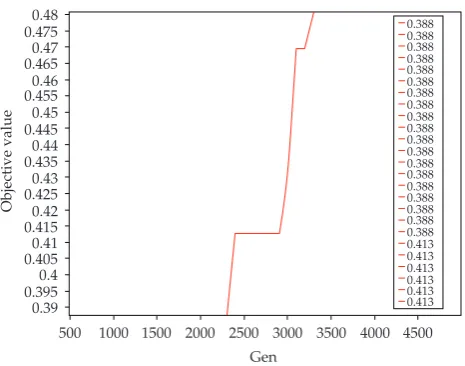
For problems 5.8 and 5.9, we can solve them by using the rough simulation-based genetic algorithm. Let the number of chromosomes in every generation be 20, the probability of crossover 0.85 and of mutation 0.1. Then after a run of a genetic algorithm computer program 5000 generations, we get the optimal solution x, yT 0.178,0.251,0.571,0.349,0.479,0.172Tand the objective value as shown inFigure 1.
6. Conclusion
In this paper, we have considered a class of two-person zero-sum matrix games with rough payoffs. Firstly, we have given the definition of the game with rough payoffs and then proposed two kinds of equilibrium strategy. Secondly, we have discussed wether the two-person zero-sum matrix games with rough payoffs exist the equilibrium strategy. Thirdly, we proposed the genetic algorithm to solve the most complicated case. It is an available and efficient way to search the equilibrium of this kind of games with rough payoffs. Lastly, the numerical example illustrated well our research methods. We have only considered one kind of games with uncertain payoffs. Of course, there are many other games with uncertain payoffs which need to be researched.
Acknowledgments
This research has been supported by the Key Program of NSFCGrant no. 70831005and the National Science Foundation for Distinguished Young Scholars, ChinaGrant no. 70425005.
References
1 J. von Neumann and O. Morgenstern, Theory of Games and Economic Behavior, John Wiley & Sons, New York, NY, USA, 1947.
3 G. Owena and G. H. McCormick, “Finding a moving fugitive. A game theoretic representation of search,” Computers & Operations Research, vol. 35, pp. 1994–1962, 2008.
4 J. Berg and A. Engel, “Matrix games, mixed strategies, and statistical mechanics,” Physical Review Letters, vol. 81, pp. 4999–5002, 1998.
5 L. Ein-Dor and L. Kanter, “Matrix games with nonuniform payoffdistributions,” Physica A, vol. 302, no. 1–4, pp. 80–88, 2001.
6 S. Takahashi, “The number of pure Nash equilibria in a random game with nondecreasing best responses,” Games and Economic Behavior, vol. 63, no. 1, pp. 328–340, 2008.
7 J. Xu, “Zero sum two-person game with grey Number payoffMatrix in Linear Programming,” The Journal of Grey System, vol. 10, no. 3, pp. 225–233, 1998.
8 J. C. Harsanyi, “Games with incomplete information played by “Bayesian ´Y players. I. The basic model,” Management Science, vol. 14, pp. 159–182, 1967.
9 A. K. Dhingra, S. S. Rao, et al., “A cooperative fuzzy game theoretic approach to multiple objective design optimization,” European Journal of Operational Research, vol. 83, pp. 547–567, 1995.
10 R. Espin, E. Fernandez, G. Mazcorro, et al., “A fuzzy approach to cooperative n-person games,” European Journal of Operational Research, vol. 176, no. 3, pp. 1735–1751, 2007.
11 Z. Pawlak, Rough Sets, Kluwer Academic Publishers, Dordrecht, The Netherlands, 1991.
12 Z. Pawlak, “Rough sets,” International Journal of Computer and Information Sciences, vol. 11, no. 5, pp. 341–356, 1982.
13 H. Nurmi, J. Kacprzyk, and M. Fedrizzi, “Probabilistic, fuzzy and rough concepts in social choice,” European Journal of Operational Research, vol. 95, pp. 264–277, 1996.
14 B. Liu, Theory and Practice of Uncertain Programming, Physica, New York, NY, USA, 2002.
15 L. Campos, “Fuzzy linear programming models to solve fuzzy matrix games,” Fuzzy Sets and Systems, vol. 32, no. 3, pp. 275–289, 1989.
16 I. Nishizaki and M. Sakawa, Fuzzy and multiobjective games for conflict resolution, vol. 64 of Studies in Fuzziness and Soft Computing, Physica, Heidelberg, Germany, 2001.
17 T. Maeda, “Characterization of the equilibrium strategy of the bimatrix game with fuzzy payoff,” Journal of Mathematical Analysis and Applications, vol. 251, no. 2, pp. 885–896, 2000.
18 R. P. Luce and H. Raiffa, Games and Decisions, John Wiley & Sons, New York, NY, USA, 1957.
19 T. Parthasarathy and T. E. S. Raghavan, Some Topics in Two-Person Games, American Elsevier Publishing, New York, NY, USA, 1971.
20 R. Slowinski, D. Vanderpooten, et al., “A generalized definition of rough approximations based on similarity,” IEEE Transactions on Knowledge and Data Engineering, vol. 12, no. 2, pp. 331–336, 2000. 21 E. Polak, “A survey of methods of feasible directions for the solution of optimal control problems,”
IEEE Transactions on Automatic Control, vol. 17, no. 5, pp. 591–596, 1972.
22 G. G. L. Meyer and L. J. Podrazik, “A parallel frank-wolfe/gradient projection mthod for optimal control,” in Proceedings of the 30th Conterence on Decision and Contro, pp. 1705–1710, Brighton, UK, 1991.
23 M. Gen and R. Cheng, Gennetic Algorithms and Engineering Optimization, John Wiley & Sons, New York, NY, USA, 2000.