DOI 10.3349/ymj.2008.49.4.647
Purpose: The aim of this study is to examine the effect Klorhex and Fittydent, which are used as cleaning agents on the adhesion ofCandidaon the surfaces of acrylic denture and palatal mucosa. In addition, ability of yeasts to adhere to acrylic strips was evaluated after applying these agents in vitro. Materials and Methods: Each group of 15 patients cleaned their dentures with either Klorhex or with Fittydent. The control group cleaned their dentures with water. Results: It was found that 62.2% of the patients had colonies of Candida species on their palatal mucosa which was reduced to 51.1% after using these cleaning agents. The colonization rate with Candida spp on their dentures was reduces from 82.2% to 68.8% using these cleaning agents. The mean adhesion value of theCandidastrains isolated from the acrylic strips were found to be 75 cell/strip prior to applying the Klorhex and Fittydent and 37.5 cell/strip and 15 cell/strip after applying these agents, respectively. Conclusion:These results showed that Klorhex and Fittydent have a certain preventive effect on the colonization rate ofCandida spp on the surface of these dentures, the palatal mucosa, as well as on the acrylic strips in vitro.
Key Words: Candida, colonization, adhesion, acrylic
INTRODUCTION
Candidiosis induced by Candida albicans is the most common fungal infection of the oral cavity in humans. The predisposing factors to infections with Candida species can be divided into two major categories, systemic factors and local
fac-tors. Some of the systemic factors include age, endocrine diseases, systemic steroids and antibio-tics, concurrent infections and deficiency states. Local factors include reduced salivation, smoking, topical antibiotics or steroid treatment, coexistent oral mucosal diseases and specifically the wearing of dentures.1,2 There is reliable evidence showing that unclean dentures and insufficient hygiene care are significant predisposing factors.1 Candida associated denture stomatitis is a common infec-tion observed in elderly denture wearers because the acrylic denture fitting surfaces act as a reser-voir for infection. Candida species are frequently isolated both from acrylic denture surfaces and from the palatal mucosa.2 The tissue surfaces of the dentures usually show microporosites, which harbor the microorganisms that are difficult to remove by mechanical or chemical cleaning. In vitro studies indicate that the microbial contamination of denture acrylic resin occurs quite rapidly and the yeast cells adhere strongly to denture base materials.1,3-6
It is well known that the removal of denture plaque is essential for maintaining the health of oral soft tissue.7,8 Studies comparing the efficacy of the proposed denture cleansing techniques, either mechanical or chemical, used a variety of methods to evaluate the control of plaque. Among elderly patients the most popular method for removing denture plaque is brushing with an abrasive paste and water. However, effective plaque removal requires a degree of manual dexterity that is often lacking particularly among elderly individuals.9-11 Therefore, chemical
clean-Effectiveness of Different Cleaning Agents against the
Colonization of
Candida
spp and the
in Vitro
Detection of the
Adherence of These Yeast Cells to Denture Acrylic Surfaces
A. Dilek Nalbant,1 Ayse Kalkanci,2 Banu Filiz,1 and Semra Kustimur2
1Department of Prosthetic Dentistry, Faculty of Dentistry, University of Gazi, Ankara; 2Department of Microbiology, Gazi
University Faculty of Medicine, Ankara, Turkey.
Received December 1, 2003 Accepted June 5, 2004
ing with immersion denture cleaners is suggested as the first choice for plaque control in these patients.11,12 Candidal infections have been succes-sfully treated with chlorhexidine gluconate be-cause it is an effective oral disinfectant.13,14 Fitty-dent is a chemical cleaning agent that is also used to remove denture plaque.9
Several studies have been performed to inves-tigate the adhesion of Candida albicans on acrylic surfaces. However, many of them are in vitro studies, which have proposed complex and dif-ficult techniques. Researchers have problems in quantifying the candidal adherence to surfaces due to the co-aggregation of adhered yeasts and to the laborious, time-consuming removal meth-ods.3,5,14 The aim of this study was to examine the adherence of Candida on the surfaces of acrylic denture prosthetic materials and the palatal mu-cosa in a group of patients and examine the in vitro adhesion abilities of these yeasts to acrylic strips. This study describes a simple microscopic examination, which was presented previously.15-17 In addition, the difference in the ability of yeast cells to adhere to acrylic surfaces were evaluated before and after using cleaning agents.
MATERIALS AND METHODS
Study population
The study protocol was reviewed and approved by the Faculty of Medicine, Gazi University ethics committee. Forty-five complete denture wearers attending the Department of Prosthetic Dentistry of Gazi University, Faculty of Dentistry were enrolled in the study. The group consisted of 19 males and 26 females aged between 43 - 91 with a mean age of 63.7. All the subjects underwent a routine dental check up and none of them com-plained of any mucosal lesions. The exclusion criteria were; 1) subjects taking antifungal agents or antiseptic mouthwashes, 2) subjects taking medication known to predispose them to oral candidiosis, such as antibiotics or steroid therapy, 3) subjects with a medical history of any disease or medical condition that predisposed them to oral candidiosis or promoted subjects oral carriage of Candida species.
The patients were randomly divided into three groups wearing complete dentures. Each group of 15 patients had their dentures cleaned either with Klorhex (0.2% of chlorhexidine solution-belongs to Bisbiquanides groupe) (Drogsan Doğa kaynakları İlac Hammaddeleri Sanayi ve Tic. A. Ş., Ankara, Turkey) or with Fittydent (Sodium perborate, sodium bicarbonate) (Mag. Hoeveler and Co. Gmbh, Geinberg, Germany). The control group cleaned their dentures with water. For the microbiological examinations, the posterior mid-palatal part of the mid-palatal mucosa and the cor-responding area of the fitting denture base were swabbed with sterile cotton swabs. These swabs were then transferred to a Sabouraud dextrose broth in the Department of Prosthetic Dentistry. The specimens were obtained from the same part of the denture and palatal mucosa before and seven days after using the cleaning agents. In the first group, the dentures were soaked in a 200 mL Klorhex bath, while the dentures in the second group were soaked in a 200 mL solution of distilled water with one tablet of effervescent Fittydent. The dentures in the control group were washed overnight in 200 mL of water.
Culture and the identification
Cotton swabs were streaked onto the Sabouraud dextrose agar (SDA) plates in the Research Lab-oratory of Gazi University Faculty of Medicine, Department of Microbiology. The plates were incubated at 37 for 48 hours. The yeast colonies were identified using the identification criteria such as germ tube production, the fermentation of carbohydrates in ID32 C strips (bioMerieux, Marcy l'Etoile, France). The yeast cultures were stored in 0.9% NaCl at - 20 until they were tested.
Preperation of yeast suspensions
phosphate buffered saline (PBS, pH 7.2). A final yeast suspension of approximately 4 × 10⁷ yeast cells/mL was prepared by adding 100 Lμ of the deposit to 10 mL of PBS. The number of the yeast cells per mL in all the experiments was counted spectrophotometrically.
Preperation of acrylic strips
Twenty acrylic resin disks (20 × 1 mm) were prepared. Each disk was cut from a pink base-plate wax sheet. Twenty wax disks were invested in a denture flask using a standard processing technique.18,19 The wax was eliminated and heat-curing acrylic resin (Meliodent. Heraus Kulzer, Germany) was packed into the mold cavity. The denture acrylic poly (methyl-methacrylate) pow-der and the monomer liquid were mixed ac-cording to the manufacturer's recomendations. All the disks were polymerized with the same batch of acrylic resin using a standard heat-curing resin cycle (10 hours at 90 ). The disks were polished after they had been deflasked and prepared. They were sterilized by ethylene oxide and aired for 3 days in order to remove all the ethylene oxide.
Adhesion assay
Using strict aseptic techniques, the acrylic strips were placed in tubes containing 4 × 10⁷ yeast cells/mL of PBS. The tubes were placed in a shaker incubator for 3 hours at 37 with gentle agitation. The strips were then washed in sterile distilled water, air-dried, and stained using a gram stain. After drying at room temperature the strips were mounted on glass slides and the adherent yeasts were quantified using optical microscopy at a × 40 magnification. Four fields were randomly counted in each strip, and all the experiments were repeated on three separate occasions with duplicate determinations on each occasion.
The adhesion of the Candida strains isolated from the denture surfaces to the acrylic strips was examined. The adhesion assay was also repeated for the acrylic strips with the adhered Candida strains isolated from the denture surfaces, after the strips were incubated in 2 mL of a Klorhex solution at a concentration of 0.2% and a Fittydent
solution at room temperature overnight.
Statistical analysis
The Friedman non-parametric two-way analysis of the variance was used to compare the levels of theCandida species at the palatal mucosa and the denture surfaces before and after using the cleaning agents.20The effect of each cleaning agent on the adhesion of the yeast cells to the denture acrylic was analyzed statistically with a Wilcoxon signed rank test.
RESULTS
The prevalence of Candida species on the sur-faces of the dentures and palatal mucosa before using the cleaning agents and the effect of these agents on this colonization are documented in Table 1. The Candida species were isolated from the palatal mucosa of 28 patients (62.2%), and from the denture surfaces of 37 patients (82.2%). The Candida species were isolated both from the palatal mucosa and denture surfaces of 16 patients (36.3%). The detection of more than 10 colonies of Candida species on the agar plate was evaluated as a "positive" culture result. The distribution of the 28 Candida species isolated from the palatal mucosa were as follows; 25 Candida albicans, 2 Candidaglabrata, 1 C. albicans plus C. glabrata. The distribution of the 37 Candida species isolated from the denture surfaces were as follows: 35 C. albicans, 1 C. tropicalis, 1 C. glabrata.
It was found that 62.2% of the patients had Candida spp colonies on their palatal mucosa, which was reduced to 51.1% after using the cleaning agents. The cleaning agents reduced the colonization rate ofCandida spp on their dentures from 82.2% to 68.8%. The number of the yeast colonies was reduced in nine (60%) of the patients using Klorhex, while they were reduced in seven (46.6%) patients using Fittydent. On the other hand, the colonization rates were unchanged in the control group.
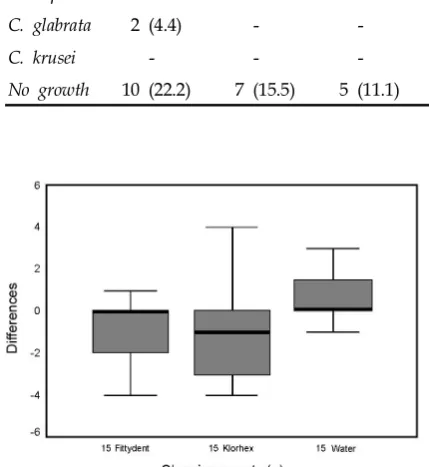
Friedman test results, significant differences in the colonization of Candida species were found between the water and Klorhex on the palatal mucosa as well as between water and Fittydent for the denture surface (Figs. 1 and 2).
The adhesion ability of the Candida strains were evaluated using Candida spp isolated from the denture surfaces. The value of the adhesion of Candidaspecies is shown in Table 2. After soaking the dentures in Fittydent overnight, the adhesion scores changed for all of the strains tested. No
[image:4.595.59.538.133.302.2]adhesive cells were observed after applying the Fittydent on five of the acrylic strips. The mean adhesion value of the Candida strains isolated from the denture surfaces were calculated as 15 cells/strip after applying the Fittydent, while it was 75 cells/strip before application. The mean adhesion value of Candida strains was 37.5 cells/ strip after applying the Klorhex. According to the Wilcoxon signed rank test results, the adherence of the Candida species in the Klorhex and Fittydent groups was similar (Table 3).
Table 1. Growth of the Different Yeast Species Cultured from the Palatal Mucosa and the Corresponding Denture
Surfaces before and after Using the Cleaning Agents
Before After
Palate
No. of carriers (%) No. of carriers (%)Denture No. of carriers (%)Palate No. of carriers (%)Denture
Test group (n = 30)
Control group (n = 15)
Test group (n = 30)
Control group (n = 15)
Test group (n = 30)
Control group (n = 15)
Test group (n = 30)
Control group (n = 15)
C. albicans 18 (40) 8 (17.8) 25 (55.5) 10 (22.2) 9 (20) 11 (24.4) 16 (35.5) 11 (24.4)
C. tropicalis - - - 1 (2.2) - - - 1 (2.2)
C. glabrata 2 (4.4) - - 1 (2.2) 3 (6.6) - 1 (2.2) 1 (2.2)
C. krusei - - - 1 (2.2)
[image:4.595.56.271.249.483.2]-No growth 10 (22.2) 7 (15.5) 5 (11.1) 3 (6.6) 18 (40) 4 (8.9) 12 (26.7) 3 (6.6)
Fig. 1.Boxplot of the colonization value of the Candida species on the palatal mucosa before and after using the cleaning agents. According to the Non parametric Friedman two-way analysis of variance; Water (i), Klorhex (j); Ri-Rj =12; critical value > 10.641;
[image:4.595.309.541.301.481.2]signifi-cance. There was no significant difference between the water and Fittydent; Fittydent and Klorhex.
Fig. 2.Boxplot of the colonization value of Candida species on the denture surfaces before and after using the cleaning agents. According to the Non parametric Friedman two-way analysis of variance; Water (i), Fittydent (j); Ri-Rj =
DISCUSSION
The prevalence of oral candidal carriage is varies widely in different populations. Candida species have been isolated from the oral cavity in 24 - 60% of the general population.2,21-25Yeast colo-nization of the mucosa, gingiva, tongue-buccal mucosa, the surface of orthodontic brackets and dentures has been investigated in different populations in Turkey.26-29 It is well known that a significant proportion of elderly denture wearers suffer from Candida-associated denture
stomati-tis.18,30,31 The colonization ofCandida species on the oral mucosa and the surfaces of the denture materials may be the first step of an infection.3,21 This study found 62.2% of the patients were colonized with Candida species on their palatal mucosa, while 82.2% of them were colonized on their denture surfaces. Both the palatal mucosa and denture surfaces were colonized in 36.3% of the patients.
[image:5.595.64.538.120.323.2]The results in all these previous reports corre-late with the results in the present study. There-fore, the importance of the oral carriage of the
Table 2. Selected Candida Strains and Their Adherence Values to the Acrylic Strips
Species Adhesion scores
Before After fittydent After klorhex
C. albicans ++ NA +
C. albicans ++++ ++ ++
C. albicans +++ NA ++
C. albicans ++ + +
C. albicans ++++ + ++
C. albicans ++ NA +
C. albicans ++ NA +
C. albicans ++++ NA +
C. albicans ++++ + ++
C. glabrata +++ + ++
NA, no adhesion; +, 1 - 25 cells; ++, 25 - 50 cells; +++, 50 - 75 cells; ++++, 75 - 100 cells.
Table 3.Mean Adhesion Values of the Selected Candida Strains before and after Using Klorhex and Fittydent and
the Results of the Wilcoxon Signed Rank Test
Mean adhesion values Wilcoxon signed rank test K1
K2
75 cells/strip 37.5 cells/strip
K1 K2
-2.842a
0.004 (K1 K2) (F1 F2)
-1.897a
0.058 F1
F2
75 cells/strip 15 cells/strip
F1 F2
-2.848a
0.004
aBased on negative ranges.
*Significant at level α= 0.05.
Mean adherence values of selectedCandidastrains isolated from denture surfaces before using Klorhex, K1; after using Klorhex, K2.
Mean adherence values of selectedCandidastrains isolated from denture surfaces before using Fittydent, F1; after using Fittydent,
[image:5.595.64.535.391.499.2]yeasts needs to be discussed in all populations. In this study, Candidaalbicans was the most common species isolated from the oral cavity (Table 1). C. tropicalis, C. galabrata, C. kruseiwere also isolated, as reported in previous studies.2,18,23-25,30
Mechanical methods and some chemical agents have been used to eliminate denture plaque.7,32 Chlorhexidine is one of these chemical agents with a powerful antimicrobial effect against most oral bacteria, and can be used on prescription both as a mouthrinse and denture soak.33,34 Fittydent is another chemical that is used as a cleaning agent for prosthesis.9
The results of this study showed that both Klorhex and Fittydent have a certain preventive effect on the colonization rate of Candida species on the surface of the dentures and on the palatal mucosa. Candida spp were isolated from the palatal mucosa as 51.1% after using these cleaning agents. The number of colonies on the surface of dentures was also affected, and was reduced by up to 68.8% after using both with Klorhex or Fittydent. In contrast, the colonization rates were unchanged in the control group. A statistically significant difference was found between the water and Klorhex application on the surface of palatal mucosa, and the water and Fittydent application on the surface of dentures (Figs. 1 and 2).
In vivoand in vitrostudies have shown clorhexi-dine to be effective against fungi.13,35 In a clinical study, a denture cleaner showed a 51% reduction in plaque levels at day 2 and 42% at day 14 when compared with water.7 Dills et al.32 reported that brushing was not as effective as effervescent soaking. Kulak et al.9showed that sodium hypo-chloride and Savlon are significantly more effec-tive in the decontamination of denture surfaces than Fittydent or other cleaners .
In this study Klorhex and Fittydent were also tested for their ability to inhibit candidal adhesion to acrylic surfaces in vitro. These results indicate that the exposure of denture acrylic to Klorhex and Fittydent effectively inhibited the adherence of all ten C. albicans strains to acrylic in vitro. However, of these two agents, Fittydent appears to be more effective in modulating the adhesion to denture acrylic, as it significantly inhibited the adhesion of almost all the Candidaisolates.
None-theless, although not statistically significant, both agents induced a substantial inhibition of the adhesion of the isolates.
The adhesion of Candida spp to the epithelial cells and to the acrylic surfaces has been ex-amined in different studies. Panagoda et al.36 used an image analysis system (IBAS 2000; Kontron, Berlin, Germany). This semi-automated system allows the rapid quantification of adherent yeasts by scanning only the surface area occupied with adherent cells.37 Waters et al.38 used another in vitro model to compare the adherence of several C. albicans strains to denture base materials and experimental soft lining materials. They used acri-dine orange to examine the adhesion of the cells microscopically. This method is similar to one used in this study, as it requires a fluorescent microscope, and is more suitable, cheaper and practical for scanning.
No additional factors such as galactose, sucrose were used in this adhesion assay. Saliva or serum was not used as augmentative factors for the adhesion ability of the yeast cells. The solution used in the adhesion assay consisted of phosphate buffered saline only. A simple environment was preferred because the aim was to evaluate this virulence factor independently from the host fac-tors. Moreover, several studies have been perfor-med to examine the adhesion of C. albicans on acrylic surfaces or epithelial cells in the presence of bacteria, saliva and serum or carbohydr-ates.5,6,14,39,40
The effect of antiseptic solutions and denture cleaners on the adhesion of yeast cells to acrylic surfaces has been investigated in previous studies.6,19 Mc Courtie et al.14reported that a treat-ment of acrylic with chlorhexidine reduced the adherence by 19 - 86%. In another study, the same researchers found that adherence was reduced to 20% after a pretreatment with chlorhexidine.41 In this study, the adhesion decreased from an average of 75 cells/strip to 37.5 cells/strip after Klorhex and 15 cells/strip after Fittydent.
REFERENCES
1. Budtz-Jörgensen E. Etiology, pathogenesis, therapy, and prophylaxis of oral yeast infections. Acta Odontol Scand 1990;48:61-9.
2. Zegarelli DJ. Fungal infections of the oral cavity. Otolaryngol Clin North Am 1993;26:1069-89.
3. Ellepola AN, Samaranayake LP. Adhesion of oral Candida albicans isolates to denture acrylic following limited exposure to antifungal agents. Arch Oral Biol 1998;43:999-1007.
4. Nikawa H, Nishimura H, Hamada T, Kumagai H, Samaranayake LP. Effects of dietary sugars and, saliva and serum on Candida bioflim formation on acrylic surfaces. Mycopathologia 1997;139:87-91.
5. Samaranayake LP, MacFarlane TW. Anin-vitrostudy of the adherence of Candida albicans to acrylic surfaces. Arch Oral Biol 1980;25:603-9.
6. Samaranayake LP, McCourtie J, MacFarlaneTW. Factors affecting the in-vitro adherence of Candida albicans to acrylic surfaces. Arch Oral Biol 1980;25:611-5. 7. Sheen SR, Harrison A. Assessment of plaque
preven-tion on dentures using an experimental cleanser. J Prosthet Dent 2000;84:594-601.
8. Nikawa H, Hamada T, Yamamoto T. Denture plaque-past and recent concerns. J Dent 1998;26:299-304. 9. Kulak Y, Arikan A, Albak S, Okar I, Kazazoğlu E.
Scanning electron microscopic examination of different cleaners: surface contaminant removal from dentures. J Oral Rehabil 1997;24:209-15.
10. Kulak-Ozkan Y, Kazazoglu E, Arikan A. Oral hygiene habits, denture cleanliness, presence of yeasts and sto-matitis in elderly people. J Oral Rehabil 2002;29:300-4. 11. Hoad-Reddick G, Grant AA, Griffiths CS. Investigation into the cleanliness of dentures in an elderly popu-lation. J Prosthet Dent 1990;64:48-52.
12. Nikawa H, Hamada T, Yamashiro H, Kumagai H. A review of in vitroandin vivo methods to evaluate the efficacy of denture cleansers. Int J Prosthodont 1999;12: 153-9.
13. Persson RE, Truelove EL, LeResche L, Robinovitch MR. Therapeutic effects of daily or weekly chlorhexidine rinsing on oral health of a geriatric population. Oral Surg Oral Med Oral Pathol 1991;72:184-91.
14. McCourtie J, MacFarlane TW, Samaranayake LP. Effect of saliva and serum on the adherence of Candida species to chlorhexidine-treated denture acrylic. J Med Microbiol 1986;21:209-13.
15. Kaabachi O, Jemli B, Barguellil F, Boudabous A, Gargouri S, Amor A. Comparative study of adherence of fiveCandidaspecies to polyvinyl chloride. Ann Biol Clin (Paris) 2001;59:271-6.
16. Costa Pires MF, Corrêa B, Gambale W, Paula CR. Experimenal model of Candida albicans (serotypes A and B) adheremce in vitro. Braz J Microbiol 2001;32: 163-9.
17. Kimura LH, Pearsall NN. Adherence of Candida al-bicans to human buccal epithelial cells. Infect Immun
1978;21:64-8.
18. Nikawa H, Nishimura H, Hamada T, Makihira S, Samaranayake LP. Relationship between thigmotro-pism and Candida biofilm formation in vitro. Myco-pathologia 1999;144:125-9.
19. Spiechowicz E, Santarpia RP 3rd, Pollock JJ, Renner RP. In vitrostudy on the inhibiting effect of different agents on the growth of Candida albicans on acrylic resin surfaces. Quintessence Int 1990;21:35-40.
20. Some methods based on ranks. In: Conover WJ, editor. Practical Nonparametric Statistics. New York: John Wiley & Sons; 1980. p.213-343.
21. Arendorf TM, Walker DM. The prevalence and intra-oral distribution ofCandidaalbicans in man. Arch Oral Biol 1980;25:1-10.
22. Darwazeh AM, Al-Dosari A, Al-Bagieh NH. Oral Candidaand nasal Aspergillus flora in a group of Saudi healthy dentate subjects. Int Dent J 2002;52:273-7. 23. Kuc IM, Samaranayake LP, van Heyst EN. Oral health
and microflora in an institutionalised elderly popu-lation in Canada. Int Dent J 1999;49:33-40.
24. Sedgley CM, Samaranayake LP. The oral prevalence of aerobic and facultatively anaerobic gram-negative rods and yeasts in Hong Kong Chinese. Arch Oral Biol 1994; 39:459-66.
25. Darwazeh AM, Al-Refai S, Al-Mojaiwel S. Isolation of Candida species from the oral cavity and fingertips of complete denture wearers. J Prosthet Dent 2001;86:420-3.
26. Sayiner, A, Ozbakkaloglu B, Hilmioglu S, Inci R. Yeast colonization of mucosal linings in the elderly. Turkish J Infect 1997;11:137-40.
27. Aytimur M, Surucuoglu S, Hilmioglu S, Aydemir S, Burhanoglu D, Saydam C. Investigation of oralCandida colonization in the elderly wearing complete denture. Turkish J Infect 1997;11:141-3.
28. Alpoz AR, Hilmioglu S, Tasbakan MI. Oral carriage of Candida and association between Candida and dfs, DMFs scores in a group of 7-12 year-old children. Turkish J Infect 1999;13;169-72.
29. Gökdal I, Kalkanci A, Paçal G, Altuğ Z. Candida colonization on the surface of orthodontic brackets and the adhesion of these strains to buccal epithelial cells. Mikrobiyol Bul 2002;36:65-9.
30. Pires FR, Santos EB, Bonan PR, De Almeida OP, Lopes MA. Denture stomatitis and salivaryCandidain Brazilian edentulous patients. J Oral Rehabil 2002;29:1115-9. 31. Budtz-Jorgensen E, Bertram U. Denture stomatitis I.
The etiology in relation to trauma and infection. Acta Odontol Scand 1970;28:71-92.
32. Dills SS, Olshan AM, Goldner S, Brogdon C. Com-parison of the antimicrobial capability of an abrasive paste and chemical-soak denture cleansers. J Prosthet Dent 1988;60:467-70.
33. Ellepola AN, Samaranayake LP. Adjunctive use of chlorhexidine in oral candidoses: a review. Oral Dis 2001;7:11-7.
Asses-sment of antimicrobial treatment of denture stomatitis using an in vivo replica model system: therapeutic efficacy of an oral rinse. J Prosthet Dent 1992;67:72-7. 35. Kulak Y, Arikan A, Delibalta N. Comparison of three different treatment methods for generalized denture stomatitis. J Prosthet Dent 1994;72:283-8.
36. Panagoda GJ, Samaranayake LP. A new, semi-auto-mated technique for quantification of Candida adher-ence to denture acrylic surfaces. Mycoses 1999;42:265-7. 37. Panagoda GJ, Ellepola AN, Samaranayake LP. Ad-hesion ofCandidaparapsilosis to epithelial and acrylic surfaces correlates with cell surface hydrophobicity. Mycoses 2001;44:29-35.
38. Waters MG, Williams DW, Jagger RG, Lewis MA. Adherence ofCandidaalbicans to experimental denture
soft lining materials. J Prosthet Dent 1997;77:306-12. 39. Millsap KW, Bos R, van der Mei HC, Busscher HJ.
Adhesion and surface-aggregation of Candida albicans from saliva on acrylic surfaces with adhering bacteria as studies in a parallel plate flow chamber. Antonie Leeuwenhoek 1999;75:351-9.
40. Nikawa H, Nishimura H, Makihira S, Hamada T, Sadamori S, Samaranayake LP. Effect of serum concen-tration on Candida biofilm formation on acrylic sur-faces. Mycoses 2000;43:139-43.