A Monthly Double-Blind Peer Reviewed Refereed Open Access International e-Journal - Included in the International Serial Directories.
GE-International Journal of Management Research (GE-IJMR) ISSN: (2321-1709)
230 | P a g e
GE-International Journal of Management Research
Vol. 4, Issue 1, Jan 2016 IF- 4.316 ISSN: (2321-1709)© Associated Asia Research Foundation (AARF)
Website: www.aarf.asia Email : [email protected] , [email protected]“SOURCE SEGREGATION”: A RESPONSIBLE STEP TOWARDS
EFFECTIVE SOLID WASTE MANAGEMENT BY RESTAURANTS OF
PUNE CITY, INDIA.
Aparna Deshpande1, Prof.Dr.Seema Zagade2 1
Research Scholar, (Hotel Management), Savitribai Phule Pune University,Pune Maharashtra, India.
2
Chairman, (Board of Studies Hotel Management) Savitribai Phule Pune University,Pune, Maharashtra, India. Professor, Maharashtra State Institute of Hotel Management & catering
Technology-Pune.
ABSTRACT
With the increase in globalization and industrialization; Pune has seen a tremendous growth
as one of the metropolitan city. Apart from Its nomenclature as „Oxford of East‟, Pune city
has also gained popularity as Silicon city and Automobile hub resulting in heavy influx of
population. This has resulted into increase in generation of solid waste, ranging from
1200-1400 metric tons per day. This situation is alarming as this may increase in future and can
prove to be uncontrollable. Remedial measures are been taken up by The Municipal
Corporation of Pune city to cope up with this problem, but the efforts are proving to be
insufficient.
To cater to the eating out habits of the growing population Pune city has experienced
mushrooming up of various Food & Beverage outlets ranging from star hotels; Fine dine
restaurants, Standalone restaurants, Fast Food outlets to small joints. It is noticed that out
of total waste generated, approximately 25% is being contributed by hotels, restaurants and
commercial organizations. The waste generated is mostly in the form of packaging material,
paper, metal, glass, plastic and food waste.etc which can be segregated in various forms like-
Dry- Wet, Degradable- Biodegradable, Recyclables, Reusable waste etc. All these waste is
dumped in places like Urali Devachi and Phursungi which is 20 kms from main Pune city.
This mixed waste (consisting of degradable and non degradable waste) if dumped on landfills
A Monthly Double-Blind Peer Reviewed Refereed Open Access International e-Journal - Included in the International Serial Directories.
GE-International Journal of Management Research (GE-IJMR) ISSN: (2321-1709)
231 | P a g e
due to decomposition of the waste can be hazardous to public health. This unscientific
dumping of solid waste is creating lot of health issue for local residents of Urali Devachi and
Phursungi.
Rather than considering solid waste as garbage, if it is segregated and processed
scientifically can prove to be resourceful. Waste if segregated at source will help in assuring
not only public health but will also reduce cost incurred in disposing and waste hauling fees.
Properly segregated waste can be either reused, recycled or composted can fetch good
monetary returns. Segregation at the source is one of the important steps in solid waste
management system as it helps in categorizing the waste systematically in major categories
and disposal will be easier and safer.
Dreaming to becoming India‟s Smart City and Clean city it is the responsibility of hospitality
industry of Pune city to be the major contributor in this mission. Restaurants of Pune city is
the integral part of the life of Pune‟s major population, so it is important to know their
contribution in this mission. The purpose of this study is to find out the current situation in
Pune city‟s Standalone and Fine Dine restaurants about their involvement in source
segregation of solid waste.
KEYWORDS: Source Segregation, Waste Audit, Solid Waste Management, Waste Mapping, Waste Stream
INTRODUCTION
Solid waste disposal is a big challenge faced by many developing countries in the world.
With growing population and globalization this challenge is getting more and more difficult
and calls for urgent attention of not only the authorities but also people in general. The only
solution to this problem is to have proper solid waste management practices implemented and
followed by the stakeholders.
With growing population, Indian hospitality industry is also spreading its wings, not only the
hotels but various Food And Beverage outlets like: Standalone Restaurants, Fine Dine
Restaurants, Fast Foods Outlets, Pubs, Café etc are also growing with leap and bound. With
this growth the problem of solid waste disposal is also proving headache for the industry.
Various researches done on this issue shows that many Indian cities today are facing solid
waste disposal problem and every city is trying their best to adapt to the best solid waste
A Monthly Double-Blind Peer Reviewed Refereed Open Access International e-Journal - Included in the International Serial Directories.
GE-International Journal of Management Research (GE-IJMR) ISSN: (2321-1709)
232 | P a g e
Pune, once crowned to be the „Pensioner‟s Paradise‟ with the increase in globalization and
industrialization; it has evolved as one of the metropolitan city. Apart from Its nomenclature
as „Oxford of East‟, city has also gained popularity as Silicon city and Automobile hub
resulting in heavy influx of population. This growth is being witnessed in last decade.
Increase in population has created problem of solid waste disposal. Currently Pune is
generating around 1200-1300 tons of solid waste in a day, which is disposed off 20 kms away
in village Urali Devachi. This landfill near the city is becoming a health hazards for the
residents of the village. There is lot of unrest amongst the residents of Urali Devchi due this
unscientific disposal of solid waste on landfill which is polluting the environment in that area.
To cater to the eating out habits of this generation has paved a way for mushrooming up of
various Food & Beverage outlets ranging from Star Hotels; Fine Dine Restaurants,
Standalone Restaurants, Fast Food outlets to small joints. As per study done it is revealed
that restaurants in Pune city generates around 435.20 tons of waste each day which is around
16% of total waste generated in a day by city [1]. The waste generated by Pune city is in the
form of Dry and Wet waste amounting to 50-50% each. It is observed the percentage of wet
waste is more prominent in residential and commercials areas of Pune such as hotels and food
industry. This waste is mostly in the form of packaging material, paper, metal, glass, plastic
and food waste. Organic waste contributes for about 24% of total generated waste [2], which
mostly consist of food waste like cooked, uncooked scrapes, leftover, spoiled food etc.
Lots of researchers are working towards the solution for this problem. PMC is also taking
extra efforts to implement solid waste management practices in the city. However these
efforts are not sufficient to eradicate the major issue of waste disposal in scient ific way. This
involves proper collection, storage, segregation, transportation, processing and disposal of
solid waste.
Segregation of waste at source is the one of the major steps towards effective solid waste
management activity. Systematic waste segregation will help to segregate the waste like
degradable- non degradable, wet waste –dry waste, recyclables- non recyclables, reusable-
non reusable etc which can further be processed depending on its nature and thus help reduce
landfills being dumped with mixed waste.
Integrated approach in solid waste management, by Pune Municipal Corporation can be a
fruitful effort towards reducing this issue, as city‟s population is estimated to grow by 2025
and, so do the estimated rise in generation of solid waste to approximately 3500 tons per day
A Monthly Double-Blind Peer Reviewed Refereed Open Access International e-Journal - Included in the International Serial Directories.
GE-International Journal of Management Research (GE-IJMR) ISSN: (2321-1709)
233 | P a g e OBJECTIVE OF THE STUDY
The main aim of the researcher is to get acquainted with the waste segregation practices
adopted and implemented by the Standalone and Fine Dine Restaurants of Pune city.
The objective of the study is to:
Identify the current practices of waste segregation at source followed by the
Standalone and Fine Dine Restaurants of Pune city.
To explore the acceptance of the Waste Segregation at source practices by the
employees.
To understand the views of the Standalone and Fine Dine Restaurant owner‟s in terms
of waste segregation at source concept.
HYPOTHESIS
H1: Waste segregation at source is highly recommended by the Standalone and Fine
Dine Restaurants.
H0: Many of the Standalone and Fine Dine Restaurants feels that segregating waste is
not a crucial stage in waste management system.
H1: Employees are ignorant about the benefits of the waste segregation at source due
to lack of proper training.
H0: Training is not important to generate awareness amongst the employees for
understanding the benefits of waste segregation.
H1: Standalone and Fine Dine Restaurant owners realize that waste segregation at
source is an important step in Waste Management System.
H0: As per many Standalone and Fine Dine Restaurant owners waste segregation at
source is an insignificant part of Waste Management system.
REVIEW OF LITERATURE
Managing Solid waste is becoming a major challenge for all the developing countries in the
world. Hospitality industry, one of the major contributors in world‟s economy is also on radar
of being one of the contributors in waste generation. The literature reviewed reflects the
various aspects of need for effective solid waste segregation methods.
Solid Waste Management: Challenges Faced By The Developing Countries
In this article author expressed his view on waste management practices followed by Indian
hotels and restaurants Industry. He insists on taking up a leading position by converting its
tons of waste generated into resources. This could help India to reduce its $180 billion fossil
fuel imports. He also shows concern on hotel‟s policy of handing over waste to the
A Monthly Double-Blind Peer Reviewed Refereed Open Access International e-Journal - Included in the International Serial Directories.
GE-International Journal of Management Research (GE-IJMR) ISSN: (2321-1709)
234 | P a g e
leading to illegal dumping of waste on landfills. There is also hesitancy of the hospitality
industry in establishing in house waste management system due to quantum of waste and
problem of odour. But he is quiet positive about the new entrepreneurs, who would find
solution for the problem for their restaurants and ancillary business by converting waste into
useful resources in future [3].
It has been also observed that country like Egypt has many constraints in implementing
proper waste management due to problem with collection process, recycling, disposal of
waste and inadequate landfills. Egyptian hotels views waste as lost profits due to high capital
cost, additional investment in purchasing recycling equipment and increased labour charges
[4].
Inefficient, old and obsolete systems of solid waste management, dearth of formal organized
system of proper segregation of waste into biodegradable and non-biodegradable, and process
of segregation done by scavengers and scrape dealers in an unscientific way leading to
hazardous health issue to the handlers are also major challenges faced by majority of the
countries. Apart from this, the study highlights the verdict of committee constituted by
Hon‟ble Supreme Court of India in March 99, of unsatisfactory and inefficient services due to
lack of financial resources, inefficient institutional arrangements, inappropriate technology,
weak legislative measures and lack of public awareness towards solid waste management [5].
With growing concern about solid waste management recycling and incineration of waste
has increased but the amount of waste to landfills is not decreased due to growth in waste
generation. The authors point out the reason for the same is due to unsustainable trends to
unsatisfactory implementation of waste laws, and need for improvement in certain elements
of policy and legal framework. Another implementation problem is like dumping waste at
mismanaged landfills and shipments of hazardous waste in violation of international
conventions. Waste management was vital objective of European Union Waste management
policies since, many years but there has been very limited progress noticed so far as neither
community nor national targets have been satisfactorily met [6].
Study conducted in few selected Hotels in Owerri, Nigeria highlights alarming situation that
none of the hoteliers practice source segregation of waste. The method of source segregation
of waste is not very popular in developing countries, as people still have the feeling of being
“below an accepted level of social dignity”. The study also shows that some hoteliers still
practices open dumping and open burning of waste which causes environmental degradation.
Lack of source separation of solid waste, recycling of waste becomes inefficient as it gets
A Monthly Double-Blind Peer Reviewed Refereed Open Access International e-Journal - Included in the International Serial Directories.
GE-International Journal of Management Research (GE-IJMR) ISSN: (2321-1709)
235 | P a g e Components Of Solid Waste Segregation
The researcher has identified three most important components related to waste separation
[8]. Those are:
Awareness among the stakeholders on waste separation has large impact on overall
waste management system in the city.
Knowledge about the right technology and good practices can provide decision
makers to plan proper waste separation programme.
Availability of right equipment and machinery to deal with separated waste can
promote effective waste separation process.
It is clear from the findings reported in the case study that mixed waste amounting for
approximately; food waste 40%, glass 14%, paper 13%, cardboard 9% sent for disposal on
landfills can be easily segregated and recycled. There is also a matter of concern that around
50% of waste is of organic nature and if it is mixed with other waste and not separated leads
to contamination of those material which can otherwise recycled. Even sending mixed waste
in an incinerator may hamper the burning process [9].
Factors Affecting Waste Segregation
The study also reveals the factors affecting waste segregation at Municipal level like [8]
- Limited knowledge of technology and good waste management practices.
Shortage of equipment for collecting and segregating waste
Need for good decision maker who are concern about the environmental issues.
This study highlights problems arising during storage of solid waste at the point of
generation. They refers that since most of the Indian cities lack practices of scientific and
systematic storage of waste at source , there is possibility of dumping that waste in nearby
open areas, streets etc causing environmental hazards. Non existence of system like
segregation of waste into degradable and non degradable is not regular practice, placing
different collection bins to segregate waste as per their types [5].
Waste Segregation At Source, The Solution
Waste segregation methods if done systematically have possibility of rerouting tons of waste
from dumping stations and can save on disposal cost drastically .All this can be overcome by
conducting awareness campaigns which can motivate individuals to play a part in segregating
A Monthly Double-Blind Peer Reviewed Refereed Open Access International e-Journal - Included in the International Serial Directories.
GE-International Journal of Management Research (GE-IJMR) ISSN: (2321-1709)
236 | P a g e
Waste Mapping: Author suggests new concept of waste mapping. This is relatively new
concept which means understanding from where and how the waste occurs and how much it
cost [10].
Waste Audit: As specified in the report, waste audit is the assessment of identifying type and
quantity of waste generated by an organization. This assessment will help in identifying the
waste stream and collection containers to be deployed in various places of the organization so
that the segregation of the waste at source can be possible [11]. This process will not only
identify the type of waste generates, but it will also help in the recycling, reusing the material
and even can give possible alternative ways on reducing waste.
Waste Stream: Restaurant waste stream consists of paper, plastic, cardboard, food waste,
glass, metals, textile etc. All these waste if segregated and processed could result in reducing
load on landfills.
As specified in a guide issued [12], the waste can be categorized into:
Garbage: mostly consisting of disposables made up of Styrofoam, aluminium foil, plastic,
straws etc. This could be handed over to waste haulers or Municipal Waste pickers for further
processing.
Organic waste: leftover food, paper napkins, paper products soiled with food, teabags, paper
tray liners, soiled paper bags.
Recyclable: Beverage containers, glass bottles, juice cartons, metal food cans, newspaper,
paper bags, office paper, cardboards etc.
This research paper throws light on importance of working towards sustainable waste
management system. Author also shows concern on failure of management of Municipal
Solid Waste due to non availability of means of processing the humongous amount of
generated solid waste in metropolitan cities [13].
The effective way of disposing of solid waste is by source separation of waste into Dry waste
and Wet waste, where Dry waste mostly compose of non biodegradable recyclable or
reusable waste which can easily processed; whereas Wet waste mostly composed of
biodegradable waste including vegetable waste, fruits, flowers, meat bones, ashes etc. which
can be easily composted. This process will not only will prevent landfills from getting
polluted due to mixed decomposed and will ease the job of the waste pickers and will also
provide raw material to the manufacturer.
As specified in report [14] waste segregation is an important part of waste management and
that can be done in various stages:
A Monthly Double-Blind Peer Reviewed Refereed Open Access International e-Journal - Included in the International Serial Directories.
GE-International Journal of Management Research (GE-IJMR) ISSN: (2321-1709)
237 | P a g e
2) In Municipal collection bins( where different bins are provided for different waste)
3) At transfer station where facilities are provided to sort the waste as per its nature.
4) At actual processing site where waste can be either sorted before processing or after
processing, depending again on the nature of the waste.
5) Sorting at landfills
The actual segregation process of waste can be done in any of the given way-
1) Sorting the waste manually
2) Sorting waste using semi- mechanized way
3) Sorting waste in fully mechanized way.
Pune City Situation
As declared by the Pune Municipal Corporation 1st July 2005 onwards the residents and
commercial establishments were bound to separate their waste and then it was being collected
by the Municipal corporation vehicles. A ground trusting on solid waste segregation practices
done by Pune Municipal Corporation in 14 wards including residential areas, commercial
establishments like Hotels, Restaurants, wedding halls, slaughter houses, shops etc., it was
found that 50% of the wards segregate hotel waste as dry and wet waste.
[15] The composition of Municipal waste which is of Heterogeneous in nature consists of
organic waste (70%),paper(8%), plastics(7%), rags, metals(4%), glass pieces(6%), ashes,
scrape material, dead animals, discarded chemicals, paints, agricultural and industrial waste.
These wastes can be categorized into two types mainly:
a) Biodegradable and
b) Non-biodegradable
This is disposed off un-segregated at landfill site near Urali Devachi . The unscientific
disposal of 1200-1300 metric tons of such mixed waste creates environmental pollution of air
and ground water leading to health related issues. At Urali Devachi out of 43 hectors of land
allotted for solid waste 15 hectors is already filled and sealed for further use.
A task taken up by Hanjer biotech Pvt. Ltd co. who is working on the concept of 3 R‟s i.e.
Reduce, Reuse and Recycle, as this plant has technology which can process mixed waste,
there is no compulsion on garbage segregation at source. But looking into the growing
population and its effect on increase in garbage creation, the author feels that the capacit y of
the plant can be increased if the waste is segregated at source and only wet garbage is
processed in plant and that is possible only if municipality sticks to the garbage segregation at
A Monthly Double-Blind Peer Reviewed Refereed Open Access International e-Journal - Included in the International Serial Directories.
GE-International Journal of Management Research (GE-IJMR) ISSN: (2321-1709)
238 | P a g e
There is lot of concern on the less percentage of segregation of waste done in different wards
of Pune city. Author in this paper adds that „segregation at source is the only solution to
overcome the problem of solid waste. The positive association of corporation and the citizen
can play a major role in these efforts [17].
Research Methodology
To obtain data related to above research problem, both primary and secondary data collection
methods were used.
Literatures on solid waste management practices were reviewed. Based on which a
questionnaire was drafted which included 16 questions based on following
1) General information of Restaurants
2) Current solid waste management practices adopted
3) Staff training and support
4) Views of the restaurateurs about the restaurants role in solid waste segregation
activity
Sample size was 50 out of which 30 responses were usable.
Result and Discussion:
The obtained results are represented in the form of various charts and tables.
CHART NO I: TYPE OF RESTAURANTS
Chart I, shows the number of respondent from various categories of restaurants.This study
was conducted in 30 Restaurants of Pune city, including Fine Dine, Speciality And
A Monthly Double-Blind Peer Reviewed Refereed Open Access International e-Journal - Included in the International Serial Directories.
GE-International Journal of Management Research (GE-IJMR) ISSN: (2321-1709)
239 | P a g e
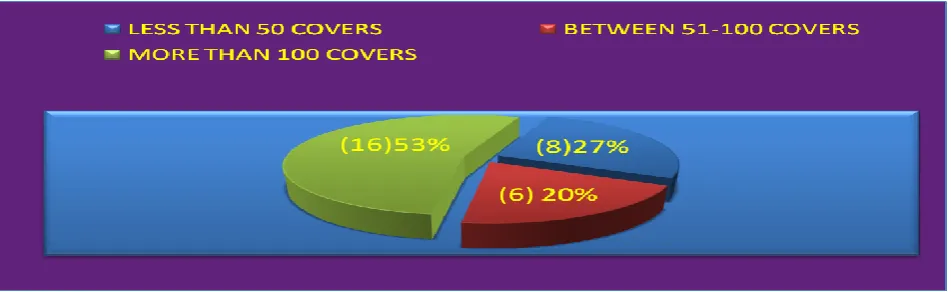
CHART NO II: NUMBER OF COVERS IN RESTAURANT
[image:10.595.74.550.54.200.2]Chart II, shows Mixed samples chosen for number of covers in the restaurant, the maximum respondents were from more than 100 covers restaurants.
TABLE NO 1 : TYPE OF SOLID WASTE GENERATED BY RESTAURANTS
TYPE OF SOLID WASTE
GENERATED
NO. OF
RESTAURANT PERCENTAGE
FOOD WASTE 30 100%
PLASTIC &RUBBER 18 60%
CARDBOARD 18 60%
FEROUS METALS 2 6.70%
GLASS AND CERAMIC 18 60%
PAPER 23 76.70%
TEXTILE 1 3.30%
[image:10.595.71.546.318.512.2]ANY OTHER 2 6.70%
Table I ,shows different types of solid waste generated in restaurants. It was observed that all
the restaurants generated food waste(30), followed by paper waste (23 restaurants), glass
waste (18), cardboard(18), Plastic & Rubber (18), Ferrous Metals(2), Textile(1), Any Other ,
A Monthly Double-Blind Peer Reviewed Refereed Open Access International e-Journal - Included in the International Serial Directories.
GE-International Journal of Management Research (GE-IJMR) ISSN: (2321-1709)
240 | P a g e CHART NO III: SEGREGATION OF WASTE BY RESTAURANT INTO BIODEGRADABLE AND
NON BIODEGRADABLE
Chart III, It was observed from chart that only 77% (23) Restaurants Segregate waste into
biodegradable and non biodegradable. The remaining 23% (7) restaurants segregate waste
[image:11.595.75.544.73.193.2]into dry and wet waste as made compulsory by the Municipal Corporation.
TABLE NO 2: DISPOSAL OF WASTE BY RESTAURANTS WHO DO NOT SEGREGATE WASTE
INTO BIODEGRADABLE AND NON BIODEGRADABLE
DISPOSAL OF WASTE NO OF RESTAURANTS PERCENTAGE
OPEN DUMPING 1 14%
OPEN BURNING 0 0%
BY MUNICIPAL WASTE COLLECTOR 0 0%
BY CONTRACT WASTE HAULER 5 72%
[image:11.595.73.552.296.415.2]ANY OTHER METHOD 1 14%
Table II, The remianing 7 restaurants who does not segregate waste into biodegradable and
non biodegradable but segregate waste into dry and wet waste and dispose off their waste in
different way like 1 restaurant dump dry waste on an open area and hand over wet to the
municipal waste collector, where as 5 restaurants hand over waste to the contract waste
hauler and remining 1 restaurant hand it over to Mall Waste Management team for further
[image:11.595.72.565.554.690.2]processing.
TABLE NO 3: SEGREGATION METHODS ADOPTED BY RESTAURANTS
SEGREGATION METHODS ADOPTED BY RESTAURANTS
NO OF
RESTAURANTS PERCENTAGE
SORTING WASTE BY USING DIFFERENT CONTAINERS 12 40%
SORTING BY DRY WASTE AND WET WASTE 18 60%
COMBINING WASTE AND HANDING IT OVER TO HAULER
FOR SEGREGATION 0 0%
ANY OTHER 0 0%
Table III, Around 18 restaurants sort their waste into Dry and Wet as specified by Municipal
A Monthly Double-Blind Peer Reviewed Refereed Open Access International e-Journal - Included in the International Serial Directories.
GE-International Journal of Management Research (GE-IJMR) ISSN: (2321-1709)
241 | P a g e CHART NO IV: WASTE AUDIT CONDUCTED BY RESTAURANT
Chart IV, It has been observed that around 17 restaurants conducts waste audit.
CHART NO V: FREQUENCY OF WASTE AUDIT CONDUCTED BY RESTAURANTS
Chart V, To know the frequency of waste audit conducted by the 17 restaurants, it was found that 35% of the respondent conduct waste audit every day, 35% of the respondent conduct waste audit once in a week, 18% conduct once in month whereas 6% respondent once in a six month and 6% conduct once in a year.
CHART NO VI: PERSONNEL APPOINTED TO CONDUCT WASTE SORTING ACTIVITY
A Monthly Double-Blind Peer Reviewed Refereed Open Access International e-Journal - Included in the International Serial Directories.
GE-International Journal of Management Research (GE-IJMR) ISSN: (2321-1709)
242 | P a g e
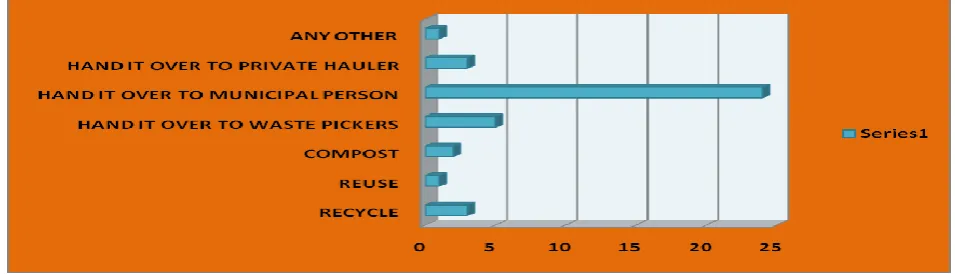
CHART NO VII: DISPOSAL OF SEGREGATED WASTE BY THE RESTAURANTS
Chart VII, Most of the respondent hand over segregated waste (mostly wet waste) to the
corporation trucks. Around 5 respondents hand over dry waste to the waste picker.one of the
respondent reuses the material like plastic containers, cardboard cases etc. 3 respondent
recycles materials like tin , glass, plastic, cardboard etc. through the private recyclers. 2 of the
respondent compost their wet waste in their composting pit which is then handed over to the
local farmers. 3 respondents hand over their both wet and dry (segregated) waste to private
hauler. 1 of the respondent waste is being collected by the mall management team for further
[image:13.595.69.547.58.195.2]processing.
TABLE NO IV: STAFF AWARENESS ABOUT SOLID WASTE SEGREGATION METHODS
STAFF AWARENESS ABOUT WASTE SEGREGATION METHODS
NO OF
RESTAURANT PERCENTAGE
YES 30 100%
[image:13.595.76.551.383.443.2]NO 0 0%
Table IV, 100% Restaurants feels that there staff are aware about waste segregation methods.
CHART NO VIII: WASTE HAULING FEE PAYED BY THE RESTAURANTS
Chart VIII, It has been observed that mostly waste hauling fee is being paid by only those
who hand over both dry and wet waste to the private hauler as against hauling fee.63% do not
A Monthly Double-Blind Peer Reviewed Refereed Open Access International e-Journal - Included in the International Serial Directories.
GE-International Journal of Management Research (GE-IJMR) ISSN: (2321-1709)
243 | P a g e CHART NO IX: TRAINING CONDUCTED FOR STAFF BY RESTAURANT FOR WASTE
SEGREGATION METHODS
Chart IX, 67% respondent organise staff training related to waste segregation where as 33%
does not conduct any training related to waste segregation methods though they feel it is very
[image:14.595.80.546.71.191.2]essential aspect in waste managemnt system.
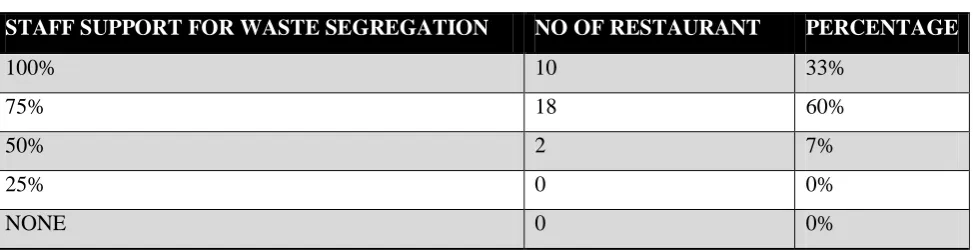
TABLE NO V: RESTAURANT STAFF SUPPORT IN WASTE SEGREGATION ACTIVITY
STAFF SUPPORT FOR WASTE SEGREGATION NO OF RESTAURANT PERCENTAGE
100% 10 33%
75% 18 60%
50% 2 7%
25% 0 0%
NONE 0 0%
Table V, 33% of respondent feels that their 100% of their staff is supportive about the waste
segregation activity whereas 33% of respondent felt that their 75% of the staff is supportive,
remaining 7% feels only 50% of their staff are supportive.
Views Expressed by Restaurateur about their role in solid waste segregation activity: 1) Restaurant use degradable and non- degradable materials in massive quantity which if
segregated can be recycled or reused and harmful material can be separated and
dispose off separately.
2) Disposing mixed waste can become unmanageable and crucial if not taken proper
care.
3) A blanket rules to be framed for large restaurants above 75 covers and they should be
made compulsory to maintain wet waste processing unit.
4) Segregation waste will not only help preventing pollution but the reuse and recycling
[image:14.595.74.561.270.395.2]A Monthly Double-Blind Peer Reviewed Refereed Open Access International e-Journal - Included in the International Serial Directories.
GE-International Journal of Management Research (GE-IJMR) ISSN: (2321-1709)
244 | P a g e
5) Restaurateur understands and supports the view of compulsorily conducting activities
like Waste Audit, Training Programme, and Awareness about segregation methods
etc.
6) Restaurateur also feels that following different bins methods for waste segregation
can boost up the process.
7) Waste minimization through waste segregation can also be an important step in
reducing load on landfills.
8) Few Restaurateurs feels that waste segregation is the „least discussed topic in
hospitality fraternity‟ and can be a menace if neglected.
9) Restaurants need to put little extra efforts to make a huge difference.
10)Lack of space to store the segregated waste and to compost is the major hurdle in
implementing waste management activities.
11)Restaurants can be given benefits in tax concession if they are involved in solid waste
segregation activity.
12)Since waste processing equipments are costlier, by following simple waste
segregation methods restaurant can help reduce the waste load.
Recommendation and suggestions:
After going through the study the researcher recommends following points which could be
useful in minimizing the waste on landfills:
1) Creating awareness for Source Segregation of solid waste amongst the restaurants.
2) Insisting on following Separate Bin Systems( different colour coded bins for different
types of waste)
3) Conducting staff training frequently by the Municipal authorities or expert to
inculcate habit of waste segregation at source.
4) Conducting periodically, waste audits to understand the waste stream and then
diverting waste into its respective categories for easy disposal.
5) More incentives in terms of tax relaxation, discount should be given to the restaurants
that practices segregation at source.
Conclusions:
From the study conducted in various restaurants, we can conclude that though majority of the
restaurants are aware about the segregation of waste at source and its benefits, the same is not
being systematically followed due to various reasons like: Lack of space for waste
segregation, Lack of training, Lack of support from the staff. To inculcate the habit of
A Monthly Double-Blind Peer Reviewed Refereed Open Access International e-Journal - Included in the International Serial Directories.
GE-International Journal of Management Research (GE-IJMR) ISSN: (2321-1709)
245 | P a g e
awareness amongst the staff and by implementing effective waste segregation systems. To
reduce the heavy load of ever increasing solid waste, there is an urgent need to implement
“segregation at source” practices on all front and this should be lawfully made compulsory.
Limitations
The sample chosen does not cover all strata of restaurant population. This study was limited
to Fine Dine and Standalone restaurants of Pune City. These are the outlets those have to
manage their own operations and are situated in prime locations of the Pune city. The study
includes the data provided by the restaurant employees like Restaurant Owner, Chefs, and
Restaurant Managers etc.
Scope for Future Research:
Limitation on sample size can be overcome considering the quantum of other types of
restaurants and Food and beverage outlets for future research. Apart from just concentrating
on the restaurant involvement, research can be conducted on exploring employee‟s attitude
and behavior towards acceptance of these practices and even studying consumer‟s perception
on effective solid waste segregation practices adopted by restaurants. Even research can be
done demographically on restaurants approach towards waste segregation methods and 3R
concept (Reduce/ Reuse/Recycle).
References
1) Rode Sanjay, (2010), “Integrated Approach to Solid Waste Management in Pune
City”, Munich Personal RePEc Archive Paper No. 32137, 28,
http://mpra.ub.unimuenchen.de/32137/.
2) Kubert Charles, “Going Greener, Opportunities to improve your Restaurants
Environmental Practices”, Environmental Law & Policy Center, Chicago,
http://greenrestaurants.org Online access 15/5/15
3) Khatri Niranjan ,(2015),Towards „Swachh Hotels‟Crafting A New vision, Federation
of Hotel and Restaurant, India, vol. 15/ Issue 5, 48-50, www.fhrai.com
4) Ball Stephen & Mohamed Abou Taleb , “Benchmarking waste disposal in the
Egyptian hotel industry”, Tourism and Hospitality Research, 2011 11:1,
http://thr.sagepub.com/content/11/1/1
5) Kumar Vijay & Dr. R.K Pandit (2013), “Problems of solid Waste Management in
Indian Cities” , International Journal of Scientific and Research Publications,
Volume 3, Issue 3, 1 ISSN 2250-3153.
6) Pleşea Doru Alexandru,& Smaranda Vişan (2010) , “Good Practices Regarding Solid
A Monthly Double-Blind Peer Reviewed Refereed Open Access International e-Journal - Included in the International Serial Directories.
GE-International Journal of Management Research (GE-IJMR) ISSN: (2321-1709)
246 | P a g e
7) Nworuh O. B; Morakinyo O.M; Iwuala C.C; Nwoke E.A and Ulkomma S.A (2011),
“Waste Management Practices In Selected Hotels In Owerri, Nigeria”, Journal of
Environmental Sciences and Resource Management, Volume 3, 68-73.
8) Guerrero Lilliana Abarca, Ger Maas, William Hogland (2013), “Solid Waste
Management Challenges For Cities In Developing Countries”, Elsevier, Waste
management, volume 33,220-232.
9) Sloan Philip, Willy Legrand & Joseph S Chen, “Waste Management”, Sustainability
in Hospitality Industry: Principles of sustainable operations, Second Edition,
(Routledge,), 67-89.
10)Pirani Sanaa I., Hassan A. Arafat , (2014), “Solid waste management in the hospitality
industry: A review”, Journal of Environmental Management, Elsevier,146, 320-336.
11)Snarr John (2000), Recycling Guidebook for the Hospitality and Restaurant Industry,
Metropolitan Washington Council of Governments Department of Environmental
Programs,
12)RRFB (2008), “Sorting it out: A guide to waste reduction, recycling and composting
in the food service industry”, 1-877-313-RRFB,
http://putwasteinitsplace.ca/assets/resources/rrfb-sorting_it_out_for_food_service.pdf,
online accessed on 19/5/15.
13)Gidde. M. R , V. V.Todkar ,K K Kokate,( 2008), “Municipal Solid Waste
Management in Emerging Mega Cities: A case study of Pune City” , GCE , Indo
Italian Conference on green and clean environment,441-450.
14)Ramchandra T.V & Bachamanda Shruti, (2006), “Environmental Audit of Municipal
Solid Waste Management” , Technical report: 118.
15)Mane T.T and Hingane Hemalata N, (2012), “Existing situation of solid waste
management in Pune City, India”, Research Journal of Recent Sciences , ISSN
2277-2502 Vol. 1 (ISC-2011), 348-351.
16)Mane A. V. and Parveen Anjum (2013), “ Municipal Solid Waste Management: A
Case Study of Phursungi Plant, Pune”, World Journal of Environmental Biosciences,
2013 e ISSN 2277- 8047,Volume 2, Issue 2: 89-99.
17) Jagtap Rajendra & Prof. Dr. Mahesh V Shitole, (2014), Pune‟s solid waste
management , Tactful Management Research Journal, ISSN : 2319-7943, 131-135.