GE-International Journal of Management Research
Vol. 4, Issue 1, Jan 2016 IF- 4.316 ISSN: (2321-1709)© Associated Asia Research Foundation (AARF)
Website: www.aarf.asia Email : [email protected] , [email protected]PERFORMANCE EVALUATION OF ACTIVELY MANAGED MUTUAL
FUNDS AND INDEX FUNDS: A COMPARATIVE STUDY.
*Sumana B.K, ** Prof B.Shivaraj
* Research Scholar, B.N. Bahadur Institute of Management Sciences,
University of Mysore, Mysore.
** Professor, B.N. Bahadur Institute of Management Sciences, University of Mysore, Mysore.
ABSTRACT
Active management is an important model for investment strategy today. The objective with
active management is to produce better returns than those of passively managed funds. The
Index funds which are passively managed try to replicate the performance of market index.
There is a perennial debate between active management and passive management. This paper is
an empirical study of performance of index funds and actively managed mutual fund from
2012-2015. This study focuses on how portfolios of index funds have performed relative to portfolios of
actively managed funds. The mutual funds have been analyzed on these parameters 1) Jensen`s
Alpha 2) Beta 3) Tracking error 4) Rsquare. The analysis revealed the performance of index
funds and actively managed funds on the above indicators are mixed.
Introduction
Active management refers to a portfolio management strategy where the manager makes specific
investments with the goal of outperforming an investment benchmark index. The aim of the
active management is to beat the market. Active portfolio managers attempt to construct a risky
portfolio that maximizes the reward-to-variability (Sharpe) ratio. Active fund managers pick
managed mutual fund because the fund tries to replicate the performance of a market index. The
fund buys shares in securities included in a particular index in proportion of each security`s
representation in that index. The fund manger does not rely on asset allocation, security selection
of the fund as in the case of active fund management instead the portfolio manager takes the
market index exposure. In India the actively managed funds have consistently outperformed the
index funds. The first publicly available and widely accepted index mutual fund in US was
launched by The Vanguard Group in 1976. It tracked the S&P 500® US stock index. The idea
was spearheaded by Vanguard founder John C. Bogle. There are eighteen index funds in India
and the first index fund was Principal index fund which tracks CNX Nifty in the year
1999(Source: nseindia.com). There are 41 AMC`s in India with Rupees 9,594.14 billion asset
under management (Source: RBI Dec 2014). There is always a debate between active funds and
index funds in terms of performance and fees. Compared to index funds, actively managed funds
have performed better in India. The reasons could be the markets lack depth in India and are not
as developed as US markets. Hence, there are plenty of opportunities outside of the index that an
actively managed fund can tap, as the index does not capture the broad market too well. The
tracking error (and therefore, expenses) in the Indian context is higher as a result of poorly
constructed indices and the difficulty involved in tracking them. The choice of indices is mostly
restricted to Nifty and Sensex. Index funds work well if markets are efficient. Since all
information that may affect a stock’s price is already factored in its price, there is little scope to
gain beyond that. However, in the Indian context, there is a larger group of stocks, especially in
the mid and small-cap segment that sees constant re-rating and price discoveries as information
asymmetry exists. Index funds are used by investors who are risk-averse. In comparison to
actively managed funds, index funds have lower expense ratio, lower transaction costs, better
control of risk through diversification and less prone to risk of fund manager's performance.
Among institutional investors, index funds are used by pension and insurance funds. Among
individuals, investors who do have knowledge of the markets or are averse to sector-specific
risks prefer index funds. Index funds can be either for equity funds or debt funds. Indexing is
popular with investors who prefer steady returns through a conservative, long-term and low risk
Literature Review
Most of the mutual fund studies were during 1960. Fama, Sharpe, Treynor were few researchers
to note the lack of skill by mutual fund managers. According to Jensen (1968) mutual funds were
on average were not able to predict security prices well enough to outperform a buy and hold
policy. Carhart observed that although some funds outperformed, on average, mutual fund
managers did not exhibit superior investment skill. Sharpe (1999) mentions that the before costs
the average actively managed dollar will equal the return on the average passively managed
dollar and after costs, the return on the average actively managed dollar will be less than the
return on the average passively managed dollar. According to the research conducted by NERD
Wallet (an Investment management Company) in 2013, only 24% of the active managers beat
the market over the past ten years. Mercer, an investment consulting firm conducted a study on
Indian Equity mutual fund in May 2011, classified the mutual funds and measured the
performance with appropriate benchmarks. It then analyzed the fund performance vis-a-vis the
newly defined benchmarks and found that 70% of large-cap funds outperformed the BSE-100.
However, only 55% managed to do so over a five-year period. Among the diversified equity
funds, 63% yielded returns in excess of their benchmark, the BSE-500 Index. This ratio dropped
to 52% for the five-year period.Lubos Pastor et all (2012), argues that active management poor
track record has resulted in growth of Index funds. This has reduced the share of investment in
active management. With the increase in industry size the fund managers find difficulty in
outperforming the benchmark. Narend (2014) studied Indian ETF`s and index mutual funds since
inception till 2013 andthe study reveals that, in India, index funds have done better than ETFs in
terms of a lower tracking error and a higher Jensen’s alpha while ETFs have performed better in
terms of active returns.
Tracking Error
Tracking error indicates how closely the fund is tracking the index. It refers to the ratio of how
close the weights of the stocks in the portfolio are to the weights of the stocks in the index. The
more closely the weights of the stocks are tracked in the index, lower will be the tracking error.
The factors that affect tracking error are inflows or outflows in the fund, corporate actions,
change of index constituents, cost (transaction costs including broker' commission, bid and ask
funds are usually lower than the benchmarked index. Tracking error is defined as the annualized
standard deviation of the difference in returns between the index fund and its target index. The
tracking error is always calculated against the total returns index that shows the returns on the
index portfolio, inclusive of dividend.
Research Objectives
The objectives of the study is to compare the performance of index funds and actively managed
mutual fund from 2013-2015(up to October). The mutual funds have been analyzed on the these
criteria 1) Active return 2) Jensen`s Alpha. R squared and beta is calculated to find how well
both, actively managed mutual funds and index fund track their respective benchmarks.
Tracking error of actively managed funds and also the index funds tracking error is calculated to
find how closely the mutual funds mirror their respective indices.
Research Methodology
In this study, we examine the index funds and diversified actively managed equity mutual funds.
The sample size for the study is eight. Four of which are Index funds and diversified equity
mutual funds. The data is collected from NSE, BSE websites and bluechipindia.com. The daily
closing prices and NAV`s are collected from year 2013-2015(up to October). The limitation of
the study is
The following tables indicate the funds selected for the study.
Index Funds and their Benchmarks
Number Index fund Index/Benchmark
1 HDFC Index Fund (G) BSE SENSEX
2 LIC Nomura Index Fund (G) BSE SENSEX
3 UTI Nifty Index Fund CNX NIFTY
4 IDBI Nifty Index Fund CNX NIFTY
Actively Managed Mutual Funds and their Benchmarks
Number Diversified Equity Funds
(Actively Managed)
Index/Benchmark
1 Birla Sunlife Opportunities
(Growth)
S&P CNX 500
2 Franklin High Growth
Companies(Growth)
S&P CNX 500
3 SBI Magnum Multiplier Fund BSE 200
4 ICICI Prudential Multicap Fund
(G)
BSE 200
Table: 2
The performance of the index funds and diversified mutual funds are measured by comparing
their daily returns with the returns of the respective benchmark. The mutual funds performance is
analyzed using risk adjusted performance measure Jensen`s alpha. Jensen alpha measures the
average return over and above the expected return. Jensen`s measure is the portfolio`s alpha
value. While higher the alpha better it is for the investor. It shows if the portfolio manager has
outperformed the index. Jensen`s alpha for the actively managed mutual fund and index fund is
calculated as follows:
Where,
α
p =Portfolio alpha= Portfolio average return
β
p =Portfolio betaTracking error is calculated as the annualized standard deviation of the difference in returns
between the index fund and its target index.
Data Analysis and Interpretation
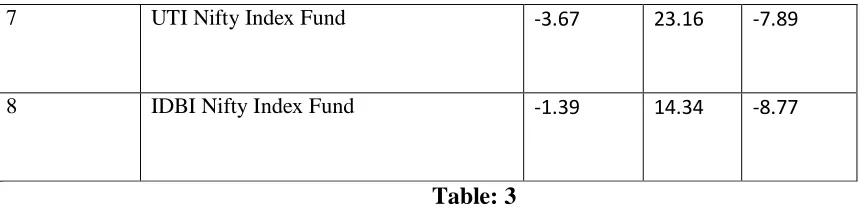
The following table No: 1 indicates the Jensen Alpha of the mutual funds under the study.
Among the diversified equity mutual fund (actively managed), The Jensen Alpha of 44.91% in
the year 2014 the highest for Birla sunlife for all the three years. Franklin high growth companies
fund has the Lowest alpha of 0.99% in the year 2014 and -4.56 % in 2015. Among the Index
funds, HDFC index fund has the highest alpha of 0.17 % in the year 2013. In the year 2014, UTI
Nifty Index fund has the highest alpha of 23.16%. In the year 2015 all the Index funds had
negative returns. Whereas the index funds have delivered good returns in the year 2014 as
compared to other years.
Number Diversified Equity Funds
(Actively Managed)
Jensen Alpha
2013(%) 2014(%) 2015(%)
1 Birla Sunlife Opportunities (G) 14.72 44.91 8.95
2 Franklin High Growth Companies(G) 7.97
0.99
-4.56
3 SBI Magnum Multiplier Fund 4.61 3.15 1.53
4 ICICI Prudential Multicap Fund (G) 2.91 19.62 4.97
Index Funds
5 HDFC Index Fund (G) 0.17 18.06 -9.31
7 UTI Nifty Index Fund -3.67 23.16 -7.89
[image:7.612.69.503.34.138.2]8 IDBI Nifty Index Fund -1.39 14.34 -8.77
Table: 3
Table No: 4 display the Beta, R square and Tracking Error of the sample mutual funds. Beta for
diversified equity mutual funds is high for SBI Magnum Multiplier fund in year 2013 and ICICI
prudential has highest beta in the year 2015. Birla sunlife has the lowest beta in the year 2014.
Franklin High growth has negative beta in the year 2013. It signifies that the mutual funds have
inverse relation with the index. It signifies that the actively managed mutual funds are less
volatile than its benchmarks. The Rsquared is very low and close to zero which signifies the
actively managed have little or no correlation with the index. Low tracking error means a
portfolio is closely following its benchmark. High tracking errors (TE) indicates the reverse.
Actively managed portfolios seek to provide above-benchmark returns, and they generally
require added risk and expertise to do so. In such cases, tracking error will be high. TE for
Franklin for diversified mutual fund is highest in 2013 and 2014. SBI has the highest TE in 2015.
Among the Index funds HDFC, LIC Nomura, UTI Nifty have negative beta in the year 2013. In
the years 2014 & 2015 beta is very low. The Rsquared is very low for all the index funds, Which
shows there is very little correlation between the Index funds and the Index which is unlikely of
an Index funds. Low R-squared indicates that very few of the fund's movements are explained by
movements in its benchmark index. Tracking error for the UTI index fund is highest in 2013 and
2014. Whereas IDBI has the lowest TE in 2014.
N
o
Diversified Equity Funds
(Actively Managed)
Beta Rsquare Annualized Tracking Error
2013 2014 2015 2013 2014 2015 2013 2014 2015
1 Birla Sunlife
Opportunities
(G)
0.0404 0.01 64
0.178 2
0.0028 0.000 4
0.0390 0.205 26
0.1715 0.1843
Growth
Companies(G)
3 SBI Magnum
Multiplier Fund
0.6883 0.31 06
0.193 0
0.5894 0.093 5
0.0341 0.111 8
0.1544 0.1983
4 ICICI Prudential
Multicap Fund
(G)
0.2509 0.32 00
0.895 2
0.0738 0.094 0.9145 0.199 2
0.1566 0.0445
Index Funds
5 HDFC Index
Fund (G)
-0.0399 0.20 447
0.205 56
0.0015 0.042 4
0.0438 0.254 73
0.1585 0.1909
6 LIC Nomura
Index Fund (G)
-0.0347 0.04 34
0.109 5
0.0012 0.001 7
0.0101 0.250 3
0.1760 0.2155
7 UTI Nifty Index
Fund
-0.0328 0.01 60
0.212 0
0.0010 0.000 0.0455 0.260 2
0.2185 0.1912
8 IDBI Nifty
Index Fund
0.2466 0.35 92
0.209 2
0.0615 0.129 6
0.0440 0.221 1
0.1431 0.1923
Table: 4
Conclusion
The Jensen Alpha for the actively managed mutual funds is better than Index funds alpha in all
the three years. With the Index funds returns being negative in the year 2015. Actively managed
mutual funds have low beta which signifies less volatile than its index. Even the Index funds
have low beta which shows that funds are less risky and is apt for risk averse investors. Rsquared
for few actively managed mutual funds are nearly zero and very low which indicates that the
actively managed mutual funds have no or very less correlation. This highlights that the fund’s
returns cannot be explained fully by the movements in the market, which is the crux of active
funds. However the study has limitations, as the sample considered for the study is eight
diversified equity mutual funds and index funds for a period of three years.
References:
1. Cahart (1997). “On Persistence in Mutual Fund Performance,” The Journal of Finance
Vol. 52, No. 1.
2. Jensen 1986
3. Mercer, an investment consulting firm conducted a study on Indian Equity mutual fund in
May 2011
4. Narend, (2014). “Performance of ETFs and Index Funds: a comparative analysis”,
source: NSE website.
5. Pastor, L. a. S., Robert F (July 23, 2012). "On the Size of the Active Management
Industry." Working Paper.
6. Sharpe, W. F. (1991). "The Arithmetic of Active Management." "Financial Analysts
Journal" Vol. 47: pp. 7-9.
7. Seth C. Anderson and Parvez Ahmed (2005), A good starting point for reviewing early
mutual fund studies is Mutual Funds: Fifty Years of Research Findings, New York,