LOG KERNEL AND ITS APPLICATION
SUDESHNA BANERJEA AND CHIRANJIB SARKARReceived 11 January 2005; Revised 12 June 2006; Accepted 21 June 2006
We used function theoretic method to solve a singular integral equation with logarithmic kernel in two disjoint finite intervals where the unknown function satisfying the integral equation may be bounded or unbounded at the nonzero finite endpoints of the interval concerned. An appropriate solution of this integral equation is then applied to solve the problem of scattering of time harmonic surface water waves by a fully submerged thin vertical barrier with a single gap.
Copyright © 2006 Hindawi Publishing Corporation. All rights reserved.
1. Introduction
The following singular integral equation with logarithmic kernel arises in various scat-tering and radiation problems of linear water wave theory involving vertical barriers:
Gg(u) ln
xx−+uudu=f(x), x∈G, (1.1)
wheregand f are differentiable functions andGmay consist of single or disjoint multiple intervals.
Usually in the literature, (1.1) was solved by reducing it to a Cauchy-type singular in-tegral equation and consequently this solution was utilized to solve the corresponding water wave problem. The solution of (1.1) obtained by reducing it to Cauchy-type singu-lar integral equation posed difficulty in solving the corresponding scattering or radiation problem due to the fact that the weak singularity in (1.1) was converted to strong singu-larity of Cauchy type. This difficulty was taken care of by Chakrabarti et al. [3], Manam [5], while solving the problem of scattering of water waves by a vertical wall with a gap. They used function theoretic method to solve the corresponding integral equation (1.1) withG≡(a,b) orG≡(0,a)∪(b,c) directly instead of reducing it to Cauchy-type singu-lar integral equation. In the present paper, we have used function-theoretic method to
Hindawi Publishing Corporation
International Journal of Mathematics and Mathematical Sciences Volume 2006, Article ID 35630, Pages1–12
solve (1.1) withG≡(0,a)∪(b,c) under the condition when
(i)
g(u)∼O(u−p)−1/2, asu−→p, (1.2)
(ii)
g(u)∼O(u−p)1/2, asu−→p, (1.3)
pbeinga,borc. Utilizing the boundedness ofg(u) ata,b,cgiven by (1.3), the problem of scattering of water waves by a submerged vertical wall with a gap is solved completely. This problem was solved earlier by Chakrabarti and Vijaya Bharathi [4] and Banerjea and Mandal [2]. In the present paper, we have used a very simple method to solve the problem completely. InSection 2, we have obtained the solution of a singular integral equation (1.1) with G≡(0,a)∪(b,c) whereg(u) satisfies (1.2) and (1.3). InSection 3, we have formulated the problem of scattering of water waves by a vertical wall submerged in water and discussed the genesis of (1.1). Then we used the boundedness property ofg(u) given by (1.3) to obtain solution of the scattering problem in a simple manner. Chakrabarti and Vijaya Bharathi [4] used complex variable technique while Banerjea and Mandal [2] used two types of singular integral equation method to solve the problem. The singular integral equations arising in [2] consist of Cauchy kernel and a combination of logarithmic and Cauchy kernel. In both methods in [2], the weakly singular kernel was converted to strong singular kernel. In the present paper, we have reduced the corresponding boundary value problem to (1.1) with weakly singular kernel whenG≡(0,a)∪(b,c).
2. Method of solution of a singular integral equation with logarithmic kernel
Let us consider the equation
1 π
Gg(t) ln
yy−+ttdt=f(y), y∈G, G≡(0,a)∪(b,c), (2.1)
where f(y) is a known function andg(u) is an unknown function which satisfies (1.2). Here f(u) andg(u) are both differentiable functions.
For solution of (2.1) under the condition (1.2), let
F(z)= d dz
Gg(u) ln u
+z u−z
du, (2.2)
where F(z) is sectionally analytic function in complex z-plane cut along (−c,−b)∪ (−a, 0)∪(0,a)∪(b,c) andF(z)∼O(1/z2) as|z| → ∞.
We denote
F±(x)= lim
Using Plemelj’s formula we have
F+(x) +F−(x)=κ(x),
F+(x)−F−(x)=λ(x), (2.4)
κ(x)= ⎧ ⎨ ⎩
2π f(x), x∈G,
2π f(−x), x∈G, (2.5)
λ(x)= ⎧ ⎨ ⎩
2πig(x), x∈G,
−2πig(−x), x∈G, (2.6)
andG≡(0,a)∪(b,c) andG≡(−c,−b)∪(−a, 0).
The first equation of (2.4) defines a Riemann-Hilbert problem forF(z), the solution of which is given by
F(z)=F0(z)
Dz2+Bz+C+ 1
2πi
G∪G κ(t) F+
0(t)
dt t−z
, (2.7)
whereD,B,Care unknown constants and
F0(z)=z2−a2z2−b2z2−c2−1/2. (2.8)
Using Plemelj’s formula in (2.7) and utilizing (2.4), (2.5), and (2.6), we get the expres-sion for the functiongas
g(x)= 1 π
1 R(x)
Dx2+Bx+C+ 2xP(x), in 0< x < a, (2.9)
g(−x)= 1 π
1 R(x)
−Dx2−Bx−C−2xP(x), in −a < x <0, (2.10)
and also
g(x)=π1−R(x)1 Dx2+Bx+C+ 2xP(x), inb < x < c, (2.11)
g(−x)= 1 π
1 −R(x)
−Dx2−Bx−C−2xP(x), in −c < x <−b. (2.12)
Comparing (2.9) with (2.10) and (2.11) with (2.12), we get
D=C=0. (2.13)
Thus,
g(u)= ⎧ ⎪ ⎪ ⎪ ⎨ ⎪ ⎪ ⎪ ⎩
2u R(u)
B0+P(u)
, 0< u < a,
−2u R(u)
B0+P(u)
, b < u < c,
whereB0=B/2 is a constant to be determined
P(u)=
G
f(t)S(t)
u2−t2 dt, (2.15)
R(x)=a2−x2b2−x2c2−x21/2, (2.16)
S(u)= ⎧ ⎨ ⎩
R(x), 0< x < a,
−R(x), b < x < c. (2.17)
In order to determineB0, we proceed as follows.
By direct integration, we get from (2.14),
Gug(u)du=B0 1 π
G 2u2
S(u)du. (2.18)
Multiplying both sides of (2.1) with 1/S(x) andx/S(x) and integrating overG, we get the following two relations:
G f(x) S(x)dx=
I1(a)
π a
0g(u)du+
I1(c)
π c
bg(u)du,
G x f(x)
S(x) dx= I2(a)
π a
0 g(u)du+
I2(c)
π c
bg(u)du
(2.19)
with
I1(u)=
G 1 S(x)ln
uu−+xxdx,
I2(u)=
G x S(x)ln
uu−+xxdx.
(2.20)
Multiplying (2.1) byT(x), where
T(x)=
x2x2−b2
x2−a2c2−x2
1/2
(2.21)
and integrating overG, and using the following result:
I3(u)=
GT(x) ln
uu−+xxdx
= ⎧ ⎨ ⎩
π(u−a) +I3(a), 0< u < a,
π(u−c) +I3(c), b < u < c,
(2.22)
we get
Gug(u)du=
aπ−I3(a)
π
a
0g(u)du+
cπ−I3(c)
π c
bg(u)du
+
Gf(x)T(x)dx.
Now, from (2.19), we get a
0g(u)du=
π I2(c)
G f(x)
S(x)dx−I1(c)
G x f(x)
S(x) dx
, (2.24)
c
bg(u)du= π
I1(a)
G x f(x)
S(x) dx−I2(c) G f(x) S(x)dx , (2.25) where
=I1(a)I2(c)−I1(c)I2(a). (2.26)
Hence by (2.23), using (2.24) and (2.25), we get
Gug(u)du= K1
G f(x) S(x)dx+
K2
G x f(x)
S(x) dx+
Gf(x)T(x)dx, (2.27)
where
K1=πaI2(c)−cI2(a)+I2(a)I3(c)−I2(c)I3(a),
K2=
πcI1(a)−aI1(c)
+I1(c)I3(a)−I1(a)I3(c)
. (2.28)
And finally, using (2.18) and (2.27), the unknown constantB0is determined.
Thus the solution of (1.1) withg(u) satisfying (1.2) is given by (cf. (2.14)),
g(u)= ⎧ ⎪ ⎪ ⎪ ⎨ ⎪ ⎪ ⎪ ⎩ 1 π 2u R(u)
B0+P(u)
, 0< u < a,
−1 π
2u R(u)
B0+P(u)
, b < u < c,
(2.29)
whereB0is a known constant.
Makinga→0 in (2.29), the results in [3] can be recovered.
Next, we find the solution of (2.1) withg(u) satisfying (1.3). We rewriteP(x) in (2.15) as follows:
P(x)=a2−x2b2−x2c2−x2 a
0
f(t)
x2−t2R(t)dt
−x2−a2x2−b2c2−x2c
b
f(t)
x2−t2R(t)dt
+a2−x2b2−x2 a
0
f(t) R(t)dt−
c
b f(t) R(t)dt
+a2−x2
⎡ ⎣a
0
c2−t2 a2−t2b2−t2f
(t)dt−c
b
c2−t2 t2−a2t2−b2f
(t)dt
⎤ ⎦
+ ⎡ ⎣a
0
c2−t2b2−t2
a2−t2 f(t)dt−
c
b
c2−t2t2−b2
t2−a2 f(t)dt
⎤ ⎦.
Substituting (2.30) into (2.29), we observe that forg(u) to satisfy (1.3), we must have the following relations:
⎡ ⎣a
0
c2−t2b2−t2f(t)
a2−t21/2 dt+
c
b
t2−b2c2−t2f(t)
t2−a21/2 dt
⎤
⎦+B0=0,
⎡ ⎣a
0
c2−t2f(t)
a2−t2b2−t21/2dt−
c
b
c2−t2f(t)
t2−a2t2−b21/2dt
⎤ ⎦=0,
a
0
f(t) R(t)dt−
c
b f(t) R(t)dt
=0.
(2.31)
These are three sovability conditions which f(t) must satisfy in order that the solution of (1.1) satisfying (1.3) exists.
Here the solution of (1.1) is given by
g(x)= ⎧ ⎪ ⎪ ⎪ ⎪ ⎨ ⎪ ⎪ ⎪ ⎪ ⎩
2x π R(x)
a
0
f(t)
x2−t2R(t)dt−
c
b
f(t)
x2−t2R(t)dt
, 0< x < a,
−2x π R(x)
a
0
f(t)
x2−t2R(t)dt−
c
b
f(t)
x2−t2R(t)dt
, b < x < c,
(2.32)
whereR(t) is given by (2.16).
In the next section, we will consider the problem of scattering of surface water waves by a submerged vertical barrier with a gap and reduce the corresponding boundary value problem to the integral equation (2.1).
3. Genesis of the integral equation mathematical formulation of the scattering problem
We consider the irrotational motion of an incompressible inviscid fluid under the ac-tion of gravity and use a rectangular Cartesian coordinate system in which the y-axis is taken vertically downwards, so that the fluid region occupies the region y >0;x∈R, and the vertical barrier occupies the regionx=0; y∈B, where B≡[a,b]∪[c,∞). As-suming the harmonic time dependencee−iσt(σ >0) in the velocity potentialΦ(x,y,t)= R{φ(x,y)eiσt},the problem under consideration is that of solving the following boundary value problem forφ:
∂2φ
∂x2+
∂2φ
∂y2 =0, y >0,x∈R, (3.1)
with
∂φ
whereK=σ2/g, g being the gravitational acceleration,
∂φ
∂x=0, onx=0±, y∈B, (3.3)
φ(0+,y)=φ(0−,y), y∈G(gap), G≡(0,a)∪(b,c), (3.4)
r1/2∇φ is bounded asr−→0, (3.5)
“r” being the distance from sharp edges of the barrier,
∇φ−→0, asy−→ ∞,
φ∼ ⎧ ⎨ ⎩
(1−R)e−K y+iKx, x−→ ∞,
e−K y+iKx+Re−K y−iKx, x−→ −∞,
(3.6)
whereRis the reflection coefficient.
3.1. Reduction of scattering problem to singular integral equation with logarithmic kernel. We first expressφ(x,y) by using Havelock’s expansion satisfying (3.1) and the conditions (3.2) and (3.6),
φ∼ ⎧ ⎪ ⎪ ⎨ ⎪ ⎪ ⎩
(1−R)e−K y+iKx+ ∞
0 A(ξ)L(ξ,y)e
−ξxdξ, x >0,
e−K y+iKx+Re−K y−iKx− ∞
0 A(ξ)L(ξ,y)e
−ξxdξ, x <0, (3.7)
whereL(ξ,y)=ξcosξ y−Ksinξ yandA(ξ) is unknown.
For satisfying (3.3), (3.4), and (3.5), the unknown functionA(ξ) must satisfy the set of dual integral equation
∞
0 A(ξ)L(ξ,y)dξ=Re
−K y, y∈G,
∞
0 ξA(ξ)L(ξ,y)dξ=iK(1−R)e
−K y, y∈B,
(3.8)
which can be alternatively written as
∞
0 A(ξ) sinξ y dξ=
⎧ ⎪ ⎪ ⎨ ⎪ ⎪ ⎩
D1eK y− R
2Ke−
K y, 0< y < a,
D2eK y− R
2Ke−
K y, b < y < c,
(3.9)
∞
0 ξA(ξ) sinξ y dξ=
⎧ ⎪ ⎪ ⎨ ⎪ ⎪ ⎩
E1eK y−i(1−R)
2 e−
K y, a < y < b,
E2eK y−i(1−R)
2 e−
K y, c < y <∞,
(3.10)
Now, for accommodating the origin and also the point at infinity, we have
D1= R
2K, E2=0. (3.11)
Let
∞
0 ξA(ξ) sinξ y dξ=g(y), y∈G, (3.12)
then using (3.11) and (3.12) in (3.10) and by Fourier sininversion,
π
2ξA(ξ)=
Gg(y) sinξt dt−
i(1−R) 2
Be
−Ktsinξt dt
+E1
b
ae
Ktsinξt dt.
(3.13)
SubstitutingA(ξ) from (3.13) into (3.9) and using the result 0∞(sinξ ysinξt/ξ)dξ=
(1/2) ln|(y+t)/(y−t)|, we have
1 π
Gg(t) ln
yy−+ttdt= ⎧ ⎪ ⎪ ⎨ ⎪ ⎪ ⎩
R 2K
eK y−e−K y+P
1(y), 0< y < a,
D2eK y− R
2Ke
−K y+P
1(y), b < y < c,
(3.14)
where
P1(y)=1
π
−i(1−R) 2
Be
−Kulny+u y−u du+E1
b
ae
Kulny+u y−u du
. (3.15)
Now, (3.14) is identical with (1.1) with f(y) as
f(y)= ⎧ ⎪ ⎪ ⎨ ⎪ ⎪ ⎩
R 2K
eK y−e−K y+P
1(y), 0< y < a,
D2eK y−
R 2Ke−
K y+P
1(y), b < y < c,
(3.16)
whereP1(y) is given by (3.15) andR,D2,E1 are unknown constants to be determined,
andG≡(0,a)∪(b,c).
Now it is important to know the behaviour ofg(u) asu→a,b,c. For this, let
φx(0,y)= ⎧ ⎨ ⎩
ω(y), y∈G,
0, y∈B (by (3.3)). (3.17)
Using (3.7), we get d
d y−K
∞
0 ξA(ξ) sinξ y dξ=(1−R)iKe
Comparing it with (3.12), we get
ω(y)= −dg
d y+Kg(y) +iK(1−R)e
−K y. (3.19)
Noting that (3.5) holds, we find that
g(y)∼O(y−t)1/2, asy−→t,t=a,b,c. (3.20)
Thusg satisfies the integral equation (2.1) with the condition (1.3), the solution of which is given by (2.32) together with the solvability conditions (2.31).
3.2. Determination ofR,D2,E1. Knowing thatg(u) satisfies (1.3), we use f(y) from
(3.16) into (2.31) to obtain the following equations for unknown constantsR,D2,E1as
a11R+a12D2+a13E1=b1,
a21R+a22D2+a23E1=b2,
a31R+a32D2+a33E1=b3,
(3.21)
whereai js andbjs are given by
a11=1
2
A4 5+
K1
Δ.A1+K2
Δ.A11+H1
+ i 2π
B4
1
F1
+K1
Δ.B1
F2
+K2
Δ.B11
F2
+δ1
F2
+δ3
F2
,
a12= −
α4
3(K,y) +
K1
Δ.α3(K,y) +
K2
Δ.α13(K,y)−β3(K)
,
a13=γ41
F12,y
−γ4
3
F14,y
+K1
Δ.B1
F22
+K2
Δ.B11
F22
+δ1
F22
+δ3
F22
,
a21=1
2
A2 5+i.A22
, a22= −α23(K,y), a23=α22(K,y),
a31=1
2
A5+i.A2, a32= −α3(K,y), a33=α2(K,y),
b1= i
2π
B4 1
F1+K1
Δ.B1F2+K2 Δ.B11
F2+δ1F2+δ3F2,
b2=1
2A
2
2, b3=1
2A2,
where
An
1=αn1(K,y)−αn1(−K,y) +αn3(−K,y), A1=α1(K,y)−α1(−K,y) +α3(−K,y),
An
2=αn2(−K,y)−αn4(−K,y), A2=α2(−K,y)−α4(−K,y),
An5=αn5(−K,y)−αn3(−K,y), A5=α5(−K,y)−α3(−K,y),
Bn
1(F)=γn1(F,y)−γn3(F,y), B1(F)=γ1(F,y)−γ3(F,y),
H1=β1(K,y)−β1(−K,y)−β3(−K,y),
F1=F12+F14, F12=
b
a 2ue−Ku
u2−y2du, F14=
∞
c
2ue−Ku u2−y2du,
F2=F22+F24, F22=
b
ae
−Kulny+u y−u
du, F14=
∞
c e
−Kulny+u y−u du,
(3.23)
αni(K,y)=
yneK y
R(y)d y, αi(K,y)=
eK y R(y)d y,
γn i(F,y)=
yn
R(y).F d y, γi(F,y)=
1 R(y).F d y,
βi(K,y)=
T∗(y).eK yd y, δ
i(F,y)=
T∗(y).F d y,
(3.24)
where, for integrals in (3.24), the range of integration is determined by the value ofi: fori=1, integration range is from 0 toa, fori=2, integration range is fromatob, for i=3, integration range is frombtoc, fori=4, integration range is fromcto∞, fori=5, integration range is from−atoa.
Solving (3.21), the three unknowns can be determined andg(u) can be known from (3.21). Hence from (3.12),A(ξ) is known andφcan be obtained from (3.7). This solves the problem completely.
4. Discussion
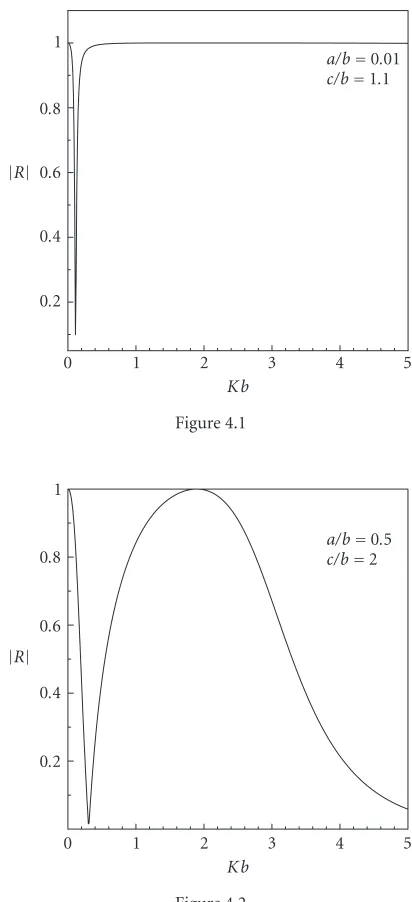
The reflection coefficient|R|has been numerically evaluated for various values of wave numberKband presented graphically in Figures4.1and4.2, respectively.
InFigure 4.1, we have takena/b=0.01 andc/b=1.1. It is observed that|R|decreases at first, reaches a minimum, and then increases asKbincreases and ultimately becomes almost unity. This figure is in agreement with [1, Figure 1]. This type of behaviour is expected because for small value of ratioa/b, the upper end of the barrier is very near the free surface. Hence the short waves which are confined near the free surface are almost totally reflected by the barrier.
0 1 2 3 4 5
Kb
0.2 0.4 0.6 0.8 1
R
a/b=0.01
[image:11.468.128.334.69.520.2]c/b=1.1
Figure 4.1
0 1 2 3 4 5
Kb
0.2 0.4 0.6 0.8 1
R
a/b=0.5
c/b=2
Figure 4.2
free surface, the short waves are totally transmitted. Also it is observed fromFigure 4.2
that a gorge appears in the reflection coefficient for small values of wave number. This phenomenon occurs due to some resonance effect taking place owing to the interaction of flow with the gaps. Similar behaviour was also observed by Banerjea [1].
5. Conclusion
We have used a function-theoretic method to obtain the solution of (1.1) and thereby uti-lize the boundedness property of the function satisfying (1.1), the problem of scattering of water waves by a submerged vertical barrier with a gap is solved easily.
Acknowledgments
Chiranjib Sarkar is grateful to CSIR for partial support to this work. This work is also par-tially supported by DST by a research project no. SR/S4/MS:263/05 through SB. Authors are thankful to Dr. Rupanwita Gayen for her help in numerical computation.
References
[1] S. Banerjea, Scattering of water waves by a vertical wall with gaps, Journal of Australian Mathe-matical Society. Series B 37 (1996), no. 4, 512–529.
[2] S. Banerjea and B. N. Mandal, Scattering of water waves by a submerged thin vertical wall with a
gap, Journal of Australian Mathematical Society. Series B 39 (1998), no. 3, 318–331.
[3] A. Chakrabarti, S. R. Manam, and S. Banerjea, Scattering of surface water waves involving a
verti-cal barrier with a gap, Journal of Engineering Mathematics 45 (2003), no. 2, 183–194.
[4] A. Chakrabarti and L. Vijaya Bharathi, Transmission of water waves through a gap in a submerged
vertical barrier, Indian Journal of Pure and Applied Mathematics 22 (1991), no. 6, 491–512.
[5] S. R. Manam, A logarithmic singular integral equation over multiple intervals, Applied Mathemat-ics Letters 16 (2003), no. 7, 1031–1037.
Sudeshna Banerjea: Department of Mathematics, Jadavpur University, Kolkata 700032, India
E-mail address:[email protected]
Chiranjib Sarkar: Department of Mathematics, Jadavpur University, Kolkata 700032, India