SYMMETRICALLY GENERATED GROUPS
MOHAMED SAYEDReceived 25 March 2004 and in revised form 13 January 2005
A double-coset enumeration algorithm for groups generated by symmetric sets of invo-lutions together with its computer implementation is described.
1. Introduction
The Todd-Coxeter algorithm described in [13] remains a primary reference for coset enu-meration programs. It may be viewed as a means of constructing permutation represen-tations of finitely presented groups. A number of effective computer programs for single-coset enumeration have been described, see, for example, [2,7,8].
Enumerating double cosets, rather than single cosets, gives substantial reduction in total cosets defined which leads to minimizing the storage (and time) needed. In [8,9] Linton has developed two double-coset enumeration programs. The process in the earlier one, which is a corrected version of the algorithm proposed in [3], is viewed as a direct generalization of the ordinary single-coset enumeration. The later one is related to the present algorithm but with different calculations.
In this paper, we present a double-coset enumeration algorithm which is specially de-veloped for groupssymmetrically generatedby involutions. Several finite groups, includ-ing all nonabelian finite simple groups, can be generated by symmetric sets of involu-tions, see, for example, [6,10,11]. The algorithm has been implemented as a Magma [1] program and this implementation has been used with success to check symmetric presentations for many finite simple groups.
2. Involutory symmetric generators of groups
LetGbe a group and letT= {t0,t1,...,tn−1}be a set of elements of orderminG. Defining
Ti= tiandT= {T0,T1,...,Tn−1}allows us to defineN=ᏺG(T), the set normalizer in
GofT. We say thatT is asymmetric generating setforGif the following two conditions hold:
(i)G= T, and
(ii)NpermutesTtransitively.
Copyright©2005 Hindawi Publishing Corporation
We callN thecontrol subgroup. Conditions (i) and (ii) imply thatGis a homomorphic image of theprogenitor
m∗n:N, (2.1)
wherem∗nrepresents a free product ofncopies of the cyclic groupCmandNis a group of automorphisms ofm∗n which permutes the ncyclic subgroups by conjugation, see [5,10].
Since in this paper we are only concerned with involutory symmetric generators we restrict our attention to the casem=2 (whileNwill simply act by conjugation as permu-tations of theninvolutory symmetric generators).
Theorem2.1. All nonabelian finite simple groups can arise as finite homomorphic images
of progenitors of the form2∗n:N.
Proof. LetHbe a maximal subgroup of a finite simple groupG. Suppose that 1=t∈G, t2=1. Under the subgroupH,tG, the conjugacy class oftinG, splits into orbits as
tG=᐀1∪˙᐀2∪···˙ ∪˙᐀r. (2.2) Without loss of generality, we may assume that᐀1= {t0,t1,...,tn−1}is not a subset ofH. It is clear that
ᏺG᐀1
≥H,᐀1
=G, (2.3)
sinceHis maximal inGand᐀1is not a subset ofH. Therefore,
1=᐀1G, (2.4)
and, sinceGis simple, we have
᐀1
=G. (2.5)
Moreover, ifπ∈H andtπi =ti(i=0, 1,...,n−1), thenπ∈ᐆ(G) and soπ=1, that is, H permutes the elements of᐀1 faithfully (and transitively). Now, let 2∗ndenote a free product ofncopies of the cyclic groupC2with involutory generatorst0,t1,...,tn−1and let
N∼=Hconsist of all automorphisms of 2∗nwhich permute thetiasHpermutes theti: π−1t
iπ=tiπ=tπ(i) forπ∈N. (2.6) Then, clearlyGis a homomorphic image of 2∗n:N, a split extension of 2∗nby the
per-mutation automorphismsN.
Since the progenitor is a semidirect product (ofTwithN), it follows that in any homomorphic imageG, we may use the equation
tiπ=πtiπ=πtπ(i), (2.7)
andwis a word in the symmetric generators. Indeed, this (symmetric) representation is unique providedwis simplified so those adjacent symmetric generators are distinct. Thus any additional relator by which we must factor the progenitor to obtainGmust have the form
πwt0,t1,...,tn−1, (2.8)
whereπ∈Nandwis a word inT. Another consequence of this is that a relation of the form (πti)n=1 for someπ∈Nin a permutation progenitor becomes
πn=t
itπ(i)···tπn−1(i). (2.9)
In the next section we describe how a factor group 2∗n:N
π1w1,π2w2,...,πsws (2.10) may be identified.
3. Double-coset enumeration algorithm IfNxNis a double-coset ofNinG, we have
NxN=NπwN=NwN, (3.1)
wherex=πw∈G, withπ∈N, andwis a word in the symmetric generators. We denote this double-coset by [w], for example, [01] denotes the double-cosetNt0t1N. The double-cosetNeN=N, whereeis the identity element, is denoted by [∗].
We will allowito stand for the cosetNti,ijfor the cosetNtitj, and so on. We will also letistand for the symmetric generatortiwhen there is no danger of confusion. Thus we write, for instance,ij∼kto meanNtitj=Ntkandij=kto meantitj=tk.
We define the subgroupsNi,Nij,Nijk,...(fori,j, andkdistinct) as follows:
Ni=Ꮿ Nti, Nij=Ꮿ
Nti,tj, Nijk=Ꮿ
Nti,tj,tk,
(3.2)
or, more generally,
Ni1i2···im=Ꮿ
Nti1,ti2,...,tim
, (3.3)
fori1,i2,...,imdistinct.
Letgbe an element ofG. Then we define thecoset stabilizing subgroup(ofNginN) by
N(g)=π∈N|Ngπ=Ng. (3.4)
It is sometimes useful to have the notation of alengthof a coset. The fact that forπ∈N we have
Nwtiπ=Nπ−1wtiπ=Nwtπi=Nwti (3.5)
shows that allNcosets have a representative inT0∪T1∪ ··· ∪Tn−1. We are in a posi-tion to define the lengthL(Nw)=L(w) of a cosetNw. Firstly, we haveL(N)=0. IfNw has lengthnandt∈T, thenNwthas length at mostn+ 1 and has length preciselyn+ 1 if it does not have (or has not been proved to have) length at mostn. We specify that all cosets of lengthn+ 1 have the formNwtwhereL(Nw)=nandt∈T.
IfNw1andNw2are cosets inNwN, then we have thatL(w1)=L(w2), that is, all cosets ofNwN have the same length. Thus, we can precisely compute the number of (right) cosets inNwNby using the simple but important following lemma.
Lemma3.1. The number of cosets in the double-coset[w]=NwNis|N|/|N(w)|.
Proof. Forπ1,π2∈N,
Nwπ1=Nwπ2⇐⇒Nwπ1π2−1=Nw⇐⇒π1π2−1∈N(w)
⇐⇒N(w)π
1π2−1=N(w)⇐⇒N(w)π1=N(w)π2.
(3.6)
Thus,Nwπ1andNwπ2are distinct cosets inNwNif and only ifN(w)π1andN(w)π2are
distinct cosets ofN(w)inN.
This last lemma makes double-coset enumeration overN to obtain the index of N in G a practical proposition. In order to obtain the index ofN in G, we will find all double cosets [w] and work out how many (single) cosets each of them contains. We will know that we have completed the double-coset enumeration when the set of right cosets obtained is closed under right multiplication. Moreover, the completion test is best performed by obtaining the orbits ofN(w)on the symmetric generators. We need only identify, for each [w], the double-coset to whichNwtibelongs for one symmetric generatortifrom each orbit.
It is easy to see that ifN(w)is a transitive subgroup ofN, thenNwdoes not extend to a longer coset. Indeed, if thetiare involutions andN(w)is a transitive subgroup ofN, then all the cosetsNwtiare shorter thanNwexcept whenNw=N, see [6,10,11].
With the observations of this section, we are in a position to carry out simple double-coset enumeration.
Example 3.2. Consider the group
G∼= 2∗4:S4
(2, 3)=t0t1
2, (3.7)
which means that the progenitor 2∗4:S
4is quotiented out by the relation (2, 3)=[t0t1]2. The double cosets of length up to 3 are
Next, we observe thatN=N(2, 3)=Nt0t1t0t1, which we write as∗ ∼0101 in our nota-tion. By postmultiplying both sides byt1, we deduce thatNt1=Nt0t1t0, that is, 010∼1. Furthermore, postmultiplying both sides byt0 yieldsNt1t0=Nt0t1 which is 01∼10. We have thus shown the double-coset equality [010]=[1]=[0]. Also, we have shown thatNt1t0=N(t0t1)(0,1)=Nt0t1and thus that (0, 1)∈N(01). Since we also haveN(01)≥
N01= (2, 3), we have thatN(01)≥ (0, 1), (2, 3). AlsoN(∗)=N= (0, 1, 2, 3), (2, 3)and
N(0)≥N0= (1, 2, 3), (2, 3). Thus, we find that the double cosets [∗], [0], and [01] contain at most 1, 4, and 6 cosets, respectively. We have now shown that any length-3 coset is in [012]. However, we have that 102∼012=01212·21=0(0, 3)21∼321. But
t3t2t1=(t1t0t2)(0,2,1,3)and soN(012)=N(102)≥ (0, 1), (0, 2, 1, 3) ∼=D8, and thus [012] has at most 3 cosets. Moreover,N(012)is a transitive subgroup ofN, so cosets in this double-coset extend no further and we have completed the double-coset enumeration.
Thus,|G:N| ≤14, so|G| ≤336= |PGL2(7)|, and the (relatively) easy task of finding generators for PGL2(7), see [4], satisfying the required relations completes the identifica-tion ofGwith PGL2(7). The correspondence between the 14 cosets and the 7 points and the 7 lines of the projective plane of order 2 is given in [11]. The Cayley diagram ofG overNis given below:
[∗] [0] [01] [012]
1 4 1 4 3 2 6 2 4 3 (3.9)
where each circle is labeled with a double-coset [w], with the number in the circle being the number of cosets in this double-coset. The numbers around the circles indicate the number of symmetric generatorsisuch that [wi] is a particular double-coset [w].
4. Implementation
In this implementation we try to codify the technique that has been developed for hand working. A more detailed description and improvements are provided. Given a control subgroupN (of a groupG) as permutations onnletters together with some relations, in which elements ofNare written in terms ofn(involutory) symmetric generators (of
4.1. Data structure. The control subgroupNis defined as a permutation group of degree
n. The two sequences
π=π1,π2,...,πm
, w=w1,w2,...,wm
, (4.1)
whereπi∈Nandwiare words in the symmetric generators, represent the left- and the right-hand side of the problem relations. Also, ss and sg are defined as two sequences whose terms are the double-coset representative words and the coset stabilizing sub-groups, respectively.
4.2. The algorithm design. The system contains a set of routines (procedures) such as dcoset,eqper,reduce,main,names,x2per,t2per,sym2per,per2sym,mult, andinvert. In the remainder of this paper, we give a detailed description and an outline of some difficulties which arise with the implementation.
4.2.1. dcoset procedure. The procedure identifies, for each [w], the double-coset to which
Nwtibelongs for one of the symmetric generatorstifrom each orbit of the coset stabiliz-ing subgroupN(w). Also, it produces
N(w)i=Ꮿ
N(w)ti, (4.2)
a single-point stabilizer inN(w).
dcoset 1. Repeat 2 for each element ss[i] (in the double-coset representative sequence ss) which has the maximal length.
dcoset 2. Identify the orbits of the coset stabilizing subgroup sg[i]. For each orbit which does not contain the last element of ss[i], establish a new double-coset representative, ss[j], as ss[j]=Append(ss[i], orbit representative), define sg[j], the single-point stabi-lizer in sg[i] by the same orbit representative.
4.2.2. eqper procedure. When the relations have been applied to a double-coset, permu-tations of the control subgroupNwhich fix that coset can be added as new generators to the corresponding coset stabilizing subgroup. In order to examine each double-coset [w], each relation must be studied to establish whether a part of it is equivalent to this coset and so we can easily deduce a permutation ofNwhich fixes that coset.
Given any two sequences (each represents a word in the symmetric generators)
e1=
a1,a2,...,ar
, e2=
b1,b2,...,br
, ai,bi∈ {1, 2,...,n}; (4.3) the procedure checks the equivalence (e2p=e1, for somep∈N) between them. If they are equivalent, it determines the permutationpofNsuch thate2p=e1.
We know that
N≥Nb1≥Nb1b2≥ ··· ≥Nb1b2···br. (4.4) Assume that
Consequently, there exist transeversals
τ1,...,τn1
,σ1,...,σn2
,ρ1,...,ρn3
,...,φ1,...,φnr
(4.6)
such that
N=Nb1τ
1∪N˙ b1τ2∪···˙ ∪N˙ b1τn1,
Nb1=Nb1b2σ
1∪N˙ b1b2σ2∪···˙ ∪N˙ b1b2σn2,
Nb1b2=Nb1b2b3ρ
1∪N˙ b1b2b3ρ2∪···˙ ∪N˙ b1b2b3ρn3,
.. .
Nb1···br−1=Nb1···brφ
1∪N˙ b1···brφ2∪···˙ ∪N˙ b1···brφnr.
(4.7)
Now, ife2p=e1,p∈N, then we can find the permutationp=φ···ρστ, where
τ∈ {τ
1,...,τn1},σ∈ {σ1,...,σn2},ρ∈ {ρ1,...,ρn3},...,φ∈ {φ1,...,φnr}, (4.8) as follows. Sinceσ,ρ,...,φfixb1, the equationbP1=a1can be reduced tobτ
1 =a1. Also, the permutationsρ,...,φfixb2, so the equationbP2=a2 can be reduced tobσ
τ 2 =a2. Similarly, we haveb3ρστ=a3,...,bφ
···ρστ
r =ar. Thus, we can easily identify (in a recur-sive manner) the permutationsτ,σ,ρ,...,φand consequentlyp.
eqper 1. Setpas the identity element ofSn. eqper 2. Fori∈ {1, 2,...,r}do
Ifi=1, then trans=Transversal(N,Nb1),
else trans=Transversal(Nb1b2···bi−1,Nb1b2···bi).
If there exists a permutation trans[j] such thatai(p−1·trans[j]−1)=bi, then set p= trans[j]·p,
otherwise e1 is not equivalent to e2, leave the loop and return with a proper prompt.
4.2.3. Reduce procedure. Any wordwin the symmetric generators is put by the procedure into its canonically shortest form. No other representations of group elements are used; words in the symmetric generators are simply shortened by application of the relations (and their conjugates underN). The relation
wi=πi, (4.9)
wherewi=ti1ti2···tirandπi∈N, can be written as
ti1ti2···tik=πitirtir−1···tik+1, (4.10)
The procedure checks if a part of any given word in the symmetric generators of length equal tokis equivalent toti1ti2···tik, the left-hand side of one of the previous relations using theeqper procedure, if so, the procedure replaces this part bytirtir−1···tik+1 after
permuting by p−1 (a permutation obtained from theeqperprocedure) and moves the permutationπp−1over to the left of the whole word.
Reduce 1. For any sequence in the symmetric generators, set the pointer at the first letter. Reduce 2. Check if the firstkelements starting from the pointer position are equivalent to the left-hand side of the given relation, replace them by the right-hand side of the same relation after permuting byp−1, and conjugate the preceding elements by the permuta-tionπip−1.
Reduce 3. Shift the pointer one position and go to 2.
Moreover, in order to put the wordwin the canonically shortest form, we may need to insert the identity elementt2i in a particular position (in this word). Assume thatw= [x1,x2,...,xk−1,y1,y2,...,yk−1], length(wi)=2k−2. The procedure checks if there exists an elementsfrom the symmetric generators such that eithersy1y2···yk−1∼ti1ti2···tik orx1x2···xk−1s∼ti1ti2···tik (or both). If so, the procedure replaces any of these two words (or both) by the right-hand side of the relation after permuting by a suitable per-mutation ofN.
4.2.4. Main processing. In this section, we show how the program generates the double cosets and give an efficient method for handling the collapses. It is useful to note that the principle of termination will always be reached for any symmetric presentation of a finite group.
Input and initialization. LetN≤Snbe a permutation group of cardinalityn. The prob-lem relations are given aswi=πi,i∈ {1, 2,...,m}, wherewiare words in the symmetric generators andπi∈N. The relations are sorted in ascending order according to the length ofwi, the variablelevelis set equal to|L(w1)/2 + 1|, the double-coset representative words up to length equal to,levelare obtained, and the corresponding stabilizing subgroups are defined.
Reduction. The same double-coset will often have many names and the purpose of the procedure is to find these coincidences by using the relationswi=πi. For every element sw (in the symmetric generators) in the ss sequence and every additional relationwi=πi, call thereduceprocedure. Having obtained a new word of length less than the length of sw; the procedure deletes the double-coset of representative word sw and records that sw is equivalent to this new word. If a new word of length equal to the length of sw and equivalent to sw is obtained, then the procedure adds a permutation—which sw should be conjugated by to obtain this new word—to the coset stabilizing subgroup in the sg sequence.
this might lead to the collapse of part of or the entire double-coset diagram. Rather than starting collapses at the end of each level or delaying them to the end of the processing, they may be initiated at specific levels. The process of determining when the collapses should be started is demonstrated as follows: supposewi=πi,i∈ {1, 2,...,m}, are the problem relations such that length(wi)=2ki+ 1 or 2ki. During the processing, the suit-able levels to check the collapses areki.
Collapse 1. Set level 1=level.
Collapse 2. If new relations have been defined during level 1 which is equal ton, say, try to reduce again the double cosets of length equal ton−1 using these relations, together with the problem relations, otherwise go to 4.
Collapse 3. Set level 1=n−1 and go to 2.
Collapse 4. Call thedcosetprocedureltimes, wherel=level−level 1, starting from level 1 and modify ss and sg sequences according to the new data.
Termination. The double-coset enumeration is complete when the set of right cosets ob-tained is closed under right multiplication. SinceN is a finitely generated subgroup of countable index in a finitely presented groupG, the point of termination will always be reached.
Termination 1. Setl=length(ss).
Termination 2. Call thedcosetprocedure. Ifl=length(ss), then call theoutputprocess, else call the reduction process.
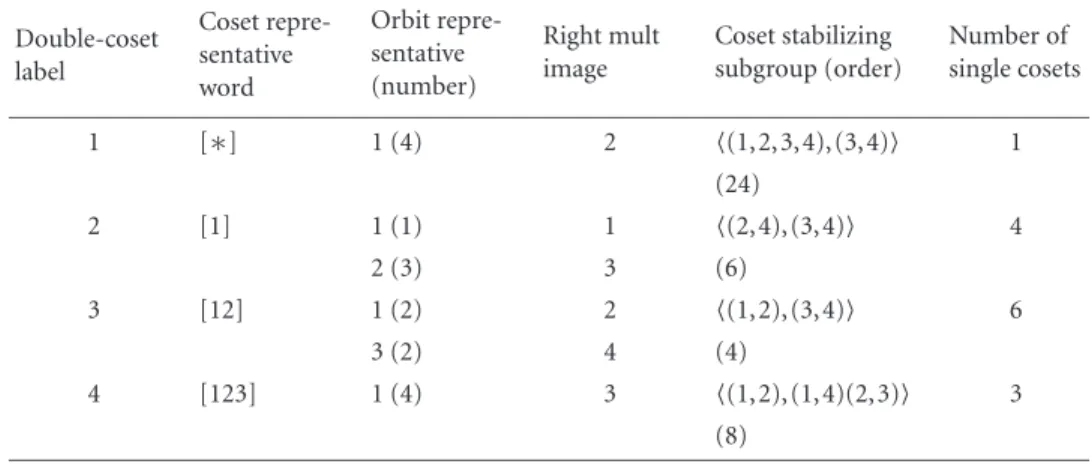
Output. The information contained in the double-coset representatives and the coset stabilizing subgroups sequences may be portrayed graphically in the form called a Cay-ley diagram. Unfortunately this is not suitable to be produced using the current Magma programming language. It is, however, possible to display the output in a tabular form. The use of this algorithm makes it possible to show the following: double-coset labels to-gether with their representative words, orbit representatives and the number of elements in each orbit, right multiplication images, coset stabilizing subgroups and their orders, the number of cosets in each double-coset, and the order of the groupG.
4.2.5. Names procedure. When the control subgroupN is large, but the number of the cosets ofN in Gis small, the action of the elements ofGon these cosets can be easily obtained. This procedure builds cst, a sequence of length equal to the number of the cosets ofN, whose terms represent words in the symmetric generators. These words form a complete set of coset representatives forNinG. The first element of the cst sequence is the empty word followed byn= |N:N(i)|words of length one, and so forth.
Names 1. Set cst=[·].
Names 3. For each double-coset representative word ss[i] of lengthl >1, apply the ele-ments of the right transversal of sg[i] inNto this coset to obtain a sequence of all cosets of lengthl. Append this sequence to cst.
4.2.6. x2per procedure. As mentioned earlier, each element of the groupGcan be rep-resented by a permutation onnletters;nis the cardinality of the permutation groupN, followed by a word in theninvolutory symmetric generators. Given a permutationx∈N, the procedure constructs a permutation,xp, say, which gives the action ofxon the cosets ofNinG.
x2per 1. Initializexsas a sequence of integers of length equal to the number of the cosets ofN.
x2per 2. For eachi,j such that length(cst[i])=length(cst[j]), if (cst[i])x=cst[j], then setxs[i]=j.
x2per 3. Convert the sequence of integersxstoxp, a permutation on the cosets ofN. 4.2.7. t2per procedure. This procedure gives the action of the symmetric generators on the cosets ofNinG. In generaltiin its action on the cosets ofNhas the form
(∗,i)(j,ji)···(jk,jki)···(jkl,jkli)···, fori,j,k,ldistinct. (4.11)
In practice our symmetric presentation is given in terms of a set of generators ofN together with one of the symmetric generators. So, if the action of one of the symmetric generators,ti, on the cosets ofNis known, we can obtain the action of the others on the cosets ofN by permuting this symmetric generator byNN (the control subgroupN in its action on the cosets ofN).
t2per 1. Initializetsas a sequence of integers of length equal to the number of the cosets ofN.
t2per 2. For eachi,jsuch that length(cst[i])=length(cst[j]) + 1, if (cst[i] cat 1)=cst[j], then setts[i]=jandts[j]=i.
t2per 3. Convert the sequence of integerstsintotp[1], a permutation on the cosets ofN. t2per 4. Constructtp[i],i=2, 3,...,nby permutingtp[1] byNN.
4.2.8. sym2per procedure. This procedure converts a symmetrically represented element
xofGinto a permutation acting on the cosets ofNinG. Letx=πw, whereπ∈Nand
w=[i,j,k,...], a word in the symmetric generators. Then p=x2per(π)·tp[i]·tp[j]· tp[k]..., wherepis a permutation acting on the cosets ofN.
per2sym 1. Assumep=πw, obtainwasw=cst[1p].
per2sym 2. Obtainπas a permutation on the cosets ofN, using the equationπ=pw−1. per2sym 3. Identify the action of π on the cosets of length one as π=[j|(1tp[i])π= (1tp[j]), for alli,j∈ {1, 2,...,n}].
Finally writeπas a permutation ofSn.
4.2.10. mult procedure. Suppose thatπwandσuare two symmetrically represented ele-ments inG. We have thatπw·σu=πσwσu=ρv, whereπ,σ,ρ∈Nandw,u,vare words in the symmetric generators. Elements represented as above are transformed into per-mutations on the cosets ofN and the procedure performs the multiplication operation before it transforms the result back into the symmetric representation.
mult 1. Multiplywσ anduafter converting them into permutations on the cosets ofN using thet2perprocedure and store the result in a temporary variable calledtemp. mult 2. Transformtempto its symmetric representationρvusing the per2sym proce-dure.
mult 3. Identifyρasρ=πσρ.
On the other hand, the procedurereducecan be used to put the wordwσuin its canon-ically shortest form.
4.2.11. Invert procedure. The procedure gives the inverse of any symmetrically repre-sented elementπwin the groupG. We have
(πw)−1=w−1π−1=π−1πw−1π−1=π−1w−1π−1=πw, (4.12)
whereπwis a symmetrically represented element ofG.
5. Examples
In order to illustrate the process, we consider the following small but interesting exam-ples.
Example 5.1.
G∼= 2∗4:S4 (3, 4)=t1t2
2∼=
N,T|N∼=S4∼= x,y,tπ
i =tπ(i), (3, 4)=
t1t2 2
,
x: (1, 2, 3, 4), y: (3, 4).
(5.1)
Table 5.1. Result of the double-coset enumeration of PGL2(7) overS4.
Double-coset label
Coset repre-sentative word
Orbit repre-sentative (number)
Right mult image
Coset stabilizing subgroup (order)
Number of single cosets
1 [∗] 1 (4) 2 (1, 2, 3, 4), (3, 4) 1
(24)
2 [1] 1 (1) 1 (2, 4), (3, 4) 4
2 (3) 3 (6)
3 [12] 1 (2) 2 (1, 2), (3, 4) 6
3 (2) 4 (4)
4 [123] 1 (4) 3 (1, 2), (1, 4)(2, 3) 3
(8)
The list of the 14 single cosets together with their equivalent names is [[[]], [[1], [2], [3], [4]], [[[12], [21]], [[23], [32]], [[34], [43]], [[24], [42]], [[14], [41]], [[13], [31]]], [[[123], [213], [432], [342], [124], [214], [431], [341]], [[143], [413], [234], [324], [142], [421], [231], [321]], [[132], [312], [423], [243], [134], [314], [421], [241]]]]. The action of the elementx=(1, 2, 3, 4) on single cosets is given by
xp=(2, 3, 4, 5)(6, 7, 8, 10)(9, 11)(12, 13). (5.2)
Also, the action of our 4 symmetric generators is given as follows:
t1: (1, 2)(3, 6)(4, 11)(5, 10)(7, 13)(8, 12)(9, 14),
t2: (1, 3)(2, 6)(4, 7)(5, 9)(8, 12)(10, 13)(11, 14),
t3: (1, 4)(2, 11)(3, 7)(5, 8)(6, 12)(9, 14)(10, 13),
t4: (1, 5)(2, 10)(3, 9)(4, 8)(6, 12)(7, 13)(11, 14).
(5.3)
The second example shows the ability of the process to perform harder reductions and to handle collapses.
Example 5.2.
G∼= 2∗4:S4
(1, 2)(3, 4)t1 5
,(1, 2, 3)t1
11. (5.4)
The input consists of the control subgroupN∼=S4 acting on the set {1, 2, 3, 4}, to-gether with the two sequencesπ=[(1, 2)(3, 4), (1, 2, 3)] andw=[[1, 2, 1, 2, 1], [2, 1, 3, 2, 1, 3, 2, 1, 3, 2, 1]].
has the following diagram: QQ Q QQ
[∗] [1] [12]
[123] [121]
1 4 12
24 12
4 1 3 1
2 1
(5.5)
Since
12121∼ ∗ =⇒121∼12, (5.6)
then we have the double-coset equality [121]=[12]. So the Cayley diagram is reduced to
[∗] [1] [12] [123]
1 4 1 4 3 1 12 2 24
1
(5.7)
Then, the coset enumeration is extended to level four as
S S S S S SS
[∗] [1] [12] [123]
[1234] [1232] [1231]
1 4 12 24
24 24 24
4 1 3 1 2
The above Cayley diagram can be reduced by repeated use of the first relation. We have that
1231=121·131=12(1, 3)(2, 4)13∼(12)(1,3)(2,4)13∼3413=⇒(1, 3)(2, 4)∈N(1231), 1232=1(1, 4)(2, 3)23∼1(1,4)(2,3)23∼423∼123=⇒[1232]=[123],
(5.9)
so the Cayley diagram becomes
QQ Q QQ
[∗] [1] [12] [123]
[1234] [1231]
1 4 12 24
24 12
4 1 3 1 2
1 1
1 1
1
(5.10)
At this time the check for collapses fails and the Cayley diagram at the beginning of level five has the following shape:
QQ QQ S S S SS
[∗] [1] [12] [123]
[1234] [1231] [12312] [12341] [12342] [12343]
1 4 12 24
24 12 24 24 24 24
4 1 3 1 2
Now
12341=1231·141∼3413(1, 4)(2, 3)14∼214214
∼12412∼12312=⇒[12341]=[12312], 12342=1232·242
=1(2, 3)(1, 4)23242∼423(1, 3)(2, 4)24
∼24124∼12312=⇒[12342]=[12312],
12343=12(1, 2)(3, 4)34∼2134∼1234=⇒[12343]=[1234].
(5.12)
Applying the process again, level six has been reached which will cause a part of the Cayley diagram to collapse to its final form. We have
123121=123(1, 2)(3, 4)12∼21412
∼2(1, 4)(2, 3)142∼3142=⇒[123121]=[1234], 123123∼21321∼12312=⇒[123123]=[12312].
(5.13)
The Cayley diagram takes the following shape:
QQ QQ QQ QQ
[∗] [1] [12] [123]
[1234] [1231]
[12312]
1 4 12 24
24 12
24
4 1 3 1 2
1 1 1 1 1 2 1 2 2 1 2 1 1 (5.14) Finally
1234=12341·1∼124121∼124(1, 2)(3, 4)12∼21312
∼2(1, 3)(2, 4)132∼4132=⇒(1, 4, 2)∈N(1234), (5.15)
also
1231=1234·41∼(1234)(1,2,4)41∼243141∼243(1, 4)(2, 3)14∼31214
The Cayley diagram now terminates as
[∗] [1] [12] [123]
[1234] [1231]
1 4 12 24
8 6
4 1 3 1 2
1 1
1 1
1 4
3 1
(5.17)
We may readily construct our symmetric generators as permutations on 1 + 4 + 12 + 24 + 6 + 8=55 letters and verify that they do indeed satisfy the relations we assumed. It is easy to recognize the groupG—in this case the projective general linear group PGL2(11) of order 55×24=1320—and check that it does contain such a symmetric generating set.
6. Conclusion
The present double-coset enumeration algorithm is different from the existing coset enu-meration techniques in the way it handles the elements of the group and for telling the user more about the structure of the group. For instance, the operations of inversion and multiplication can be performed manually (or mechanically) by means of short al-gorithms. Also, it is helpful to define the group in terms of generators and relations in the standard way; we can find a symmetric generating set for the group and from this generating set we can determine the relations which we need to add to our progenitor presentation.
It should be emphasized that the performance of our enumerator depends largely on the defining set of additional relations. Although the enumerator seems to be slow, it works well withπij=ijirelations. The other factor which particularly affects the effi-ciency of the implementation is that it is heavily Magma dependent. Our program is run on a Sun Sparc Station 5 with CPU clock rate 110 MHz. For example, the groupsG2(4) : 2 and Suz : 2 (see symmetric presentations in [11]) take about 0.2 second and 0.35 second of CPU time, respectively. Single-coset enumerations of these groups (using the same machine) take about 0.04 second and 0.11 second of CPU time, respectively. However, the time required using our implementation for the example PGL2(11) shown above is relatively high comparing with the time required using single-coset enumeration.
References
[1] W. Bosma, J. Cannon, and C. Playoust,The Magma algebra system. I. The user language, J. Symbolic Comput.24(1997), no. 3-4, 235–265.
[3] J. H. Conway, An algorithm for double coset enumeration?, Computational Group Theory (Durham, 1982) (M. D. Atkinson, ed.), Academic Press, London, 1984, pp. 33–37. [4] J. H. Conway, R. T. Curtis, S. P. Norton, R. A. Parker, and R. A. Wilson,Atlas of Finite Groups,
Oxford University Press, Eynsham, 1985.
[5] R. T. Curtis,Symmetric presentations. I. Introduction, with particular reference to the Mathieu groupsM12andM24, Groups, Combinatorics & Geometry (Durham, 1990), London Math.
Soc. Lecture Note Ser., vol. 165, Cambridge Press, Cambridge, 1992, pp. 380–396. [6] R. T. Curtis and Z. Hasan,Symmetric representation of the elements of the Janko groupJ1, J.
Symbolic Comput.22(1996), no. 2, 201–214.
[7] J. Leech,Coset enumeration, Computational Group Theory (Durham, 1982) (M. D. Atkinson, ed.), Academic Press, London, 1984, pp. 3–18.
[8] S. A. Linton,The maximal subgroups of the sporadic groupsTh,Fi24andFi24and other Topics, Ph.D. thesis, University of Cambridge, London, 1989.
[9] ,Double coset enumeration, J. Symbolic Comput.12(1991), no. 4-5, 415–426. [10] M. Sayed,Computational methods in symmetric generation of groups, Ph.D. thesis, University of
Birmingham, Birmingham, 1998.
[11] ,Nested symmetric representation of elements of the Suzuki chain groups, Int. J. Math. Math. Sci.2003(2003), no. 62, 3931–3948.
[12] M. Suzuki, Group Theory. I, Grundlehren der Mathematischen Wissenschaften, vol. 247, Springer, Berlin, 1982.
[13] J. A. Todd and H. S. M. Coxeter,A practical method for enumerating cosets of a finite abstract group, Proc. Edinb. Math. Soc.5(1936), 26–34.
Mohamed Sayed: Department of Mathematics and Computer Science, Faculty of Science, Kuwait University, P.O. Box 5969, Safat 13060, Kuwait