Citation:
Pickavance, J and Azmoodeh, A and Wilson, AD (2018) The effects of feedback format, and egocentric & allocentric relative phase on coordination stability. Human movement science, 59. pp. 143-152. ISSN 0167-9457 DOI: https://doi.org/10.1016/j.humov.2018.04.005
Link to Leeds Beckett Repository record: http://eprints.leedsbeckett.ac.uk/4946/
Document Version: Article
The aim of the Leeds Beckett Repository is to provide open access to our research, as required by funder policies and permitted by publishers and copyright law.
The Leeds Beckett repository holds a wide range of publications, each of which has been checked for copyright and the relevant embargo period has been applied by the Research Services team.
We operate on a standard take-down policy. If you are the author or publisher of an output and you would like it removed from the repository, please contact us and we will investigate on a case-by-case basis.
The Effects of Feedback Format, and Egocentric & Allocentric Relative
Phase on Coordination Stability
John Pickavance1
Arianne Azmoodeh1
&
Andrew D Wilson1*
1 Psychology, School of Social Sciences, Leeds Beckett University, Leeds, UK
* Corresponding Author
Email: [email protected] / [email protected]
Web: https://cognitioninaction.wordpress.com/
Twitter: @PsychScientists
Abstract
The stability of coordinated rhythmic movement is primarily affected by the required mean relative
phase. In general, symmetrical coordination is more stable than asymmetrical coordination;
however, there are two ways to define relative phase and the associated symmetries. The first is in
an egocentric frame of reference, with symmetry defined relative to the sagittal plane down the
midline of the body. The second is in an allocentric frame of reference, with symmetry defined in
terms of the relative direction of motion. Experiments designed to separate these constraints have
shown that both egocentric and allocentric constraints contribute to overall coordination stability,
with the former typically showing larger effects. However, separating these constraints has meant
comparing movements made either in different planes of motion, or by limbs in different postures.
In addition, allocentric information about the coordination is either in the form of the actual limb
motion, or a transformed, Lissajous feedback display. These factors limit both the comparisons that
can be made and the interpretations of these comparisons. The current study examined the effects
of egocentric relative phase, allocentric relative phase, and allocentric feedback format on
coordination stability in a single task. We found that while all three independently contributed to
stability, the egocentric constraint dominated. This supports previous work. We examine the
evidence underpinning theoretical explanations for the egocentric constraint, and describe how it
Introduction
Coordinated rhythmic movement is a well-established laboratory task used to study the composition
and organisation of perceptually controlled action. It requires the online (perceptual) coordination
and control of multiple limbs. The structure of the behaviour is surprisingly rich, and it is simple
enough to model in great detail (e.g. Beek, Peper & Daffertshofer, 2002; Bingham, 2001, 2004a, b;
Cattaert, Semjen & Summers, 1999; Daffertshofer, Peper, & Beek, 2005; Haken, Kelso, Bunz, 1985;
Peper, Ridderikhoff, Daffertshofer & Beek, 2004; Snapp-Childs, Wilson & Bingham, 2011). In
addition, there are some coordinations that are difficult to produce without practice, allowing us to
study the acquisition of these actions (e.g. Zanone & Kelso, 1992a, b, 1997; Wilson, Snapp-Childs,
Coats & Bingham, 2010).
The current study directly compares the effects of three factors on coordination stability;
egocentrically defined relative phase, allocentrically defined relative phase, and the format of the
allocentric feedback.
Relative Phase
The primary factor that affects coordination stability is the target relative phase. When two
oscillating limbs are at the same point in their cycle (phase) at the same time, this is 0° mean relative
phase, or in-phase, and it is the most stable state. If the two limbs are at opposite points in their
cycle at the same time, this is 180° mean relative phase, or anti-phase. This is also a stable state,
although it is less stable than 0°/in-phase (e.g. if the frequency is steadily increased, phase variability
increases and there is a tendency to transition from 180° to 0°; Kelso, 1984). These are typically the
only two coordinations people can produce stably without practice; other relative phases are easily
perturbed by small errors leading to a transition to one of the stable states. This basic pattern was
captured in the original Haken-Kelso-Bunz (HKB) model (Haken et al, 1985), which describes 0° and
Golonka & Wilson, 2012 and Kelso, 1995 for overviews, and Park & Turvey, 2008 for a detailed
analysis of the nature of the HKB modelling approach).
In human movement coordination, relative phase can be defined in two different frames of
reference: an egocentric, body relative frame of reference; and an allocentric, external frame of
reference.
The Egocentric Frame of Reference
The egocentric frame of reference is body centred about the sagittal midline. In this frame, a
coordinated rhythmic movement that entails mirror symmetrical movements (i.e. in-out/in-out
movements) about the midline is referred to as in-phase coordination. Side-to-side movements (e.g.
in-out/out-in) are referred to as anti-phase coordination. In-phase movements are more stable than
anti-phase movements. The HKB model (Haken et al, 1985) defines relative phase in an egocentric
frame of reference.
This egocentric constraint (Swinnen, 2002) on coordination stability is attributed to muscle
homology. Homologous muscles are the functionally equivalent muscles in matching limbs; for
example, the biceps of the two arms are homologous, as are the triceps. Thus, under normal
postural conditions, in-phase coordinations require the simultaneous use of homologous muscles,
and anti-phase coordinations require the simultaneous use of non-homologous muscles.
One proposed mechanism for how muscle homology might affect coordination stability is neural
crosstalk (e.g. Marteniuk, MacKenzie & Baba, 1984; Swinnen, Young, Walter & Serrien, 1991).
Specifically, when non-homologous muscles must be activated simultaneously, the relevant motor
commands interact with and inhibit one another at various stages of planning and implementing the
movement. This has been formalised in several models (e.g. Beek et al, 2002; Cattaert et al, 1999;
The Allocentric Frame of Reference
Coordinated rhythmic movements must be parallel to each other to produce the HKB stability
differences, because relative phase is only uniquely defined under these conditions. When two
coordinated movements are orthogonal to each other, the asymmetries between in-out/in-out
motions and in-in/out-out motions disappear (e.g. Bogaerts, Buekers, Zaal, & Swinnen, 2003;
Wimmers & Beek, 1992).
This means that there is a second human-relevant way to define relative phase, and that is in an
allocentric frame of reference. In this frame, when the two oscillators in a coordinated rhythmic
movement move in the same direction throughout the cycle, they are at 0° mean relative phase.
When they move in the opposite direction throughout the cycle, they are at 180° mean relative
phase. 0° movements are more stable than 180° movements. The Bingham model (Bingham, 2001,
2004a, b; Snapp-Childs et al, 2011) defines relative phase in an allocentric frame of reference.
This allocentric constraint (Swinnen, 2002) on coordination stability is attributed to the relative
direction of motion of the two oscillators. 0° coordinations are more stable than 180° because
relative direction is more stable (and because the relative speeds are lower; Snapp-Childs et al,
2011). Intermediate relative phases are specified by varying proportions of the same/different
direction of motion and cannot be stably produced without training.
There are two strands of research that have revealed the effects of the allocentric constraint on
coordination stability. The first strand investigated coordination of non-homologous limbs (e.g.
Serrien & Swinnen, 1997; Swinnen, Dounskaia, Verschueren, Serrien & Daelman, 1995). In these
tasks, muscle homology is not definable and coordination stability was strongly governed by the
relative direction of motion (with isodirectional, 0° coordination more stable than non-isodirectional,
180° coordination).
The second strand considers the perception of relative phase. The first clue that internal, neural
that the HKB stability pattern persisted when two people coordinated with each other, coupled only
by vision. Bingham then embarked on a research program to investigate the informational basis for
the perception of relative phase. He and colleagues have shown the HKB pattern in judgments of
relative phase and phase variability, both visually (Bingham, Schmidt & Zaal, 1999; Bingham, Zaal,
Shull & Collins, 2000; Zaal, Bingham & Schmidt, 2000; Bingham 2004b) and haptically (Wilson,
Bingham & Craig, 2003). Unstable coordinated actions (such as 90°) can also be stably produced
without training if the visual feedback is altered to be more readily detected. This can be done by
mapping a non-isodirectional coordination movement into an isodirectional feedback display
(Wilson, Collins & Bingham, 2005a), or by removing the relative direction component entirely with
Lissajous feedback (Kovacs, Buchanan & Shea, 2009a, b; Kovacs & Shea, 2011). Perceptual stability
leads to action stability, independently of how the limbs are being used.
This research has been formalised into a perception-action model of coordinated rhythmic
movement (Bingham, 2001, 2004a, b; Snapp-Childs, Wilson & Bingham, 2011; see Golonka & Wilson,
2012 for an overview). This model couples two phase-driven damped mass-spring oscillators via
perceived relative phase. The information for relative phase is the relative direction of motion, with
the detection of this variable modified by the relative speed. The key predictions of the model have
all been successfully tested (Wilson & Bingham, 2008; Wilson, Snapp-Childs & Bingham, 2010;
Snapp-Childs et al, 2011); however it does not yet address the egocentric constraint.
Egocentric vs Allocentric Constraints
Homologous muscle use produces isodirectional limb movement if the motion is in the sagittal
plane, parallel to the body’s midline. The two frames of reference for measuring relative phase are
therefore often confounded. However, it is possible to separate these frames, either by altering the
plane of the motion (e.g. into the transverse plane orthogonal to the body’s midline) or altering the
posture of the limbs (e.g. one prone, one supine). In each case, egocentric in-phase movements
The general result from studies using these manipulations is that while both factors contribute to
coordination stability (e.g. Amazeen, DaSilva, & Amazeen, 2008; Meesen, Wenderoth, Temprado,
Summers, & Swinnen, 2006; Salesse, Temprado, & Swinnen, 2005; Wilson, Collins, & Bingham,
2005a, 2005b), homology tends to show larger effect sizes and can often dominate (e.g. Kagerer,
Summers, & Semjen, 2003; Li, Levin, Forner-Cordero, Ronsse & Swinnen, 2008; Peper, de Boer, de
Poel, & Beek, 2008; Temprado, Swinnen, Carson, Tourment & Laurent, 2003; although see
Meschner, Kerzel, Knoblich & Prinz, 2001, and Brandes, Rezvani, & Heed, 2017, for examples of
allocentric dominance).
For example, Temprado et al (2003) used both kinds of manipulations across two experiments. First,
they compared coordination stability of movements in the transverse and sagittal planes
(Experiment 2). Muscle homology dominated; coordinations that required homologous muscle
activations were nearly always more stable1. They then compared coordination stability of
movements about the wrist in the sagittal plane, with hands either both prone, both supine, or one
prone and the other supine (Experiment 3). Here they again found a large effect of homology, but
also a smaller, reliable effect of direction.
Despite the evidence for substantive contributions to coordination stability from both egocentric
and allocentric constraints, the two fields have progressed very separately. Thus, currently, no
model adequately addresses both egocentric and allocentric constraints. Our goal in the present
paper is to begin to explore how to expand Bingham’s perception-action model to account for the
egocentric constraint.
Feedback Displays
Coordination stability is also affected by the form of the allocentric feedback provided. A common
method for continuous online feedback is the Lissajous display (Lee, Swinnen & Verschueren, 1995).
In this display, the relative motions of the two oscillators are integrated and drive the motion of a
single target in two dimensions. One oscillator defines the x coordinate, the other defines the y
coordinate. At 0°, this yields a line of slope 1; at 180°, a line of slope -1. Intermediate relative phases
produce ellipses of varying eccentricity, with 90° producing a circle. This feedback is now well known
to support the production of any mean relative phase very easily, and to stabilise movements that
vary in amplitude or frequency (Kennedy, Wang, Panzer & Shea, 2016; Kovacs et al, 2009a, b; Kovacs
& Shea, 2010; Kovacs, Buchanan & Shea, 2010a, b). If the limbs are concealed from view, there is no
allocentric relative direction information available from them to affect coordination stability, and the
egocentric effects, while present, are often mitigated by the easily detected feedback about
performance.
It is interesting that altering the perceived outcome of an action can affect how well it can be
performed (e.g. Wilson et al, 2005a, b) but in the context of studying coordination there are two
downsides. Firstly, there is the issue of feedback dependence. People trained on a novel
coordination using Lissajous feedback cannot maintain their improved performance when the
feedback is removed (although fading the use of the feedback does help; Kovacs et al, 2011;
Maslovat et al, 2009). Secondly, and more importantly, Lissajous feedback removes relative direction
information and so its contribution to coordination stability cannot be assessed or controlled.
To address these issues, Wilson, Coats, Snapp-Childs & Bingham (2010) developed Coordination
displays and Coordination feedback. Coordination displays present a simple point-light display of two
dots (one per oscillator) on a screen. The dots can be controlled by a computer (for judgment
studies; e.g. Wilson & Bingham, 2008), by a person using joysticks (for bimanual coordination
experiments), or by both (for unimanual coordination experiments in which a person coordinates
with a computer-controlled dot; see Snapp-Childs, Wilson & Bingham, 2015 for a comparison of the
two action methods). The mapping between the joysticks and the dots can also be altered to map
any coordinated movement onto any visual outcome (as in Wilson et al, 2005a, b). Coordination
from white to green when the person is moving at a target relative phase, +/- an error bandwidth.
Thus, these displays are ‘full cue’ with regards to information about allocentric constraints, and the
feedback simply augments, and does not transform, the display in any way. With this display,
therefore, movement production can be both egocentrically and allocentrically constrained, these
can be combined in many ways, and the feedback drives learning without creating dependence on
the colour change signal (Wilson et al, 2010).
The Current Experiment
As noted, previous work comparing egocentric and allocentric constraints on coordination stability
has separated the two by changing the movements being produced across conditions. This makes it
difficult in principle to compare the various tasks, and it has led to a variety of results in the
literature. Temprado et al (2003) manipulated both the plane of the movements (from frontoparallel
to sagittal) and the hand posture (from both limbs prone or supine to one prone, one supine). The
first manipulation mostly produced an egocentric dominance across conditions. The second
condition again produced egocentric dominance, but there was also a smaller, but detectable
contribution from the allocentric constraint. Conversely, Meschner et al (2001) used the hand
posture manipulation and found allocentric dominance. They then used a finger tapping task in
which the fingers being coordinated were homologous or not; again, regardless of limb homology,
they again found allocentric dominance. Finally, they had people perform unseen circular
movements to control the linear motion of two flags, and found allocentric dominance once more.
Perhaps these mixed results are a consequence of separating the frames of reference with
postural/planar manipulations.
The other issue is the presence or absence of allocentric, relative direction information about
relative phase. When it is present, it is typically through vision of the limbs, and one way it can be
absent is through using Lissajous feedback. The former forces the use of the postural/planar
coordination stability, one that works to remove the differences between productions of various
relative phases (e.g. Kovacs et al, 2009).
The current experiment therefore tested the contributions of the egocentric and allocentric
constraints on coordination stability while addressing these issues. Participants produced bimanual
coordinated rhythmic movements in the fronto-parallel plane only, and these were either in-phase
or anti-phase (Egocentric Relative Phase). These movements either produced 0° or 180 mean
relative phase on the screen (Allocentric Relative Phase), and the display was either in Coordination
or Lissajous (Feedback Format). These three factors were fully crossed within-subject. Therefore, we
were able to separate egocentric and allocentric constraints without changing the action
requirements, while also investigating the consequences of the feedback display format.
Method
Participants
Thirty-two students and staff (12 male, 20 female, Mage = 29.81, SDage = 6.85, age range = 20-47)
from Leeds Beckett University participated. All participants had unrestricted movement and
self-reported normal/corrected to normal vision. Ethical permission was granted from the Leeds Beckett
Psychology Research Ethics Committee.
Design
The study was a 2x2x2 repeated measures design. There were three independent variables:
Egocentric Relative Phase (2 levels: In-Phase, Anti-Phase), Allocentric Relative Phase (2 levels: 0°,
180°), and Feedback Display (2 levels: Coordination, Lissajous). Each participant took part in all 8
conditions with their hands concealed under a box, in a partially counterbalanced order (see Table
1). In addition, at the end of the session there was a No Vision control condition in which
participants produced coordinated movements using either In-Phase or Anti-Phase movements. In
these trials, the feedback display was turned off entirely and the hands remained concealed under
We analysed two dependent variables: Coordination Stability (assessed as the proportion
time-on-target, +/-20°; PTT20), and Coordination Consistency (assessed as SDΨ = (-2*lnU)^1/2, where U is
the uniformity measure, here the mean vector length; Batschelet, 1981). While PTT20 is a better
measure of coordination performance (Snapp-Childs et al, 2011, 2015), we also analysed SDΨ to
allow more direct comparisons to previous work using this and related variability measures.
Apparatus and Stimuli
Refer throughout this section to Figure 1. Participants sat at a desk on a height adjustable chair,
approximately 75cm from a Dell monitor (resolution 1920x1080, refresh rate 60Hz) placed with eye
level aligned with the top of the monitor. Two Logitech 3D pro joysticks were connected via USB 2.0
to a Dell PC (3.2GHz, NVIDIA graphics, Windows 7). Joysticks were fixed firmly to the desk with
minimal distance between them. The rumble feature was disabled and the plastic cladding had been
removed to provide unrestricted movement. A modified cardboard box concealed the joysticks to
ensure participants received visual feedback from the display only.
The displays, data recording, and calculation of dependent variables was handled by a custom
MATLAB toolbox written by ADW incorporating the Psychtoolbox (Brainard, 1997; Kleiner et al.
2007; http://psychtoolbox.org).
Egocentric Relative Phase
In the In-Phase conditions, in-out/in-out movements were required to produce the target Allocentric
Relative Phase. In the Anti-Phase conditions, side to side, parallel movements were required. The
mapping of joystick motion to display motion was altered in software so that all four combinations
of egocentric and allocentric relative phase could be produced for each feedback display.
Allocentric Relative Phase and Feedback Format
Coordination displays (Wilson et al, 2010) consisted of two white dots displayed centrally on a black
background, one above the other. The left joystick controlled the upper dot and the right joystick
dots aligned, moving from left to right (and back again), and a target Allocentric Relative Phase of
180° required participants to move both dots in opposite directions (and back again), crossing in the
middle.
Lissajous displays (Lee et al, 1995) consisted of a single white dot and a single white line, displayed
centrally on a black background. The left joystick controlled the dot’s horizontal movement, and the
right joystick controlled vertical movement. 0° was depicted by a line of slope +1, and 180° was
depicted by a line of slope -1. Both required participants to track the line with the dot.
In the No Vision condition, the screen displayed the black background only.
Procedure
Each condition was presented as a block of trials. The first trial was a demonstration of the target
Allocentric Relative Phase at 1Hz in the relevant Display mode, accompanied by verbal instructions
on how to produce it (“in and out” or “side to side”). This was followed by a 20s practice trial of the
movements required for this block (data not recorded). Participants were not paced (metronomes
have been shown to act as distractors; Kovacs et al, 2009a) but were asked to maintain the 1Hz
frequency shown in the demo trial. Instructions and practice were repeated if participants
misunderstood. Participants then proceeded to 5 recorded 20s trials.
Refer to Table 1. Conditions were blocked by Display type. The first two sets of blocks were either
Coordination or Lissajous feedback, with the subsequent sets testing the alternative feedback
condition. Within each set, the first block target Allocentric Relative Phase was always 0°, and the
second block target always 180°. Between sets, we alternated between In-Phase and Anti-Phase
movements. The final set of two blocks were always the No Vision condition, with a block of 5
Analysis
The position time series from each joystick was recorded at 60Hz throughout each trial and filtered
using a Butterworth low-pass filter with cut-off frequency 10Hz. This filtered signal was
differentiated to yield velocity, and continuous relative phase calculated as tan-1(V/X) at each
sample. Coordination stability (PTT20°) was calculated as the proportion of time the joysticks were
within 20° of the target Allocentric Relative Phase. Coordination consistency (SDΨ) was calculated
from a log transformation of circular uniformity as per Snapp-Childs et al (2011). These calculations
were performed in MATLAB 2014.
Fourteen trials were excluded in which the joysticks became loose, the monitor lost power, or the
participant did not follow instructions. Participants’ mean PTT20 and SDΨ was calculated from all
valid trials for each condition.
Data from each of the eight Egocentric Relative Phase * Allocentric Relative Phase * Display
conditions were analysed in JASP v0.8.5.1 (2018) using a separate repeated measures ANOVA for
each dependant variable. The data from the No Vision condition were analysed in JASP with a
paired-sample one-way Student t-test for each DV, testing the prediction that In-Phase movements
would be 1) more stable and 2) more consistent than Anti-Phase movement.
Results
Coordination Stability (PTT20°)
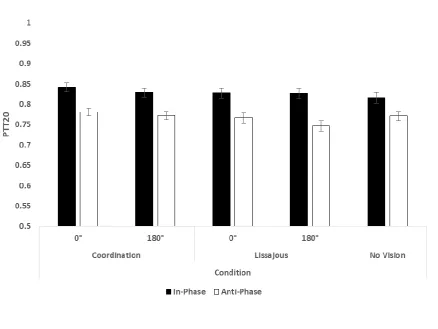
Refer to Figure 2. A three-way repeated measures ANOVA on PTT20 revealed significant main effects
of Egocentric Relative Phase (F(1, 31) = 85.8, p < .01, ηp² = .74), Allocentric Relative Phase (F(1, 31) =
8.17, p < .01, ηp² = .21), and Feedback Display (F(1, 31) = 7.53, p < .05, ηp² = .20). Participants were
able to produce the target relative phase more stably with In-Phase movements (M = .83, SD = .07)
than with Anti-Phase Movements (M = .77, SD = .06); with Allocentric Relative Phase at 0° (M = .80,
SD = .07) than with it at 180° (M = .79, SD = .07); and with Coordination feedback (M = .81, SD = .07)
A one-way paired samples Student’s t-test on PTT20 revealed a significant difference between
Egocentric Relative Phase conditions in the No Vision control (t(31) = 3.78, p < .01). As predicted,
In-Phase movements (M = .82, SD = .08) were more stable than Anti-In-Phase movements (M = .77, SD =
.06).
Coordination Consistency (SD
Ψ
)
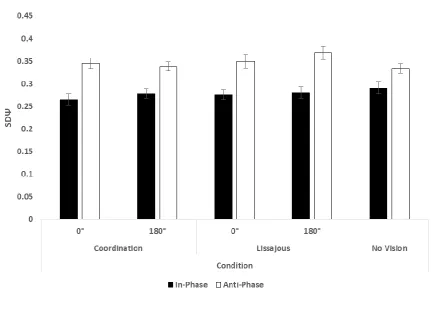
Refer to Figure 3. A three-way repeated measures ANOVA on SDΨ revealed significant main effects
of Egocentric Relative Phase (F(1, 31) = 73.7, p < .001, ηp² = .70); and Allocentric Relative Phase (F(1,
31) = 4.33, p = .046, ηp² = .12). Participants were able to move more consistently using In-Phase
movements (M = .27, SD = .07) that with Anti-Phase movements (M = .35, SD = .07) and with
Allocentric Relative Phase at 0° (M = .31, SD = .08) than at 180° (M = .32, SD = .08). The main effect
of Feedback Display was only close to significance (F(1, 31) = 4.00, p = .054). No interactions were
significant (all ps > .164).
A directional paired samples Student’s t-test on SDΨ revealed a significant difference between
Egocentric Relative Phase conditions in the No Vision control (t(31) = 3.37, p <.01). As predicted,
In-Phase movements (M = .29, SD = .08) were more consistent than Anti-In-Phase movements (M = .31,
Discussion
This experiment evaluated the contributions of egocentric relative phase, allocentric relative phase
and allocentric display format on coordination stability and consistency. To improve and build upon
previous work, we separated the egocentric and allocentric constraints without confounding the
required actions by altering the plane of the movements or posture of the hands across conditions.
In-phase movements were more stable than anti-phase movements, 0° was produced more stably
than 180°, and Coordination feedback led to more stable performance than Lissajous feedback. The
egocentric effect was by far the largest. This pattern is consistent with previous studies and expands
the result to demonstrate how the format of the visual feedback also affects stability.
On one hand, our data seems to support models of coordinated rhythmic movement in which the
egocentric constraint (modelled as muscle homology and neural crosstalk) is the primary factor in
coordination stability (e.g. Beek et al, 2002; Cattaert et al, 1999; Daffertshofer et al, 2005) over
perception-action models that currently emphasise the allocentric constraint (e.g. Bingham, 2001,
2004a, b; Snapp-Childs et al, 2011). In order to develop the Bingham model to account for the
egocentric constraint, we need to consider the evidence about the source of the egocentric
constraint, and that evidence does not entirely favour a neural crosstalk explanation.
What Is the Source of the Egocentric Constraint?
As described in the Introduction, the current candidate explanation for the egocentric constraint on
coordination stability involves neural crosstalk and interference. The basic idea is that neural
commands sent to the two limbs interfere with one another when non-homologous muscles are
required, and that this interference occurs in the brain.
However, Swinnen, Dounskaia & Duysens (2002) tested this hypothesis by manipulating where in the
workspace the coordinated movements were happening, while Swinnen, Dounskaia, Levin, &
Duysens (2001) spring loaded the arms producing the movements to affect patterns of muscle
an egocentric frame of reference, this frame was not being defined with respect to patterns of
muscle activation. Swinnen et al (2002) concluded that because the egocentric frame of reference
was abstracted away from the details of the limbs, it was the result of how the brain encodes
direction information.
To align this result with the ecological approach underpinning the Bingham model (Golonka &
Wilson, 2012), we would like to reframe this conclusion in terms of perception. From an ecological
point of view, the first place to look for an explanation for structure in behaviour is in the structure
of the perceptual information used to coordinate and control the behaviour. In the case of
coordinated rhythmic movement, one source of information is the relative direction of motion of
local regions of optic flow. The medium of the optic array in which this flow occurs shares the
allocentric frame of reference of the things moving in the world. This is why the allocentric
constraint is a factor in coordination stability and why it is implemented the way that it is in the
perception-action Bingham model (Bingham, 2001, 2004a, b; Snapp-Childs et al, 2011).
Unlike the optic array, the medium of haptic perception is literally composed of body tissue (Turvey
& Fonseca, 2014) and so the frame of reference is often egocentric (Kappers & Bergmann Tiest,
2015). We therefore propose that the source of the egocentric constraints on coordination stability
is not the brain, but the haptic perception of relative phase. We also propose that the haptic
information will also be relative direction of motion (as in vision), just measured in an egocentric
frame of reference.
There is some supporting evidence for this perceptual (vs neural) analysis, although none comes
from work explicitly designed to test the hypothesis. Wilson, Bingham & Craig (2003) tested the
haptic perception of relative phase variability, and showed that the information here was the
relative direction of motion. The coordinated movements to be judged were tracked, not generated
by the participants, and so neural crosstalk is unlikely to have played a role. However, the
relative direction produce the same answer; future work should test haptic judgments in the
fronto-parallel plane or with different limb postures. More recently, Zhu, Mirich, Huang, Snapp-Childs &
Bingham (2017) showed that people could learn a novel 90° coordination with either visual or haptic
feedback, but that this training did not transfer across modalities. This would be expected if the
frames of reference are incompatible (although it is not the only explanation). Finally, the work by
Swinnen et al (2001, 2002) suggests that it is the frame of reference in which direction information is
treated that matters most, and ecologically that frame is best analysed in terms of perception,
rather than at the level of neural encoding.
The perceptual hypothesis remains speculative, however, and it needs data from a programme of
research matching the investigation of the visual perception of relative phase (see Wilson, Huang,
Bingham & Zhu, 2018 for an initial, exploratory analysis). The resulting understanding of the haptic
perception of relative phase could then be implemented in an extended version of the Bingham
model, and the competing hypotheses about the origins of the egocentric constraint tested
explicitly.
Summary
The current experiment examined the effects of egocentric relative phase, allocentric relative phase
and feedback format on coordination stability and showed that while all three factors matter,
egocentric relative phase has the largest effect. In order to move towards expanding Bingham’s
perception-action model to include the egocentric constraint, we considered the existing evidence
for what, in the human body, seems to be implementing that constraint. Although the effects have
been discussed for many years in terms of muscle homology and neural cross-talk, recent evidence
favours direction information being either neurally encoded (Swinnen, 2001, 2002) or, as we suggest
here, ecologically perceived in an egocentric frame of reference that is not defined by patterns of
References
Amazeen, E., DaSilva, F., & Amazeen, P. (2008). Visual–spatial and anatomical constraints interact in
a bimanual coordination task with transformed visual feedback. Experimental Brain Research,
191(1), 13-24.
Batschelet, E. (1981). Circular statistics in biology. NY, Academic Press.
Beek, P. J., Peper, C. E., & Daffertshofer, A. (2002). Modeling rhythmic interlimb coordination:
Beyond the Haken–Kelso–Bunz model. Brain and Cognition, 48(1), 149-165.
Bingham, G. P. (2001). A perceptually driven dynamical model of rhythmic limb movement and
bimanual coordination. In Proceedings of the 23rd Annual Conference of the Cognitive Science
Society (pp. 75-79).
Bingham, G. (2004a). A perceptually driven dynamical model of bimanual rhythmic movement (and
phase perception). Ecological Psychology, 16(1), 45-53.
Bingham, G. P. (2004). Another timing variable composed of state variables: phase perception and
phase driven oscillators. In Advances in Psychology (Vol. 135, pp. 421-442). North-Holland.
Bingham, G., Schmidt, R., & Zaal, F. (1999). Visual perception of the relative phasing of human limb
movements. Perception & Psychophysics, 61(2), 246-258.
Bingham, G. P., Zaal, F. T., Shull, J. A., & Collins, D. R. (2001). The effect of frequency on the visual
perception of relative phase and phase variability of two oscillating objects. Experimental
Brain Research, 136(4), 543-552.
Bogaerts, H., Buekers, M. J., Zaal, F. T., & Swinnen, S. P. (2003). When visuo-motor incongruence aids
motor performance: the effect of perceiving motion structures during transformed visual
feedback on bimanual coordination. Behavioural Brain Research, 138(1), 45-57.
Brandes, J., Rezvani, F., & Heed, T. (2017). Abstract spatial, but not body-related, visual information
guides bimanual coordination. Scientific Reports, 7(1), 16732.
Cattaert, D., Semjen, A., & Summers, J. J. (1999). Simulating a neural cross-talk model for
between-hand interference during bimanual circle drawing. Biological Cybernetics, 81(4), 343-358.
Daffertshofer, A., Peper, C. L. E., & Beek, P. J. (2005). Stabilization of bimanual coordination due to
active interhemispheric inhibition: a dynamical account. Biological Cybernetics, 92(2),
101-109.
Golonka, S., & Wilson, A. D. (2012). Gibson’s ecological approach. Avant: Trends in Interdisciplinary
Studies 3 (2), 40-53.
Haken, H., Kelso, J. S., & Bunz, H. (1985). A theoretical model of phase transitions in human hand
movements. Biological Cybernetics, 51(5), 347-356.
JASP Team (2018). JASP (Version 0.8.5) [Computer software].
Kagerer, F. A., Summers, J. J., & Semjen, A. (2003). Instabilities during antiphase bimanual
movements: Are ipsilateral pathways involved? Experimental Brain Research, 151, 489–500.
Kappers, A. M. L. & Bergmann Tiest, W. M. (2015) Haptic Perception. In The Cambridge Handbook of
Applied Perception Research. Hoffman, R. R., Scerbo, M. W., Parasuraman, R. & Szalma, J. L.
(eds.). New York, NY: Cambridge University Press, p. 345-365.
Kelso, J. A. (1984). Phase transitions and critical behavior in human bimanual coordination. American
Journal of Physiology-Regulatory, Integrative and Comparative Physiology, 246(6),
R1000-R1004.
Kelso, J. A. S. (1995). Dynamic Patterns. Cambridge, Mass.: MIT Press.
Kennedy, D. M., Wang, C., Panzer, S., & Shea, C. H. (2016). Continuous scanning trials: transitioning
Kleiner, M., Brainard, D., Pelli, D., Ingling, A., Murray, R., & Broussard, C. (2007). What’s new in
Psychtoolbox-3. Perception, 36(14), 1.
Kovacs, A., Buchanan, J., & Shea, C. (2009a). Bimanual 1:1 with 90° continuous relative phase:
difficult or easy! Experimental Brain Research, 193 (1), 129-136.
Kovacs, A., Buchanan, J., & Shea, C. (2009b). Using scanning trials to assess intrinsic coordination
dynamics Neuroscience Letters, 455 (3), 162-167.
Kovacs, A., & Shea, C. (2010). Amplitude differences, spatial assimilation, and integrated feedback in
bimanual coordination Experimental Brain Research, 202 (2), 519-525.
Kovacs, A. J., & Shea, C. H. (2011). The learning of 90 continuous relative phase with and without
Lissajous feedback: External and internally generated bimanual coordination. Acta
Psychologica, 136(3), 311–320.
Lee, T. D., Swinnen, S. P., & Verschueren, S. (1995). Relative phase alterations during bimanual skill
acquisition. Journal of Motor Behavior, 27(3), 263-274.
Li, Y., Levin, O., Forner-Cordero, A., Ronsse, R., & Swinnen, S. P. (2009). Coordination of complex
bimanual multijoint movements under increasing cycling frequencies: the prevalence of
mirror-image and translational symmetry. Acta Psychologica, 130(3), 183-195.
Marteniuk, R. G., MacKenzie, C. L., & Baba, D. M. (1984). Bimanual movement control: Information
processing and interaction effects. The Quarterly Journal of Experimental Psychology Section
A, 36(2), 335-365.
Maslovat, D., Brunke, K. M., Chua, R., & Franks, I. M. (2009). Feedback effects on learning a novel
bimanual coordination pattern: Support for the guidance hypothesis. Journal of Motor
Meesen, R. L. J., Wenderoth, N., Temprado, J. J., Summers, J. J., & Swinnen, S. P. (2006). The coalition
of constraints during coordination of ipsilateral and heterolateral limbs. Experimental Brain
Research, 174, 367–375.
Mechsner, F., Kerzel, D., Knoblich, G., & Prinz, W. (2001). Perceptual basis of bimanual coordination.
Nature, 414(6859), 69-73.
Park H., Turvey M.T. (2008) Imperfect Symmetry and the Elementary Coordination Law. In: Fuchs A.,
Jirsa V.K. (eds) Coordination: Neural, Behavioral and Social Dynamics. Understanding Complex
Systems. Springer, Berlin, Heidelberg.
Peper, C. E., de Boer, B. J., de Poel, H. J., & Beek, P. J. (2008). Interlimb coupling strength scales with
movement amplitude. Neuroscience Letters, 437, 10–14.
Peper, C. L. E., Ridderikhoff, A., Daffertshofer, A., & Beek, P. J. (2004). Explanatory limitations of the
HKB model: Incentives for a two-tiered model of rhythmic interlimb coordination. Human
Movement Science, 23(5), 673-697.
Salesse, R., Temprado, J. J., & Swinnen, S. P. (2005). Interaction of neuromuscular, spatial, and visual
constraints on hand-foot coordination dynamics. Human Movement Science, 24, 66–80.
Schmidt, R. C., Carello, C., & Turvey, M. T. (1990). Phase transitions and critical fluctuations in the
visual coordination of rhythmic movements between people. Journal of Experimental
Psychology: Human Perception and Performance, 16(2), 227.
Serrien, D. J., & Swinnen, S. P. (1997). Coordination constraints induced by effector combination
under isofrequency and multifrequency conditions. Journal of Experimental Psychology:
Human Perception and Performance, 23(5), 1493.
Snapp-Childs, W., Wilson, A. D., & Bingham, G. P. (2011). The stability of rhythmic movement
coordination depends on relative speed: the Bingham model supported. Experimental Brain
Swinnen, S. P. (2002). Intermanual coordination: from behavioural principles to neural-network
interactions. Nature Reviews: Neuroscience, 3(5), 348-359.
Swinnen, S. P., Dounskaia, N., & Duysens, J. (2002). Patterns of bimanual interference reveal
movement encoding within a radial egocentric reference frame. Journal of Cognitive
Neuroscience, 14(3), 463-471.
Swinnen, S. P., Dounskaia, N., Levin, O., & Duysens, J. (2001). Constraints during bimanual
coordination: the role of direction in relation to amplitude and force
requirements. Behavioural Brain Research, 123(2), 201-218.
Swinnen, S. P., Dounskaia, N., Verschueren, S., Serrien, D. J., & Daelman, A. (1990). Relative phase
destabilization during interlimb coordination: the disruptive role of kinesthetic afferences
induced by passive movement. Experimental Brain Research, 105(3), 439-454.
Swinnen, S. P., Young, D. E., Walter, C. B., & Serrien, D. J. (1991). Control of asymmetrical bimanual
movements. Experimental Brain Research, 85(1), 163-173.
Temprado, J., Swinnen, S., Carson, R., Tourment, A., & Laurent, M. (2003). Interaction of directional,
neuromuscular and egocentric constraints on the stability of preferred bimanual coordination
patterns. Human Movement Science, 22(3), 339-363.
Turvey, M. T., & Fonseca, S. T. (2014). The medium of haptic perception: a tensegrity
hypothesis. Journal of Motor Behavior, 46(3), 143-187.
Wilson, A. D., & Bingham, G. P. (2008). Identifying the information for the visual perception of
relative phase. Perception & Psychophysics, 70(3), 465-476.
Wilson, A. D., Bingham, G. P., & Craig, J. C. (2003). Proprioceptive perception of phase
variability. Journal of Experimental Psychology: Human Perception and Performance, 29(6),
Wilson, A. D., Snapp-Childs, W., & Bingham, G. P. (2010). Perceptual learning immediately yields new
stable motor coordination. Journal of Experimental Psychology: Human Perception and
Performance, 36(6), 1508.
Wilson, A. D., Snapp-Childs, W., Coats, R., & Bingham, G. P. (2010). Learning a coordinated rhythmic
movement with task-appropriate coordination feedback. Experimental Brain Research, 205(4),
513-520.
Wilson, A. D., Collins, D. R., & Bingham, G. P. (2005a). Perceptual coupling in rhythmic movement
coordination: stable perception leads to stable action. Experimental Brain Research, 164(4),
517-528.
Wilson, A. D., Collins, D. R., & Bingham, G. P. (2005b). Human movement coordination implicates
relative direction as the information for relative phase. Experimental Brain Research, 165(3),
351-361.
Wilson, A. D., Huang, S., Bingham, G. P., & Zhu, Q. (2018). Age reduces the egocentric constraint on
coordination stability; An exploratory report. Manuscript under review.
Wimmers, R. H., Beek, P. J., & van Wieringen, P. C. (1992). Phase transitions in rhythmic tracking
movements: A case of unilateral coupling. Human Movement Science, 11(1-2), 217-226.
Zaal, F. T., Bingham, G. P., & Schmidt, R. C. (2000). Visual perception of mean relative phase and
phase variability. Journal of Experimental Psychology: Human Perception and
Performance, 26(3), 1209.
Zanone, P. G., & Kelso, J. A. S. (1992a). Evolution of behavioral attractors with learning:
Nonequilibrium phase transitions. Journal of Experimental Psychology: Human Perception and
Zanone, P. G., & Kelso, J. A. S. (1992b). Learning and transfer as dynamical paradigms for behavioral
change. In Tutorials in Motor Behavior II, Advances in Psychology (Stelmach, G., & Requin, J.,
Eds.). Amsterdam: North-Holland.
Zanone, P. G., & Kelso, J. A. S. (1997). Coordination dynamics of learning and transfer: Collective and
component levels. Journal of Experimental Psychology: Human Perception and Performance,
23(5), 1454-1480.
Zhu, Q., Mirich, T., Huang, S., Snapp-Childs, W., & Bingham, G. P. (2017). When kinesthetic
information is neglected in learning a Novel bimanual rhythmic coordination. Attention,
Tables
A
Sets
1 2 3 4 5
Block 1 (5x 20s trials) Coordination Allocentric 0° Egocentric In-Phase Coordination Allocentric 0° Egocentric Anti-Phase Lissajous Allocentric 0° Egocentric In-Phase Lissajous Allocentric 0° Egocentric Anti-Phase No Vision Egocentric Anti-Phase Block 2 (5x 20s trials) Coordination Allocentric 180° Egocentric Anti-Phase Coordination Allocentric 180° Egocentric In-Phase Lissajous Allocentric 180° Egocentric Anti-Phase Lissajous Allocentric 180° Egocentric In-Phase No Vision Egocentric In-Phase B
Set Order 1 1 2 3 4 5
Set Order 2 1 2 4 3 5
Set Order 3 2 1 3 4 5
Set Order 4 2 1 4 3 5
Set Order 5 3 4 1 2 5
Set Order 6 3 4 2 1 5
Set Order 7 4 3 1 2 5
Set Order 8 4 3 2 1 5
Table 1.
A) We created 5 different sets of trials. Participants either did all the Coordination conditions first, or
all the Lissajous conditions first, then switched. The No Vision set was always done last. Within a set,
Allocentric 0° was always the first block of trials, and Allocentric 180° the second. We then
alternated the actions required (Egocentric In-Phase or Egocentric Anti-Phase) to achieve each target
Allocentric Relative Phase so that a different movement was required to produce each display
behaviour. This set-up allowed some counterbalancing of conditions while not overloading the
participant with constantly changing task demands.
Figures
Figure 1.
Schematic of the experimental apparatus and conditions. A) Coordination feedback and Lissajous
feedback depicted with Allocentric Relative Phases of 0° and 180°. B) Apparatus. Dotted line
denotes the solid box concealing joysticks. C) Egocentric conditions: In-Phase movements required
Figure 2.
Proportion time-on-target (PTT20) across all conditions. All three main effects were significant, and
Figure 3.
Coordination consistency (SDΨ) across all conditions. The main effects of Egocentric and Allocentric
Relative Phase were significant, and the two No Vision conditions were also different in the