BioMed Central
Page 1 of 10
(page number not for citation purposes)
BMC Musculoskeletal Disorders
Open Access
Research article
A systematic review of outcomes assessed in randomized
controlled trials of surgical interventions for carpal tunnel
syndrome using the International Classification of Functioning,
Disability and Health (ICF) as a reference tool
Christina Jerosch-Herold*, José C de Carvalho Leite and Fujian Song
Address: School of Allied Health Professions, University of East Anglia, Norwich, UK
Email: Christina Jerosch-Herold* - [email protected]; José C de Carvalho Leite - [email protected]; Fujian Song - [email protected]
* Corresponding author
Abstract
Background: A wide range of outcomes have been assessed in trials of interventions for carpal tunnel syndrome (CTS), however there appears to be little consensus on what constitutes the most relevant outcomes. The purpose of this systematic review was to identify the outcomes assessed in randomized clinical trials of surgical interventions for CTS and to compare these to the concepts contained in the International Classification of Functioning, Disability and Health (ICF).
Methods: The bibliographic databases Medline, AMED and CINAHL were searched for randomized controlled trials of surgical treatment for CTS. The outcomes assessed in these trials were identified, classified and linked to the different domains of the ICF.
Results: Twenty-eight studies were retrieved which met the inclusion criteria. The most frequently assessed outcomes were self-reported symptom resolution, grip or pinch strength and return to work. The majority of outcome measures employed assessed impairment of body function and body structure and a small number of studies used measures of activity and participation.
Conclusion: The ICF provides a useful framework for identifying the concepts contained in outcome measures employed to date in trials of surgical intervention for CTS and may help in the selection of the most appropriate domains to be assessed, especially where studies are designed to capture the impact of the intervention at individual and societal level. Comparison of results from different studies and meta-analysis would be facilitated through the use of a core set of standardised outcome measures which cross all domains of the ICF. Further work on developing consensus on such a core set is needed.
Published: 05 December 2006
BMC Musculoskeletal Disorders 2006, 7:96 doi:10.1186/1471-2474-7-96
Received: 17 August 2006 Accepted: 05 December 2006
This article is available from: http://www.biomedcentral.com/1471-2474/7/96
© 2006 Jerosch-Herold et al; licensee BioMed Central Ltd.
Background
Carpal tunnel syndrome is the most common peripheral entrapment neuropathy and a frequent cause of disability in the upper extremity[1]. Surgical release or decompres-sion rates in the USA amount to 400,000 to 500,000 per year [2] and 43 to 74 per 100,000 in the UK[3]. Conserv-ative treatment of CTS also accounts for a large proportion of resources and includes splinting, nerve gliding, ultra-sound and carpal bone mobilisation[2]. Whilst the reported success rates of carpal tunnel release range from 70 to 90 percent there is little agreement on how results should be evaluated[4].
The evidence from trials evaluating the outcomes from surgical and non-surgical interventions is extensive[2,5], however the pooling of results as required for meta-anal-ysis has been impeded by the wide range of outcome measures used. Outcomes from carpal tunnel release have been assessed in many different ways including objective nerve conduction studies, clinical measures of sensibility, muscle function and dexterity, patient-reported symp-toms and perceived function and the impact on daily activity, work and leisure. It has also been noted, that there is a lack of consensus among clinicians over what constitutes the most reliable, valid and responsive instru-ments to evaluate outcomes in carpal tunnel syn-drome[4,6].
Outcome measures should not only capture the impact of the disorder on body structure (impairments) but also on activities and participation as defined in the International Classification of Functioning, Disability and Health (ICF)[7]. The ICF is part of the family of International Classifications developed by the World Health Organisa-tion[7]. It provides a framework which uses unifying ter-minology for the classification of diseases and their effect on body structure and functioning, activities and partici-pation. The ICF complements existing classifications sys-tems such as the International Statistical Classification of Diseases and related health problems – ICD-10. The ICF is particularly useful to understand and measure health outcomes which look beyond mortality and morbidity [7] as it reflects a biopsychosocial perspective describing the impact of disease from an individual and societal perspec-tive. Its applications in health are manifold, including outcome evaluation and work is underway linking the measurement of health status in different patient popula-tions with the ICF[8].
Given the wide range of outcomes that have been employed in trials of surgical interventions for CTS and the lack of consensus among clinicians on what are con-sidered the most relevant outcomes to assess [4]it was hypothesised that linking the outcomes to the ICF would highlight where outcome measures overlap in the
con-cepts and domains which they assess and whether the existing outcomes assessed encompass all aspects of func-tioning as conceptualised by the ICF. The results of such a review may inform the selection of outcome domains and respective instruments for future trials on interventions in CTS. Similar work has already been undertaken in the fields of back pain, osteoarthritis [9] and stroke [10] and this in turn has resulted in the development of consensus on core sets for outcome assessment in these populations.
Methods
A systematic review was performed to identify the out-comes assessed and concepts contained in the measures used in trials of interventions for CTS, and to relate these concepts to the ICF as a reference tool.
Search strategy
The bibliographic databases Medline (January 1966 to July 2005), CINAHL (January 1982 to July 2005), AMED (Jan-uary 1985 to July 2005) were searched using the following MeSH terms: randomized controlled trial, controlled clin-ical trial, carpal tunnel decompression, carpal tunnel release, carpal tunnel surgery. The titles and abstracts of articles retrieved through the search were checked apply-ing the eligibility criteria as defined below. In order to crosscheck the sensitivity of the search strategy and iden-tify any studies not retrieved through the search the bibli-ographies of a Cochrane review on surgical interventions for CTS were also examined[5].
Study selection criteria and procedures
The review considered all published studies if they met the following eligibility criteria: randomized or quasi-rand-omized trials, the interventions were surgical, the patients had a diagnosis of CTS made through clinical symptoms with or without confirmatory electrodiagnostic testing, and the outcomes assessed were described. Studies designed solely for the purpose of evaluating the effective-ness of different local anaesthesia on pain during or within 48 hours of surgery were excluded.
BMC Musculoskeletal Disorders 2006, 7:96 http://www.biomedcentral.com/1471-2474/7/96
Page 3 of 10
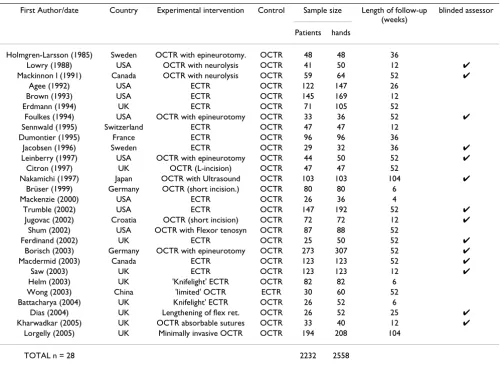
[image:3.612.55.555.355.721.2](page number not for citation purposes) Table 1: Summary of randomized controlled trials of surgical interventions for carpal tunnel syndrome
First Author/date Country Experimental intervention Control Sample size Length of follow-up
(weeks)
blinded assessor
Patients hands
Holmgren-Larsson (1985) Sweden OCTR with epineurotomy. OCTR 48 48 36
Lowry (1988) USA OCTR with neurolysis OCTR 41 50 12 ✔
Mackinnon l (1991) Canada OCTR with neurolysis OCTR 59 64 52 ✔
Agee (1992) USA ECTR OCTR 122 147 26
Brown (1993) USA ECTR OCTR 145 169 12
Erdmann (1994) UK ECTR OCTR 71 105 52
Foulkes (1994) USA OCTR with epineurotomy OCTR 33 36 52 ✔
Sennwald (1995) Switzerland ECTR OCTR 47 47 12
Dumontier (1995) France ECTR OCTR 96 96 36
Jacobsen (1996) Sweden ECTR OCTR 29 32 36 ✔
Leinberry (1997) USA OCTR with epineurotomy OCTR 44 50 52 ✔
Citron (1997) UK OCTR (L-incision) OCTR 47 47 52
Nakamichi (1997) Japan OCTR with Ultrasound OCTR 103 103 104 ✔
Brüser (1999) Germany OCTR (short incision.) OCTR 80 80 6
Mackenzie (2000) USA ECTR OCTR 26 36 4
Trumble (2002) USA ECTR OCTR 147 192 52 ✔
Jugovac (2002) Croatia OCTR (short incision) OCTR 72 72 12 ✔
Shum (2002) USA OCTR with Flexor tenosyn OCTR 87 88 52
Ferdinand (2002) UK ECTR OCTR 25 50 52 ✔
Borisch (2003) Germany OCTR with epineurotomy OCTR 273 307 52 ✔
Macdermid (2003) Canada ECTR OCTR 123 123 52 ✔
Saw (2003) UK ECTR OCTR 123 123 12 ✔
Helm (2003) UK 'Knifelight' ECTR OCTR 82 82 6
Wong (2003) China 'limited' OCTR ECTR 30 60 52
Battacharya (2004) UK Knifelight' ECTR OCTR 26 52 6
Dias (2004) UK Lengthening of flex ret. OCTR 26 52 25 ✔
Kharwadkar (2005) UK OCTR absorbable sutures OCTR 33 40 12 ✔
Lorgelly (2005) UK Minimally invasive OCTR OCTR 194 208 104
TOTAL n = 28 2232 2558
ECTR = endoscopic carpal tunnel release; OCTR = Open carpal tunnel release; flex ret. = flexor retinaculum; tenosyn = tenosynovectomy
reviewers and a data extraction form completed. Any dis-crepancies between reviewers were discussed and agreed.
Results
137 studies were identified through the initial search. After checking the abstracts and further review of the full-text article a total of 28 studies which met inclusion crite-ria were identified [13-40] A summary of the main study characteristics is shown in Table 1.
Review of studies and outcome domains assessed
The studies, conducted between 1985 and 2005, were all designed to evaluate the relative effectiveness of different surgical techniques such as endoscopic carpal tunnel release (ECTR) or open carpal tunnel release with or with-out epineurotomy. Standard open carpal tunnel release (OCTR) was the control intervention in 27 of the 28 trials. A total of 2558 hands in 2232 patients were studied in 28 studies. The length of follow-up after decompression var-ied greatly between the studies, ranging from 4 weeks to 2 years. The mean follow-up time was 37 weeks with 13
studies reporting follow-up at 1 year or longer. There was no apparent association between the type of outcomes assessed and other study characteristics such as the type of intervention studied, the length of follow-up or the coun-try of the study.
BMC Musculoskeletal Disorders
200
6,
7
:96
http
://www.bio
m
e
dcent
ral.com/147
1-247 Page 4 of
(page number not for citation purposes)
Pain, sensory, motor symptoms,
sleep disturbance
Grip Pinch MMT/
thenar atrophy
RoM Touch
threshold
2PD Vibration Nerve conduction
or interstitial pressure
Skin incisional complications
Pillar pain, causalgia
Holmgren (1985) ✔ NS ✔ ✔
Lowry (1988) ✔ NS ✔ ✔ ✔ ✔
Mackinnon (1991) ✔ NS ✔ ✔ ✔ ✔ ✔ ✔
Agee (1992) ✔ NS ✔ ✔ ✔ ✔ ✔ ✔
Brown (1993) ✔ NS ✔ ✔ ✔ ✔ ✔ ✔ ✔ ✔
Erdmann (1994) ✔ ✔ ✔ ✔ ✔
Foulkes (1994) ✔ NS ✔ ✔ ✔ ✔ ✔ ✔ ✔
Sennwald (1995) ✔ ✔ ✔ ✔ ✔
Dumontier (1995) ✔ NS ✔ ✔ ✔
Jacobsen (1996) ✔ NS ✔ ✔ ✔
Leinberry (1997) ✔ ✔ ✔
Citron (1997) ✔ NS ✔ ✔ ✔
Nakamichi (1997) ✔ NS ✔ ✔ ✔ ✔ ✔ ✔ ✔ ✔
Brüser (1999) ✔ NS ✔ ✔ ✔ ✔ ✔
Mackenzie (2000) ✔ BCTQ ✔ ✔
Trumble (2002) ✔ BCTQ ✔ ✔ ✔ ✔ ✔ ✔ ✔
Jugovac (2002) ✔ NS ✔ ✔ ✔ ✔
Shum (2002) ✔ BCTQ ✔ ✔ ✔ ✔
Ferdinand (2002) ✔ NS ✔ ✔ ✔ ✔ ✔ ✔ ✔
Borisch (2003) ✔ NS ✔ ✔
Macdermid (2003) ✔ BCTQ ✔ ✔ ✔ ✔
Saw (2003) ✔ BCTQ ✔ ✔
Helm (2003) ✔ NS ✔ ✔
Wong (2003) ✔ NS ✔ ✔ ✔ ✔ ✔
Battacharya (2004) ✔ NS ✔ ✔ ✔
Dias (2004) ✔ BCTQ ✔ ✔ ✔ ✔ ✔
Kharwadkar (2005) ✔ BCTQ ✔ ✔
Lorgelly (2005) ✔ BCTQ
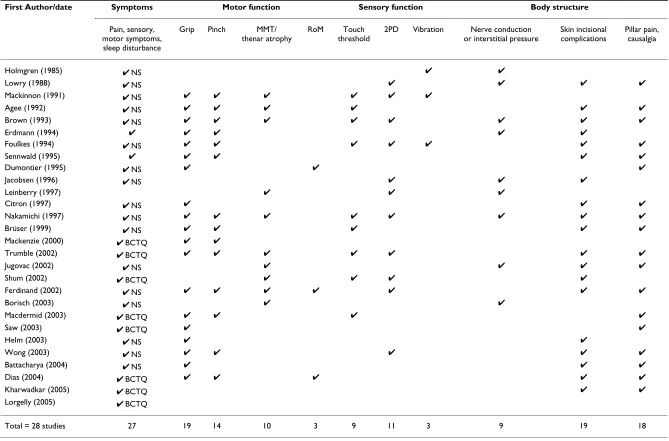
Total = 28 studies 27 19 14 10 3 9 11 3 9 19 18
[image:4.792.78.747.79.520.2]BMC Musculoskeletal Disorders 2006, 7:96 http://www.biomedcentral.com/1471-2474/7/96
Page 5 of 10
(page number not for citation purposes)
testing (MMT) and/or presence or absence of wasting of the thenar muscles. Sensibility was assessed in 15 studies and included touch threshold with monofilaments or the pressure specifying device (PSSD), two-point discrimina-tion and vibradiscrimina-tion. Other outcomes within the impair-ment domain included range of moveimpair-ment of wrist or fingers, nerve conduction studies and interstitial pressures of the carpal canal.
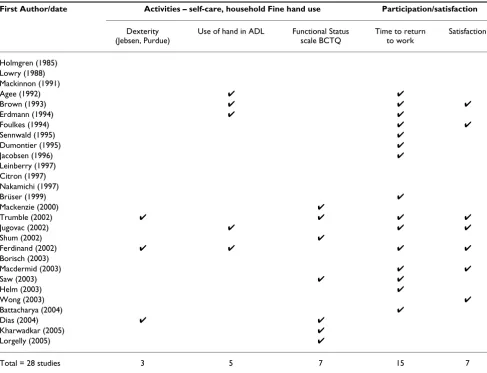
At the level of activity limitations, hand function was assessed with timed dexterity tests in three studies or through self-reported use of hand in activities of daily liv-ing includliv-ing the Functional Status Score of the BCTQ (12 studies). Measures of participation used in the trials were return to work which featured as a primary or secondary outcome measure in 15 studies and satisfaction (7 stud-ies).
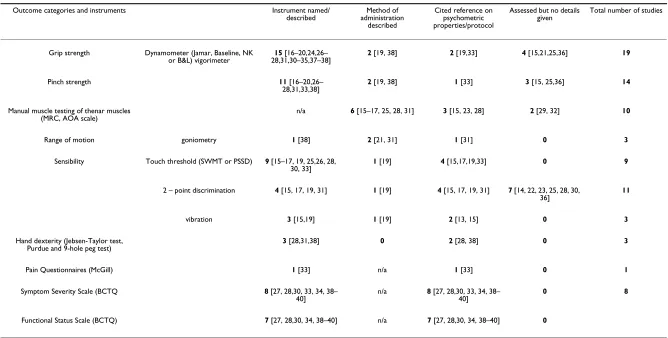
The level of reporting on the actual methods of assess-ment varied between studies. In several studies standard-ised outcome measures were used but with none or minimal detail on the actual instrument used, method of administration or reference to literature on standardised protocols. For example, 11 studies assessed two-point dis-crimination with only 4 studies stating the instrument used and one study describing the method (Table 4).
[image:5.612.59.546.109.482.2]The BCTQ, a standardised patient-based outcome meas-ure for use in CTS, started to featmeas-ure only in studies pub-lished in 2000 and later, despite the original paper by Levine dating back to 1993. Non-standardised methods of assessing symptom resolution continued to be reported in 6 studies post 2000 and included assessing a range of symptoms which patients were asked to rate on a 3 or 4 point ordinal scale or to indicate as present or absent.
Table 3: Outcomes assessed in RCTs of surgical interventions for CTS at the level of activity limitations and participation restrictions of the ICF
First Author/date Activities – self-care, household Fine hand use Participation/satisfaction
Dexterity (Jebsen, Purdue)
Use of hand in ADL Functional Status
scale BCTQ
Time to return to work
Satisfaction
Holmgren (1985) Lowry (1988) Mackinnon (1991)
Agee (1992) ✔ ✔
Brown (1993) ✔ ✔ ✔
Erdmann (1994) ✔ ✔
Foulkes (1994) ✔ ✔
Sennwald (1995) ✔
Dumontier (1995) ✔
Jacobsen (1996) ✔
Leinberry (1997) Citron (1997) Nakamichi (1997)
Brüser (1999) ✔
Mackenzie (2000) ✔
Trumble (2002) ✔ ✔ ✔ ✔
Jugovac (2002) ✔ ✔ ✔
Shum (2002) ✔
Ferdinand (2002) ✔ ✔ ✔ ✔
Borisch (2003)
Macdermid (2003) ✔ ✔
Saw (2003) ✔ ✔
Helm (2003) ✔
Wong (2003) ✔
Battacharya (2004) ✔
Dias (2004) ✔ ✔
Kharwadkar (2005) ✔
Lorgelly (2005) ✔
Total = 28 studies 3 5 7 15 7
BMC Musculoskeletal Disorders
200
6,
7
:96
http
://www.bio
m
e
dcent
ral.com/147
1-247 Page 6 of
(page number not for citation purposes)
Outcome categories and instruments Instrument named/
described
Method of administration
described
Cited reference on psychometric properties/protocol
Assessed but no details given
Total number of studies
Grip strength Dynamometer (Jamar, Baseline, NK or B&L) vigorimeter
15 [16–20,24,26– 28,31,30–35,37–38]
2 [19, 38] 2 [19,33] 4 [15,21,25,36] 19
Pinch strength 11 [16–20,26–
28,31,33,38]
2 [19, 38] 1 [33] 3 [15, 25,36] 14
Manual muscle testing of thenar muscles (MRC, AOA scale)
n/a 6 [15–17, 25, 28, 31] 3 [15, 23, 28] 2 [29, 32] 10
Range of motion goniometry 1 [38] 2 [21, 31] 1 [31] 0 3
Sensibility Touch threshold (SWMT or PSSD) 9 [15–17, 19, 25,26, 28, 30, 33]
1 [19] 4 [15,17,19,33] 0 9
2 – point discrimination 4 [15, 17, 19, 31] 1 [19] 4 [15, 17, 19, 31] 7 [14, 22, 23, 25, 28, 30, 36]
11
vibration 3 [15,19] 1 [19] 2 [13, 15] 0 3
Hand dexterity (Jebsen-Taylor test, Purdue and 9-hole peg test)
3 [28,31,38] 0 2 [28, 38] 0 3
Pain Questionnaires (McGill) 1 [33] n/a 1 [33] 0 1
Symptom Severity Scale (BCTQ 8 [27, 28,30, 33, 34, 38–
40]
n/a 8 [27, 28,30, 33, 34, 38– 40]
0 8
Functional Status Scale (BCTQ) 7 [27, 28,30, 34, 38–40] n/a 7 [27, 28,30, 34, 38–40] 0
[image:6.792.78.746.85.423.2]BMC Musculoskeletal Disorders 2006, 7:96 http://www.biomedcentral.com/1471-2474/7/96
Page 7 of 10
(page number not for citation purposes)
For some domains there were inconsistencies in the meth-ods of quantifying the outcome. Return to work was a pri-mary or secondary outcome in 15 studies and was often reported as the number of the days from surgery to resumption of employment. However, this is likely to vary between studies and depends on factors such as type of work undertaken (manual versus non-manual) employ-ment status (self-employed versus employee) and varia-tions in healthcare systems and how 'sick notes' are issued. The time taken to return to work also does not indicate whether someone is able to resume the activities without pain or discomfort and to the satisfaction of the individual and/or his employer. Furthermore, work as a measure of participation is not relevant to those patients who are not in employment or retired.
Linking outcomes assessed in CTS trials with the ICF
Current understanding of the pathophysiology of CTS together with the clinical manifestation of signs and symptoms allows the specific body structures and func-tions to be identified which are implicated in this disease. Depending on the severity of their symptoms, patients are also affected in their ability to carry out activities (activity limitations) and participation in work or leisure (partici-pation restrictions). These in turn are also influenced by personal and environmental factors [7].
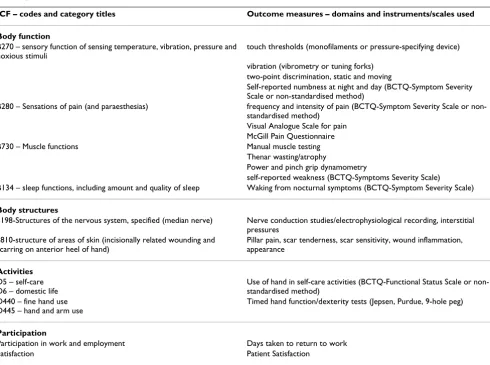
Using the ICF as a framework, firstly the codes and catego-ries within health and health-related domains relevant to CTS were identified (see figure 1). Secondly the outcomes assessed in the 28 studies retrieved were mapped to the relevant domains and categories of the ICF. Where
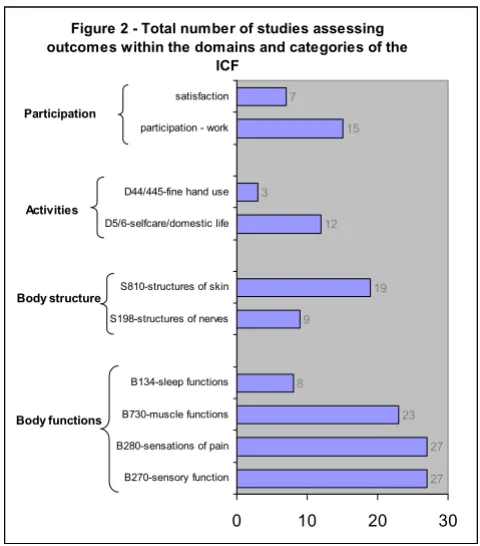
instru-ments contained subscales and several items these were individually assigned to the relevant category (see table 5). The frequency with which the domains and categories of the ICF were assessed in all 28 studies is presented in Figure 2.
The outcomes assessed in the 28 studies together covered all three domains of the ICF, that is, impairments of body structure and function, activity limitations and participa-tion restricparticipa-tions. However the majority of outcomes assessed focused on impairments of body structure and function, that is, sensory functions, sensations of pain, motor functions and sleep functions. Activity limitations and participation restrictions were assessed far less fre-quently in trials and included the patient-rated Functional Status Scale of the BCTQ, timed hand dexterity tests and self-reported time taken to resume activities of daily liv-ing, mostly self-care and household chores. Number of days taken to return to work or satisfaction were the only measures of participation restrictions.
Discussion
This systematic review has identified a wide range of out-come domains which were assessed in trials of surgical interventions and using a variety of methods and instru-ments. Based on the total count of studies which assessed different domains, self-reported resolution of symptoms, grip strength and return to work were the most frequently assessed outcomes.
The focus of these trials on assessing outcomes at the level of body function and structure and lesser use of measures of activity and participation concurs with findings from Gummerson et al [42] who reviewed trials of upper extremity disorders published in 4 journals over 11 years and totalling 92 studies. Only 41% of those studies reported outcomes on activity and participation.
Aspects such as the impact of CTS on functioning and health-related quality of life was included in only a few tri-als and limited to measures of days taken to return to work. A number of region-specific, patient-based outcome instruments which include questions about appearance, use of hand in self-care, work and leisure have been devel-oped in the last 10 years. Examples of these are the Patient Evaluation Measure (PEM)[43] and the Disabilities of the Arm, Shoulder and Hand Questionnaire (DASH)[44]. They are not disease-specific measures but region-specific and their validity has been tested in patient populations with a range of upper extremity musculoskeletal disor-ders, including CTS. Questions such as those from the DASH optional work module 'did you have difficulty using your usual technique at work?' or 'did you have difficulty in doing your work as well as you would like?' evaluate partici-pation in work and provide useful additional information Interaction of concepts of the ICF and relation to outcome
domains assessed in CTS trials (adapted from ICF, WHO 2002)
Figure 1
Interaction of concepts of the ICF and relation to outcome domains assessed in CTS trials (adapted from ICF, WHO 2002).
Health Condition/Disorder: Carpal Tunnel Syndrome
Body structures/body function
x sensory functions, x muscle functions, x sensations of pain in
median nerve distribution x sleep functions x structure of median
nerve
x structure of areas of skin
Activities (limitations)
x Self-care x domestic life x Hand and arm
use x fine hand use
Environmental and Personal factors
Participation (restrictions)
beyond the simple quantification of sick days. There are also a number of generic measures of health-related qual-ity of life, such as the SF-36 [45] which capture participa-tion and the psychosocial impact of the disease or disorder and which can be used in CTS patients. Of the RCTs reviewed, none used generic measures of participa-tion or other health-related quality of life or health status measures.
Whilst it is important to obtain a comprehensive assess-ment of the impact of CTS on body function and structure as well as activity and participation, the use of a large bat-tery of instruments also increases the burden on the patient and the tester. There was some overlap between the concepts assessed in trial outcomes. For example, in the domains body functioning, the functions of muscles were assessed by manual muscle testing of the abductor pollicis brevis muscle, dynamometry for pinch and power grip strength and degree of thenar wasting. In several trials two or more of these measures were used concurrently. A review of the evidence is needed on which of these
meth-ods and instruments is most valid, reliable and responsive which, in turn, reduces assessment burden and redun-dancy of similar outcome measures.
[image:8.612.62.552.104.469.2]The use of the disease-specific measure, the BCTQ is becoming more established in recent trials. A systematic review of the psychometric properties of the BCTQ indi-cated that it is valid for the population, has good reliabil-ity and is responsive [46] and should replace any other non-standardised methods for assessing self-reported symptom resolution and functional status. The two sub-scales together encompass the two domains of the ICF – body function and activities. The use of clinician-derived measures of motor and sensory function was high yet the lack of detail on instruments, methods of testing and ref-erence to published protocols or literature on psychomet-ric properties of these tests raises questions over whether these were employed in the same way, thus hindering comparability of results. There are several advantages to using standardised outcome measures: if data about the reproducibility and population-specific validity of an
Table 5: Classification of outcomes assessed in randomized controlled trials of surgical interventions for CTS according to the domains and categories of the ICF
ICF – codes and category titles Outcome measures – domains and instruments/scales used
Body function
B270 – sensory function of sensing temperature, vibration, pressure and noxious stimuli
touch thresholds (monofilaments or pressure-specifying device)
vibration (vibrometry or tuning forks) two-point discrimination, static and moving
Self-reported numbness at night and day (BCTQ-Symptom Severity Scale or non-standardised method)
B280 – Sensations of pain (and paraesthesias) frequency and intensity of pain (BCTQ-Symptom Severity Scale or
non-standardised method) Visual Analogue Scale for pain McGill Pain Questionnaire
B730 – Muscle functions Manual muscle testing
Thenar wasting/atrophy
Power and pinch grip dynamometry
self-reported weakness (BCTQ-Symptoms Severity Scale)
B134 – sleep functions, including amount and quality of sleep Waking from nocturnal symptoms (BCTQ-Symptom Severity Scale)
Body structures
S198-Structures of the nervous system, specified (median nerve) Nerve conduction studies/electrophysiological recording, interstitial
pressures S810-structure of areas of skin (incisionally related wounding and
scarring on anterior heel of hand)
Pillar pain, scar tenderness, scar sensitivity, wound inflammation, appearance
Activities
D5 – self-care D6 – domestic life
Use of hand in self-care activities (BCTQ-Functional Status Scale or non-standardised method)
D440 – fine hand use D445 – hand and arm use
Timed hand function/dexterity tests (Jepsen, Purdue, 9-hole peg)
Participation
Participation in work and employment Days taken to return to work
BMC Musculoskeletal Disorders 2006, 7:96 http://www.biomedcentral.com/1471-2474/7/96
Page 9 of 10
(page number not for citation purposes)
instrument are known the use of it as a primary outcome measure is justified; knowledge of the responsiveness of an outcome measures can inform sample size calculations which are important to ensure that studies are adequately powered; and finally, the results from several studies can be compared and pooled if the same outcomes have been assessed using the same standardised methods and instru-ments.
This review has some limitations: we considered RCTs only in this review, based on the assumption that in well-designed trials careful attention would be paid to the selection of outcome measures. There are however a number of large follow-up and cohort studies which also report outcomes from surgical decompression and inclu-sion of these studies may have highlighted additional out-come domains and instruments.
Conclusion
The ICF provides a useful framework for identifying the concepts contained in outcome measures employed to date in trials of surgical intervention for CTS. It can help in the selection of the most appropriate domains to be assessed, especially where studies are designed to capture the impact of the intervention at individual and societal level. The findings of this review on surgical outcomes
indicate that studies to date have focused primarily on assessment of impairment and less on the activity limita-tions and participation restriclimita-tions. It is important that consensus is achieved on which outcome measures should be used for which domains and on the standardi-sation of methods. A minimum set of outcome measures should include patient-reported scales of symptom sever-ity and functional status such as the BCTQ, clinical meas-ures of motor and sensory function and everyday performance in self-care, work and leisure as well as health-related quality of life. Further work is needed to review the psychometric properties of existing instru-ments in CTS populations and to develop consensus on a core set of outcome measures to be used in future clinical trials for CTS which crosses all three domains of the ICF.
Competing interests
The author(s) declare that they have no competing inter-ests.
Authors' contributions
CJH conceived of the original idea, obtained funding and participated in the search, review and drafting of the man-uscript. JCCL carried out the searching and reviewing of studies and helped draft the manuscript. FS provided expert advice on systematic reviewing and contributed to the manuscript. All authors read and approved the final manuscript.
Acknowledgements
The work was funded by the British Association of Hand Therapists Ltd through a research bursary award.
References
1. Lundborg G: Nerve injury and repair, regeneration,
recon-struction and cortical remodelling. 2nd edition. Philadelphia: Elsevier, Churchill Livingstone; 2004.
2. Mueller M, Tsui D, Schnurr R, Biddulph-Deisroth L, Hard J,
MacDer-mid JC: Effectiveness of hand therapy interventions in
pri-mary management of carpal tunnel syndrome: a systematic review. Journal of Hand Therapy 2004, 17(2):210-228.
3. Burke FD: Carpal tunnel syndrome: reconciling 'demand
management' with clinical need. Journal of Hand Surgery 2000,
25B(2):121-127.
4. Gerritsen AA, de Vet HC, Scholten RJ, van Tulder MW, Bouter LM:
Enabling meta-analysis in systematic reviews on carpal tun-nel syndrome. Journal of Hand Surgery 2002, 27A(5):828-832. 5. Scholten RJ, Gerritsen AA, Uitdehaag BM, van Geldere D, de Vet HC,
Bouter LM: Surgical treatment options for carpal tunnel syn-drome. Cochrane Database of Systematic Reviews 2004. Art. No.: CD003905.
6. O'Connor D, Marshall S, Massy-Westropp N: Non-surgical treat-ment (other than steroid injection) for carpal tunnel syn-drome. Cochrane Database of Systematic Reviews 2003. Art. No.: CD003219.
7. WHO: International Classification of Functioning, Disability
and Health. Geneva: World Health Organisation; 2002. 8. Cieza A, Brockow T, Ewert T, Amman E, Kollerits B, Chaterji S,
Ustun B, Stucki G: Linking health-status measurements to the International Classification of Functioning, Disability and Health. Journal of Rehabilitation Medicine 2002, 34:205-210. 9. Brockow T, Cieza A, Kuhlow H, Sigl T, Franke T, Harder M, Stucki G:
Identifying the concepts contained in outcome measures of clinical trials on musculoskeletal disorders and chronic
[image:9.612.55.295.87.360.2]wide-Total number of studies assessing outcome within the domains and categories of the ICF
Figure 2
Total number of studies assessing outcome within the domains and categories of the ICF.
Figure 2 - Total number of studies assessing outcomes within the domains and categories of the
ICF
27 27 23 8
9
19 12 3
15 7
0 10 20 30 B270-sensory function
B280-sensations of pain B730-muscle functions B134-sleep functions S198-structures of nerves S810-structures of skin D5/6-selfcare/domestic life D44/445-fine hand use participation - work satisfaction Participation
Activities
Body structure
spread pain using the International Classification of Func-tioning, Disability and Health as a Reference. Journal of Rehabilitation Medicine 2004:30-36.
10. Szilvia G, Brockow T, Cieza A, Ewert T, Omar Z, Resch KL: Identi-fying the concepts contained in outcome measures of clinical trials on stroke using the International Classification of Func-tioning, Disability and Health as a reference. Journal of Rehabil-itation Medicine 2002, 36(suppl 44):56-62.
11. Thoma A, Veltri K, Haines T, Duku E: A meta-analysis of rand-omized controlled trials comparing endoscopic and open carpal tunnel decompression. Plastic & Reconstructive Surgery
2004, 114(5):1137-1146.
12. Thoma A, Veltri K, Haines T, Duku E: A systematic review of
reviews comparing the effectiveness of endoscopic and open carpal tunnel decompression. Plastic & Reconstructive Surgery
2004, 113(4):1184-1191.
13. Holmgren-Larsson H, Leszniewski W, Linden U, Rabow L, Thorling J:
Internal neurolysis or ligament division only in carpal tunnel syndrome – results of a randomized study. Acta Neurochirurgica
1985, 74(3–4):118-121.
14. Lowry WE Jr, Follender AB: Interfascicular neurolysis in the severe carpal tunnel syndrome. A prospective, randomized, double-blind, controlled study. Clinical Orthopaedics & Related Research 1988, 227:251-254.
15. Mackinnon SE, McCabe S, Murray JF, Szalai JP, Kelly L, Novak C, Kin B, Burke GM: Internal neurolysis fails to improve the results of primary carpal tunnel decompression. Journal of Hand Surgery
1991, 16A(2):211-218.
16. Agee JM, McCarroll HR Jr, Tortosa RD, Berry DA, Szabo RM, Peimer CA: Endoscopic release of the carpal tunnel: a randomized prospective multicenter study. Journal of Hand Surgery 1992,
17A(6):987-995.
17. Brown RA, Gelberman RH, Seiler JG 3rd, Abrahamsson SO, Weiland AJ, Urbaniak JR, Schoenfeld DA, Furcolo D: Carpal tunnel release: a prospective, randomized assessment of open and endo-scopic methods. The Journal of Bone and Joint Surgery 1993, 75-A(9):1265-1275.
18. Erdmann MWH: Endoscopic carpal tunnel decompression.
Journal of Hand Surgery 1994, 19B(1):5-13.
19. Foulkes GD, Atkinson RE, Beuchel C, Doyle JR, Singer DI: Outcome following epineurotomy in carpal tunnel syndrome: a pro-spective, randomized clinical trial. Journal of Hand Surgery 1994,
19A(4):539-547.
20. Sennwald GR, Benedetti R: The value of one-portal endoscopic carpal tunnel release: a prospective randomized study. Knee Surgery, Sports Traumatology, Arthroscopy 1995, 3(2):113-116. 21. Dumontier C, Sokolow C, Leclercq C, Chauvin P: Early results of
conventional versus two-portal endoscopic carpal tunnel release. A prospective study. Journal of Hand Surgery 1995,
20B(5):658-662.
22. Jacobsen MB, Rahme H: A prospective, randomized study with
an independent observer comparing open carpal tunnel release with endoscopic carpal tunnel release. Journal of Hand Surgery 1996, 21B(2):202-204.
23. Leinberry CF, Hammond NL 3rd, Siegfried JW: The role of epineu-rotomy in the operative treatment of carpal tunnel syn-drome. Journal of Bone & Joint Surgery 1997, 79A(4):555-557. 24. Citron ND, Bendall SP: Local symptoms after open carpal
tun-nel release. A randomized prospective trial of two incisions. Journal of Hand Surgery 1997, 22B(3):317-321.
25. Nakamichi K, Tachibana S: Ultrasonographically assisted carpal tunnel release. Journal of Hand Surgery 1997, 22A(5):853-862. 26. Bruser P, Richter M, Larkin G, Lefering R: The operative
treat-ment of CTS and its relevance to endoscopic release. Euro-pean Journal of Plastic Surgery 1999, 22:80-84.
27. Mackenzie DJ, Hainer R, Wheatley MJ: Early recovery after endo-scopic vs. short-incision open carpal tunnel release. Annals of Plastic Surgery 2000, 44(6):601-604.
28. Trumble TE, Diao E, Abrams RA, Gilbert-Anderson MM: Single-por-tal endoscopic carpal tunnel release compared with open release. The Journal of Bone and Joint Surgery 2002,
84A(7):1107-1115.
29. Jugovac I, Burgic N, Micovic V, Radolovic-Prenc L, Uravic M, Gol-ubovic V, Stancic MF: Carpal tunnel release by limited palmar incision vs traditional open technique: randomized control-led trial. Croatian Medical Journal 2002, 43(1):33-36.
30. Shum C, Parisien M, Strauch RJ, Rosenwasser MP: The role of flexor tenosynovectomy in the operative treatment of carpal tun-nel syndrome. The Journal of Bone and Joint Surgery 2002,
84A(2):221-225.
31. Ferdinand RD, MacLean JGB: Endoscopic versus open carpal tun-nel release in bilateral carpal tuntun-nel syndrome: a prospec-tive, randomised, blinded assessment. The Journal of Bone and Joint Surgery 2002, 84B(3):375-9.
32. Borisch N, Haussmann P: Neurophysiological recovery after
open carpal tunnel decompression: comparison of simple decompression and decompression with epineurotomy. Jour-nal of Hand Surgery 2003, 28B(5):450-454.
33. Macdermid JC, Richards RS, Roth JH, Ross DC, King GJ: Endoscopic versus open carpal tunnel release: a randomized trial. Journal of Hand Surgery 2003, 28A(3):475-480.
34. Saw NL, Jones S, Shepstone L, Meyer M, Chapman PG, Logan AM:
Early outcome and cost-effectiveness of endoscopic versus open carpal tunnel release: a randomized prospective trial. Journal of Hand Surgery 2003, 28B(5):444-449.
35. Helm RH, Vaziri S: Evaluation of carpal tunnel release using the Knifelight instrument. Journal of Hand Surgery 2003,
28B(3):251-254.
36. Wong KC, Hung LK, Ho PC, Wong JM: Carpal tunnel release. A
prospective, randomised study of endoscopic versus limited-open methods. Journal of Bone & Joint Surgery 2003,
85B(6):863-868.
37. Bhattacharya R, Birdsall PD, Finn P, Stothard J: A randomized con-trolled trial of knifelight and open carpal tunnel release. Jour-nal of Hand Surgery 2004, 29B(2):113-115.
38. Dias JJ, Bhowal B, Wildin CJ, Thompson JR: Carpal tunnel decom-pression. Is lengthening of the flexor retinaculum better than simple division? Journal of Hand Surgery 2004,
29B(3):271-276.
39. Kharwadkar N, Naique S, Molitor PJ: Prospective randomized
trial comparing absorbable and non-absorbable sutures in open carpal tunnel release. Journal of Hand Surgery 2005,
30B(1):92-95.
40. Lorgelly PK, Dias JJ, Bradley MJ, Burke FD: Carpal tunnel syn-drome, the search for a cost-effective surgical intervention: a randomised controlled trial. Annals of the Royal College of Sur-geons of England 2005, 87(1):36-40.
41. Levine DW, Simmons BP, Koris MJ, Daltroy LH, Hohl GG, Fossel AH,
Katz JN: A self-administered questionnaire for the
assess-ment of severity of symptoms and functional status in carpal tunnel syndrome. The Journal of Bone & Joint Surgery 1993,
75A(11):1585-1592.
42. Gummesson C, Atroshi I, Ekdahl C: The quality of reporting and outcome measures in randomized clinical trials related to upper-extremity disorders. Journal of Hand Surgery 2004,
29A:727-734.
43. Dias J, Bhowal B, Wildin C, Thompson J: Assessing the outcome of disorders of the hand: is the patient evaluation measure reliable, valid, responsive and without bias? The Journal of Bone and Joint Surgery 2001, 83-B(2):235-240.
44. Hudak P, Amadio P, Bombardier C, (UECG) TUECG: Development
of an upper extremity outcome measure: The DASH (Disa-bilities of the Arm, Shoulder, and Hand). American Journal of Industrial Medicine 1996, 29:602-608.
45. Ware J, Snow K, Kosinki M, Gandek B: The MOS 36-item
Short-Form Health Survey (SF-36). Boston: The Health Institute, New England Medical Center; 1993.
46. de Carvalho Leite JC, Jerosch-Herold C, Song F: A systematic review of the psychometric properties of the Boston Carpal Tunnel Questionnaire. BMC Musculoskeletal Disorders 2006, 7:78.
Pre-publication history
The pre-publication history for this paper can be accessed here: