2018 International Conference on Information, Electronic and Communication Engineering (IECE 2018) ISBN: 978-1-60595-585-8
The Research on Breaker Fault Status Parameter Classification of
Improved Particle Swarm Optimization
Yi-hang SUN, Jian GAO and Feng TIAN
Beijing Institute of Mechanical Equipment, Beijing, China 100854
Keywords: Circuit breaker, SVM, Vibration signal, PSO, Energy method, Fault diagnosis.
Abstract. In order to improve the mechanical structure of the type of fault resolution precision high voltage circuit breaker spring mechanism, the paper analyzes the characteristics of the circuit breaker and the combination of mechanical vibration signal PSO algorithm (PSO) SVM parameter optimization method proposed collaborative dynamic acceleration constant inertia weight particle swarm optimization (WCPSO) optimization support vector machine (SVM) analysis breaker fault classification parameters and kernel function parameters. The vibration signal circuit breaker empirical mode decomposition, the total intrinsic mode components through energy analysis to obtain the required fault feature vectors and support vector machine as input, the use of dynamic acceleration constant synergy inertia weight PSO
support vector machines penalty factor C and radial basis kernel function
parameters optimize the fault feature vector signal input test samples aft er SVM training
sample trained optimized for fault classification, fault status classification.
Introduction
With the maturity distribution automation systems, circuit breakers and distribution system as an important device has important significance for its fault diagnosis. Mechanical vibration signals generated breakers in sub-closing action contains a lot of state information, has
important practical implications for the analysis of vibration signals of these [1].
These frontier of contemporary theories and methods will inevitably penetrate into the diagnostic techniques in the past, making the diagnosis can almost simultaneous development
of these frontier[2-3]. Swarm intelligence optimization technology as a new technology, is a
new hot field of artificial intelligence research, which will be used in PSO breaker fault
diagnosis, a new hotspot[4-7]. social insects swarm intelligence is inspired by a series of new
solutions to complex problems through traditional simulation generated by their actions, it is the simple dumb many groups of individuals by a simple mutual cooperation between the
intelligent behavior exhibited. Among them, the PSO[8] (Particle Swarm Optimization, PSO) is
a J.Kennedy and RCEberhart proposed in 1995 based on the principle of swar m intelligence optimization algorithms, It converges fast, easy to implement and only a few parameters need to be adjusted, and thus was put forth to become intelligent optimization and evolutionary
computing a new hotspot[9-11].
How to use effective mathematical tool for runtime behavior of PSO, convergence, convergence speed, parameter selection, parameter robustness and computational complexity
of the analysis should be the current research focus[5].
Feature Vectors Extracted Based on the Total Weight of Energy by IMF
According to the test signal and the theoretical knowledge known techniques, regardless of the
actual dimensions in the case of the oscillating signals x t( )time integral of the square of
2
( )
x t is called the energy of the signal:
2
( ) | ( ) |
When the signal isx t( )discrete signal, the signal energy value added and interval signal, namely:
2 0
( ) n | ( ) | t
Q i x t t
(2)
Wheretis the sampling interval, the sampling interval is herein 0.05ms,Q i( )is the total
energy of the signal on the whole interval segment
Fault classification process block diagram shown in Figure1, the signal is first collected for EMD decomposition, IMF and extract feature vector component fault signal input in learning good SVM classification.
Feature Vector Extraction
SVM Fault Classification Signal
Acquisition
EMD Decomposition
Figure 1. Process of state detection.
(1) The original vibration signals of EMD, take the first n IMF component contains major faults, this paper takes the first six IMF components.
(2) Calculation of each IMF (discrete signal) a total energy componentQ i( ):
2 =0
( ) n i ( ) t
Q i c t dt
(n=5000) (3)
(3) The components of the total energy for IMF normalized:
i
( )
Q i E
E
(4)
WhereEiis the total energy IMF component,Eis the total energy of the original vibration
signal.
(4) IMF component to the total energy of the element structure eigenvectors T:
1 2
[ , ,..., n]
T E E E (5)
(5) Collaborative dynamic acceleration constant inertia weight PSO optimized SVM get better classification performance, using the training data SVM training.
(6) The fault input feature vectors of training samples tested in good optimized SVM, given the state of the circuit breaker failure type.
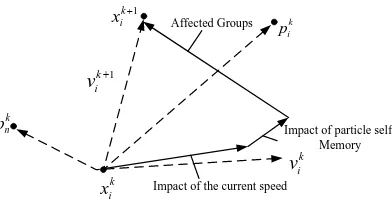
Collaborative Dynamic Acceleration Constant Inertia Weight Coefficient Particle Swarm Optimization Method
PSO tend to search the optimal solution is composed of two random acceleration constant cognitive factors and social factors c1 c2 guidance, c1 and c2 represent the stochastic particle acceleration value to their extreme right and extreme global advance. If c1 = c2 = 0, then the particles will be flying this speed until the border. In this case, the particles can only search a limited area, it is difficult to find a good solution. When c1 = 0, then no cognitive particles in particle interactions, the ability of the new algorithm search space. Its faster convergence rate than the standard algorithm, but encounter complex problems more easily than the standard algorithm into local pole. When c2 = 0, there is no sharing of information between the community particles, a size of the group is equivalent to running m a single particle, thereby obtaining a very low probability of the optimal solution.
Elementary particle swarm optimization algorithm for updating the formula :
1
1 1( ) 2 2( ), 1, 2,...
k k k k k k
i i i i n i
v v c r p x c r p x i
k i
x
k i
v
Impact of the current speed
Impact of particle self-Memory Affected Groups
1
k i x
1
k i
v
k i
p
[image:3.595.199.395.71.177.2]k n p
Figure 2. Particle location update.
Constant optimization of the dynamic equation and particle update formula :
c1=R1+R2.t/Tmax c2=R3-R4.t/Tmax (7) R1, R2, R3, R4 as the initial setting. t is the current update algebra, Tmax is the maximum update algebra. Wherein the selection is to select the initial setting of the simulation function calculated by the algorithm in the optimal range of values.
1
1 1( ) 2 2( ), , 1, 2,...
k k k k k k
i i i i n i
v v c r p x c r p x i k (8)
1 1
k k k
i i i
x x v , i, k =1,2,…n (9)
Whereis a coefficient of inertia weight, acceleration constants c1, c2 are non -negative
constants, r1, r2 uniformly distributed random numbers 0-1 on. 4 Improved PSO_SVM breaker fault condition in the classification
The number of employed population particle swarm is 30, the maximum is 300 algebra. R1 = 1.2, R2 = 0.6, R3 = 5, R4 = 2.2 for the analysis and optimization function s by generalized
derived this number is dynamic acceleration constant optimization best initial settings, =
0.8 (typically 0.4-values between 1.2). Kernel function using radial basis function, Fitness function is the accuracy verify under the cross-classification.optimized SVM penalty
factor C and radial basis function , optimization steps are as follows:
(1) the optimization of the parameters C and , the value range is constraint C :0.1-1000,
:0.01-100, in the definition of the space 30 are randomly generated initial population of
particles: pop (i, 1) = x1, x2, ..., xi and pop (i, 2) = y1, y2, ..., yi. Set the maximum evolution generation Tmax = 300, the current evolution algebra set t = 1, by formula (10) to calculate the initial value of dynamic acceleration constants c1 = 1.22 c2 = 4.93, produce changes in the composition of the initial displacement of each particle displacement matrix:
pop(i,j) i=1,2,…,30; j=1,2 (10) (2) the use of the fitness function, namely to verify the accuracy of cross -classified under the calculated fitness value of each particle.
(3) compare the fitness value of particles and their optimal values. If the current value is better than their own, then set to the current value.
Optimization results obtained by SVM classification carried out in the breaker failure status classification, and then compare optimized.
Experimental Results and Analysis
WCPSO-SVM using particle swarm optimization algorithm for support vector machine parameters and kernel function parameters were optimized.
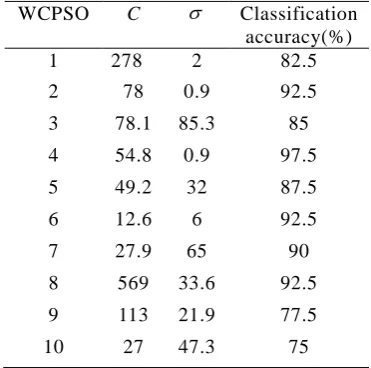
Table 1. WCPSO parameter optimization results.
WCPSO C Classification accuracy(%) 1 278 2 82.5
2 78 0.9 92.5
3 78.1 85.3 85
4 54.8 0.9 97.5
5 49.2 32 87.5
6 12.6 6 92.5
7 27.9 65 90
8 569 33.6 92.5
9 113 21.9 77.5
10 27 47.3 75
As can be seen from the table when the SVM penalty factor C = 54.8 and radial basis
function = 0.9, the performance out of the classification accuracy, highest performance.
Table 2. Classification parameters compare.
Parameters to be optimized
No optimization
PSO WCPSO
C 100 36.9 54.8
2 0.9 1.4
Classification accuracy(%)
78.1 85.3 92.6
Classification time(s)
44.3 35.5
In order to verify the advantages WCPSO this optimization method, firstly no parameter optimization of SVM, PSO parameter optimization of SVM and SVM parameter optimization WCPSO the training and test data were analyzed. SVM uses "many" classification thinking, as opposed to other methods, it can better control the classification accuracy. As Table 2 shows, Time refers to the classification table from iteration to optimize the completion tim e classification,for optimizing the classification function without taking 100 penalty factor C
and radial basis function parameter optimization results take 2; classification function for
PSO take 36.9 penalty factor C and radial basis function parameter takes 0.9 optimization
results; for WCPSO classification function takes the penalty factor C 54.8 and optimization
results RBF kernel function parameter takes 1.4. Time refers to the classification table
from iteration to optimize the completion time classification.
Optimize the classification of 20 times the average time for comparison, after the lapse of the SVM WCPSO optimized SVM classification data showing the time of the advantages of short computation time.
Conclusion
[image:4.595.183.415.328.431.2]References
[1] Bessedik, S.A. and H. Hadi, Prediction of flashover voltage of insulators using least
squares support vector machine with particle swarm optimisation. Electric Power Systems Research, 2013. 104(0): pp. 87-92.
[2] Zhao, C., et al., Fault diagnosis of sensor by chaos particle swarm optimization algorithm
and support vector machine. Expert Systems with Applications, 2011. 38(8): pp. 9908-9912.
[3] Wu, Q., Fault diagnosis model based on Gaussian support vector classifier machine.
Expert Systems with Applications, 2010. 37(9): p. 6251-6256.
[4] Tang, X., et al., Multi-fault classification based on support vector machine trained by
chaos particle swarm optimization. Knowledge-Based Systems, 2010. 23(5): pp. 486-490.
[5] Shi, Z.-b., Q. Song, and M. Ma, Diagnosis for Vibration Fault of Steam Turbine Based on
Modified Particle Swarm Optimization Support Vector Machine, in Measuring Technology and Mechatronics Automation Iv, Pts 1 and 2, Z.X. Hou, Editor. 2012. pp. 113-116.
[6] Ma, X., Power Transformer Fault Diagnosis Based on Least Squares Support Vector
Machine and Particle Swarm Optimization, in Intelligent Structure and Vibration Control, Pts 1 and 2, S.B. Zhong, Y.M. Cheng, and X.L. Qu, Editors. 2011. pp. 624-628.
[7] Lee, T.-F., et al., Particle swarm optimization-based SVM application: Power transformers
incipient fault syndrome diagnosis. 2006 International Conference on Hybrid Information Technology, Vol 1, Proceedings, ed. G. Lee, et al. 2006. 468 -476.
[8] Kennedy J, E.R., Particle swarm optimization. In:Proc.IEEE Int'l.Cof. on Neural
Networks,IV. Piscataway, NJ:IEEE Service Center., 1995; 1942-1948.
[9] Guo, H., et al., The Research of Support Vector Machine with Optimized Parameters Based
on Particle Swarm Optimization. Istm/2011: 9th International Symposium on Test and Measurement, ed. T.D. Wen. 2011. 96-99.
[10] Fei, S., et al., Application of Particle Swarm Optimization-based Support Vector Machine
in Fault Diagnosis of Turbo-generator. 2008 International Symposium on Intelligent Information Technology Application, Vol II, Proceedings, ed. Q. Zhou and J. Luo. 2008. 1040-1044.
[11] Cao, J., Fault diagnosis for electrical control system by support vector machine and