© Associated Asia Research Foundation (AARF)
A Monthly Double-Blind Peer Reviewed Refereed Open Access International e-Journal - Included in the International Serial Directories. Page | 222
SEQUENTIAL TESTING PROCEDURE AND THEIR ROBUSTNESS
STUDY FOR ERLANG DISTRIBUTION
Surinder Kumar, Vaidehi Singh and Prem Lata Gautam
Department of Statistics, School for Physical and Decision Sciences Babasaheb Bhimrao Ambedkar University, Lucknow, India-226025
ABSTRACT
The sequential testing procedures are developed for testing the hypotheses regarding the
shape and rate parameters of the Erlang distribution. Theoretical expression for the operating
characteristics (OC) and average sample number (ASN) functions are derived for these
parameters. The robustness of the SPRT'S in respect of OC and ASN functions are studied, when
the distribution under study has undergone a change. The acceptance and rejection regions for
0
H against H1 are derived in case of rate parameter. The expressions of OC and ASN functions
for the robustness of the SPRT in case of rate parameter, when the coefficient of variation is
known are also derived and studied. Finally, the results are presented through Tables and
Graphs, so that one can see the numerical evaluated departures in OC and ASN functions.
Keywords: Erlang distribution, Sequential probability ratio test, Operating characteristics, Average sample number, Robustness, Coefficient of variation, Acceptance and rejection region.
International Research Journal of Natural and Applied Sciences
ISSN: (2349-4077) Impact Factor- 5.46, Volume 5, Issue 3, March 2018 Website- www.aarf.asia, Email : [email protected] , [email protected]
© Associated Asia Research Foundation (AARF)
A Monthly Double-Blind Peer Reviewed Refereed Open Access International e-Journal - Included in the International Serial Directories. Page | 223
1. Introduction
The concept of sequential testing of statistical hypotheses for testing between two simple hypotheses is first developed by Wald (1947). This concept is heavily dominated by the sequential probability ratio test (SPRT). In order to study the performance of the SPRT’S, Wald (1947) derived the theoretical expressions for the operating characteristics (OC) and average sample number (ASN) functions. Sequential probability ratio test has been applied by several researchers, to tackle with different testing problems, for references one may referred to Oakland (1950), Epstein and Sobel (1955), Johnson (1966), Phatarford (1971), Bain and Engelhardt (1982), Chaturvedi et al. (2000), Sevil and Demirhan (2008).
The robustness of the SPRT in respect of OC and ASN functions has been studied by several authors, when the distribution under consideration has undergone a change, while dealing with various probabilistic models. For references, Harter and Moore (1976) gives sampling plans for reliability tests under the assumption of a constant failure rate and by using Monte Carlo techniques, the robustness of the exponential SPRT is studied, when the underlying distribution is a Weibull distribution. Montagne and Singpurwalla (1985) investigated the robustness of the sequential life-testing procedure with respect to the risks and the expected sample sizes for the exponential distribution when the life length is not exponential. Hubbard and Allen (1991) applied SPRT on the mean of the negative binomial distribution when the dispersion parameter is known and the robustness of the test to the misspecification of dispersion parameter is studied. Chaturvedi et al. (1998) considered a family of life-testing models and studied the robustness of the SPRT’S for various parameters involved in the model and also generalised the results of Montagne and Singpurwalla (1985).
Joshi and Shah (1990) developed SPRT for testing a simple hypothesis (against a simple alternative) for the mean of an inverse Gaussian distribution, assuming the coefficient of variation (CV) to be known. They obtained theoretical expressions for the OC and the ASN functions.
© Associated Asia Research Foundation (AARF)
A Monthly Double-Blind Peer Reviewed Refereed Open Access International e-Journal - Included in the International Serial Directories. Page | 224
2. Set up a problem:
Let us consider a random variable (r.v.) X follows the Erlang distribution presented by the probability density function (pdf)
! ) 1 -( ,
;
1 k
e x k
x f
x k k
; 0x, 0, kN (2.1)
where k is the shape parameter and λ is the rate parameter. The Erlang distribution is the sum of ‘k ’ independent exponential random variables each with the same parameter. For a given
sequence of observations X1, X2, X3… from (2.1), the problem of testing the simple null hypo-
thesis H0:0 against the simple alternative hypothesis H1:1(0) is considered.
In Section 3, 4, 5, 6 and 7, respectively, we develop the SPRT’S for the parameters involved in the model (2.1). The robustness of the SPRT’S in respect of OC and ASN functions, when the distribution under consideration has undergone a change is studied [see Remarks 3.1, 4.1, 5.1, 6.1]. Also, the robustness of the SPRT for a mis-specified coefficient of variation is studied in Section 7[see Remarks 7.1]. In Section 8, the acceptance and rejection regions for H0 vs H1 in case of λ are derived and plotted in Figure 8.1. Finally, in Section 9, the results and findings are presented through Tables and Graphs.
3. SPRT for testing the hypothesis regarding ‘λ’
The SPRT for testing H0:0 against H1: 1(1 0) is defined as follows
k x f
k x f Z
i i i
, ;
, ; ln
0 1
(3.1)
0 1
0 1
ln
i
i k x
Z (3.2)
We choose two numbers A and B such that 0B1A. At the nth stage of sampling accept H0if
n i
i
z
1
lnB, rejectH0 if
n i
i
z
1
lnA, otherwise continue sampling by taking the
© Associated Asia Research Foundation (AARF)
A Monthly Double-Blind Peer Reviewed Refereed Open Access International e-Journal - Included in the International Serial Directories. Page | 225
1
A and
1
B (3.3)
The Operating Characteristic (OC) Function L()is given by
h h h B A A 1 )
L( (3.4)
where ‘h’ is the non-zero solution of
eZi h 1E (3.5)
or, 1 ) , ; ( ) , ; ) , ; ( h 0 0 1
f x k dxk f(x k x f i i i (3.6)
From (2.1) and (3.2), we obtain
k h kh h Zi e E ) ( 1 0 1 1 0 ] [ (3.7)
Finally, from equation (3.5) we get
h h 0 1 1 0 1 ) (
(3.8)
This expression (3.8), is not useful for finding the values of OC and ASN functions, hence, in order to tackle this problem we take the logarithm of both sides and using the
expansion ; 1 1
3 2 ) 1 ln( 3 2
x x x x x and retaining the term up to third degree in ‘h’,
we get
0 1
0
1 ln 1
ln k h
kh 3 1 0 3 2 1 0 2 1 0 0 1 3 2 ln
h h
© Associated Asia Research Foundation (AARF)
A Monthly Double-Blind Peer Reviewed Refereed Open Access International e-Journal - Included in the International Serial Directories. Page | 226 or 0 ln 2 3 0 1 1 0 2 1 0 3 1 0 2 h h (3.9)
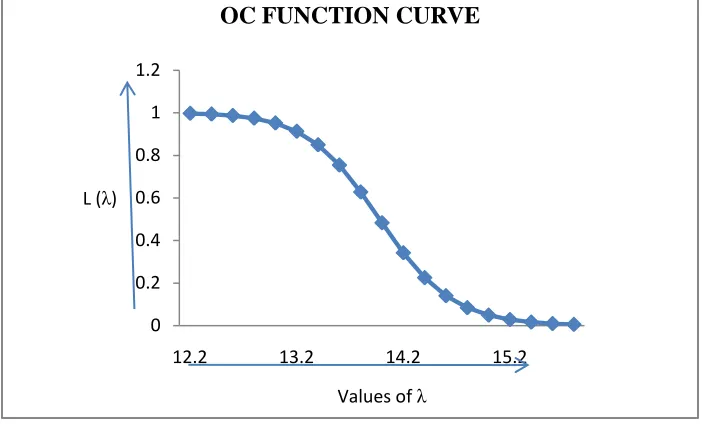
which is a quadratic equation in ‘h’. On solving (3.9), we get the real roots of ‘h’. Finally, on substituting the values of ‘h’ in equation (3.4) the numerical values of OC function are obtained. The ASN function is approximately given by
) ( ln ) ( 1 ln ) ( ) / ( Z E A L B L NE (3.10)
provided that E(Z)≠0, where
0 1
0 1 ln )
(Z k
E (3.11)
From equation (3.11), the ASN function under H0 and H1 is given by
1 0 0 1 0 ln ln ln ) 1 ( ) ( k A B N
E (3.12)
and 1 0 0 1 1 ln ln ) 1 ( ln ) ( k A B N
E (3.13)
Remarks 3.1: Let us consider the problem of testing the simple null hypothesis H0 :0 13
© Associated Asia Research Foundation (AARF)
A Monthly Double-Blind Peer Reviewed Refereed Open Access International e-Journal - Included in the International Serial Directories. Page | 227
4. Robustness of the SPRT for ‘λ’when ‘k’ has undergone a change
Let us suppose that the parameter ‘k’ has undergone a change to k*and then probability distribution in (2.1) becomes f(x;,k*). In order to study the robustness of SPRT developed in Section 3 with respect to OC function, the values of ‘h’are obtained by solving the following
1 ) , ; ( ) , ; ( ) , ; ( * 0 , 0 1
f x k dxk x f k x f i h i i (4.1) 1 ) 1 ( 0 )] ( [ * 0
1 0 1 *
*
e x dxk k h x k kh
Finally, we get
1 1 * 1 0 0 1
kh k
h (4.2)
taking logarithm on both sides of equation (4.2) and using the expression of ln(1-x), x 1. In
order to obtain the roots of the given equation and retain the terms upto third degree in ‘h’ we get the following quadratic equation
0 ln 2 3 0 1 1 0 2 1 0 3 1 0 2 p hp p h
, (4.3)
where k k p *
which is quadratic equation in ‘h’. On solving, we get the real roots of ‘h’. The Robustness of the SPRT with respect to ASN is studied by replacing the denominator of (3.10) by
Z
z f x k dxE
0 * ) , ; (
( 0 1) ( )0
1 E x
In k Z
E
0 1 *
© Associated Asia Research Foundation (AARF)
A Monthly Double-Blind Peer Reviewed Refereed Open Access International e-Journal - Included in the International Serial Directories. Page | 228
, ln
)
( 0 1
0 1 p Z E (4.4)
Remarks 4.1: For testing the simple null hypothesis H0:0 13against the simple alternative
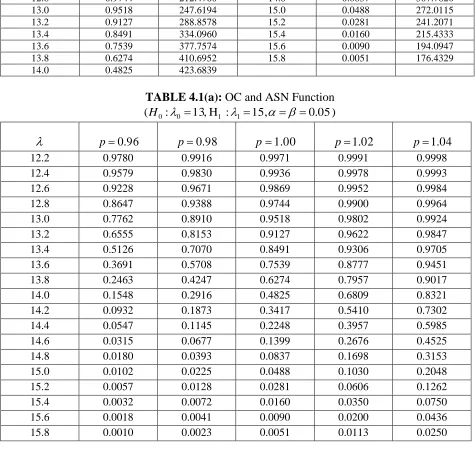
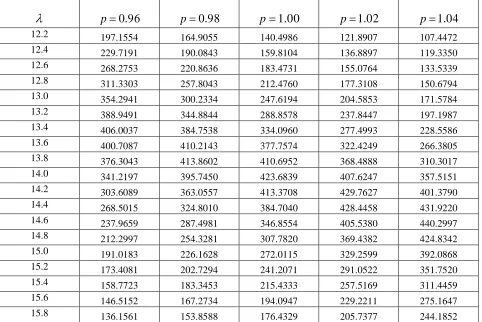
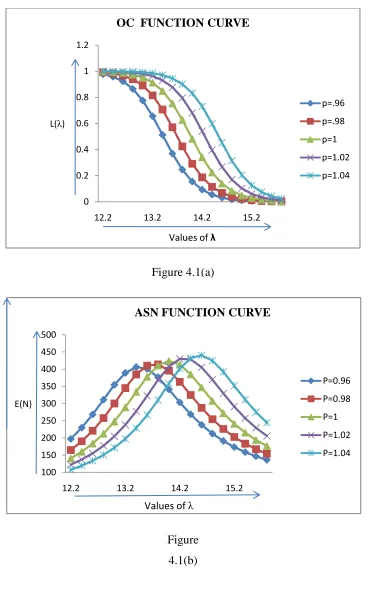
hypothesis H1:115for 0.05 for different values of 'k' the real roots of ‘h’ are obtained from equation (4.3). From Table 4.1(a) and Table 4.1(b), the values of OC and ASN curves are plotted in Figure 4.1 (a) and Figure 4.1 (b) for various values of 'p' . The OC curve
shifts to the left (right) and ASN curve shifts to the left downward (right upward) for p1(p >1). From both the curves, it is evident that the SPRT is highly sensitive for any change in ‘k’.
5. SPRT for testing the hypothesis regarding 'k'
Let the sequence of observation X1, X2, X3… from (2.1). Our goal is to test the simple
null hypothesis H0:kk0 against the simple alternative hypothesis H0:kk1(k1k0).The
SPRT for testing H0 is defined as follows:
Let (5.1) ) , ; ( ) , ; ( ln 0 1 k x f k x f Z i i i
i k k k k xi
k k
Z ln ( 1 0)ln ( 1 0)ln
1
0
(5.2)
For OC curve we have
1 ) , ; ( ) , ; ( ) , ; ( 0 0 1
f x k dxk x f k x f i h i i (5.3)
From (2.1) and (5.2)
( )
11
0 1 1
0
© Associated Asia Research Foundation (AARF)
A Monthly Double-Blind Peer Reviewed Refereed Open Access International e-Journal - Included in the International Serial Directories. Page | 229 This expression (5.4) is not useful for finding the values of OC and ASN functions, hence we further calculate and taking the logarithm of both sides and using the approximation
(5.5) ln 2 1 2 ln
ln x x x x
we have 0 ) ( 2 1 ln 1 ln 2 1 ln 2 1 ) 1 2 ( 4 ) 1 4 (
12 0 0 1 1 1 0
2 0 1 3 0 1 2 k k k k k k k k k k k k h k k k k h (5.6)
which is quadratic equation in ‘h’. On solving, we get the real roots of ‘h’. The numerical values of OC function is now obtain from equation (5.6). The Robustness of the SPRT with respect to ASN is studied by replacing the denominator of (3.10) by
Zi k
ln k0 ln k1 (k1 k0)ln (k1 k0)E(lnxi)E
and
( ) ln )
(Inx k
E i
Using the result of Gradshteyn and Ryzhik (1965, p.576 § 4.352(1)) that
(5.7) 2 1 ln ) ( x x
x
) 8 . 5 ( ) ( 2 1 ln 1 ln 2 1 ln 2 1 )
( 0 0 1 1 k1 k0
k k k k k k k Z
E i
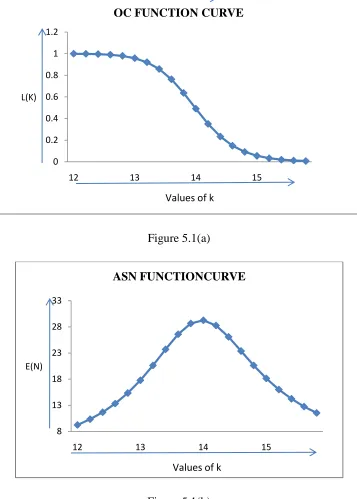
Remarks 5.1: Let us consider the problem of testing the simple null hypothesis H0 :k0 13
© Associated Asia Research Foundation (AARF)
A Monthly Double-Blind Peer Reviewed Refereed Open Access International e-Journal - Included in the International Serial Directories. Page | 230
6. Robustness of the SPRT for ‘k’ when ‘λ’ has undergone a change
Let us suppose that the parameter ‘λ’ has undergone a change to λ*
and then probability distribution in (2.1) becomes f(x;*,k).In order to study the robustness of SPRT developed in Section 5 with respect to OC function, the values of ‘h’are obtained by solving the following
0 * 01 ( ; , ) 1
) , ; ( ) , ; ( dx k x f k x f k x f i h i i (6.1) 1 1 0 1 ) ( * ) ( 1
0 1 0 1 0 *
dx e x k kk h h k k k hk k k x
Finally, we get
( )
11 0 1 ) ( 1
0 1 0
k k k h k k
k h k k
h
(6.2)
where *
taking logarithm on both sides of equation (6.2) and using the approximation (5.5). In order to obtain the roots of the given equation and retain the terms upto third degree in ‘h’ we get the following quadratic equation
(6.3) 0 ) ( 2 1 ln 1 ln ) ( ln 2 1 ln 2 1 ) 1 2 ( 4 ) 1 4 ( 12 0 1 0 1 1 1 0 0 2 0 1 3 0 1 2 k k k k k k k k k k k k k k h k k k k h
which is quadratic equation in ‘h’. On solving, we get the real roots of ‘h’. The numerical values of OC function is now obtain from equation (6.3). The Robustness of the SPRT with respect to ASN is studied by replacing the denominator of (3.10) by
Zi k
In k0 In k1 (k1 k0)In (k1 k0)E(lnxi)E
where * ln ) ( )
(ln x k
E i
© Associated Asia Research Foundation (AARF)
A Monthly Double-Blind Peer Reviewed Refereed Open Access International e-Journal - Included in the International Serial Directories. Page | 231
(6.4) ) ( 2 1 ln ln 1 ln 2 1 ln 2 1 )
( * 0 0 1 1 k1 k0
k k k k k k Z
E i
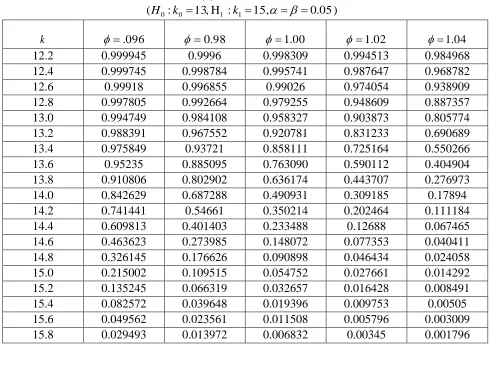
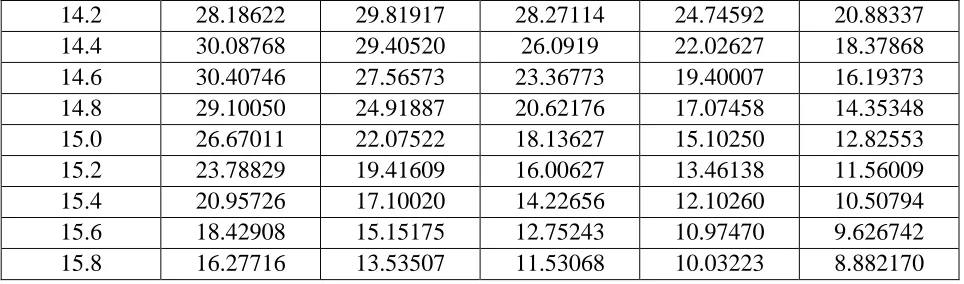
Remarks 6.1: For testing the simple null hypothesis H0:k0 13against the simple alternative
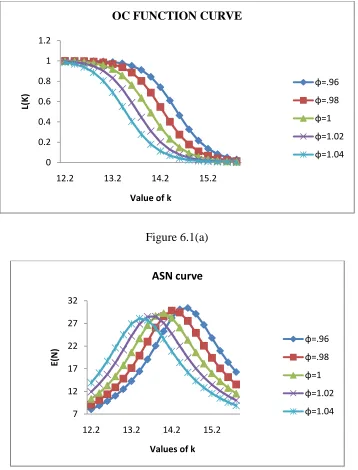
hypothesis H1:k115for 0.05 for different values of 'k' the real roots of ‘h’ are obtained from equation (6.3). From Table 6.1(a) and Table 6.1(b), the values of OC and ASN curves are plotted in Figure 6.1 (a) and Figure 6.1 (b) for various values of' ' . The OC curve shifts to the right (left) and ASN curve shifts to the right upward (left downward) for 1(1 ). From both the curves, it is evident that the SPRT is highly sensitive for any change in ‘k’.
7. Robustness of the SPRT for ‘λ’ with known coefficient of variation (CV)
For Erlang distribution mean and variance are
k and(k 2), respectively then coefficient ofvariation (CV) =(1 k). Let us suppose that coefficient of variation changes from a to a*, so that, the (pdf) of (2.1) shifts to f(xi;,a*).
Then OC and ASN function is
From (3.2) and (2.1)
(7.2) 1 ) ( 2 * 2 1 1 0 0 1 a a h
h
taking logarithm on both sides of equation (7.2) and using the expression of ln(1-x), x 1.In order to obtain the roots of the given equation and retain the terms upto third degree in ‘h’ we get the following quadratic equation
© Associated Asia Research Foundation (AARF)
A Monthly Double-Blind Peer Reviewed Refereed Open Access International e-Journal - Included in the International Serial Directories. Page | 232 which is quadratic equation in ‘h’. On solving, we get the real roots of ‘h’. The numerical values of OC function is now obtain from equation (7.3). The Robustness of the SPRT with respect to ASN is studied by replacing the denominator of (3.10) by
0 1
0 1 ln )
(Z Q
E
(7.4)
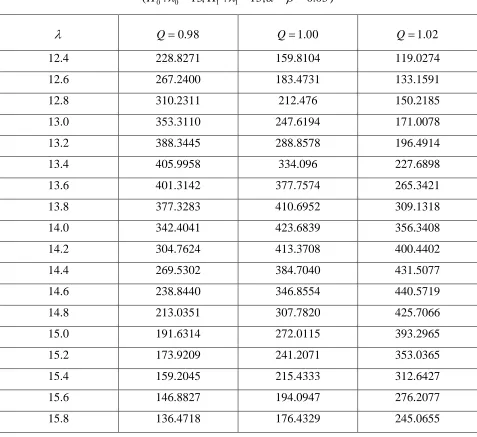
Remarks 7.1: For testing the simple null hypothesis H0:0 13 against the simple alternative
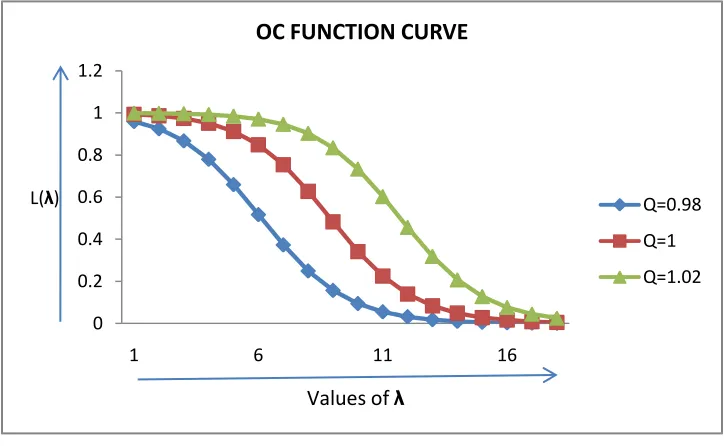
hypothesis H1:115for 0.05 for different values of '' the real roots of ‘h’ are obtained from equation (7.3). From Table 7.1(a) and Table 7.1(b), the values of OC and ASN curves are plotted in Figure 7.1 (a) and Figure 7.1 (b) for various values of ‘Q’. The OC curve shifts to the left (right) and ASN curve shifts to the left downward (right upward) for Q1(
1
Q ). From both the curves, it is evident that the SPRT is highly sensitive for any change in ‘λ’.
8. Implementation of Erlang distribution
We wish to test the simple hypothesis H0 :0against H1: 1(1 0)having
pre-assigned0 , 1. Let
) -(1 B and ) 1 (
A and is defined as
) (
In 0 1
0
1
i
i k x
Z
Let us defined,
n
i i
X n
Y
1 )
( and N= first integer n ( ≥1) for which the inequality
dn c n
Y( ) 1 or Y(n)c2 dnholds with the constants
) (
ln ,
) (
ln ,
) (
ln
1 0
0 1
1 0 2 1 0
1
k
d A c
B
c (8.1)
Remarks 8.1: The figure (8.1) shows the acceptance and rejection regions for H0under the case
© Associated Asia Research Foundation (AARF)
A Monthly Double-Blind Peer Reviewed Refereed Open Access International e-Journal - Included in the International Serial Directories. Page | 233 ,
472 . 1 1
c c2 1.472 and d 0.1431, respectively. Thus, if Y(N)0.1434N1.472, we accept H0 and if Y(N)0.1434N1.472, we accept H1. At the intermediate stages, we continue sampling.
[image:12.612.68.541.138.309.2]9. Tables and Figures
TABLE 3.1: OC and ASN Function
) 05 . 0 15,
: H , 13 :
(H0 0 1 1
L(λ) E(N) L(λ) E(N)
12.2 0.9971 140.4986 14.2 0.3417 413.3708
12.4 0.9936 159.8104 14.4 0.2248 384.7040
12.6 0.9869 183.4731 14.6 0.1399 346.8554
12.8 0.9744 212.4760 14.8 0.0837 307.7820
13.0 0.9518 247.6194 15.0 0.0488 272.0115
13.2 0.9127 288.8578 15.2 0.0281 241.2071
13.4 0.8491 334.0960 15.4 0.0160 215.4333
13.6 0.7539 377.7574 15.6 0.0090 194.0947
13.8 0.6274 410.6952 15.8 0.0051 176.4329
14.0 0.4825 423.6839
TABLE 4.1(a): OC and ASN Function
) 05 . 0 15,
: H , 13 :
(H0 0 1 1
p0.96 p0.98 p1.00 p1.02 p1.04
12.2 0.9780 0.9916 0.9971 0.9991 0.9998
12.4 0.9579 0.9830 0.9936 0.9978 0.9993
12.6 0.9228 0.9671 0.9869 0.9952 0.9984
12.8 0.8647 0.9388 0.9744 0.9900 0.9964
13.0 0.7762 0.8910 0.9518 0.9802 0.9924
13.2 0.6555 0.8153 0.9127 0.9622 0.9847
13.4 0.5126 0.7070 0.8491 0.9306 0.9705
13.6 0.3691 0.5708 0.7539 0.8777 0.9451
13.8 0.2463 0.4247 0.6274 0.7957 0.9017
14.0 0.1548 0.2916 0.4825 0.6809 0.8321
14.2 0.0932 0.1873 0.3417 0.5410 0.7302
14.4 0.0547 0.1145 0.2248 0.3957 0.5985
14.6 0.0315 0.0677 0.1399 0.2676 0.4525
14.8 0.0180 0.0393 0.0837 0.1698 0.3153
15.0 0.0102 0.0225 0.0488 0.1030 0.2048
15.2 0.0057 0.0128 0.0281 0.0606 0.1262
15.4 0.0032 0.0072 0.0160 0.0350 0.0750
15.6 0.0018 0.0041 0.0090 0.0200 0.0436
[image:12.612.66.541.230.679.2]© Associated Asia Research Foundation (AARF)
A Monthly Double-Blind Peer Reviewed Refereed Open Access International e-Journal - Included in the International Serial Directories. Page | 234 TABLE 4.1(b): OC and ASN Function
) 05 . 0 15,
: H , 13 :
(H0 0 1 1
p0.96 p0.98 p1.00 p1.02 p1.04
12.2 197.1554 164.9055 140.4986 121.8907 107.4472
12.4 229.7191 190.0843 159.8104 136.8897 119.3350
12.6 268.2753 220.8636 183.4731 155.0764 133.5339
12.8 311.3303 257.8043 212.4760 177.3108 150.6794
13.0 354.2941 300.2334 247.6194 204.5853 171.5784
13.2 388.9491 344.8844 288.8578 237.8447 197.1987
13.4 406.0037 384.7538 334.0960 277.4993 228.5586
13.6 400.7087 410.2143 377.7574 322.4249 266.3805
13.8 376.3043 413.8602 410.6952 368.4888 310.3017
14.0 341.2197 395.7450 423.6839 407.6247 357.5151
14.2 303.6089 363.0557 413.3708 429.7627 401.3790
14.4 268.5015 324.8010 384.7040 428.4458 431.9220
14.6 237.9659 287.4981 346.8554 405.5380 440.2997
14.8 212.2997 254.3281 307.7820 369.4382 424.8342
15.0 191.0183 226.1628 272.0115 329.2599 392.0868
15.2 173.4081 202.7294 241.2071 291.0522 351.7520
15.4 158.7723 183.3453 215.4333 257.5169 311.4459
15.6 146.5152 167.2734 194.0947 229.2211 275.1647
15.8 136.1561 153.8588 176.4329 205.7377 244.1852
Table 5.1: OC and ASN Function ) 05 . 0 15,
: H , 13 :
(H0 k0 1 k1
k L(k) E(k) k L(k) E(k)
12.0 0.9994 9.2375 14.0 0.4909 29.2605
12.2 0.9983 10.3343 14.2 0.3502 28.2711
12.4 0.9957 11.6721 14.4 0.2335 26.0919
12.6 0.9903 13.3148 14.6 0.1481 23.3677
12.8 0.9793 15.3305 14.8 0.0909 20.6218
13.0 0.9583 17.7702 15.0 0.0548 18.1363
13.2 0.9208 20.6176 15.2 0.0327 16.0063
13.4 0.8581 23.7009 15.4 0.0194 14.2266
13.6 0.7631 26.5972 15.6 0.0115 12.7524
[image:13.612.67.549.88.410.2]© Associated Asia Research Foundation (AARF)
A Monthly Double-Blind Peer Reviewed Refereed Open Access International e-Journal - Included in the International Serial Directories. Page | 235
Table 6.1(a): OC and ASN Function
) 05 . 0 15,
: H , 13 :
(H0 k0 1 k1
k .096 0.98 1.00 1.02 1.04
12.2 0.999945 0.9996 0.998309 0.994513 0.984968
12.4 0.999745 0.998784 0.995741 0.987647 0.968782
12.6 0.99918 0.996855 0.99026 0.974054 0.938909
12.8 0.997805 0.992664 0.979255 0.948609 0.887357
13.0 0.994749 0.984108 0.958327 0.903873 0.805774
13.2 0.988391 0.967552 0.920781 0.831233 0.690689
13.4 0.975849 0.93721 0.858111 0.725164 0.550266
13.6 0.95235 0.885095 0.763090 0.590112 0.404904
13.8 0.910806 0.802902 0.636174 0.443707 0.276973
14.0 0.842629 0.687288 0.490931 0.309185 0.17894
14.2 0.741441 0.54661 0.350214 0.202464 0.111184
14.4 0.609813 0.401403 0.233488 0.12688 0.067465
14.6 0.463623 0.273985 0.148072 0.077353 0.040411
14.8 0.326145 0.176626 0.090898 0.046434 0.024058
15.0 0.215002 0.109515 0.054752 0.027661 0.014292
15.2 0.135245 0.066319 0.032657 0.016428 0.008491
15.4 0.082572 0.039648 0.019396 0.009753 0.00505
15.6 0.049562 0.023561 0.011508 0.005796 0.003009
15.8 0.029493 0.013972 0.006832 0.00345 0.001796
Table 6.1(b): OC and ASN Function
) 05 . 0 15,
: H , 13 :
(H0 k0 1 k1
k 0.96 0.98 1.00 1.02 1.04
12.2 8.052826 9.070382 10.33428 11.9178 13.89641
12.4 8.870748 10.11046 11.67214 13.64174 16.08068
12.6 9.848712 11.37437 13.31481 15.75179 18.67666
12.8 11.03152 12.92305 15.33047 18.28361 21.59022
13.0 12.47603 14.82574 17.77018 21.18239 24.51754
13.2 14.25006 17.14521 20.61763 24.20702 26.90107
13.4 16.42349 19.89954 23.70091 26.85593 28.09234
13.6 19.04171 22.98667 26.59718 28.46045 27.73625
13.8 22.06654 26.08093 28.65254 28.53432 26.03132
[image:14.612.64.554.48.418.2] [image:14.612.68.548.442.685.2]© Associated Asia Research Foundation (AARF)
A Monthly Double-Blind Peer Reviewed Refereed Open Access International e-Journal - Included in the International Serial Directories. Page | 236
14.2 28.18622 29.81917 28.27114 24.74592 20.88337
14.4 30.08768 29.40520 26.0919 22.02627 18.37868
14.6 30.40746 27.56573 23.36773 19.40007 16.19373
14.8 29.10050 24.91887 20.62176 17.07458 14.35348
15.0 26.67011 22.07522 18.13627 15.10250 12.82553
15.2 23.78829 19.41609 16.00627 13.46138 11.56009
15.4 20.95726 17.10020 14.22656 12.10260 10.50794
15.6 18.42908 15.15175 12.75243 10.97470 9.626742
15.8 16.27716 13.53507 11.53068 10.03223 8.882170
TABLE 7.1(a): OC and ASN Function
) 05 . 0 15,
: H , 13 :
(H0 0 1 1
Q0.98 Q1.00 Q1.02
12.4 0.9586 0.9936 0.9994
12.6 0.9240 0.9869 0.9984
12.8 0.8667 0.9744 0.9964
13.0 0.7792 0.9518 0.9925
13.2 0.6592 0.9127 0.9850
13.4 0.5167 0.8491 0.9710
13.6 0.3729 0.7539 0.9460
13.8 0.2493 0.6274 0.9032
14.0 0.1569 0.4825 0.8345
14.2 0.0946 0.3417 0.7335
14.4 0.0555 0.2248 0.6025
14.6 0.0320 0.1399 0.4566
14.8 0.0182 0.0837 0.3188
15.0 0.0103 0.0488 0.2074
15.2 0.0058 0.0281 0.1279
15.4 0.0033 0.0160 0.0761
15.6 0.0018 0.0090 0.0443
[image:15.612.66.548.36.178.2]© Associated Asia Research Foundation (AARF)
A Monthly Double-Blind Peer Reviewed Refereed Open Access International e-Journal - Included in the International Serial Directories. Page | 237
TABLE 7.1(b): OC and ASN Function
) 05 . 0 15,
: H , 13 :
(H0 0 1 1
Q0.98 Q1.00 Q1.02
12.4 228.8271 159.8104 119.0274
12.6 267.2400 183.4731 133.1591
12.8 310.2311 212.476 150.2185
13.0 353.3110 247.6194 171.0078
13.2 388.3445 288.8578 196.4914
13.4 405.9958 334.096 227.6898
13.6 401.3142 377.7574 265.3421
13.8 377.3283 410.6952 309.1318
14.0 342.4041 423.6839 356.3408
14.2 304.7624 413.3708 400.4402
14.4 269.5302 384.7040 431.5077
14.6 238.8440 346.8554 440.5719
14.8 213.0351 307.7820 425.7066
15.0 191.6314 272.0115 393.2965
15.2 173.9209 241.2071 353.0365
15.4 159.2045 215.4333 312.6427
15.6 146.8827 194.0947 276.2077
[image:16.612.68.545.67.504.2]© Associated Asia Research Foundation (AARF)
A Monthly Double-Blind Peer Reviewed Refereed Open Access International e-Journal - Included in the International Serial Directories. Page | 238 Figure 3.1(a)
Figure 3.1(b) 0
0.2 0.4 0.6 0.8 1 1.2
12.2 13.2 14.2 15.2
L (λ)
Values of λ
OC FUNCTION CURVE
140 190 240 290 340 390 440
12.2 13.2 14.2 15.2
E(N)
Values of λ
[image:17.612.130.484.7.597.2] [image:17.612.131.482.45.257.2]© Associated Asia Research Foundation (AARF)
[image:18.612.123.491.28.629.2] [image:18.612.128.487.45.318.2]A Monthly Double-Blind Peer Reviewed Refereed Open Access International e-Journal - Included in the International Serial Directories. Page | 239 Figure 4.1(a)
Figure 4.1(b)
0 0.2 0.4 0.6 0.8 1 1.2
12.2 13.2 14.2 15.2
L(λ)
Values of λ
OC FUNCTION CURVE
p=.96
p=.98
p=1
p=1.02
p=1.04
100 150 200 250 300 350 400 450 500
12.2 13.2 14.2 15.2
E(N)
Values of λ
ASN FUNCTION CURVE
P=0.96
P=0.98
P=1
P=1.02
© Associated Asia Research Foundation (AARF)
A Monthly Double-Blind Peer Reviewed Refereed Open Access International e-Journal - Included in the International Serial Directories. Page | 240 Figure 5.1(a)
Figure 5.1(b) 0
0.2 0.4 0.6 0.8 1 1.2
12 13 14 15
L(K)
Values of k OC FUNCTION CURVE
8 13 18 23 28 33
12 13 14 15
E(N)
[image:19.612.127.484.41.540.2] [image:19.612.127.487.45.256.2]© Associated Asia Research Foundation (AARF)
A Monthly Double-Blind Peer Reviewed Refereed Open Access International e-Journal - Included in the International Serial Directories. Page | 241 Figure 6.1(a)
Figure 6.1(b) 0
0.2 0.4 0.6 0.8 1 1.2
12.2 13.2 14.2 15.2
L(K
)
Value of k
OC FUNCTION CURVE
φ=.96
φ=.98
φ=1
φ=1.02
φ=1.04
7 12 17 22 27 32
12.2 13.2 14.2 15.2
E(N
)
Values of k
ASN curve
φ=.96
φ=.98
φ=1
φ=1.02
[image:20.612.129.487.35.505.2]© Associated Asia Research Foundation (AARF)
A Monthly Double-Blind Peer Reviewed Refereed Open Access International e-Journal - Included in the International Serial Directories. Page | 242 Figure 7.1(a)
Figure 7.1(b) 0
0.2 0.4 0.6 0.8 1 1.2
1 6 11 16
L(λ)
Values of λ OC FUNCTION CURVE
Q=0.98
Q=1
Q=1.02
100 150 200 250 300 350 400 450 500
12.4 13.4 14.4 15.4
E(N)
Values of k
ASN FUNCTION CURVE
Q=0.98
Q=1
[image:21.612.125.488.68.291.2] [image:21.612.126.487.77.575.2]© Associated Asia Research Foundation (AARF)
A Monthly Double-Blind Peer Reviewed Refereed Open Access International e-Journal - Included in the International Serial Directories. Page | 243 Figure 8.1
REFERENCES
1 Bacanli, S. and Demirhan, Y. P. (2008): A group sequential test for the Inverse Gaussian Mean Statistical Papers, 49, 337-386.
2 Bain, L. J. and Engelhardt, M. (1982): Sequential Probability Ratio Tests for the shape parameter of NHPP, IEEE Transaction on Reliability, R-31, 79-83.
3 Chaturvedi, A., Kumar, A. and Surinder, K. (1998): Robustness of the sequential procedures for a family of life-testing models. Metron, 56, 117-137.
4 Chaturvedi, A., Kumar, A. and Surinder, K. (2000): Sequential testing procedures for a class of distributions representing various life testing models. Statistical papers, 41, 65-84.
5 Chaturvedi, A., Tiwari, N., and Tomer, S. (2002): Robustness of the sequential testing procedure for the generalized life distribution. Brazilian Journal of Probability and Statistics , 16, 7-24.
-2 -1 0 1 2 3 4 5 6
0 5 10 15
Y(N)
Accept H0
ACCEPTANCE AND REJECTION REGION
L1
L2
Continue sampling Reject H0
© Associated Asia Research Foundation (AARF)
A Monthly Double-Blind Peer Reviewed Refereed Open Access International e-Journal - Included in the International Serial Directories. Page | 244
6 Epstein, B. and Sobel, M. (1955): Sequential life tests in exponential case. Ann. Math. Statist., 26, 82-93.
7 Gradshteyn, I.S and Ryzhik, I.M (1980): Tables of integrals, Series and Products Academic Press, London.
8 Harter, L. and Moore, A. H. (1976): An evaluation of the exponential and Weibull test plans. IEEE Transaction on Reliability, 25, 100-104.
9 Hubbard, D. J. and Allen, O. B. (1991): Robustness of the SPRT for a negative binomial to misspecification of the dispersion parameter. Biometrics, 47, 419-427.
10 Johnson, N. L. (1966): Cumulative sum control chart and the Weibull Distribution. Technometrics, 8, 481-491.
11 Joshi, S. and Shah, M. (1990): Sequential Analysis applied to testing the mean of an inverse Gaussian distribution with known coefficient of variation. Commun. Statist.-Theor. Meth., 19(4), 1457-1466.
12 Montagne, E. R. and Singpurwalla, N. D. (1985): Robustness of sequential exponential life-testingprocedures. Jour. American Statist. Assoc., 391, 715-719.
13 Oakland, G. B. (1950): An application of sequential analysis to whitefish sampling. Biometrics, 6, 59-67.
14 Phatarfod, R. M. (1971): A sequential test for Gamma distribution. Jour. American Statist. Assoc., 66, 876-878.