2018 3rd International Conference on Information Technology and Industrial Automation (ICITIA 2018)
ISBN: 978-1-60595-607-7
The Correlation Recognition of Distorted
Images Based on Synthetic
Discriminant Function
Honghui Sun, Hongxia Wang, Min Li and Qinghua Zhang
ABSTRACT
In order to improve the recognition function of the joint transform correlation, this paper describes the conception and application method of distorted images correlation recognition, makes Synthetic Discriminant Functions (SDF) in the computer and analyses the recognition results of rotation and scale distorted images. The recognition experiment results of real images show that the correlation recognition method based on SDF realize the distortion invariant pattern recognition of distorted images, and it is effective and feasible.1
INTRODUCTION
The scientific researchers constantly study many methods in order to resolve the important problem that how to realize the distortion invariant pattern recognition of the joint transform correlation. The problem is not resolved effectively until 1984, Casasent offered the Synthetic Discriminant Function (SDF) to resolve the recognition of distorted images[1]. The matched filters based on the synthetic discriminant function can be off-line made and online operation, so the method is flexible and be considered as the effective method to resolve the distorted image recognition.
THE INTRODUCTION OF SYNTHETIC DISCRIMINANT FUNCTION
The basic thought of synthetic discriminant function is that the target images need to be recognized and the distorted images are made to a training set. These
1
images of the training set are operated to find out the suitable parameters and then compose the synthetic discriminant function. Based on SDF the space matched filters are made, when the correct target image is input the matched filters, a correlation output peak is showed in the output space. As long as the target image is one of the training images set of SDF, the output correlation peak is not changed along with the distorted target images [1].
Assume {fn}is the express training sample images set of target distorted images,
where n1,,N, it stands for there are N distortion images in the set, {fn}must
represent the general various distortion images of the target statistically, and one or several distortion shapes of the target need to be recognized can be chosen to be the samples based on actual situation. Assume the filter function h is the linear
combination of training sample images set {fn}, based on the definition of equal
correlation peaks, the correlation peak of hand every member fn in the {fn}is the
equal constant ( Assume it is equal to 1 ).i.e. fnh1.Where, means correlation
operation, and h is the linear combination of training sample images set {fn}, in
other words,
N 1 m m mf a h
.Because output central correlation peak is only need to be considered on the correlation recognition, it is feasible that the dot product can
instead of correlation, and that the space relation of fnand his not need to be
consider. So plugh intofn h1, we have
1 1 1
nm N m m m N m m n nn h f h f a f a r
f
(1)
Where rnmmeans the member of the cross-correlation matrix R of {fn}, and
m n nm f f
r
, the equation (1) is expressed as the matrix form, then
T
Ra (1,,1) ,The both sides ofRa(1,,1)T left multiply by inverse
matrix ofR,we have
1
R
a .To find the inverse matrix of Rand plug it into the
equation (1), then we have a, to plug ainto
N 1 m m mf a h
THE DESIGN AND PRODUCTION OF THE SDF
The flow process of the program design of SDF based on the computer is shown as follow[2]. Firstly the images collected by the CCD are input into the
computer and made analog-digital conversion to the digital image fi, and the digital
filtering processing is made to remove the noise signals. Secondly the digital image
i
f
is transferred to frequency spectrum Fiby the Fourier Transform, then compute
the conjugate multiply Fi Fj
and ( i j) 1
F F
FT
(FT1means the inverse Fourier
transform.), so we have fi fj. Thirdly the maximum correlation peaks Pijare
taken out, so due torij Pij / pii pjj
, the matrix element rij can be gotten.
Fourthly the matrix R is combined by the whole matrix elementsrij, then to
compute the inverse matrix of Rand substitute it into
1
R
a to compute weight
coefficient a . Fifthly a are substituted into
N
1 m
m mf
a h
to get the synthetic discriminant functionh. Finally the synthetic discriminant functionh is made the digital- analog conversion to the digital template image of h.
THE DISTORTION INVARIANT PATTERN RECOGNITION BASED ON THE SDF
The rotating and rescaling distortion template images of the SDF are made by the computer, the rotating distortion template images of the SDF is introduced emphatically as follow.
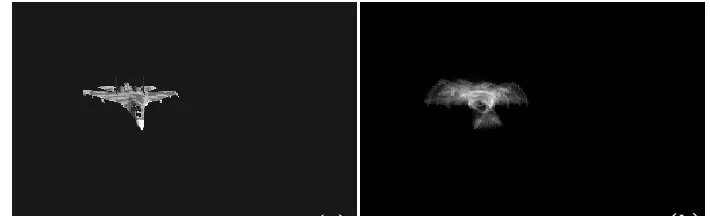
The target image is shown in Figue.1 (a), the size of it is 256256 pixels. The
rotating transform at 50intervals are done by the system software and the training
temple image set of rotating distortion targets composed by nine images (200,
0
15
, 0
10
, 0
5
, 0
0 , 0
5 , 0
10 , 0
15 , 0
20 ) and the rotating distortion template image of the SDF is shown in Figue.1 (b).Every rotating image of nine temple images set and the rotating distortion template image of SDF are processed by the joint transform correlation, and the correlation peak values is shown in Table I, the average value 2.99843 of nine correlation peak values is regard as the ideal correlation peak value and compute the absolute and relative error values of every images.
distortion template image can be recognized as the same target image. In order to verify the effectiveness and feasibility of the SDF, the other ten rotating distortion
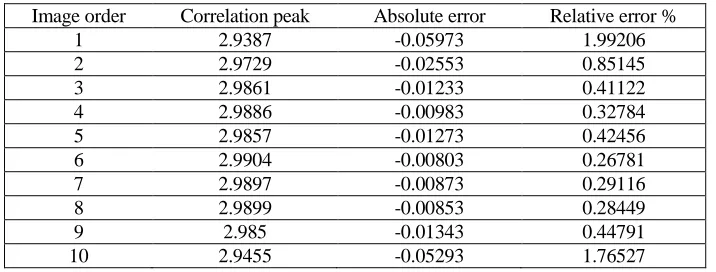
template images (220,180,130,70,30、30,70,130,180,220) are used to test and compute the output correlation peak values. Every rotating image of ten temple images set and the rotating distortion template image of SDF are processed by the joint transform correlation, and the correlation peak values is shown in Table II.
Based on the Table II, we know the correlation peak value errors of ten other temple images an d the rotating distortion template image of SDF are small, comparing with the ideal average value, the maximum absolute error value is -0.05973and the maximum relative error value is 1.99%. Because the test temple image has a small rotating distortion relative to the nine training temple images set, the correlation peak values are less than the ideal correlation peak values. Usually we set when the relative error value is less than or equal to 5%, the distortion target image is regarded as the true target image, so the rotating distortion template images
relative to the true image (the rotating distortion range is 220~220 ) are regarded to be recognized and the recognition rate is 100%.
[image:4.612.113.468.374.483.2]In the same way we can make the rescaling distortion template image of the SDF.
TABLE I. THE CORRELATION PEAK PARAMTERS OF NINE TEMPLE IMAGES AND THE ROTATING DISTORTION TEMPLATE IMAGE OF SDF.
Image order Correlation peak Absolute error Relative error % 1 2.9952 -0.003233333 0.107841 2 3.0035 0.005066667 0.168979 3 3.0022 0.003766667 0.125623 4 2.9992 0.000766667 0.025569 5 2.9873 -0.011133333 0.371311 6 2.9976 -0.000833333 0.027791 7 3.0021 0.003666667 0.122287 8 3.0058 0.007366667 0.245687 9 2.993 -0.005433333 0.181212 Figure1. (a) The target image, (b) the rotating distortion template image of SDF (−200~200).
TABLE II. THE CORRELATION PEAK PARAMTERS OF TEN OTHER TEMPLE IMAGES AND THE ROTATING DISTORTION TEMPLATE IMAGE OF SDF.
Image order Correlation peak Absolute error Relative error % 1 2.9387 -0.05973 1.99206 2 2.9729 -0.02553 0.85145 3 2.9861 -0.01233 0.41122 4 2.9886 -0.00983 0.32784 5 2.9857 -0.01273 0.42456 6 2.9904 -0.00803 0.26781 7 2.9897 -0.00873 0.29116 8 2.9899 -0.00853 0.28449 9 2.985 -0.01343 0.44791 10 2.9455 -0.05293 1.76527
CONCLUSIONS
Refer to the recognition experimental result, and it can be come to a conclusion that the joint transform correlation based on the SDF is feasible for distortion invariant pattern recognition. Because the temple images are ideal images without noise, the recognition rate is 100% for a definite distortion range. The recognition rate on practical application is little less than the recognition rate of ideal condition. Combining a SDF template image including more distorted images is difficult, so it is need high computation speed, high accuracy class of template image and high-performance optic devices. The computer analysis of experimental results show, the distortion invariant pattern recognition correlator based on the SDF is characterized by high discrimination, real-time and flexible processing, and compact construction. The correlation technology in the thesis will have broad developing prospect in image processing, pattern recognition, target tracing and robot sight etc.
REFERENCES
1. Huijun Shong, S. Jutamulia. 2012. Modern Optic Information Processing, Peking University Publishing House, pp. 41- 131.