R E S E A R C H
Open Access
About some exponential inequalities
related to the sinc function
Marija Rašajski
1, Tatjana Lutovac
1and Branko Maleševi´c
1**Correspondence:
1School of Electrical Engineering,
University of Belgrade, Belgrade, Serbia
Abstract
In this paper, we prove some exponential inequalities involving the sinc function. We analyze and prove inequalities with constant exponents and inequalities with certain polynomial exponents. Also, we establish intervals in which these inequalities hold.
MSC: Primary 33B10; secondary 26D05
Keywords: Exponential inequalities; sinc function
1 Introduction
Inequalities related to the sinc function,sincx=sinxx(x= 0), occur in many fields of math-ematics and engineering [1–7] such as Fourier analysis and its applications, information theory, radio transmission, optics, signal processing, sound recording, etc.
The following inequalities are proved in [8]:
cos2x 2≤
sinx
x ≤cos
3x
3≤
2 +cosx
3 (1)
for everyx∈(0,π). In [9], the authors considered possible refinements of inequality (1) by a real analytic functionϕa(x) = (sinxx)aforx∈(0,π) and parametera∈Rand proved the following inequalities:
Statement 1([9], Theorem 10) For all x∈(0,π)and a∈(1,32),
cos2x 2≤
sinx x
a ≤sinx
x . (2)
In [9], based on the analysis of the sign of the analytic function
Fa(x) =
sinx x
a
–cos2x 2
in the right neighborhood of zero, the corresponding inequalities for parameter values
a≥32 are discussed.
In this paper, in Sect.3.1, using the power series expansions and the Wu–Debnath the-orem, we prove that inequality (2) holds fora=32. At the same time, this proof represents
another proof of Statement1. Also, we analyze the casesa∈(32, 2) anda≥2 and prove the corresponding inequalities.
In Sect.3.2, we introduce and prove a new double-sided inequality of similar type in-volving polynomial exponents.
Finally, in Sect.3.3, we establish a relation between the cases of constant and polynomial exponents.
2 Preliminaries
In this section, we review some results that we use in our study. In accordance with [10], the following expansions hold:
lnsinx
x = –
∞
k=1
22k–1|B 2k|
k(2k)! x
2k (0 <x<π), (3)
ln cosx= – ∞
k=1
22k–1(22k– 1)|B
2k|
k(2k)! x
2k (–π/2 <x<π/2), (4)
where Bi(i∈N) are Bernoulli’s numbers.
In our proofs, we use the following theorem proved by Wu and Debnath [11].
Theorem WD([11], Theorem 2) Suppose that f(x)is a real function on(a,b)and that n is a positive integer such that f(k)(a+),f(k)(b–) (k∈ {0, 1, 2, . . . ,n})exist.
(i) Suppose that(–1)(n)f(n)(x)is increasing on(a,b).Then,for allx∈(a,b),we have the following inequality:
n–1
k=0
f(k)(b–)
k! (x–b) k+ 1
(a–b)n
f(a+) –
n–1
k=0
(a–b)kf(k)(b–)
k!
(x–b)n
<f(x) < n
k=0
f(k)(b–)
k! (x–b)
k. (5)
Furthermore,if(–1)nf(n)(x)is decreasing on(a,b),then the reversed inequality of(5)
holds.
(ii) Suppose thatf(n)(x)is increasing on(a,b).Then,for allx∈(a,b),we have the
following inequality:
n
k=0
f(k)(a+)
k! (x–a) k
<f(x)
< n–1
k=0
f(k)(a+)
k! (x–a) k+ 1
(b–a)n
f(b–) –
n–1
k=0
(b–a)kf(k)(a+)
k!
(x–a)n. (6)
Furthermore,if f(n)(x)is decreasing on(a,b),then the reversed inequality of(6)holds.
Remark1 Note that inequalities (5) and (6) hold forn∈Nand forn= 0.
The following theorem, which is a consequence of TheoremWD, was proved in [12].
Theorem 2([12], Theorem 1) Let a function f : (a,b)−→Rhave the following power series expansion:
f(x) = ∞
k=0
ck(x–a)k (7)
for x∈(a,b),where the sequence of coefficients{ck}k∈N0 has a finite number of nonpositive
terms,and their indices are in the set J={j0, . . . ,j}.
Then,for the function
F(x) =f(x) –
i=0
cji(x–a)
ji=
k∈N0\J
ck(x–a)k (8)
and the sequence{Ck}k∈N0 of the nonnegative coefficients defined by
Ck=
⎧ ⎨ ⎩
ck, ck> 0,
0, ck≤0,
(9)
we have
F(x) = ∞
k=0
Ck(x–a)k (10)
for every x∈(a,b).
Also,F(k)(a+) =k!C
k,and the following inequalities hold:
n
k=0
Ck(x–a)k
<F(x) < n–1
k=0
Ck(x–a)k+ 1 (b–a)n
F(b–) –
n–1
k=0
Ck(b–a)k
(x–a)n (11)
for all x∈(a,b)and n∈N0,that is,
m
k=0
Ck(x–a)k+
i=0
cji(x–a)
ji
<f(x)
< m–1
k=0
Ck(x–a)k+
i=0
cji(x–a)
ji
+(x–a) m
(b–a)m
f(b–) –
m–1
k=0
Ck(b–a)k–
i=0
cji(b–a)
ji
(12)
3 Main results
3.1 Inequalities with constants in the exponents
First, we consider a connection between the number of zeros of a real analytic function and some properties of its derivatives. It is well known that the zeros of a nonconstant analytic function are isolated [13]; see also [14] and [15].
We prove the following statement.
Theorem 3 Let f : (0,c)−→Rbe a real analytic function such that f(k)(x) > 0for x∈(0,c)
and k=m,m+ 1, . . . (for some m∈N). Suppose that the following conditions hold:
(1) there is a right neighborhood of zero in whichf(x) < 0,f(x) < 0,. . .,f(m–1)(x) < 0,and (2) f(c–) > 0,f(c–) > 0,. . .,f(m–1)(c–) > 0.
Then there exists exactly one zero x0∈(0,c)of the function f.
Proof Asf(m)(x) > 0 forx∈(0,c), it follows that f(m–1)(x) is an increasing function for
x∈(0,c). From conditions (1) and (2) we conclude that there exists exactly one zero
xm–1∈(0,c) of the functionf(m–1)(x). Next, we can conclude that functionf(m–2)(x) is
decreasing forx∈(0,xm–1) and increasing forx∈(xm–1,c). It is clear that the function
f(m–2)(x) has exactly one minimum in the interval (0,c) at pointx
m–1andf(m–2)(xm–1) < 0.
From condition (2) it follows that the functionf(m–2)(x) has exactly one rootx
m–2on the
interval (0,c) andxm–2∈(xm–1,c).
By repeating the described procedure, we get the statement of the theorem.
Let us consider the family of functions
fa(x) =aln sinx
x – 2ln cos x
2 (13)
forx∈(0,π) and parametera∈(1, +∞). Obviously, the following equivalence is true:
a1<a ⇐⇒ fa(x) <fa1(x) (14)
fora,a1> 1 andx∈(0,π).
Thus
3
2<a ⇐⇒ fa(x) <f23(x) forx∈(0,π). (15)
By the power series expansions (3) and (4), we have
fa(x) = ∞
k=1
Ekx2k (16)
fora> 1 andx∈(0,π), where
Ek=
((2 –a)4k– 2)|B
2k|
Fora=32, we haveE1= 0 andEk> 0 fork= 2, 3, . . . . Thus from (16) we have
f3
2(x) > 0 forx∈(0,π),
and consequently we have the following result.
Theorem 4 For all x∈(0,π),we have
cos2x 2 ≤
sinx x
3 2
≤sinx x .
Since
sinx x
3 2
≤
sinx x
a
forx∈(0,π) anda∈(1,32], the previous theorem can be thought of as a new proof of Statement1.
Consider now the family of functionsfa(x) =alnsinxx – 2ln cosx2 forx∈(0,π) and pa-rametera>3
2.
It easy to check that for the sequence
αk= 2 – 2
4k, k∈N, (18)
the following equivalences are true:
a=αk ⇐⇒ Ek= 0,
a∈(αk,αk+1) ⇐⇒
∀i∈ {1, 2, . . . ,k}Ei< 0∧(∀i>k)Ei> 0. (19)
Let us now consider the functionm: [32, 2)−→N0defined by
m(a) =k if and only if a∈(αk,αk+1]. (20)
It is not difficult to check thatlima→2–m(a) = +∞, whereas for a fixeda∈(
3 2, 2), the
number of negative elements of the sequence{Ek}k∈Nism(a), and their indices are in the set{1, . . . ,m(a)}. For this reason, we distinguish two casesa∈(32, 2) anda≥2.
As for the parametera= 2 andx∈(0,π), we have
sinx x
2
≤cos2x
2 ⇐⇒ sin
2x
2≤
x
2
2
,
whereas fora> 2 andx∈(0,π), we have
sinx x
a ≤
sinx x
2
.
Theorem 5 For all a≥2and x∈(0,π),we have
sinx x
a
≤cos2x
2. (21)
Consider now the case where the parametera∈(32, 2). As noted before, for any fixed
a∈(32, 2), there is a finite number of negative coefficients in the power series expansion (17), so it is possible to apply Theorem2.
According to Theorem2, we have the following inequalities:
n
k=m(a)+1
Ekxk+
m(a)–1
i=0
Eixi
<fa(x)
<
fa(c–) –
n–1
k=m(a)+1
Ekck–
m(a)–1
i=0
Eici
xn cn+
n–1
k=m(a)+1
Ekxk+
m(a)–1
i=0
Eixi (22)
for allx∈(0,c),c∈(0,π),n>m(a) + 1, anda∈(32, 2).
The family of functionsfa(x) forx∈(0,π) anda∈(32, 2) satisfy conditions (1) and (2) of Theorem3, as we prove in the following lemma.
Lemma 1 Consider the family of functions fa(x) =alnsinxx– 2ln cosx2 for x∈(0,π)and
parameter a∈(3
2, 2).Let m=m(a),wherem(a)is defined as in(20).
Then dk
dxkfa(x) > 0for k=m,m+ 1, . . .and x∈(0,π),and the following assertions hold:
(1) There is a right neighborhood of zero in which the following inequalities hold:
fa(x) < 0, dxdfa(x) < 0,. . ., d
m–1
dxm–1fa(x) < 0;
(2) fa(π–) > 0,dxdfa(π–) > 0,. . ., d
m–1
dxm–1fa(π–) > 0.
Proof Let us recall that, for any fixeda∈(32, 2), there is a finite number of negative coeffi-cients in the power series expansion (17). Also, we have
d dxfa
(x) =a
cotx–1
x
+tanx 2.
For the derivatives of the functionfa(x) in the left neighborhood ofπ, it suffices to observe that
d dxfa
(π–x) =a
–cotx– 1 π–x
+cotx 2=
2 –a
x –
a
π +
a
1 3–
1 π2
–1 6
x+· · ·.
From this the conclusions of the lemma can be directly derived.
Thus, for every a∈(32, 2), the corresponding functionfa(x) =alnsinxx – 2ln cosx2 has exactly one zero on the interval (0,π). Let us denote it byxa.
The following theorem is a direct consequence of these considerations.
Theorem 6 For every a∈(32, 2)and all x∈(0,xa],where0 <xa<π,we have
sinx x
a
≤cos2x
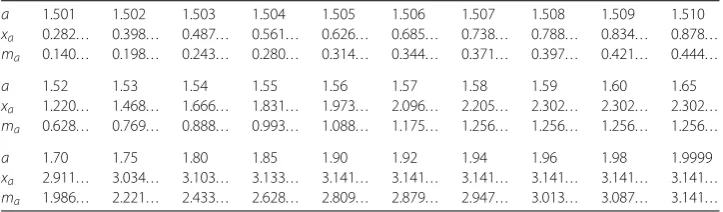
Table 1 Valuesxaandmafor some specifieda∈(32, 2) related to Theorems6and10, respectively
a 1.501 1.502 1.503 1.504 1.505 1.506 1.507 1.508 1.509 1.510 xa 0.282. . . 0.398. . . 0.487. . . 0.561. . . 0.626. . . 0.685. . . 0.738. . . 0.788. . . 0.834. . . 0.878. . .
ma 0.140. . . 0.198. . . 0.243. . . 0.280. . . 0.314. . . 0.344. . . 0.371. . . 0.397. . . 0.421. . . 0.444. . .
a 1.52 1.53 1.54 1.55 1.56 1.57 1.58 1.59 1.60 1.65 xa 1.220. . . 1.468. . . 1.666. . . 1.831. . . 1.973. . . 2.096. . . 2.205. . . 2.302. . . 2.302. . . 2.302. . .
ma 0.628. . . 0.769. . . 0.888. . . 0.993. . . 1.088. . . 1.175. . . 1.256. . . 1.256. . . 1.256. . . 1.256. . .
a 1.70 1.75 1.80 1.85 1.90 1.92 1.94 1.96 1.98 1.9999
xa 2.911. . . 3.034. . . 3.103. . . 3.133. . . 3.141. . . 3.141. . . 3.141. . . 3.141. . . 3.141. . . 3.141. . .
ma 1.986. . . 2.221. . . 2.433. . . 2.628. . . 2.809. . . 2.879. . . 2.947. . . 3.013. . . 3.087. . . 3.141. . .
For the selected discrete values of a∈(32, 2), the zerosxa of the corresponding func-tionsfa(x) are shown in Table1. Although the valuesxacan be obtained by any numerical method, the following remark can also be used to locate them.
Remark7 For a fixeda∈(32, 2), selectn>m(a) + 1 and consider inequalities (22). Denote the corresponding polynomials on the left- and right-hand sides of (22) byPL(x) andPR(x), respectively. These polynomials are of negative sign in a right neighborhood of zero (see [15], Theorem 2.5), and they have positive leading coefficients. Then, the rootxa of the equationfa(x) = 0 is always localized between the smallest positive roots of the equations
PL(x) = 0 andPR(x) = 0.
3.2 Inequalities with polynomial exponents
In this subsection, we propose and prove a new double-sided inequality involving the sinc function with polynomial exponents.
To be more specific, we find two polynomials of the second degree that, when placed in the exponent of the sinc function, give an upper and a lower bound forcos2x2.
Theorem 8 For every x∈(0, 3.1),we have the double-sided inequality
sinx x
p1(x) <cos2x
2<
sinx x
p2(x)
, (24)
where p1(x) =32+ x
2
2π2 and p2(x) =32+x
2
80.
Proof Consider the equivalent form of inequality (24)
p1(x)ln
sinx
x < 2ln cos x
2<p2(x)ln sinx
x .
Now, let us denote
Gi(x) =pi(x)ln sinx
x – 2ln cos x
2
Based on TheoremWD, from (3) we obtain
– m–1
k=1
22k–1|B 2k|
k(2k)! x
2k+
1
c 2m
lnsinc
c –
m–1
k=1
22k–1|B 2k|
k(2k)! c
2k
x2m
<lnsinx
x < –
n
k=1
22k–1|B 2k|
k(2k)! x
2k (25)
forx∈(0,π), wheren,m∈N,m,n≥2. Based on TheoremWD, from (4) we obtain
– m–1
k=1
22k–1(22k– 1)|B
2k|
k(2k)! x
2k+
1
c 2m
ln cosc– m–1
k=1
22k–1(22k– 1)|B
2k|
k(2k)! c
2k
x2m
<ln cosx< – n
k=1
22k–1(22k– 1)|B2k|
k(2k)! x
2k (26)
forx∈(0,c), where 0 <c<π
2,n,m∈N,m,n≥2, that is,
n
k=1
(22k– 1)|B2k| 2k(2k)! x
2k
< –ln cosx 2
< m–1
k=1
(22k– 1)|B
2k| 2k(2k)! x
2k–
2
c 2m
ln cosc 2–
m–1
k=1
(22k– 1)|B
2k| 2k(2k)! c
2k
x2m (27)
forx∈(0,c) and 0 <c<π,n,m∈N,m,n≥2. Now, let us introduce the notation
H1(x,m1,n1,c1)
= –p1(x)
m1–1 k=1
22k–1|B 2k|
k(2k)! x
2k
– 2
– m1–1
k=1
(22k– 1)|B
2k| 2k(2k)! x
2k+ 1
c2m1
1
lnc1 2 +
n1–1 k=1
(22k– 1)|B
2k| 2k(2k)! c
2k
1
x2m1
form1,n1∈N,m1,n1≥2,c1∈(0,π), andx∈(0,c1);
H2(x,m2,n2,c2)
=p2(x)
– m2–1
k=1
22k–1|B2k|
k(2k)! x
2k+ 1
c2m2
2
lnsinc2
c2
+ m2–1
k=1
22k–1|B2k|
k(2k)! c
2k
2
x2m2
+ 2 n2
k=1
(22k– 1)|B
2k| 2k(2k)! x
2k
By inequalities (25) and (27) we have
G1(x) <H1(x,m1,n1,c1),
G2(x) >H2(x,m2,n2,c2),
form1,n1,m2,n2∈Nandc1,c2∈(0,π).
Forc1=c2= 3.1,m1= 25, andn1= 10 and form2= 13 andn2= 27, it is easy to prove
thatH1(x,m1,n1,c1) < 0 andH2(x,m2,n2,c2) > 0 for everyx∈(0,c1).
Hence we conclude thatG1(x) < 0 andG2(x) > 0 for everyx∈(0, 3.1), and the
double-sided inequality (24) holds.
Remark9 Note that this method can be used to prove that inequality (24) of Theorem8 holds on any interval (0,c) wherec∈(0,π), but the degrees of the polynomialsH1andH2
get larger ascapproachesπ.
3.3 Constant vs. polynomial exponents
Let us observe the inequalities in Theorems6and8and inequality (24) containing con-stants and polynomials in the exponents, respectively.
A question of establishing a relation between these functions, with different types of exponents, comes up naturally. The following theorem addresses this question.
Theorem 10 For all a∈(32, 2)and x∈(0,ma),where ma=
2π2(a–3
2),we have the
fol-lowing double-sided inequality:
sinx x
a <
sinx x
3 2+x
2 2π2
<cos2x
2. (28)
Proof Leta=32+ε,ε∈(0,12), andx> 0. Then
3 2+
x2
2π2
lnsinx
x –aln
sinx x
=
3 2+
x2
2π2
lnsinx
x –
3 2+ε
lnsinx
x
=
x2
2π2–ε
lnsinx
x =
1 2π2
x–√2π2εx+√2π2εlnsinx
x .
Now we have
x∈0,√2π2ε ⇐⇒
3 2+αx
2
lnsinx
x >
3 2+ε
lnsinx
x
⇐⇒
sinx x
3 2+x
2 2π2
>
sinx x
3 2+ε
.
Hence, applying Theorem8, the double-sided inequality (28) holds for alla∈(32, 2) and
x∈(0,ma).
Remark11 Note that Theorem 10represents another proof of the following assertion from [9]:
∀a∈(3/2, 2)(∃δ> 0)∀x∈(0,δ) sinx
x a
<cos2x 2.
4 Conclusion
In this paper, using the power series expansions and the application of the Wu–Debnath theorem, we proved that inequality (2) holds fora=32. At the same time, this proof repre-sents a new short proof of Statement1.
We analyzed the casesa∈(3
2, 2) anda≥2, and we proved the corresponding
inequal-ities. We introduced and proved a new double-sided inequality of similar type involving polynomial exponents. Also, we established a relation between the cases of constant and polynomial exponents.
Acknowledgements
The authors are grateful to the Serbian Ministry of Education, Science and Technological Development, for their support. Also, the authors are grateful to the reviewers for their careful reading and for their valuable comments.
Funding
The research of the first, second, and third authors was supported in part by the Serbian Ministry of Education, Science and Technological Development, under Projects ON 174033, TR 32023, and ON 174032 & III 44006, respectively.
Competing interests
The authors would like to state that they do not have any competing interests in the subject of this research.
Authors’ contributions
All the authors participated in every phase of the research conducted for this paper. All authors read and approved the final manuscript.
Publisher’s Note
Springer Nature remains neutral with regard to jurisdictional claims in published maps and institutional affiliations.
Received: 8 April 2018 Accepted: 21 May 2018 References
1. Mitrinovi´c, D.S.: Analytic Inequalities. Springer, Berlin (1970)
2. Mortici, C.: The natural approach of Wilker–Cusa–Huygens inequalities. Math. Inequal. Appl.14(3), 535–541 (2011) 3. Rahmatollahi, G., De Abreu, G.T.F.: Closed-form hop-count distributions in random networks with arbitrary routing.
IEEE Trans. Commun.60(2), 429–444 (2012)
4. Anderson, D.G., Vuorinen, M., Zhang, X.: Topics in special functions III. In: G.V. Milovanovi´c, M.Th. Rassias (eds.) Analytic Number Theory, Approximation Theory and Special Functions, pp. 297–345. Springer, Berlin (2014)
5. Cloud, M.J., Drachman, B.C., Lebedev, L.P.: Inequalities with Applications to Engineering. Springer, Berlin (2014) 6. Lutovac, T., Maleševi´c, B., Rašajski, M.: A new method for proving some inequalities related to several special
functions. Results Math. (accepted).arXiv:1802.02082
7. Maleševi´c, B., Lutovac, T., Rašajski, M., Mortici, C.: Extensions of the natural approach to refinements and generalizations of some trigonometric inequalities. Adv. Differ. Equ.2018, 90 (2018)
8. Yang, Z.-H.: New sharp Jordan type inequalities and their applications. Gulf J. Math.2(1), 1–10 (2014)
9. Lutovac, T., Maleševi´c, B., Mortici, C.: The natural algorithmic approach of mixed trigonometric-polynomial problems. J. Inequal. Appl.2017, 116 (2017)
10. Gradshteyn, I., Ryzhik, I.: Table of Integrals Series and Products, 8th edn. Academic Press, San Diego (2015)
11. Wu, S., Debnath, L.: A generalization of L’Hospital-type rules for monotonicity and its application. Appl. Math. Lett.22, 284–290 (2009)
12. Rašajski, M., Lutovac, T., Maleševi´c, B.: Sharpening and generalizations of Shafer–Fink and Wilker type inequalities: a new approach. J. Nonlinear Sci. Appl.11(7), 885–893 (2018).https://doi.org/10.22436/jnsa.011.07.02
13. Godement, R.: Analysis I: Convergence, Elementary Functions. Springer, Berlin (2004) 14. Krantz, S.G., Parks, H.R.: A Primer of Real Analytic Functions. Springer, Berlin (1992)