S
Interactive and Dynamic Multi-Objective
Software Refactoring Recommendations
Vahid Alizadeh, Marouane Kessentini, Wiem Mkaouer, Mel Ocinneide, Ali Ouni and Yuanfang Cai
Abstract—Successful software products evolve through a process of continual change. However, this process may weaken the design of the software and make it unnecessarily complex, leading to significantly reduced productivity and increased fault-proneness. Refactoring improves the software design while preserving overall functionality and behavior, and is an important technique in managing the growing complexity of software systems. Most of the existing work on software refactoring uses either an entirely manual or a fully automated approach. Manual refactoring is time-consuming, error-prone and unsuitable for large-scale, radical refactoring. On the other hand, fully automated refactoring yields a static list of refactorings which, when applied, leads to a new and often hard to comprehend design. Furthermore, it is difficult to merge these refactorings with other changes performed in parallel by developers. In this paper, we propose a refactoring recommendation approach that dynamically adapts and interactively suggests refactorings to developers and takes their feedback into consideration. Our approach uses NSGA-II to find a set of good refactoring solutions that improve software quality while minimizing the deviation from the initial design. These refactoring solutions are then analyzed to extract interesting common features between them such as the frequently occurring refactorings in the best non-dominated solutions. Based on this analysis, the refactorings are ranked and suggested to the developer in an interactive fashion as a sequence of transformations. The developer can approve, modify or reject each of the recommended refactorings, and this feedback is then used to update the proposed rankings of recommended refactorings. After a number of introduced code changes and interactions with the developer, the interactive NSGA-II algorithm is executed again on the new modified system to repair the set of refactoring solutions based on the new changes and the feedback received from the developer. We evaluated our approach on a set of eight open source systems and two industrial projects provided by an industrial partner. Statistical analysis of our experiments shows that our dynamic interactive refactoring approach performed significantly better than four existing search-based refactoring techniques and one fully-automated refactoring tool not based on heuristic search.
Index Terms—Search-based software engineering, Refactoring, interactive optimization, software quality.
✦
1 I
NTRODUCTIONUCCESSFUL software products evolve through a process of continual change. However, this process may weaken the design of the software and make it unnecessarily com- plex, leading to significantly reduced productivity, increased fault-proneness and cost of maintenance, and has even led to projects being canceled. Many studies report that soft- ware maintenance activities consume up to 90% of the total cost of a typical software project. It has also been shown that software developers typically spend around 60% of their time in understanding the code they are maintaining [1]. Clearly, software developers need better ways to manage and reduce the growing complexity of software systems and improve their productivity. The standard solution is refactoring, which involves improving the design structure of the software while preserving its functionality [2]. There has been much work done on various techniques and tools
• Vahid Alizadeh, Marouane Kessentini, Wiem Mkaouer are with the University of Michigan, MI,USA.
E-mail: {alizadeh,marouane,mmkaouer}@umich.edu
• Mel Ocinneide is with the University College Dublin, Dublin, Ireland. E-mail: [email protected]
• Ali Ouni is with ETS, Montreal, Canada. E-mail: [email protected]
• Yuanfang Cai is with Drexel University, USA. E-mail: [email protected]
for software refactoring [2], [3], [4], [5] and these approaches can be classified into three main categories: manual, semi- automated and fully-automated approaches, as outlined below. In manual refactoring, the developer refactors with no tool support at all, identifying the parts of the program that require attention and performing all aspects of the code transformation by hand. It may seem surprising that a developer would eschew the use of tools in this way, but Murphy-Hill et al. [6] found in their empirical study of the developers usage of the Eclipse refactoring tooling that in almost 90% of cases the developers performed refactorings manually and did not use any automated refactoring tools. Kim et al. [7] confirmed this observation, finding that the interviewed developers from Microsoft preferred to perform refactoring manually in 86% of cases. In spite of its apparent popularity, manual refactoring is very limited however; several studies have shown that manual refactoring is error- prone, time-consuming, not scalable and not useful for radical refactoring that requires an extensive application of refactorings to correct unhealthy code [8].
By semi-automated refactoring, we refer to the situation where a developer uses the standard refactoring tooling available in IDEs such as Eclipse and Netbeans to apply the refactorings they deem appropriate. Murphy-Hill et al. [6] analyzed data collected from 13,000 Java developers using the Eclipse IDE over a 9-month period, finding that the
2
trivial Rename refactoring accounted for almost 72% of the refactorings performed, while the combination of Rename, Extract Method/Variable and Move accounted for 89.3% of the total number of refactorings performed.
In fully-automated refactoring, a search-based process is employed to find an entire refactoring sequence that im- proves the program in accordance with the employed fit- ness function (involving e.g., code smells, software quality metrics etc.). This approach is appealing in that it is a complete solution and requires little developer effort, but it suffers from several serious drawbacks as well. Firstly, the recommended refactoring sequence may change the program design radically and this is likely to cause the developer to struggle to understand the refactored program [9]. Secondly, it lacks flexibility since the developer has to either accept or reject the entire refactoring solution. Thirdly, it fails to consider the developer perspective, as the developer has no opportunity to provide feedback on the refactoring solution as it is being created. Furthermore, as development must halt while the refactoring process exe- cutes, fully-automated refactoring methods are not useful for floss refactoring where the goal is to maintain good design quality while modifying existing functionality. The developers have to accept the entire refactoring solution even though they prefer, in general, step-wise approaches where the process is interactive and they have control of the refactorings being applied [10].
In light of the discussion above, we propose an approach to refactoring recommendation that (1) provides refactoring- centric interaction, (2) enables refactoring and development to proceed in parallel and (3) collects information in a non- intrusive manner that can be used to inform dynamically the refactoring process. We postulate that enabling the de- veloper to interact with the refactoring solution is essential both to creating a better refactoring solution, and to creating a solution that the developer understands and can work with.
We propose that this interaction should be centered on refactorings, which are of direct interest to a developer, rather than code smells or software quality metrics, which have been found not to be strong drivers of the refactoring process in practice [11, 12]. Refactoring and development must be allowed to proceed in parallel, as this is part of test- driven development [13] and the Agile approach to soft- ware development in general [14]. Thus the developer can continue to extend the program with new functionality or bug fixes while the refactoring recommendation process ex- ecutes. Finally, any development carried out is used where possible to improve the refactoring recommendations, e.g., the developer is more likely to value refactorings that affect recently updated code.
Our goal is to present the developer with few refactorings at a time, allowing them to accept / reject/ modify each refactoring as they see it. Thus, developers are not forced to either accept or run the entire refactoring operations or reject them and the developers may not control the number the applied refactorings. In our approach, the developers can apply operations to the extent that they want. Finding a refactoring solution is a naturally multi-objective problem, so there is not one single ”best” solution, rather there is a set of non-dominated solutions, the so-called Pareto front [15].
In this paper, we use the multi-objective evolutionary algo- rithm NSGA-II [15] to create the Pareto front, using a fitness function that aims to improve software quality metrics while maintaining design coherence and reducing the number of recommended refactorings. The question we face is how to choose one solution from this front to present to the developer? The traditional approach is to seek a ”knee point” on the front, but this ignores the fact that developers have their own refactoring priorities and may prefer a refactoring solution elsewhere on the front. To this end, we propose, for the first time in search-based software refactoring, the use of innovization (innovation through optimization) [16] to analyze and explore the Pareto front interactively and implicitly with the developer. Innovization is a technique that seeks interesting commonalities among the solutions of the Pareto front with the aim of developing a deeper understanding of the problem.
Our innovization algorithm starts by finding the most frequently-occurring refactorings among the set of non- dominated refactoring solutions. Based on this analysis, a complete refactoring solution is chosen from the front that best matches the most frequently-occurring refactorings, i.e., one that best represents the entire front in some sense. The recommended refactorings are then ranked and suggested to the developer one by one.
The developer can approve, modify or reject each suggested refactoring. Each such action by the developer is fed back into the search process. For example, if the developer rejects a refactoring, the search process will subsequently avoid this refactoring in creating new solutions. After the software has been changed to some degree, i.e. the developer has changed it by adding new functionality, fixing some bugs or applying some refactorings and/or has provided feedback by rejecting a number of refactorings, NSGA-II will continue to execute in the new modified context to repair the set of good refactoring solutions based on the updated code and the feedback received from the developer. The feedback received from the developers will be also used as a set of new constraints to consider for the next iterations of NSGA-II. The algorithm will avoid, for example, including rejected refactorings by the developer when generating new solutions or repairing existing ones. However, the algorithm is not based on simply discarding all refactoring suggestions rejected by developer since adding new constraints to re- duce the search space may make the current recommended refactoring solutions invalid.
We implemented our proposed approach and evaluated it on a set of eight open source systems and two industrial systems provided by our industrial partner, the Ford Motor Company. Statistical analysis of our experiments showed that our proposal performed significantly better than four existing search-based refactoring approaches [17, 18, 19] [20] and an existing refactoring tool not based on heuristic search, JDeodorant [21]. In our qualitative analysis, we found that the software developers who participated in our experiments confirmed the relevance of the suggested refactorings and the flexibility of the tool in modifying and adapting the suggested refactorings.
to repair non-dominated solutions after interactions with developers, (2) ten software applications are studied rather than five, (3) the number of participants in the experi- ments is doubled from 11 to 22, (4) an entirely new set of experimental results are presented and analyzed in far greater detail, (5) a comparison with a larger set of existing refactoring techniques is included.
It also extends our previous study [9] where we proposed a fully-automated, multi-objective approach to find the best refactoring solutions that improve software quality metrics and reduce the number of recommended refactorings. In [9], we did not consider any developer interaction (fully- automated approach) and did not update/repair refactoring solutions based on new code changes introduced by devel- opers. A recent study [45] extended our previous work [22] to propose an interactive search based approach for refac- toring recommendations. The developers have to specify a desired design at the architecture level then the proposed approach try to find the relevant refactorings that can gen- erate a similar design to the expected one. In our work, we do not consider the use of a desired design, thus developers are not required to manually modify the current architecture of the system to get refactoring recommendations.
The primary contributions of this paper can be summarized as follows:
1) The paper introduces a novel interactive way to refactor software systems using innovization and interactive dynamic multi-objective optimization. The proposed technique supports the adaptation of refactoring solutions based on developer feedback while also taking into account other code changes that the developer may have performed in parallel with the refactoring activity.
2) We propose an implicit exploration of the Pareto front of non-dominated solutions based on our novel interactive approach that can help software developers to use multi-objective optimization for software engineering problems, avoiding the neces- sity for manual exploration of the Pareto front to find the best trade-off between the objectives. 3) The paper reports the results of an empirical study
on an implementation of our approach. The ob- tained results provide evidence to support the claim that our proposal is more efficient, on average, than existing refactoring techniques based on a bench- mark of eight open source systems and two indus- trial projects. The paper also evaluates the relevance and usefulness of the suggested refactorings for software developers in improving the quality of their systems.
The remainder of this paper is structured as follows. Section 2 presents the relevant background details. Section 3 describes our novel approach to interactive code refactoring while the results obtained from our experiments are pre- sented and discussed in Section 4 and 5. Threats to validity are discussed in Section 7. Section 7 provides an account of related work. Finally, in Section 8, we summarize our conclusions and present some ideas for future work.
2 BACKGROUND
In this section, we describe the required background to un- derstand the proposed approach. First, we give an overview about software refactoring. Then, several definitions related to interactive and dynamic multi-objective optimization are described.
2.1 Software Refactoring
Refactoring is defined as the process of improving the code after it has been written by changing its internal structure without changing its external behavior. The idea is to reorga- nize variables, classes and methods to facilitate future adap- tations and enhance comprehension. This reorganization is used to improve different aspects of the software quality such as maintainability, extensibility, reusability, etc. Some modern Integrated Development Environments (IDEs), such as Eclipse, Netbeans, provide support for applying the most commonly used refactorings, e.g., move method, rename class, etc.
In order to identify which parts of the source code need to be refactored, most of the existing work relies on the notion of bad smells (e.g., Fowler’s textbook [23]), also called design defects or anti-patterns. In this paper, we assume that code smells have been already detected, and need to be corrected. Typically, code smells refer to design situations that adversely affect the development of the software. When applying refactorings to fix design defects, software metrics can be used as an overall indication of the quality of the new design. For instance, high intra-class cohesion and low inter-class coupling usually indicate a high-quality system.
2.2 Interactive and Dynamic Evolutionary Multi- Objective Optimization
In this section, we give a brief overview about two impor- tant aspects in the Evolutionary Multi-objective Optimiza- tion (EMO) [50] paradigm related to the: (1) Interaction with the user and (2) Dynamicity of the problem.
Interacting with the human user means allowing the user to inject his/her preferences into the computational search algorithm and then using these preferences to guide the search process. To express his/her preferences, the user needs some preference modeling tools. The most commonly used ones are [50]:
• Weights: Each objective is assigned a weighting coeffi- cient expressing its importance. The larger the weight is, the more important the objective is.
• Solution ranking: The user is provided with a sample of solutions (a subset of the current population) and is invited to perform comparisons between pairs of equally-ranked solutions in order to differentiate between solutions that the fitness function regards as equal.
• Objective ranking: Pairwise comparisons between pairs of objectives are performed in order to rank the problem’s objectives where strong conflict exists between a pair of objectives.
4
the desired level that he/she wishes to achieve. This desired level is called aspiration level.
• Reservation point (also called a reservation level vec- tor): The user supplies, for each objective, the ac- cepted level that he/she wishes to reach. This ac- cepted level is called reservation level.
• Trade-off between objectives: The user specifies that the
or maximizing an objective function vector under some constraints over time. Its general form is the following [50]:
M inf (x, t) = [f1(x, t), f2(x, t), ..., fM (x, t)]T
gj (x, t) ≥0, j = 1, ...P ;
hk (x, t) = 0, k=1,...,Q;
xL U
gain of one unit in one objective is worth degradation in some others and vice versa.
• Outranking thresholds: The user specifies the neces- sary thresholds to design a fuzzy predicate modeling the truth degree of the predicate solution x is at least as good as solution y.
• Desirability thresholds: The user supplies: (1) an abso- lutely satisfying objective value and (2) a marginally infeasible objective value. These thresholds represent the parameters that define the desirability functions. Based on these preference modeling tools, we observe that the goal of a preference-based EMO algorithm is to assign different importance levels to the problem’s objectives with the aim to guide the search towards the Region of Interest (ROI) that is the portion of the Pareto Front that best matches the user preferences. In fact, usually, the user is not interested with the whole Pareto front and thus he/she is searching only for his/her ROI from which the problem’s final solution will be selected. Several preference-based EMO algorithms have been proposed and used to solve real problems such as PI-EMOA [46], iTDEA [47], NOSGA [48], DF-SMS-EMOA [49], just to cite a few. There are several algorithmic challenges that should be overcome such as the preservation of Pareto dominance, the preservation of population diversity, the scalability with the number of objectives, etc.
Until now, the user’s preferences are expressed and handled in the objective space. It is important to highlight that one of the original aspects of our work in this paper, as detailed later, is allowing the user (a software developer) to express his/her preferences in the decision space and then handling these preferences to help the user finding the most desired refactoring solution. Moreover, our approach helps the user in eliciting his/her preferences, which is very important for any preference-based EMO algorithm. These preferences are introduced implicitly by moving between the Pareto front of non-dominated solutions after obtaining feedback from the user about just a few parts of the solution in order to better understand his preferences. This implicit exploration
i ≤xi ≤xi , i=1,...,n;
where M is the number of objective functions, t is the time instant, P is the number of inequality constraints, Q is the number of equality constraints, XL and xU correspond
i i
respectively to the lower and upper bounds of the variable
xi .
A solution xi satisfying the (P + Q) constraints is said to
be feasible, and the set of all feasible solutions defines the feasible search space denoted by Ω. In this formulation, we consider a minimization MOP since maximization can be easily turned into minimization based on the duality principle by multiplying each objective function by −1 and transforming the constraints based on the duality rules. The resolution of a MOP yields a set of trade-off solutions, called Pareto optimal solutions or non-dominated solutions, and the image of this set in the objective space is called the Pareto front. Hence, the resolution of a MOP consists in approximating the entire Pareto front. In the following, we provide some background definitions related to multi- objective optimization. It is worth noting that these defini- tions remain valid in the case of DMOPs.
Definition 1: Pareto optimality
A solution x∗∈Ω is Pareto optimal if ∀x ∈Ω and I = {1, ..., M }
either ∀m ∈I we have fm(x) = fm(x∗) or there is at least one
m ∈I such that fm(x) > fm(x∗) .
The definition of Pareto optimality states that x∗ is Pareto optimal if no feasible vector exists that would improve some objectives without causing a simultaneous worsening in at least one other objective.
Definition 2: Pareto dominance
A solution u = (u1, u2, ..., un) is said to dominate another solution
v = (v1, v2, ..., vn) ( denoted by f (u) ≺f (v) ) if and only if f (u) is
partially less than f (v). In other words, ∀m ∈ {1, ..., M } we have
fm(u) ≤fm(v) and ∃m ∈ {1, ..., M }where fm(u) < fm(v) .
Definition 3: Pareto optimal set
For a given MOP f (x), the Pareto optimal set is
P ∗= {x ∈Ω|¬∃x/ ∈Ω, f (x/) ≺f (x)}.
of the Pareto front will be detailed in the next section where we describe the formulation of our refactoring problem. The incorporation of user preferences may require the handling of dynamicity issues related to the introduced changes to the solution or the input (i.e. the software system). Handling dynamicity in EMO means solving dynamic problems where the objective functions and or the constraints may change over time such due to, for example, the dynamic nature of most of software evolution problems including software refactoring. Applying evolutionary algorithms (EAs) to solve Dynamic Multi-Objective Problems (DMOPs) has received great attention from researchers thanks to the adaptive behavior of evolutionary computation methods. A DMOP consists of minimizing
Definition 4: Pareto optimal front
For a given MOP f (x) and its Pareto optimal set P ∗, the Pareto front is P F ∗= {f (x), x ∈P ∗}.
In the next section, we describe an overview of our dynamic interactive refactoring approach then a detailed formulation of our solution.
3 SEARCH-BASED INTERACTIVE
REFACTORING RECOMMENDATION
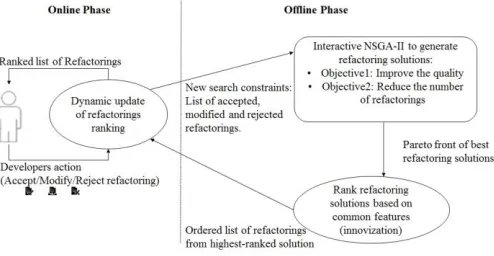
Figure 1. Approach Overview.
3.1 Approach Overview
The goal of our approach is to propose a new dynamic interactive way for software developers to refactor their systems. The general structure of our approach is sketched in Fig. 1.
Our technique comprises two main components. The first component is an offline phase, executed in the back- ground, when developers are modifying the source code of the system. During this phase, the multi-objective algorithm, NSGA-II, is executed for a number of iterations to find the non-dominated solutions balancing the two objectives of improving the quality, which corresponds to minimizing the number of code smells, maximizing/preserving the se- mantic coherence of the design and improving the QMOOD (Quality Model for Object-Oriented Design) quality metrics, and the second objective of minimizing the number of refactorings in the proposed solutions.
The output of this first step of the offline phase is a set of Pareto-equivalent refactoring solutions that optimizes the above two objectives. The second step of the offline phase explores this Pareto front in an intelligent manner using in- novization to rank recommended refactorings based on the common features between the non-dominated solutions. In our adaptation, we assume true the hypothesis that the most frequently occurring refactorings in the non-dominated so- lutions are the most important ones. Thus, the output of this second step of the offline phase is a set of ranked solutions based on this frequency score. NSGA-II is able to generate not only one good refactoring solution, but a diverse set of non-dominated solutions. This set of refactoring solutions may include specific patterns that make them better and different than dominated (imperfect) refactoring solutions. To extract these patterns, we used the heuristic of prioritiz- ing the recommendation of refactorings that are the most redundant ones among the non-dominated solutions. To our intuition, it seems very likely that common patterns in the set of non-dominated solutions are very likely to be good patterns. The opposite situation, where some non- dominated solutions share a pattern that in of poor quality, seems highly unlikely, though it could plausibly occur were the poor quality pattern to be an essential enabling feature for another pattern of high quality. While we are only expressing an intuition here, innovization has proven itself to be of value later in the experiments section.
The second component of our approach is an online phase to
manage the interaction with the developer. It dynamically updates the ranking of recommended refactorings based on the feedback of the developer. This feedback can be to approve/apply or modify or reject the suggested refactoring one by one as a sequence of transformations. Thus, the goal is to guide, implicitly, the exploration of the Pareto front to find good refactoring recommendations. Since the ranking is updated dynamically, our interactive algorithm allows the implicit move between non-dominated solutions of the Pareto front.
After a number of interactions, developers may have mod- ified or rejected a high number of suggested refactorings or have introduced several new code changes (new func- tionalities, fix bugs, etc.). Whenever the developers stop the refactoring session by closing the suggestions window, the first component of our approach is executed again on the background to update the last set of non-dominated refactoring solutions by continuing the execution of NSGA- II based on the two objectives defined in the first component and also the new constraints summarizing the feedback of the developer. In fact, we consider the rejected refactor- ings by the developer as constraints to avoid generating solutions containing several already rejected refactorings. This may lead to reducing the search space and thus a fast convergence to better solutions. Of course, the continuation of the execution of NSGA-II takes as input the updated version of the system after the interactions with developers. The whole process continues until the developers decide that there is no necessity to refactor the system any further.
3.2 Adaptation
We describe in the following subsections the details of the various components of our framework.
3.2.1 Multi-objective formulation
In our previous work [9], we proposed a fully automated ap- proach, to improve the quality of a system while preserving its domain semantics. It uses multi-objective optimization based on NSGA-II to find the best compromise between code quality improvements and reducing the number of code changes.
6
j=1
solutions to analyze which is not suitable for interactive optimization algorithms since it will introduce noise in the search. Thus, we considered the textual measures as constraints to satisfy when generating the refactoring so- lutions rather than an objective to optimize as highlighted later. The users interaction history is sufficient based on our experiments thus we ignored the use of development history in our new interactive approach.
As explained in Algorithm 1, the process starts with a complete execution of a regular NSGA-II algorithm based on the objectives described in the previous section (offline
phase) then three components are introduced to improve the recommendations: innovization, interactive and dynamic components.
front of the non-dominated refactoring solutions based on the fitness functions that will be discussed later. Then, the in- novization component (Section 3.3) ranks the different non- dominated solutions based on the most common refactoring patterns between them. The different ranked refactorings are presented to the user based on the interactive compo- nent. During this interactive component, the developer may accept or reject or modify the refactoring recommendations (Section 3.3). Finally, the last dynamic component uses the interaction data with the user to reduce the search space of possible refactoring solutions and improve the future suggestions by repairing the Pareto front as detailed later in Section 3.3.
3.2.2 Solution representation
Algorithm 1 Dynamic Interactive NSGA-II at generation t
1: Input
2: Sys: system to evaluate, Pt: parent population
3: Output
4: Pt+1
5: Begin
6: /* Test if any user interaction occurred in the previous iteration */
7: if UserFeedback = TRUE then
8: /* Rejected refactoring operations as constraints */
9: Ct ←GetConstraints();
10: /* Updated source code after applying changes */
11: Sys ←GetRef actored −System();
12: U serF eedback ←F ALSE;
13: end if
14: St ←∅, i ←1;
15: Qt ←V ariation(Pt);
16: Rt ←Pt ∪Qt;
17: Pt ←evaluate(Pt, Ct, Sys);
18: (F1, F2, ...) ←N onDominatedSort(Rt);
19: repeat
20: St ←St ∪Fi;
21: i ←i + 1
22: until (|St| ≥N )
23: Fl ←Fi; 1> //Last front to be included
24: if |St| = N then
25: Pt+1 ← St;
26: else
27: Pt+1 ←∪l−1 Fj ;
28: /*Number of points to be chosen from Fl*/
29: K ←N − |Pt+1|;
30: /*Crowding distance of points in Fl */
31: Crowding −Distance −Assignment(Fl);
32: Quick − Sort(Fl);
33: /*Choose K solutions with largest distance*/
34: Pt+1 ← Pt+1 ∪Select(Fl, k);
35: end if
36: if t + 1 = T hreshold then 37: U serF eedback ←T RU E;
38: /* Select and rank the best front */
39: Rank − Solution(F1);
40: T hreshold ←T hreshold + t + 1;
41: end if
42: End
The first iterations of the algorithm identify the Pareto
A solution consists of a sequence of n refactoring operations involving one or multiple source code elements of the system to refactor. The vector-based representation is used to define the refactoring sequence. Each vector’s dimension has a refactoring operation and its index in the vector indicates the order in which it will be applied. For every refactoring, pre- and post-conditions are specified to ensure the feasibility of the operation.
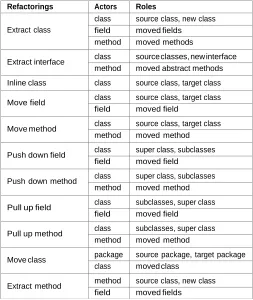
The initial population is generated by randomly assigning a sequence of refactorings to a randomly chosen set of code elements, or actors. The type of actor usually depends on the type of the refactoring it is assigned to and also depends on its role in the refactoring operation. An actor can be a package, class, field, method, parameter, statement or variable. Table 1 depicts, for each refactoring, its involved actors and its corresponding parameters.
The size of a solution, i.e. the vector’s length is ran- domly chosen between upper and lower bound values. The determination of these two bounds is similar to the problem of bloat control in genetic programming where the goal is to identify the tree size limits. Since the number of required refactorings depends mainly on the size of the target system, we performed, for each target project, several trial and error experiments using the HyperVolume (HV) performance indicator [49] to determine the upper bound after which, the indicator remains invariant. For the lower bound, it is arbitrarily chosen. The experiments section will specify the upper and lower bounds used in this study. Table 2 shows an example of a refactoring solution including three operations applied to a simplified version of a solution ap- plied to JVacation v1.0, a Java open-source trip management and scheduling software.
3.2.3 Solution variation
In each search algorithm, the variation operators play the key role of moving within the search space with the aim of driving the search towards optimal solutions.
Refactorings Actors Roles
Extract class
class source class, new class
field moved fields
method moved methods
Extract interface class source classes, new interface method moved abstract methods
Inline class class source class, target class
Move field class source class, target class
field moved field
Move method class source class, target class
method moved method
Push down field class super class, subclasses
field moved field
Push down method class super class, subclasses
method moved method
Pull up field class subclasses, super class
field moved field
Pull up method class subclasses, super class
method moved method
Move class package source package, target package
class moved class
Extract method method source class, new class
[image:7.612.47.300.75.375.2]field moved fields
Table 1
List of considered refactorings for our solution representation.
condition example is to check that the method exists and was moved to the target class and did not exist anymore in the source class. More details about the adapted pre- and post-conditions for refactorings can be found in [2]. We also apply a repair operator that randomly selects new refactorings to replace those creating conflicts.
3.2.4 Solution evaluation
The generated solutions are evaluated using two fitness functions as detailed in the following paragraphs.
Minimize the number of code changes as an objective: The appli- cation of a specific suggested refactoring sequence may re- quire an effort that is comparable to that of re-implementing part of the system from scratch. Taking this observation into account, it is essential to minimize the number of suggested operations in the refactoring solution since the designer may have some preferences regarding the percentage of deviation with the initial program design. In addition, most developers prefer solutions that minimize the number of changes applied to their design. Thus, we formally defined the fitness function as the number of modified actors/code elements (packages, classes, methods, attributes) by the generated refactorings solution.
n
f (x) = \ #code elements(Ri, x) (1)
their parents in order to have a more efficient search process. For mutation, we use the bit-string mutation operator that picks probabilistically one or more refactoring operations from the solutions and replace or modify or delete them. While the crossover operator does not introduce or modify a refactoring of a solution but just the sequence (a swap between refactoring of different solutions), the mutation operator definitely can add or modify or delete a refac- toring when applied to any solution of the population. When a mutation operator is applied, the goal is to slightly change the solution for the purpose to probably improve its fitness functions. We used these three operations for the mutation operator that are randomly selected when a mutation is applied to a solution. Thus, the mutation operator can introduce new refactorings by either adding completely new ones or modifying the controlling parame- ters of an existing refactoring. For example, move method (m1, A, B) could be replaced by movemethod(m1, A, C) or movemethod(m3, A, B) where m1, A and B are the controlling parameters of the refactoring move method. Furthermore, the selection operator allows to regenerate part of the population randomly at every iteration thus new refactoring will be introduced since new solutions are generated during the execution process.
When applying the change operators, the different pre- and post-conditions are checked to ensure the applicability of the newly generated solutions. For example, to apply the refactoring operation movemethod a number of neces- sary pre-conditions should be satisfied such as the method
i−1
where x is the solution to evaluate, n is the number of refactorings in the solution x and #code elements is a func- tion that counts the number of modified code elements in a refactoring. Any solution with refactorings being performed on the same code elements will have better (lower) fitness value for this objective. Such a definition of the objective is in favor of code locality since it encourages refactoring the same code fragment, as developers prefer to refactor the specific elements with which they are most familiar [7] instead of applying scattered changes throughout the whole system. The proposed fitness function is different from that employed in our previous work [9] where only the number of applied refactorings are counted. In fact, each refactoring type may have a different impact on the system in terms of number of code changes it engenders, something that can be identified using our new formulation.
Maximize software quality as an objective: Many studies have utilized structural metrics as a basis for defining quality in- dicators for a good system design [18, 51]. As an illustrative example, [38] proposed a set of quality measures, using the ISO 9126 specification, called QMOOD. Each of these quality metrics is defined using a combination of low-level metrics as detailed in Tables 3 and 4.
The QMOOD model has been used previously in the area of search-based software refactoring [18], [52] and so we use it to estimate the effect of the suggested refactoring solutions on software quality. QMOOD has the advantage that it defines six high-level design quality attributes (reusability, flexibility, understandability, functionality, extendibility, and effectiveness) that can be calculated using 11 lower level design metrics. Its objective function is defined as:
6
and the source and target classes should exists. A post- Quality = i=1 QAi(S)
8
Design Metric Design Prop-
erty Description
Design Size in
Classes (DSC) Design Size
Total number of classes in the design.
Number Of
Hierarchies (N OH)
Hierarchies
Total number of ”root” classes in the design (count(MaxInheritenceTree (class)=0))
Average Num- ber of Ances- tors (AN A)
Abstraction
Average number of classes in the inheritance tree for each class.
Direct Access
Metric (DAM ) Encapsulation
Ratio of the number of private and protected at- tributes to the total number of attributes in a class.
Direct Class Coupling (DCC)
Coupling
Number of other classes a class relates to, either through a shared attribute or a parameter in a method.
Cohesion Among
Methods of
class (CAM C)
Cohesion
Measure of how related methods are in a class in terms of used parameters. It can also be computed by:
1 − LackOfCohesionOfMeth-ods()
Measure Of
Aggregation (M OA)
Composition
Count of number of at- tributes whose type is user defined class(es).
Measure of
Functional Abstraction (M F A)
Inheritance
Ratio of the number of in- herited methods per the total number of methods within a class.
Number of
Polymorphic Methods (N OP )
Polymorphism
Any method that can be used by a class and its descendants. Counts of the number of methods in a class excluding private, static and final ones.
Class Interface
Size (CIS) Messaging
Number of public methods in class.
Number of
Methods (N OM )
[image:8.612.43.568.75.144.2]Complexity Number of methods de- clared in a class.
Table 2
Example of a solution representation.
Operation Source/entity Target entity
Move Method ctrl.booking.BookingController::handleLodgingViewEvent (java.awt.event.ActionEvent):void
ctrl.booking.LodgingModel
Extract Class ctrl.booking.SelectionModel:: - flightList + addFlight():void +clearFlight():void
ctrl.booking.FlightList
[image:8.612.311.562.194.522.2]Move Method ctrl.booking.BookingController::createBookings():void ctrl.CoreModel
Table 3
QMOOD metrics description.
Table 4
Quality attributes and their computation equations.
Quality attributes Definition Computation
Reusability A design with low coupling and high cohe- sion is easily reused by other designs.
0.25 ∗Coupling + 0.25 ∗Cohesion + 0.5 ∗
M essaging + 0.5 ∗DesignSize
Flexibility The degree of allowance of changes in the design.
0.25∗Encapsulation−0.25∗Coupling +0.5∗
Composition + 0.5 ∗P olymorphism
Understandability The degree of understanding and the easiness of learning the design implementation details.
0.33 ∗Abstraction + 0.33 ∗Encapsulation −
0.33 ∗Coupling + 0.33 ∗Cohesion −0.33 ∗
P olymorphism −0.33 ∗Complexity −0.33 ∗
DesignSize
Functionality Classes with given functions that are publicly stated in interfaces to be used by others.
0.12 ∗ Cohesion + 0.22 ∗P olymorphism + 0.22∗M essaging +0.22∗DesignSize+0.22∗
Hierarchies
Extendibility Measurement of design’s allowance to incor- porate new functional requirements.
0.5 ∗Abstraction −0.5 ∗Coupling + 0.5 ∗
Inheritance + 0.5 ∗P olymorphism
Effectiveness Design efficiency in fulfilling the required functionality.
0.2 ∗Abstraction + 0.2 ∗Encapsulation + 0.2 ∗Composition + 0.2 ∗Inheritance + 0.2 ∗
P olymorphism
Where QAi is the quality attribute number i being cal-
culated based on the returned structural metrics from the system S.
Since it may not be sufficient to consider structural metrics, we used the design coherence measures of our previous work to ensure that every refactoring solution preserves the
semantics of the design. We start from the assumption that the vocabulary of an actor is borrowed from the domain terminology and therefore can be used to determine which part of the domain semantics an actor encodes. Thus, two actors are likely to be semantically similar if they use similar vocabularies.
3.3 Interactive Recommendation of Refactorings
The first step of the interactive component is executed as described in Algorithm 2, to investigate if there are some common principles among the generated non-dominated refactoring solutions.
Algorithm 2 Rank Refactoring Operation procedure
Algorithm 3 GUF (Get User Feedback) procedure to manage
the interactions with the developer (Online Phase)
1: Input
2: RNS: Ranked Non-dominated SolutionSet
3: Output
4: HM: HashMap of refactorings along with their occur- rences.
5: Begin
1: Input
2: NS: Non-dominated SolutionSet of the first front
3: Output
4: HM: HashMap of refactorings along with their occur- rences.
5: Begin 6: HM ←∅;
7: /* Compute the number of occurrence of each refactor- ing operation*/
8: for i = 1 to |N S| do
9: for each j = 1 to |N Si| do
10: /* If a refactoring operation does not exist in the list, add its hash and set its occurrence number to 1*/
11: if (N Si,j ∈/ HM ) then
12: HM ←HM ∪Hash(N Si,j );
13: HM [Hash(N Si,j )] ← 1;
14: /* If a refactoring operation exists in the list, increment its occurrence number */
15: else
16: HM [Hash(N Si,j )] ← HM [Hash(N Si,j )] +
1;
17: end if
18: end for
19: end for 20: End
6: AppliedRef actorings ← ∅;
7: RejectedRef actorings ← ∅;
8: for i = 1 to |RN S| do 9: ref [i] ←0;
10: end for
11: /* Main loop to suggest refactorings one by one to the user*/
12: while |RejectedRef actorings < a do
13: /* Select index of the the solution with highest rank*/
14: index ←M axRank(RN S);
15: d ← U serDecision(RN Sindex,ref [index]);
16: /* If the user has applied or modified the opera- tion*/
17: if (d = T rue) then
18: AppliedRef actorings ←
AppliedRef actorings ∪ RN Sindex,ref [index];
19: /* If the user has rejected the operation*/
20: else
21: RejectedRef actorings ←
RejectedRef actorings ∪RN Sindex,ref [index];
22: end if
23: Ref [index] ←ref [index] + 1;
24: /* Update solutions indexes */
25: for i = 1 to |RN S| do
26: U pdateRank(RN Si; AppliedRef actorings, RejectedRef ac
The algorithm checks if the optimal refactoring solutions have some common features such as identical refactoring operations among most or all of the solutions, and a specific common order/sequence in which to apply the refactorings. Such information will be used to rank the suggested refac- torings for developers using the following formula:
27: end for
28: end while 29: End
Rank(Rx,y ) = n
j=0
size(Sj )
i=0
[Ri,j = Rx,y ]
∈[0...1] (3)
n
M AX(
j=0
size (Sj )
i=0
[Ri,j = Rx,y ])
where Rx,y is the refactoring operation number x (index
in the solution vector) of solution number y, and n is the number of solutions in the front. Si is the solution of index i. All the solutions of the Pareto front are ranked based on the score of this measure applied to every solution.
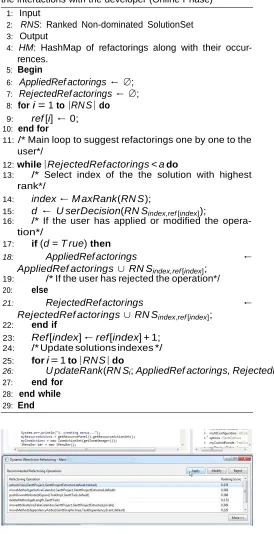
[image:9.612.311.585.59.593.2]Once the Pareto front solutions are ranked, the second step of the interactive step is executed as described in Algorithm 3. The refactorings of the best solution, in terms of ranking, are recommended to the developer based on their order in the vector. Then, the ranking score of the solutions is up- dated automatically after every feedback (interaction) with the developer. Our interactive algorithm proposes three levels of interaction as described in Fig. 2 and Algorithm 3.
Figure 2. Refactorings recommended by our technique.
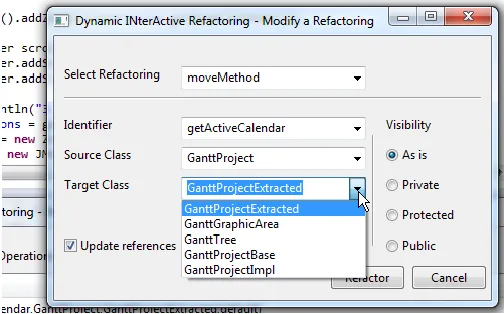
The developer can check the ranked list of refactorings and then apply, modify or reject the refactoring. If the devel- oper prefers to modify the refactoring, then our algorithm can help them during the modification process as described in Fig. 3.
10
Figure 3. Recommended target classes by our technique for a move method refactoring to modify.
refactoring then, having specified the source method to move, our interactive algorithm automatically suggests a list of possible target classes ranked based on the history of changes and semantic similarity. This is an interesting feature since developers often know which method to move, but find it hard to determine a suitable target class [22]. The same observation is valid for the remaining refactoring types. Another action that the developers can select is to reject/delete a refactoring from the list.
After every action selected by the developer, the ranking is updated based on the feedback using the following formula:
size(Si )
solutions will change after every interaction. If many refac- torings are rejected, the NSGA-II algorithm will continue to execute while taking into consideration all the feedback from developers as constraints to satisfy during the search. The rejected refactorings should not be considered as part of the newly generated solutions and the new system after refactoring will be considered in the input of the next iteration of the NSGA-II.
In the non-interactive refactoring systems, the set of refac- torings, suggested by the best-chosen solution, needs to be fully executed in order to reach the solution’s promised results. Thus, any changes applied to the set of refactorings such as changing or skipping some of them could deterio- rate the resulting system’s quality. In this context, the goal of this work is to cope with the above-mentioned limitation by granting to the developer’s the possibility to customize the set of suggested refactorings either by accepting, modifying or rejecting them. The novelty of this work is the approach’s ability to take into account the developer’s interaction, in terms of introduced customization to the existing solution, by conducting a local search to locate a new solution in the Pareto Front that is nearest to the newly introduced changes. We believe that our approach may narrow the gap that exists between automated refactoring techniques and human intensive development. It allows the developer to select the refactorings that best matches his/her coding preferences while modifying the source code to update existing features.
3.4 Running Example: Illustration on the JVacation System
Rank(Si) =
\
k=1
Rank(Rk,i) (4) 3.4.1 Context
To illustrate our interactive algorithm, we consider the +(RO ∩ AppliedRef actoringsList)
−(RO ∩RejectedRef actoringsList) +0.5 ∗(RO ∩M odif iedRef actoringsList)
Where Si is the solution to be ranked, the first compo-
nent consists of the sum of the ranks of its operations as explained previously and the second component will take the value of 1 if the recommended refactoring operation was applied by the developer, or -1 if the refactoring operation was rejected or 0.5 if it was partially modified by the developer. The recommended refactorings will be adjusted based on the updated ranking score.
It is important to note that we calculate the ranking score for each non-dominated solution using the innovization component and then the solution with the highest score is presented refactoring by refactoring to the developer. In fact, refactorings tend to be dependent on one another thus it is important to ensure the coherence of the recommended solution. After a number of modified or rejected refactorings or several new code changes introduced, the generated Pareto front of refactoring solutions by NSGA-II needs to be updated since the system was modified in different locations.
To check the applicability of the refactorings, we contin- uously check the pre-conditions of individual refactorings on the version after manual edits. Thus, the ranking of the
refactoring of JVacation v1.0 1 , a Java open-source
trip management and scheduling software. We asked a developer to update an existing feature by adding one more field (Premium member ID) in the personal information form that a user has to fill out when booking a flight.
As JVacation architecture is based on the Model/View/Controller model, adding this extra field would trigger small updates on the View by adding a textbox in the personal information input form. Also the controller that handles the booking process needs to be revised. At the model level, an attribute needs to be added to the class that hosts the booking information. Finally, an update on the database level is needed to save the newly modified booking objects.
To simplify the illustration, we have limited the update to these above-mentioned changes knowing that, in order to completely implement this function, several other updates may be needed in other views and controllers in order to show, for example, the newly added field, as part of the information related to the passengers’ records for a given flight. We asked the developer to refactor the software system while performing the given task, therefore, the developer has initially launched the plugin that triggered our interactive algorithms. We assisted the developer in only selecting the initial default parameters
[image:10.612.47.299.44.201.2]Table 5
Quality attributes value on the JVacation system.
Quality Attribute Original System
Solution 1
Solution 2
Solution 3
Reusability
1.74225
(+0.5) (+0.4) (+0.5)
1.79225 1.79225 1.79225
Flexibility
1.82
(+0.001) (+0.001) (+0.001)
1.820 1.820 1.820
Understandability
-4.5408
(+0.08) (+0.07) (+0.087) -4.5398 -4.5398 -4.5398
Functionality
1.16314
(+0.5) (+0.6) (+0.5)
1.21314 1.21314 1.21314
Extendibility
19.7225
(+0.007) (+0.012) (+0.011) 19.7295 19.7300 19.7299
Effectiveness 9.5406 9.5406 9.5406 9.5406
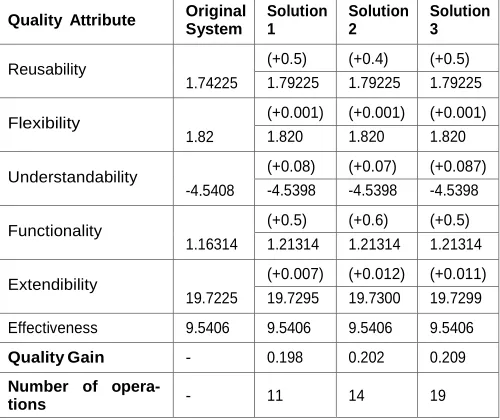
Quality Gain - 0.198 0.202 0.209
Number of opera-
tions - 11 14 19
for the optimization algorithm (such as the minimum and maximum chromosome lengths).
3.4.2 Illustration of the Innovization Component
After generating the upfront list of best refactoring solu- tions, three solutions are selected from the Pareto front that were involved in the interactive session to simplify this running example. Each solution has a fitness score composed of the median of quality improvement calculated based on the structural measures of the refactored system for each solution, and the number of operations within each solution. The previous section describes, these fitness val- ues, for each solution, in terms of quality improvement and refactoring effort compared to the original system values before refactoring. These information is shown in Table 5.
One of the classic challenges in multiobjective optimiza- tion is the choice of the most suitable solution for the developer. The straightforward solution for this problem would be to manually investigate all solutions, i. e., execute all refactoring operations for each solution and allow the developer to compare between several refactored designs. This task can easily become tedious due to the important number of solutions in the Pareto front.
To facilitate the selection task, decision making support tools can be used to automate the selection of solutions based on the decision maker’s preferences. In our context, these preferences can be considered as the packages and classes that the developer is interested in when implementing the requested feature. Thus, another straightforward heuristic would be to automatically shortlist solutions that only refac- tor entities that are of interest to developers. Unfortunately, this will not necessarily reduce drastically the number of preferred solutions especially if the system is small.
To cope with this issue, another interesting idea would be to calculate the overlap between solutions. Still, choosing the most appropriate solution can be challenging as the developer has to manually break the tie between solu- tions by comparing between their specific refactorings. This
comparison may not be straightforward because specific refactorings between to candidate solutions may both be of an interest to the developer, for example, when comparing between solution 1 and solution 2, both solutions contain a move-method operation that agree on moving a function called getSaluation() but disagree on the target class.
Since this function belongs to the booking panel, the par- ticipating entities are of an interest to the developer, so no choice can be automatically done based on the developer’s preferred entities. Moreover, both target classes (respec- tively LabelSpinner and LabelEdit), each proposed by one solution, belong to the same package (gui.components) and they are semantically close, so the fitness function values cannot be used to break the tie. In this scenario, only the developer would be qualified to take the decision of either accepting one operation over the other or maybe rejecting both operations. Thus, simply filtering solutions based on the developer’s preferred entities may fall short in this kind of scenarios. Furthermore, asking the developer to exhaustively break the tie between shortlisted solutions can become tedious.
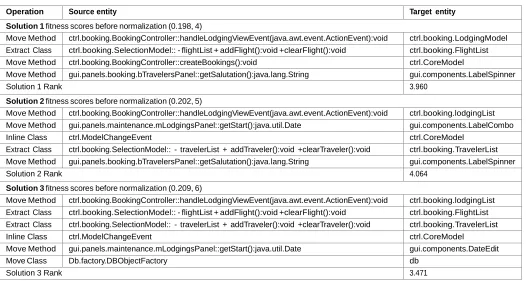
In this context, our interactive process differs from simply filtering operations based on a given preference as it learns from the developer’s decision making and dynamically break the tie between Pareto-equivalent solutions by up- grading those with the highest number of successful rec- ommendations (applied refactorings) while penalizing those who contain rejected operations. To illustrate this process, Table 6 describes each solution’s refactorings along with its rank after the execution of the first step of the interactive algorithm. For the purpose of simplicity, we considered a first fragment of each solution. The solutions are ranked based on Equation 3 to identify the most common refactor- ings between the non-dominated solutions. This is achieved by counting the number of occurrences of operation within the Pareto front solution set, this number will be averaged by the maximum number of occurrences found.
3.4.3 Illustration of the Interactive and Dynamic Compo- nents
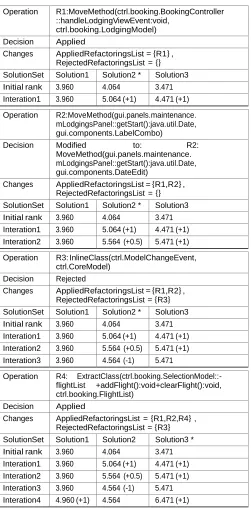
In the interaction part, the recommended refactoring wanted to move a function that defines the trip’s starting date to a LabelCombo class. The developer thought that mov- ing it to DateEdit class makes more sense instead because the return value of the moved function is of type Date and DateEdit is semantically closer to the method. So the refactroings were partially modified by the developer and the ranking score of the second solution was increased by 0.5 for Solution 2 but by 1 for Solution 3 since it has already a move method operation that suggests moving the same method to the chosen class by the developer, i. e., the applied operation exists in that solution.
12
Table 6
Three simplified refactoring solutions recommended for JVacation v1.0.
Operation Source entity Target entity
Solution 1 fitness scores before normalization (0.198, 4)
Move Method ctrl.booking.BookingController::handleLodgingViewEvent(java.awt.event.ActionEvent):void ctrl.booking.LodgingModel Extract Class ctrl.booking.SelectionModel:: - flightList + addFlight():void +clearFlight():void ctrl.booking.FlightList
Move Method ctrl.booking.BookingController::createBookings():void ctrl.CoreModel
Move Method gui.panels.booking.bTravelersPanel::getSalutation():java.lang.String gui.components.LabelSpinner
Solution 1 Rank 3.960
Solution 2 fitness scores before normalization (0.202, 5)
Move Method ctrl.booking.BookingController::handleLodgingViewEvent(java.awt.event.ActionEvent):void ctrl.booking.lodgingList
Move Method gui.panels.maintenance.mLodgingsPanel::getStart():java.util.Date gui.components.LabelCombo
Inline Class ctrl.ModelChangeEvent ctrl.CoreModel
Extract Class ctrl.booking.SelectionModel:: - travelerList + addTraveler():void +clearTraveler():void ctrl.booking.TravelerList
Move Method gui.panels.booking.bTravelersPanel::getSalutation():java.lang.String gui.components.LabelSpinner
Solution 2 Rank 4.064
Solution 3 fitness scores before normalization (0.209, 6)
Move Method ctrl.booking.BookingController::handleLodgingViewEvent(java.awt.event.ActionEvent):void ctrl.booking.lodgingList Extract Class ctrl.booking.SelectionModel:: - flightList + addFlight():void +clearFlight():void ctrl.booking.FlightList Extract Class ctrl.booking.SelectionModel:: - travelerList + addTraveler():void +clearTraveler():void ctrl.booking.TravelerList
Inline Class ctrl.ModelChangeEvent ctrl.CoreModel
Move Method gui.panels.maintenance.mLodgingsPanel::getStart():java.util.Date gui.components.DateEdit
Move Class Db.factory.DBObjectFactory db
Solution 3 Rank 3.471
operations are shown to the user based on their order in the vector. Table 7 summarizes the various interactions between the developer and the suggested refactorings from the three above mentioned solutions when adding the new feature.
The first recommended refactoring of the top ranked solution (Solution 2) suggests moving an event function from the controller class of the booking process, since the developer is required to investigate this class and since this function is not called during the booking procedure, moving it out of the class will reduce the number of investigated functions, so the operation was applied by the developer and accordingly the ranking score was increased by 1 for both Solutions 2 and 3 since they include this refactoring in their solutions.
Upon the rejection of the third suggested refactoring, the ranking score of solution 3 has become higher than the one of
solution 2, this has triggered the fourth recommended opera- tion to be issued from solution 3 instead. All the refactorings that belong to the intersection between solution 3 and the lists of applied/rejected refactorings will be skipped during the recommendation process.
For instance, the first and second operation of solution 3
will be skipped as they have been already applied by the developer, and the third operation will be suggested during the fourth interaction. This operation suggests the extraction of a class from the selection mode of the booking process. Since this refactoring will facilitate the distinction between functions related to the flight from those related to the passengers, the developer has approved the operation. The algorithm will stop recommending new refactorings either on the request of the developer or when the system achieves acceptable quality improvement in terms of reducing the
number of design defects and improving quality metrics. These parameters can be specified by the developer or the team manager.
4 VALIDATION
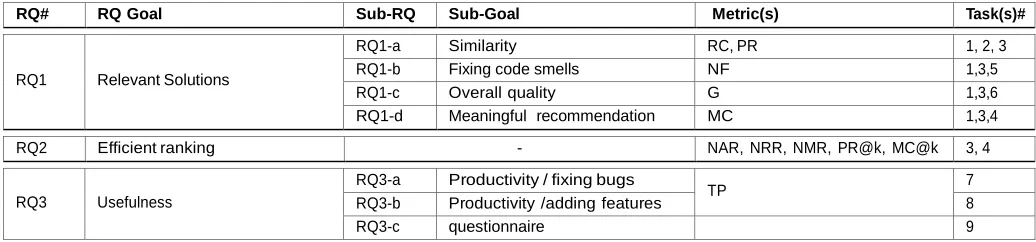
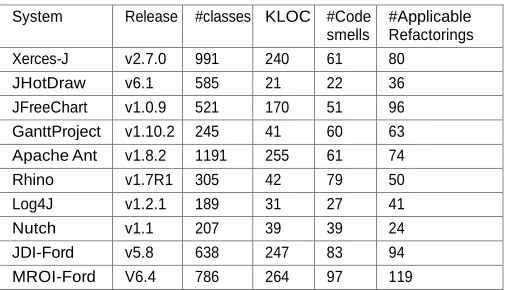
To evaluate the ability of our refactoring framework to generate good refactoring recommendations, we conducted a set of experiments based on eight open source systems and two industrial projects provided by the IT department at the Ford Motor Company. The obtained results are subse- quently statistically analyzed with the aim of comparing our proposal with a variety of existing approaches. The relevant data related to our experiments can be found in [61]. In this section, we first present our research questions and validation methodology followed by experimental setup. Then we describe and discuss the obtained results.
4.1 Research Questions