R E S E A R C H
Open Access
Some limit theorems for the second-order
Markov chains indexed by a general infinite tree
with uniform bounded degree
Zhiyan Shi
1*, Weiguo Yang
1, Lixin Tian
1and Qingpei Zang
1,2* Correspondence: [email protected]
1Faculty of Science, Jiangsu
University, Zhenjiang, 212013, China
Full list of author information is available at the end of the article
Abstract
In this paper, we study a convergence theorem for a finite second-order Markov chain indexed by a general infinite tree with uniformly bounded degree. Meanwhile, the strong law of large numbers (LLN) and Shannon-McMillan theorem for a finite second-order Markov chain indexed by this tree are obtained.
2000 Mathematics Subject Classification:60F15; 60J10.
Keywords:uniformly bounded tree, second-order Markov chain, strong law of large
numbers, Shannon-McMillan theorem
1. Introduction
A tree is a graphG= {T, E} that is connected and contains no circuits. Given any two vertices s, t(s≠ tÎ T), let σt be the unique path connecting sand t. Define the graph distanced(s,t) to be the number of edges contained in the pathσt.
Let TC,Nbe a Cayley tree. In this tree, the root (denoted byo) has only Nneighbors,
and all other vertices haveN+ 1 neighbors. LetTB,Nbe a Bethe tree, on which each
vertex hasN + 1 neighboring vertices. Here, bothTC,Nand TB,Nare homogeneous
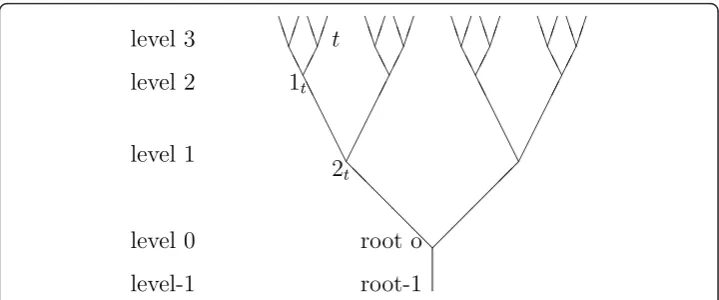
tree. An infinite tree with uniformly bounded degree is that the numbers of neighbors of any vertices in this tree are uniformly bounded. Therefore, the homogeneous tree is the special case of infinite tree with uniformly bounded degree. In this paper, we mainly consider a general infinite tree with uniformly bounded degree, that is, the tree is formed by an infinite tree that has uniformly bounded degree with the rooto con-necting with another point denoted by the root -1. In order to understand this tree graph, we give a figure (see Figure 1), which is formed by aTC,2with the root o con-necting with another root -1. When the context permits, this type of trees is all denoted simply byT.
Let s,t(s, t ≠o, -1) be vertices of a general infinite tree with uniformly bounded degreeT. Writet ≤ sif tis on the unique path connecting oto s, and |s| for the number of edges on this path. For any two verticess,t(s,t≠o, -1) of treeT, denote bys∧tthe vertex farthest fromosatisfyings∧t≤sands∧t≤t.
The set of all vertices with distancenfrom root ois called thenth generation ofT, which is denoted byLn. We say thatLnis the set of all vertices on level nand
espe-cially root-1 is on the -1st level on treeT. We denote byT(n)the subtree of a general
infinite tree with uniformly bounded degree T containing the vertices from level -1 (the root -1) to level n. Let t(≠o, -1) be a vertex of a general infinite tree with uni-formly bounded degree T. Predecessor of the vertex tis another vertex that is nearest fromton the unique path from root -1 tot. We denote the predecessor of t by 1tand
the predecessor of 1tby 2t. We also say that 2tis the second predecessor oft.XA =
{Xt,tÎA} and denoted by |A| the number of vertices ofA, andxA is the realization of XA.
Definition 1Let G= {1, 2, ...,N} andP(z|y,x) be a nonnegative functions onG3. Let
P= (P(z|y,x)), P(z|y,x)≥0, x,y,z∈G.
If
z∈G
P(z|y,x) = 1,
P will be called a second-order transition matrix.
Definition 2 LetT be a general infinite tree,G= {1, 2, ...,N} be a finite state space,
and {Xt,tÎ T} be a collection ofG-valued random variables defined on the probability
space(,F,P). Let
P= (p(x,y)), x,y∈G (1)
be a distribution onG2, and
P= (P(z|y,x)), x,y,z∈G (2)
be a second-order transition matrix. If for any vertext(t≠o, -1),
P(Xt=z|X1t =y,X2t =x, andXσ forσ∧t≤1t)
=P(Xt=z|X1t =y,X2t =x) =P(z|y,x) ∀x,y∈G,
(3)
and
P(X−1=x,Xo=y) =p(x,y), x,y∈G, (4)
{Xt,tÎT} will be called aG-valued second-order Markov chain indexed by a general
infinite tree Twith the initial distribution (1) and second-order transition matrix (2) or called aT-indexed second-order Markov chain.
@ @ @ @ @
level 0
root o
level-1
root-1
level 2
level 3
A A A A A
A A A A A
level 1
2
t A AAA
A
A AA
1
tBB
BB
[image:2.595.118.478.88.238.2]BB BB
t
BB BB BB BBThe subject of tree-indexed processes is rather young. Benjamini and Peres (see [1]) have given the notion of the tree-indexed Markov chains and studied the recurrence and ray-recurrence for them. Berger and Ye (see [2]) have studied the existence of entropy rate for some stationary random fields on a homogeneous tree. Ye and Berger (see [3,4]), by using Pemantle’s result(see [5]) and a combinatorial approach, have stu-died the Shannon- McMillan theorem with convergence in probability for aPPG -invar-iant and ergodic random field on a homogeneous tree. Yang and Liu(see [6])have studied a strong law of large numbers for the frequency of occurrence of states for Markov chains field on a homogeneous tree (a particular case of tree-indexed Markov chains field and PPG-invariant random field). Yang (see [7]) has studied the strong law of large numbers for frequency of occurrence of state and Shannon-McMillan theorem for homogeneous Markov chains indexed by a homogeneous tree. Takacs (see [8]) has studied the strong law of large numbers for the univariate functions of finite Markov chains indexed by an infinite tree with uniformly bounded degree. Recently, Yang (see [9]) has studied the strong law of large numbers and Shannon-McMillan theorem for nonhomogeneous Markov chains indexed by a homogeneous tree. Huang and Yang (see [10]) have studied the strong law of large numbers for Markov chains indexed by an infinite tree with uniformly bounded degree, which generalize the result of [8]. Shi and Yang (see [11]) have also studied a limit property of random transition probability for a second-order nonhomogeneous Markov chains indexed by a tree.
In this paper, we first study a convergence theorem for a finite second-order Markov chain indexed by a general infinite tree with uniformly bounded degree. As corollaries, we obtain some limit theorems for the frequencies of occurrence of states for this Markov chain. Finally, we obtain the strong law of large numbers and Shannon-McMillan theorem for a class of finite second-order Markov chain indexed by a gen-eral infinite tree with uniformly bounded degree.
2. Strong limit theorems
Lemma 1 LetTbe a general infinite tree with uniformly bounded degree. Let {Xt,tÎ
T} be aT-indexed second-order Markov chain with state spaceGdefined as in Defini-tion 2, {gt(x,y,z),tÎT} be a collection of functions defined onG3. LetL-1= {-1},L0 = {o} andFn=σ(XT(n)
)(n≥1). Set
Fn(ω) =
t∈T(n)\{o}{−1}
gt(X2t,X1t,Xt) (5)
and
tn(λ,ω) =
eλFn(ω)
t∈T(n)\{o}{−1}
Eeλgt(x2t,X1t,X,)|X1 t, X2t
, (6)
wherelis a real number. Then{tn(λ,ω),Fn,n≥1}is a nonnegative martingale.
Proof: The proof of Lemma 1 is similar to Lemma 2.1 in [9], so we omit it.
Theorem 1 Let {Xt,tÎT} and {gt(x,y,z),tÎ T} be defined as Lemma 1,
Gn(ω) =
t∈T(n)\{o}{−1}
and {an,n≥1} be a sequence of nonnegative random variables. Leta >0. Set
A ={lim
n→∞an=∞}
and
D(a) =
lim sup n→∞ 1 an
t∈T(n)\{o}{−1}
E[gt2(X2t, X1t, Xt)e
a|gt(X2t,X1t,Xt)|X
1t,X2t] =M(ω)<∞
∩A.
(8) Then lim n→∞ 1 an
(Fn(ω)−Gn(ω)) = 0 a.e. ω∈D(a). (9)
Proof: By Lemma 1, we have known that{tn(λ,ω),Fn,n≥1}is a nonnegative
mar-tingale. According to Doob martingale convergence theorem, we have
lim
n→∞tn(λ,ω) =t(λ,ω)<∞ a.e. (10)
By (10) we have
lim sup
n→∞
1
an
lntn(λ,ω)≤0 a.e. ω∈A. (11)
By (5), (6) and (11), we get
lim sup n→∞ 1 an ⎧ ⎨
⎩λFn(ω)−
t∈T(n)\{o}{−1}
lnE[eλgt(X2t,X1t,Xt)|X1 t,X2t]
⎫ ⎬
⎭≤0 a.e.ω∈A. (12)
By (12) and inequalities ln x≤x- 1 (x >0),0≤ex−1−x≤ x2
2e|x|, as 0<|l|≤ awe
have lim sup n→∞ 1 an ⎧ ⎨
⎩λFn(ω)−λ
t∈T(n)\{o}{−1}
E[gt(X2t,X1t,Xt)|X1t,X2t] ⎫ ⎬ ⎭
≤ lim sup
n→∞
1 an{
t∈T(n)\{o}{−1}
lnE[eλgt(X2t,X1t,Xt)|X 1t,X2t]
−λ
t∈T(n)\{o}{−1}
E[gt(X2t,X1t,Xt)|X1t,X2t]}
= lim sup
n→∞
1 an
t∈T(n)\{o}{−1}
{lnE[eλgt(X2t,X1t,Xt)|X
1t, X2t]−E[λgt(X2t, X1t, Xt)|X1t, X2t]}
≤lim sup
n→∞
1 an
t∈T(n)\{o}{−1}
{E[eλgt(X2t,X1t,Xt)|X
1t, X2t]−1−E[λgt(X2t, X1t,Xt)|X1t,X2t]}
≤λ2
2 lim supn→∞
1 an
t∈T(n)\{o}{−1}
{E[gt2(X2t, X1t,Xt)e
a|gt(X2t,X1t,Xt)||X 1t, X2t]}
= λ 2
2M(ω) ω∈D(a), a.e.
(13)
Letting 0 <l≤a, by (13), we have
lim sup n→∞ 1 an ⎧ ⎨ ⎩Fn(ω)−
t∈T(n)\{o}{−1}
E[gt(X2t,X1t,Xt)|X1t,X2t] ⎫ ⎬
Let l®0+in (14), by (8) we have
lim sup
n→∞
1
an ⎧ ⎨ ⎩Fn(ω)−
t∈T(n)\{o}{−1}
E[gt(X2t,X1t,Xt)|X1t,X2t] ⎫ ⎬
⎭≤0, ω∈D(a).(15)
Taking -a≤l<0 in (15), similarly we get
lim sup
n→∞
1
an ⎧ ⎨ ⎩Fn(ω)−
t∈T(n)\{o}{−1}
E[gt(X2t,X1t,Xt)|X1t,X2t] ⎫ ⎬
⎭≥0, ω∈D(a).(16)
Combining (7), (15) and (16), we obtain (9).
Corollary 1 Let {Xt, tÎ T} be a general infinite tree T with uniformly bounded
degree defined by Definition 2. Let {gt(x, y, z), t Î T} be a collection of uniformly
bounded functions defined on G3. That is, there existsK >0 such that |gt(x, y,z)|≤ K. Fn(ω) andGn(ω) be given by (5) and (7), respectively. LetN≥0, then
lim
n→∞
1
|T(n+N)|(Fn(ω)−Gn(ω)) = 0, a.e. (17)
Proof: Letting an = |T(n+N)| in Theorem 1, noticing that {gt(x, y), tÎ T} are
uni-formly bounded, and then D(a) =Ωfor alla>0. This corollary follows from Theorem 1 directly.
In the following, let Ik(x) =
1 x=k
0 x=k. We always let N≥ 0,m,l,k ÎG, d
0 (t) := 1
and denoted by
dN(t) :=|τ ∈T:Nτ =t|, (18)
SNl,k(A) :=
t∈A
Il(X1t)Ik(Xt)d
N
(t), (19)
SNm,l,k(A) :=
t∈A
Im(X2t)Il(X1t)Ik(Xt)d
N(t).
(20)
Corollary 2Let Tbe a general infinite tree with uniformly bounded degree. Let {Xt,t
Î T} be aT-indexed second-order Markov chain with state spaceGdefined by Defini-tion 2. Then for all m, l,kÎ G,N≥0, we have
lim
n→∞
1
|T(n+N)|{S N
l,k(T(n)\{−1})−
m∈G
SNm+1,l (T(n−1)\{−1})P(k|m,l)}= 0 a.e. (21)
Proof: Because of the uniformly bounded degree ofT, there isa <∞withdN(t)< aN.
Let gt(x,y, z) =dN(t)Il(y)Ik(z),an= |T(n+N)|. Obviously, {gt(x, y,z),tÎ T} are uniformly
bounded. Since
Fn(ω) =
t∈T(n)\{o}{−1}
gt(X2t,X1t,Xt)
=
t∈T(n)\{o}{−1}
Il(X1t)Ik(Xt)d
N(t)
= SNl,k(T(n)\{−1})−Il(X−1)Ik(Xo)dN(o),
and
Gn(ω) =
t∈T(n)\{o}{−1}
E[gt(X2t,X1t,Xt)|X1t,X2t]
=
t∈T(n)\{o}{−1}
xt∈G
gi(X2t,X1t, xt)P(xt|X1t, X2t)
=
t∈T(n)\{o}{−1}
xt∈G
Il(X1t)Ik(xt)d
N
(t)P(xt|X1t, X2t)
=
t∈T(n)\{o}{−1}
Il(X1t)d
N(t)P(k|X 1t,X2t)
=
m∈G
t∈T(n)\{o}{−1}
Im(X2t)Il(X1t)d
N(t)P(k|l,m)
=
m∈G
t∈T(n−1)\{−1}
Im(X1t)Il(Xt)d
N+1(t)F(k|l,m)
=
m∈G
SNm+1,l (T(n−1)\{−1})P(k|l,m).
(23)
This corollary follows from Corollary 1 directly.
Corollary 3 Let {Xt, t Î T} be a second-order Markov chain taking values in G
indexed by a general infinite tree with uniformly bounded degree defined as before. Then for allm,l,kÎG, we have
lim
n→∞
1
|T(n+N)|{S N m,l,k(T
(n)\{o}{−1})−SN+1 m,l (T
(n−1)\{−1})P(k|m,l)}= 0 a.e.
(24)
Proof: Letgt(x,y,z) =dN(t)Im(x)Il(y)Ik(z),an= |T(n+N)|. Obviously, {gt(x,y,z),tÎT}
are uniformly bounded. Since
Fn(ω) =
t∈T(n)\{o}{−1}
gt(X2t,X1t,Xt)
=
t∈T(n)\{o}{−1}
Im(X2t)Il(X1t)Ik(Xt)d
N(t)
= SNm,l,k(T(n)\{o}{−1}),
(25)
and
Gn(ω) =
t∈T(n)\{o}{−1}
E[gt(X2t,X1t,Xt)|X1t,X2t]
=
t∈T(n)\{o}{−1}
xt∈G
gt(X2t, X1t, xt)P(xt|X1t, X2t)
=
t∈T(n)\{o}{−1}
xt∈G
Im(X2t)Il(X1t)Ik(xt)d
N(t)P(x
t|X1t, X2t)
=
t∈T(n)\{o}{−1}
Im(X2t)Il(X1t)d
N(t)P(k|l,m)
=
t∈T(n−1)\{−1}
Im(X1t)Il(Xt)d
N+1(t)P(k|l,m)
= SNm,+1l (T(n−1)\{−1})P(k|l,m).
(26)
3. LLN and Shannon-McMillan theorems
In this section, we study the strong law of large numbers and the Shannon-McMillan theorems for a second-order Markov chain indexed by a general infinite tree with uni-formly bounded degree. In the following, we first give a definition and a lemma.
Definition 3Let G= (1, 2, ...,N) be a finite state space, and
P= (p(k|l,m)), m,l,k∈G (27)
be a second-order transition matrix. Define a stochastic matrix as follows:
¯
P= (p((l,k)|(m,i))), (m,i), (l,k)∈G2, (28)
where
p((l,k)|(m,i)) =
p(k|l,m)l=i
0 otherwise. (29)
Then P¯ is called a two-dimensional stochastic matrix determined by the second-order transition matrix P.
Lemma 2(see [12])
Let P¯ be a two-dimensional stochastic matrix determined by the second-order transi-tion matrix P. If the elements of Pare all positive, i.e.,
P= (p(k|l,m)), p(k|l,m)>0,m,l,k∈G,
then P¯ is ergodic.
Theorem 2 LetTbe a general infinite tree with uniformly bounded degree. Let {Xt,t
Î T} be aT-indexed second-order Markov chain taking values inGgenerated by P. Let the two-dimensional stochastic matrixP¯ determined byPbe ergodic. Then for all
m,l,kÎG, we have
lim
n→∞
SN
l,k(T(n)\{−1})
|T(n+N)| =π(l,k) a.e., (30)
lim
n→∞
SNm,l,k(T(n)\{o}{−1})
|T(n+N)| =π(m,l)P(k|l,m) a.e., (31)
where {π(l,k),l,kÎG} is the stationary distribution determined by P¯.
Proof: By (21) and (29), we have
lim
n→∞
⎧ ⎨ ⎩
SN
l,k(T(n)\{−1}) |T(n+N)| −
(m,i)∈G2
SNm,+1i (T(n−1)\{−1})
|T(n+N)| P((l,k)(m,i))
⎫ ⎬
⎭= 0. a.e.(32)
We now prove the following equation by induction: FixedN≥0 and for allh≥1, we have
lim n→∞
⎧ ⎨ ⎩
SNl,k(T(n)\{−1}) |T(n+N)| −
(m,i)∈G2 SN+h
m,i (T(n−h)\{−1}) |T(n+N)| P
h((l,k)(m,i))
⎫ ⎬
The case h= 1 is immediate from the equation (32). The caseh+ 1 follows by
⎧ ⎨ ⎩
SN
l,k(T(n)\{−1})
|T(n+N)| −
(m,i)∈G2
SN+h+1
m,i (T(n−h−1)\{−1})
|T(n+N)| P
h+1((l,k)|(m,i)) ⎫ ⎬ ⎭ = ⎧ ⎨ ⎩ SN
l,k(T(n)\{−1})
|T(n+N)| −
(m,i)∈G2
(s,t)∈G2
SN+h+1
m,i (T(n−h−1)\{−1})
|T(n+N)| P
h((l,k)—(s,t))P((s,t)|(m,i)) ⎫ ⎬ ⎭ = ⎧ ⎨ ⎩ SN
l,k(T(n)\{−1})
|T(n+N)| −
(s,t)∈G2
SN+h
s,t (T(n−h)\{−1})
|T(n+N)| P
h((l,k)|(s,t)) ⎫ ⎬ ⎭
+{ (s,t)∈G2
SN+h
s,t (T(n−h)\{−1})
|T(n+N)|
−
(m,i)∈G2
SN+h+1
m,i (T(n−h−1)\{−1})
|T(n+N)| P((s,t)|(m,i)) ⎤
⎦Ph((l,k)|(s,t))}
(34)
Notice that the first term vanishes as n® ∞, because of the induction hypothesis. According to the equation (32), the second term approximates to zero asn ®∞. By
induction, we have (33) holds for all h ≥ 1. Since
(m,i)∈G2
Sh+N
m,l (T(n−h)\{−1}) =|T(n+N)| − |T(h+N−1)|. By (33), we have
lim sup
n→∞ |
SN
l,k(T(n)\{−1})
|T(n+N)| −π(l,k)|
≤lim sup
n→∞ |
(m,i)∈G2
SN+h
m,i (T(n−h)\{−1})
|T(n+N)| P
h((l,k)|(m,i))−π(l,k)|
= lim sup
n→∞ |
(m,i)∈G2
SN+h
m,i (T(n−h)\{−1})
|T(n+N)| (P
h((l,k)|(m,i))−π(l,k))−|T(N+h−1)|
|T(n+N)| π(l,k)|
≤lim sup
n→∞
(m,i)∈G2
SN+h
m,i (T(n−h)\{−1})
|T(n+N)| |P
h((l,k)|(m,i))−π(l,k)) + lim sup n→∞
|T(N+h−1)| |T(n+N)| π(l,k)
≤
(m,i)∈G2
|Ph((l,k)|(m,i))−π(l,k)| a.e.
(35)
Since
lim
n→∞P
h((l,k)|(m,i)) =π(l,k), ∀(m,i)∈G2,
(36)
(30) follows from (35) and (36), (31) follows from (30) and (24).
Corollary 4 Under the conditions of Theorem 2, let
Sm,l,k(T(n)\{o}{−1}) :=S0m,l,k(T(n)\{o}{−1}=|{t∈T(n): (X2t, X1t, Xt) = (m,l,k)}|. Then
lim
n→∞
Sm,l,k(T(n)\{o}{−1})
|T(n)| =π(m,l)P(k|m,l) a.e. (37)
Let Tbe a tree, {Xt,tÎT} be a stochastic process indexed by treeT taking values in G,xT(n)be the realization of
XT(n). Denote
P(xT(n)) =P(XT(n)=xT(n)).
Let
fn(ω) =−
1
|T(n)|lnP(X T(n)
fn(ω) is called the entropy density of XT(n). If {Xt, tÎ T} is a second-order Markov
chain indexed by a general infinite tree with uniformly bounded tree defined as in Definition 2, we easily have
fn(ω) =
1
|T(n)|
⎡
⎣lnP(X−1,Xo) +
t∈T(n)\{o}{−1}
lnP(Xt|X1t,X2t) ⎤
⎦. (38)
The convergence of fn(ω) to a constant in a sense (L1 convergence, convergence in probability, a.e. convergence) is called the Shannon-McMillan theorem, or the entropy theorem or the AEP in information theory. Here from Theorems 1, 2, and Corollary 4, we can easily obtain the Shannon-McMillan theorem with a.e. convergence for a sec-ond-order Markov chain indexed by a general infinite tree with uniformly bounded tree.
Theorem 3 Let {Xt, t Î T} be a second-order Markov chain taking values in G
indexed by a general infinite tree with uniformly bounded tree T, andfn(ω) be defined
as (38). Then
lim
n→∞fn(ω) =−
m∈G
l∈G
k∈G
π(m,l)P(k|l,m) lnP(k|l,m) a.e. (39)
Proof:
lim
n→∞fn(ω) =−nlim→∞ 1 |T(n)|
⎡
⎣lnP(X−1,Xo) +
t∈T(n)\{o}{−1}
lnP(Xt|X1t,X2t) ⎤ ⎦
= −lim n→∞
1 |T(n)|
t∈T(n)\{o}{−1}
lnP(Xt|X1t, X2t)
= −
m∈G
l∈G
k∈G lim n→∞
1 |T(n)|
t∈T(n)\{o}{−1}
Im(X2t)Il(X1t)Ik(Xt) lnP(k|l,m)
= −
m∈G
l∈G
k∈G lim n→∞
Sm,l,k(T(n)\{o}{−1})
|T(n)| lnP(k|l,m),
(40)
Equation (39) follows from (40) and (37) directly.
Acknowledgements
The authors would like to thank the referees for their valuable suggestions and comments. This work is supported by the Research Foundation for Advanced Talents of Jiangsu University(11JDG116) and the National Natural Science Foundation of China (11071104, 11171135, 71073072).
Author details
1Faculty of Science, Jiangsu University, Zhenjiang, 212013, China2School of Mathematical Science, Huaiyin Normal
University, Huaian, 223300, China
Authors’contributions
ZS, WY and LT carried out the design of the study and performed the analysis. QZ participated in its design and coordination. All authors read and approved the final manuscript.
Competing interests
The authors declare that they have no competing interests.
Received: 15 June 2011 Accepted: 4 January 2012 Published: 4 January 2012
References
1. Benjamini, I, Peres, Y: Markov chains indexed by trees. Ann Probab.22, 219–243 (1994). doi:10.1214/aop/1176988857 2. Berger, T, Ye, Z: Entropic aspects of random fields on trees. IEEE Trans Inform Theory.36, 1006–1018 (1990). doi:10.1109/
3. Ye, Z, Berger, T: Ergodic, regularity and asymptotic equipartition property of random fields on trees. Comb Inform Syst Sci.21, 157–184 (1996)
4. Ye, Z, Berger, T: Information Measure for Discrete Random Field. Science, Beijing. (1998)
5. Pemantle, R: Andomorphism invariant measure on tree. Ann Probab.20, 1549–1566 (1992). doi:10.1214/aop/1176989706 6. Yang, WG, Liu, W: Strong law of large numbers for Markov chains fields on a bethe tree. Statist Probab Lett.49,
245–250 (2000). doi:10.1016/S0167-7152(00)00053-5
7. Yang, WG: Some limit properties for Markov chains indexed by a homogeneous tree. Statist Probab Lett.65, 241–250 (2003). doi:10.1016/j.spl.2003.04.001
8. Takacs, C: Strong law of large numbers for branching Markov chains. Markov Process. Relat Fields.8, 107–116 (2001) 9. Yang, WG, Ye, Z: The Asymptotic Equipartition property for Markov chains indexed by a Homogeneous tree. IEEE Trans
Inform Theory.53(9), 3275–3280 (2007)
10. Huang, HL, Yang, WG: Strong law of large numbers for Markov chains indexed by an infinite tree with uniformly bounded degree. Sci China.51(2), 195–202 (2008). doi:10.1007/s11425-008-0015-1
11. Shi, ZY, Yang, WG: Some limit properties of random transition probability for second-order nonhomogeneous Markov chains indexed by a tree. J Inequal Appl (2009). ID 503203
12. Yang, WG, Liu, W: The asymptotic equipartition property for Mth-order nonhomogeneous Markov information sources. IEEE Trans Inf Theory.50(12), 3326–3330 (2004). doi:10.1109/TIT.2004.838339
doi:10.1186/1029-242X-2012-2
Cite this article as:Shiet al.:Some limit theorems for the second-order Markov chains indexed by a general infinite tree with uniform bounded degree.Journal of Inequalities and Applications20122012:2.
Submit your manuscript to a
journal and benefi t from:
7Convenient online submission 7Rigorous peer review
7Immediate publication on acceptance 7Open access: articles freely available online 7High visibility within the fi eld
7Retaining the copyright to your article