ISSN: 1992-8645 www.jatit.org E-ISSN: 1817-3195
ZAHMAH SOCIAL FORCE MODEL FOR PEDESTRIAN
MOVEMENT
1
AHMAD ZAKWAN AZIZUL FATA, 2SARUDIN KARI, 3MOHD SHAFRY MOHD RAHIM, TANZILA SABA4 AND AMJAD REHMAN5*
1
Faculty of Computing, Universiti Teknologi Malaysia, Johor, Malaysia 2
Advanced Informatics School, Universiti Teknologi Malaysia, Kuala Lumpur, Malaysia 3
Faculty of Computing, Universiti Teknologi Malaysia, Johor, Malaysia 4
College of Computer and Information Sciences Prince Sultan University Riyadh, 11586 Saudi Arabia 5
College of Computer and Information Systems Al-Yamamah University Riyadh, 11512 Saudi Arabia
*Contact author [email protected]
ABSTRACT
The Social Force Model is one of the well-known approaches that could successfully simulate pedestrian’s movement realistically. However, it is not suitable to simulate a complex pedestrian movement. Hence, this research proposed a novel model which improved the Social Force Model for simulating high density crowd such as Tawaf. Tawaf is an Islamic ritual, which requires agents to encircle the Kaabah. This ritual has been complex yet unique, due to its capacity, density, and various demographic backgrounds of the agents. A certain set of rules that must be followed by each agent, which introduces anomalies in the flow around the Kaabah. The agents also will be assigned with unique attributes such as; gender, walking speed and intention outlook to make the simulations more realistic. The findings of this research will contribute to the simulation activities of pedestrians in a highly dense population.
Keywords: Autonomous Agents, Behaviour, Force, Tawaf, Pedestrians.
1. INTRODUCTION
The crowd in general can be defined as a large number of people gathered together in a disorganized or unruly way. It is also can be defined as a group of people who are linked by a common interest or activity, such as sport event, political rally or religious ceremony [1,2,3].
Based the definition alone shows that by using the conventional Social Force Model does not fulfil the requirement of being a crowd. It is because, Social Force Model just assumes that everyone within the crowd have the same characteristics, which make the pedestrians within the crowd simulation by using the Social Force Model move in unison without any hectic behaviour of a typical crowd [4,5].
In order to cope with this problem, this research innovated Zahmah concept. Similar to the crowd, Zahmah also means crowd or traffic in Arabic [6,7]. However, this is where the similarities end. Zahmah is a concept which controls the behaviour
of the crowd as individuals. Yet it still manages to control the crowd to move together as a whole. Controlling the behaviour of the crowd as a whole is a lot simpler because it can be treated as one organization that has a same direction and purpose. However, it will lack of individuality and uniqueness of each person within the crowd [8,9]. Therefore, Zahmah concept was introduced, in order to give each person in the crowd with their own identities and personalities without sacrificing the interaction between each of them. It means that although they have their own characteristic they still can move and interact with other people in the crowd. Not just a group of people walking alone within the crowd without any interaction with each other at all [10,11,12].
ISSN: 1992-8645 www.jatit.org E-ISSN: 1817-3195 to the event occurs continuously without a time
limit or constraint. As people come and goes replacing the person who left the place. People or agents in Zahmah also have a diverse demographic background since they all come from all over the world. Meaning, each agent within the crowd has different age, gender and ways of interactions. In Zahmah all agents mostly have the same common goal and purpose [13,14]. Hence, the flow of pedestrian generally will be in one flow. However, some of them may move against the flow or other directions which cause the pedestrians flow more chaotic compared to other crowd situations. Besides, the pedestrians in Zahmah sometime come in small groups consist of two of more people within a group. Each person within the same groups will have the tendency to move around closely together. This will make the flow of the crowd even more unique and hectic [15,16,17].
One of the situations that suitable for the Zahmah concept to be applied is Tawaf. Tawaf is one of the Islamic rituals that can only be done in Makkah, Saudi Arabia. Tawaf means circling the Kaabah seven times starting from Hajarul Aswad (Black Stone) and end at the same point, according to its rules [18,19]. Although this ritual seems very simple, it is challenging than it looks. It is mainly due to the vast number of pilgrims whom doing the ritual together especially during Hajj season. Other than that, it is also because of the Tawaf rules which make this scenario more interesting. One of the rules is preserving wuduk (ablution). During Tawaf each pilgrim needs to preserve their wuduk until they complete the ritual, if they nullify it, they have to repeat the ritual all over again. However, it is quite hard to preserve it in a dense and crowded area since touching a different gender can nullify the ablution. Thus, they will try to avoid each other whenever they encounter pilgrim with the opposite gender. Although Ulama had stated that this will not cause the ablution to be nullified, most pilgrims will still keep their distance from each other [20,21,22].
2. PREVIOUS WORK
One very advanced microscopic approach for simulating pedestrian motion is the Social Force Model. This model solves the Newton’s equation for each individual. Repulsive interaction, friction forces, dissipation and fluctuations are among the existing forces within the Social Force Model. This model has been proven to simulate real world scenarios in pedestrian movement successfully [23,24].
Relative to Cellular Automata Model and Rule-Based Model, The Social Force Models can realise the pedestrian behaviour more convincingly and more natural. However, they he Social Force Model is designed to be as simple as it can be. Thus, every agent within the crowd simulation is represented by a circle with its own diameter and the model describes continuous coordinates, velocities and interactions with other objects. Each parameter has a natural interpretation, is individual for each pedestrian, and is often chosen randomly within some empirically found or otherwise plausible interval [25,26,27]
The social forces model describes the human crowd behaviour with a mixture of socio psychological and physical forces [28,29]. The most important social forces model is the Helbing’s model.
Most of other researchers prefer using the social force model as their base model to simulate the Tawaf ritual; for example, researchers which also from Universiti Sains Malaysia [30,31] used to simulate the flow of pilgrims in the Tawaf Area. They simulate the flow of pilgrims getting inside into the mosque and getting out from the mosque. The flows of the pilgrims are bidirectional and towards each other and it shows a congested area in the main entrance. Thus, these researchers are proposing a new design for the entrance [32,33].
3. METHODOLOGY
a. Fundamentals of Social Force Model
ISSN: 1992-8645 www.jatit.org E-ISSN: 1817-3195
Figure 1 : Social Force Model
Each pedestrian in crowd simulation are called agents and each agent position are defined in two dimensions, x-axis and y-axis. The position is represented on x-axis is xα and the position on the y-axis is yα. Agents do not have the third dimension because they mostly just walk on a flat surface.
{
,
}
p
α=
x
αy
αThe main force in the social force model is the driving force. This force describes as the motivation of the agent α to move towards desired direction, d. The agent will move according to his or her desired walking velocity, vα. Where vc is the actual walking velocity of the agents and τa is the relaxation time for agent α.
.
cderive
a a
v d
v
f
α ατ
τ
=
−
In order to get the desired direction, dα of agent α was by calculating the distance between the goal position of agent α, gα and current position of agent α, pα. Goal position is the main objective which motivates agent α to walk at first, while the current position is the position of agent α at that time. All of this was controlled by a scaling parameter, w.
g
p
d
w
g
p
α α
α
α α
−
=
−
The second force is the repulsion forces between agents within the crowd. This force is important so that the agents do not collide with each other. Each agent will have their own, repulsion strength. The strength depends on the distance between agents with another agent in that scenario. For example the position of agent α, pα and position of agent β, pβ, which shown in figure 2. The closer agent α towards agent β, the higher repulsion strength will be. Each agent also will have their own radius of interaction, r which determines the distance for
each interaction start. Lastly, naβ is the normalized vector pointing from agent α towards agent β.
Figure 2 : Repulsion forces between to agents
The third and last force is the attraction forces between agents. Agents usually walk in groups, especially in crowded areas, to avoid getting lost and isolated. Agents from the same group tend to walk together and if they get separated, they will regroup again if possible. This attraction forces can be done by manipulating the c, scaling parameter of attraction forces between agents from the same group.
attraction
f
=
cn
αβIn conclusion, the social force model consists of several forces that works together in order to determine the next position of the agent during that period of time. This is a continuous process until all the agent arrived at their own goal position. This sum of all forces, describes the movement and direction of the agent as shown in the equation below.
0 0
n n
social drive repulsion attraction
f
f
f
f
β= β=
=
+
∑
+
∑
b. Fundamentals of ZS Force Model
ISSN: 1992-8645 www.jatit.org E-ISSN: 1817-3195
Figure 3 : ZS Force Model
Based on the Figure 3, shows that basically ZS Force Model was consisted of a few forces that works together in order to make an agent move. The most important force is the driving force. This is because without the drive to go to somewhere the agents do not need to even move in the first place. After the agents find their drive and start walking, the agents will need a repulsion force to avoid other agents or objects along their journey toward their destination. The agents also might need an attraction force if they found something that grabs their attention along the journey. Other than that, if the agents walk within a small group of a few agents, group force is needed to keep these agents sticks together among all the other agents outside the small group. Lastly, since ZS Force Model is applicable to Tawaf situation, each agent also needs the circling forces to keep each agent circumambulate the Kaabah until they complete the ritual.
i. Goal
One of the main forces in this new model is the goal force. The goal is the desired position that each agent wants to go. The goal position is different for each agent. For example, in the real world, some people want to go to the store, some want to go home and some other places. The desire to arrive at the goal position will make the pedestrian move from their current position to their goal position. However, in Tawaf everybody have the same main goal, which is to circle the Kaabah 7 times. As we can see in Figure 4 shows that the agent will start circling at the Hajarul Aswad (Black Stone) and move in counter clockwise rotation. This is different from any other situation that every agent will have their own different goal, which makes the Tawaf situation unique.
Figure 4 : Tawaf pedestrian movement flow
(
)
(
)
a a a
a
d t
p
Y
g
p
t
p
Y
−
×
=
+
−
×
This goal force was the extended version of the driving force in the Social Force Model. During Tawaf, agents need to circle around the Kaabah, thus makes it as the epicentre of the circumambulation, t. Other than that, since the agents are moving around the Kaabah, so is the goal position of the agents. Thus, in ZS Force Model the goal position, ga will constantly move around to make the agents circle around the Kaabah, as shown in figure 5. Parameter d is the distance which the goal will be repositioned each time pedestrians reach at their goal position. The smaller the distance value, d the more accurate the rotation calculation around the Kaabah will be.
.
/
/
}
goal a c a
f
=
v d
α ατ
−
v
τ
Figure 5 : Movement of agent’s position and goal position
ii. Gender
ISSN: 1992-8645 www.jatit.org E-ISSN: 1817-3195 touch each other. If they touched each other, both
of them have to restart their Tawaf ritual all over again. Thus, pedestrians will try to avoid each other if they encounter different gender agents.
None of the previous researchers are focusing on simulating the different interaction between both genders. This is because mostly in other situation there are only minor differences between both interactions. However, in Tawaf scenario, it plays a very important part in order to simulate the situation precisely.
exp[
]
gender
p
p
f
s
n
r
α β
αβ
−
=
In order to simulate this situation, the interaction force equation will be enhanced, as can be seen in Table 1. Each agent has their own interaction forces and interaction threshold. Interaction force is the repulsion strength towards other pedestrians, so that they do not collide with each other. While, interaction forces are the distance which the interaction forces will begin to trigger. If different genders pedestrians meet with each other, both of them will have a higher force of interaction compared to the interaction force if they have the same gender. However, their threshold of interaction will remain the same distance for both interactions. The threshold of interaction remains the same because people mostly have similar distance of interaction, even though the force of interaction is different. The interaction forces also increase the closer the agents towards each other.
Table 1: Parameter modification
Condition Parameters Interaction Force
Interaction Threshold
Same Gender F1 = 0.015f F2 = 0.005f F3 = 0.0025f
D1= 0.5f D2 = 1.0f D3 = 2.0f Different
Gender
F1 = 0.019f F2 = 0.009f F3 = 0.0029f
D1= 0.5f D2 = 1.0f D3 = 2.0f
iii. Walking Speed
Everybody has their own desired walking speed. It is influenced by many factors such as intention outlook, age, and gender. For example, a younger man will have a faster walking speed compared to an old lady. However, this can be completely the opposite if the intent of the old lady differs from the younger man. For instance, if the old lady is in an
emergency situation, she will try to walk as quickly as she can. Meanwhile, a younger man without any emergency will walk slowly than the old lady.
During Tawaf, there are a lot of agents walking in the same place at the same time. Some of them want to finish faster, will walk faster compared to the other agents. The driving force equation will be manipulated in order to realize this behaviour. In order to get the min value for walking speed actual walking speed, vα will be subtracted from the desired walking speed, vc of each agent. While getting max value for walking speed, desired walking speed, vc will be subtracted from the actual walking speed, vα.
.
/
/
}
speed a c a
f
=
v d
α ατ
−
v
τ
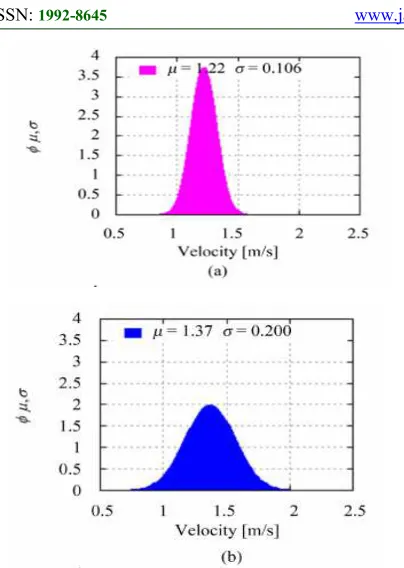
Since every agent has their own desired walking speed, it must be distributed evenly among the agents within the crowd simulation. Thus, the walking speed will be distributed accordingly by using the Gaussian distribution model (figure 6). The Gaussian distribution model is used because it is one of the most popular models to distribute a normal distribution similar to the real world scenarios. A random number generator cannot be used in this simulation due to the distribution might be awkward and does not simulate the real world situation.
Figure 6 : Walking speed distribution (Gaussian distribution model)
ISSN: 1992-8645 www.jatit.org E-ISSN: 1817-3195
Figure 7 : Walking speed distribution in Tawaf movement. (a)Women. Average walking speed is 1.22 m/s
(b) Men. Average walking speed is 1.37 m/s
iv. Grouping
Agents sometime like to walk in groups. Agents within the same group have the tendency to keep close to the other members of the group. Even if they were separated, they will try to reunite of possible. The groups are mostly consisted of two or more agents. These groups also can be a combination of both male and female or just one gender. The interaction forces between members of the group are also weaker than the interaction forces between agents outside the group.
Thus, to realise this situation within the crowd simulation, this research chose the Helbing’s Rule-Based Model [35] to be integrated into the ZS Force Model. This model was chosen because it is very suitable to be used to simulate group behaviour; since all the agents within the group have a similar direction and walking speed. As discussed in the previous sections the Rule-Based Model has three main rules which are cohesion, separation and alignment [36-40].
Cohesion is for the formation the group. Each agent location, Pj within the same group will total together and then divided by the number of the
group members, m. Hence, the groups will move together to the same position.
j i
p
c
m
=
∑
The next rule is alignment, which is used to make sure that every group member move at the same walking speed. A group cannot have a member who walks too fast or too slow. They must have similar speed in order to move together. Hence, the average speed of the group will be calculated. The total walking speed of each agent, Vj will be divided by the total number of the group members, m.
j i
v
m
m
=
∑
The separation rules will be eliminated because the Repulsion force of the Social Force Model has a better solution for collision detection compared to this Rule-Based Model. In addition, if the separation rule is implemented on top of the Social Force Model will cause redundant of repulsion forces. This will make the agent to move awkwardly and unnaturally.
As a conclusion the grouping force will consist of two rules of Helbing’s Rule-Based Model. These rules are cohesion and alignment. These two rules will be integrated with the rest of the ZS Force Model to make a better crowd simulation model.
0
n
group i i
f
c
m
β =
=
+
∑
c. ZS Force Model
ISSN: 1992-8645 www.jatit.org E-ISSN: 1817-3195
0 0 0 0 0 0
n n n n n n
ZSFM driving repulsion attraction goal gender speed group
f
f
f
f
f
f
f
f
β= β= β= β= β= β=
=
+
∑
+
∑
+
∑
+
∑
+
∑
+
∑
4. RESULT AND DISCUSSION
The experiment in this research is to combine all the forces and test whether each of them can work together within the same model.
The result shows that all the new forces within ZS Force Model can work together in order to make a better crowd simulation. All the forces can simulate a better crowd behaviour, not just for the whole crowd, but also as individuals and also small groups.
The implementation of the ZS Force Model for high density crowd simulation had successfully been done in this section. This method could produce efficient forces to avoid collision between agents without separating agent whom within a group. Other than that, a few of Tawaf rules can be realised successfully in this crowd simulation. Those rules are goal position and gender respectively. Hence, the objective of this research was archived by introducing a novel model which is ZS Force Model to improve the simulation of crowd flow in high density crowd situations.
A crowd usually consists of people from different backgrounds, such as gender, age, and intention outlook. It is also sometime consists of several groups of pedestrians which tends to move together. Previous researchers have proposed several methods to solve this problem; however, their solution does not include each of this attribute together.
In this research a new Model of crowd simulation has been proposed by using the Zahmah concept. As discussed before in previous section Zahmah is a concept of that controls the behaviour of the crowd as individuals, but yet still manages to control the crowd to move together as a whole. The current existing models are not diverse enough in term of demographic background which indirectly influences the behaviour of the crowd [37,38,39].
ZS Force Model was designed to handle these issues by giving each agent in the simulation a different set of attributes, which make every agent unique just like in the real world. Some of the agents are also will be set as groups to replicate the grouping behaviour in crowd simulation. This model has hybrid all the required parameters such as gender, age, and intention outlook, which does not consider by the other models. These attributes
were clearly defined from the Zahmah concept which was reflected in the high density crowd environment. This model has been tested in the Tawaf scenario which produces a more accurate simulation result compared to the conventional Social Force Model.
As explained in the previous sections, Tawaf have lots of rules and regulation to be followed by each agent. These rules that make the movement of crowds become more unique and difficult to be simulated. Nevertheless, by using the ZS Force Model a few of these rules had been applied in the crowd simulation. Based on the simulation result, it shows that the ZS Force Model has been successfully simulated some of the Tawaf rules. Those rules are circumambulation and gender interaction.
Based on implementation, this model also applicable for other scenarios; such as in a crowded train station or road intersections. Similar to the Tawaf ritual, these scenarios also have a high density population with various demographic backgrounds. Though, the Tawaf ritual might have a much higher population and density compared to the other scenarios.
5. CONCLUSION
As a conclusion, based on the experimental results this model can simulate high population crowd more accurate than the conventional Social Force Model. All the attributes within this model allow the simulation to be more natural and exhibit the behaviour comparable to the real-world crowd.
ISSN: 1992-8645 www.jatit.org E-ISSN: 1817-3195 In order to improve the simulation for the Tawaf
ritual, other Tawaf rules can be added along with existing rules within ZS Force Model. To make the simulation more interesting, other agents’ behaviour such as getting out from Mataf area, getting into Mataf area or praying can be added into the simulation. With the implementation of these behaviours the crowd flow will become more chaotic and hectic.
ACKNOWLEDGEMENTS
This research paper supported by Universiti Teknologi Malaysia using Fundamental Research
Grant Scheme (FRGS); Vot number
R.K130000.7838.4F639. Special thanks to the Ministry of Education (MOE) and Research Management Centre (RMC) providing financial support of this research.
REFRENCES:
[1] Oxford Dictionary www.oxforddictionaries.com /ms/definisi/bahasa-inggeris/crowd?q=crowd+& searchDictCode=all, Jan 2016.
[2] M Harouni, MSM Rahim, M Al-Rodhaan, T Saba, A Rehman, A Al-Dhelaan. "Online Persian/Arabic script classification without contextual information", The Imaging Science
Journal, vol. 62(8), 2014, pp. 437-448, doi.
10.1179/1743131X14Y.0000000083
[3] MS Fadhil, MH Alkawaz, A Rehman, T Saba "Writers Identification Based on Multiple Windows Features Mining", 3D Research 7, 2016, pp. 1-6, doi. 10.1007/s13319-016-0087-6 [4] N. Z. S. Othman, M. S. M. Rahim, and M.
Ghazali, “Integrating Perception into V-Hajj: 3D Tawaf Training Simulation Application”,
Communications in Computer and Information
Science. PART 1 ed. Vol. 251 CCIS, Dec 2011,
page 79-92.
[5] AE Rad, MSM Rahim, A Rehman, A Altameem, T Saba. "Evaluation of current dental radiographs segmentation approaches in computer-aided applications", IETE Technical
Review, vol. 30(3), 2013, pp.210-22,
doi.10.4103/0256-4602.113498.
[6] Saba, T., Almazyad, A.S. Rehman, A. Online versus offline arabic script classification,
Neural Computing and Applications,vol.27(7),
2016, pp 1797–1804, doi. 10.1007/s00521-015-2001-1.
[7] T. Saba, A. Rehman, A. Altameem, M. Uddin Annotated comparisons of proposed preprocessing techniques for script recognition,
Neural Computing and Applications, vol. 25(6),
2014, 1337-1347 , doi. 10.1007/s00521-014-1618-9
[8] D. Helbing, and P. Molnár, “Social Force Model for Pedestrian Dynamics”, 1998, http://arxiv.org/pdf/cond-mat/9805244.pdf. [9] M. A. M. Azahar, M. S. Sunar, D. Daman, and
A. Bade, “Survey on Real-Time Crowds Simulation”, Technologies for E-Learning and Digital Entertainment the series Lecture Notes
in Computer Science, 5093, 3008, page
573-580.
[10] JWJ Lung, MSH Salam, A Rehman, MSM Rahim, T Saba. " Fuzzy phoneme classification using multi-speaker vocal tract length normalization", IETE Technical Review, vol. 31 (2), 2014, pp. 128-136.
[11] Z. F. Muhsin; A. Rehman; A. Altameem; T. Saba; M. Uddin "Improved quadtree image segmentation approach to region information",
the imaging science journal, vol. 62(1), pp.
56-62, 2014.
[12] M. H. Dridi, “Tracking Individual Targets in High Density Crowd Scenes Analysis of a Video Recording”, Advances in Complex
Systems Vol. XXI, No. 1, 2014.
[13] M. H. Dridi, “Pedestrian Flow Simulation Validation and Verification Techniques”,
Current Urban Studies, 3, 2015, page 119-134.
[14] M. H. Dridi, “Simulation of High Density Pedestrian Flow: A Microscopic Model”, Open
Journal of Modelling and Simulation, 3, 2015,
page 81-95.
[15] Neamah, K. Mohamad, D. Saba, T. Rehman, A. "Discriminative features mining for offline handwritten signature verification", 3D
Research, vol.5(3), 2014, doi.
10.1007/s13319-013-0002-3.
[16] S. A. Stuvel, M. F. de Goeij, A. F. van der Stappen, and A. Egges, “An Analysis of Manoeuvring in Dense Crowds”, Motion in
Games 2015 conference proceedings, 2015.
[17] JWJ Lung, MSH Salam, A Rehman, MSM Rahim, T Saba. " Fuzzy phoneme classification using multi-speaker vocal tract length normalization", IETE Technical Review, vol. 31 (2), 2014, pp. 128-136
[18] Z. Xiaoping, Z. Tingkuan, and L. Mengting, “Modeling Crowd Evacuation of A Building Based On Seven Methodological Approaches”, Building and Environment, 44, 2008, 437– 445 [19] Z. Zainuddin, and E. A. Lim, “Response
ISSN: 1992-8645 www.jatit.org E-ISSN: 1817-3195 Tawaf”, Chinese Physics Letters, vol. 29(7)
2012.
[20] Norouzi, A. Rahim, MSM, Altameem, A. Saba, T. Rada, A.E. Rehman, A. & Uddin, M. Medical image segmentation methods, algorithms, and applications IETE Technical
Review, vol.31(3), 2014,
doi.10.1080/02564602.2014.906861.
[21] Soleimanizadeh, S. Mohamad, D. Saba, T. Rehman, A. (2015) Recognition of partially occluded objects based on the three different color spaces (RGB, YCbCr, HSV) 3D Research, vol. 6 (3), 1-10., doi. 10.1007/s13319-015-0052-9.
[22] T. Saba, A. Rehman, A. Al-Dhelaand and M. Al-Rodhaand. Evaluation of current documents image denoising techniques: a comparative study, Applied Artificial Intelligence, vol. 28(9),
2014, pp. 879-887, doi.
10.1080/08839514.2014.954344
[23] A. Selamat, C. Phetchanchai, T. Saba, A. Rehman. Index financial time series based on zigzag-perceptually important points, Journal of
Computer Science, vol. 6(12), 2010, 1389-1395,
doi. 10.3844/jcssp.2010.1389.1395
[24] Saba T, Al-Zahrani S, Rehman A. Expert system for offline clinical guidelines and treatment Life Sci Journal 2012;vol. 9(4), 2012, pp.2639-2658.
[25] Elarbi-Boudihir, M. Rehman, A. and Saba, T. Video motion perception using optimized Gabor filter. International Journal of Physical
Sciences, Vol. 6(12), 2011, pp. 2799-2806.
[26] Rehman, A. and Saba, T. Features extraction for soccer video semantic analysis: current achievements and remaining issues, Artificial
Intelligence Review, vol. 41(3), 2014, pp:
451-461, doi. 10.1007/s10462-012-9319-1.
[27] Rehman, A. and Saba, T. “Evaluation of artificial intelligent techniques to secure information in enterprises”. Artificial
Intelligence Review, vol. 42(4), 2014, pp.
1029-1044, doi. 10.1007/s10462-012-9372-9. [28] Saba, T. and Altameem, A. Analysis of vision
based systems to detect real time goal events in soccer videos, Applied Artificial Intelligence, vol. 27(7), 2013, pp. 656-667, doi. 10.1080/08839514.2013.787779
[29] Saba, T. and Rehman, A. Machine Learning and Script Recognition, Lambert Academic publisher, 2012, pp.55-62.
[30] A. Rehman and T. Saba. Document skew estimation and correction: analysis of
techniques, common problems and possible solutions, Applied Artificial Intelligence, vol. 25(9), 2011, pp. 769-787. doi. 10.1080/08839514.2011.607009
[31] T Saba, A Rehman, M Elarbi-Boudihir. Methods and strategies on offline cursive touched characters segmentation: a directional review, Artificial Intelligence Review vol. 42 (4), 2014, pp. 1047-1066. doi 10.1007/s10462-011-9271-5
[32] A. Rehman and T. Saba “Off-line cursive script recognition: current advances, comparisons and remaining problems”. Artificial Intelligence
Review, vol. 37(4), 2012, pp.261-268. doi.
10.1007/s10462-011-9229-7.
[33] T. Saba, A. Rehman and G. Sulong. “Improved statistical features for cursive character recognition” International Journal of Innovative
Computing, Information and Control (IJICIC)
vol. 7(9), 2011, pp. 5211-5224
[34] M. H. Dridi, “Simulation of High Density Pedestrian Flow- Microscopic Model”, 2012. [35] D. Helbing, and P. Molnár, “Social Force
Model for Pedestrian Dynamics”, 1998, http://arxiv.org/pdf/cond-mat/9805244.pdf. [36] Mundher, M. Muhamad, D. Rehman, A. Saba,
T. Kausar, F. (2014) Digital watermarking for images security using discrete slantlet transform, Applied Mathematics and
Information Sciences, vol 8(6), 2014, pp.
2823-2830, doi.10.12785/amis/080618.
[37] Rehman, A. and Saba, T. “Neural network for document image preprocessing” Artificial
Intelligence Review, vol.42(2), 2014, pp
253-273 doi.10.1007/s10462-012-9337-z.
[38] S Joudaki, D Mohamad, T Saba, A Rehman, M Al-Rodhaan, A Al-Dhelaan. Vision-Based Sign Language Classification: A Directional Review,
IETE Technical Review, vol.31 (5), 2014,
pp.383-391,
doi.10.1080/02564602.2014.961576
[39] T.Saba and A. Rehman ). Effects of artificially intelligent tools on pattern recognition,
International Journal of Machine Learning and
Cybernetics, vol. 4, 2012, pp. 155-162. doi.
10.1007/s13042-012-0082-z.