ORIGINAL RESEARCH ARTICLE
ANALYSIS OF CONSTRUCTION COST AND TIME OVERRUN
FACTORS FOR HIGH RISE BUILDINGS
1*
Miss. Suwarna Jape and
2Prof. Upendra Saharkar
1
PG student (Construction and Management), DYPIET, Ambi, Savitribai Phule Pune University,
Pune, Maharashtra, India
2
Head of Department (Civil Engineering), DYPIET, Ambi, Savitribai Phule Pune University,
Pune, Maharashtra, India
ARTICLE INFO ABSTRACT
In construction industries achievement of the time and cost objectives is a major problem in spite of availability of control techniques and project control software’s. Research in the field of going on to identify causes of cost and time overruns. Now a days people are concentrating on the factors affecting the cost and time while construction of a project so that it will make ease to practitioner to have complete control over the project. While doing so various surveys has been conducted by researcher over 24 respondents (for fourty eight surveys 24 for cost overrun and 24 for time overrun) for various construction project in Pune, which was followed by personal interview with experience professionals from these organizations. The job was to identify the common factors which affects both time and cost control during construction projects (5). Subsequently 45 measures have been developed which leads us to know to how they impact on the cost and time of project, depending on the characteristics such as degree of severity and number of occurrence. The result of this study assist policy makers to make checklist of good practice and help them to understand factors causing actual delay, indirectly effective control over their projects (2).
*Corresponding author:
Copyright ©2017, Suwarna Jape and Upendra Saharkar. This is an open access article distributed under the Creative Commons Attribution License, which permits unrestricted use, distribution, and reproduction in any medium, provided the original work is properly cited.
INTRODUCTION
It is expected that over 50 per cent of India’s population will be residing in urban areas. With such large expected growth in the urban population, the demand for residential space will substantially increase. With the prevailing sky high prices of urban land and environmental laws restricting availability of such land for construction of buildings, cities will have to go vertical only to accommodate maximum population. Pune is one of topmost developing urban city in India. Pune is land fast growing commercials business hub viz. for manufacturing and software industries in India. Pune is best connected to various other important cities by all means and rest of the country by rail road and air. Major domestic airlines maintain daily connections between Pune and rest of the India.
Land in the city is limited and hence real estate cost and transactions are very costly. For relieving pressure on Pune, new villages has been developed across surrounding Pune. Pune has the numerous high rise building. High rise buildings are being constructed in the surrounding villages changing the villages in to new urban life (14). The population living in Pune is 45, 00,000 in city and 40, 00,000 for Pimpri Chinchwad adjoining city to Pune. As the population is increasing, land scarcity is major problem in Pune, there is less space to expand right or left in horizontal direction, so to accommodate the needs there is no option except to go vertical. As these structures are coming up in vast speed, there is a need to take a look in their construction and management process. Constructing high rise structures is a challenging task involving many risks, as well as such projects are mighty for the promoters and contractors.
ISSN: 2230-9926
International Journal of Development Research
Vol. 07, Issue, 07, pp.13904-13908, July,2017
Article History:
Received 09th April, 2017
Received in revised form 24th May, 2017
Accepted 16th June, 2017
Published online 22nd July, 2017
Citation: Miss. Suwarna Jape and Prof. Upendra Saharkar. 2017. “Analysis of construction cost and time overrun factors for high rise buildings”,
International Journal of Development Research, 7, (07), 13904-13908.
ORIGINAL RESEARCH ARTICLE Open Access
Key Words:
Completing these structures in time and budget is one of the major challenges, and main focus is given to them in the study.
[image:2.595.319.551.79.579.2]RESEARCH METHODOLOGY
Table 1. Below are parameter wise RII & Ranking for Cost Overrun Parameters
Fourty-five causes of delay were found after the interview and survey. A questionnaire survey was prepared to find the impact of on various organization for the defined causes. Information was collected from various construction organizations. Research questionnaire is divided into five levels such as very high, high, medium, low and very low and marks given as 5, 4, 3, 2, & 1 respectively. Each level rate the impact of factors through which the background for potential delay and cost control in the construction projects can be verified. These causes are shared with experienced professionals in order to have a clear idea. Based on previous studies two questions for each factor were asked:
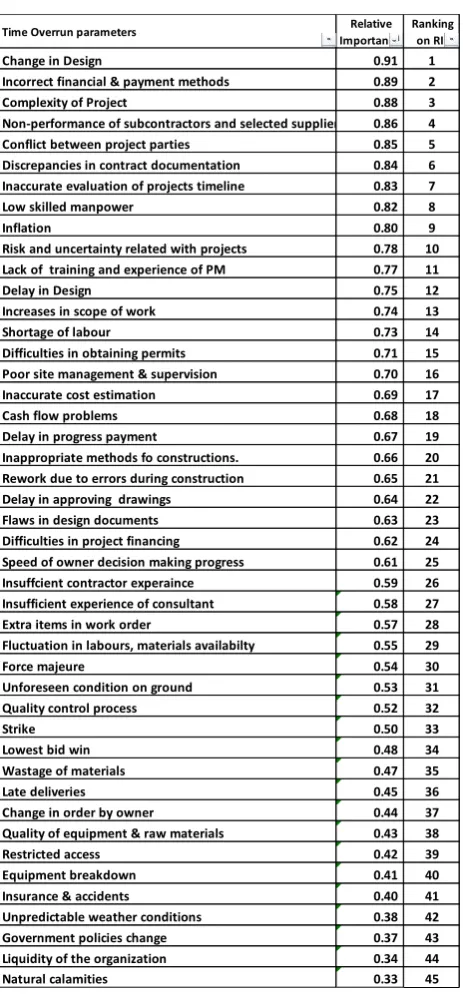
Table 2. Below are parameter wise RII & Ranking for Time Overrun Parameters
What is the impact of each cause on Cost control? 2) What is the impact of each cause on Time control?
Major factors under study identified causes of delay are design changes, conflict between project parties, inaccurate evaluation of projects time, project complexity (3). There are some causes which are related to country. This research included additional major delay factors which are identified as the Low skilled manpower, shortage of labour, insufficient drawings, inadequate planning & timeline for project, Cash flow problems and Government policies changes (11). There are many reasons why delays occur. For example rework, organizational inefficiency, shortage of material, failure of equipment’s, changes in scope and orders, act of God, etc. Additionally, delays are mostly interconnected, creating a critical situation leading to complexity. Many important reasons for delay related to owner decisions, performance indices for contractor, and advance planning during the project design step.
Cost Overrun parameters Relative
Importance Ranking
on RII
Change in Design 0.91 1
Complexity of Project 0.89 2
Risk and uncertainty related with projects 0.88 3
Low skilled manpower 0.86 4
Inaccurate evaluation of projects timeline 0.85 5
Incorrect financial & payment methods 0.84 6
Discrepancies in contract documentation 0.83 7
Conflict between project parties 0.82 8
Inflation 0.80 9
Non-performance of subcontractors and selected suppliers 0.78 10
Lack of training and experience of PM 0.79 11
Delay in Design 0.75 12
Increases in scope of work 0.74 13
Shortage of labour 0.73 14
Difficulties in obtaining permits 0.71 15
Poor site management & supervision 0.70 16
Inaccurate cost estimation 0.69 17
Cash flow problems 0.68 18
Delay in progress payment 0.67 19
Inappropriate methods fo constructions. 0.66 20
Rework due to errors during construction 0.65 21
Delay in approving drawings 0.64 22
Flaws in design documents 0.63 23
Difficulties in project financing 0.62 24
Speed of owner decision making progress 0.61 25
Strike 0.59 26
Insufficient experience of consultant 0.58 27
Quality control process 0.57 28
Fluctuation in labours, materials availabilty 0.55 29
Force majeure 0.57 30
Unforeseen condition on ground 0.53 31
Insuffcient contractor experaince 0.52 32
Extra items in work order 0.50 33
Equipment breakdown 0.48 34
Change in order by owner 0.47 35
Unpredictable weather conditions 0.45 36
Lowest bid win 0.44 37
Wastage of materials 0.43 38
Restricted access 0.42 39
Liquidity of the organization 0.41 40
Late deliveries 0.40 41
Government policies change 0.38 42
Quality of equipment & raw materials 0.37 43
Insurance & accidents 0.34 44
Natural calamities 0.33 45
Time Overrun parameters Relative
Importance Ranking
on RII
Change in Design 0.91 1
Incorrect financial & payment methods 0.89 2
Complexity of Project 0.88 3
Non-performance of subcontractors and selected suppliers 0.86 4
Conflict between project parties 0.85 5
Discrepancies in contract documentation 0.84 6
Inaccurate evaluation of projects timeline 0.83 7
Low skilled manpower 0.82 8
Inflation 0.80 9
Risk and uncertainty related with projects 0.78 10
Lack of training and experience of PM 0.77 11
Delay in Design 0.75 12
Increases in scope of work 0.74 13
Shortage of labour 0.73 14
Difficulties in obtaining permits 0.71 15
Poor site management & supervision 0.70 16
Inaccurate cost estimation 0.69 17
Cash flow problems 0.68 18
Delay in progress payment 0.67 19
Inappropriate methods fo constructions. 0.66 20
Rework due to errors during construction 0.65 21
Delay in approving drawings 0.64 22
Flaws in design documents 0.63 23
Difficulties in project financing 0.62 24
Speed of owner decision making progress 0.61 25
Insuffcient contractor experaince 0.59 26
Insufficient experience of consultant 0.58 27
Extra items in work order 0.57 28
Fluctuation in labours, materials availabilty 0.55 29
Force majeure 0.54 30
Unforeseen condition on ground 0.53 31
Quality control process 0.52 32
Strike 0.50 33
Lowest bid win 0.48 34
Wastage of materials 0.47 35
Late deliveries 0.45 36
Change in order by owner 0.44 37
Quality of equipment & raw materials 0.43 38
Restricted access 0.42 39
Equipment breakdown 0.41 40
Insurance & accidents 0.40 41
Unpredictable weather conditions 0.38 42
Government policies change 0.37 43
Liquidity of the organization 0.34 44
[image:2.595.43.283.140.650.2]The study reveals that main causes of delay were related to designing people, changes asked by user, weather condition, situation at site, not on time delivery, financial situation and rise in required quantity. The study guides to understand the specific attention to parameters will support various practicing people in reducing disputes for contracts (8). Delays have a direct relationship with non-performance of suppliers (3).
DATA COLLECTION
The data were collected from twenty four respondents (for fourty eight surveys 24 for cost overrun and 24 for time overrun) for various construction project in Pune. The data can be analysed through the following statistical formulas, Here T = total respondents, who responded for the all parameters with value having range from 1 to 5. The relative importance index can be devised as below: RII (Relative importance index) = Summation of I ÷ (M x T) Where I is the total intensity or weightage given to every factor by responding persons. The scale for which is from 1 to 5. M is the maximum rank available (i.e. 5 in this case indicate maximum impact) and T is total number of respondents those who replied the question. Table reflects the outcome for time control & cost control parameters used for the survey questions. Table also shows cost & time control parameter impact in scale of 1 to 5 according to the respondents. (5 being the higher impact and 1 is the lowest impact) Calculation of Relative Importance Index (RII) (2), for e.g.
Cost Factors
RII for Change in design (for Cost factors) is calculated as below:
= (4+4+3+5+5+5+5+5+ 4+5+5+5+4+5+5+ 4+5+4+5+ 4+ 3+5+5+5) / (5*24) = 109/ 120 = 0.91
RII Complexity of Project (for Cost factors) is calculated as below:
=(3+4+5+4+5+4 +4+4+5+5+5+4+4+5+4+ 5+5+ 5+4+5+ 5+ 4+5+ 4)/ (5*24) = 107/ 120 = 0.89
RII for Delay in progress payment (for Cost factors) is calculated as below:
= (3+3+4+3 +4+4+3+3+3+4+3 +3+3+4+3+3+4+3+2 +5+3 +3+3+4) / (5*24) = 80/ 120 = 0.67
RII for Inappropriate methods of constructions (for Cost factors) is calculated as below:
= (4+4+4+5+4+4+1+4+3+ 3+5+3+3+3+3+3 +1+1+4+ 3+4+ 3+3+4) / (5*24) = 79/ 120 = 0.66
RII for Insurance & accidents (for Cost factors) is calculated as below:
=(3+1+1+2+1+2+1+3+1+3+1+1+3+1+3+1+2+1+1+3+1+1+3 +1) / (5*24) = 44/ 120 = 0.34
RII for Natural calamities (for Cost factors) is calculated as below:
=(2+3+1+1+3+2+3+2+2+1+3+1+1+1+2+2+1+1+2+1+2+1+1 +1) / (5*24) = 45/ 120 = 0.33
Time factors
RII for Change in design (for Time factors) is calculated as below:
= (5+4+5+5+5+5+4+4+ 5+3+5+5+5+ 4+5+3+5+5+5+4 +5 +3+5 +5)/ (5*24) = 109/ 120 = 0.91
RII for Incorrect financial & payment methods (for Time factors) is calculated as below:
=(4+ 5+5+4+4+4+4+ 5+5+4+5+4+5+5+5+ 5+4+4+4+5+ 5+4 +4 +4)/ (5*24) = 107/ 120 = 0.89
RII for Delay in approving drawings (for Time factors) is calculated as below:
= (4+4+3+2+ 3+2+2+4+3+3+ 3+4+3+4+3+3+ 3+4+3+4+ 3+3+3+4)/ (5*24) = 77/ 120 = 0.64
RII for Flaws in design documents (for Time factors) is calculated as below
=(3+4+3+3+3+3+3+3+3+3+3+2+3+4+3+3+3+4+3+4+3+3+3 +4)/ (5*24) = 76/ 120 = 0.63
RII for Liquidity of the organization (for Time factors) is calculated as below:
=(1+ 3+3+4+3+3+1+1+2 +1+1+2+1+1+2+1+1+2+1 +1+2+2 +1+1)/ (5*24) = 41/ 120 = 0.34
RII for Natural calamities (for Time factors) is calculated as below
=(3+1+2+4+2+1+1+1+2+3+1+1+1+1+2+2+1+1+2+1+2+3+1 +1)/ (5*24) = 40/ 120 = 0.33
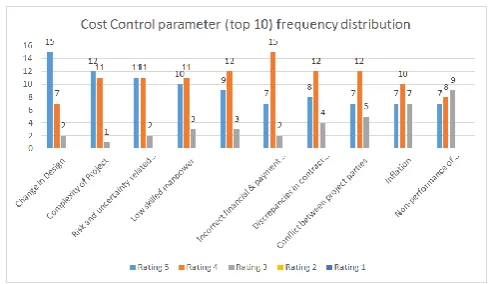
Bar Chart 1. Top 10 Cost parameters rating
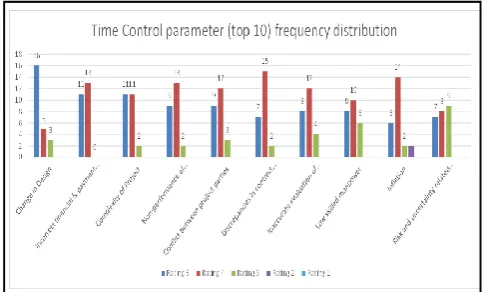
[image:3.595.311.558.490.632.2]Bar Chart 2. Top 10 Time parameters rating
Pier Chart 1.Top 10 cost parameters frequency distribution for rating 5
[image:4.595.41.285.54.200.2]Pie Chart 2.Top 10 Time parameters frequency distribution for rating 5
Table indicated the major time controlling parameters, we can say that changes in design, problems in financing the project & accounts payable , complexity of project, performance concerns of supplier and blame game between project parties with RII of 0.91, 0.89, 0.88, 0.86 and 0.85 respectively. Next level parameters are problems gaps in documentation of agreement, unrealistic projects timeline, low skill manpower, price rise, risk & uncertainty related to projects with RII of 0.84, 0.83, 0.82, 0.80 and 0.78 respectively. The parameters which have very less effects on cost overrun are liquidity of the organization & natural calamities with RII of 0.34 & 0.33
respectively. Number one parameter in both list has 1st rank for
changes in design. This parameter control the time and cost overrun to the maximum level. This impact timeline and cost of project. No of incidences, unclear and random designs always make heavy impact on project deliverables. A more critical analysis of tables 1 and 2 reveals that five of the top
twelve factors ranked as inhibiting time control and cost control are the same. Both list have majority of the common parameters. After ranking was done for all parameters for cost & time control overrun, statistical analysis was done. From statistical perspective the Spearman’s correlation coefficient was calculated which ranges from +1 to -1. Significance of the same is most important, where +1 indicates signify perfect correlation for positive linking and -1 indicates perfect correlation for negative linking i.e. no absolute linking. Any value in between defined the strength of linkage to the extent based on it is on positive or negative side.
Equation for Spearman rank correlation coefficient.
Sc = 1 – (6Σdr2 ⁄ (N3 – N))
Sc = 1 – (6 * 428) ⁄ (91125 – 45) = 0.97
Where Sc = Spearman rank correlation coefficient.
dr = rank difference for every parameter.
N = no of parameters or rank pairs. The test outcome coefficient is 0.97, indicating strong +ve relation and implies a strong linkage with rank of time controlling parameters & cost controlling parameters. This indicates parameters affected by time overrun are same or nearby ranked for parameter affected affecting cost overrun. Thus we conclude that parameters affecting time overrun and cost overrun are almost same or similar in nature.
DEVELOP MITIGATING MEASURES
With survey results and analysis conducted, Major top parameters affecting projects were studied in deep by conducting interviews. This helped to understand the reasons from construction to control projects. This helped to create list of actions to be used to mitigate the affecting parameters. Top ten parameters were finalised to focus on due to important consideration that both have implications on cost and time.
Conclusion
This study implies the important reasons and effect of delay on construction projects. The intension of the paper was to know the parameters affecting time and cost overrun. Fourty five parameters considered for study and analysis for the same was carried out. The Major 10 parameters causing project delay are changes in design, problems in financing the project & accounts payable , complexity of project, performance concerns of supplier, blame game between project parties, problems gaps in documentation of agreement, unrealistic projects timeline, low skill manpower, price rise, risk & uncertainty related to projects. This study shows a way to understand on how much interlink is there between the time and cost parameters. Further to this if we can work on four to six higher RII cost factors, automatically the project timeline will get reduced. Additional parameters like technologies used in construction also helps tom improve project timeline. Use of automation equipment helps improve time line, however it also attracts the cost. There can be further study performed for various applications like bridge construction, tunnel, dams, etc.
REFERENCES
in Construction Contracts” Journal of construction engineering and management © asce / November 2010 / 1207. www.ascelibrary.org
Abraham Warszawski, Analysis of Costs and Benefits of Tall Buildings F.
American Journal of Civil Engineering and Architecture, Science and Education Publishing, 2015, Vol. 3, No. 1, 15-20
Anuja Rajguru, Parag Mahatme. “Effective techniques in cost
optimization of construction project “. IJRET:
International Journal of Research in Engineering and Technology eISSN: 2319-1163 | pISSN: 2321-7308 Chitkara, K. K., Construction Project Management, Tata
McGraw-Hill, New Delhi, 2003 Routledge Publication. Cite as: Olawale, Y., and Sun M. 2010. “Cost and time control
of construction projects: Inhibiting factors and mitigating measures in practice.” Construction Management and
Economics, 28 (5), 509 – 526.
David C W Kwok, “construction planning for High-rise residential building”. Gammon Building Construction (Macau) Ltd.
Dipti R. Shetye, Dr. S.S.Pimplikar, “Cash Flow of High Rise
Residential Building”, International Journal of
Engineering Research and General Science Volume 2, Issue 4, June-July, 2014 ISSN 2091-2730
Gary C. “Construction Management and Economics” Publisher: Routledge Publication details, including instructions for authors and subscription information: http://www.tandfonline.com/loi/rcme20
George Otim, Fiona Nakacwa, Michael Kyakula, “Cost Control Techniques Used On Building Construction Sites in Uganda”. Second International Conference on Advances in Engineering and Technology.
Intan Rohani Endut, Akintola Akintoye and John Kelly, “Cost and time overruns of projects in Malaysia“. School of Build and Natural Environment, Glasgow Caledonian University, 70 Cowcaddens Road Glasgow G4 0BA Ivy Q. Blackman and David H. Picken, “Height and
Construction Costs of Residential High-Rise Buildings in Shanghai”. www.ascelibrary.org
Kaming, P., Olomolaiye, P., Holt, G., Harris, F. 1997. “Factors influencing construction time and cost overruns on high-rise projects in Indonesia”, Construction Management and Economics, 82-95.
Kerzner, H. 2003. “Project Management A Systems Approach to Planning, Scheduling, and Controlling”, John Wiley and Sons Inc., New Jersey
Kulkarni, S.B., Chaphalkar, N.B. “Introduction to project management.” Vision publication.
Kumaraswamy, M. and Chan, W. 1998. Contribution in construction delays “Construction Management and Economics”, 15-31.
Nicholas, J. 2001. “Project Management for Business and Technology”, Prentice Hall, New Jersey.
Ojedokun, O.Y., Odewumi, T.O., Babalola, A.O. 2012. “Cost Control Variables in Building Construction (A case study of Ibadan North Local Government, Oyo State, Nigeria”, IOSR Journal of Mechanical and Civil Engineering (IOSR-JMCE), ISSN: 2278-1684 Volume 4, Issue 1 (Nov-Dec., PP 32-37
Raina, V.K. 1999. “Construction Management Practice”. Tata McGraw-Hill Publishing Company Limited7, West Patel Nagar, New Delhi, India.
Ramaswamy, R. “Practical handbook on construction management.” Nabhi publication.
Rupali Kavilkar and Shweta Patil. “Study of High Rise Residential Buildings in Indian Cities”. IACSIT International Journal of Engineering and Technology, Vol. 6, No. 1, February 2014, DOI: 10.7763/IJET.2014.V6.671 Salad M E Sepasgozar, Mohamad Ahmadzade Razkenari,
Khalegh Barati.“The Importance of New Technology for Delay Mitigation in Construction Projects”,
Shanmughanathan N and Dr. G Bhaskar. “Effective cost and time management techniques in construction industry” International journal of advance engineering technology.
E-ISSN 0976-3945. Vol VII/Issue
II/April-June,2016,/743-747
Weinberg, S. and Abramowitz, S. 2008. Statistics Using SPSS: An Integrative Approach. Cambridge University Press, Cambridge.
www.ascelibrary.org