ORIGINAL RESEARCH ARTICLE
INTERNET OF THINGS (IOT) ADVANTAGES ON E-LEARNING IN
THE SMART CITIES
1*
Majid Bayani,
2Karol Leiton and
3Mayra Loaiza
1,2
National University, School of Informatics, Heredia, Costa Rica
3
National University, School of Language and Literature Science, Heredia, Costa Rica
ARTICLE INFO ABSTRACT
This article focuses on the research associated to the benefits of the e-learning in the smart cities. A theoretical analysis is explored in this paper. Emergent technology such as IoT is rapidly developing in the computing and digital world. Creation of the smart cities is growing with the concept of the IoT in parallel. E-citizens as one of the main elements have a vital role in the community and building the smart cities. It is self-evident that a new form of the citizen (e-citizen) in the smart cities can play a vital role if it receives adequate e-education. These subjects can become creative and entrepreneur players which can guarantee the educational objectives of the smart cities. In the digital era, the IoT campuses in the smart cities are concentrated on the amplification of the e-education component by using effective e-learning. This article focuses on the need of adopting IoT technologies in smart city campuses, analyzing the predictable advantages of the e-learning. The remarkable benefits of the e-learning and its application in the smart cities with a detailed discussion are presented in the paper. The conclusion can be used as a concise topic for the future study of the smart city researchers.
Copyright ©2017,Majid Bayani et al. This is an open access article distributed under the Creative Commons Attribution License, which permits unrestricted use, distribution, and reproduction in any medium, provided the original work is properly cited.
INTRODUCTION
Internet of things (IoT) is a prevalent technology that provides communication and collaboration between the physical and virtual objects. As it develops, it grows in size and dimension impacting different aspects of our life such as the education (Bayani and Vilchez, 2017). IoT was presented to the world, by Kevin Ashton in 1999 when he was working in the Auto-ID lab at MIT, stating the technologies that drive IoT such as Radio Frequency Identity device (RFID) and Wireless sensor networks (WSNs) (Wood , 2015). Based on the primary idea of IoT, all objects that obtain an IP address will be able to interact with each other physically and virtually (Parashar, Khan, and Neha, 2016). The main structure of Internet of things is based on the data sensed by sensors, tags or actuators and sending it through a gateway to a cloud system. The interaction in the IoT includes Machine-to-Machine, Object- to Machine or Object-to-object types (IoT-GSI, 2012; GSMA Association, 2014).
*Corresponding author: Majid Bayani,
National University, School of Informatics, Heredia, Costa Rica.
The range of applications developed in the field of IoT is from a small home to the advanced surgery systems. Internet of things includes many aspects of the human’s life such as smart cities, smart businesses and smart energy consumption, etc. Education is one of the most perceptible human activities that IoT has influence on, transforming the shape of education to an innovative structure in the close future (Tianbo, 2012; Maksimović, 2017). Relatively, the Internet of Things (IoT) is a prevalent phenomenon that supports creativity in many fields. The area of education (e-education) is one of these fields. As IoT can be joined with other IT technologies, it can offer a vast variety of the e-educational technologies which can change the future of the education systems. The future education center will be equipped with smart objects. Students and teachers authenticate their validity of as users passing finger-prints and RFID ID Card in front of the reader, mobile checking in order to enter to the physical rooms or access to the automatic system management of the school. The IoT classrooms in the future include the sensors to validate the access of the educators and students. The smart whiteboards and desks will be furnished with the RFID or WSN (Bayani, Marin and Barrantes, 2010) devices that can physically detect the users. Students and educators can interact with each other
ISSN: 2230-9926
International Journal of Development Research
Vol. 07, Issue, 12, pp.17747-17753, December,2017
Article History:
Received 11th September, 2017 Received in revised form 21st October, 2017
Accepted 29th November, 2017
Published online 29th December, 2017
Key Words:
Internet of things (IoT), E-learning, Smart City, E-education, Smart Education.
Citation: Majid Bayani, Karol Leiton and Mayra Loaiza, 2017. “Internet of Things (IoT) Advantages on E-learning in the Smart Cities”, International
Journal of Development Research, 7, (12), 17747-17753.
mutually in the smart class (E-Leap, 2016). Internet of things can provide the efficient connection between all things physically and virtually. This allows the educative objects, such as students, connecting -online- to the labs, library, didactic materials, assessments, and educational messages and administrative tasks in an efficient manner (effective e-learning) in a large-size virtual classroom. Furthermore, in this form of e-learning, all learning tasks and activities will be determined as objects (Sok-Pal and Jeom-Goo, 2016). In addition, e-learning, originated in the 80’s, refers to applying electronic tools, soft and hardware applications and web-based processes in the learning system (Moore, Dickson-Deane and Galyen, 2011). Actually, the speed technology evolution and communication tools have enabled the online learning by means of the large learning environment (Internet). The IoT allows the expansion of learning environments by integrating the physical and virtual objects by interfering in the learning process (Garreta and Mangas, 2010). The traditional e-learning, as a digital methodology, can provide a vast virtual access environment for learners, but at the same time there are some limitations. The geographical position, face to face communication between objects, and effective cooperation between virtual and physical agents are supposed to be the main limitations in e-learning. Applying smart objects in the learning environment is one of solution for the mentioned issues. IoTs is considered as the main provider of smart agents for e-learning ecosystems (Jafari, 2002; Soava, Sitnikova and Danciulescu, 2014).
IoT can present two essential elements into the traditional e-learning that are smartness and object interaction (things to things, machine to machine) (Jafari, 2002). IoTs can provide a huge platform for learners and instructors with a wide variety of distance learning devices and objects. High interaction between virtual and physical objects can generate a great number of collaboration environments (Soava, Sitnikova and Danciulescu, 2014). As previously mentioned, the scope of the IoT application is extended from the simple smart home, smart connected cities, and urban system management to the complicated healthcare systems.
IoT comprises all macro human life activities, such as e-education which is one of the recent focuses of the urban smart city researchers. Using the communication Technology by IoT has been converted as the most essential factors in designing the smart cities. As a tool, it allows passing from a knowledge-transfer e-learning model to a collaborative type in order to increase knowledge of the e-citizen developing their skills in the e-community and forming the e-Learning digital smart
society (Selinger, Sepulveda and Buchan, 2013 ; Zanella et
al., 2014). Urban IoTs are designed to support the smart city
concept, in order to take advantage of the most advanced ITC technologies. One of various dimensions for the smart city idea is that the cities will become smarter by combining the diverse advanced technologies. Incorporating the IoT into the Information and communication technologies can help in improving the added-value services and educational activities with the purpose of administration process enhancement. Smart Cities can combine diverse ITC and IoT technologies in order to reduce their environmental impact and offer better
e-educative platform and services (Bonino et al., 2015; Zanella
et al., 2014; Zistl, 2017). This paper explores several
technological advantages of IoT on E-learning process in the smart cities that will be presented in the following sections.
IoT in E-Education
As mentioned before, education is one of the main concepts in the humans’ activities that, is meeting the recent technology and development challenges such as IoT (ISOC, 2014; Sun and Shen, 2016).
Basic IoT Structure
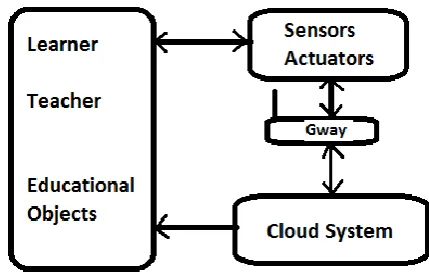
A Basic system Architecture of IoT is exposed in Figure 1. As Figure 1 shows, the basic IoT architecture is divided into three layers: application, network and perception layers (Sethi and
[image:2.595.321.543.220.312.2]Sarangi, 2017; Bayani et al., 2017).
Figure 1. A Basic Architecture of IoT in Education
[image:2.595.322.537.530.667.2]The application layer provides services to user applications using an interface. The network layer is in charge of providing connection between nodes and gateway. The gateway point is considered as an intermediary between the application and perception layers, in order to obtain the data sensed from the sensor nodes in the perception layer and send information to a cloud system. Moreover, the perception layer includes the physical objects or sensors that can sense an event or object action. A small sensing system in this layer is responsible for sensing (RFID, WSN) and storing the data sensed. Figure 2 has demonstrated a basic IoT educative structure where IoT devices detect the events, object tracking or any data in the perception layer. The sensory data will be sent to the gateway, stored in a small cloud system. The data after processing could be used for further decisions.
Figure 2. A Basic IoT Educational Architecture
IoT role in Smart Education
Every day more smart objects are tailored to the several scenarios and are becoming more ubiquitous in different area of education (Gubbi, Buyya, Marusica, and Palaniswamia, 2013). Amongst the smart services supported by the emergent technologies such as IoT, smart education is one of the main elements in implementation of IoT smart cities, which are
enabled by virtual learning and digitalization (Figure 3). This classification has resulted in many investigations by researchers. Figure 3, is one of the simplest divisions IoT smart cities segmentation which education is one of the main elements of a smart city implemented by IoT.
transformed the traditional education elements such as institution, university, school, student and other elements to the smart E-Education, E-institution, E-University, E and E-student. Smart education is a challenge in the structure of smart cities that some researches have paid attention to (Tian, and Zheng, 2017; Soliman, and Elsaadany, 2016; Bululukova, Tabakovic and Wahl, 2016;
Wosinski, 2017). Most educational centers are not connected or share their information between themselves. Adaptive technologies such as IoT are required in order to fulfill this gap, transforming the traditional educational
current model by means of the recent technology such as
Internet of things (IoT) (An et al., 2013; Wolff, Kortuem and
Cavero, 2015; Tikhomorov, Dneprovskaya and Yankovskay,
[image:3.595.324.543.53.272.2]2015; Kim et al. 2013; Kim and Bae, 2012).
Figure 3. IoT Smart city Segmentation
The use of IoT in the educational atmosphere provokes a large amount of connections between educational objects generating huge sizes of data. Involving the IoT in the educational field also, permits more communication between different
objects such as virtual and physical as well as learners and instructors. Relatively, new opportunities of innovations are opened to the educational applications in order to improve the learning process enabling more interaction between physical and virtual objects that provide many smart features (
Villanueva, Solarte and García, 2016; IEC, 2016 ;
2016). As Figure 4 shows, IoT enables the communication
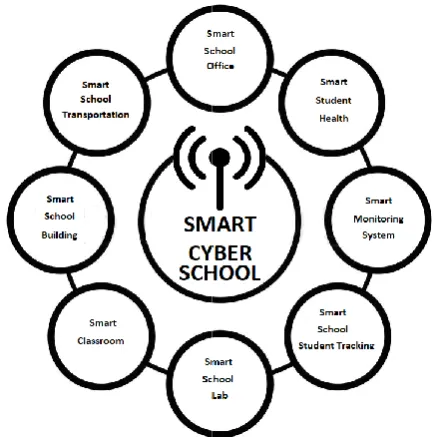
technology and Figure 5 shows how IoT developments in the field of education in cyber schools (Create IoT Foundation, 2017). The ideas of smart cities and its educative entities such as smart schools is a popular concept and application of IoT in the education systems (Andone, Holotescu and G
2014; Elsaadany and Abbas, 2016; Klett and Wang, 2014; Klett, 2013; Liu, Huang and Wosinski, 2017).
Figure 4. IoT enabled the Communication (from free pic.) enabled by virtual learning and digitalization (Figure 3). This classification has resulted in many investigations by researchers. Figure 3, is one of the simplest divisions of the IoT smart cities segmentation which education is one of the main elements of a smart city implemented by IoT. IoT has transformed the traditional education elements such as institution, university, school, student and other elements to University, E-school Smart education is a challenge in the structure of smart cities that some researches have paid attention to
, and Elsaadany, 2016; and Wahl, 2016; Liu, Huang and Most educational centers are not connected or share their information between themselves. Adaptive technologies such as IoT are required in order to fulfill this gap, transforming the traditional educational model to the current model by means of the recent technology such as ., 2013; Wolff, Kortuem and Cavero, 2015; Tikhomorov, Dneprovskaya and Yankovskay,
. 2013; Kim and Bae, 2012).
city Segmentation
The use of IoT in the educational atmosphere provokes a large amount of connections between educational objects generating huge sizes of data. Involving the IoT in the educational field also, permits more communication between different types of objects such as virtual and physical as well as learners and instructors. Relatively, new opportunities of innovations are opened to the educational applications in order to improve the learning process enabling more interaction between physical and virtual objects that provide many smart features (Marquez,
Villanueva, Solarte and García, 2016; IEC, 2016 ; Byun et al.,
As Figure 4 shows, IoT enables the communication developments in the Create IoT Foundation, The ideas of smart cities and its educative entities such as smart schools is a popular concept and application of IoT in (Andone, Holotescu and Grosseck, 2014; Elsaadany and Abbas, 2016; Klett and Wang, 2014; Klett, 2013; Liu, Huang and Wosinski, 2017).
[image:3.595.54.269.288.402.2]IoT enabled the Communication (from free pic.)
Figure 5. Cyber School with IoT (
IoT Technology benefits on E
Nowadays, the recent Internet technologies have changed the education structure. The idea of the ubiquitous technology have brought many benefits such as the possibility of teaching and learning at any time, any place that learners and teachers wish in the education sector. It means a great degree of accessibility that can provide Internet and related technologies which have transformed traditional education systems to the modern concepts in the field of education, in special e learning. By using the IoT ap
activities, the learners can interact with the instructors, by remotely doing all assigned works, online assessments and getting the results in a real-time mode.
Both students and teachers, no longer spend their time, to carr out the manually functions. Instead, they can concentrate on the learning tasks that are the principal object in the learning efficiency of the students. They can use the Internet technologies such as RFID, WSN and Cloud system, to collect data related to learner efficiency; likewise, educators can use in order to enhance performance of all educational objects (Students, Educators and other tools) (Bayani
2017; De la guia et al., 2016).
Internet technology is impacting everyday life (Bayani Vilchez, 2017). It can propose many advantages in various segments related to the learning schemes. Among these factors, several elements are selected and in the following section the relationship between some educational com
of the smart IoT and the provided benefits will be discussed.
Remote access to LAB
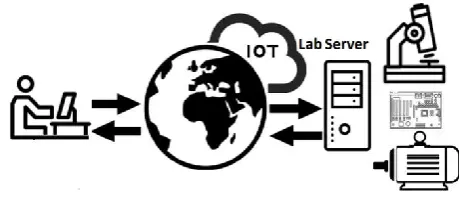
One of the main features that IoT provides is connection between objects physically and virtually. As Figure 6 shows, a user (learner) can connect to the labs
and have access to the lab objects through the Internet. The structure of IoT makes possible a user to remotely connect to the equipment and implement the experiments, collect and receive data for further analysis or homework. Also students or teachers can implement the designed experiments virtually by accessing the virtual labs remotely.
5. Cyber School with IoT (Create IoT Foundation, 2017)
Technology benefits on E-learning
Nowadays, the recent Internet technologies have changed the education structure. The idea of the ubiquitous technology have brought many benefits such as the possibility of teaching and learning at any time, any place that learners and teachers education sector. It means a great degree of accessibility that can provide Internet and related technologies which have transformed traditional education systems to the modern concepts in the field of education, in special e-learning. By using the IoT applications in the e-learning activities, the learners can interact with the instructors, by remotely doing all assigned works, online assessments and
time mode.
Both students and teachers, no longer spend their time, to carry out the manually functions. Instead, they can concentrate on the learning tasks that are the principal object in the learning efficiency of the students. They can use the Internet technologies such as RFID, WSN and Cloud system, to collect o learner efficiency; likewise, educators can use in order to enhance performance of all educational objects (Students, Educators and other tools) (Bayani and Vilchez, ., 2016). IoT as a recent prevalent ting everyday life (Bayani and Vilchez, 2017). It can propose many advantages in various segments related to the learning schemes. Among these factors, several elements are selected and in the following section the relationship between some educational components of the smart IoT and the provided benefits will be discussed.
[image:3.595.52.275.642.782.2]Figure 6. IoT Remotely Access to Lab
Real time access to global library
Another structure provided by IoT is a worldwide internetworking of the libraries. IoT, through the Internet connection permits accessing to the physical or electronic version of books or libraries. Online global connection to the libraries around the world can provide the global researching possible for students, researchers or teachers. By using the smart technologies such as Internet of things the intelligence feature of IoT diffuses into the schemes, processes, and making the system more effective (Hamm, and Kelly III, 2013;
Ding ,Chen and Yang, 2014; Ostermaier et al., 2010).
Consequently, IoT enables smart access to the global library system management. The learner in this way can have access 7/24 (Bayani and Vilchez, 2017) to the large amounts of university libraries in order to get access to the online resources. The IoT and the technologies that support it, build a huge number of global linking between book collections and public libraries around the world. This allows the users to connect to the giant book treasury and knowledge banks online.
Smart Collaboration
Based on the E-learning education systems, the collaboration system is wildly required in these types of the infrastructure (Bayani and Vilchez, 2017). The online environment that provides IoT, as well as the effective connection and communication between objects, allows creating an interactive platform in different levels of the education eco-systems. The effective communication is essential in contexts of collaboration environment for educative infrastructures. Because of the efficient communication between physical and virtual objects as well as hyper-connectivity that is provided by Internet of things, a high grade of communication and interactions are generated (Bayani and Vilchez, 2017; Coe,
Paquet, and Roy, 2001; Karageorgos et al., 2010). Technically,
Internet of things can provide a large size of efficient collaboration platform, such as the smart technologies of RFID and WSN drive it and provide the proper and effective communication between virtual and physical objects. It is required to remember that all collaboration systems are not smart. However, using the recent Internet technologies that support IoT, the actual concept of collaboration in the e-learning can transform the different high performance smart cooperation. In a smart collaboration environment, elaborated by the Internet of things, the online-users carry out a more intelligent, collaborative, and present in the process of e-learning. They can design a better schedule of their activities in a smart collaboration environment. Smart collaboration systems also can encourage a more efficient team-work
planning (Sun and Shen, 2016; Inagaki, 2008; Kohtake et al.,
2003).
Internet of things has the capacity of providing a vast collaboration platform by connecting large amounts of objects globally. It can motivate team-building in an enormous size which means creating the very big project groups that end to rain of interactions between the group and ideas. The learners, as well the instructors, can work in a global infrastructure around the world or within the national geographical locations. In general, it can be said that a significant improvement is predictable and projected by using IoT tools, module and technologies.
Online Self Learning
The principal idea in the auto-didacticism or self-learning is to encourage the learners to study materials without a teacher intervention. In this model of studying, the students are self-motivated in order to accomplish their homework individually (Soava, Sitnikova and Danciulescu, 2014; Juang and Lin, 1998; Chen and Yang, 2010). As all objects that are everywhere and before appearing IoT could not interact with other objects, are now electronically alive, and can help the human user in its researching knowledge independently. Let’s assume a simple scenario in the campus of a university in which some touchable wireless computers are positioned around the campus. The learner that has a question or develops a query can interact with the computer and accomplish the query. The user by passing authentication process through a physical scanning (fingerprint or RFID Card) can obtain all information that needs by getting access to the machine. In this way, learner can get access to a large number of educational resources anywhere, anytime, doing homework, collecting materials, sending and receiving homework to the instructors. IoT allows connecting anything to any things, anywhere and anytime. Students can connect to any labs and libraries (previously discussed) doing experiments, retrieving any data that they need by registering their mobile of physical authentication. They can receive planned homework, doing assessment and assignments, sending the works and receiving the results of their exams.
Other Factors
Other IoT implementation benefits of the e-learning that can be considered as essential indicators in this study such as:
building smart citizens, e-training, e- teaching, e-community ,
business entrepreneur’s skill, and e-governance, etc, that are
not our focal points.
DISCUSSION AND CONCLUSION
In this paper a concise review of the benefits that Internet of things can bring up is explored. Internet of things is changing the scheme of actual educational system. IoT provides a very efficient communication between objects physically and virtually. Also, it makes a possible connections between the physical world and the Internet which before was not feasible. IoT enables the global connection of different points, centers, institutes, labs, libraries, entities, organisms, organizations, companies, agencies located around the world to the physical objects. A theoretical analysis was developed in order to study the main benefits of the IoT on the e-learning in the smart environment and communities.
A detailed list of IoT advantages in E-learning are presented in the following:
IoT can connect the internal educational system, as
well as global points, to the online learners and teachers which means accessing to the huge didactic resources by learners. The learners can implement their experiments connecting to the advanced labs around the world. They can research to find many solutions for their questions and queries by linking to large volume of information that are stored anywhere and anytime that ends to improve the e-learning process.
By developing a new scheme of IP address (IPv6),
almost all devices that can obtain an IP can connect to each other and to the physical or virtual universe. This can generate massive amounts of data and interaction between objects. Students and instructors as the educational objects can interact in a real time. Human, robots and software teachers will help students remotely, from anywhere and at any time. They can answer all queries that have occupied the learners’ minds, by doing online assessment and giving related results. It is very clear that this phenomenon has a positive impact over leaner performance.
IoT, practically, removes the existence electronic
walls, time limitations and other barriers between learners and large volume of resources such as experienced teachers, results of researches and solutions, and advanced lab tools. IoT along with its supported technologies facilitates this connection. As, those restrictions are eliminated, the speed of access to the required information is increased practically. Students or teachers can reach to e-information that they need in seconds or minutes.
IoT smart cities can provide the personalized
e-learning platforms that are adapted to the e-students’ needs individually. Besides, IoT smart cities facilitate the integration of the e-citizens into the e-community. It can increase the e-learner involvement in the process of the learning.
IoT is changing the performance of the actual
E-learning tools or Medias like wireless connections, security (RFID authentication) and dimension of resources (cloud systems)
Smart cities by using the IoT technology can provide
an effective and collaborative e-learning or e-training platform to e-communities who can collaborate and bring cooperation to experience sharing, competency, new models of the e-business and that are needed for sustainability and maintenance of the city. IoT E-learning platform can provide many opportunities to smart city communities in order to participate in the development of smart cities by upgrading their
capacity through knowledge and education
transferring.
A well-educated community will be compromised to
the order, law, and participation, functionality of a city and life quality to the citizens. These features can be achieved under the framework of the smart cities.
In summary, “building a smart city means leading to smart
e-learning”. Appling IoT e-learning in the smart cites permits
the e-citizen to be hyper-connected and creative with high grade of participation and collaboration in the learning process
and other decisions in the community. IoT implementation in the smart cities promises a significant influence on the e-learning processes by offering full access to the educational resources of the e-community, electronically, through a centralized integrated system in a smart manner. In conclusion, the theoretical study shows that the efficiency and impact of IoT in the implemented e-education and e-learning process in the smart cities is predictable, measurable and could not be ignored. Hyper-connectivity between objects, high grade of accessibility, scalability and integration of the communication networks (RFID and WSNs) are properties of the IoT which can intensify the efficiency of e-learning approach in the
“smart environment” such as smart cities. They might be
considered as the major tools which can support IoT-based learning system which despite of the present challenges is creating alternative efficient methodologies in the e-education ecosystem of the smart cities in the close future. Based on this reality, the future work will be focused on the existing e-learning methodologies and compatibility of them in the smart cities.
REFERENCES
An, S., Lee, E. and Lee, Y. 2013. A Comparative study of E-learning system for Smart Education, ”International Association for Development of the Information Society (IADIS), International Conference on e-Learning, Prague, Czech Republic, ERIC Number: ED562296 , Jul 23-26. Andone, D., Holotescu, C. and Grosseck, G. 2014. “Learning
communities in smart cities. Case studies,” IEEE International Conference on Web and Open Access to Learning (ICWOAL), 10.1109/ICWOAL.2014.7009244. Bayani Abbasy, M. and Vílchez Quesada, E. 2017.
“Predictable Influence of IoT (Internet of Things) in the
Higher Education”, International Journal of Information
and Education Technology vol. 7, no. 12, pp. 914-920.
Bayani, M., Segura, A., Saenz, J. and Mora, B. 2017.“ Internet of Things Simulation Tools: Proposing Educational
Components,” SIMUL, Greece, Athens,The Ninth
International Conference on Advances in System Simulation, IARIA Conference, pp. 57-63.
Bonino, D., Delgado M. T., A. Alapetite, T. Gilbert, M. Axling, H. Udsen, J. A. Carvajal Soto, and Spirito, M. A. 2015. “Almanac: Internet of Things for Smart Cities,” 3rd International Conference on Future Internet of Things and Cloud (FiCloud), Rome, Italy, 2015.
Bululukova, D., Tabakovic, M. and Wahl, H. 2017. “Smart Cities Education as Mobility, Energy and ICT Hub,” 2016 IEEE 5th International Conference on Smart Cities and Green ICT Systems (SMARTGREENS), 19 June.
Byun, J., Kim, S., Sa, J., Kim, S., Shin, Y. and Kim, J. 2016. “Smart City Implementation Models Based on IoT
Technology,” Advanced Science and Technology Letters
,vol.129 (Mechanical Engineering), pp.209-212,
http://dx.doi.org/10.14257/astl.2016.129.41.
Camacho, E., Orozco-Barbosa, V.L., Luján, L., Penichet, V.M.B. and Pérez, V.R.M. M.L. 2016. Introducing IoT and wearable technologies into task-based language
learning for young children,” IEEE Transactions on
Learning Technologies, vol. 9, no. 4 , pp.366-378, Oct-Dec
2016.
Chen, Y., Yang, M. 2010. Study and construct online self-learning evaluation system model based on AHP method, in: 2nd IEEE International Conference on Information and Financial Engineering (ICIFE), IEEE, pp. 54-58.
Coe, A., Paquet, G. and Roy, J. 2001. “E-governance and
smart communities: a social learning challenge,” Social
Science Computer Review ,SAGE JOURNAL , vol .19,
Issue 1.
Create IoT Foundation, “IoT Deployment In Education,” URL: http://www.cyberschool.id/content/iot-education.
Ding, Z., Chen, Z. and Yang Q. 2014. “IoT-SVKSearch: A real-time multimodal search engine mechanism for the
internet of things,” Int. J. Commun. Syst, pp. 871–897. doi:
10.1002/dac.2647.
Elsaadany, A., Abbas K. 2016. “Development and implementation of e-learning system in smart educational environment,” 39th IEEE International Convention on Information and Communication Technology, Electronics
and Microelectronics (MIPRO), 10.1109/ MIPRO.
2016.7522286.
Free Pic. Retrieved from URL: https://pixabay.com/es/red-iot-internet-de-las-cosas-782707/.
Garreta Domingo, M. and Mangas Forner, J. A. 2010. “Expanding the Learning Environment: Combining Physicality and Virtuality - The Internet of Things for
eLearning”, 10th IEEE International Conference on
Advanced Learning Technologies, 5-7 July,
DOI: 10.1109/ICALT.2010.211.
GSMA Association, "Understanding the Internet of Things (IoT)",July 2014.URL: “ww.gsma.com”.
Gubbi, J., Buyya, R., Marusica, S. and Palaniswamia, M. 2013. “Internet of Things (IoT): A vision, architectural elements, and future directions”, Future center, Comput. syst,, vol.29,no.7,pp.1645-1660.
Hamm, S.S. and Kelly, J. 2013. III “Smart Machines: IBM's Watson and the Era of Cognitive Computing,” Publisher: Columbia University Press 10: 023116856X ISBN-13: 978-0231168564, Series: Columbia Business School Publishing, 2013.
IEC,“Io T 2020. Smart and Secure IoT Platform (White
Paper),”Publisher: International Electrotechnical
Commission (2016), ISBN-10: 283223593X,
ISBN-13: 978-2832235935, 194 pages
Inagaki, T. 2008. “Smart collaboration between humans and machines based on mutual understanding,” Elsevier, Annual Reviews in Control , vol. 32, Issue 2, December,
pp. 253-261.http://www.s ciencedirect.co
m/science/journal/13675788
IoT-GSI, 2012. “Internet of Things Global Standards
Initiative”, February 2012, URL:
http://www.itu.int/en/ITU-T/gsi/iot/Pages/default.aspx. ISOC, 2015. “The Internet of Things (IoT): An Overview
“Understanding the Issues and Challenges of a More
Connected World, Oct, URL:
https://www.internetsociety.org/sites/default/files/ISOC-IoT-Overview-20151014_0.pdf.
Jafari, A. 2002. “Conceptualizing Intelligent Agents For Teaching and Learning”, School of Engineering and
Technology Indiana University Purdue University
Indianapolis, IUPUI, Educause Quarterly, Vol 25, No.3,
,pp. 28 – 34.
Juang, F. and Lin, C. T. 1998. “An On-line Self-constructing Neural Fuzzy Inference Network and Its Applications,” IEEE Transactions on Fuzzy Systems, Vol. 6, No. 1, pp. 12-32, Feb.
Karageorgos, A., Avramouli, D., Ntalos, G., Tjortjis, C. and Vasilopoulou, K. 2010.“Towards Agent-based 'Smart' Collaboration in Enterprise Networks,” In: 8th Int'l Workshop on Agent-based Computing for Enterprise Collaboration (ACEC) at WETICE 2010, Larissa, Greece. IEEE Computer Society Press, Los Alamitos 32.
Kim, M. and Bae, Y.K. 2012. “Development of a Smart Education Model for Field Application of Smart
Education,” Korean Society for Internet Information, vol.
13, Issue 5, pp.77-92.
Kim, T., Cho, J.Y. and Lee, B.G. 2013. “Evolution to Smart Learning in Public Education: A Case Study of Korean Public Education,” In: Ley T., Ruohonen M., Laanpere M., Tatnall A. (eds) Open and Social
Technologies for Networked Learning. IFIP Advances
in Information and Communication Technology, vol.
395. Springer, Berlin, Heidelberg.
Klett, F. 2013. ”Plenary Talk: Smart Cities - Infrastructures and Technologies for Education, and Human and Skills
Development, “IEEE-CCD Guadalajara Smart City Launch
, Guadalajara Mexico, Nov.
Klett, F. and Wang, M. 2014. “Knowledge Management and E-Learning,” Editorial: Smart cities of the future: Creating tomorrow’s education toward effective skills and career development today ,vol.6, no.4, pp. 344– 355Dec.
Kohtake, N., Matsumiya, K., Takashio, K. and Tokuda, H.
2003. “Smart Device Collaboration for Ubiquitous
Computing Environment,” Workshop of Multi-Device
Interface for Ubiquitous Peripheral Interaction, Fifth International Conference on Ubiquitous Computing (UbiComp2003), USA.
Leap, E. 2016. “The Internet of Things’ Impact on
e-Learning”,Retrived from URL:
https://www.eleapsoftware.com/the-internet-of-things-impact-on-elearning/, December 23.
Liu, D., Huang, R. and Wosinski, M. 2017.“Smart Learning in Smart Cities,” Publisher Springer Singapore, ISBN
978-981-10-4343-7, DOI :10.1007/978-981-10-4343-7,first
Edition ,232pages.
Maksimović, M. 2017. “Transforming Educational
Environment Through Green Internet of Things (G-IOT),”,
Zlatibor, XXIII Skup TRENDOVI RAZVOJA, University of
East Sarajevo, Faculty of Electrical Engineering,
no.T1.1-3, 2017 URL:
http://www.trend.uns.ac.rs/stskup/trend_2017/radovi/T1.1/ T1.1-3.pdf
Marquez, J., Villanueva, J., Solarte, Z. and Garcia, A. 2016. “IoT in Education: Integration of Objects with Virtual Academic Communities,” In: Rocha Á., Correia A., Adeli
H., Reis L., Mendonça Teixeira M. (eds) New Advances in
Information Systems and Technologies. Advances in
Intelligent Systems and Computing, vol 444. Springer,
Cham, pp 201-212.
Moore, J. L., Dickson-Deane, C. and Galyen, K. 2011.
“e-Learning, online learning, and distance learning
environments: Are they the same?,The Internet and Higher
Education, Web mining and higher education: Introduction to the special issue ,Vol. 14, Issue 2, March, pp. 129-135. Ostermaier, B., Römer, K., Mattern, F., Fahrmair, M. and
Kellerer, W. 2010. “A Real-time Search Engine for The Web of Things,” IEEE Proceedings of Internet of Things 2010 International Conference (IoT 2010). Tokyo, Japan, November.
Parashar, R., Khan, A. and Neha,2016. “A Survey: The
Internet of Things”, International Journal of Technical
Research and Applications, e-ISSN: 2320-8163,Vol. 4, Issue 3, (May-June, 2016), pp. 251-257.
Selinger, M., Sepulveda, A. and Buchan, J. 2013. “Education and the Internet of Everything: How ubiquitous connectedness can help transform pedagogy”, Cisco Consulting Service and Cisco EMEAR Education team, October.
Sethi, P. and Sarangi, S. R. 2015. “Internet of Things: Architectures, Protocols, and Applications,” Journal of Electrical and Computer Engineering, 2017, Article ID 9324035, 25 pages, https://doi.org/10. 1155/2017/9324035. Soava, G., Sitnikova, C. and Danciulescu, D.A 2014.
“Optimizing Quality of a System Based on Intelligent Agents for E-Learning”, 21st International Economic Conference (IECS 2014), May, Sibiu, Romania, pp. 47 – 55.
Soliman, M. and Elsaadany, A. 2016. “Smart Immersive Education for Smart Cities with Support via Intelligent Pedagogical Agents,” 2016 IEEE 39th International
Convention on Information and Communication
Technology, Electronics and Microelectronics (MIPRO), 28 July, 10.1109/MIPRO.2016.7522247.
Sun, G. and Shen, J. 2016.“Towards organizing smart collaboration and enhancing teamwork performance: a GA-supported system oriented to mobile learning through
cloud-based online course ,” International Journal of
Machine Learning and Cybernetics, Vol., Issue 3, pp 391–
409.
Tian, J. and Zheng, Z. 2017. “Smart Education in Yunna, China: Present Situation and Construction measures,” IEEE International Conference on Service Systems and
Service Management (ICSSSM), 10.1109/
ICSSSM.2017.7996245.
Tianbo, Z. 2012. “The Internet of Things Promoting Higher Education Revolution,” in 2012 Fourth International Conference on, Multimedia Information Networking and Security (MINES), Nanjing, pp. 790-793.
Tikhomorov, V., Dneprovskaya, N. and Yankovskay, E. 2015.
“Three Dimensions of Smart Education,” Smart Education
and Smart e-Learning, 2015, In: L. Uskov V., Howlett R.,
Jain L. (eds) Smart Education and Smart e-Learning. Smart Innovation, Systems and Technologies, vol 41. Springer, Champp 47-56
Wolff, A., Kortuem, G. and Cavero, J. 2015. “Towards Smart City Education,” Sustainable Internet and ICT for Sustainability (SustainIT), Spain, Electronic ISBN: 978-3-9018-8270-8.
Wood, A. A. 2015. “The Internet of things is revolutionizing our lives, but standards are a must” .Retrieved from URL: https://www.theguardian.c om/media-network/ 2015/ mar/3 1/the-internet-of-things-is-revolutionising-our-lives-but-standards-are-a-must,Theg uardia n.com.
Zanella, A., Bui, N., A. Castellani, L. Vangelista and Zorzi, M.
2014. “Internet of Things for Smart Cities,” IEEE Internet
of Things Journal, vol. 1, no. 1.
Zistl, S. “Smart Cities: Data-Driven Cities,” URL:
https://www.siemens.com/innovation/en/home/pictures-of-the-future/
infrastructure-and-finance/smart-cities-trends.html.