© 2018, IRJET | Impact Factor value: 6.171 | ISO 9001:2008 Certified Journal | Page 942
Design and Analysis of Residential Building using E-TABS
S Abhishek
1, Manoj S K
2, Roopa B D
3,
Bhagyashree M S
4, Guruprasad C H M
51,2,3,4
U.G. Student, Department of Civil Engineering, S.T.J. Institute of Technology. Ranebennur, Karnataka, India
5
Assistant Professor, Department of Civil Engineering, S.T.J. Institute of Technology. Ranebennur, Karnataka, India
---***---Abstract -
ETABS stands for Extended Three DimensionalAnalysis of Building Systems. The main purpose of this software is to design multi-storeyed building in a systematic process. The effective design and construction of an earthquake resistant structures have great importance all over the world. This project presents multi-storeyed residential building analysed and designed with lateral loading effect of earthquake using ETABS. This project is designed as per INDIAN CODES- IS 1893-part2:2002, IS 456:2000..
Every structural engineer should design a building with most efficient planning and also be economical. They should ensure that it is serviceable, habitable in healthy environment for its occupants and have longer design period. Structurally robust and aesthetically pleasing building are being constructed by combining the best properties of any construction material and at the same time meeting specific requirements like type of building and its loads, soil condition, time, flexibility and economy. In the view of above, the high rise buildings are best suited solution. This paper discusses the analysis of a commercial building (G+1) located at Hyderabad under effect of Seismic forces. Shear forces and bending moments of beams and columns are observed and concluded that larger span have more shear forces and bending moment.
Key Words: Structural design, ETABS, Shear forces,
Bending moments.
1. INTRODUCTION
ETABS is a sophisticated, yet easy to use, special purpose analysis and design program developed specifically for building system. ETABS version 9.0 features an intuitive and powerful graphical interface coupled with unmatched modeling, analytical, and design procedures, all inte-grated using a common database. Although quick and easy for simple structures, ETABS can also handle the largest and most complex building models, including a wide range of nonlinear behaviors, making it tool of choice for structural engineers in the building industry.
Dating back more than 30 years to the original development of ETABS, the predecessor of ETABS, it was clearly recognized that buildings constituted very special class structures. Early releases of ETABS provide input, output and numerical solution techniques that took into consideration and characteristics unique to building type structure, providing a tool that offered significant savings in time and increased accuracy, over general purpose programs.
As computers and computer interfaces evolved, ETABS added computationally complex analytical options such as dynamic nonlinear behavior, and powerful CAD-like drawing tools in a graphical and object based interface.
Most building is of straightforward geometry with horizontal and vertical beams and vertical columns. Although any building configuration is possible with ETABS, in most cases, simple grid system defined by horizontal floors and vertical column lines can establish building geometry with minimal effort.
1.1
DESIGN PHILOSOPHIESThere are three philosophies for the design of reinforced concrete namely:
1) Working stress method 2) Ultimate load method 3) Limit state method
1.2 STAGES IN STRUCTURAL DESIGN
1) Drawing Study 2) Load Combinations 3) Analysis Of Structures 4) Structural design
2
OBJECTIVE
Following are the objectives
1. Modeling the building using the software ETABS V.9
2. Applying gravity loads and different load combinations as per Indian codal provision.
© 2018, IRJET | Impact Factor value: 6.171 | ISO 9001:2008 Certified Journal | Page 943
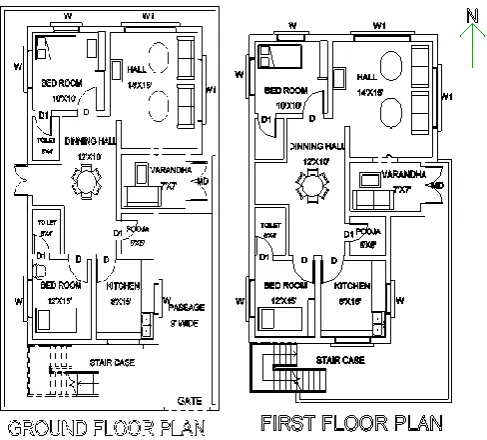
3. Plan of Residential Building
Table -1: SILENT FEATURE OF PROPSED BUILDING:
Sl.No Description Features
1 LOCATION BANGLORE
2 TYPE OF BUILDING G+1
3 STRUCTURE. R.C.C FRAME
4 BUILT UP AREA 140 m2
5 HEIGHT B/W THE FLOOR 3.1 m
6 DEPTH OF FOUNDATION
BELOW G.L 1.5 m
7 PRIMARY AND SECONDARY
WALL THICKNESS 230, 115 mm
4.
Analysis Methods
Etab is the premier FEM analysis and design tool for any type of project including towers, culverts, plants, bridges, stadiums, and marine structures. With an array of advanced analysis capabilities including linear static, response spectra, time history, cable, and pushover and non-linear analyses, Etab provides good compatibility with a scalable solution that will meet the demands of project every time.
Preparation of plan in Autocad
Importing to Etabs
Building modeling in Etabs
Defining and assigning of materials
Manual design (as per
IS456-2000 SP-16) Assigning loads as per
IS 456-2000
Analyse the building model
Check results
Design using Etabs software
comparison
conclusion
Fig -1: METHODOLYGY
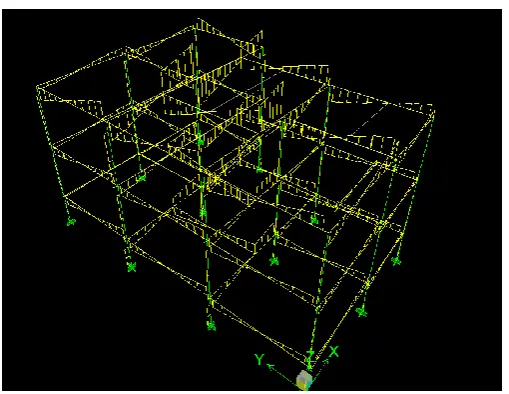
5. ANALYSIS RESULT
[image:2.595.39.283.104.324.2]© 2018, IRJET | Impact Factor value: 6.171 | ISO 9001:2008 Certified Journal | Page 944
Fig-3:
BENDING MOMENT DIAGRAMFig-4: Shear force diagram from Etab
6. DESIGN DETAILS
Design of slab 1 Lx=2.40 m
Ly=4.37 m
LY/Lx =1.80 < 2 (Hence slab designed as two way )
Total load on slab = 9.35 kN/m2
Factored moment =10 Kn-m Assuming depth of slab = 150 mm Design of the as under reinforced Slab cover =25 mm
Bend the alternative bars@ a distance of L/7 from the face of the wall = 2.40 / 7= 0.342 m
Assuming dia 8mm 150 c/c (main reinforcement)
Distribution reinforcementAst min as distribution reinforcement = 0.12 % *b*D
=0.12 %*1000*150 =180 mm2
Sapcing of 10 mm dia = (π *102 *100)/180 = 200 mm
Provide 8 mm dia @ 150 mm c/c Check for deflection:
Assuming span to depth ratio = L/d < 20 = 2.4/125 <20
= 19.2 < 20, Hence safe.
Design of Slab 2:
LY = 4.7 m ,
LX = 4.0 m,
Aspect ratio (ly/ lx) =4.7/4 =1.17 < 2 (hence two way slab two edges discontinuous , two edge continuous
x y MX =x
* w*LX2
My=Y * w*LX2
Dia spacing x
Dia spacing y -ve
reinforcement 0.084 - 12.56 kN .m - 8 @200 dia mm c/c
8 dia @150 mm c/c +ve
reinforcement 0.064 0.043 9.57 kN.m. 8.88 kN.m 8 @150 dia mm c/c
8 dia @150 mm c/c
Design of slab 3:
LY = 3.9 m ,
LX = 3.5 m,
Aspect ratio (ly/ lx)=3.9/3.5=1.11 < 2 (hence two way slab )
One short edge discontinuous.
x y MX =x
* w*LX2
My =Y * w*LX2
Dia spacing x
Dia spacing y -ve
reinforcement 0.048 0.037 5.5 KN.m 4.5KN.m 10 dia 200 mm c/c
8 dia 180 mm c/c +ve
reinforcement 0.036 0.028 4.2 KN.m 3.5 KN.m 8 dia 180 mm c/c
8 dia 180 mm c/c
Slab 6: Lx=2.4, Ly =5.0, aspect ratio ( Ly/LX )= 2.1 > 2 , one
way slab )
Total load on slab = 9.35 kN/m2
MX= w *Lx2 / 8 = (9.35 *2.4 2)/8
= 6.73 kN.m
Factored moment = 1.5 *6.73 = 10 kN.m
Assuming 8 dia @ 270 mm c/c (main reinforcement) Distribution reinforcement
Ast as distribution reinforcement = 0.12 %*1000*150
=180 mm2
Spacing of 6 mm dia =3.142 *62*1000/(4*180)
= 150 mm So, provide 8 mm dia @ 150 c/c.
Check for deflection:
Assuming span to depth ratio = L/d < 20 = 2.4/125 <20
[image:3.595.35.290.273.470.2]© 2018, IRJET | Impact Factor value: 6.171 | ISO 9001:2008 Certified Journal | Page 945
7. DESIGN OF BEAM
Data Grid beam no 1-A
Characteristic compressive strength of concrete = fck = 20
N/mm2
Characteristic strength of steel = fy = 500 N/mm2
Adopt d = 400 mm D = 450 mm b = 230 mm Length = L =7.6 m From Etab results,
Negative moment at interior support, Mu = 55 kN-m
Positive moment at center of span, Mu = 43 kN-m
Maximum shear force at support section, Vu = 50 KN
Main reinforcement
For -ve B.M,
Mu = 0.87 fyAstd[1- Astfy/bdfck]
55x106 = 0.87x500xAstx450x[1- Astx500/230x450x20]
Ast = 350.63 mm2
Provide 2 bars of 12 mm dia and 2 bars of 10mm dia (Ast=380mm2) @ top tension face near supports
For +ve B.M,
Mu = 0.87 fyAstd[1- Astfy/bdfck]
43x106 = 0.87x500xAstx450x[1- Astx500/230x450x20]
Ast = 300 mm2
Provide 3 bars of 12 mm dia (350 mm2) at bottom tension
face at centre of span section.
Shear reinforcement,
= vu/ b d = 50x103/230x450
= 0.48 N/mm2
Pt = 100x Ast / b d = 100x350 / 230x450
= 0.33 %
Refer table 19 (IS 456) read out,
= 0.42 N/mm2
Hence shear reinforcement is required.
Vus = vu - b d
=50 – ( 0.42x230x450)103
= 10.16 kN
Use 8 mm dia two legged stirrups, the spacing is, Sv = (0.87fyAsv d) /
Vus
= (0.87x 500 x 50 x 450) / 10.16x1000 Sv = 250 mm
Adopt 8 mm dia two legged stirrups @ 220 mm c/c Check for deflection,
At centre of span:
Pt = 100 Ast / b d = 100x350 / 230x450
= 0.33 %
From fig,4 of IS 456 , Kt = 1.2 , Kc =1 ,Kf =1
(L/d) max = (L/d) basic x Kt x Kf
=26 x 1.2 x 1 = 31.2
(L/d) actual = 7600/450 = 16.88
(L/d) actual < (L/d) max
Hence deflection control is satisfied
8
.
DESIGN OF COLUMNS
Data,
Characteristic compressive strength of concrete = fck = 20
N/mm2
Characteristic strength of steel = fy = 500 N/mm2
Pu = 250 KN (taken from Etab)
b = 230 mm D= 350 mm
Length = L = 3100 mm
Longitudinal reinforcement = Pu =0.4 * fck *AC + 0.67 * fy * Asc
=0.4* fck *Ag + ( 0.67 *415 – 0.4 *20 )*Asc
250*103=0.4 *20*230*350 + (0.67*500-0.4*20)*Ast
Ast = 1200 mm2
So , Pt min = 0.8%
Ast = 699.2 mm2
Provide # 4 bars of 16 mm diameter Design of lateral ties
Tie diameter
So , provide lateral reinforcement 8mm ties Tie spacing St
So , provide tie spacing at 8mm @ 230 mm c/c Design of uniaxial column
PU = 164 kN
Muz= 10 kN.m
Width =b =230 mm Depth = d= 350 mm d'/D =0.15
PU/(fck *b*D) = 164*103/(20*230*350) = 0.101
MU/(fck *b*D2)= 10*106/(20*230*3502)=0.017
AST min =0.8 (from SP 16 code )
P/fck = 0.06 (minimum)
P= 0.06*20=1.2
Area of steel = (1.2*230*350)/100 =966 mm2
=9.66 cm2
So, provide 4 bars of 20 mm diameter
Design for lateral ties Tie diameter =
So, provide 8 mm lateral ties
Design tie spacing ≯
© 2018, IRJET | Impact Factor value: 6.171 | ISO 9001:2008 Certified Journal | Page 946
18 DESIGN OF FOOTING
Isolated Footing
Unfactored Load = 266 KN Factored Load
= 398 KN
Moment about X-X axis, Mux =9 KN-m Moment about Y-Y axis, Muy = 3 KN-m S.B.C. of Soil = 180 KN/ m2
Grade of Concrete = M 20 Grade of Steel = Fe-500
• Proportioning of footing size:
Ag =1.1P/SBC
=1.1*266/180=1.63m2
Assume, L=B= 1.3m
Let provide footing size 1.3m*1.3m Provide A=1.7m2
e= M/P=9/266=0.033 < L/6=1.5/6=0.5, C=1.3/2=0.65m, Zx=Zy=1.3*1.33/12=0.238m4,
Pmax = (P/A) + (Mux*C/Zx) + (Muy*C/Zy) ≤ SBC =266/1.7+11*0.65/0.238 +3*0.65/0.238
=149+23.6+5.4
=178 kn/m2 < 180 (safe)
Depth of footing calculation,
• Bending consideration.
Factored upward pressure =P '= 1.5*178= 261.79 kN/m2
Maximum bending moment = (261.79 * 0.5752) / 2 =44.04
kN-m
For known material property M20 & Fe-500 So, Depth = √ ((Mu )/(0.138*fck*b*))
=√(44*106)/(0.138*20*1000)
Depth = 130.26 mm
As per Indian standard depth = 150 (minimum)
Based on one way shear
Permissible shear stress (τv ) = k * τc Here, K = (0.5 + βc ) = 1
βc = SHORT SPAN / LONG SPAN ) = 1 so, K=(0.5+1)=1.5
τc = 0.25 = 0.25 *√20 = 1.18 N/mm2
τv = ks * τc = 1*1.118 = 1.118 N/mm2
Therefore, Resisting force = (1220 + 4d ) * d*1.18
= 4.472* d2 + 1363.9 d …………(1)
Punching shear force = ( 1.5 * P –(1.5 * P' *Area ))
= (1.5*210 *103 -(1.5*90*10 3 *87400+380d + 230d +d2
))…(2)
Taking, punching shear force = Resisting shear force 540*103 – 11799 – 82.35d – 0.135 d2 = 4.472 *d 2 +1363.96 d
This implies effective depth ‘d3’= 216.24 mm
Let overall depth of footing D =300 mm
Assuming diameter of bar in footing = 16 mm Minimum cover required for footing = 50mm Therefore, effective depth =d =300-58=242 mm
CONCLUSION
Finally concluded that I have my satisfaction with my internship in that particular company, further procedure of Dynamic analysis of the multi-story buildings I will keep my internship with the company and I hope am learned what they gives design works with period of internship. The Internship gave ample exposure to the field practice in the modeling, analysis and design of the multi storied buildings and various construction techniques used in the industry. The analysis was done using the software package ETAB and drawing details in AutoCAD and REVIT. The structural components were designed manually in addition to the software design. This training helped to understand and analyze the structural problem faced by the construction industry. Site visits also gave an exposure to the industry. It provide help us to apply theoretical knowledge in industrial application, acquire knowledge of various stages of construction, project management and team-work, practice ethical and professional work culture, provide opportunity for students to work with industrial practitioners.
In next eight weeks I am going to learn SAFE software to design foundation and study the dynamic analysis of some more multistory buildings in ETAB.
REFERENCES
• .Unnikrishna Pillai and Devdas Menon, “Reinforced Concrete Design”, Tata +McGraw-Hill publishing company limited.
• N.Krishna Raju, “Advanced Reinforced concrete design”, CBS publishers & distributors, Delhi.
• N.Krisnna Raju, “Design of reinforced concrete structures”, CBS publishers & distributors , delhi.
• IS:456-2000 “Indian Standard code of practice for plain and reinforced Cement Concrete”, Bureau of Indian Standards, New Delhi.
• SP:16-1980 “Design aids Reinforced Concrete” to IS:456-1978, Bureau of Indian Standards, New Delhi.