37
Chapter
5
Ba
0.5Sr
0.5TiO
3based Photodiode Application as Light Sensor for Automatic
Lighting Control Switch
Budi Harsono1,a, Johansah Liman1, Ade Kurniawan2, Johan Iskandar2, Eti Rohaeti3, Irzaman4
1
Electrical Engineering Department, Faculty of Engineering and Computer Science, Krida Wacana Christian University, Jakarta
2
Postgraduate Student on Physics Departement, FMIPA, IPB, Bogor
3
Chemical Departement, FMIPA, IPB, Bogor
4
Physics Departement, FMIPA, IPB, Bogor
a
Abstract. Photodiode that was made from ferroelectric material, Barium Strontium Titanate (BST), was used as
light sensor for automatic lighting control switch. BST based photodiode was placed in one leg of wheatstone bridge circuit to increase the sensor sensitivity. When light strike into the BST based photodiode sensor, the electric current flow through the BST sensor is increase. The electric current that flow through the BST sensor will also flow through the wheatstone bridge resistor at the same leg. This cause the voltage of the leg to increase otherwise the other leg‟s voltage will remain not change. This different voltage of the wheatstone bridge circuit output will then amplified by differential amplifier circuit. The op-amp used for the differential amplifier is TL-074 general purpose op-amp. The amplification of the differential amplifier is set to 27x. The output of the differential amplifier will then compared with a reference voltage by op-amp voltage comparator to get digital output: logic„High‟ for dark condition dan logic„Low‟ for daylight condition. Output from op-amp voltage comparator then feed to NPN transistor to drive a single pole double throw relay. The normally open output of the relay is connected to fluorescent lamp, so the lamp will turn on when dark and turn off when daylight condition. As a result, lighting switch can be controlled by BST sensor. The switch will turn on when less light intensity strike the sensor and turn off when the light intensity strike the sensor is increase.
Keywords: Photodiode, BST, light sensor, automatic switch, op-amp
I.
Introduction
Ferroelectric thin films are potentially important materials for a variety of devices such as ferroelectric memories, infrared pyroelectric sensors and in other integrated technologies. Barium strontium titanate (BST) is currently one of the most interesting ferroelectric materials due to its high dielectric constant and composition-dependent Curie temperatur [1].
Barium Strontium Titanate (BaxSr1-xTiO3) being environment friendly, has high dielectric constant, low
38
BST thin film can be created with a number of techniques, e.g. Chemical Solution Deposition (CSD), Pulsed Laser Deposition (PLD), sputtering and Metallo Organic Chemical Vapour Deposition (MOCVD) [4-6]. It has been demonstrated that Ba0.5Sr0.5Ti03 thin films were prepared by the CSD method on the substrate Si (100) p-type substrate can work as a light sensor and had photo diode characteristic [7, 8].
The purpose of this study is using Ba0.5Sr0.5TiO3 based photodiode as a light sensor for automatic lighting
control switch.
II. Experimental Method
In this study, BST thin film was grown on p-type silicon (100) substrate using Chemical Solution Deposition (CSD) method. The materials used in this experiment were Barium asetate powder [Ba(CH3COO)2] (99%),
Strontium asetate powder [Sr(CH3COO)2] (99%), Titanium dioxide powder [TiO2] (97.999%), and 2-Methoxy
ethanol solvent [H3COCH2CH2OH] (99%). All the materials were obtained from Sigma Aldrich.
First, the Silicon substrate was cut to the size of 1x1 cm2 using a glass cutter. The substrate was then washed with aqua bidest distilled water for 30 seconds. Then the materials necessary (barium acetate, strontium acetate, and titanium dioxide) were weighed using Sartonius BL6100 analytical balance. Molar fraction of Ba and Sr was 0.5. The materials were then mixed and dissolved in 2.5 ml of 2-Methoxy ethanol. Furthermore, the solution that has been made was homogenized with Branson 2510 ultrasonicator for 90 minutes to obtain a homogeneous BST solution.
BST solution which has been homogeneous then dripped on the p-type silicon substrate and spun using a spin coater for 30 seconds at a speed of 3000 rpm. BST coating process on p-type silicon (100) substrate is repeated 3 times with one minute in-between breaks. BST thin film on p-type silicon (100) substrate then annealed using VulcanTM-3000furnace for 22 hours at 850oC temperature.
The next process was the contact deposition process. BST film that have been annealed were covered with aluminum foil with four square holes of 2x2 mm2in the part to be fitted with contact. The material used as a contact in this study was aluminium 99.999%. The deposition process was conducted using Metal Oxide Chemical Vapor Deposition (MOCVD) method.
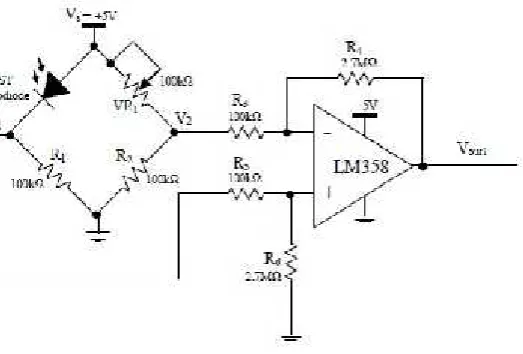
The next step was building the wheatstone bridge and difference amplifier circuit to increase the sensitivity of the BST light sensor. The circuit is shown in Fig. 1. The wheatstone bridge output (V1-V2) was adjusted at 0V
in very dark condition (at about 2 lux light intensity). Output from difference amplifier can be obtained from Equation 1 and internal resistance of BST sensor can be obtained from Equation 2.
The output of the difference amplifier was then passed to the voltage comparator circuit to obtained a discrete output that distinguishes the dark and light conditions. Voltage comparator circuit was shown in Fig. 2. Vrefwas
39
[image:3.595.174.436.126.303.2]The output of the voltage comparator was then used to drive a relay through the driver transistor, so that when conditions are dark, the fluorescent lamp will turn on and during bright conditions, the lamp will turn off. The relay circuit is shown in Fig. 3.
40
III. Results And Discussions
The output voltage of the Wheatstone bridge circuit (V1-V2) measured in several levels of light intensity are given
41
42
Overall test results are shown in Table 4. From the overall test results, we obtained that lamp will turn on when ligh intensity is below 135 lux (dark condition) and will turn off when light intensity is 135 lux or higher (light condition).
IV. Conclusions
The change of the internal resistance of the BST sensor is very small, so the output voltage of the wheatstone bridge circuit need to be amplified by difference amplifier to achieve an applicable output voltage. From the overall test result, Barium Strontium Titanate (Ba0.5Sr0.5TiO3) based photodiode was successfully used as a light sensor for automatic lighting control switch.
References
[1]. F. M. Pontes, E. R. Leite, D. S. L. Pontes, E. Longo, E. M. S. Santos, S. Mergulha˜o, P. S. Pizani, F. Lanciotti, Jr., and T. M. Boschi, and J. A. Varela, “Ferroelectric and optical properties of Ba0.8Sr0.2TiO3 thin film,”Journal of Applied Physics, Vol.91, No.2, pp. 5972-5978, May 2002. [2]. K. Anumeet, S. Anupinder, K.Asokan, S. Lakhwant, “Structural and Optical Properties of Iron
43
[3]. C. Huck, A. Poghossian, M. Bäcker, S. Reisert, J. Schubert, W. Zander, V.K. Begoyan, V.V. Buniatyan, M.J. Schöning, “Chemical sensors based on a high-k perovskite oxide of barium strontium titanate ,”in Procedia Engineering 87, pp. 28–31, 2014.
[4]. Y. Xin, R.Wei, S. Peng,W. Xiaoqing, and Y. Xi, “Enhanced Tunable Dielectric Properties Of Ba0.5Sr0.5TiO3/ Bi1.5Zn1.0Nb1.5O7 Multilayer Thin Films By A Sol-Gel Process,” Thin Solid Films, Vol.520, No. 2, pp. 789–792, 2011.
[5]. A. W. Nuayi, H. Alatas, Irzaman, dan M. Rahmat, “Enhancement of Photon Absorption on BaXSr1-XTiO3 Thin-Film Semiconductor Using Photonic Crystal,” International Journal of Optics, 2014.
[6]. Umar, Faanzir, A. W. Nuayi, R. Siskandar, H. Syafutra, H. Alatas, and Irzaman, “Characterization of optical properties of Ba0.55Sro.45TiO3 Thin Film” in SNIPD Symposium Proceeding, ITB Bandung, pp. 280-284, 2013.
[7]. J. Iskandar, H. Syafutra, J. Juansah, dan Irzaman, “Characterizations of electrical and optical properties on ferroelectric photodiode of barium strontium titanate (Ba0.5Sr0.5TiO3) films based on the annealing time differences and its development as light sensor on satellite technology,” Procedia Environmental Sciences 24, pp. 324–328, 2015.