269
Chapter 36
Hipotetic Model of Continuous Professional Development of Vocational Lecturer
in The Higher Vocational Education In Lampung
Sugiyanto1,a
1
Department of Mechanical Engineering, Faculty of Engineering, Lampung University, Indonesia
a
Abstract. One key to the effectiveness and efficiency of higher vocational education lies in human resources namely lectures. Lectures are professional educators and scientist with main task of transforming, developing, and spreading the knowledge, technology, and art through education, research, service to the community. To do that, need development model of continuous professional competence which will affect the increase of 4 competence of lecturers, especially professional competence. The problem is the development of lecture professional competence in higher vocational education in Lampung has not optimally yet, and uncoordinated well, so that the level of professionalism of lecturers depend on himself. The objective of this research is to develop hypothetical model of continuous professional competence development of vocational lecturer in the higher vocational education in Lampung. The research begins with describing the condition of existing management professional competence of vocational lecturer, then do the theoretical studies and concludes with the development of hypothetical model.
Keywords: continuous professional development, higher vocational education, lecturer professionalism
I. Introduction
Lecturer in vocational education, must have special professional competence. Because vocational education is the total process of education aimed at developing the competencies needed Effectively function in an occupation or group of occupations, Wenrich and Wenrich (1974). Vocational education as a forum for competence development in accordance with one's needs, developed on the basis of a person's need for a particular jo. Vocational education has another purpose beside to develop the hard skills, also oriented on soft skills, educational values and attitudes (Wenrich&Wenrich,1974, Thompson 1973), applied, occupational/ jobspecific consisting of lines diploma (D-I, D-II, D-III and D-IV) and specialists (Sp1 and Sp2), (Hadiwiratama in Dedi Supriadi, 2002). Education Diploma and politeknik will produce alumni who are entrepreneurial, (Bambang Budiyono 2001, Clarke 2008).
The importance of continuous improvement of the professional competence of vocational lecturers have not been fully recognized by professors and leaders in higher education vocational institutions.Lecturer professional competence covers three areas/ Tri Dharma College: education and teaching, research and community service. Continuous improvement of professional competence for lecturers, supported by Government Regulation 37/2009 and Law No. 14 Year 2005 on Teachers and Lecturers Article 60, Law Number 20 Year 2003 on National Education System Article 39 paragraph 2 of Law No. 20 in 2003. The development of continuous professional competence for vocational lecturers means that the lecturer competence development carried out in accordance with the needs, gradually, continuing to increase professionalism.
270
- Permenpan–RB 6 year 2013PL AN RE PO RT IM PL EM EN TA TI O N CO N TR O L CO M PE TE NT U CO M PE TE N TN
competence that lecturer have will determine the quality of faculty that are owned by the college, which will ultimately determine the competitive quality of higher education itself . George Klemp (1980) in Boyatzis (1982) and Dubois (2004) describe the "job competency as an underlying characteristic of a person the which results in effective and/or superior performance in a job". He also expressed "competencies are characteristics that are causally related to effective or superior performance in a job".
To answer the truth of the above needs to be generated hypothetical model of Continuous Competence Professional Development of Vocational Lecturers (CCPD-VL) on vocational education in Lampung.
II.
Research Methods
The study was conducted in three phases, namely: (1) preliminary studies, assessment of the condition of professional competence development lecturer (existing pre-assessment), (2) the development of prototypes and (3) the outcome of research, which produces the final hypothetical model. Data obtained by the analysis of theory, observation and interviews, with observation measurement tools guide and the interview guide. The study population is a lecturers in vocational education in Lampung by purposively sampled.
III. Results and Discussions
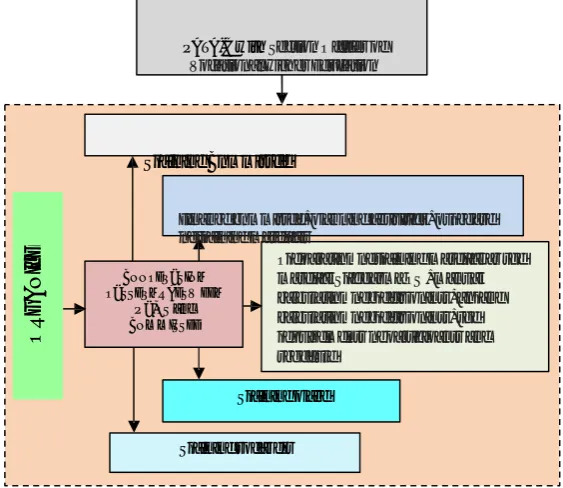
The research of development hypothetical model CCPD-VL outline contained in Fig. 1 below
Vocational Higher Education
Character Analysis of Vocational Lecturer
DIKTI
- Tridharma Perguruan Tinggi - Teacher and lecturer law
No:4
Needs Analysis of Vocational Lecturer
Selection Type of Intervention
Arranging CCPD-VL Training materials: Guide and Materials
Implementation of CCPD-VL Training
guided:
a. Training guidelines b . Material based on specified time uration c.Staff Officer / d Guidelinesfor assessment Credit score
Lecturer
Improvement material and exercise
Module
Define the CCPD-VL Training Tools
Financing plan (money) valuation
Plan Reporting System (minute)
Coordinate planning result: TPJA-PT, staff, research institute, training
place, module. ORGANIZE Evaluation of CCPD-VL mplementatio Implementation report CCPD-VL COMPETENCE
CCPD-VL models Vocational Education be able to :
( 1 ) measuring the continuous professional competence vocational lecturers match the standard set , ( 2 ) contains about steps of CCPD-VL ,
[image:2.595.82.468.345.745.2]( 3 ) can be implemented by the Vocational Higher Education .
271
Pe
re
nc
an
aa
n
The first phase of the hypothetical model CCPD-VL is planning covers several aspects: personal (man), financing (money), material (materials), method (method), equipment (machine) and reporting (minute). In planning CCPD-VL involves three units namely PATA-C (Position Assessment Team Academic College), Institute for Research and Community Service (IRCS), and Section Officer (SO). Briefly linkages agencies/ institutions that play a role in planning and components as well as aspects of planning can be observed in Fig. 2.
Vocational education
DIKTI
- Tridharma Perguruan Tinggi - Teacher and lecturer law - Permenpan –RB No:46 year 2013 - Permendikbud No. 092 year 2014
MAN Head ofSO, Leader of PATA-C, Head of IRCS, Senior Lecturer,Vocational Lecturer
MONEY Finance committee, planning, and implementation oftraining
MATERIAL Training guide, training materials, standard guidenumber of credits , infrastructure training, participants
requirements, training schedule .
METHOD CCPD-VL Model: Training
MACHINE CCPD Training Tools
MINUTE Report system: stages, content, timing, and reporting purpose
Fig2. Chart of CCPD-VL Planning Component
272
Training PlaceForms to counting the credit points
Training
Training speakers
Im
pl
em
en
ta
tio
n
Co
nt
ro
l
O
RG
AN
IZE
PATA-C withSection Officer of Vocational Higher Education
Training Committee
Finance committee, planning activities, purchase of training materials
COOPERATION PATTERNS BETWEEN
QA-PT and COMMITTEE
Preparation of training material as the material Tridharma PT , manual calculation of credit points, borang calculation of credit points, the requirements of participants and schedule
Training place
[image:4.595.170.452.45.289.2]Training speakers
Figure 3. Chart of CCPD-VL Organizing Component
Vocational Lecturer
CCPD-VL Proess
Training tools Training timing
[image:4.595.99.462.324.504.2]Guidelines for assessment the number credit of VL
Fig. 4. Chart of CCPD-VL Implementation Component
The fourth stage is the control, executed by : (1) an evaluation of the development of professional competence of vocational lecturers using predefined assessment standards , this evaluation is to determine the vocational lecturers that has developed and underdeveloped professional competence. (2) Evaluation of education and training CCPD-VL ranging from planning, organizing and implementation. Evaluation is expected as feedback for the organization of training CCPD-VL next year. The implementation of evaluation made by the organizing committee.as shown in Fig. 5.
CCPD-VL Tridharma PT
Guideline of credit score
Implementation of CCPD-VL Training
Evaluation of Planning, Organizing , and Execution
[image:4.595.125.389.605.699.2]273
IV. Conclusions and Suggestions
CCPD-VL hypothetical model of vocational higher education which is developed is expected to be an alternative in the development of professional competence on an ongoing basis for vocational lecturers to overcome the problem of not smooth faculty in developing professional competence and in order to get CCPD-VL models that are effective, efficient and practical . Thus the model that developed is able to : (1) measure the professional competence of lecturers on an ongoing basis according to the guidelines calculation of credit points, (2) contains about steps models CCPD-VL and guidebooks training CCPD-VL, and (3) can be implemented by vocational higher education.
References
[1]. Boyatzis, Richard E. (1982). The Competent Manager: A Model for Effective Performance.New York: John Wiley & Sons.
[2]. Budiyono, Bambang. (Mei2001). Penyelenggaraan Pendidikan Diploma Diera Global. Paper was presented in Semiloka Nasional “Pengembangan Pendidikan Diploma untuk Memenuhi Kebutuhan Tenaga Kerja Industri Era Global Dalam Rangka Optimasi Potensi Daerah”, in Garuda Hotel Yogyakarta.
[3]. Clarke,L.& Winch, C. (2008). Vocational Education Internasional Approaches, Developments and Systems. London & New York :Routledge.
[4]. Dubois, David D., & William J. Rothwell. (2004).Competency-Based Human Resource Management. 1st. Ed. California:Davies-Black Publishing.
[5]. Green, Paul C. (1999).Handbook for developing Competency-Based Training Programs. New York: John Wiley&Sons. Accessed on Februari 2nd, 2014. from: http://www.slideshare.net/ VassilisEngonopoulos/competency-based-hr-management-27737682.
[6]. Spencer, Lyle M. and Spencer, Signe. M.(1993). Competence at Work: Model for Superior Performance, New York: John Wiley & Son.
[7]. Supriadi, Dedi (2002). Satu Setengah Abad Pendidikan Kejuruan di Indonesia. In Dedi Supriadi (Ed.), Sejarah Pendidikan Teknik dan Kejuruan di Indonesia (pp.1-32). Jakarta: Direktorat Jendral Pendidikan Dasar dan Menengah.
[8]. Thompson, J. F. (1973).Foundations of Vocational Education. Socialand Philosophical Concepts. New Jersey:Prentice-Hall.