Journal of Criminal Law and Criminology
Volume 55
Issue 4
December
Article 3
Winter 1964
Patterns in Criminal Aggravated Assault
David J. Pittman
William Handy
Follow this and additional works at:
https://scholarlycommons.law.northwestern.edu/jclc
Part of the
Criminal Law Commons
,
Criminology Commons
, and the
Criminology and Criminal
Justice Commons
This Criminology is brought to you for free and open access by Northwestern University School of Law Scholarly Commons. It has been accepted for inclusion in Journal of Criminal Law and Criminology by an authorized editor of Northwestern University School of Law Scholarly Commons.
Recommended Citation
RESEARCH REPORTS
PATTERNS IN CRIMINAL AGGRAVATED ASSAULT*
DAVID J. PITTMAN AND WILLIAM HANDYI
No crimes are considered more serious than homicide and aggravated assault, for homicide deprives an individual of his life, and aggravated assault is an attempt to deprive an individual of his life or to cause him serious injury.
The act of homicide has been analyzed in numerous studies, the most complete of these being Wolfgang's Patterns in Criminal Homicide.' In his study, Wolfgang formulated a series of hypotheses concerning the nature of acts of homicide, tested them through the use of police homicide data, and thereby established the "patterns" in criminal homicide.
As far as can be discerned no study of Wolf-gang's type has been made of the crime of ag-gravated assault. The lack of such a study is remarkable, for often the line dividing aggravated assault from homicide is so thin that a factor such as the speed of an ambulance carrying the victim to the hospital will determine whether the crime will be aggravated assault or homicide. The purpose of this study is to analyze the crime of aggravated assault and to attempt to establish its "patterns," as Wolfgang did for homicide, by testing where possible Wolfgang's homicide hy-potheses against acts of aggravated assaults.
The Federal Bureau of Investigation classifies the crime of aggravated assault as "assault with intent to kill or for the purpose of inflicting severe bodily injury by shooting, cutting, stabbing,
* The study here reported was conducted under the auspices of the Crime Research Center, a cooperative undertaking of the St. Louis Metropolitan Police De-partment, the- Governmental Research Institute of St. Louis, and the Social Science Institute of Wash-ington University.
t Dr. Pittman is Professor of Sociology in Washing-ton University. He also serves as Sociological Consul-tant to the St. Louis Metropolitan Police Department. Dr. Pittman has published numerous articles dealing with criminological studies and alcohol problems. He has served as a lecturer and consultant in both fields.
Mr. Handy received his B.A. degree from Washing-ton University. He served as a Research Assistant with the Crime Research Center before leaving for active duty with the Armed Services. He was an author of "The K-9 Corps: The Use of Dogs in Police Work," published in this Journal in 1961.
'WOLFGANG, PATTERNS IN CR NAL HOMICmE (1958).
maiming, poisoning, scalding, or by the use of acids, explosives, or other means."' 2 In November, 1960, the FBI added a supplement to this defi-nition by stating that aggravated assault was "an unlawful attack by one person upon another for the purpose of inflicting severe bodily injury accompanied by the use of a weapon or other means likely to produce death or great bodily harm. Attempts should be included since it is not necessary that any injury result from an aggra-vated assault."3 The following guides were also given in this supplement: "Careful consideration of the following factors should clarify the classi-fication of an aggravated assault. (1) The serious-ness of the injury. (2) The type of weapon used or the use made of an object as a weapon. (3) The intent of the assailant to cause serious injury."4 Furthermore all these factors should be weighed before the crime is classified as an aggravated assault.
Even with this clarification of the definition of aggravated assault, the crime remains one of the most difficult to classify. According to the Depart-ment of Justice of the State of California:
"Aggravated assault is an offense which is very difficult to classify. There has been a growth in the number of aggravated assaults reported over the years, but there does not seem to be a corresponding growth in the number of feloni-ous assaults prosecuted. This would suggest that because of the relationship of the parties or the conditions under which the assaults occurred, many altercations, largely domestic quarrels, characterized in reports as aggravated assaults, do not seem to fall in the general area of feloni-ous assault. There is a need to have a
sub-classifying of this type of offense in order to
arrive at a true picture of assault."s
This statement was prepared before the supple-ment in the FBI definition and clearly states one
2 FBI, UNiFoRm CnTYa REPORT 29 (1960).
3FBI,
UNFORMCan
REPoRN@G-AGGRAvATEO AssAuLTs (Supp. Nov. 1960).4 Ibid.
5 CAL. DEP'T oF JusTicE, BuREAU OF CRnaNAL
STA=IeS, CRIHm IN CA=ORUA 18 (1958).
RESEARCH REPORTS
of the many reasons for the refinement. However, other factors which are impossible to regulate by a clarification in definition will adversely affect the proper classification of aggravated assaults; the way in which the police officer fills out a report
form and the difference of interpretation held by two clerks who classify these acts may cause variance. Such factors will have to be overlooked in this study, and the police classification of the crime will be accepted.
By popular definition, the crime of aggravated assault is known as "attempted murder," "assault with intent to kill," "assault with intent to do great bodily harm" or just "assault." All of these terms might be thought of as sub-classifications of the act, for they all more or less describe the purpose of the offender.
STUDY METHOD
The study group was composed of a random sample of 25 per cent of the 965 crimes classified by the St. Louis Metropolitan Police Department as aggravated assault for the period January 1, 1961, to December 31, 1961. Sampled cases totaled 241. Copies of the offense reports for each sampled case were obtained as well as the arrest records of the offender and the victim involved in the act. The information concerning the crime contained in offense reports was considered adequate, and the arrest records were also considered sufficient. Records such as those concerning the individual's prison, parole, and psychiatric status were un-available, and the addresses of the individuals were not current and were difficult to determine. The collected data were analyzed in terms of a set of formulated hypotheses concerned with the vari-ables of time, location and season of year, weapon, reporting, injury, police processing, alcohol in-volvement, victim-offender relationship, and arrest records.
In a few cases there were multiple offenders or victims. Generally, the additional offender or victim will not be considered, and the act will be analyzed as one crime, the emphasis being on the act and not on the individuals involved. In certain analyses, however, all offenders and all victims must be considered, and this accounts for the variable number of cases.
RESULTS I. Time
During week days, interaction among people is limited by their work, and there is less leisure time
DAY AND TimE
TABLE 1 OF OCCURRENcE
AssAULT CASES
OF AGGRAVATED
Mid- 6:00 Noon- 6:00
night- .m- Per
6 00 m- 6:00 Total a.m. Noon p~m. night
Sunday ... 15 5 5 10 35 14.5
Monday ... 1 2 7 11 21 8.6 Tuesday ... 5 4 5 10 24 10.0 Wednesday ... 7 1 8 8 24 10.0 Thursday ... 5 0 6 10 21 8.6 Friday ... 10 5 5 24 44 18.4
Saturday ... 22 6 11 33 72 29.9
Total ... 65 23 47 106 241 Per cent ... 27.0 9.6 19.5 43.9100.0100.0
TABLE 2 Tim. or Occu=zNcE
8:00 Pm.- 4:00 am.-Noon Noon-8:00p.m. Total 4:00 am.
140 31 70 241
Mean no. for 8-hour period = 80.3.
than on the weekends. For this reason, it was hypothesized that the majority of the acts of aggravated assault would occur between 6:00 p.m. Friday and 6:00 a.m. Monday.
As shown in Table 1, 132 of the 241 acts occurred during the hypothesized time. The period between 10:00 p.m. and 11:00 p.m. contained more acts than any other hour. More aggravated assaults occurred on Saturday than on any other day of the week, with Friday and Sunday following in that order. The hours between 4:00 p.m. and 3:00 a.m. were those during which the largest number of acts occurred, confirming the view of the police that this period has the largest number of all types of crime, since they reach their climax under the cover of darkness.
Our second hypothesis concerning time factor was that the majority of the acts would occur between 8:00 p.m. on a given evening and 4:00 a.m. the following morning. This hypothesis was accepted. As shown in Table 2, the number of acts is the greatest between 8:00 p.m. and 4:00 a.m., the period of darkness and more interaction. Aggravated assaults decline sharply during the next eight hours, when most people are sleeping
RESEARCH REPORTS
TABLE 3
PLACE OF OCCURRENCE BY MONTH
Jan ... 5 2 10 Feb ... 12 2 6 March ... 10 3 3 April ... 11 1 6 May ... 8 1 7 June ... 9 2 6 July ... 7 5 12 Aug ... 10 2 10 Sept ... 10 1 8 Oct ... 9 0 9 Nov ... 13 4 6 Dec ... 6 4 8
Total ... 110 27 91 Per Cent ... 45.6 11.2 37.8
Rea- I I Per
dence OtherI Total I Cent
7.9 8.7 6.6 7.9 7.5 7.1 10.0 10.0 9.1 7.9 9.5 7.9
5.41100.01
and then going to work. The number begins to rise again between noon and 8 p.m., as interaction after the working day slowly increases, and finally reaches its climax between 10:00 and 11:00 p.m. in the evening.
II. Location and Season of the Year
Criminal aggravated assaults may occur in a wide variety of places, but it was hypothesized that place of occurrence would be related to the season of the year, victim-offender relationship, and sex status. First, it was hypothesized that the largest number of acts would occur on public streets, rather than in taverns or bars, residences, or other places. This hypothesis was accepted (Table 3).
Also it was expected that more acts would occur during the winter than during other seasons. Summer months for St. Louis were defined as June, July, August, and September,e while winter months were defined as November, December, January, and February. Table 3 shows that 87 acts occurred during the four summer months, while 82 occurred during the winter months. Thus,
this hypothesis was rejected.
In relation to location and season of year, it was hypothesized that during the winter months, a greater number of acts would occur indoors as
6 In St. Louis, the month of September is regarded as a summer month.
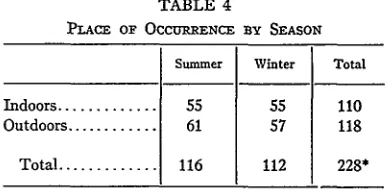
against the summer, when the larger number would occur outdoors. For this testing, summer was defined as April through September, and winter as October through March, so that all of the acts might be included. This hypothesis was also rejected (see Table 4).
It was thought that since females spend the majority of their time indoors, the acts in which they were offenders would be likely to occur in-doors, and this hypothesis was accepted (Table 5). Since related persons tend to have most of their interaction within their own home, it was hypothe-sized that if the offender and victim were related, the act of assault would take place within a residence. As shown in Table 6, the hypothesis was accented.
III. Weapon
In choosing a weapon for assault, the offender's choice is almost unlimited, and any given weapon may be used in a variety of ways. A gun, for instance, may be employed as a firearm or as a club. The offender may choose one of the more common weapons, such as a gun or knife, or some unique concoction such as a curtain rod, bottle, meat cleaver, shovel, or can opener.
It was hypothesized that a knife, being readily accessible, would be used in more instances than
TABLE 4
PLACE OF OCCURRENCE BY SEASON
Summer Winter Total Indoors ... 55 55 110
Outdoors ... 61 57 118
Total ... 116 112 228*
* For remaining 13 acts, location indoors or out-doors not assigned.
TABLE 5
PLACE OF OCCURRENCE BY SEX OF OFFENDER
Female Male Total
Indoors ... 41 75 116
Outdoors ... 18 107 125
Total ... 59 182 241
.Chi sq. = 14.27; P < .001. All cases assigned to outdoors-indoors categories.
[image:4.505.32.224.75.298.2] [image:4.505.233.427.396.491.2]RESEARCH REPORTS
TABLE 6
PLACE OF OCCURRENCE BY ]KIN RELATIONSHIP
Kin Not Kin Total
In Residence ... 42 49 91
Not in Residence .... 5 145 150
Total ... 47 194 241
Chi sq. = 66.13; P < .001.
TABLE 7
TYPE OF FORCE BY RACE OF OFFENDER
White Negro Total
Offender Offender
Personal Force ... 6 7 13
Weapon ... 36 189 225
Total ... 42 196 238*
Chi sq. = 7.72; P < .01.
* Three unknown.
any other weapon. In 126 of the 241 cases, the offender did choose a knife; guns were used in only 39 cases. Personal force (fists, feet, or any part of the body, but without the use of a weapon), although certainly more accessible than a knife, was used in only 14 cases, perhaps because the offender is more certain of inflicting injury upon his victim with a knife than with his own striking power. The remaining 62 cases involved weapons ranging from sharp instruments to fire, lye, and vases.
It was further hypothesized that, proportion-ately, white offenders would use personal force to a greater extent than would Negro offenders. The fact that in Negro neighborhoods, weapons for self defense are commonly carried7 gave rise to this proposition. The hypothesis was accepted (Table
7).
It was hypothesized that white females would use guns more frequently than other weapons, since guns requires less strength to use and are "cleaner" than other weapons. This hypothesis was rejected, as no white female offender selected a gun, while four of them chose knives. Apparently the accessibility of knives and the lack of
knowl-7 E.g., Schultz, Why the Negro Carries Weapons, 53 '. Cnnr. L., C. & P.S. 476 (1962).
edge about guns took precedence over other
factors.
IV. Reporting
There are numerous ways in which a case of aggravated assault may become known to the police. The crime may be reported by the victim, the offender, a witness, a hospital, or a physician, or it may be observed by the police. The hypothesis that the victim would report the crime in the majority of cases proved acceptable, for such was the case in 146 of the 241 acts. In only 10 cases did the offender report his own crime, while in 41 cases a witness reported the act. In 16 cases the police observed the crime or its consequences, in 23 cases they were called by medical authorities, and in five cases by a relative of the victim. Acts
in progress observed by the police were usually
those occurring on a street where a crowd had gathered. In those cases in which a relative noti-fied police, much time had elapsed since the act.
V. Injury
In the act of aggravated assault, the offender or the victim may be wounded, and the degree of injury varies. Although the extent of injury does determine, in some cases, whether or not the crime is classified as aggravated assault, it does not necessarily determine which party is the victim and which the offender. Sometimes the offender may be seriously wounded, and the victim only slightly injured, if at all.
In all of the sampled cases, the victim was wounded to some degree, and only when he re-fused medical attention was he not conveyed to a hospital. As was hypothesized, in more than half the cases, the victim was seriously wounded, while the offender was not (Table 8). Seriously wounded
TABLE 8
SERIOUSINMSS OF WOUND BY VICIM AND OFFENDER
Seriously Not
Wounded Seriously Total Wounded
Victim ... 134 117 251
Offender ... 35 222 257
Total ... 169 339 508*
Chi sq. = 90.47; P < .001.
* More than one offender or victim in 22 cases
[image:5.505.21.212.72.322.2] [image:5.505.221.424.502.638.2]RESEARCH REPORTS
TABLE 9
LENGTH OF T= BETWEEN THE ACT AND
APPREHENSION OF THE OFFENDER
Time Elapsed Number Pe Arrested ecentage
0.1 hour ... 116 62.3 1-5 hours ... 28 15.1 5-24 hours ... 19 10.2 Over 24 hours ... 23 12.4
Total ... 186 100.0
was defined as being incapacitated to the extent to require hospitalization.
VI. Police Processing
Aggravated assault is generally a distinct crime; in other words, usually no other Index Crime is involved, since the assault follows some type of ver-bal argument. In only three of the 241 cases was another Index Crime involved-in all cases rob-bery. In these cases, the police reports contained information which led authorities to believe that robbery was an afterthought, with assault the pri-mary motive of the offenders.
Sometimes, both the victim and the offender are charged by the police with aggravated assault. Both were charged in 10 of the sampled cases. In the remaining 231 cases, the victim was charged with either suspicion of affray or suspicion of peace disturbance. The charging of the victim with one of these counts was a police practice at the time of the study, and the charge was deleted only when it was ascertained that the victim was in no way responsible for the attack upon himself. Witnesses were often charged with affray or peace disturb-ance, depending on their role in the act. Clearance by arrest of aggravated assault cases is generally high, being surpassed only by homicide. In this sample, 77.2 per cent of the cases were cleared by arrest.
Elapsed time following a crime before the offender is apprehended is of importance to the police, for the longer the time lapse, the less the chance the police will arrest the offender. For aggravated assault, it was believed that the offender would usually be apprehended within an hour after the act, and such proved to be the case (Table 9). Of course a number of offenders were apprehended at the scene of the crime.
In 193 of the 241 cases, the identity of the of-fender was known to either the ofof-fender, the wit-ness, or the police. This number corresponds closely with the number of clearances by arrest; in only seven cases was the offender not apprehended when his identity was known.
It was hypothesized that more female than male offenders would be apprehended, since a female would be less able to avoid arrest by escape, more likely to be known to the offender, a witness, or police, and less likely to take part in a street' at-tack. The hypothesis was accepted (Table 10).
We hypothesized that a Negro offender would be more likely to be arrested than a white one, for the former would have less means at his disposal to avoid arrest and detection. The competing hy-pothesis would be that significantly fewer Ne-groes than whites would be arrested, in accordance with a popular belief in certain segments of the society that the police ignore Negro personal crimes of violence. Table 11 shows that both hy-potheses were rejected. Where Negroes were the offenders, 79 per cent of the cases were cleared by arrest; the comparable figure for whites was 74 per cent. This is not a statistically significant dif-ference.
TABLE 10 CL.ARANcE BY SEX
Arrested Not Total
Arrested
Female Offender ... 60 2 62
Male Offender ... 126 50 176
Total ... 186 52 238*
CM sq. = 17.03; P < .001.
* Three unknown.
TABLE 11
CLEARANCE BY RACE
Not Total
Arrested Arrested
Negro Offender ... 155 41 196
White Offender ... 31 11 42
Total ... 186 52 238*
Chi sq. = .56; P < .50. Association not significant.
* Three unknown.
[image:6.505.32.225.71.204.2]RESEARCH REPORTS
VII. Alcohol Involvement
It was hypothesized that prior alcohol ingestion by both the offender and the victim would be com-mon in acts of aggravated assault. It was found, however, that alcohol ingestion was present in only slightly more than one-quarter (57 offenders and 58 victims) of all the cases. This, however, may be a consequence of either the inability to detect the presence of prior alcohol ingestion or the failure to report it. But in 41 cases the offender and victim had been drinking together prior to the crime. To discern the role of alcohol ingestion in aggravated assault, one would need more complete informa-tion than police records provide.
VIII. The Relationship of Offender and Victim
Prior to the act of aggravated assault, the of-fender and victim have generally been in inter-action with each other. Verbal arguments (181 of 241 cases) usually precede the aggression. These quarrels may range from domestic incidents to tavern disputes over who was to sit on which bar stool. On the surface the quarrels appear to have little rationality. They must be understood in terms of the social and psychological mechanisms which the offenders and victims have developed to handle their aggressive impulses.
Furthermore, aggravated assault most often in-volves only one offender and one victim-in this sample, 219 cases of 241. In eight cases there was one offender and a multiplicity of victims, in 11 cases more than one offender but one victim, and in only three cases a multiplicity of both.
Since it was expected that there would be few interracial assaults (in this sample only 10 cases, of which only one was cross-sex and cross-race lines), it was hypothesized that if the offender and victim were of the same race, they would be of the
TABLE 12
RACE AND SEX RELATION O OFFENDER AND VICTIt
Same Race Different SeRae Race Total
Same Sex ... 135 9 144
Different Sex ... 93 1 94
Total ... 228 10 238*
Chi sq. = 3.65; P < .10. Association not significant.
* Three unknown.
TABLE 13
AGES or O zENDERS AND Vicrimis Not in
Under 20-34 35-49 SD+ Same
20 Age
Group
Both Offender and Victim 22 75 33 16 77* Offender only ... 35 105 71 30
-Victim only ... 28 91 59 35
-* Remainder unknown.
same sex. Table 12 shows that the hypothesis was rejected.
Persons of the same age group are most likely to interact with each other, and for this reason it was hypothesized that the victim and offender would be within the same age category. The categories adopted were under 20, 20-34, 35-49, and 50+. The assumption was true in 146 of the 241 cases. Where offender and victim were in the same age category, there were more cases in the 20-34 age group than in any other single group. Also, more offenders and more victims, considered apart, were in the 20-34 group than in any other single age group. (Table 13.)
In 106 of the cases, the offender was older than the victim, while in 92 cases the victim was older. In 23 cases, they were of the same age, and in the remaining 20 cases the age of the offender was un-known.
It was expected that the majority of both of-fenders and victims would be in-migrants to St. Louis. This assumption was checked by ascertain-ing the place of birth of the arrestees. Of the of-fenders, 71 per cent were born outside St. Louis, and of the victims 62 per cent were born outside the city.
Of the known offenders (237), 139 were Negro males, while 118 of the victims were Negro males; the hypothesis was thus validated that in cases involving Negro male offenders, the majority of victims would be Negro males.
[image:7.505.225.416.74.191.2]RESEARCH REPORTS
TABLE 14
KINSHIP RELATIONSHIP oF MALE AND FEMALE
OFFENDER AND VICTIM
Not Total
Relsted Related
Male Attacks Female. 21 72 93
Female Attacks Male. 15 30 45
Total ... 36 102 138
Chi Sq. = 1.82; P < .20. Association not significant.
TABLE 15
RELATION op MALE AND FEMALE OFFENDER AND
VICrI
Male Female
Attacks Attacks Total
Female Male
Former Close
Rela-tion ... ... 9 16 25 No Former Relation.. 16 9 25
Total ... 25 25 50
Chi sq. = 3.92; P < .05.
It was expected that blue collar workers would be involved in more acts of aggravated assault than their white collar counterparts-a belief confirmed by the data. Two-hundred twelve of the 252 vic-tims and 229 of the 237 offenders were blue collar
workers. A housewife was considered to be a blue
collar worker if her husband's socio-economic status was blue collar.
It was hypothesized that a female, being more likely to have interaction with a male to whom she was related than with an unrelated male, would commit aggravated assault against a male to whom she was related more frequently than would a male attack a female to whom he was related. Table 14 indicates that this hypothesis was rejected.
In cases involving a male and a female not
legally related, it was hypothesized that prior to the
assault the two would have had a relationship of
common law marriage, sexual intimacy, or dating.
Table 15 supports the hypothesis in cases involving
a female attacking a male, but not in cases of a male attacking a female. This finding indicates that the female is more likely than a male to ag-gress against one with whom there is some intimate relationship.
Inter-racial assault was an uncommon occur-rence in this sample. Only 10 of the 241 cases in-volved an offender and victim of different race. It was hypothesized that in an inter-racial assault, a white person would most likely be the victim. This hypothesis was accepted (Table 16).
Only a small number (22 cases) of the victims had previous arrests for Index Crimes. Most of-fenders, however, had previous criminal records (Table 17), with the prior arrest most frequently being for peace disturbance. The record, however, does not indicate whether this prior act was a slight scuffle or affray or a reduced charge from a more serious offense. At least 37 of the offenders had at least one previous arrest on an assault charge.
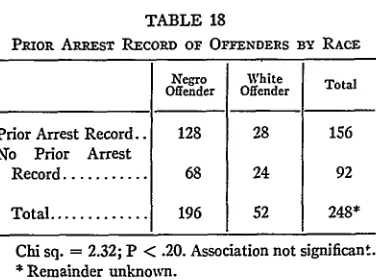
It was hypothesized that Negro offenders would be no more likely to have prior arrest records than white offenders; this belief was confirmed (Table 18).
The last hypothesis was that there would be no correlation between the age of the offender and presence of a prior arrest record. Using the age categories previously cited, it was found that the age category 20-34, into which the largest number of offenders fell, had a higher percentage of prior records than did other groups, but the percentage did not sharply increase or decrease with a change in age. Forty-six per cent of the offenders under 20,
TABLE 16
INTER-RAcIAL ASSAULTS
White Negro Total Offender Offender
White Victim ... 40 8 48
Negro Victim ... 2 188 190
Total ... 42 196 238
Chi sq. = 178.19; P < .001.
TABLE 17
PRIOR ARREST REcoRD OF OFFENDERS AND VICTIMS
Offenders Victims Total
Prior Arrest Record.. 156 121 277 No Prior Arrest
Record ... 92 131 223
Total ... 248 252 500
Chi sq. = 11.21; P < .001.
[image:8.505.24.218.106.349.2]RESEARCH REPORTS
TABLE 18
PRIOR ARREST RECORD OF OFFENDERS BY RACE
Negro White Total Offender Offender
Prior Arrest Record.. 128 28 156 No Prior Arrest
Record ... 68 24 92
Total ... 196 52 248*
Chi sq. = 2.32; P < .20. Association not significant.
* Remainder unknown.
62 per cent of those 20-34, 48 per cent of those 35-49, and 57 per cent of those 50 or over had prior arrest records.
AGGRAVATED ASSAULT, THE TYPICAL PATTERN
These patterns in aggravated assault are based on a random sample of 241 acts in 1961 drawn from the cases reported to the St. Louis Metropolitan Police Department. From the analysis presented here, it is possible to state the expected pattern of aggravated assault in the "typical" case.
An act of aggravated assault is more likely to occur on a weekend than during the week, specifi-cally between 6:00 p.m. Friday and 6:00 a.m. Monday, with peak frequency on Saturday, be-tween 10:00 p.m. and 11:00 p.m. While the event shows little likelihood of being more frequent in the four summer months considered together than in the winter, this type of assault peaks in the months of July and August.
The crime will occur on a public street, or, secondly, in a residence. If a female is the offender, the act will occur indoors, if a male offender, out-doors. When offender and victim are related, the act will more likely occur in a residence than else-where. The general neighborhood context is one populated by lower socioeconomic groups-espe-cially Negroes of this class.
The weapon used by both men and women will in most cases be a knife, with a gun the second choice. In acts involving white offenders, personal force will be used more often than in those involv-ing Negro offenders.
Generally, the act will be reported to the police by the victim. The victim will be wounded seri-ously enough to require hospitalization, but the offender will not. More than 75 per cent of the aggravated assault cases will be cleared by arrest within one hour after the crime occurs. A Negro is
no more likely to be arrested for his crime than is a white.
These records indicate that neither the offender nor the victim will be under the influence of alcohol, nor will they have been drinking together, and neither will be a user of drugs.
The aggravated assault will be preceded by a verbal argument, most likely centering around a domestic quarrel.
The offender and victim will be of the same race and of the same sex; there will be only one offender and one victim, and both will have been born out-side of the city in which the crime occurs. Both will be of the same age group, usually between the ages of 20 and 35, with the offender being older. The victim will more often be married than the offender, but both will be blue collar workers. A female offender is more likely to be related to her male victim than is the male offender to his female victim. Females assault males with whom they have had a previous close relationship (such as dating, sexual intimacy, or common law marriage); but this is not the case with males assaulting females.
Negro offenders are no more likely than their white counterparts to have a prior arrest record. Offenders in the age bracket 20-34 will in the ma-jority of cases have a prior arrest record.
AGGRAVATED ASSAULT COMPARED TO
CRIMINAL HOMICIDE
Despite the lack of sociological studies of aggra-vated assault, it was believed that this offense had many similarities to homicide. A comparison of the findings in this study with .those of Wolfgang8 for criminal homicide reveals more similarities than differences, even though the two studies represent different time periods, cities, and police depart-ments.
1. Time. For both aggravated assault and homi-cide, occurrences were higher on Saturdays, with the time of day being most frequently late evening and early morning hours; for homicide, between 8:00 p.m. and 2:00 a.m., and for aggravated as-sault, between 4:00 p.m. and 3:00 a.m. The next highest time for both acts were the hours imme-diately following the highest period.
2. Location. Both crimes occurred more often on a public street than in any other location, with resi-dences second. Summer months accounted for a higher percentage of crimes in both cases, but to a
[image:9.505.22.210.69.209.2]RESEARCH REPORTS
greater extent for homicides. In winter these crimes occurred indoors. Females committed both acts more often indoors than outdoors. If the victim and offender were related, the crime most likely occurred in a residence. Both types of acts usually took place in a lower class, Negro neighborhood. 3. Weiapon. The weapon most often used differed between hominicide and aggravated assault; a pistol or revolver Was most common in homicides, while a knife -wdi most common in assaults. White fe-males used a revolver or pistol most often in homicide, while they used a knife most often in assault.
4. Police Processing. No other Index Crime was involved in the majority of both crimes, and there was a high cleanup rate for both, although it was higher for homicides. The offender in both crimes was arrested within a short time of committing the act, and he was known to either witnesses or police. Clearance was higher for females and Ne-groes than for males and whites in both homicide and assault.
S. Alcohol Involvement. The ingestion of alcohol
was more common in homicide than in assault, as was a drinking episode between offender and victim prior to the crime.
6. Situational Context. Verbal arguments pre-ceded both crimes, but alcohol was involved in the
arguments in homicide-situations more often than in aggravated assault cases.
7. Offender-Victim Relationship. For both crimes, the victim and offender were typically of the same age, sex, and race. There were most often only one victim and one offender. Negro males were dispro-portionately involved in both types of crime. The participants in both acts were usually married, blue collar workers, and the victims of inter-racial assaults were white more often than Negroes. In acts of homicide, a wife attacked her husband more often than a husband attacked his wife, while the reverse was the case in aggravated assaults.
8. Prior Arrest Records. For both homicide and aggravated assault, the majority of the victims had no prior arrest record, while the majority of the offenders did. For homicide offenders, two-thirds had a prior record of a crime against the person, while for aggravated assault the number of offenders having this type of record, if one excepts peace disturbance, was negligible.
This comparison of findings concerning acts of homicide and aggravated assault indicates that the pattern for the two crimes is quite similar. Both acts, of course, are reflections of population sub-groupings which tend to externalize their aggres-sion when confronted with conflict situations.
![TABLE 6]KIN edge about guns took precedence over otherfactors.](https://thumb-us.123doks.com/thumbv2/123dok_us/8828225.925759/5.505.21.212.72.322/table-kin-edge-guns-took-precedence-otherfactors.webp)