Journal of Chemical and Pharmaceutical Research, 2014, 6(7):246-250
Research Article
CODEN(USA) : JCPRC5
ISSN : 0975-7384
Communications protocol application in the substation automatic system
Wang Liang
Tibet University for Nationalities, Tibet, China
_____________________________________________________________________________________________
ABSTRACT
With the economic development, the traditional substation control system cannot satisfy the current electric power requirement. It is necessary to effectively use the communication protocol in the substation automatic system. This article introduces the communication protocol in the first place. Moreover, it discusses the IEC 101 protocol characteristics, frame structure, and the overall summon transmitting in details. Then, the substation automatic system obtains the optimized analysis of hardware and software. At last, this paper provides part of the system core code, which has a positive effect to the software designer and substation maintainer.
Keywords: communication protocol, substation, automation
_____________________________________________________________________________________________
INTRODUCTION
Substation places the important position of the network system as well as the center circle of transmission and distribution. With the economy and technology development, it is necessary to change the traditional substation into the primary and the secondary equipment. Decrease the cost, improve the security, reduce the maintainer, and realize the unattended operation under 200KV is the target of the substation automatic system.
Protocol analysis
The communication protocol is the unified regulation of synchronization method, transmittal step, data format, error correction, transfer rate, and character control between the both sides, which have to be executed. Since we entered WTO, different fields connect with the international standard continuously. About the substation communication protocol, occident use IEC protocol. Beijing passed IEC 101 (2.0 Edition) in 2002, and it will be the standard of our utility industry.
IEC 101 protocol
Protocol characteristics
IEC protocol is the first integrated communication system for using the substation automatic system. Compare with the internet communication system, it has the following characteristics:
IEC 101 frame structure
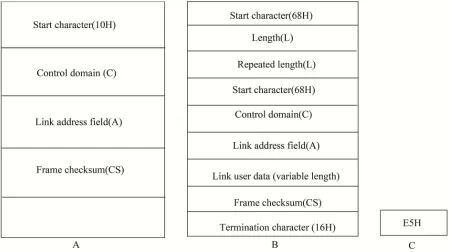
[image:2.595.82.533.156.408.2]The substation automatic system requires a large amount of transmitted data quantity and type, which include tele-command, interrogation, telemetering, tele-control, fault report, self-test report, and the sequence of event. It means the same type data will has great differences when facing the various equipment or measurement time. Therefore, IEC 101 protocol based on the detailed data quantity and design the different frame structure. Figure 1 has the details.
Fig. 1: IEC 101 transmission frame structure
Figure 1 has three kinds of transmission frame structure. A is the fixed frame structure, B is the frame structure with variable length, C is the single byte frame structure. Star character means the first byte of each frame, and the termination character is the last byte. Although the fixed frame and variable frame have the different start characters, the termination characters are the same (16H). The control domain length is one byte and stands for the frame control information. The length of the link address field is two bytes, which means the local collection unit address. Frame checksum length is one byte and it is the cumulative arithmetical check. The variable frame has length, link user data and other information. The single byte frame shows with E5H. If there have no required data on the slave station, send E5H.
Overall call-transmitting procedure of IEC 101
Fig. 2: Overall call-transmitting procedure of IEC 101
1.
Evaluation of substation automatic systemElectric power is related to the life and asset security of the nation and people. The automatic system requires distribute structure mode. Therefore, communication timelines are the system core center. The process of information sending request, data management, identification, and transmission has to less than 40 milliseconds. Network topology and software optimization is the necessity.
Hardware
Software design
The traditional industry control electricity software uses a standard bus application and easy to control. It is hard to maintain it. Therefore, use the configuration software and internet technology to design the software is inevitable. It provides convenience to operate the remote and control. In order to change the traditional disadvantages, we can add the following technologies in the automatic software.
(1)Real-time task queue
It breaks the traditional time limit and the system management will be easier and in time. The process is: when adding the new object, the system will create a new task and add it to the end of the task queue. During the process, the queue will carry out all the tasks follow the arriving time. Otherwise, we cannot control the sequence based on the task priority. It is possible to divide the task priority level into three modules. The system will check the highest priority level and operate it. It will carry out the proximate grade task and then the lowest level. The task queue will empty after finishing all the tasks.
(2)Digital transmission mode
System alarm and data transmission might cause the unnecessary lost on account of the error code. Change the traditional analog signal transmission and use the digital transmission and optimize the link connection can solve this problem.
(3)Buffer mechanism
In the traditional automatic control system, data lost is the caused by the busy condition. It needs data resend and build the connection. This will lead resource waste. We can use the buffer mechanism that puts data in the buffer zone.
(4)Optimize the database structure
Data operation includes read and write. If the database construction stays the same with the hardware equipment, it will greatly improve the read-write speed.
2.
Detailed realizationThis article designs the substation automatic system that aims at the software. It uses VC++6. 0, and the database is SQL2000. The core codes are in the following:
unsigned int __stdcall WriterThreadFun(PVOID pM) {
int nData = 0; while (nData < 20) {
WaitForSingleObject(g_hEmpty, INFINITE); g_arrDataQueue[g_j] = ++nData;
g_j = (g_j + 1) % QUEUE_LEN; EnterCriticalSection(&g_cs);
SetConsoleColor(FOREGROUND_GREEN); printf(" Write data ‘%d’ into the queue ‘\n", nData’)
SetConsoleColor(FOREGROUND_RED | FOREGROUND_GREEN | FOREGROUND_BLUE); LeaveCriticalSection(&g_cs);
Sleep(rand() % 300);
ReleaseSemaphore(g_hFull, 1, NULL); } return 0; } int main() { InitializeCriticalSection(&g_cs);
g_hEmpty = CreateSemaphore(NULL, QUEUE_LEN, QUEUE_LEN, NULL); g_hFull = CreateSemaphore(NULL, 0, QUEUE_LEN, NULL);
srand(time(NULL)); g_i = g_j = 0;
HANDLE hThread[2];
WaitForMultipleObjects(2, hThread, TRUE, INFINITE);
for (int i = 0; i < 2; i++) CloseHandle(hThread[i]); CloseHandle(g_hEmpty); CloseHandle(g_hFull); DeleteCriticalSection(&g_cs); return 0;
}
CONCLUSION
This article uses a communication protocol to research the substation automatic system, which places important station on industry and people’s livelihood. Moreover, it has significant meaning to the automatic research. The substation automatic system is the huge engineering. Due to the length limitation, here not detailed the network structure design and database design. Hope the interested colleagues can do the further perfection.
REFERENCES
[1]Li Jungang, Song Xiaohui, Di Junfeng, Wei Yong, communication network redundancy design of the intelligent substation based on IEC 62439-3,Automation of Electric Power Systems, Automation of Electric Power Systems,
2011,34(10), 70-73
[2]Hu Changjin, Electro-technical Application, 2011(30)17,32-34,
[3] Dou Xiaobo, Hu Minqiang, Wu Zaijun, Du Yansen, Min Tao, Power System Technology,2008,51(17), 98-104
[4]He Jixin, East china science & technology,2012 27(8), pp.280-281
[5]Wang Langjun, 35kV substation automatic information application based on the GPRS transmission distribution network ,Telecommunications for Electric Power System,2009 30(199),42-46