SPEED TRACKING OF INDIRECT FIELD
ORIENTED CONTROL INDUCTION MOTOR
USING NEURAL NETWORK
AZUWIEN AIDA BINTI BOHARI
UNIVERSITI TUN HUSSEIN ONN MALAYSIA
STATUS CONFIRMATION FOR MASTER’S THESIS
SPEED TRACKING OF INDIRECT FIELD ORIENTED CONTROL INDUCTION MOTOR USING NEURAL NETWORK
ACADEMIC SESSION: 2015/2016
I, AZUWIEN AIDA BINTI BOHARI, agree to allow this Master’s Thesis to be kept at the library under the following terms:
1. This Master’s Thesis is the property of the Universiti Tun Hussein Onn Malaysia.
2. The library has the right to make copies for educational purposes only.
3. The library is allowed to make copies of this report for educational exchange between higher
educational institutions.
4. **Please Mark (√)
CONFIDENTAL (Contains information of high security or of great importance to Malaysia as STIPULATED under the OFFICIAL SECRET ACT 1972)
RESTRICTED (Contains restricted information as determined by the organization institution where research was conducted)
FREE ACCESS
(WRITER’S SIGNATURE) AZUWIEN AIDA BINTI BOHARI
Writer’s Name
Permanent address:
POS 74, KAMPUNG PARIT BARU, PARIT RAJA, 86400BATU PAHAT, JOHOR.
Date : ____________________
Approved by,
(SUPERVISOR’S SIGNATURE) DR. WAHYU MULYO UTOMO
Supervisor’s Name
Date : ____________________
NOTE:
** If this Master’s Thesis is classified as CONFIDENTIAL or RESTRICTED,
please attach the letter from the relevant authority/organization stating
reasons and duration for such classifications.
iii
This thesis has been examined on date 29 February 2016 and is sufficient in fulfilling the scope and quality for the purpose of awarding the Degree of Masters in Electrical Engineering
Chairperson:
Prof. Madya Siti Hawa Binti Ruslan
Faculty of Electrical and Electronic Engineering Universiti Tun Hussein Onn Malaysia (UTHM)
Examiners:
Prof. Madya Dr. Abu Zaharin Bin Ahmad Faculty of Electric and Electronic Engineering Universiti Malaysia Pahang (UMP)
SPEED TRACKING OF INDIRECT FIELD ORIENTED CONTROL INDUCTION MOTOR USING NEURAL NETWORK
AZUWIEN AIDA BINTI BOHARI
A thesis submitted in
fulfillment of the requirement for the award of the Degree of Master
Faculty of Electrical and Electronic Engineering Universiti Tun Hussein Onn Malaysia
ii
I hereby declare that the work in this thesis is my own except for quotations and summaries which have been duly acknowledged
Student : ……….. AZUWIEN AIDA BINTI BOHARI
Date : ………..
Supervisor : ……….. DR. WAHYU MULYO UTOMO
Special dedicated to my mother Rodiah Ramlan, my father Bohari Selamat, my
husband Mohd Nizam Mohd Talib, my daughter Syafia Nurhanna Mohd Nizam and
my son Muhammad Izz Zafran Bin Mohd Nizam, thank you so much for the support
iv
ACKNOWLEDGEMENT
First of all, Alhamdullilah, praise to Allah for His Blessings I have finished writing this dissertation for Master of Electrical Engineering. I express my sincere appreciation to my supervisor, Dr Wahyu Mulyo Utomo for his encouragement, guidance, advices and critics. Without his continuous support and interest, this research could not be finished.
I would like to gratitude Faculty of Electrical and Electronic Engineering (FKEE) Universiti Tun Hussein Onn Malaysia for any valuable supports during conducting this project and in preparing this report.
ABSTRACT
vi
ABSTRAK
TABLE OF CONTENTS
TITLE i
DECLARATION ii
DEDICATION iii
ACKNOWLEDGEMENT iv
ABSTRACT v
ABSTRAK vi
TABLE OF CONTENTS vii
LIST OF TABLES xii
LIST OF FIGURES xiii
LIST OF SYMBOLS AND ABBREVIATIONS xviii
LIST OF APPENDICES xx
CHAPTER 1 INTRODUCTION 1
viii
CHAPTER 2 LITERATURE REVIEW 6
2.1 Introduction 6 2.2 Electric Motor Classification 6 2.2 Advantages AC Motor over DC Motor 7 2.3 Induction Motor Control Methods 8 2.4 Field Oriented Control (FOC) 10 2.4.1 Review of Existing Previous Work 11 2.4.1.1 Field Oriented Control of
IM Drive
12
2.4.1.2 FOC of IM Drive System with Conventional Speed Controller
13
2.4.1.3 FOC of IM Drive with Artificial Intelligent Speed Controller
17
2.5 Gap of Study 23 2.6 Conclusion 23
CHAPTER 3 METHODOLOGY 24
3.1 Introduction 24 3.2 Project Flow Chart 24 3.3 Control Strategy of the FOC of IM Drive
System
26
3.3.3 Flux And Torque Controller 28 3.3.4 Park and Clark Transformation
Block
29
3.4 Proposed NN Speed Controller 30 3.4.1 Updating Algorithm of Proposed
NN
35
3.4.2 Training of Proposed NN Speed Controller
38
3.5 Conclusion 43
CHAPTER 4 RESULT AND ANALYSIS 44
4.1 Introduction 44 4.2 Overview of Systems Developments 44 4.3 Simulation Model using MATLAB 46
4.3.1 Space Vector Pulse Width Modulation Inverter Block
46
4.4 Simulation Results and Discussion 47 4.4.1 Simulation Test for Better
Performance of the Proposed NNIFOC of IM
47
4.4.2 Simulation Test for Speed Variation 52 4.4.3 Simulation Test for Constant Speed
with Load Disturbance
54
4.4.4 Experimental Performance Comparison
x
4.5 Hardware Development and Implementation
58
4.5.1 The Real-Time Interface Integration with DSP Controller
59
4.5.1.1 Feedback of the Motor Speed Signal
60
4.5.1.2 Feedback of the Motor Current Signal
60
4.5.2 The Experimental Set-Up 61 4.6 The Experimental Results and Discussion 62
4.6.1 Experimental Test for Better Performance of the Proposed NNIFOC of IM Drive System
63
4.6.2 Experimental Test for Speed Variation
67
4.6.3 Experimental Test for Constant Speed with Load Disturbance
68
4.6.4 Experimental Performance Comparison
71
4.7 Conclusion 73
CHAPTER 5 CONCLUSION 75
5.1 Conclusion 75
5.2 Future Work 76
LIST OF PUBLICATIONS 76
APPENDIX 86
xii
LIST OF TABLES
2.1 Gap of study for the NN based FOC of IM drive according to the several recent works
23
4.1 Performance comparison for different constant speed condition
57
4.2 Performance comparison for speed variation condition 57 4.3 Performance comparison for constant speed with load
disturbance
58
4.4 Performance comparison for different constant speed condition
71
4.5 Performance comparison for speed variation condition 72 4.6 Performance comparison for constant speed with load
disturbance
LIST OF FIGURES
2.1 Electric motors family 7 2.2 General classification of IM control methods 9 2.3 Indirect vector control method 11 2.4 Direct vector control method 11 2.5 The speed controller of FOC IM drives incorporated by PID
controller
14
2.6 The speed controller of FOC IM drives incorporated by fuzzy logic controller
17
2.7 The speed controller of FOC IM drives incorporated by NN controller
20
3.1 Project flow chart 25 3.2 Block diagram of speed control IFOC of IM drives system 27 3.3 Block diagram of PI, flux and torque controller 29 3.4 Backpropagation NN training flow chart 31 3.5 Neuron Structure 32 3.6 Structure of NNIFOC 35 3.7 Block diagram of FOC 38 3.8 Graph of input, target and output of training data for 1 neuron
of hidden layer structure
xiv
3.9 Best validation performance obtain by 1 neuron of hidden layer structure
40
3.10 Graph of input, target and output of training data for 2 neuron of hidden layer structure
41
3.11 Best validation performance obtain by 2 neuron of hidden layer structure
41
3.12 Graph of input, target and output of training data for 3 neuron of hidden layer structure
42
3.13 Best validation performance obtain by 3 neuron of hidden layer structure
42
4.1 The general testing diagram of the proposed NNIFOC of IM drive system
45
4.2 The complete Simulink block of the proposed NNIFOC of IM drive system
46
4.3 The Simulink circuit of the SVPWM control technique for the three phase’s inverter
47
4.4 The speed, current and torque response for the speed of 600 rpm with 0.2Nm load torque applied: (a) Online learning NNIFOC; (b) Offline learning NNIFOC
48
4.5 The speed, current and torque response for the speed of 900rpm with 0.2Nm load torque applied: (a) Online learning NNIFOC; (b) Offline learning NNIFOC
49
4.6 The speed, current and torque response for the speed of 1200rpm with 0.2Nm load torque applied: (a) Online learning NNIFOC; (b) Offline learning NNIFOC
49
4.7 The speed, current and torque response for the speed of 600rpm with 0.8Nm load torque applied: (a) Online learning NNIFOC; (b) Offline learning NNIFOC
4.8 The speed, current and torque response for the speed of 900rpm with 0.8Nm load torque applied: (a) Online learning NNIFOC; (b) Offline learning NNIFOC
50
4.9 The speed, current and torque response for the speed of 1200rpm with 0.8Nm load torque applied: (a) Online learning NNIFOC; (b) Offline learning NNIFOC
51
4.10 The speed, current and torque response for a step speed variation under the 0.2Nm load torque applied: (a) Online learning NNIFOC; (b) Offline learning NNIFOC
53
4.11 The speed, current and torque response for a step speed variation under the 0.8Nm load torque applied: (a) Online learning NNIFOC; (b) Offline learning NNIFOC
53
4.12 The speed, current and torque response for a constant speed of 600 rpm with load disturbance of 0.2 Nm and 0.8 Nm at the time of 0.7s, and 1.2s; (a) Online learning NNIFOC, (b) Offline learning NNIFOC
55
4.13 The speed, current and torque response for a constant speed of 900 rpm with load disturbance of 0.2 Nm and 0.8 Nm at the time of 0.7s, and 1.2s; (a) Online learning NNIFOC, (b) Offline learning NNIFOC
55
4.14 The speed, current and torque response for a constant speed of 1200 rpm with load disturbance of 0.2 Nm and 0.8 Nm at the time of 0.7s, and 1.2s; (a) Online learning NNIFOC, (b) Offline learning NNIFOC
56
xvi
0.2Nm load torque applied: (a) Online learning NNIFOC; (b) Offline learning NNIFOC
4.19 The speed and current response for the speed of 900 rpm with 0.2Nm load torque applied: (a) Online learning NNIFOC; (b) Offline learning NNIFOC
64
4.20 The speed and current response for the speed of 1200 rpm with 0.2Nm load torque applied: (a) Online learning NNIFOC; (b) Offline learning NNIFOC
64
4.21 The speed and current response for the speed of 600 rpm with 0.8Nm load torque applied: (a) Online learning NNIFOC; (b) Offline learning NNIFOC
65
4.22 The speed and current response for the speed of 900 rpm with 0.8Nm load torque applied: (a) Online learning NNIFOC; (b) Offline learning NNIFOC
65
4.23 The speed and current response for the speed of 1200 rpm with 0.8Nm load torque applied: (a) Online learning NNIFOC; (b) Offline learning NNIFOC
66
4.24 The speed and current response for a step speed variation under 0.2Nm load torque applied: (a) Online learning NNIFOC (b) Offline learning NNIFOC
67
4.25 The speed and current response for a step speed variation under 0.8Nm load torque applied: (a) Online learning NNIFOC (b) Offline learning NNIFOC
68
4.26 The speed and current response for a constant speed of 600 rpm with load disturbance of 0.2 Nm and 0.8 Nm at the time of 3s, and 5s; (a) Online learning NNIFOC, (b) Offline learning NNIFOC
69
4.27 The speed and current response for a constant speed of 900 rpm with load disturbance of 0.2 Nm and 0.8 Nm at the time
of 3s, and 5s; (a) Online learning NNIFOC, (b) Offline learning NNIFOC
4.28 The speed and current response for a constant speed of 1200 rpm with load disturbance of 0.2 Nm and 0.8 Nm at the time of 3s, and 5s; (a) Online learning NNIFOC, (b) Offline learning NNIFOC
xviii
LIST OF ABBREVIATIONS AND SYMBOLS
α - Alpha
A - Ampere
β - Beta
Nm - Newton Meter V - Voltage kW - Kilo Watt
AC - Alternating Current ANN - Artificial Neural Network DTC - Direct Torque Control DC - Direct Current
IM - Induction Motor
IRFOC - Indirect Rotor Field Oriented Control ISFOC - Indirect Stator-Flux-Oriented Control IVC - Indirect Vector Control
IVCIM - Indirect Vector Control Induction Motor MSE - Mean Square Error
NN - Neural Network
NNIFOC - Neural Network Indirect Field Oriented Control PI - Proportional Integral
PID - Proportional Integral Derivative PWM - Pulse Width Modulation
RNN - Recurrent Neural Network rpm - Round Per Minute
SDRFOC - Sensorless Direct Rotor Field Oriented Control SMC - Sliding Mode Control
VC - Vector Control
xx
LIST OF APPENDICES
A Dynamic Model of Induction Motor 86
B Motor Parameters 88
CHAPTER 1
INTRODUCTION
1.1 Introduction
In this chapter, the introduction of the thesis will be explained in detail that consists of research background, focus of the study, problem statements, research objectives, scope and outlines.
1.2 Background Study
Russia, Japan, China, the European Union and the United States are five big motor consumers, about 84% collectively account for motor electricity consumption in the countries [1]. Approximately, 68% of the electricity used by electric motors with input power range from 0.75 kW up to 375 kW. Most of them are asynchronous current (AC) induction motor (IM) with 2, 4, 6 or 8 poles. There are various types of motor designs available, but the AC IM has been dominating and frequently used.
Electric motors use about half the electricity produced by developed countries, where 90% is from induction motor [2]. The rugged structure, robustness, low cost, high reliability and very minimal maintenance are among the advantages of IM as compared to direct current (DC) motor counterpart.
2
response, unfortunately the dynamics are sluggish. To obtain high precision and good dynamics, VC approach is being employed with closed-loop feedback control [3]. Translation of coordinate from fixed reference stator frame to the frame of rotating synchronous is implied by the VC [4, 5]. IM variable speed AC drives with VC technique has been popular in recent years for better performance set by DC drives.
The possibility of the flux and torque separated control in the dynamic complex of IM is achieved using decoupling technique in early 1970s [6,7] Decoupling between flux and torque is highly recommended for excellent control of flux and torque. The relevant mathematical description of three-phase IM is contributed by field oriented control (FOC) which produces high dynamic performance [8, 9].
1.3 Problem Statement
IM is superior to DC machine with respect to physical size, weight, inertia, cost and speed. In addition, it is able to operate in elusive and hostile environment than DC motor with mechanical commutation. However, the operation of IM is much more complicated and lack of precision control as the flux and torque of its input current are coupled.
it possible to train a NN to represent a variety of complicated nonlinear systems. Online NN is chosen according to the fact that even offline model can handle large data as computation time is not critical to their structure, it is only robust to small variation, but fail to adapt to larger changes in the system, while the online model adapts to variation quickly in non-linear behavior of the system. This research is not limited to control the speed in any operation with different load torques and speed variations but at the same time, to maintain and increase the system performance when dealing with system uncertainties, such as dynamic load disturbance.
1.4 Research Objective
The objective of this project is to control the IM with the proposed speed controller. The controller is able to maintain the performance of the motor in any conditions given, namely
i. To model and develop FOC IM drive system using MATLAB Simulink. ii. To develop a proposed speed controller using online and offline NN
technique to track the speed of IM based FOC.
iii. To verify the performance of proposed neural network indirect field oriented control (NNIFOC) for both offline and online method in simulation and experiments.
1.5 Research Scope
The motor specifications for the hardware are given below:
- frequency, f : 50 Hz - Pole, p : 2
- Stator Resistance, Rs : 8.2Ω
- Rotor Resistance, Rr : 5.3667Ω
- Stator Self Inductances, Ls : 0.4934H
- Rotor Self Inductances,Lr : 0.4934H
4
This project is conducted as the following stages: i. Modeling and simulation:
- MATLAB Simulink is used to develop the proposed online NNFOC of IM drives system.
ii. Software and hardware implementation:
- The speed controller to deal with speed variation and load disturbance is designed.
- Prototype of the proposed NNIFOC of IM drives system is constructed. - Code Composer Studio, CC Studio v3.3 is used as an interface to connect
the proposed NNIFOC of IM with digital board controller (DSP) board controller.
1.6 Thesis Outline
This section explains the design, comparison and performance of proposed NNIFOC IM drive. It is divided into five chapters and the summary of each chapter is given below.
(a) Chapter 1 : Introduction
This first chapter gives some background introductions of the research. Problems of previous work are highlighted and research objectives are also discussed here.
(b) Chapter 2 : Literature Reviews
This chapter explains the electric motor classifications. In addition, advantages AC over DC motor and their control method are also discussed. The review of previous and current research in FOC IM drive system are presented.
(c) Chapter 3 : Research Methodology
(d) Chapter 4 : Simulation and Experimental Results
This chapter describes performance of the proposed NNIFOC IM drive in both simulation and hardware implementation. The proposed design is simulated using MATLAB Simulink, while the experiment is realized through C2000 DSP controllers, TMS320C2800 controller board. The test data obtained in simulation is verified with experimental setup.
(e) Chapter 5 : Conclusions
6
CHAPTER 2
LITERATURE REVIEW
2.1 Introduction
This chapter describes fundamental knowledge of induction motor. Besides, background studies of the available control methods for motor drives conjointly with the proposed FOC method is also described here. Some literatures related to the topic that have been invented or have been produced nowadays also will be discussed to reveal and give overview concept and the idea of the entire project.
2.2 Electric Motor Classification
Figure 2.1 : Electric motors family
2.2 Advantages AC Motor over DC Motor
Electric motor contributes significantly in industrial production and many other applications. The use of AC motor has extensively spread in industry attributable to their simple and rugged structure and excellent performance. The AC motor, particularly the squirrel cage type, is widely used up to 70% in industries. As compared to DC motor, an AC motor is very reliable, simple in construction, low cost and simpler maintenance requirements [10]. In addition, they are also resistant to heavy overloads.
On the other hand, an induction motor does not face any problems with spark and corrosion and can be used in volatile environment. The major limitation is the presence of DC motor brushes and commutators [11-13]. When the brush wears off, low pressure environment increases dramatically and the sparks from the brushes can lead to explosion if the environment contains explosive materials since they need brushes to connect the rotor winding. The highest impediments of DC motor are the brush erosion, maintenance, requirements, environmental effect, power limits and lastly complex structure.
Electric Motor
DC Motor
Brushless DC Motor Brush DC
Motor
AC Motor
Asynchronous Motor
Synchronous Motor
8
The main limitation of an IM is based on controllability which is caused by its complex mathematical model and nonlinear behavior at saturation stage. The complexity of an AC drive increases substantially if high performances is required as the control and estimation in general, are considerably more complex. The motor speed should tightly comply with a specific reference trajectory on any load disturbance, parameter variations and uncertainties for high performance system [14].
No linear ties between stator current and either the torque or flux since an IM requires complex algorithms. This means that it is hard to manage the torque and speed. High performance control and evaluation methods for IM drives are very demanding and it is an interesting subject at the same time. Nowadays, a lot of methods have been developed for IM drives and leads to excellent control performance. It shows that the development of high performance motor drives to manipulate the motor is very crucial in industrial applications [15]. Normally, a good dynamic speed tracking and load regulating as well as the performance are incentives to the drive and load parameter variations are the characteristics of the high performance drive system [16].
2.3 Induction Motor Control Methods
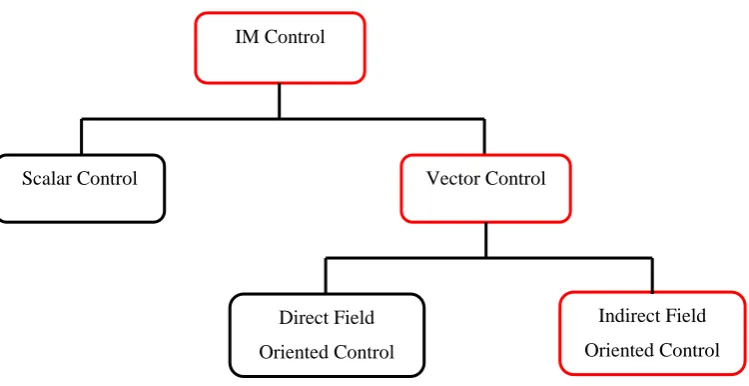
Many researchers are interested in IM as it provides diverse control techniques. Its control methods are divided in two groups, namely the vector and scalar control which are also known as open and close loop control [17].
Figure 2.2 : General classification of IM control methods
The magnitude and angular speed as well as the instantaneous positions of voltage and controlled current are the vital parameters for dynamic states of vector control. Therefore, the control provides correct orientation for both steady and transient states besides acting on the position of space vectors. This belongs to high-performance control implemented in a closed-loop mode and it enhances dynamically decoupled fast flux and torque control [3, 18]. The benefits that have been offered by VC are the speed control over a wide range, precise speed regulation, fast dynamic response and operational above base speed. Only several basic schemes that are offered in the market despite the vector control itself can be implemented in many different ways. Nowadays, FOC and direct torque control (DTC) are the most popular strategies.
The appearance of VC in early 1970s allowed a considerable increase of dynamic performance of IM [19]. Based on Fleming’s Law, the VC makes performance of IM to be as good as DC motor where torque and flux can be controlled independently after being decoupled. The effect of factors, such as inaccurate control and variable motor parameter will make actual performance of VC be worse than predicted in practical engineering applications. Some improved techniques, such as flux observer, rotor resistance identification are adopted to reduce the effect of this variation such that the control of VC can be satisfied in most applications and several methods are investigated to address this problem.
IM Control
Scalar Control Vector Control
Direct Field
Oriented Control
Indirect Field
10
2.4 Field Oriented Control (FOC)
FOC have made possible the application of IM for high performance applications where traditionally only DC drives were applied. Separate excitation DC motor has similar way as field oriented scheme that allows the control of IM. Speed control of three-phase AC electric motors is achieved by controlling the current where it is one of the methods used in variable-frequency drives or variable speed drives to control its torque. FOC torque is obtained by controlling the torque and flux current independently. By using FOC, at low and high speeds, there is not any torque ripples, thus smoother and accurate control can be achieved.
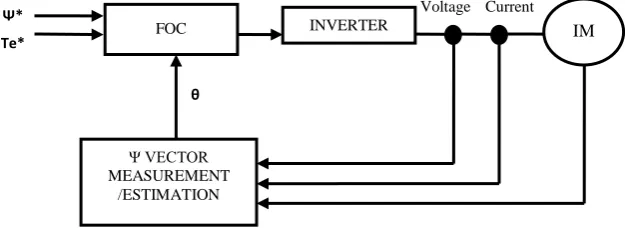
Figure 2.3 and Figure 2.4 shows the basic schemes of indirect and direct methods of VC. The direct VC method relies on the stator or air-gap flux with generation of unit vector signals. From stator voltage and current, the air-gap signals can be measured directly and estimated. Stator quantities can be directly computed through the stator flux. Rotor field angle does not need rotor speed in these systems. Rotor field angle and unit vectors are indirectly acquired by summation of the rotor speed and slip frequency which happens in indirect vector control (IVC).
Controlling the stator currents represented by a vector is included in FOC. Transforming a three-phase time and speed dependent system into two coordinates, i.e. d and q coordinates time invariant system by this control which based on projections. A structure that is similar to a DC machine control is brought by the projections.
Figure 2.3 : Indirect vector control method
Figure 2.4 : Direct vector control method
Knowledge of two currents and rotor flux position are the fundamental requirements for FOC. The core knowledge of FOC is the rotor flux position. The rotor flux is not aligned with d-axis and the current components are incorrectly estimated if there is an error in this variable. The rotor speed is not equivalent to rotor flux in the machine. A big credit to FOC is that it turns torque and flux of IM for direct and separate control. Instantaneous control of the separate quantities facilitates accurate transient and steady state management and obtaining DC motor’s advantage for FOC IM.
2.4.1 Review of Existing Previous Work
Reviews have been made for FOC IM with conventional and artificial intelligent based speed control techniques. Different control methods with their own advantages and disadvantages have also been discussed. On the other hand, speed performance has its own merits with different speed control methods.
FOC INVERTER IM
Ψ VECTOR MEASUREMENT
/ESTIMATION
θ
Voltage Current
Ψ* Te*
Voltage
INVERTER IM
FOC
SLIP CALCULATION
∫ Ψ*
Te*
θ
+ +
[image:34.595.184.497.272.386.2]12
2.4.1.1 Field Oriented Control of IM Drive
The control of AC electric machines is known as a considerable development and a possibility of real-time applications is similar to a consequence of the important progress in power electronics and micro computing [20]. Robustness, cost, reliability, effectiveness, maintenance free, simple and rugged structure, and ease of control [4, 15] that is used in various applications ranging from industrial motion, control systems to home appliances are some of the AC IM desirable features. DC motor drive has proven to have good dynamic torque response but the AC motor has also come up with the same features [21]. But it has only been used in industrial applications that do not require high performance for a long time. Very complex mathematical model due to coupling of physical parameters becomes a challenging problem because there is not any linear relationship between stator current and either the torque or flux and they exhibit significant non linearity than DC drives in dynamic industrial applications [22].
The use of the IM has become more popular since Blashke and Hasse who developed the new technique known as FOC [23]. It has been proven that this control strategy is well adapted to all types of electrical drives associated with IM and good at providing the same performance as DC machine [24]. A powerful tool for high performance control of IM has turned up to be FOC. Traditionally, only DC drives are used for high performance applications, but this technique has also made the application of IM successfully replacing the expensive DC motor.
Direct and indirect methods are the two schemes that can be reached in FOC. Flux position is measured or evaluated on the basis of flux components in the stator coordinates in direct FOC schemes. On the other hand, flux position is indirectly determined through rotor speed and slip estimation for indirect control schemes [25]. Among all the methods, simplicity of design and construction, the absence of rotor flux position sensor and the ability to operate at low speeds has made the indirect FOC control strategy well known.
through a coordinate transformation, to decouple the electromagnetic torque control from rotor flux, and therefore manage like a DC motor. To obtain DC quantities with dynamic behaviour, the variables are converted into a reference frame in this technique [26]. To achieve fast transient response of the IM, decoupling control between the flux and torque assigns. Thus, it is preferably used in high performance motor applications.
Normally, a high performance drive system is insensitive to load parameter variations, and must possess good dynamic speed tracking and load regulating capabilities [27]. The decoupling of torque and flux characteristics and easy implementation are the primary advantages of FOC technique. A parameter disturbance still limits the performance of these drives caused by detuning. Main criteria in controller design are the controllability of speed and torque in an IM without any peak overshoot and minimum ripples with good transient and steady-state response. A conventional controller is used to accomplish variable-speed operation.
2.4.1.2 FOC of IM Drive System with Conventional Speed Controller
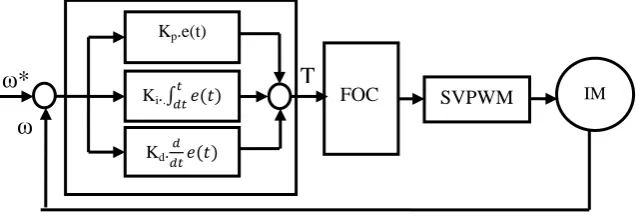
Although under ideal field oriented conditions, conventional controllers could not provide best performance over a wide range of operations. FOC is traditionally handled by conventional controllers, namely PI and PID controllers in variable speed of IM [6]. Zeigler Nichols and poles assignment are the known methods to determine optimal way for the PID controller’s parameters. Conventional controller complies with either using open or closed loop modes. It is a stable operation of the motor which in turn improves the operation of the motor and prolong its lifespan and eliminates steady-state errors by incorporating the limits in the integral portion of PI controller.
14
[image:37.595.155.477.175.286.2]and load disturbances that cannot always effectively control systems with changing parameters [29]. Hence, it is unable to regulate for conditions variations simultaneously and does not lead to good tracking as well. Deterioration of drive performance is usually caused by this type of behavior [30].
Figure 2.5 : The speed controller of FOC IM drives incorporated by PID controller
PID controllers that mostly used in industries as a practical implementation of FOC three-phase IM based on Space Vector Pulse Width Modulation (SVPWM) technique using DSP board TMS320F2812 is presented by Sulaiman, 2013. Inner current loop and outer speed control loop using PI controller are the two control loops of motor control. By using computational rotor time constant, rotor angular velocity and stator current of the rotor flux are estimated. Under different speed variations and load disturbance, performance of the drives system is tested. The motor can run in contrast speed and also dissimilar load disturbance with identical PI controller setting [31].
Comparisons between a variable gain proportional integral (VGPI) controller and a conventional PI controller used for speed control with an IFOC of a Doubly Fed IM (DFIM), being fed by two pulse width modulation (PWM) inverters with a separate DC bus link is presented by Chikouche, 2013. Based on state space input-output decoupling technique, the same transfer function (1/s) for all four decoupled currents is obtained by introducing a new approach for decoupling the motor’s currents in a rotating (d-q) frame. With better disturbance rejection than the classic PI controller, the results show a remarkable behavior of the VGPI controller during regulation and tracking. The VGPI regulator regulates well to load torque disturbance as well as faster dynamics with negligible steady-state errors under dynamic operating conditions and stabilizes against rotor resistance variation [32].
ω* T
ω
FOC SVPWM IM
Kp.e(t)
Ki..∫ 𝑒(𝑡)𝑑𝑡𝑡
An analysis for achieving control torque and speed with IFOC of IM is described by Maher, 2012. Low-cost applications are suitable for an indirect field-oriented output feedback motor PI controller. By using an analog-to-digital converter, a current model control is used to sense back electromotive force (EMF). This has proven that the conventional PI controller cannot compensate for such parameter variations in the plant and PI controller is not an intelligent controller nor is the slip calculation accurate [33].
Based on a sensorless closed-loop rotor flux observer with PI speed controller whose main advantages are simplicity and robustness to motor parameter detuning, Radu Bojoi, 2008 has implemented a sensorless direct rotor field-oriented control (SDRFOC) scheme of three-phase IMs for low-cost applications. At a low-cost fixed point, a DSP controller with full algorithms has been developed. In order to replace the traditional V/Hz open-loop control, the simple observer is implemented with low-cost fixed point DSP controllers, making it an attractive solution [34].
On the other hand, methods of computing PID parameters controller for VC of IM is proposed by Ajangnay, 2010. Settling time is required and motor parameters will be computed by the proposed method with optimal parameters for current loop, flux loop, and speed loop as functions. The only parameter required to be given by a user such that the method calculates the PID parameter for each loop control as the significance of the proposed method is the only factor to prove the proposed method. Robustness of the proposed method to system parameters variations is shown in simulation [35].
16
To control the speed of IM based on VC strategy, robust PI controllers are designed. Using Kharitonov theorem the design defines robust stability and performance regions in the kp–ki, PI controller coefficient plane. While necessary equations are derived from required foundations for designing a robust PI controller are also generally introduced. After the equations are derived, the required foundations for designing a robust PI controller are also introduced. The proposed method provides a systematic approach to design PI controllers for an IM and could be used to easily compute the stability region apart from ensuring robust stability and performance of the closed-loop system [37].
The PWM with IFOC of an IM in parallel Hybrid Electrical Vehicle to enhance the performance and the stability of the system is applied by Abad, 2011. PI controller is employed to control rotor speed of the IM. To be able to control the output voltage of the PWM inverter which feeds the IM, a hysteresis current controller is applied. The IM responses to torque changes very quickly and precisely. Nevertheless, the torque response is not fair enough as shown in simulation for various rotor speeds. It takes 0.2s for the torque to reach its steady-state condition in every step of changing the rotor speed. Consequently, speed should be sustained at different torque [38].
Reljic, 2006 proposed a modified PI controller with feed-forward for desired performance such as quick response, reference tracking, low steady-state errors, and wide system bandwidth and good disturbance rejecting capability despite being the traditional PI controller. In this paper, optimization procedure for classical PI and modified PI controller is mentioned. The only problem is that the modified PI controller has 3 parameters to tune [39].
2.4.1.3 FOC of IM Drive with Artificial Intelligent Speed Controller
The control algorithm should include a complicated computation process to eliminate the variations in the load disturbance so as to overcome the drawbacks in conventional controllers [28]. Real-time implementation requires extensive computations as the control algorithms applicable to these systems have become increasingly more complicated. The essential of intelligent controllers is to gain adequate dynamic performance of traditional methods. NN and fuzzy logic controller (FLC) are considered as potential candidates for such an application in recent years [41]. The research on the design and implementation have proved their dexterity in many respects and gained great importance [26].
FLC as a sophisticated method which lends itself very well to regulate and control to understandable process using appropriate conventional classic methods is a solution that had been proposed in [42]. A FLC has excelled in dealing with systems that are complex, ill-defined, non-linear, or time-varying. It is relatively easy to implement, as it usually needs no mathematical model for the controlled system. The simplicity in control are the advantages of FLC over PI controller by converting the linguistic control strategy of human experience into an automatic control strategy that will be achieved [43].
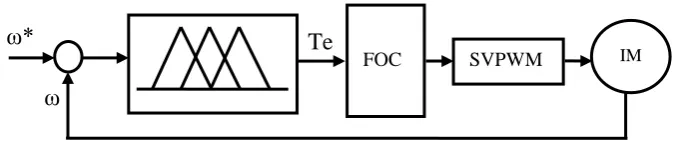
[image:40.595.160.499.628.699.2]FLC takes high quality performance subject to varying operating conditions, for instance step change in speed and torque reference [44-46]. Figure 2.6 show the speed controller of FOC IM drives that implemented by FLC. As for IM speed control applications the FLC is the simplest of all the intelligent controllers [47]. Despite that, FLC also have difficulties in tuning the parameters of the membership function according to changes in the system and in determining appropriate control laws
Figure 2.6 : The speed controller of FOC IM drives incorporated by fuzzy logic controller
Te ω
ω*
18
It has been proven that various control strategies in controlling inverter fed IM Drives gives good steady-state performance but poor dynamic performance. Variable speed AC Drives came into existence to achieve good dynamic performance and to meet preferences set by DC drives. By decoupling torque and flux control FOC of IM has produced fast transient response. Major difficulty for IFOC method is the field orientation detuning caused by parameter variations. Even when proper field orientation is achieved, the traditional probability density function PID controllers also have trouble meeting a wide range of speed tracking. When detuning occurs, PID controller’s performance is severely degraded. FLC design that meets the speed tracking requirements even when detuning occurs is proposed by Brian Heber, 1997. Methods for synthesizing a controller from engineering experience that can be more robust, having better performance, and reduce the cycle times is achievable in FLC [48].
Fuzzy logic based controller used for an indirect vector controlled (IVC) three-phase IM has been proposed by Bhushan, 2011 and Mariun, 2004 in terms of theory, design and simulation. By decoupling the flux and torque, the FOC of an IM has achieved fast transient response. By using MATLAB, the simulations have been realized. Based on drive at different operating conditions such as parameter variations and sudden change in load, the performance of the proposed FLC has been investigated and compared with the results obtained from the conventional PI controller. A FLC in indirect vector control IM (IVCIM) gives superior performance in terms of fast dynamic response and parameter variations and more robust than PI controller [49-52].
IM have many applications in industries because of its low maintainability and robustness. An IM with smart speed control system using fuzzy logic controller was introduced by Eltamaly, 2010. To compare the performance of control system with FLC with two speed control techniques, scalar control and IFOC are used. Especially with high dynamic disturbance IFOC technique with FLC provides better speed control. With speed variation and transient conditions in controlling three-phase IM with IFOC, the simulation results have proven the superiority of the FLC that gives fast response, smooth performance, and high dynamic response [44].
Chao, 2011 research on the speed control performance improvement of a detuned indirect field oriented (IFO) IM drive. A transfer function model is established and the dynamic behavior of a detuned IFO IM drive is observed. An ideal IFO IM drive for a nominal case with desired dynamic response is designed from then PID two-degree-of-freedom controller (2DOFC). The detuning of field-orientation accompanying the load parameter changes may significantly worsen the speed dynamic response as the variation of motor parameters occurs. A proposed fuzzy robust control (FRC) to preserve prescribed response is yielded by a compensation signal in this case. The compromise between control effort and performance is considered, robust model following speed response is obtained since the compensation signal is adaptively tuned by a model following the error driven fuzzy weighting controller [38].
A FLC requires finer tuning and simulation before operational even though it is easy to verify and explicit. NN has been used in some power electronic applications in the past decade. Using a system input and output, the NN controller, on the other hand, has the ability to adapt itself to changes in control environment [54]. It is able to identify and control nonlinear system [8, 55]. It does not require exact model of the system or complicated control theories. The outputs are the torque of the artificial NN valuated on several counts including their adaptability, non-linearity, and generalization capabilities as well as the operating speed that trains a NN to represent a variety of complicated nonlinear systems has made it possible in the recent development of NN technology [56].
20
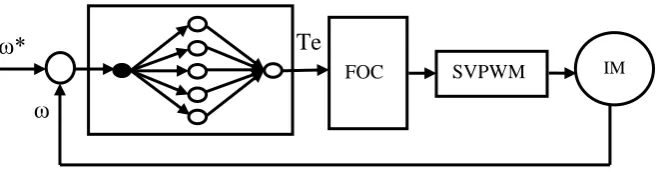
[image:43.595.164.497.193.279.2]speed controller of FOC IM drives implemented by NN controller is shown in Figure 2.7. NN is taking advantage of learning capability of and it is possible to practically employ a NN that is insensitive to system parameter variation [33]. It is assumed that NN as an artificial intelligence tool that leads to modern techniques in power electronic motion control systems.
Figure 2.7 : The speed controller of FOC IM drives incorporated by NN controller
NN for online and offline models have their own advantages and disadvantages. Offline model can only robust to small variation, but fail to adapt to larger changes in the system even though it can handle large data as computation time that is not critical to their structure. To emulate the function of FOC, the use of an offline training of NN has been proposed in [57,58]. To simplify the implementation of FOC it shows that NN provides new solution. FOC of IM extracts the input and output signal for training the NN. Because of its limitation to larger changes of the system so that it can follow the speed trajectory specified by reference model, the NN has been trained using a several condition to update their weight.
Peter Girovsky, 2012 dealt with a problem of speed estimation in a shaft sensorless FOC structure with IM that is based on NN modeling approach that trained offline by Lavenberg Marquardt algorithms. The structures of artificial NN estimators are based on measurable motor variables and the results of NN angular speed estimator is verified by a real-time system. The drive has better adaptability and robustness in comparison with the drive without estimator [13].
The Artificial Neural Network (ANN) principles in the development of an ANN based FOC of an IM was a research project by BA-Razzouk, 1997. In implementing an IFOC, a two-layer ANN has been trained offline to estimate the slip, the direct and quadrature current to be used. Alternative intelligent to the conventional FOC controllers uses this method. The three IM Drive basic schemes of flux orientation, namely, stator flux, air gap can be applied to the proposed method.
Te ω*
ω
It is accomplished with manipulating only the weights and biases of the ANN, using the same training strategy and the same ANN structure can easily handle these three schemes [59].
A scheme for estimation of rotor resistance using a NN block is presented by Ebrahimi, 2010. By using stator voltage and current, the flux and torque have been estimated. At the input and estimates the actual rotor resistance at the output, which is used in the control of an indirect vector controlled drive system, a back propagation NN receives the flux and torque errors and a supposed rotor resistance. In detuning operations, the NN has been trained offline with mathematical model of the control scheme. The NN estimator used with IRFOC control has been studied in the detuning condition. Despite when the rotor time constant is increased from nominal rate to twice the nominal value, as well as torque variations, the performance of the controller is good. Though this method’s design is simple, estimation is done quickly and accurately.
A DSP implementation of a NN IM controller performing with FOC is presented by Mohamadian, 2003. Two stages of training are required to train the NN, which is at offline training stage and another stage where experimental data is employed to train the NN has been confirmed by experimental test results. Compared to the errors caused by the limited number of neurons and any lack of information in the training data, the NN error due to computation approximations is negligible [58].
On the other hand, Parma, 2003 proposed a scheme that based on the direct application of an artificial NN, trained with sliding mode control, into the feedback control system based on the online model adapts to variation quickly in the non-linear behavior of the system [9]. Robustness and high speed learning is inherits from Sliding Mode Control (SMC) when NN learning is implemented with an online adaptation algorithm. As a function of speed and flux references, it is important to mention that the control quality can be improved if the training algorithm is employed with adaptive gains. Using only two ANN controllers the training algorithm based on SMC is robust enough to maintain the system’s controllability. The findings show that NN with online learning can replace the PI and PID controllers used in classical motor drives [60].
22
speed, the estimation algorithm uses a state observer combined with an intelligent adaptive mechanism based on a recurrent NN (RNN). A simple PI controller, which reduces sensitivity to variations, due essentially to the influence of temperature, estimates the stator and rotor resistance. Various operating conditions of the IM drive are tested by the proposed sensorless control scheme. It guarantees that a precise trajectory tracking with prescribed dynamics as the experimental results demonstrate good robustness against load torque disturbances, the estimated flux and rotor speed converge to their true values [61].
The use of RNN was proposed by Mayaleh, 1998 where the method of vector control allows high-performance control of torque, speed or position to be achieved from an IM by online estimation of the rotor resistance. A highly coupled nonlinear IM is controlled as a linear-decoupled separately excited DC motor. In the VC method, it is necessary to perform coordinate transformation because decoupling of the flux and torque of the stator currents in VC is ensured by accurate calculation of the unit vectors. Simulation results show that the new approach is capable of fast estimation of the rotor resistance with negligible errors [62].
2.5 Gap of Study
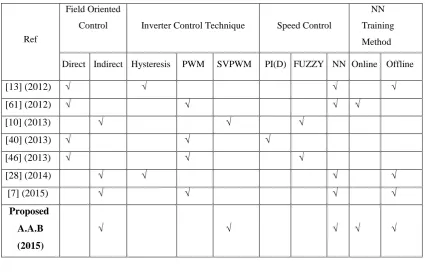
Table 2.1 : Gap of study for the NN based FOC of IM drive according to the several recent works.
Ref
Field Oriented
Control Inverter Control Technique Speed Control
NN
Training
Method
Direct Indirect Hysteresis PWM SVPWM PI(D) FUZZY NN Online Offline
[13] (2012) √ √ √ √
[61] (2012) √ √ √ √
[10] (2013) √ √ √
[40] (2013) √ √ √
[46] (2013) √ √ √
[28] (2014) √ √ √ √
[7] (2015) √ √ √ √
Proposed A.A.B (2015)
√ √ √ √ √
2.6 Conclusion
24
CHAPTER 3
METHODOLOGY
3.1 Introduction
In this chapter, the overall planning and block diagram of this project are discussed further. Before proceeding to detail development of the proposed NNIFOC schemes of IM drives, it is essential to understand the concept of the feed-forward network and the online learning control schemes. Then, the specific explanation of the proposed NNIFOC of IM drives is given.
3.2 Project Flow Chart