Resource centres and selfstudy: issues in
computer assisted language learning
Jarvis, HA
Title
Resource centres and selfstudy: issues in computer assisted language
learning
Authors
Jarvis, HA
Type
Book Section
URL
This version is available at: http://usir.salford.ac.uk/11268/
Published Date
2008
USIR is a digital collection of the research output of the University of Salford. Where copyright
permits, full text material held in the repository is made freely available online and can be read,
downloaded and copied for noncommercial private study or research purposes. Please check the
manuscript for any further copyright restrictions.
Resource Centres and Self-Study: issues in computer assisted language
learning
Huw Jarvis, University of Salford
Abstract
University students increasingly access computer-based materials (CBMs) beyond the classroom, in Resource Centres (RCs) – where the facilities are usually only available to students studying a specific academic discipline, in college and university libraries – where the facilities are available to all students, as well as at home and in internet cafes; and there is an increasing expectation that such materials are, at times at least, being used for self-study purposes. The pedagogical advantage of using a number of particular CBMs in both classroom-based situations and beyond is well documented. Surprisingly, however, few studies have been conducted which look at the choices that students make where a wide range of CBMs are available, as in self-study contexts, and the extent to which students view such CBMs as actually helping their learning. This paper reports on a languages-based study, which employs a combination of quantitative and qualitative research methodologies in order to examine such issues. It asks the following questions: Which CBMs do non-native speakers (NNS) of the English language make use of and why? Where access is available in a range of locations, where do students choose to work and what might the implications of this be for RCs? To what extent do students consider a variety of CBMs as actually helping with their language studies? What might the answers to these questions imply for our understanding of computer-assisted language learning (CALL)? Although this study is based in languages, its findings arguably have implications for educational practice across academic disciplines. Several themes arise out of this work; firstly, the physical location of an RC is important even when most CBMs are available elsewhere - it is suggested here that where the physical and the virtual worlds meet is a significant factor and one which warrants further investigation. Secondly, from the learners’ perspective, a wide-range of CBMs are viewed as helping with learning, irrespective of whether they fulfill a direct and obvious teaching role. Thirdly, world wide web-based delivery is the preferred to networked, and sometimes more sophisticated, commercially available multi-media CD ROM packages. Finally, live computer-mediated-communication (CMC) appears to be a considerably underused resource. These findings suggest that the validity of some of the long-established frameworks for
conceptualising CALL need to be questioned.
Key words: computers, self-study, learner autonomy, CALL, internet, language resource centres.
Introduction
Computers and the materials that they support, throughout their evolution in pedagogy, have long been associated with self-study and autonomous learning. To date, however, there is surprisingly little research which investigates this linkage from the learners’ perspective across the wide-range of CBMs which are available for students to make use of in their studies. The research agenda has instead tended to focus on how effective a particular software programme is, and this is usually examined in fairly controlled situations, either in classroom delivery or structure delivery via a virtual learning environment (VLE). This lack of work in the area of less controlled situations, across a number of CBMs is a serious omission given widespread availability in RCs, libraries and beyond. This paper is a contribution to addressing this shortfall.
Concepts and Issues: Computer Assisted Language Learning (CALL)
A further distinction, is to view CBMs as being tool or tutorial-based, a notion originally introduced by Taylor (1980) and further developed by Levy (1997). The former has an explicit teaching function whilst the latter does not. Tool-based CBMs are increasingly important for all HEI students, Collins and Wende (2002 :7) observe that “ICT use, in terms of email, word-processing, Power Point, and the Web, has become standard as part of the teaching and learning process…”. Tutorial-based CBMs allow for conscious language learning and are particularly valued for their use in self-study, they allow students to practise language and receive feedback on whether their answers are right or wrong. How then are these notions realised within the context of CBMs and self-study?
CBM Applications
CBM-based activities in self-study contexts include: language practice exercises in text-based or multi-media forms; sending emails to each other and\or to academic tutors and\or “chatting”; accessing and posting information on a VLE; accessing information from the WWW or library catalogues and making use of on-line dictionaries. Appendix 1 documents the questionnaire used in the study and provides a more detailed list of the variety of CBMs - most of these are self-explanatory. The outcome to language practice activities might be measured with correct or incorrect responses to reading, writing, listening, grammar, vocabulary and
pronunciation exercises - here the tutorial role of CALL is being used by students. Outcomes to other CBM activities might include a word-processed written assignment and\or a Power Point presentation – here the tool function of CALL is being used. Depending on the types of activities undertaken, CALL might be operating within any of Warschauer and Kern’s three phases. Specific examples of tutorial CALL include commercial multi-media packages which are made available on a local area network (LAN). Examples available to participants in this study include, Essential Academic Skills in English (EASE)
http://www.ease.ac.uk/, Mind Game and Tense Buster by Clarity Software http://www.clarity.com.hk/, a pronunciation suite by Sky Software Househttp://www.skysoftwarehouse.com/index.php?page=pronunciation
and Issues in English by Proteatextwarehttp://www.proteatextware.com.au/iie.htm .
The internet also provides students with a range of such tutorial-based programmes, some of which are free of charge. The quantity of such materials is huge, but the quality is varied. Some of the material allows for language practice and interaction with a global community of learners (and can thus be classified as sociocognitive CALL). More frequently, however, such material involves students interacting with the computer by inputting answers to questions and receiving automated feedback, albeit limited; the better examples reflect a communicative approach whilst other examples seem to adopt a behavioural-based methodology. One such example of a tutorial-based CBM which specifically focuses on the needs of NNS at HEIs is Using English for Academic Purposes http://www.uefap.com/.
Most of the CBMs listed in Appendix 1 were available to students to use not only in the RC, but also elsewhere. The one exception to such availability however was the commercial LAN multi-media packages which, for licensing reasons, are only available in the RC. One CBM which is less self explanatory is Blackboard to develop independent learning (DILL). This was delivered within the timetable as a course component and was designed to guide the learners on how to make the most of language learning outside the classroom. At the beginning the students discussed their learning styles and were shown how to find materials in the RC. Throughout the course, strategies for all the language skills of listening, speaking, reading, writing as well as vocabulary and grammar were covered. In addition to improving the learners’ strategy use, the DILL classes aimed to help the students with more general study skills such as reflecting on their learning, assessing their progress, making plans and setting goals for their future independent learning. It is recognised that the presence of a RC and the availability of CBMs within it and elsewhere does not in itself mean that self-study will necessarily take place, a degree of guidance is seen by some as essential (Sheerin, 1997; Sturtridge, 1997). Whilst DILL starts in the classroom it is very much the intention that it continues beyond, and involves being guided to use CBMs (as well as other material such a paper-based self-study books), and participating in VLE discussion forums on a range of topics around language and language learning.
Self-Study
Self-study is of course one of the defining characteristics of learning at an HIE. By way of illustration a 15 credit module at M level will typically involve 150 hours of study; with a little as 24 hours of this time being spent in face-to-face lectures and seminars, the importance of self-study is self evident. Whilst the exact proportions of face-to-face contact and self-study will vary between programmes and levels, all involve a significant amount of self-study. There is a considerable body of work in this area within languages and beyond, and when based on individuals making their own choices, as in this study, this is usually discussed in terms of learner autonomy: Benson, (2001); Dickinson, (1996); Little, (1991); Palfreyman and Smith (2003), Scharle and Szabo, (2000). Most definitions focus on the notion of taking charge of one’s own learning. Dickinson’s (1987:11) definition as “the situation in which the learner is totally responsible for all of the decisions concerned with his learning and the implementation of those decisions” is the one which is
particularly useful for the purposes of this study in that the participants used CBMs in the Language Resource Centre (LRC), and elsewhere, of their own accord and without any practitioner intervention. A review of the literature reveals surprisingly little work on CBMs and self-study, and that which has been conducted tends to focus on what learners do when they interact with a particular courseware (Schwienhorst, 2003; Groß and Wolff, 2001; Komori and Zimmerman, 2001; Dias, 2000), rather than the choices that students make about which CBMs to use and how such materials are perceived.
The Research
We have seen that a wide range of CBMs are available for students to use in RCs, and beyond, and we have placed these within a conceptualisation of CALL. Furthermore we have noted that one of the purposes of RCs is to provide a physical location for students to use CBMs for self-study purposes. The purpose of this study was to obtain learner perspectives on the extent to which these notions were recognised across a wide variety of CBMs. It asks the following: Which CBMs do non-native speakers (NNS) of the English language make use of and why? Where access is available in a range of locations, where do students choose to work and what might the implications of this be for RCs? To what extent do students consider a variety of CBMs as actually helping with their language studies? What might the answers to these questions imply for our understanding of computer-assisted language learning (CALL)?
Context: the resource centre
Resource centres have come to be a prevalent feature in a wide range of contexts in schools, colleges and universities or Higher Education Institutions (HEIs) and the LRC at the HEI in this study is considered to be a major asset in the delivery of languages-based programmes. Such centres will typically include paper-based materials, such as reference and self-study books, as well as technology-based provisions, such as TV’s, video’s, DVDs and, above all, computers and computer-based materials (CBMs). Whilst RCs provide a range of self-study materials, it would be fair to assert, and this is supported by the data in this study, that CBMs dominate. Indeed, arguably, they have become the defining characteristic of such centres. In many educational contexts across the globe it would be difficult to imagine a RC without CBMs. At HEIs access to RCs is usually restricted to students who are enrolled on a programme within the School or Department, as is the case in this study and for this reason we shall henceforth refer to the RC as a Language Resource Centre (LRC). The justification for this is that in contrast to other locations such as a library, it allows centres to provide a wider range of specific self-study based materials for their students in a dedicated environment.
Participants and Their Courses
All participants were on one of several English language courses with an English for Academic Purpose (EAP) focus; the primary purpose of which is to equip NNS with the language and study skills required for successful academic study. The vast majority of participants were drawn from two main EAP programmes. A common core pre-sessional summer programme was available to all non-native speakers (NNS) irrespective of the academic discipline that they were going to follow in September and irrespective of the level at which they were going to study (foundation, level 1 or M level). The second main programme was subject-specific postgraduate access programme – here all the students were studying English in order to go on to M level postgraduate studies within the School of Business. A small number of participants were drawn from other programmes such as a pre-undergraduate foundation course and credit-bearing modules available on other languages-based BA programmes.
Participants came from a broad geographical spread which included Europe, Africa, The Middle East, Asia and South America. Over half the participants were from mainland China, but the spread of other participants was much more even. The programmes were available at several language levels from lower intermediate to advanced. The participants taking part in the quantitative element of this study totaled 68. However, not all participants answered every single question, particularly with regards the use and value of CBMs in the LRC (Appendix 1, Q:3), and the totals for each response are, therefore, specified. Data from 38 participants is drawn from the pre-curser to this study, which compared practices and perceptions of modern foreign language students with their English as a Foreign Language (EFL) counterparts (Jarvis, forthcoming 2008) and this figure is combined with a further 30 participants who were new to this study. It should also be noted that the questionnaire includes one CBM , Can 8 (Q 3.13) which is only applicable to final year modern foreign language students, and is not, therefore, included in our discussions here. There were no significant differences between students on different programmes or between nationality-background groupings and the data is therefore presented and discussed as a total figure for all participants.
A total of 6 students took part in the qualitative element which involved face-to-face, one-to-one interviews with a research assistant. Their responses were recorded and transcribed and where relevant their insights are included in the results and implications section. The selection of these particular students was largely
pragmatic in that the six students were drawn from those who replied to an email shot. Availability at a mutually convenient time in March 2006 was the critical factor in the final selection. Student 2 was on a pre-sessional summer course prior to going on to undertake PhD studies, the remaining 5 participants were all on a subject-specific postgraduate access course. Two students were Chinese, two were Thai, one was
Methodology
The study thus employs both quantitative and qualitative techniques. The former is used to explore “the measurement and analysis of casual relationships between variables, not processes” whilst the latter allows for a focus on “processes and meanings that are not rigorously examined, or measured in terms of quantity, amount, intensity, or frequency (Denzin and Lincoln, 1998: 8). The quantitative element consisted of a Likert scale questionnaire (Appendix 1) which was administered to students in the LRC over a period of six months throughout semester 2 and the summer months of 2005. This element was designed to generate data in order to identify trends. The qualitative element consisted of more detailed open-ended interviews which were used to get closer to meanings, views and feelings of participants.
CBMs
Used Every, Most or Some visits to the
LCC (%)
Helps A lot or To some extent with language learning (%)
On-line dictionaries 70.1 75
Email to contact tutors and/or classmates 70.1 53.2
Live chats with friends and /or family 40.3 34.4
Live chats with tutors and /or classmates 25.4 37.7
The WWW to access sites with exercises to practise
language 86.8 82
The WWW to access academic information 92.4 83.6
The WWW to access personal information 76.1 50
Library catalogues and other electronic resources 66.7 60
Blackboard to develop independent language learning 66.2 52.6
The word processor to write assignments 82.9 74.6
Power Point to work on presentations 38.8 44.3
Excel to present and collate data 36.9 31
Computer assisted language learning materials 68.6 83.9
Results and Implications
The study generated a considerable amount of data and our discussion will only draw upon that which is of particular relevance. However, the full findings of the quantative study are included (as percentages and in italics) within the questionnaire (Appendix 1), but limitations of space do not allow for the inclusion of the transcripts from the interviews.
LRC Use
All students to the School are given an orientation to the LRC and with 89.6% participants reporting that they were shown round and 82.1% having specifically been shown the CBMs, it is reasonable to assume that the responses obtained in this study come from informed students. In response to the question (2.1) regarding the importance of the LRC to participants’ language studies, a total of 67.6% reported that it was very important, 23.5% that it was important, 8.8% that it was quite important, with no one reporting it as not very important or not important. The majority of students make frequent use of it, with 48.5% reporting visiting 4 to 5 times per week and 55.6% two to three times per week. A total of 42.6% reported usually spending 1 to 2 hours in the centre, 16.2% more than two hours, 14.7% half an hour to one hour, 25% replied with “it depends” and only 1.5% reported less than half an hour. All students (100%) reported usually using CBMs, 35% TV and Video, 38.2% Books and Worksheets, 23.5% Audio cassettes and 7% Other materials. The significance of CBMs for students in self-study contexts, over and above all other materials, is clearly demonstrated. This data indicates that students value the resources in the LRC and the reasons were mentioned in the interviews. Student 6 typically articulates this as follows: “… there are a lot of materials … I can find more information about vocabulary, grammar.” The resources that an LRC offers are clearly important and it is CBMs which dominate students’ usage. Despite many CBMs being available elsewhere, this does not seem to undermine student enthusiasm for RCs.
CBMs and their Value to language Learning in the LRC
Table 1: CBM frequency of use and value to language learning
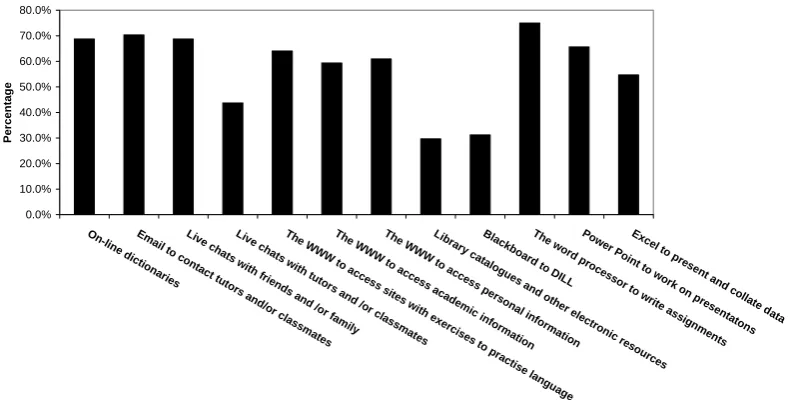
Graph 1: Computer uses outside LRC (N=64)
0.0% 10.0% 20.0% 30.0% 40.0% 50.0% 60.0% 70.0% 80.0% On -line d
ictio naries
Em
ail to c on
tact tu tors an
d/o r cla
ssm ates Live c
hats w ith frien
ds a nd /or f
am ily Live c
hats w ith tuto
rs and /or cla
ssm ates The W
WW to a
cce ss sites
w ith exer
cis es to p
ractise lan
guage The W
WW to acce
ss a cadem
ic inform ation The W
WW to acce
ss p erson al in form ation Library ca talo
gues a nd
oth er elec
tronic resou
rces Bla
ckboar d to DIL
L The w
ord pro cessor to wr ite a ssignm ents Powe r P oint to
w ork
on pre sentato
ns Exc
el to pre sent an
d colla te d Per cen tag e ata
On-line dictionaries; Email to contact tutors or classmates; WWW
sites a) with exercises to practise language, b) to access academic information and c) to access personal information; Library catalogues and other electronic resources; Blackboard to DILL; the word-processor and CALL materials are all frequently used and valued as helping with language learning a lot or to
some extent by at least 50% of students. In contrast the less frequently used CBMs such as Live chat to friends, tutors or classmates; Power Point and Excel are not widely viewed as helping with language learning. It is clear that where students perceive that a CBM helps with language learning, it is frequently used and the opposite is also true. It is worth noting that students do not appear to view tutorial-based CBMs as helping with their language studies any more than tool-based materials, nor do we see much evidence of social interaction via CMC – we will return to the implications of these findings in due course.
It is also worth noting that the data suggests that the integrated use of CBMs is being realised. For example students working on a word processed assignment are likely to be accessing relevant information from the WWW (and other sources) and checking word meaning using an on-line dictionary whilst doing so – in such scenarios each CBM appears to be valued as helping with language studies. Bax (2003) has characterised this as the “normalisation of CALL” where computers are fully integrated into language pedagogy, it would seem from the questionnaire that this is happening in self-study contexts and this is further supported with the qualitative data. Student 4 for example comments that: “…yes I use the internet to help me to write my project…”,
whilstStudent 1 observes that: “…everything is in the computer, the information, the dictionary and my assignment work too … I can use it together ….”
CBMs outside the LRC
The data in the bar chart indicates that many of the CBMs which are used inside the LRC and are viewed as helping with language learning are also used outside the LRC.
Implications and Discussion
An LRC is considered the ideal environment for self-study
Many students would seem to view the LRC as the ideal environment for language learning in self-study contexts. This is reflected in several respects; from the quantative study we can for example note the rather infrequent use of Blackboard to DILL from home. The interviews provide further evidence of this - when asked to comment on where they prefer to work when using CBMs, student 1 replied the LRC because:
“…the only thing in my brain is to study. But when I am not in the university, I will always remember playing games, or looking movies… in the LRC, I think, the main, the main point I use computer is to study. Student 5 says: “But you know in a room, living room, the more leisure times we should, should spend, maybe we will use computer to listen , listen music. Play games and also…also do some chat with all my friends.” Student 3 was particularly emphatic about the value of the LRC in helping him to focus: “… I can’t work for my own course, I need support in a sense. I need support…it’s no easy for me to work from home.”
In an anywhere, anytime era of on-line access and communication of information, such comments remind us that despite all that the virtual world has to offer, it is the physical location which remains vitally important in helping students to focus on langue learning activities. The study concludes that the point at which the physical world meets the virtual world is highly significant in self-study and the realisation of this aspect of learner autonomy via CBMs.
Students take a broad view of which CBMs are helpful for language learning
Tool-based CBMs such as on-line dictionaries and word-processors, medium-based CBMs such as
asynchronous emails are generally valued for language learning just as much as tutorial-based CALL. There are, for example, only slight differences with regards frequency of use and value attached to language learning when we compare WWW sites to practise English and those to access information. Using the WWW in English is viewed as helping develop language skills even when there is not explicit teaching or learning function. Learners seem to recognise the significance of English as a lingua franca in an academic environment and the WWW is a significant medium in this respect.
The long established tutor – tool distinction in CALL does not appear to be recognised by learners and may now, in a WWW-dominated age, be dated. We have already noted that the links between tutorial CBMs in CALL and self-study are immediately obvious and have also mentioned that these materials are usually associated with the first two phases of CALL, answers or responses are inputted into the computer and feedback of a corrective or next scenario of some kind is then given. Although those students who make use of LAN-based packages gave positive feedback, the numbers that use such packages, when compared to those using WWW-based sites to practise their English, was very low. Despite the fact that these packages tend to be more fully multi-media-based in that they integrate text, graphics, audio and video, there is a clear preference for WWW-based exercises, which by comparison are predominantly text-based. The WWW is clearly the preferred medium of delivery and despite the importance of the LRC as a physical location, the opportunity to use such material, along with other materials beyond it, would seem to be important to students.
Synchronous Use of email or Live Chatting is an Underused CBM
CBMs, making it available does not necessarily mean that it can be used, and then perceived as helping with language learning – if it is to be fully harnessed in self-study contexts it needs “setting-up”. These reasons came across in the interviews, a typical comment being “I chat to people around the world in my country yes, but here no, no need” and with regards setting-up, a typical comment was, “my tutor doesn’t use live chatting” and “my classmates are not on-line”. We have seen that there are good pedagogical reasons for harnessing the potential of the CBM and it may be that providers, particularly those working outside target language environments, ought to be finding ways of doing so by pro-actively setting-up meaningful chatting in the target language in self-study contexts. All HEI providers probably need to also find ways of bringing lectures on-board in terms of posting availability in virtual contexts – such actions are likely to significantly increase the use of this CBM in self-study contexts, and in so doing providers and learners would be helping to develop and further articulate the sociocogative phase of CALL.
Conclusion
Students in this study have indicated that although they value material which explicitly helps develop their language skills, this does not negate the validity of other CBMs in their language learning and the relevance and a range of activities which fall into various CALL conceptualisations and classifications be it contacting classmates and tutors (as in sociocognitive CALL as a medium), or using on-line dictionaries and word-processors (as in CALL the tool). Above all, however, the study suggests that the physical location of an LRC is highly valued by students even when the majority of CBMs are available elsewhere, and in this respect LRCs can be characterised as being the ideal environment in which the physical and virtual worlds of the
autonomous language learner meets. Further studies might usefully further develop this notion. Synchronous use of email in an academic context appears to be underused and under-appreciated and it is suggested that this could be more fully developed.
References
Bax, S. (2003). CALL – past, present and future. System, 31/1, 13-28.
Benson, P. (2001). Teaching and researching autonomy in language learning. Harlow: Pearson Education Limited. Collins, B. and Wende, M. (2002). Models of Technology and Change in Higher Education. An international comparative survey on the current and future use of ICT in Higher Education. Center for Higher Education Policy studies. 1-85. Available at http://www.utwente.nl/cheps/documenten/ictrapport.pdf
Denzin, N.K. and Lincoln, Y.S. (Eds.) (1998). Collecting and interpreting qualitative materials.
California: Sage Publishers.
Dias, J. (2000). Learner autonomy in Japan: transforming ‘Help yourself’ from treat to invitation.
Computer Assisted Language Learning,13/1, 49-64.
Dickinson, L. (1996). Learner training for language learning. Dublin: Authentic Language Learning Resource.
Dickinson, L. (1987). Self-instruction in Language Learning. Cambridge: Cambridge University Press. Egbert, J. (2005). CALL Essentials: principles and practice in CALL classrooms. Alexandria: TESOL, Inc.
Freiermuth, M and Jarrell, D. (2006). Willingness to communicate: Can on-line chat help? International Journal of Applied Linguistics, 16/2, 190-213.
Groß, A. and Wolff, D. (2001). A multimedia tool to develop learner autonomy.
Computer Assisted Language Learning,14/3, 233-249.
Jarvis, H. (forthcoming, 2008). Computers and independent study in language resource centres: practices and perceptions of students. In Torres, P. and Marriot, R. (eds), Handbook of Research on E-Learning Methodologies for Language Acquisition. PA:Idea Group Publishing.
Jarvis, H. (2004). Investigating the classroom applications of computers on EFL courses at higher education institutions in UK. Journal of English for Academic Purposes, 3/2, 111-137.
Kitade, K. (2000). L2 learners’ discourse and SLA theories in CMC: Collaborative interaction in internet chat. Computer Assisted Language Learning, 13/2, 143-166.
Komori, S. and Zimmerman, E. (2001). A critique of Web-based kanji learning programs for autonomous learners: suggestions for improvement of WWKanji.
Computer Assisted Language Learning,14/1, 43-67.
Krashen, S. (1982). Principles and Practice in Second Language Acquisition. Oxford: Pergamon Levy, M. (1997). Computer-Assisted Language Learning. New York: Oxford University Press.
Little, D. (1991). Learner Autonomy Definitions Issues and Problems. Authentik Language Learning Resource. Palfreyman, D. and Smith, R. (eds.), (2003). Learner Autonomy Across Cultures. Language Education
Perspectives. New York: Palgrave Macmillan.
Payne, J. S. and Whitney, P.J. (2002). Developing L2 oral proficiency through sychronous CMC: Output, working memory, and interlanguage development.CALICO Journal, 20/1, 7-32.
Taylor, R. P. (Ed.) (1980). The Computer in the School: Tutor, Tool, Tutee. New York: Teacher’s Colledge Press. Thorne, S. and Payne, J. (2005). Evolutionary Trajectories, Internet-mediated Expressions, and Language Education. CALICO Journal, 22/3, 371-397.
Scharle, A. and Szabo, A. (2000). Learner autonomy. Cambridge: Cambridge University Press. Schwienhorst, K. (2003). Learner autonomy and tandem learning: putting principles into practice in
synchronous and asynchronous telecommunications environments. Computer Assisted Language Learning,16/5, 427-443.
Sheerin, S. (1997). An exploration of the relationship between self-access and independent learning. In P. Benson and P.Voller (Eds.), Autonomy andindependence in language learning. London: Longman.