Assessing Sustainability Performance of Polymer Processing: Case
Study of Hollow Fiber Membrane
Salwa Mahmood
1, a *, Nor Hazrina Jamil
1, b, Muhamad Zameri Mat Saman
1, c,
Noordin Mohd Yusof
1, d1
Faculty of Mechanical Engineering, Universiti Teknologi Malaysia, Skudai Johor, Malaysia
a
[email protected], [email protected], [email protected],
d
Keywords: Sustainability Assessment; Polymer Processing; Hollow Fiber Membrane.
Abstract. Sustainability nowadays has become new evolution of quality and efficiency indicator for
product and process. Key performance of certain product or process need to be quantified throughout it is life cycle. Polymer processing is one of the chemical processes that need attention in term of sustainability. Hence this paper presents the development of sustainability framework for assessing the sustainability performance of hollow fiber membrane module by considering the reaction of each raw material and process involved. Assessment was carried out by applying fuzzy logic approach by developing its linguistic variables and fuzzy code according the requirement. A framework to assess the sustainability performance for hollow fiber membrane processing was proposed in order to identify its sustainability score for each sustainability element; environmental, economical and social.
Introduction
Sustainability defined as meeting the needs of the present generation without compromising the need for future generation [1]. It is generally acknowledge that sustainability is a result from a balancing the economy, environment and social aspects. Manufacturing operations recently have attempted to improve their environmental impacts through the practice of improved process efficiency and waste minimization. It is because of the rise of environmental awareness and also external pressure with the both legal and societal [2]. The sustainability of humankind is now threatened by the dynamic of current technology, economy and population that accelerate the environmental and social rates of change [3].
The robust developments of sustainability assessments show that decision makers or organization really starting measuring the aspect of sustainability. The purpose of sustainability assessment is to provide decision makers with an evaluation of global to local integrated nature society system in short and long term perspective in order to assist them to determine which actions should or should not be taken in an attempt to make society sustainable [4]. The path to sustainability in product and process development must begin at the earliest stage so that the ideas are more flexible in term of recycling, reducing pollution and minimizing waste [5].
The concept of sustainability is understood intuitively, but it remains difficult to express it in operational terms [6]. Basic principles and requirement for sustainability has been proposed in order to cover each elements of sustainability. Manufacturing process developments from an environmental perspective can be linked to issues of reduction, reuse, recycle, redesign, remanufacturing and recover. Reduction from a process perspective will require integration of ideas for energy optimization and waste minimization. By reducing wastes, efficiencies tend to increase. The difficulties arise when the benefits of efforts to reduce wastes are not out weighted by the cost of developing, planning and implementing the reduction effect.
Although there are rapidly growing research works in development of new polymer function, less research has been conducted about measurement of sustainability in polymer processing. Therefore, this paper presents a comprehensive framework of sustainability criteria that focus on
hollow fiber membrane for wastewater treatment system for chemical process industry. Boundary system selected from cradle to gate consists of material selection and fabrication of hollow fiber membrane.
Polymer Processing: Case Study of Hollow Fiber Membrane
Membranes defined as selective barrier between two phases and functioning as a separator. It is driven by differences in driving force of pressure and concentration of components across the membranes. Membranes characterized by flux and selectivity properties that provide functional transport across the barrier. Membranes functionality is depending on flux rate that is the availability of membrane area. There are five types of membrane module; plate and frame module, spiral wound module, tubular module, capillary module and hollow fiber module. The difference between the others module and hollow fiber module is the dimension since the module concept is the same. Hollow fiber membranes are structured in a bundled and operated in two design; cross-flow and dead-end. For industrial application, a cross-flow filtration is preferred because of the lower fouling tendency compared to dead-end operation [7].
Material Selection. Material selection for processing hollow fiber membrane is depending on the
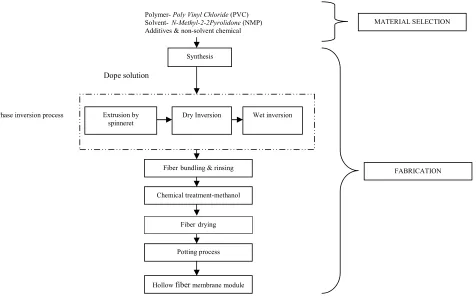
filtration application of membrane module. Asymmetric hollow fiber membranes were prepared from polymer resin, solvent and additive to produce dope solutions. A number of polymer and solvent can be used for the dope formulation. Solvent choice can affect membrane porosity and will influence membrane performance level [8]. Since this paper focusing on wastewater treatment from chemical process industry, dope spinning solution consist Poly Vinyl Chloride (PVC) as polymer,
N-Methyl-2-2Pyrolidone (NMP) for solvent, additive and non-solvent chemical. When polymer was completely dissolved, the dope solution was cooled, poured into a storage bottle and degassed to remove any micro bubbles [9].
Hollow Fiber Membrane Fabrication by Dry-wet Spinning Process. In fabrication of hollow
Figure 1 Material selection and fabrication process for hollow fiber membrane
Framework Development by using Fuzzy Logic Approach
In sustainability, environmental impact can be done by considering the material use in kilogram (kg) and energy used in Joule (J) quantitatively [5]. The level of sustainability can be measured in term of amount of energy, waste, recycle, remanufacture, harmful material and others. Data has been collected such as mass volume of liquid and solid concentration, details process, chemical produce, and any by-product produced gathered. While in economic aspects, sustainability can be measured in term of cost (RM) involved. There is no specific standard unit for measuring the social issues and it involves many attributes to be considered. It is very subjective and it is usually treated in a qualitative manner [10]. That is why fuzzy logic approach will be applied to deal with uncertainty with element cannot be measured such as safety and health in social aspects.
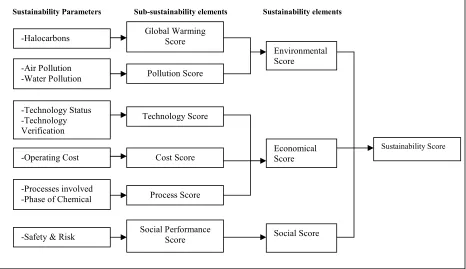
Data is gathered, potential impact of each element is identified as criteria and grouped into each sustainability elements; environmental, economical and social. Fuzzy logic approach will be used to analyze and assess the sustainability score. From mathematical point of view, fuzzy logic can be regarded as useful and practical function approximates [11]. It is generally acknowledge that fuzzy logic is suitable for convenient way to map an input space to an output space by using codification of common sense. Fuzzy inference system is applied to formulate the mapping from a given inputs to an output. The inputs involved are materials and energy used for life cycle stage involved of membrane system for wastewater treatment. This fuzzy logic will be able for intermediate assessment between ‘sustainable’ and ‘unsustainable’ of life cycle for membrane system. Figure 2 shows the framework development for measuring sustainability of hollow fiber membrane.
The triangular membership function was applied for fuzzy evaluation model for framework development. In fuzzy logic, triangular membership function is the simplest and commonly used due to its ability to be adapted into various assessments. In order to calculate the fuzzy sets for each sub elements, target range for each factor have to be defined. Linguistic variables, input, output and reference lines need to be determined throughout the fuzzy evaluation process. Reference value
Synthesis
Dope solution
Phase inversion process
Fiberbundling & rinsing Polymer- Poly Vinyl Chloride (PVC) Solvent-N-Methyl-2-2Pyrolidone (NMP) Additives & non-solvent chemical
Chemical treatment-methanol
Fiberdrying
Potting process
Hollow fiber membrane module Extrusion by
spinneret
Dry Inversion Wet inversion
indicates the minimum and maximum value of the input variable from 0 that indicates low sustainability to 1 that indicates high sustainability [12].
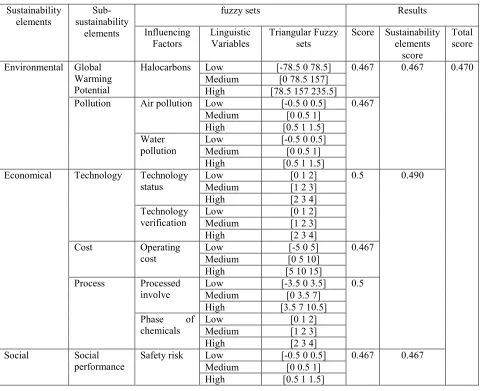
[image:4.595.75.541.243.512.2]In framework proposed, the triangular fuzzy sets are set up by referring to the significant database available. As an example, triangular fuzzy sets for halocarbons is from target range of molar mixing ratios (part per trillion, ppt 10-12) influencing factor for global warming. Their global-mean tropospheric concentration in 2003, expressed as molar mixing ratios were 157 ppt [13]. Table 1 summarized the fuzzy sets for inputs and result for sustainability performance. While the triangular fuzzy sets for outputs is consists of five linguistic variable which are low [-0.25 0 0.25], low to medium [0 0.25 0.5], medium [0.25 0.5 0.75], medium to high [0.5 0.75 1], and high [0.75 1 1.25] for each sustainability element since the output range is from zero to one.
Figure 2 Framework developments for sustainability measurement of hollow fiber membrane
Result and Discussion
From fuzzy logic evaluation framework proposed, the score value indicate both influencing factor which is global warming and pollution have the same effect in term of sustainability. As for economic score, costs are having worst effect compared to technology and process influencing factors. While for social performance, evaluation conducted and observed the medium level of sustainability during fabrication process. The value can be interpreted as the fabrication process safety risk that needs further improvement. Impact for environment and social elements in term of safety and health need attention in order to balance the sustainability score. The assessment was performed in order to help the manufacturer in decision making on sustainability of hollow fiber membrane module in terms of environmental, economical and social elements. In addition, this research help in providing justification for hollow fiber membrane manufacturer in sustainability evaluation thus help for further activity improvement.
Conclusion
A framework is proposed to assess the sustainability performance of polymer processing of hollow fiber membrane. The framework developed can be used to determine the sustainability of
Sustainability Parameters Sub-sustainability elements Sustainability elements
Social Score -Safety & Risk Social Performance Score
Environmental Score -Air Pollution
-Water Pollution -Halocarbons
Pollution Score Global Warming
Score
Economical Score -Operating Cost
-Technology Status -Technology Verification
-Processes involved -Phase of Chemical
Cost Score Technology Score
Process Score
product itself, hollow fiber membrane module. From the analysis, each sustainability elements are having slightly similar score which lead to an average of 0.470. The score can be interpreted as medium sustainability that needs further improvement. A specific set of indicators is under development for the criteria in the framework for future modification.
Table 1 Fuzzy sets and result for sustainability performance
Sustainability elements
Sub-sustainability
elements
fuzzy sets Results
Influencing Factors Linguistic Variables Triangular Fuzzy sets
Score Sustainability elements
score
Total score
Environmental Global Warming Potential
Halocarbons Low [-78.5 0 78.5] 0.467 0.467 0.470
Medium [0 78.5 157]
High [78.5 157 235.5]
Pollution Air pollution Low [-0.5 0 0.5] 0.467
Medium [0 0.5 1]
High [0.5 1 1.5]
Water pollution
Low [-0.5 0 0.5]
Medium [0 0.5 1]
High [0.5 1 1.5]
Economical Technology Technology
status
Low [0 1 2] 0.5 0.490
Medium [1 2 3]
High [2 3 4]
Technology verification
Low [0 1 2]
Medium [1 2 3]
High [2 3 4]
Cost Operating
cost
Low [-5 0 5] 0.467
Medium [0 5 10]
High [5 10 15]
Process Processed
involve
Low [-3.5 0 3.5] 0.5
Medium [0 3.5 7]
High [3.5 7 10.5]
Phase of
chemicals
Low [0 1 2]
Medium [1 2 3]
High [2 3 4]
Social Social
performance
Safety risk Low [-0.5 0 0.5] 0.467 0.467
Medium [0 0.5 1]
High [0.5 1 1.5]
Acknowledgement
The authors wish to thank the Ministry of Higher Education (MOHE), UTM and Research Management Center, UTM for the financial support to this work through the Long Term Research Grant Scheme (LRGS) funding number 4L804.
References
[1] Brundtland Commission Report, Our common future: From one earth to one world. Vol 5. Oxford University Press, World Commission on Environment and Development, 1987, pp. 22-23.
[2] A.A. Martins, T.M. Mata, C.A.V. Costa and S.K. Sikdar, Framework for Sustainability Metrics, Industrial & Engineering Chemistry Research. 46(10), 2962-2973. (2006)
[3] H. Bossel, Indicators for sustainable development: Theory, method, applications, A report to a Balaton Group. International Institute for Sustainable Development (1999).
[5] A.R. Hemdi, M.Z. Mat Saman and S. Sharif, Sustainability evaluation using fuzzy inference methods. International Journal of Sustainable Energy. 1(2011), 1-17.
[6] H. Briassoulis, Sustainable Development and its Indicators: Through a (Planner's) Glass Darkly, Journal of Environmental Planning and Management. 44(3), 409-427. (2001)
[7] M. Mulder, Basic Principles of Membrane Technology, Center for Membrane Science and Technology, University of Twente, The Netherland, 1991.
[8] J. Suhana, A.F. Ismail and H. Shahrir, Preparation and characterization of polyethersulfone hollow fiber nanofiltration membranes made from PES/NMP/PEG 400/WATER, Proceedings of Regional Symposium on Membrane Science and Technology 21-25 April 2004.
[9] A. Idris, A.F. Ismail, M.Y. Noordin and S.J. Shilton, Optimization of cellulose acetate hollow fiber reverse osmosis membrane production using Taguchi method, Journal of Membrane Science. 205(1–2), 223-237. (2002)
[10] A.R. Hemdi, M.Z. Mat Saman and S. Sharif, An indicator for measuring sustainable product design: A review and future research, Proceeding Conference Scientific and Social Research 14-15 March 2009.
[11] H.A.O. Ying and G. Chen, Necessary Conditions for Some Typical Fuzzy Systems as Universal Approximators, Automatica. 33(7), 1333-1338. (1997)
[12] A.M.G. Cornelissen, J.V.D. Berg, W.J. Koops, M. Grossman and H.M.J. Udo, Assessment of the contribution of sustainability indicators to sustainable development: a novel approach using fuzzy set theory, Agriculture, Ecosystems & amp; Environment. 86(2), 173-185. (2001)