Journal of Chemical and Pharmaceutical Research, 2014, 6(6):183-189
Research Article
ISSN : 0975-7384
CODEN(USA) : JCPRC5
The pricing analysis of reverse mortgage with redemption option
Yanxia Zhu*
1,2and Li Gong
11
School of Economics and Management of China University of Geosciences, Wuhan, China
2
College of Public Administration of Zhejiang University, Hangzhou, China
_____________________________________________________________________________________________
ABSTRACT
The paper builds the actuarial pricing models of reverse mortgages. The CIR model and jump diffusion model are used to describe the stochastic processes of interest rate and the growth rate of housing value, respectively, and through Monte Carlo simulation, the annuity payments of reverse mortgages with redemption option and no redemption option are obtained. An important conclusion is that the embedment of the redemption option will reduce the level of payment of reverse mortgage to a large extent; however, the payment still can supplement the social security benefit.
Keywords: reverse mortgage; redemption option; CIR model; jump diffusion model
_____________________________________________________________________________________________
INTRODUCTION
In the context of aged population, it is a realistic option for the government to implement the housing reverse mortgage (RM) so as to relieve the fiscal pressure and supplement the drop or insufficiency of social security income. On one hand, with the continuous increase in the dependency ratio for the aged population, the drop in the social security income becomes an inevitable trend to meet the goal of macro actuarial balance, so in order to prevent the poverty of the aged population and guarantee the sufficiency of the retirement income, the policy maker shall explore other retirement income sources for make-up. On the other hand, the residents in China own relatively high housing self-ownership rate. According to the investigation of Chinese Academy of Social Science, the housing self-ownership rate of the families in China in 2013 reached up to 90%, 30% higher than the world average level. Under the precondition of not affecting the right of dwelling of the retirees, RM can not only help the retirees transform the housing into income flows to support their retirement lives and solve the liquidity predicament which has been described as “with house but without cash”, but also provide the longevity risk guarantee to the retirees with the payments as a life annuity. Therefore, it will be of great significance to solve the social pension problems with RM in China from the actual need of establishing the multi-pillar pension system.
Based on this, this paper calculates the pricing of RM with redeemable option and non-redemption option under the condition of actuarial neutrality. The remainder of this paper is organized as follows. The next section is the literature review. In section 3, we describe the random process of changes in which the interest rate and the housing price growth rate with CIR Model and the jump-diffusion model correspondingly, and calculate the payment of RM with redemption option and non-redemption option under the actuarial condition and make the sensitivity analysis. The final part is the conclusion.
2. Literature review
In terms of RM pricing, what one concerns most is the change in housing price. It is held by so many studies adopting the continuous time model that the housing price obeys the geometric Brownian motion [2-3], however, it is held by the latest study that the housing pricing takes on relatively great jump, which is studied Chen et al. [4]. Based on this, Lee et al. described the dynamic changes in housing price with jump-diffusion model [5]. As to the random behavior of the interest rate, Vasicek model and CIR model are most widely adopted; however, Vasicek model may meet with the negative interest rate, so CIR model is adopted in most studies [5-6]. Since the existing RM pricing mainly adopts the periodic life tables, resulting in little description of the longevity risk, Lee et al. adopts the model established by Lee and Carter [7] to describe the risk [5]. Generally, the studies above mentioned mainly make RM price from the prospective of actuarial neutrality and focus on the influences of the random process of three risks above mentioned on RM pricing, which lay a theoretical foundation for the study on RM pricing. However, the redemption option of RM is seldom taken into account and the individuals’ wills of participation in RM is not analyzed. Some studies in China just simply describe the interest rate and the housing price growth rate, and the jump-diffusion process of the changes in housing price has not been involved in RM pricing. Although a few of researchers have considered the redemption option [8], however, the actuarial pricing of RA with redemption option considering stochastic processes of the changes of interest rate and house price is rare.
Based on the foregoing studies, this paper describes the stochastic processes of the interest rate and the housing price growth rate in China with CIR Model and Jump-Diffusion Model correspondingly and then estimates the parameters of the above-mentioned models with Generalized Method of Moments (GMM) and Maximum Likelihood Method (ML) respectively. Based on it, this paper simulates the annuity payment of RM with redemption option and non-redemption option under the actuarial condition with Monte-Carlo method.
3. RM pricing under the condition of actuarial neutrality 3.1 Theoretical model
(Ⅰ) Actuarial model for RM
In RM contract, the old housing owner, with the house property as the mortgage, obtains the annuity payment flow in lump sum or the fixed annuity payment flow, and it is not necessary for the borrower to repay the annuity in the period of residence till death, house selling or permanent moving out of the house, at this moment, the contract expires, the borrower repays the principal, interest and other expenses of the loan with the income from house selling. This paper mainly evaluates the reverse mortgage (RM) loan repaid with the life annuity, which can protect the longevity risk of the retirees and is the beneficial supplementation of the payment for the social security. In RM, the insurance agents provide the life fixed annuity payment flow to the old housing owner until the borrower dies.
Under the actuarial conditions, according to the traditional method, RM pricing can be indicated that the present value of the expected income of the borrower is equal to the one of the expected expenditure; in case of no redemption option, it can be indicated as:
0 0
0 0
1 1
1 1
( ) t ( ) t (1)
x x
t r t r
t x t x
t t
H t q e A t p e
ω− + ω− +
− ⋅ − ⋅
= =
⋅ ⋅ = ⋅ ⋅
∑
∑
Where H t is the housing value in time( ) t, t=1,...,ω− +x0 1, ω is the max. age of survival, x0 is the age of the retiree participating in RM,
0= 0-+1 0
tqx tpx t px is the probability of death of the retiree aged x0in time t and
0
0
1
1
1
x t x t
q
ω− +
=
=
∑
, rt is the loan interest rate of continuous compound interest, A t( ) is the payment of fixed annuityin each time. According to (1):
0 1 0 1
1 1
( ) ( ) t t (2)
x x
t r t r
t x t x
t t
A t H t q e p e
ω− + ω− +
− ⋅ − ⋅
= =
= ⋅ ⋅ ⋅
∑
∑
expires, even if the housing value is lower than the accumulative amount of loan, as to the insufficiency, the lender has no right of recourse to the assets of the borrower in other form. Therefore, in RM contract, the lender is confronted with the risks that the housing value is not so sufficient to repay the accumulative amount of loan in expiration of the contract, as is an important reason why the financial institutions feel an objection to carry out RM [5]. In order to encourage the financial institutions especially the insurers to provide RM products, the government often allows them to charge an additional premium to compensate the potential conditional losses. Therefore, considering the no-recourse clause in RM contract, the present value of the insurance premium collected by the lender due to the right of non-recourse shall be equal to the present value of the expected losses in the future.
Given the lender allocates the premium to each installment equally, the extra premium occurred in each installment due to no-recourse clause shall be:
0 1 0 1
1 1
( ) [ ( ) ( )] t t (3)
x x
t r t r
t x t x
t t
P t BAL t H t q e p e
ω− + ω− +
− ⋅ − ⋅
+
= =
= − ⋅ ⋅ ⋅
∑
∑
( )
BAL t is the accumulative amount of loan in installment t, indicated as
1
( ) ( )
t i
r t
i
BAL t A i e
−
=
=
∑
⋅ , when theborrower dies in installment t and BAL t( )>H t( ), BAL t( )−H t( ) is the loss of the lender in installment t .
Therefore, in case of no redemption option, according to Formula (2) and (3), the fixed annuity paid to the borrower in each installment isA t( )−P t( ).
In case of redemption option, given the cost of redemption option is also allocated to each installment evenly, to the lender, the cost to be collected for the redemption option in each installment shall be:
0 1 0 1
1 1
( ) [ ( ) ( )] t t (4)
x x
t r t r
t x t x
t t
t H t BAL t q e p e
ω ω
π − + + − ⋅ − + − ⋅
= =
= − ⋅ ⋅ ⋅
∑
∑
When the borrower dies in installment t andH t( )>BAL t( ), the borrower’s children can select to redeem the
housing, and H t( )−BAL t( ) is the bequest the borrower leaves to its children. As a result, in case of redemption
option, the fixed annuity paid to the borrower in each installment shall beA t( )−P t( )−π( )t .
(2) Interest rate model
CIR Model is adopted here to describe the fluctuation of interest rate in continuous and disperse form, indicated as:
( ) r( r ( )) r ( ) r( ) (5)
dr t =k µ −r t dt+σ r t dW t
( ) ( ) r( r ( )) r ( ) r( ) (6)
r t+ ∆ −t r t =k µ −r t ∆ +t σ r t ∆W t
Where, W tr( ) is a standard Wiener process, dW can be deemed as a normal variable with the mean of 0 and the
variance of dt , kr,µr and
r
σ are the constants, among which µr is the long-term mean value of the interest rate, σr is the fluctuation ratio of the interest rate and k is the regulating speed. r
Therefore, E dr( )=kr(µr−r t dt( )) ,
2
var(dr)=σ r⋅r t( ).
Furthermore, Formula (6) is written as:
( ) ( 1) ( 1) ( ) (7)
r t −r t− = + ⋅α β r t− +ε t
Based on Formula (7), k,µrandσrneed to be estimated; andE( ( ))ε t =0, var( ( ))ε t =σ2r⋅r t( −1).
(3) Housing price model
Jump-diffusion model is adopted to describe the fluctuation of the housing price in China, which can be indicated as:
+ (8)
dH
dt dW JdN
H =µ +σ
In jump-diffusion model, the instantaneous earning rate of the assets is composed of a simple diffusion process and random jump item, among which µ σ, and dW are same to the ones in CIR Model, N is the Poisson process with
the intensity λ, namely P dN( = =1) λdt, P dN( =0)= −1 λdt, J is the amplitude of random jump, indicated
with the percentage of alteration in price.
(ln ) (9)
d H =µdt+σ tdz+JdN
Where 1 2
2
µ µ= − σ , dz~N(0,1), J is the jump amplitude, indicated with the logarithm of the percentage of the
alteration in price of the assets in jump plus 1, J~N( ,θ δ2) and N ~P( )λ .
Formula (9) is discretized, then:
1
1 1
ln( ) ln( ) (10)
N N
t t t i t i
i i
H H t J J
τ τ
τ τ
µτ σ η µ σ η
−
= =
− = + +
∑
∆ + +∑
Where τ is the time interval indicated with the year, ηt ~N(0,1), ~ ( , 2) i
J Nθ δτ τ , Nτ ~P(τλ), µτ =µτ,
τ
σ =σ τ , θτ =θτ and δτ =δ τ .
Then, in t time, the change of housing price in continuous compounding with the time interval of τ is:
1
1
( ) ln( ) ln( ) (11)
N
H t t t i
i
r t H H J
τ
τ τ
µ σ η −
=
= − = + +
∑
3.2 Parameter estimation and Monte Carlo simulation
(1) Parameter estimation of interest rate model
The data about the interest rate are from the monthly weighted mean inter-bank offered rate from Jan. 1998 to Dec. 2013 in CSMAR, totally 192 data. The interest rate is transformer into continuous compound interest.
[image:4.595.201.412.682.771.2]The above-mentioned data is regressed with GMM; the instrumental variable is set as1 / (r t−1), with the regression results shown in Table 1.
Table 1 Estimated results of Formula (7)
Parameter Estimated value Standard deviation Approx Pr>t
α 0.002429 0.000712 0
β -0.109345 0.028349 0
2
σ 1.5560E-05 0.003934 0
It can be seen that all of the parameters in Formula (7) pass the significance test at the significance level of 1%; furthermore, the estimated values of three parameters in Formula (5) can be obtained, namelyk=0.109345,
0.022214
r
µ = and σr=0.003945 respectively.
(Ⅱ) Parameter estimation of housing price model
The data about the housing price are from the monthly data of the housing price indexes in China from Jan. 1994 to Dec. 2011 issued by National Bureau of Statistics, totally 216 data. Based on FormularH(t)= ln(Ht/Ht-1), the earning rate of continuous compound interest of the housing price can be obtained in each month.
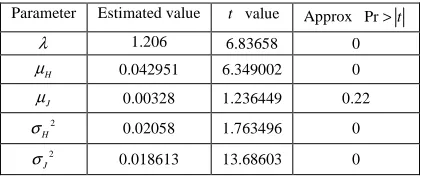
In jump-diffusion model, 5 parameters shall be estimated. Compared with the parameter estimation of other random processes, the parameter estimation of jump-diffusion model is more complicated. In the estimation methods, although the maximum likelihood method has greater difficulty in calculation, it is more effective than the GMM because the latter may meet with the problem of non-convergence [9]. Some studies adopt non-parameter estimation method, such as Johannes [10] and Mancini and Renò [11]. This paper tries to adopt Conjugate Gradient in the maximum likelihood method for estimation just because it is one of the most effective methods to settle the large-sized non-linear optimization problems. The parameter estimation results under the condition of convergence are finally obtained through 110 iterations (See Table 2).
Table 2 Parameter estimation results of Formula (11)
Parameter Estimated value t value Approx Pr>t
λ 1.206 6.83658 0
H
µ 0.042951 6.349002 0
J
µ 0.00328 1.236449 0.22
2
H
σ 0.02058 1.763496 0
2
J
It is shown by the results that other parameters pass the significance test at the significance level of 1% except the mean µJof the jump amplitude.
(Ⅲ) Monte-Carlo simulation for RA pricing
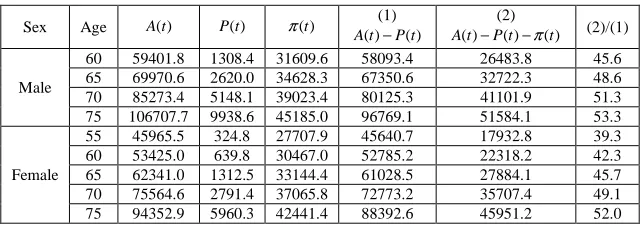
[image:5.595.146.468.246.360.2]Given the value of the housing of the borrower at the beginning of period is RMB 1,000,000 Yuan, and the Experience Life Table of China Life (2000-2003) is adapted to calculate mortality rates. Since the parameter estimation of CIR model of interest rate adopts the risk-free interest rate of interbank lending, with which an interest rate premium needs to be added to obtain the loan interest rate, usually higher than the risk-free interest rate. Here it is firstly supposed the interest rate premium is 300BP. According to the housing price fluctuation model, interest rate fluctuation model and RM pricing model under the actuarial condition for the above-mentioned estimation, we calculate A t P t( ), ( ) and π( )t with Monte-Carlo method. After the simulation for 1000 times, the fixed payment to the borrowers at different ages participating in RM in each year is shown in Table 3.
Table 3 Pricing for RM of the borrowers at different ages (RMB Yuan, %)
Sex Age A t( ) P t( ) π( )t (1) ( ) ( ) A t −P t
(2)
( ) ( ) ( )
A t −P t −πt (2)/(1)
Male
60 59401.8 1308.4 31609.6 58093.4 26483.8 45.6
65 69970.6 2620.0 34628.3 67350.6 32722.3 48.6
70 85273.4 5148.1 39023.4 80125.3 41101.9 51.3
75 106707.7 9938.6 45185.0 96769.1 51584.1 53.3
Female
55 45965.5 324.8 27707.9 45640.7 17932.8 39.3
60 53425.0 639.8 30467.0 52785.2 22318.2 42.3
65 62341.0 1312.5 33144.4 61028.5 27884.1 45.7
70 75564.6 2791.4 37065.8 72773.2 35707.4 49.1
75 94352.9 5960.3 42441.4 88392.6 45951.2 52.0
It can be seen from Table 3:
No matter the men or women, the annuitized payment of RM with redemption option is far lower than the one of RM without redemption option. For example, as to the male housing owner aged 60, the annual payment for RM with redemption option is RMB 26,484 Yuan, only equivalent to 45.6% of the payment for RM without redemption option. However, considering the benefit the existing social security including the social pooling and the individual accounts provide, the sum of them can realize over 70% of the income replacement rate, which can guarantee the retirees maintain the living standard before retirement. It can be seen that even though the redemption option results in the reduction in payment of RM to a large extent, it can also provide the sufficient supplementation to the social security benefit.
With the increase of age when the borrowers participating in RM, the ratio of the payment of RM with redemption option to the payment of RM without redemption option increase as well, when the borrower is at the age of 65, 70 and 75, this ratio rises by 3%, 5.7% and 7.7% respectively.
The payment to the female borrower participating in RM is commonly lower than the one to the male borrower; as to the female borrower aged 55, the payment of RM with redemption option is less than RMB 18,000 Yuan every year and the ratio of the payment of RM with redemption option to the one without redemption option is only 39.3%. Since the payment will not be adjusted with the inflation rate or the growth rate of the social average wage, it is predicted that the insufficiency of retirement income may take place in the later stage after retirement. Just like the male borrower, the ratio of the payment of RM with redemption option to the one without redemption option increases with the age in same manner; however, as to the female borrower at the same age, this ratio is commonly less than the one of the male borrower. For instance, as to the female borrower at the age of 60, 65, 70 and 75, this ratio is respectively 3.3%, 2.9%, 2.2% and 1.3% lower than the one of the male borrower. However, with the increase in age, the gap between the ratio of the male borrower and the female borrower is being reduced because the lower mortality rate of the female borrower than the one of the male borrower. Therefore, the younger the borrower participating in RM is, the lower the fixed payment.
3.3 Sensitivity analysis
(1) Sensitivity analysis of alteration in the mean of interest rate
money among banks.
[image:6.595.145.470.209.336.2]It can be seen from Table 4 that the increase in loan interest rate will significantly reduce the payment for RM with redemption option and the one without redemption option; in addition, with the expansion of the interest rate premium, the amplitude of drop in payment for RM with redemption option exceeds the payment for RM without redemption option. When the difference between the loan interest rate and the interbank offered rate exceeds 6%, the payment of RM with redemption option to the male borrower is only RMB 16,000 Yuan while the one to the female borrower is less than RMB 14,000 Yuan, respectively reducing by 39% and 38%. Due to no inflation adjustment, it can be forecast that it is difficult for the payment of RM with redemption option to provide the sufficient retirement income supplementation to the retirees with the increase in age of the participants in case of high loan interest rate.
Table 4 RM pricing in expanding interest rate premium (RMB Yuan, %)
Sex Margin A t( ) P t( ) π( )t (1) ( ) ( ) A t −P t
(2)
( ) ( ) ( )
A t −P t −π t (2)/(1)
Male
100BP 52932.5 2599.5 27149.4 50333.0 23183.6 46.1
150BP 50244.4 3309.0 25433.3 46935.4 21502.1 45.8
200BP 47824.5 4057.9 24053.4 43766.6 19713.2 45.0
250BP 45583.2 4807.5 22786.9 40775.7 17988. 8 44.1
300BP 43123.8 5558.6 21518.4 37565.2 16046.8 42.7
Female
100BP 46711.6 1483.0 25412.7 45228.6 19965.9 44.1
150BP 44073.5 2012.5 23555.9 42061.0 18505.1 44.0
200BP 41328.5 2579.0 21763.1 38749.5 16986.4 43.8
250BP 38753.3 3160.8 20180.7 35592.5 15411.8 43.3
300BP 36208.3 3698.4 18691.9 32509.9 13818.0 42.5
(2) Sensitivity analysis of change in the mean of housing price growth rate
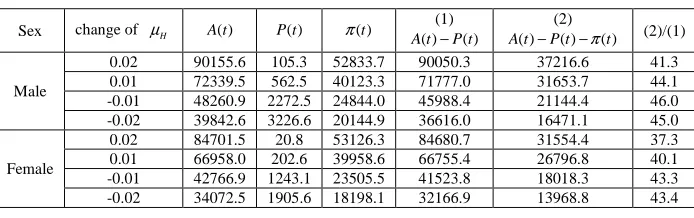
The change in housing price growth rate also has important influences on the payment for RM. Theoretically, the higher the growth of housing pricing, the higher the payment of RM with redemption option and the one without redemption option, which is just verified by the changes in payments in Table 5. Without change in fluctuation and jump, Table 5 shows the influences on the payment of RM when the mean of the housing price growth rate fluctuates about 1~2%. When the mean of the housing pricing growth rate increases by 2%, the payment to the male and female borrowers for RM increases to RMB 37,217 Yuan and RMB 31,554 Yuan, with the growth rate of 20% and 41% respectively compared to the reference, the ratio of the payment of RM with redemption option and the one without redemption option respectively drops by 4.3% and 5%; while the mean of housing price growth rate drops by 2%, the payment of RM with redemption option to the male and female borrowers drops by 37-38% while the ratio of payment of RM with redemption option and the one without redemption option does not change greatly, among 0.5~1%.
Table 5 RM pricing in change in the mean of housing price growth rate (RMB Yuan, %)
Sex change of µH A t ( ) P t ( ) π( )t
(1) ( ) ( ) A t −P t
(2)
( ) ( ) ( )
A t −P t −πt (2)/(1)
Male
0.02 90155.6 105.3 52833.7 90050.3 37216.6 41.3
0.01 72339.5 562.5 40123.3 71777.0 31653.7 44.1
-0.01 48260.9 2272.5 24844.0 45988.4 21144.4 46.0
-0.02 39842.6 3226.6 20144.9 36616.0 16471.1 45.0
Female
0.02 84701.5 20.8 53126.3 84680.7 31554.4 37.3
0.01 66958.0 202.6 39958.6 66755.4 26796.8 40.1
-0.01 42766.9 1243.1 23505.5 41523.8 18018.3 43.3
-0.02 34072.5 1905.6 18198.1 32166.9 13968.8 43.4
CONCLUSION
[image:6.595.133.480.509.618.2]Acknowledgements
The paper is funded by China Postdoctoral Science Fund project (2013M541975) and the Fundamental Research Funds for the Central Universities(CUGW120205), the views expressed are the authors’ alone.
REFERENCES
[1]Jian Chen, Shan-an Huang, Economic Research Journal, vol. 9, pp. 56-70, 2013.
[2]EJ Szymanoski, Journal of American Real Estate and Urban Economics Association, vol. 22, pp. 347-366, 1994. [3]A Bardhan, R Karapandza, B Urosevic, Journal of Real Estate Finance and Economics, vol. 32, pp. 9-20, 2006. [4]MC Chen, CC. Chang, SK Lin, SD Shyu, Journal of Risk and Insurance, VOL.77, PP. 399-422, 2010.
[5]Yung-Tusung Lee, CW Wang, HC Huang, Insurance: Mathematics and Economics, vol.52, pp. 430-441, 2012. [6]Jing Lu, P Gao, and JC Dong, Management Review, vol.22, pp. 3-8, 2010.
[7]RD Lee, LR Carter, Journal of the American Statistical Association, vol. 87, pp.659-675, 1992.
[8]Bing-zhen Chen, YL Deng, P Qin, 2013 China International Conference on Insurance and Risk Management, Kunming, China, 2013.
[9]Nik Tuzov, GMM parameter estimation for the Double Exponential Jump-Diffusion Process, Purdue University,
2006.
[10]M Johannes, Journal of Finance, vol.59, pp. 227-260, 2004.