Quasiturbine Rotor Development Optimization
MOHAMMED AKRAM MOHAMMED
A thesis submitted in
fulfillment of the requirement for the award of the Degree of Master in Mechanical Engineering
Faculty of Mechanical and Manufacturing Engineering Universiti Tun Hussein Onn Malaysia
ABSTRACT
vi
CONTENTS
TITLE i
DECLARATION ii
DEDICATION iii
ACKNOWLEDGEMENT iv
ABSTRACT v
CONTENTS vi
LIST OF FIGURES xii
LIST OF SYMBOLS AND ABBREVIATIONS xiv
LIST OF APPENDICES xvi
CHAPTER
1 INTRODUCTION
1.1 Introduction 1
1.2 Problem statement 3
1.3 Objectives 4
1.4 1.5
Scope of study
Expected outcomes
4 5
CHAPTER
2 LITERATURE REVIEW
2.1 Definition of Quasiturbine 6
2.3 Components of Quasiturbine
2.3.1 Housing 2.3.2 Rotor
2.3.2.1 Rotor segments 2.3.2.2 Shaft holder 2.3.2.3 Key
2.3.2.4 Seal 2.3.2.5 Spring
9 9 11 11 12 12 13 13
2.4 Types of Quasiturbine rotor 2.4.1 Two-port with carriages 2.4.2 Four-port without carriages 2.4.3 Two-port without carriages
14 14 15 15 2.5 QUASITURBINE Vs. OTHER ENGINES
2.5.1 TURBINE COMPARISON 2.5.2 PISTON COMPARISON
2.5.2.1 PISTON DEFFICIENCIES 2.5.2.2 QT and Piston Side by Side 2.5.3 Wankel comparison
2.5.3.1 QT and Wankel Side by Side 2.5.4 Hybrid COMPARISON
2.5.4.1 Hybrid Definition
viii
2.6 QUASITURBINE PECULIARITIES 2.6.1 Rapid transition at dead points 2.6.2 Continuous Torque
2.6.3 High compression ratio 2.6.4 Leak proof
2.6.5 Zero vibration on the shaft 2.6.6 Fast acceleration
2.6.7 Construction and reliability 2.6.8 Energy savings
2.6.9 Environmental Considerations 2.6.10 Variety of fuels
2.6.11 High power density
24 24 24 24 25 25 25 26 26 26 27 27
2.7 QUASITURBINE APPLICATIONS 2.7.1 The Return of Steam Engine 2.7.2 Engine Exhaust Heat Recovery 2.7.3 Other Applications
27 27 28 28
2.8 Advantages of Quasiturbine 29
CHAPTER
3 METHODOLOGY
3.2 The flow chart of QT development 32 3.3 The design
3.3.1 The existing design
3.3.1.1 The existing design of oval surface 3.3.1.2 The existing design of rotor
3.3.1.2.1 The male blade of existing design 3.3.1.2.2 The female blade of existing design 3.3.1.2.3 The existing design of seal
3.3.2 The proposed design
3.3.2.1 The proposed design of oval surface 3.3.2.2 The proposed design of rotor 3.3.2.2.1 The proposed design of blades 3.3.2.2.2 The proposed design of mechanism 3.3.2.3 The proposed design of seal
32 33 34 35 36 37 38 39 39 43 43 45 46
3.4 Materials selection 48
3.5 Modeling 50
3.6 Simulation
3.6.1 Solidworks software
51 51
CHAPTER 4
ANALYSIS AND RESULTS
4.1 Introduction 53
4.2 Solidworks simulation 53
x
4.3.1 The assumption
4.3.2 The motion analysis results of existing design of seal
4.3.3 The final simulation result of existing design of seal
56 57
57
4.4 Simulation of 1st proposed design of QT seal 4.4.1 The assumption
4.4.2 The motion analysis results of 1st proposed design of seal
4.4.3 The final simulation result of 1st proposed design of seal
59 59 60
60
4.5 Simulation of 2nd proposed design of QT seal 4.5.1 The assumption
4.5.2 The motion analysis results of 2nd proposed design of seal
4.5.3 The final simulation result of 2nd proposed design of seal
62 62 62
63
4.6 Simulation of 3rd proposed design of QT seal 4.6.1 The assumption
4.6.2 The motion analysis results of 3rd proposed design of seal
4.6.3 The final simulation result of 3rd proposed design of seal
64 64 65
4.7 Discussion 67
CHAPTER
5
CONCLUSIONS AND RECOMMENDATIONS
5.1 Conclusion 68
5.2 Recommendation 68
REFFERENCES 70
APPENDICES
Chapter 1
Introduction
1.1 Introduction
The Quasiturbine concept resulted from research that began with an evaluation of all engine concepts, looking at the various advantages, disadvantages and opportunities for improvement of each. The Quasiturbine Engine was invented by the Saint-Hilaire team headed by Dr. Gilles Saint-Hilaire and was first patented in 1996.During this exploratory process, the Saint-Hilaire team came to realize that a unique engine solution would be one that made improvements to the standard Wankel, or rotary engine.The Quasiturbine is at the crossroad of the 3 modern engines: Inspired by the turbine, it perfects the piston, and improves upon the Wankel. The Quasiturbine is universal in relation to energy sources: Pneumatic, Steam, Hydraulic, Combustion, Hydrogen, Detonation, Stirling and Rotary Expander (compressor/pump).
Figure 1.1 Quasiturbine pump/compressor (Hilaire,G.S.,2004)
3
1.2 Problem Statement
Various types of air compressors have been established but the Quasiturbine compressor or pump is still under development and research to enhance the efficiency and solve the issues of the Quasiturbine. The Quasiturbine has many advantages such as higher torque at lower rpm , small size ,light weight, high flow rate and mechanical simplicity but at the same has some issues that need attention such as shortage of stroke duration in engine application , limited speed and short life of seals due to wear that happening by friction between the seals and oval surface of Quasiturbine housing.
This project will progress according to the problem statement below.
i- To design and optimise the Quasiturbine rotor and seal in order to increase the efficiency for these type of compressors.
ii- Analysis and select the optimum materials suitable for the Quasiturbine operations to decrease the concentrating stress and to reduce the wear of seal of Quasiturbine rotor.
1.3 Objectives
i- To design a proposed model of rotor seal for a portable Quasiturbine compressor.
ii- To simulate the existing and the proposed model of rotor seal of Quasiturbine compressor by using Solidworks software.
iii- To develop the optimized rotor and seal design of the Quasiturbine compressor.
1.4Scope of study
i- Selection of a suitable material to decrease the wear on seal and on the oval surface.
ii- Simulate Models from the previous Quasiturbine design that was done and the proposed design of Quasiturbine seal in order to compare the performance of each by using motion analysis and simulation tool box in Solidworks software .
iii- Using simulation assumption (internal pressure of QT compressor 2 bar , spring force of seal 20 N , rotational speed of QT rotor 500 rpm )
5
1.5Expected outcomes
The expected results of this research are:
i- Selection of the most suitable material to decrease the friction between the seals and the oval surface that will reduce the wear of seals.
CHAPTER 2
LITERATURE REVIEW
2.1 Definition of Quasiturbine
7
can be used in pneumatic, steam or hydraulic motor mode, while the other is used as vacuum or pressure pump.(Saint-Hilaire , 2004)
2.2 Principle of Quasiturbine
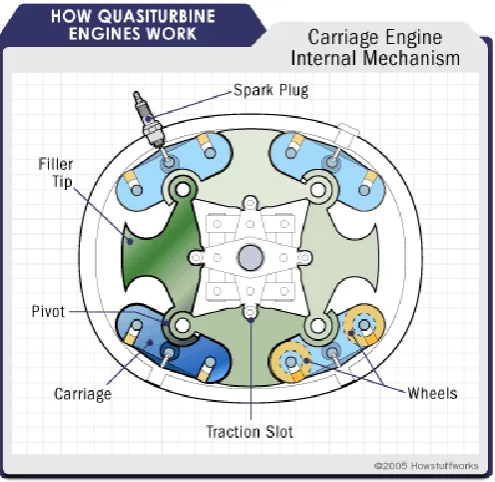
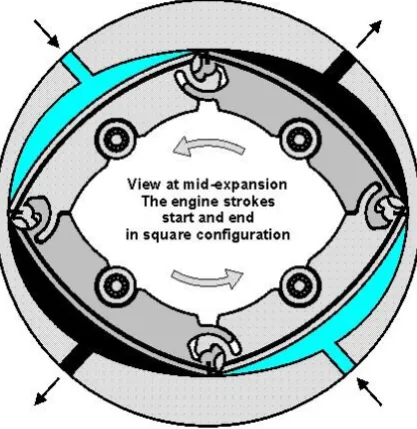
Like Wankel engines, the Quasiturbine engine is based on a rotor and housing design. But instead of three blades of rotor, the Quasiturbine rotor has four elements chained together, with combustion chambers located between each element and the walls of the housing. The four-sided rotor is what sets the Quasiturbine apart from the Wankel. There are actually two different ways to configure this design — one with carriages and one without carriages. As we’ll see a carriage, in this case, is just a simple machine piece.
Figure 2.1 Quasiturbine without carriage
Figure 2.2 Quasiturbine with carriage
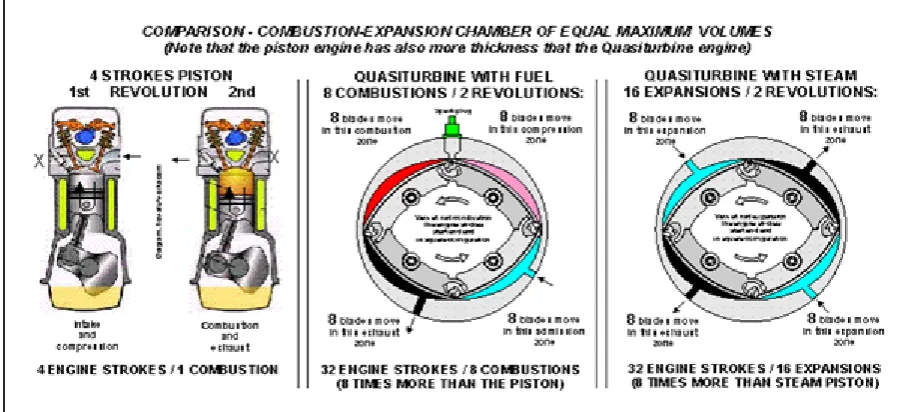
In a piston engine, one complete four-stroke cycle produces two complete revolutions of the crankshaft. That means the power output of a piston engine is half a power stroke per one piston revolution. A Quasiturbine engine, on the other hand, doesn’t need pistons. Instead, the four strokes of a typical piston engine are arranged sequentially around the oval housing. There’s no need for the crankshaft to perform the rotary conversion.
It’s very easy to see the four cycles of internal combustion: • Intake, which draws in a mixture of fuel and air
• Compression, which squeezes the fuel-air mixture into a smaller volume • Combustion, which uses a spark from a spark plug to ignite the fuel
9
[image:17.595.213.422.200.415.2]In the pump mode, the Quasiturbine driven by an external motor has 2 intakes and 2 exits related to 2 quasi-distinct circuits. Possible absence of check valve is of considerable interest in many applications because each Quasiturbine has 2 quasi-independent circuits, one can be used in pneumatic, steam or hydraulic motor mode, while the other is used as vacuum or pressure pump .(Saint-Hilaire ,2007)
Figure 2.3 Quasiturbine pump
2.3 Components of Quasiturbine
In general , the Quasiturbine has two main parts : rotor and housing .
2.3.1 Housing
Figure 2.4 Stator casing of Quasiturbine
Figure 2.5 Front cover of Quasiturbine
[image:18.595.215.423.550.735.2]11
2.3.2 Rotor
A rotary machine with a deformable rhomb generally comprises a fixed assembly or stator, and a mobile assembly or rotor, having a rhomb shape articulated at its summits and turning around its centre, able to be deformed in particular during its rotation. Each side of the rhomb determines, With the internal profile having a general oval shape of the stator, a variable-volume chamber during the movement of the rotor. The sides of the articulated rhomb are realized by plates, designated pistons, having an external surface of generally curvilinear shape. These pistons are sometimes provided, in their contact Zone With the internal profile of the stator, With tightness segments.
The Quasiturbine rotor has five parts :
2.3.2.1 Rotor segments
[image:19.595.228.413.526.705.2]
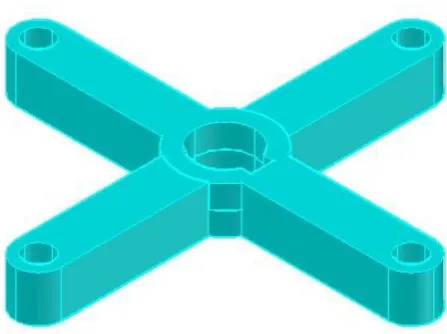
Rotor of Quasiturbine compressor has four separated segments that lastly will combine with socket method to permit every part of rotor can move in the oval surface.
2.3.2.2 Shaft holder
[image:20.595.198.422.292.459.2]In this Quasiturbine compressor construction the rotor part will attach to the shaft holder. This shaft holder will attach to the shaft and then the shaft will drive by an electric motor. Electric motor will make the shaft work (rotate) and will rotate the shaft holder and rotor. Shaft holder will attach to the shaft by use key method. Part of this shaft holder must be design in detail to make sure that this shaft holder can hold the shaft and bearing.
Figure 2.8 Shaft holder
2.3.2.3 Key
13
2.3.2.4 Seal
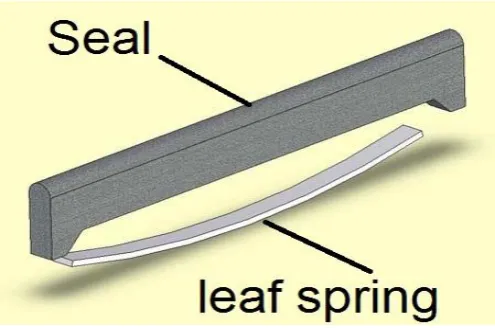
[image:21.595.121.519.303.497.2]Seal will be the one important component in this Quasiturbine compressor. Seal in this compressor will act as abstraction for four spaces in the housing. During compression and inhale process the seal will act as barricade leakage. Seal will be always touch the compressor’s housing surface assisted by spring. Seal also always touch the surface at angle that near90 degree. Seal will always pull the seal to the housing surface.
Figure 2.9 Seal of Quasiturbine rotor
2.3.2.5 Spring
Spring is the flexible component that uses to store the mechanical energy. Spring usually is made from metal that was hardened. The small spring normally found in semi hard. While the large spring normally was heat treatment in manufacturing process.
bottom of the seal.The leaf Spring will apply force on the seal to guarantee the seal always contact with oval surface of QT housing to avoid any pressure losses. Spring will be act as rejecter force during rotor move in the housing. Air in the compression and inhale space will leak if the seal not install with spring. Spring have important role at rotor. The role of spring is void air from leak to the near rotor space.
Figure 2.10 leaf spring with the seal
2.4 Types of Quasiturbine rotor
The rotor of Quasiturbine has two main types :
2.4.1 Two-port with carriages
15
2.4.2 Four-port without carriages
The second Quasiturbine design is greatly simplified to eliminate the carriages At the same time, the ports were duplicated on the opposite side of the housing, thus converting the operation from four strokes per cycle to two and doubling the number of cycles per rotor revolution. This mechanism has been demonstrated running as a pneumatic engine using stored compressed air, and also as a steam engine. This is also the design proposed for use as a pump, and particularly as a supercharger. This design uses redesigned blades, longer than those for a similar sized housing of the first type owing to the absence of the carriages, and lacking the distinctive crown contour. Only the basic rotor geometry is common with the earlier design. A pneumatic engine of this design was demonstrated powering a go-kart in November 2004, and another powering a small car in September 2005, both vehicles using stored compressed air to power the engine. As of 2005 a pneumatic chain saw driven by an air hose from a conventional external compressor is under development. With a suitably redesigned housing to allow for thermal expansion, the same rotor design has been demonstrated as a steam engine. Another potential variation of this design uses the two sets of ports independently, one as an engine and the other as a pump, thus potentially integrating the functions of a pump and its driving motor in one shaftless unit. One restriction of this usage is that the two fluids must be similar; It would not be possible for example to drive an integrated air pump with hydraulic fluid, as the rotor design is significantly different. As of 2005 no prototype of this variation has been demonstrated.(Jagadale,Kadam,Jadhav,Mulik,2007)
2.4.3 Two-port without carriages
Many other designs are possible within the patented Quasiturbine model, with or without carriages and with differing numbers of ports. As of 2005, which design will be used for further work on the internal combustion version has not been announced.
2.5 QUASITURBINE Vs. OTHER ENGINES
2.5.1 TURBINE COMPARISON
The word Quasiturbine literally means ‘similar to turbine’ and is so called because, like turbines QT is also capable of producing flatter torque. The primary energy output of the combustion of the fuel is the Pressure energy. QT, being a hydro-aerostatic device, directly transforms this pressure energy into mechanical motion. Conventional turbines are hydro-aerodynamic device which converts the pressure energy of the fluid into mechanical energy through an intermediate kinetic energy and hence its efficiency changes with variation in the flow velocity.(CAROL,2005)
2.5.2 PISTON COMPARISON
17
2.5.2.1 PISTON DEFFICIENCIES
All the processes are taking place in one single chamber. Hot process will destroy the efficiency of cold process and vice versa
The piston makes positive torque only 17% of time and drag 83% of time The gas flow is not unidirectional, but changes direction with the piston direction
The valves open only 20 % of the time, interrupting the flows at intake and at exhaust 80% of the time
The duration of the piston rest time at top and bottom are without necessity too long
Long top dead center confinement time increase the heat transfer to the engine block reducing engine efficiency
The non-ability of the piston to produce mechanical energy immediately after the top dead center
The proximity of the intake valve and the exhaust valve prevents a good mixture filling of the chamber and the open overlap lets go some un-burnt mixture into the exhaust
The piston does not stand fuel pre-vaporization, but requires fuel pulverization detrimental to combustion quality and environment
The average torque is only 15% of the peak torque, which imposes construction robustness for the peak 7 times the average
The flywheel is a serious handicap to accelerations and to the total engine weight
The valves inertia being a serious limitation to the engine revolution
The heavy piston engines require some residual compressed gas before top dead center to cushion the piston return
The internal engine accessories (like the cam shaft) use a substantial power.
At low load factor, the intake depressurization of the Otto cycle dissipates power from the engine (vacuum pump against the atmospheric pressure)
2.5.2.2 QT and Piston Side by Side
[image:26.595.112.562.487.693.2]Like the piston engine, the QT is a volume modulator of high intensity and acts as a positive displacement engine. Better torque continuity and acceleration: The crankshaft and the flywheel are the main obstacle to engine acceleration, and since the flywheel are unable to store energy at low rpm, the engine torque at idle is highly handicapped by the engine dead times. The piston of a 4-stroke engine works in power mode about 120 degrees / 720 degrees (2 turns), and thus constitutes a drag 80% of time, period during which the flywheel assumes a relative torque continuity. The Quasiturbine has jointed torque impulses, and presents a profile of almost flat torque characteristics, without the assistance of a flywheel.(CAROL ,2005)
19
Low revolution – Reduction of gearbox ratio: The gear boxes are evils necessary (expensive, complicated, delicate, and energy consuming). The RPM required by the human activity are generally lower that the performance optimum speed of the engines (e.g.: an automobile wheel generally does not rotate to more than 800 or 1000 RPM, which is 4 to 5 times less than the engine RPM). As the Quasiturbine turns 4 to 5 times less quickly than the other engines, the gear boxes can often be removed (amongst other things in the field of transport) with an increase in efficiency. Continuous combustion with lower temperature: As the Quasiturbine strokes are jointed (what is not the case with the Wankel), the lighting is necessary only in launching, since the flame transfers itself from one chamber to the following. The thermalisation of the Quasiturbine by contacts with rollers is more effective, and prevents hot point. From the thermal point of view, the Quasiturbine does not contain any internal parts requiring coolant fluid (like oil).
Better overlaps: The intake and exhaust ports being at different ends of the combustion chamber, it is possible to do a better filling of the chamber by having a simultaneous open overlapping of the two ports, without risking that a portion of the intake gas goes into the exhaust, as it is the case with the piston engine.
2.5.3 Wankel comparison
Today's Wankel engines technology is well mastered, but the concept does still present major drawbacks. Because hundreds of experts could not pin point the exact reason for the poor Wankel combustion, they have "vaguely attributed it without proof" to the elongated shape (high surface to volume ratio) of the Wankel combustion chamber. (MYRON ,2003)
2.5.3.1 QT and Wankel Side by Side
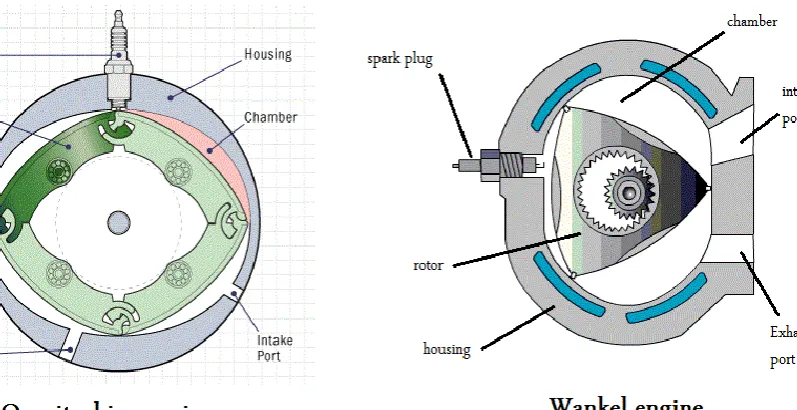
Figure 2.12 comparison between QT and Wankel engine
The Wankel engine shaft turns at three times its rotor RPM. The Quasiturbine rotor and main shaft turns at the same speed.
The Wankel engine fires only once per shaft (not rotor) revolution (which means three times per rotor revolution). The Quasiturbine fires four times per main shaft revolution, producing strong and exceptional torque continuity.
The Wankel compression and combustion stroke each last 120 degree of rotor (not shaft) rotation, of which only 90 degrees is effective (no chamber volume variation in the first 30 degrees of compression and in the last 30 degrees of combustion). Exhaust and intake strokes share together 120 degree of rotation in an excessive overlapping. In term of time management, the Wankel is even worst than the piston. All Quasiturbine strokes are of equal 90 degrees rotor rotation (not necessarily duration), with useful volume variation (like piston) at all angles and without undesired overlapping.
21
The Wankel excessive engine ports overlap imposes to trunk the power stroke somewhat before the bottom dead center BDC, which results in some lost of efficiency. In the Quasiturbine, the power stroke extends until it is fully completed.
When the Wankel engine rotor goes from one TDC (top dead center) to the next, the torque increases to a maximum value and starts decreasing right away. The torque generated by the Quasiturbine (accentuated on AC type) gets toward a plateau, and holds this maximum for a longer arc before decreasing, producing a better overall mechanical energy conversion rate.
The center of mass of the Wankel triangular piston is moving in circle with the crank, and this whole triangular mass tends to bang the seals against the housing, requiring the protection of a housing synchronization gear. The Quasiturbine has no crankshaft, and its rotor center of mass is immobile at the center during rotation. Never the Quasiturbine seals need to oppose and constraint the whole rotor mass, the only force required being the one to transform a square into lozenge and back to square.
The Wankel engine cannot operate in continuous combustion. While a full expansion stroke occurs (rotor revolution of 90 degrees), intake mixture compression is only partially initiated and not yet ready to be lighted (an additional 30 degrees rotor rotation is required as a dead time). Quasiturbine mixture is completely compressed and ready to fire at the end of each expansion stroke, making possible a flame transfer for continuous combustion.
Due to its one single firing per shaft revolution, and the dead time, the Wankel engine needs a flywheel. The Quasiturbine needs no flywheel, and consequently has faster acceleration.
The Wankel engine is a "rotating piston engine" that is subject to a constant circular vibration. The Quasiturbine has a fixed center of gravity during rotation, and is a true zero vibration engines (like the turbine), since any weight movement is exactly compensated by symmetric mirror movement through the center.
at the same speed as its rotor) is more appropriate for lower revolution uses (e.g. airplane propeller at only 2000 RPM, generator, transportation, or to reduce gearbox ratio in current applications).
2.5.4 Hybrid COMPARISON
2.5.4.1 Hybrid Definition
Detonation and hybrid are two different means to harvest the low efficiency of reduced power piston engine, and both are compatible with efficient electrical (in-wheel) power train. Detonation engine is however a more direct and efficient way, and because the on board fuel is already a form of energy storage, detonation engine avoid to re-stock this energy electrically into batteries. The chemical energy stored in the fuel is degraded when chemically re-stored in batteries.(Vishnu,2011)
2.5.4.2 Quasiturbine Over Hybrid
Detonation and hybrid are two different means to harvest the low efficiency of reduced power piston engine, and both are compatible with efficient electrical (in-wheel) power train. Detonation engine is however a more direct and efficient way, and because the on board fuel is already a form of energy storage, detonation engine avoid to re-stock this energy electrically into batteries. The chemical energy stored in the fuel is degraded when chemically re-stored in batteries. The Quasiturbine has several intrinsic efficiency characteristics which add up and reduce the engine energy lost in several ways:
23
Because of the shaping of the volume pressure pulse, the thermodynamic of the Quasiturbine can be far superior.
Because the engine weight is about 1/4 that of a piston, energy saving can be substantial in many applications.
Because the Quasiturbine is a high torque low rpm engine, much less or no transmission gears ratio is needed with corresponding efficiency increase.
Because the Quasiturbine can be made of large size, it is an efficient
alternative to utilities for efficient energy conversion (steam) in electricity or from co-generation.
Because the Quasiturbine (AC model with carriages) has the potential to run in detonation mode, it will not have the low power penalty of the Beau de * Rocha (Otto) cycle, which can provide a 50% energy saving in transportation application (much superior to hybrid concepts).
Multi-fuel capability is also an important efficiency factor permitting to use the most pertinent local combustible. Hydrogen high compatibility is also of consideration for the future.
So, the Hybrid Concepts have been developed to harvest the low piston efficiency at reduced power. If a new engine does not have such a penalty at low power, the Hybrid Concept would be of no interest. This is exactly the objective of the Quasiturbine detonation engine use in transportation.
2.6 QUASITURBINE PECULIARITIES
2.6.1 Rapid transition at dead points
The "Saint-Hilaire skating rink profile" allows the fastest possible transition around the top dead center (TDC). Considering that the successive seals move in the inverse direction, all improvement to the rate of radial variation is doubled in effect. In this case, a rotor move of no more than 10 degrees brings the engine at 50% of its maximum torque.(Saint-Hilaire ,2007)
2.6.2 Continuous Torque
Contrary to most rotating devices which are progressive, meaning that the torque is nil at TDC and increases progressively until a maximum is reached, the Quasiturbine "Saint-Hillaire skating rink profile" rapidly reaches the maximum diameter, and then follows it with accuracy on its entire length. The continuous combustion permits optimization of torque continuity. In assembling 2 units with a phase difference of 45 degrees, one assures a positive torque for any angle of the engine shaft, even at zero rpm. (Saint-Hilaire ,2007)
2.6.3 High compression ratio
70
REFERENCES
1. ABU SAID, A.F. , (2010). FABRICATE A PORTABLE QUASITURBINE PUMP . Universiti Tun Hussein Onn Malaysia .PSM 2. Aldrich, C. , (2003). Learning by Doing : A Comprehensive Guide to
Simulations, Computer Games, and Pedagogy in e-Learning and Other Educational Experiences. San Francisco: Pfeifer — John Wiley & Sons. 3. Anu Maria . Introduction to modeling and simulation. Winter simulation
conference .1997 .pp.7
4. Beard, J.E. , Pennock,G.R. ,(2000). Acceleration of the Apex Seals in a Wankel Rotary Compressor Including Manufacturing Process Variation in Location of the Seals . International Compressor Engineering Conference. PP 1457.
5. Drogosz , P .(2011 ) . TRAJECTORY OF THE APEX SEALS OF THE WANKEL ROTARY ENGINE . Electroanalysis, 18( 2) , PP 2 .
6. Gekht, E .(2013) . Apex seal for rotary internal combustion engine . US 0028769 A1.
7. Gerami, A.K.N. , Shadloo, M.S. , Ghasempour, M. , kimiaeifar, A.(2010) . Analysis of the Forces Acting on Apex Seal of A Wankel Engine .
Electroanalysis, 4(9): pp. 4208-4210.
8. Hilaire,G.S. (2004) .Quasiturbine .form http://quasiturbine.promci.qc.ca/ERelationLegal.htm
9. Hilaire,G.S. (2007). QUASITURBINE LOW RPM HIGH TORQUE PRESSURE DRIVEN TURBINE FOR TOP EFFICIENCY POWER MODULATION . Proceedings of GT2007. American Society of Mechanical Engineers .PP.1 .
10.Hilaire,R.S. (2005) . QUASIURBINE (Qurbine ) Rotor with Central Annular Support and Ventilation. US 6,899,075 B2 .
12.Jordan, A .(1980) . ROTARY INTERNAL COMBUSTION ENGINE . 4,181,481 .
13.Kemp,G ., Orosz,J., Bradshaw,C.R., Groll , E.A. (2012) . Spool Compressor Tip Seal Design Considerations and Testing.
Electroanalysis,: pp 3-7
14.Kweon,C.M. , (2011) . A Review of Heavy-Fueled Rotary Engine Combustion Technologies . Army Research Laboratory.
15.Morris, R. (2009). The fundamentals of product design. AVA Publishing. 16.Myron D. S. (2003) . Quantum Parallel: The Saint-Hilaire “Quasiturbine” As The Basis For a Simultaneous Paradigm Shift In Vehicle Propulsion Systems .
17.Orosz, J., Kemp, G., Bradshaw, C., Groll, E., 2012. Performance and Operating Characteristics of a Novel Rotating Spool Compressor. In: Proceedings of the International Compressor Engineering Conference. Purdue University, West Lafayette, IN USA. No. 1257.
18.Szorenyi ,P. (2004) . Hinged Rotor Internal Combustion Engine . US 6,718,938 B2 .