ANALYSIS OF DIJKSTRA’S AND A* ALGORITHM TO FIND THE SHORTEST PATH
AMANI SALEH ALIJA
A thesis submitted in
fulfillment of the requirements for the award of the Degree of Master of Computer Science (Software Engineering)
Faculty of Computer Science and Information Technology Universiti Tun Hussein Onn Malaysia
v
ABSTRACT
ABSTRAK
vii
TABLE OF CONTENTS
TITLE i
DECLARATION ii
DEDICATION iii
ACKNOWLEDGEMENT iv
ABSTRACT v
ABSTRAK vi
CONTENTS vii
LIST OF TABLE x
LIST OF FIGURES xi
CHAPTER 1 1
INTRODUCTION 1
1.1 Background of study 1
1.2 Problem Statement 3
1.3 Objectives of the Research 3
1.4 Scope of Research 4
1.5 Motivation 4
1.6 Research Outline 4
CHAPTER 2 5
LITERATURE REVIEW 5
2.1 Introduction 5
2.2.3 Driverless Vehicles 8 2.2.4 Transportation Networks 10
2.2.5 Human Navigation 11
2.3 Shortest path analysis 14
2.4 Shortest path algorithm 14
2.4.1 Dijkstra’s algorithm 15
2.4.2 Depth-first search algorithm 20
2.4.3 A* algorithm 20
2.4.3.1 Manhattan distance 23 2.4.3.2 Diagonal distance 25 2.4.3.3 Euclidean distance 25 2.5 Comparison of A* and Dijkstra’s 26
2.6 Review of the techniques 27
2.7 Summury 31
CHAPTER 3 32
RESEARCH METHODOLOGY 32
3.1 Introduction 32
3.2 The flow chart for the project work 32
3.2.2 Finding the shortest path using Dijkstra algorithm 35 3.2.2 Finding the shortest path using the A* algorithm 35
3.2.3 Compare the result 37
3.3 Summary 37
CHAPTER 4 38
PSEUDO CODE FOR THE AND IMPLEMENTATION 38
4.1 Introduction 38
4.2 Dijkstra's algorithm 38
4.2.1 Pseudo code for Dijkstra's algorithm 39 4.2.2 Implementation of Dijkstra's algorithm 40
ix 4.3.1 Pseudo code for the A * algorithm 42 4.3.2 Implementation of A* algorithm 43
4.4 Summary 44
CHAPTER 5 45
RESULT AND DISCUSSION 45
5.1 Introduction 45
5.2 Comparative Analysis 45
5.3 Summary 50
CHAPTER 6 51
CONCLUSIONS 51
6.1 Objectives Achievement 51
6.2 Summary 51
6.3 Future Work 52
REFERENCES 53
VITA 56
LIST OF TABLES
2.1 Difference between A* algorithm and Dijkstra’s algorithm 26
xi
LIST OF FIGURES
2.1 3D Model of latiff and Hassan 6
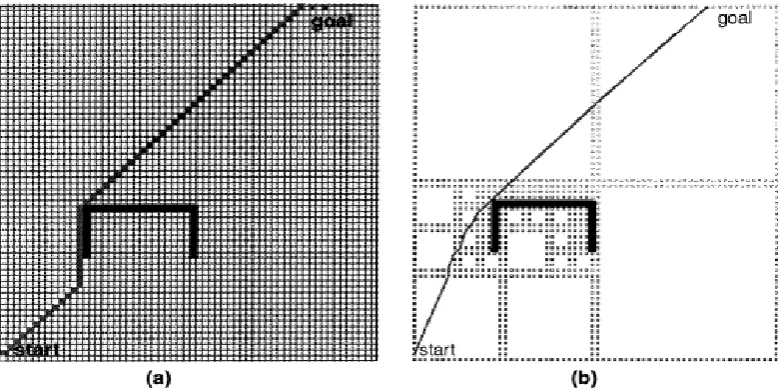
2.2 (a) Grid vs (b) Framed-Quadtreee approach in D* algorithm 8
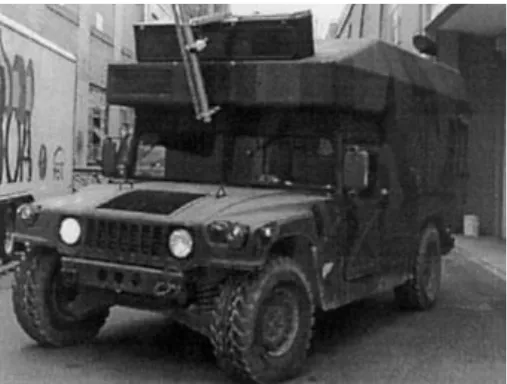
2.3 Autonomuos vehicle used in D* algorithm test 9
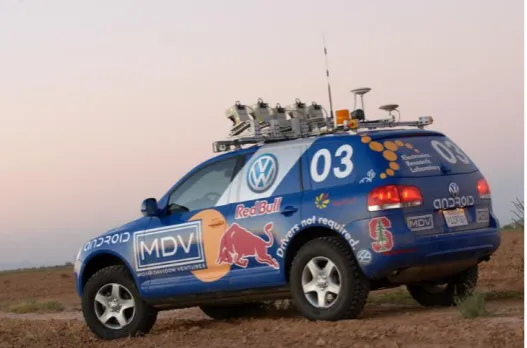
2.4 Champion DARPA challenge race 2005 10
2.5 (a) Dijkstra’s search, (b)A* search on road network of Dallas Ft-Worth urban Area 11
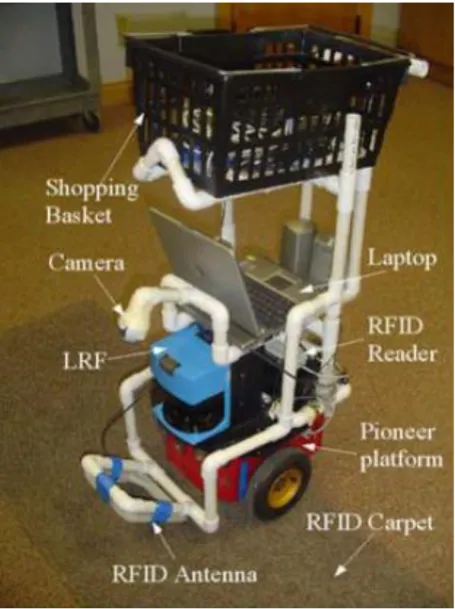
2.6 Kulyukin’s Robotic Aid 12
2.7 Wearable interface for Finger-Braille 12
2.8 Drishti’s navigation system 13
2.9 Dijkstra’s search 16
2.10 First step of Dijkstra’s algorithm 16
2.11 Second step of Dijkstra’s algorithm 17
2.12 Third step of Dijkstra’s algorithm 17
2.13 Step 4 of Dijkstra’s algorithm 18
2.14 Fifth step of Dijkstra’s algorithm 18
2.15 Step6 of Dijkstra’s algorithm 19
2.16 Shortest path by Dijkstra’s algorithm 19
2.17 Starting and Destination point in A* algorithm 21
2.18 Starting the A* search algorithm 21
2.20 Parent relation of Starting Node 22
2.21 Manhattan distance calculation 24
2.22 Diagonal distance calculation 25
2.23 Euclidean distance calculation 26
2.24 Comparison between A* and Dijkstra’s algorithm 27
3.1 The Steps Involved in the project work 33
3.2 The flow chart of Dijkstra’s algorithm 34
3.3 The flow chart of A* algorithm 36
4.1 Pseudo-code of the dijkstra’s algorithm for the shortest path problem 39
4.2 Segmentation source code for Dijkstra’s algorithm 40
4.3 Interface of Dijkstra’s algorithm 41
4.4 Pseudo-code of the A* algorithm for the shortest path problem 42
4.5 Segmentation source code for A* algorithm 43
4.6 Interface of A* algorithm 44
5.1 Case1 of Comparison between A*algorithm and Dijkstra’s algorithm 6
5.2 Case2 of Comparison between A*algorithm and Dijkstra’s algorithm 47
5.3 Case3 of Comparison between A*algorithm and Dijkstra’s algorithm 48
CHAPTER 1
INTRODUCTION
1.1 Background of the Study
Path finding is defined as the process of moving an object from its earlier position to the final position. Different application areas used Path Finding Algorithms (PFA). These include Games and Virtual Tours, Driverless Vehicles, Robot Motion and Navigation.
Path finding is usually described as a process of finding a path between two points in a certain environment. In most cases the objective is to find the shortest path possible, which would be optimal i.e., the shortest, cheapest or simplest. Several criteria such as, path which imitates path chosen by a person, path which requires the lowest amount of fuel, or from two points A and B through point C is often found relevant in many path finding tasks.
Finding the shortest path is the most difficult issue in many fields, starting with navigational systems, artificial intelligence and ending with computer simulations. Although these fields have their own specific algorithms, there are many general purpose path finding algorithms that are applied successfully. However, it remains unclear what benefits certain algorithm have in comparison with others.
Shortest path algorithms are currently used widely. They are the basis of some problems such as network flow problems, tree problems and other related problems. They decide the minimum cost of travel of the problems production cycle, the shortest path in an electric circuit or the most reliable way.
This research attempts to make an implementation of a shortest path algorithm by using A* algorithm and compare it with Dijkstra's algorithm on different criteria, including search time and the distance were implemented to analyze their efficiency in an environment based on 2 dimensional matrix.
A* algorithm is an algorithm that is widely used in path finding and graph traversal. The process of plotting a resourcefully traversal path between points is called nodes. A* traverses the chart and follows the lowermost known path, keeping a sorted priority queue of alternate path sections along the system. If at any position, a segment of the path being traversed has a higher cost as compared to another encountered path segment, it leaves the higher-cost path segment and traverse low cost path segment instead this procedure continues until the goal is reached.
The search space can be reduced by the use of an efficient heuristic function. Without heuristic or when the heuristic function equals to zero, A* becomes Dijkstra‟s path finding algorithm. In addition, if it is extremely high, A* turns into BFS. Therefore, the heuristic function plays a vital role in controlling the behavior of A*. If the heuristic function gives a very little value, then A* will become slow to find the shortest path. If heuristic evaluation is very high value, then A* will become very fast. It shows that the tradeoff between speed and accuracy of the algorithm is dependent on heuristics. Therefore, a heuristic should be chosen very cautiously, keeping in mind this tradeoff. A heuristic that is specific to the problem should be used in algorithms.The time complication of A* depends on the heuristic.
Considering the worst case scenario, the number of nodes expanded is exponential in the length of the solution, but it is polynomial when the questspace is a tree, there is a single goal state and the empirical function h.
3 be defined as an ordered pair G: = (V, E) where V is a set, having elements called vertices or nodes and E is a set of ordered pairs of vertices, called directed edges, arcs, or arrows. Directed graphs are also known as a digraph.
1.2 Problem Statement
Path finding generally refers to finding the shortest path between any two locations. Many existing algorithms are designed precisely to solve the shortest path problem such as Genetic, Floyd algorithm.
The method proposed in this study is A* algorithm and Dijkstra’s, will probably find the shortest path solution in a very short amount of time and minimum distance. A* algorithm, a kind of informed search, is widely used for finding the shortest path, because the location of starting and ending point is taken into account beforehand. The A* algorithm is a refinement of the shortest path algorithm that directs the search towards the desired goal. A* use the heuristic function to speed up the runtime. The general purpose of heuristic algorithm is to find an optimal solution where the time or resources are limited. Dijkstra algorithm is simple and excellent method for path planning. Dijkstra’s algorithm chooses one with the minimum cost until found the goal, but the search is not over as it calculates all possible paths from starting node to the goal, then choose the best solution by comparing which way had the minimum distance. Dijkstra’s algorithm is a special case of A* star algorithm where heuristic is zero. It remains current because it is realistically fast and relatively easy to implement.
1.3 Objectives of the Research
For the aim of this research to be achieved, the following objectives should be fulfilled: (i) To apply A* and Dijkstra 's algorithm to find the shortest path.
1.4 Scope of Research
The research will focus onlytocompare two algorithm A* and Dijkstra’s algorithm based ontime to search and minimum distance on the shortest path in four casesto see how the both of algorithm work in small and big size of search: 8*8 ,22*22, 33*33, 10*10 in two dimensional grid and implement the algorithms inVisual C++2008.
1.5 Motivation
Dijkstra’s Algorithm is efficient in finding the shortest possible path despite having a disadvantage of time wasting in exploring directions that are not promising. Greedy Best First Search explores in promising ways, but not necessarily find the shortest possible path efficiencies. The A* algorithm uses the actual distance from the start as well as the estimated distance to the goal. The algorithm is successful because it gathers some information used by Dijkstra’s algorithm (supporting vertices that are near to the starting point) and information that Best- First-Search uses (favoring vertices that are close to the goal). It is similar to Dijkstra’s procedure in that it can be used to find the shortest path. It is also comparable to Best-First-Search in that it can use a heuristic to guide itself.
1.6 Research Outline
5
CHAPTER 2
LITERATURE REVIEW
2.1 Introduction
Before designing the application and the system environment, this chapter gives insight intotechnique used in this project.Furthermore, general uses that are related to thisproject arespecified at the end of this chapter.
2.2 Applications of Path Finding Algorithms
Path finding algorithms are useful in theareaof robotic manipulation, as it can be used to control a robot around difficult terrain without the need of human intervention (Carsten J, 2007). Itwould be profitable if the robot were ona differentplanet like Mars, in which some topography must be avoided, but due to the extremedistances involve, guidingit completely through remote control would be difficult (too much delay in the radio transmission)(Obara T et al., 1994).It could also be useful if the robots are to be operated underwater, where radio waves could not get to it. It also find applications in almost any case where a vehicle needs to go somewhere, while avoiding obstacles, without human intervention.(David M. et al., 2004)other use is in computer games where something needs to be moved from one place to another avoiding any walls or other difficulties in the way.
2.2.1 PFAs in Games and Virtual Tours
Path finding is an important part of game programming. Game typesmove according to the path they (or computer) calculate. There are some algorithms used in the gamechanging with the complexity and purpose of the path calculation. Themostalgorithm found currently in games todayare the A* Algorithm.
“What makes the A* algorithm so appealing is that it is guaranteed to find the best path between any initial point and any ending point, assuming that a path exists.” (David M. et al., 2004).
[image:15.595.206.431.449.648.2]Users directed in a virtual building or virtual duplicateof a real building, for example a museum, can see the artworks without having to go to a physical place. This is moralfor eluding traveling long distances and attaining more people to show the works. Users can arrange their visit path and algorithm calculates the route thenthe virtual tour begins.Shafie& Hassan (2004) work on this scenario and developed an application capable of doing path planning process..They used an A* algorithm to find the path. The final path can be seen in a 3D environment (Figure 2.1).
7 Autonomous triangulation of virtual characters, is also an important task to work on.It is required to prevent obstacles and proceed to their paths without any impairment.In a virtual environmentnot like the robotic navigation, there is no data coming from sensors, there exist the site database only. (Fr ِhlich & Kullmann, 2002)haveusedA* algorithm studies, on the environmental modeling of the area and resolved that the uniform-sized grid cell methodology is a better choice, alsostatedthat A* algorithm works well in the environments where the world isflat,whichsuits our environment well.
2.2.2 Robot Motion and Navigation
Mobile robots moving in an outdoor or indoor environment must have their course scheduling and navigational schemes in order to be able to find their direction. Commonly, the navigation and pathfinding units are placed on the robots so that can move by themselves. It is imperative to have this property, if the usage of these robots is considered. In the military, detection of hazardous or explosive materials and discovery and investigation of unknown areas are very suitable for this type of robots. Razavian and Sun (2005) proposed a new algorithm called Cognitive Based Adaptive Path Planning Algorithm (CBAPPA) comparing it with A* Algorithm and Focused D* Algorithm (D*, aDynamic A* algorithm which is resulting from the A* Algorithm and has some improved added capabilities used for autonomous units),used it to observe the behaviour of biological units and paid attention to the behaviour of ignoring the irrelevant information from the surroundings, trying toreachthetarget speedily. This method may not use optimum paths, but the results were efficient. This algorithm is also prepared for self-processing units, which can be a good example for our future works.
is quite different from our environment, but can be very useful when it is implemented system in various (may be unknown) conditions.
It is stated in Artificial Intelligence (AI) for the Game Developers book(David M. et al., 2004) that: “Pathfinding problem is thought as solved, future works are for making the algorithm fast and more efficient.” Studies give more effective and faster algorithms to use and implement in different areas.
2.2.3 Driverless Vehicles
Another area of applicationof the path finding algorithms is the programmed vehicles that will be able to discover its way without making contact with the impediments.In addition, its primary usage is in the military, but it can be implemented in diverse areas of the natural life.
In the future, can hunt for the lost outdoor adventurers, hikers or can be very beneficial in case of natural disasters, which the sensors have.
[image:17.595.120.512.503.698.2](Yahja et al.,2000) introduced the D* algorithm which stands for Dynamic A* which they used framed-quadtrees (Figure 2.2) in constructing their environment and data structures, and verified their algorithm in as elf-directed vehicle (Figure 2.3). Their algorithm continuously transforms itself when it gets fresh information about the terrain.
9 According to (Yahjaet al.,2000), if accurate and complete maps were obtainable, it would be appropriate to use a normal search method such as A*.
Figure 2.3: Autonomous vehicle used in the D* algorithm trial
Figure 2.4: Champion DARPA Challenge race 2005
2.2.4 Transportation Networks
In road networks, it is getting more important to find a path to the final end point. If a person is new to a location, sample time can be was ted in locating the end point.
There exist some products established to overcome this difficulty, providing a map of the region. After entering the starting and the final destination, it is likely to acquire the shortest possible track.
11
Figure 2.5: (a) Dijkstra’s Search (b) A* search on road network of Dallas Ft-Worth urban area
Figures 2.5 showed that A* Search is also much more effectivewith respect to the number of nodes visited. Therefore, Dijkstra's Algorithm searches much more nodes than A* does.
2.2.5 Human Navigation
Figure 2.6: Kulyukin's Robotic Aid(Kulyuki et al., 2004)
Amemiya, Yamashita, Hirota and Hirose (2004)used RFID technology, motionsensor together witha wearable computer and a wearable boundaryfor Finger-Braille (Figure 2.7) in order to interact with deaf-visually diminished people. Test area was covered ove 1300 RFID tags. When the user moves, the system does the calculations and gives directions to the user by the vibration alerts on fingers.
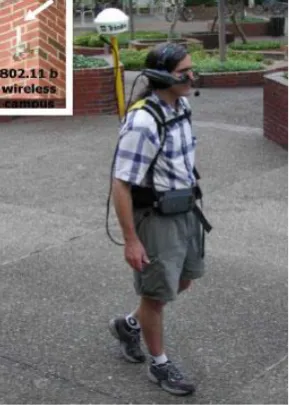
[image:21.595.137.519.538.672.2]13 Beside RFID technology, Global Positioning System (GPS) and ultrasound technology were also used in some studies. Study conducted by Ran et al (2004)proposed a dissimilar system that can be used both outdoor and indoor. The system works with Differential Global Positioning System (DGPS) at outdoor, and with ultrasound positioning system indoors (Figure 2.8). User can shift between these two systems with a simple voice command. The system switches to the ultrasound positioning system indoor, and uses simple geometry calculations to find the location.
Figure 2.8: Drishti's navigation system(Ran et al., 2004)
Mostly, all of these systems are established on outdoor navigation which intended to aid the visually impaired people. These systems bring some benefits to users,which make their life easier.However, in order to make shopping available to these people this is need to implement some of that technology in one indoor system. In all of these systems users have to carry or read some tools which have big capacities. This brings an additionalweight to the operator. These schemes should be improved in order for the integration of the visually impaired people inthe real life.
2.3 Shortest Path Analysis
A shortest path difficulty is to find a route with the least travel cost from one or more roots to one or more destinations through a network (Panahi & Delavar, 2008). Shortest path analysis is important because of its wide range of applications in transportation (Lim & Kim, 2005). (Naqiet al.,2010)stated that the shortest path helps calculate the most optimal route, and optimal routing is the process of defining the best route to get from one location to another. The best route could be shorter or faster depending on how it is defined.
The shortest path can be computed either for a given start time or to find the start time and the path that leads to less travel time journeys.
2.4 Shortest Path Algorithm
Due to the nature of routing applications, there is the need forsupple and effective shortest path techniques, both from a processing time point of view and also in terms of the memory requirements. Unfortunately, prior research does not offer a perfectcourse for picking an algorithm when one faces the difficulty of computing shortest paths on real road networks.However, like most popular papers on Shortest Path algorithms, have concentrated their focus on algorithms that guarantee optimality and have worked on tuning data structures used in implementing these algorithms. (Faramroze Engineer, 2001.).
In road networks, it is more imperative to discover the way to the final destination. When an individualis new to a place, much time may be wasted inlocating the endpoint. There exist some products established to overcome this difficulty, providing a map of the region. After entering the starting point and the final location, it is possible to get the shortest path.
15 Additionally, there is also another algorithm which plans the whole path before moving anywhere. Best-first algorithm expands the nodes based on a heuristic approximation of the cost to the objective. Nodes, which are projected to give the best cost, are expanded first. The most commonly used algorithm is A* algorithm, which is a combination of theDijkstra’s algorithm and the best-first algorithm (Mustafa, 2007).
2.4.1 Dijkstra’s algorithm
Dijkstra’s algorithm is an algorithm named after its developer, E. Dijkstra Oliver j in 1959. Woodman (2007)looks on theuntreatedneighbours of the node closest to the start, and sets or modernizes their distances (in terms of cost, not number of nodes) from the initial point.Dijkstra's Algorithm is a chart search algorithm that unravels the single-source shortest path delinquentfor a plot with non-negative edge path costs, producing a shortest path tree.
Dijkstra’s algorithm or variations of it are the most commonly used route finding algorithm for solving the shortest path (Sadeghi-Niaraki et al., 2011). Dijkstra's algorithm is sometimes called the single-source shortest path because it solves the single-source shortest-path difficulty on a subjective, directed graph (G = V, E) where
Figure 2.9: Dijkstra's Search
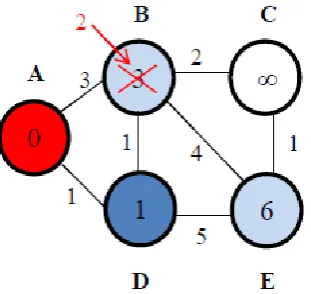
From the figure (Figure 2.10) shown the objective is to find the shortest paths from origin to all other nodes. Dijkstra’s will assign zero to initial node and node A while assigning infinity to all other nodes that are not visited. It will then assign a value gradually to get smallest value up to the destination, which is node E.
Figure2.10: First step of Dijkstra’s Algorithm
[image:25.595.227.371.466.605.2]17
Figure2.11: Second step of Dijkstra’s Algorithm
Step 2: Consider all unvisited neighbors and tentative distance will be calculated. Previously recorded value will be replaced since new value less than infinity.
Figure 2.12: Third step of Dijkstra’s Algorithm
Step 3: Since all neighbors of node A havebeen taken into account, it is struck as visited and will not be tested again.
[image:26.595.244.400.320.467.2]Figure 2.13: Step 4 of Dijkstra’s Algorithm
Step 4: Since all neighbors of node D have been taken into account, it is marked as visited and will not be checked over.
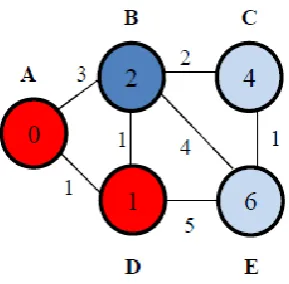
The next minimal distance from node D, node B will now be marked as current node. Its neighboring nodes will be updated with the new minimal distance value.
Figure 2.14: Fifth step of Dijkstra’s Algorithm
Step 5: Since all neighbours of node B have been accounted for, it is marked as visited and will not be testedover.
The next available minimal space from node B, which is node C now will be taken as present node. Its neighbouring nodes will be updated with afresh minimal distance value.
[image:27.595.246.394.375.521.2]19 The next available minimal space from node B, which is node C now will be taken as present node. Its neighbouring nodes will be updated with a fresh minimal distance value.
Figure2.15: Step 6 of Dijkstra’s Algorithm
Step 6: Meanwhile, all neighbours of node C have been taken into account, it is marked as visited and will not be checked .
The next shortest distance from node C is node E, which will be chosen as current node. Since all the nodes have been visited, the shortest route from node A to node E is found.
Figure2.16: Shortest path by Dijkstra’s Algorithm
2.4.2 The Depth-First Search Algorithm
The depth-first search spreads nodes (it extends a node’s descendants before its siblings) until it either reaches the goal or a certain cutoff point, it then goes onto thenextlikelyroute.
The best-first search algorithm is anempirical search algorithm, that cantake knowledge about the plot into account. It is comparable to Dijkstra’s algorithm, butit goes to the node nearby to the goal, rather than the node that is extreme from the start.
2.4.3 A* Algorithm
The algorithm was first described in 1968 by Peter Hart, Nils Nilsson, and Bertram Raphael.It is a universal space-search algorithm that can be used to find the
clarificationsto many problems,with shortest pathasone of such.It has been used in several real-time strategy games and is perhaps the most popular shortest path algorithm.
A* is the most popular choice for pathfinding, because it is fairly flexible and can be used in a wide range of contexts. (R.Anbuselvi &R.S.Bhuvaneswaran, 2009).
21
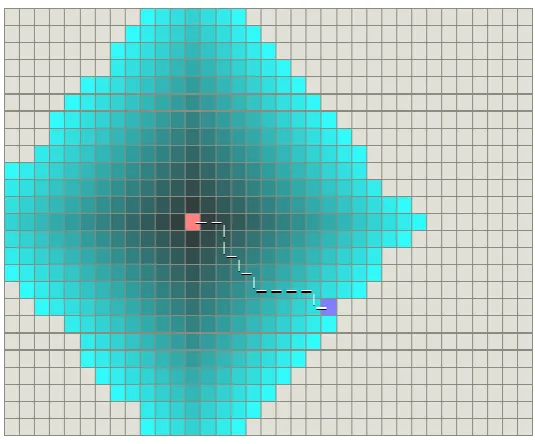
[image:30.595.218.417.76.232.2]A* algorithm starts to perform by looking at the starting node first and thenexpansion to the surrounding nodes (Figure 2.18).
Figure 2.18: Starting the A* Search Algorithm
[image:30.595.206.432.346.511.2]This operation will be carried on till the endpoint node is reached. In order to have an idea of the nodes, which will be used in the search, A* algorithm requests a way to keep track of the nodes. the nodes to be scrutinized are held in a list, called an Open List. At the beginning, place the starting node to the Open List and after inspecting all of its surrounding nodes move it from the Open List and place in another list named the Closed List (Figure 2.19). Closed List holds the nodes that are visited and there is no need to re-visit its members. When building the Open List, The algorithm checks if the node is walk able. If the node is not walkable, it is not added to the Open List.
Figure 2.19:Putting the neighbouring cells to the Open List
This procedure prepared for one cell is the main iteration over one A* loop. However, need to track some supplementary information. Need to know how the nodes are linked . Although the Open List maintains a list of adjacent nodes, we need to know how the adjacent nodes are linked as well. Can do this by tracking the parent node of each node in the Open List. A node's parent is the single node that the user steps from in order to get to its current location. On the first iteration over the loop, each node will point to the starting node as its parent (Figure 2.20).
Figure 2.20: Parent relation of Starting Node
[image:31.595.208.428.457.619.2]23 be inspected is determined by assigning a score to each node. This score, f(n), is the combination of two scores:
f(n) = g(n) + h(n)
Where g(n) is the cost of the path from the starting node to any node n, h(n) is the heuristic estimated cost from any node n to the goal.
Selectthe node with the lowest score. Use a Priority Queue to build the OpenList, and the nodes that will be added to Open List is sorted by this score. So whenpop an element from this Queue, Always get the node with the lowest score.There are some well-known heuristics used in scoring.
Calculate each node's score by adding the cost of getting there from the starting location to the heuristic value, which is an estimate of the cost of getting from the given node to the final destination. Use this score when determining which tile to check next from the Open List. Check the tiles with the lowest cost. In this case, a lower cost will equate to a shorter path.
The g(n) value shown in each open node is the cost of getting there from the starting node. In this case, each value is 1 because each node is just one step from the starting node. The h(n) value is the heuristic. The heuristic is an estimate of the number ofsteps from the given node to the destination node. Do not take obstacles intoconsideration when determining the heuristic. Do not examined the nodes between the current node and the destination node, so do not really know yet if they contain any obstacles. At this point simply want to determine the cost, assuming that there are no obstacles. The final value isf(n), which is the sum of g(n) and h(n). This is the cost of the node. It represents the known cost of getting there from the starting point and an estimate of the remaining cost to get to the destination.
Heuristics used in A* algorithm have some variations, but for grid based maps there are three heuristic functions that work well.
2.4.3.1Manhattan Distance
space. In the simple case, set D to be 1. The heuristic on a square grid where can move in 4 directions should be D times the Manhattan distance:
function heuristic(node) = dx = abs(node.x - goal.x) dy = abs(node.y - goal.y) return D * (dx + dy)
[image:33.595.226.412.276.408.2]Where D represents the cost of moving one node to one of its neighbours. Manhattan Distance (Figure 2.21) allows to move in four directions (North, South, East and West).
Figure 2.21: Manhattan distance calculation
53
REFERENCES
Adam A. Razavian, Sun J. (2005). Cognitive Based Adaptive Path Planning Algorithmfor Autonomous Robotic Vehicles, Southeast Con 2005 Proceedings, 8-10.
Amemiya T., Yamashita J., Hirota K. and Hirose M. (2004). Virtual leading blocks for thedeaf-visually impaired: a real-time way-finder by verbal-nonverbal hybridinterface and high-density RFID tag space.
Benaicha Ramzi, Taibi Mahmoud. (2013).Dijkstra Algorithm Implementation On Fpga Card For Telecom Calculations.
Benjamin Chong Min Fui.(2012). A Comparative Study Of Maze Solving Algorithm For An Autonomous Mobile Robot.
Busra Ozdenizci, Kerem , Vedat Coskun, Mehmet N. Aydin. (2011). “Development of an Indoor Navigation System Using NFC Technology ”.
Cormen, T., Leiserson, C., Rivest, R., and Stein, C. (2001). Single-source shortest Paths :Introduction to algorithms. 2nd ed. Cambridge, MA: MIT
Press,581-635.
Carsten J. (2007).Global Path Planning on board the Mars Exploration Rovers. IEEE Aerospace Conference.
David M. Bourg, Seeman G.(2004). AI for Game Developers, O'Reilly, Chapter 7. Edward M. Measure, David Knapp, Terry Jameson, and Andrew Butler. (2009).
Automated Routing of U\nmanned Aircraft Systems (UAS).
Hart P. E., Nilsson N. J., Raphael B. (1968). “A Formal Basis for the Heuristic Determination of Minimum Cost Paths.
Koenig S. and Likhachev M. (2002). Improved Fast Replanning for Robot Navigation in Unknown Terrain. Proceedings of the 2002 IEEE, International Conference on Robotics & Automation,Washington DC.
Kulyukin V., Gharpure C., Nicholson J. and Pavithran S. (2004). RFID in Robot- Assisted Indoor Navigation for the Visually Impaired. Proceedings Of lEEE/RSJ International Conference on Intelligent Robots and Systems. Liang Dai. (2005). Fast Shortest Algorithm for Road Network and Implementation. Leo Willyanto Santoso, Alexander Setiawan, Andre K. Prajogo. (2010).Performance
Analysis of Dijkstra, A* and Ant Algorithm for Finding Optimal Path: Case Study Surabaya City Map.
M. Shafie Abd. Latiff, and R. Hassan.(2004). An Efficient Virtual Tour- A Merging of Path Planning and Optimization. Work with Computing Systems Conference, Kuala Lumpur.
Manh Hung V. Le , Dimitris Saragas , Nathan Webb.(2009). Indoor Navigation System for Handheld Devices”, 2009.
Mustafa Kilinçarslan. (2007). Implementation Of A Path Finding Algorithm For The Navigation Of Visually Impaired People.
Neha Choubey and Bhupesh Kr.Gupta. (2013). Optimal route computation for online public transport enquiry system.
Obara T., Yamamoto K., Ura T., Maeda H., Yamato H. (1994). Development of an Autonomous Underwater Vehicle R1 with a Closed Cycle Diesel Engine, Proc. Oliver J. Woodman. (2007). An introduction to inertial navigation.
Puthuparampil, M. (2007). Report Dijkstra's Algorithm [online]. Unpublished Presentation, Computer Science Department, New York University. Available from:http://www.cs.nyu.edu/courses/summer07/G22.2340001/Presentations/Put huparampil.pdf. (October, 2014).
Ran L., Helal S. and Moore S., Drishti. (2004): An Integrated Indoor/Outdoor visually impaired Navigation System and Service. In Proceedings of the Second IEEE Annual Conference on Pervasive Computing and Communications (PerCom.04), pp.23-30.
55 Rahul Kala· Anupam Shukla · Ritu Tiwarihave. (2010).Fusion of probabilistic A*
algorithm and fuzzy inference system for robotic path planning.
Sadeghi-Niaraki, A., Varshosaz, M., Kim, K., and Jung, J. (2011). Real world representation of a road network for route planning in GIS. Expert Systems with Applications, 38 (10), 11999-12008.
T. Frohlich and D. Kullmann. (2002). Autonomous and Robust Navigation for SimulatedHumanoid Characters in Virtual Environments. Proceedings of the First International Symposium on Cyber Worlds (CW'02).
Xiao Cui & Hao Shi.(2011). Direction oriented pathfinding in video games.
Yahja A., Singh S., Stentz A. (2000). An efficient on-line path planner for outdoor mobile robots, Robotics and Autonomous Systems.