0095-1137/05/$08.00⫹0 doi:10.1128/JCM.43.8.3985–3994.2005
Copyright © 2005, American Society for Microbiology. All Rights Reserved.
Comparative Sequencing of the Serine-Aspartate Repeat-Encoding
Region of the Clumping Factor B Gene (
clfB
) for Resolution
within Clonal Groups of
Staphylococcus aureus
Larry Koreen,
1,2Srinivas V. Ramaswamy,
3† Steven Naidich,
4Irina V. Koreen,
1Gavin R. Graff,
5Edward A. Graviss,
3and Barry N. Kreiswirth
2*
New Jersey Medical School and Graduate School of Biomedical Sciences, University of Medicine and Dentistry of New Jersey,
Newark, New Jersey 071031; Public Health Research Institute, International Center for Public Health, Newark,
New Jersey 071032; Department of Pathology, Baylor College of Medicine, Houston, Texas 770303;
eGenomics, New York, New York 100134; and Department of Pediatrics, Penn State College
of Medicine, Hershey, Pennsylvania 170335
Received 23 December 2004/Returned for modification 12 February 2005/Accepted 16 March 2005
Molecular techniques such as spa typing and multilocus sequence typing use DNA sequence data for differentiatingStaphylococcus aureusisolates. Althoughspatyping is capable of detecting both genetic micro-and macrovariation, it has less discriminatory power than the more labor-intensive pulsed-field gel electro-phoresis (PFGE) and costly genomic DNA microarray analyses. This limitation hinders strain interrogation for newly emerging clones and outbreak investigations in hospital or community settings where robust clones are endemic. To overcome this constraint, we developed a typing system using DNA sequence analysis of the serine-aspartate (SD) repeat-encoding region within the gene encoding the keratin- and fibrinogen-binding clumping factor B (clfBtyping) and tested whether it is capable of discriminating within clonal groups. We analyzed 116S. aureusstrains, and the repeat region was present in all isolates, varying in sequence and in length from 420 to 804 bp. In a sample of 36 well-characterized genetically diverse isolates, clfB typing subdivided identicalspaand PFGE clusters which had been discriminated by whole-genome DNA microarray mapping. The combination ofspatyping andclfBtyping resulted in a discriminatory power (99.5%) substan-tially higher than that of spa typing alone and closely approached that of the whole-genome microarray (100.0%).clfBtyping also successfully resolved genetic differences among isolates differentiated by PFGE that had been collected over short periods of time from single hospitals and that belonged to the most prevalentS. aureusclone in the United States.clfBtyping demonstrated in vivo, in vitro, and interpatient transmission stability yet revealed that this locus may be recombinogenic in a primarily clonal population structure. Taken together, these data show that the SD repeat-encoding region ofclfBis a highly stable marker of microvaria-tion, that in conjunction with spa typing it may serve as a DNA sequence-based alternative to PFGE for investigating genetically similar strains, and that it is useful for analyzing collections of isolates in both long-term population-based and local epidemiologic studies.
Strain typing techniques forStaphylococcus aureus, the lead-ing cause of nosocomial infections (28), have become widely used. These techniques aid in both local/short-term epidemi-ologic outbreak investigations and global/long-term popula-tion-based studies of methicillin-resistant and -susceptible
S. aureus(MRSA and MSSA, respectively). Macrorestriction
digests using pulsed-field gel electrophoresis (PFGE) have been shown to be highly effective in outbreak settings (48). Multilocus enzyme electrophoresis (MLEE), multilocus se-quence typing (MLST), and sese-quence analysis of the repeat region within the coagulase gene, i.e.,coatyping, are effective techniques for analyzingS. aureus strains in long-term study settings (10, 42), and the sequence analysis of the repeat region within the protein A gene,spatyping, can effectively be used in both settings (22, 41). However, spatyping, like MLST and other techniques, is capable of only a certain degree of
reso-lution beyond which clonal groups of isolates cannot be sub-divided. This limitation hinders strain interrogation for newly emerging clones and outbreak investigations in hospital or community settings where robust clones, such as thespatype 2 clone, which is the most prevalentS. aureusstrain associated with health care-related infections in the United States (25) and also the strain that recently has acquired resistance to vancomycin (55), are endemic. In order to overcome this con-straint, a highly informative locus capable of discriminating within clonal groups is necessary.
For species such as Bacillus anthracis, markers have been found that subdivide closely related strains (36). However, for
S. aureus, no such marker exists aside from PFGE, a technique
that is difficult to standardize, analyze, and database (41, 52). DNA sequence-based techniques overcome these limitations of PFGE and are considerably faster to perform (9, 24, 41). However,spatyping alone, which has the single highest dis-criminatory power of the DNA sequence-basedS. aureus typ-ing techniques (22, 37), sometimes fails to discriminate be-tween two closely related strains that can be differentiated by PFGE and is often considered inferior to PFGE with regard to discriminating rapidly accumulating genetic microvariation * Corresponding author. Mailing address: PHRI TB Center,
Inter-national Center for Public Health, 225 Warren St., Newark, NJ 07103. Phone: (973) 854-3240. Fax: (973) 854-3241. E-mail: [email protected]. † Present address: Channing Laboratory, Brigham and Women’s Hospital, Harvard Medical School, Boston, MA 02115.
3985
on May 15, 2020 by guest
http://jcm.asm.org/
typing with another locus that can be analyzed for genetic variation when microresolution of strains is sought. This ap-proach has been successfully applied toNeisseria meningitidis
(12) andEnterococcus faecalis(27). Furthermore, becausespa
typing has been shown to be in agreement with MLST (1, 6, 31–34), a typing technique that helps to resolve differences among similarspatypes would also be useful in subdividing the clonal complexes identified by MLST.
Potential gene candidates for providing high-level genetic resolution are those that encode MSCRAMMs (microbial sur-face components recognizing adhesive matrix molecules) (15) such as spa, because they contain variable repeat region se-quences and because the surface proteins they encode interact with the environment and may change accordingly. The clump-ing factor B gene (clfB) ofS. aureusencodes an MSCRAMM protein that binds to fibrinogen (30) and keratin and facilitates
S. aureuscolonization in human nares (32, 53). Clumping
fac-tor B has also been implicated in the pathogenesis ofS. aureus -induced endocarditis (11). Furthermore,clfB has an unusual repeat region encoding a directly repeating serine-aspartate (SD) dipeptide that, presumably due to nucleotide mutations and ease of repeat duplication/deletion via slipped-strand mi-spairing (51) during replication, had appeared to be a highly evolving region that could be used to complementspatyping (L. Koreen, S. Ramaswamy, S. Naidich, E. A. Graviss, and B. Kreiswirth, Abstr. 103rd Gen. Meet. Am. Soc. Microbiol. 2003, abstr. C-429, 2003). Here we report on the development and evaluation of this new DNA sequence-based typing scheme for
S. aureususing theclfBSD repeat region for indexing genetic
microvariation within groups of closely related strains and for differentiating among identicalspatypes. In order to explore the unique discriminatory capability ofclfBtyping, evolution-ary analyses were performed to investigate the selection pres-sures on this repeat region.
MATERIALS AND METHODS
Bacterial strains.The following 116S. aureusstrains were analyzed to deter-mine whether use of the SD repeat-encoding region within theclfBgene (clfB typing) provided suitable discriminatory power for differentiating strains deemed closely related by other molecular markers discussed below. Thirty-six strains, which had been selected from over 2,000 isolates, were recovered from 10 countries on four continents over a period of 4 decades and included the fully sequenced COL strain. These 36 strains formed a highly diverse collection representing the most abundant lineages and the breadth of genetic variation of S. aureus(14). These strains (11 MRSA and 25 MSSA) had previously been analyzed with a whole-genome DNA microarray, MLEE, PFGE, andspaandcoa typing (14, 22); included were 14 clonal strains with electrophoretic type (ET) 234 in lineage H1 by MLEE associated with toxic shock syndrome (TSS) and well differentiated by the DNA microarray (14). Fourteen other strains were recov-ered during anS. aureuscarriage and infection surveillance study in 2002 from patients at a New York City hospital over a 2-week period. These strains hadspa type 2 and type 2-related genotypes (the most prevalentS. aureusclonal lineage found in U.S. hospitals [25]). Another 21 strains were collected from cystic fibrosis patients at a Midwestern hospital, and these strains also hadspatype 2 and type 2-related genotypes. The in vitro stability of theclfBrepeat region was tested using a strain that was passed extensively in the laboratory for 6 weeks (44); three isolates picked from single colonies from the first week and three from the last week wereclfBtyped (analysis of three isolates picked from single colonies is sufficient for finding existing genotypic discordance among isolates from the same source ([5]). The in vivo stability ofclfBtyping was tested using three carriage isolates obtained over a 21-month period from each of four hemodialysis patients consistently carrying strains of the same PFGE-determined genotype as part of our laboratory’s longitudinal hemodialysis patientS. aureus
Eisner, B. Saı¨d-Salim, B. Raucher, N. Levin, A. Kaufman, B. Koll, and B. Kreiswirth, Abstr. 40th Annu. Meet. Infect. Dis. Soc. Am. 2002, abstr. 125, 2002). Two other strains obtained from the same patient over a 3-month period in this hemodialysis study were identical according to PFGE analysis except for a two-band difference, which was interpreted as being directly due to the loss of the methicillin resistance element, staphylococcal cassette chromosomemec, based on the difference in size between the two PFGE bands and on methicillin sensitivity andmecASouthern hybridization testing of the strains. These two strains were used to test whetherclfBtyping was excessively variable, a disad-vantage occasionally attributed to PFGE (12, 17). Also, 18 strains from a well-characterized Centers for Disease Control and Prevention collection of strains obtained from different outbreaks (43, 47, 50) were used to study interpatient transmission stability of theclfBrepeat region. These strains had been previously spatyped; seven identified as outbreak I MRSA strains (strains SB-3, -5, -10, -12, -15, -19, and -20), were obtained from the Iowa Veterans Affairs Medical Center, and four others, identified as outbreak II MSSA strains (strains SB-2, -4, -6, and -11), were isolated from a contaminated anesthetic (41). Finally, seven strains (Newman, 476, 252, MW2, NCTC 8325, Mu50, and N315) whoseclfBsequences were already available in public databases were alsoclfBtyped.
Molecular analysis.DNA was isolated (41) and theclfBSD repeat region of each isolate was PCR amplified with a Geneamp System 9700 thermocycler (Applied Biosystems, Inc., Foster City, CA) using the following primers:clfBF, 5⬘-CAG CAG TAA ATC CGA AAG ACC C-3⬘;clfBR, 5⬘-CAC CTT TAG GAT TTG ATG GTG C-3⬘. Unincorporated nucleotides and primers were removed with a QIAGEN Qiaquick PCR purification kit (Valencia, CA). DNA sequenc-ing reactions were performed with a BigDye Terminator cycle sequencsequenc-ing kit (Applied Biosystems, Inc., Foster City, CA). Sequencing reaction products were purified using Centrisep columns (Princeton Separations, Adelphia, NJ). Se-quence data generated with an ABI 377 (Applied Biosystems, Inc., Foster City, CA) automated instrument were assembled and edited electronically with the ALIGN, EDITSEQ, and MEGALIGN programs (DNASTAR, Madison, WI). Contigs were built with maximal stringency using SEQUENCHER v. 4.1.2 (Gene Codes Corporation, Ann Arbor, MI). Final sequence size was verified by corre-lation with PCR amplicon size. Each uniqueclfBrepeat region nucleotide se-quence was given aclfBtype numeric identifier.
spaandcoatyping, macrorestriction analysis using PFGE, and analysis using the DNA microarray have been previously described (7, 22, 41, 42). Briefly, aspa type is defined by the makeup of the variable number tandem repeat region in the 3⬘end of the staphylococcal protein A gene (spa). The different repeats, designated randomly with letters (A to Z, A2, and B2, etc.), that comprise aspa type vary from one another by at least one point mutation and are generally each composed of 24 bp. The different types of organization of a repeat region are termed repeat profiles and range from 1 to 16 repeats in length.coatyping is similar tospatyping, except the variable number tandem repeat region in the coagulase gene consists of 81-bp repeats. Within each typing scheme, isolates with similar repeat profiles have in common sequential point mutations and were grouped together as part of the same numericspaorcoalineage (sublineages indicated with letters). For the previously performed PFGE analysis of the diversity collection (22), isolates with patterns with differences of up to six bands were considered as possibly related (48) and had been grouped together into the same alphabetic lineage, with every unique pattern within a lineage given a secondary numeric code. Patterns not falling into any lineages were identified with numeral 1. DNA microarray experiments performed by Fitzgerald et al. (14) on each of the 36 diversity collection strains used in this study assayed for the presence of over 90% of the open reading frames withinS. aureus. Based on the presence or absence of these 2,817 open reading frames, hierarchical cluster analysis had been previously used to construct a dendrogram showing relatedness among these 36 strains (14).
Comparing genetic markers and evolutionary analysis.The percent concor-dance between any two typing techniques for a particular set of isolates was calculated as previously described with cross-classification analysis of all possible pairs of those isolates (22, 38, 39). Simpson’s index of diversity, which indicates the probability that among a group of isolates any two randomly selected isolates will have different genotypes (19), was used to measure discriminatory power. Molecular evolutionary analyses of theclfBrepeats were performed as previously described forspaandcoarepeats (22). Using MEGA version 2.1 (23), the overall mean Nei-Gojobori (Jukes-Cantor-corrected) method (29) with pairwise dele-tion handling of gaps and standard error determined with 1,000 bootstrap rep-lications was used to calculate the average number of synonymous substitutions per synonymous site (dS) and nonsynonymous substitutions per nonsynonymous site (dN). Subsequently, to determine selection pressure on the repeats,Ztests were done with the null hypothesis, dN⫽dS, and the following three alternative
on May 15, 2020 by guest
http://jcm.asm.org/
hypotheses: dN⫽dS (test of neutrality), dN⬎dS (positive selection), and dN ⬍dS (purifying selection). Other testing with chi-square/Fisher’s exact tests was performed using EpiInfo 2002 (Centers for Disease Control and Prevention, Atlanta, GA). Statistical significance was determined with aPvalue of⬍0.05.
RESULTS
Choice ofclfBfor high-resolution strain typing.clfBencodes the clumping factor B protein, whose structural organization is shown in Fig. 1 (21). This gene was chosen as a typing target because of its unique repeat region containing direct repeats that each encode three SD dipeptides. The overall repeat re-gion ofclfB(an example from strain NCTC 8325, whose ge-nome has been fully sequenced, is shown in Fig. 2) is typically larger than that ofspa, and the individual repeats are 18 bp (TCN-GAY-TCN-GAY-AGY-GAY, with N equaling A, C, G, or T and Y equaling C or T), 6 bp shorter than thesparepeats. For these reasons we believed there would be increased slipped-strand mispairing (51) during replication and recom-bination, resulting in more genetic variation in the repeat re-gion ofclfBthan inspaamong related strains. Furthermore, of different genes encoding SD repeat-containing proteins inS.
aureus, onlyclfBwas found in all strains assayed previously (35,
49), andclfBhad a repeat region that was somewhat smaller, and thus easier to sequence and analyze, than other genes, such asclfA(21).
clfBSD repeats, types, and lineages.One hundred sixteenS.
aureusstrains, whose origins are described in Materials and
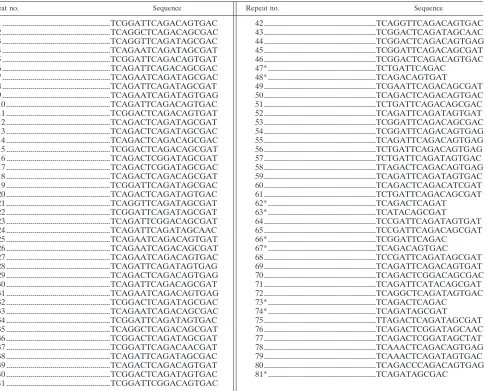
Methods, were characterized by clfB genotyping. All strains had theclfBgene present. Initially, PCR amplicons were ana-lyzed for restriction fragment length polymorphisms using BamHI and Tsp45I enzymes to test whether strains could be well differentiated by restriction fragment length polymor-phism patterns alone. However, it was determined that the restriction digests did not produce adequate strain resolution (data not shown). DNA sequencing of allclfBSD repeat re-gions was then performed. The sizes of the clfB SD repeat region PCR amplicons ranged from 627 to 1,011 bp. The av-erage number of repeats in each strain’s repeat region was 38 (range, 24 to 46 repeats), and the average repeat region size was 677 bp (range, 420 to 804 bp). Due to point mutations, a total of 81 different repeats (each given a numeric identifier) were identified among the strains tested (Table 1). Each repeat varies from another by at least one point mutation; occasion-ally, this variation created a nonsynonymous change.
Seventy-two (72) of the repeats had the standard 18-bp length, and nine of the repeats had 12-bp lengths. The 12-bp repeats (each given a numeric and an asterisk identifier) were the result of slippage events where, presumably through slipped-strand mispairing during replication, either 12-bp seg-ments were deleted from two contiguous repeats (six from
each repeat) or 6 bp was deleted from only one repeat. Imme-diately downstream of any slippage event, the repeating DNA sequence continued in standard fashion.
A computerized search algorithm was designed (eGenomics, New York, N.Y.) to take the full amplicon sequence input and automatically find the SD repeat-encoding region and identify all individual repeats. The algorithm was the following. The start site for repeat typing in the full amplicon is the sequence TCN-GAY that is found as part of the first instance of GAT-TCN-GAY in the amplicon. Every 18-mer thereafter defines a repeat, unless the fifth codon (i.e., the 13th to 15th nucleotides of an individual repeat) equals TCN. If the 13th to 15th nu-cleotides are TCN, then slippage has occurred and the 12 nucleotides preceding the TCN are made into one repeat (in-dicated with an asterisk). The signal to end the repeat typing in the full-amplicon sequence is with the nucleotide right before the first TCN-GAT-TCA-AGA.
In a manner analogous to that for thespatypes (22, 41), each
clfBtype (i.e.,clfBallele) was given a numeric identifier and was defined by the composition, number, and order of repeats (termed a repeat profile) within the repeat region. The clfB
types that had slippage events were given numeric identifiers and asterisks (if two slippage events occurred, then thatclfB
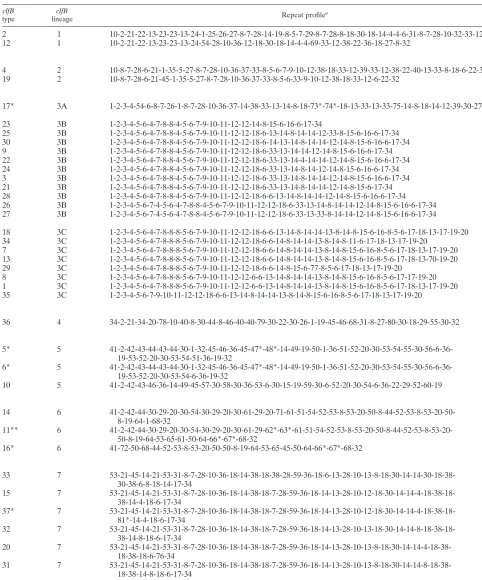
type was given two asterisks, and so forth). There was a total of 37 different clfB types found in this study (Table 2). Also, analogous to the procedure described previously forspaand
coatyping (6, 22, 41, 42),clfBlineages were formed by group-ing strains with similarclfBrepeat profiles together (Table 2), as genetic relatedness is suggested by the presence of identical point mutations. Using a global sequence alignment program, similarclfBprofile groupings were obtained (data not shown). FIG. 1. Structural organization of the clfBprotein. Repeat region
[image:3.585.43.287.69.100.2]ranged in size from 140 to 268 amino acids (aa), making the total protein approximately 800 to 928 amino acids long (21). S, signal sequence; A, binding region for keratin and fibrinogen; W, wall-span-ning region; M, membrane-spanwall-span-ning region (21, 32).
FIG. 2. SD repeat-encoding region ofclfBinS. aureusstrain NCTC 8325. Both DNA and amino acid sequences of the SD repeat-encoding region and immediate flanking regions are shown. The underlined nucleotides are the primers used to amplify the repeat region. Nucle-otides/amino acids in bold type show the first and last complete re-peats, which frame the repeat region portion (composed, in this ex-ample, of 36 direct 18-bp repeats) used forclfBtyping.
on May 15, 2020 by guest
http://jcm.asm.org/
clfBtypes, similar tocoatypes described previously (22), could be organized into either nine or seven (for deeper phylogenetic classification) lineages entitledclfBlineages I and II, respec-tively (i.e., countingclfBlineages 3A, 3B, and 3C separately or as a single lineage). Of note is that theclfBtypes where slip-page occurred did not all have a commonclfBrepeat profile; that is, they did not all fall into the same lineage (Table 2).
Diversity collection of 36 strains. (i) Discriminatory power.
The 36 strains representing the breadth of genetic diversity in
S. aureusthat were studied previously using a whole-genome
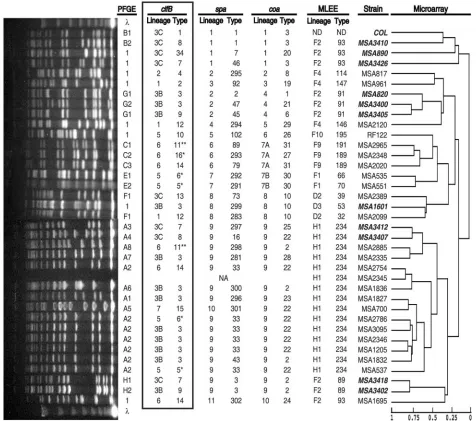
microarray (14) andspaandcoatyping (22) were clfBtyped (Fig. 3). There was a total of 17 clfB types and eight clfB
lineages I. Simpson’s index of diversity forclfB typing alone was 91.0%, compared with 97.3% forspatyping (22). However, when strains were genotyped with spatyping in combination withclfBtyping, the index of diversity increased to 99.5%, with 34 of the 36 strains being assigned different genotypes. This closely approximated the DNA microarray, whose index of diversity was 100.0%. Thus,clfBon its own appears not to have exceedingly strong resolving power, but when combined with
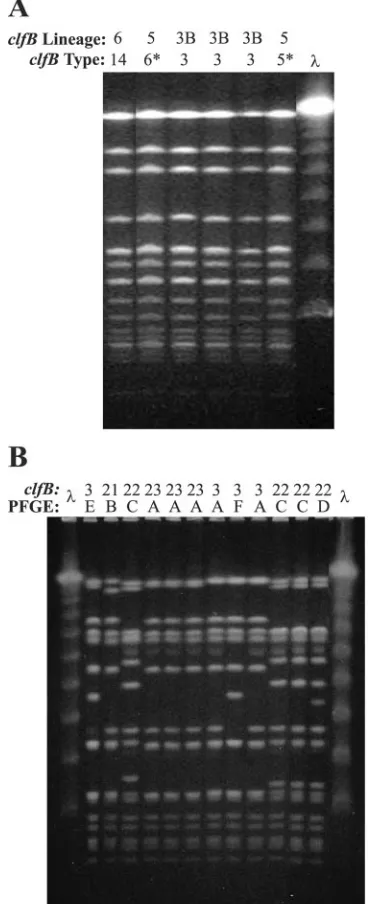
spatyping, it increasesspatyping’s resolving power greatly, as opposed to markers such ascoaand PFGE that do not (22). There were three PFGE types, three spa types, and one combinedspa-PFGE type that were found among at least two isolates in this collection of 36 strains. In all casesclfBtyping was able to differentiate these strains with genotypes that ini-tially appeared identical in at least two groups. Of the 14 ET 234 TSS strains, which previously had been difficult to discrim-inate using onlyspatyping (22) and which resulted in an 83.5% index of diversity (resolving 9 genotypes),spatyping combined withclfBtyping had a 96.7% index of diversity (resolving 12 genotypes). Of the 14 ET 234 strains, 6 were ofspatype 33, all of which had the same A2 PFGE pattern.clfBtyping resolved four different genotypes from three different clfB lineages among these six strains (Fig. 4A). These data, as well as the microarray findings, indicate that there are considerable ge-netic differences between these strains.
(ii) Evidence for recombination.In cross-classification anal-ysis of all possible pairs of the 36 isolates, individualclfBtypes were 85% concordant with PFGE types and 89% concordant
Repeat no. Sequence Repeat no. Sequence
1 ...TCGGATTCAGACAGTGAC 2 ...TCAGGCTCAGACAGCGAC 3 ...TCAGGTTCAGATAGCGAC 4 ...TCAGAATCAGATAGCGAT 5 ...TCGGATTCAGACAGTGAT 6 ...TCAGATTCAGACAGCGAC 7 ...TCAGAATCAGATAGCGAC 8 ...TCAGATTCAGATAGCGAT 9 ...TCAGAATCAGATAGTGAG 10 ...TCAGATTCAGACAGTGAC 11 ...TCGGACTCAGACAGTGAT 12 ...TCAGACTCAGATAGCGAT 13 ...TCAGACTCAGATAGCGAC 14 ...TCAGACTCAGACAGCGAC 15 ...TCGGACTCAGACAGCGAT 16 ...TCAGACTCGGATAGCGAT 17 ...TCAGACTCGGATAGCGAC 18 ...TCAGACTCAGACAGCGAT 19 ...TCGGATTCAGATAGCGAC 20 ...TCAGACTCAGATAGTGAC 21 ...TCAGGTTCAGATAGCGAT 22 ...TCGGATTCAGATAGCGAT 23 ...TCAGATTCGGACAGCGAT 24 ...TCAGATTCAGATAGCAAC 25 ...TCAGAATCAGACAGTGAT 26 ...TCAGAATCAGACAGCGAT 27 ...TCAGAATCAGACAGTGAC 28 ...TCAGATTCAGATAGTGAG 29 ...TCAGACTCAGACAGTGAG 30 ...TCAGATTCAGACAGCGAT 31 ...TCAGAATCAGACAGTGAG 32 ...TCGGACTCAGATAGCGAC 33 ...TCAGAATCAGACAGCGAC 34 ...TCGGATTCAGATAGTGAC 35 ...TCAGGCTCAGACAGCGAT 36 ...TCGGACTCAGATAGCGAT 37 ...TCGGATTCAGACAACGAT 38 ...TCAGATTCAGATAGCGAC 39 ...TCAGACTCAGACAGTGAT 40 ...TCGGACTCAGATAGTGAC 41 ...TCGGATTCGGACAGTGAC
a
Asterisks indicate repeats 12 bp in length.
42 ...TCAGGTTCAGACAGTGAC 43 ...TCGGACTCAGATAGCAAC 44 ...TCGGACTCAGACAGTGAG 45 ...TCGGATTCAGACAGCGAT 46 ...TCGGACTCAGACAGTGAC 47* ...TCTGATTCAGAC
48* ...TCAGACAGTGAT
49 ...TCGAATTCAGACAGCGAT 50 ...TCAGACTCAGACAGTGAC 51 ...TCTGATTCAGACAGCGAC 52 ...TCAGATTCAGATAGTGAT 53 ...TCGGATTCAGACAGCGAC 54 ...TCGGATTCAGACAGTGAG 55 ...TCAGATTCAGACAGTGAG 56 ...TCTGATTCAGACAGTGAG 57 ...TCTGATTCAGATAGTGAC 58 ...TTAGACTCAGACAGTGAG 59 ...TCAGATTCAGATAGTGAC 60 ...TCAGACTCAGACATCGAT 61 ...TCTGATTCAGACAGCGAT 62* ...TCAGACTCAGAT
63* ...TCATACAGCGAT
64 ...TCCGATTCAGATAGTGAT 65 ...TCCGATTCAGACAGCGAT 66* ...TCGGATTCAGAC
67* ...TCAGACAGTGAC
68 ...TCCGATTCAGATAGCGAT 69 ...TCAGATTCAGACAGTGAT 70 ...TCAGACTCGGACAGCGAC 71 ...TCAGATTCATACAGCGAT 72 ...TCAGGCTCAGATAGTGAC 73* ...TCAGACTCAGAC
74* ...TCAGATAGCGAT
75 ...TTAGACTCAGATAGCGAT 76 ...TCAGACTCGGATAGCAAC 77 ...TCAGACTCGGATAGCTAT 78 ...TCAAACTCAGACAGTGAG 79 ...TCAAACTCAGATAGTGAC 80 ...TCAGACCCAGACAGTGAG 81* ...TCAGATAGCGAC
on May 15, 2020 by guest
http://jcm.asm.org/
[image:4.585.58.545.80.471.2]TABLE 2. clfBtypes, lineages, and repeat profiles organized byclfBlineage
clfB type
clfB
lineage Repeat profile
a
2 1 10-2-21-22-13-23-23-13-24-1-25-26-27-8-7-28-14-19-8-5-7-29-8-7-28-8-18-30-18-14-4-4-6-31-8-7-28-10-32-33-12-32 12 1 10-2-21-22-13-23-23-13-24-54-28-10-36-12-18-30-18-14-4-4-69-33-12-38-22-36-18-27-8-32
4 2 10-8-7-28-6-21-1-35-5-27-8-7-28-10-36-37-33-8-5-6-7-9-10-12-38-18-33-12-39-33-12-38-22-40-13-33-8-18-6-22-32 19 2 10-8-7-28-6-21-45-1-35-5-27-8-7-28-10-36-37-33-8-5-6-33-9-10-12-38-18-33-12-6-22-32
17* 3A 1-2-3-4-54-6-8-7-26-1-8-7-28-10-36-37-14-38-33-13-14-8-18-73*-74*-18-13-33-13-33-75-14-8-18-14-12-39-30-27-8-32
23 3B 1-2-3-4-5-6-4-7-8-8-4-5-6-7-9-10-11-12-12-14-8-15-6-16-6-17-34
25 3B 1-2-3-4-5-6-4-7-8-8-4-5-6-7-9-10-11-12-12-18-6-13-14-8-14-14-12-33-8-15-6-16-6-17-34 30 3B 1-2-3-4-5-6-4-7-8-8-4-5-6-7-9-10-11-12-12-18-6-14-13-14-8-14-14-12-14-8-15-6-16-6-17-34 9 3B 1-2-3-4-5-6-4-7-8-8-4-5-6-7-9-10-11-12-12-18-6-33-13-14-14-12-14-8-15-6-16-6-17-34 22 3B 1-2-3-4-5-6-4-7-8-8-4-5-6-7-9-10-11-12-12-18-6-33-13-14-4-14-14-12-14-8-15-6-16-6-17-34 24 3B 1-2-3-4-5-6-4-7-8-8-4-5-6-7-9-10-11-12-12-18-6-33-13-14-8-14-12-14-8-15-6-16-6-17-34 3 3B 1-2-3-4-5-6-4-7-8-8-4-5-6-7-9-10-11-12-12-18-6-33-13-14-8-14-14-12-14-8-15-6-16-6-17-34 21 3B 1-2-3-4-5-6-4-7-8-8-4-5-6-7-9-10-11-12-12-18-6-33-13-14-8-14-14-12-14-8-15-6-17-34 28 3B 1-2-3-4-5-6-4-7-8-8-4-5-6-7-9-10-11-12-12-18-6-6-13-14-8-14-14-12-14-8-15-6-16-6-17-34 26 3B 1-2-3-4-5-6-7-4-5-6-4-7-8-8-4-5-6-7-9-10-11-12-12-18-6-33-13-14-8-14-14-12-14-8-15-6-16-6-17-34 27 3B 1-2-3-4-5-6-7-4-5-6-4-7-8-8-4-5-6-7-9-10-11-12-12-18-6-33-13-33-8-14-14-12-14-8-15-6-16-6-17-34
18 3C 1-2-3-4-5-6-4-7-8-8-8-5-6-7-9-10-11-12-12-18-6-6-13-14-8-14-14-13-8-14-8-15-6-16-8-5-6-17-18-13-17-19-20 34 3C 1-2-3-4-5-6-4-7-8-8-8-5-6-7-9-10-11-12-12-18-6-6-14-8-14-14-13-8-14-8-11-6-17-18-13-17-19-20
7 3C 1-2-3-4-5-6-4-7-8-8-8-5-6-7-9-10-11-12-12-18-6-6-14-8-14-14-13-8-14-8-15-6-16-8-5-6-17-18-13-17-19-20 13 3C 1-2-3-4-5-6-4-7-8-8-8-5-6-7-9-10-11-12-12-18-6-6-14-8-14-14-13-8-14-8-15-6-16-8-5-6-17-18-13-70-19-20 29 3C 1-2-3-4-5-6-4-7-8-8-8-5-6-7-9-10-11-12-12-18-6-6-14-8-15-6-77-8-5-6-17-18-13-17-19-20
8 3C 1-2-3-4-5-6-4-7-8-8-8-5-6-7-9-10-11-12-12-6-6-13-14-8-14-14-13-8-14-8-15-6-16-8-5-6-17-17-19-20 1 3C 1-2-3-4-5-6-4-7-8-8-8-5-6-7-9-10-11-12-12-6-6-13-14-8-14-14-13-8-14-8-15-6-16-8-5-6-17-18-13-17-19-20 35 3C 1-2-3-4-5-6-7-9-10-11-12-12-18-6-6-13-14-8-14-14-13-8-14-8-15-6-16-8-5-6-17-18-13-17-19-20
36 4 34-2-21-34-20-78-10-40-8-30-44-8-46-40-40-79-30-22-30-26-1-19-45-46-68-31-8-27-80-30-18-29-55-30-32
5* 5 41-2-42-43-44-43-44-30-1-32-45-46-36-45-47*-48*-14-49-19-50-1-36-51-52-20-30-53-54-55-30-56-6-36-19-53-52-20-30-53-54-51-36-19-32
6* 5 41-2-42-43-44-43-44-30-1-32-45-46-36-45-47*-48*-14-49-19-50-1-36-51-52-20-30-53-54-55-30-56-6-36-19-53-52-20-30-53-54-6-36-19-32
10 5 41-2-42-43-46-36-14-49-45-57-30-58-30-36-53-6-30-15-19-59-30-6-52-20-30-54-6-36-22-29-52-60-19
14 6 41-2-42-44-30-29-20-30-54-30-29-20-30-61-29-20-71-61-51-54-52-53-8-53-20-50-8-44-52-53-8-53-20-50-8-19-64-1-68-32
11** 6 41-2-42-44-30-29-20-30-54-30-29-20-30-61-29-62*-63*-61-51-54-52-53-8-53-20-50-8-44-52-53-8-53-20-50-8-19-64-53-65-61-50-64-66*-67*-68-32
16* 6 41-72-50-68-44-52-53-8-53-20-50-50-8-19-64-53-65-45-50-64-66*-67*-68-32
33 7 53-21-45-14-21-53-31-8-7-28-10-36-18-14-38-18-38-28-59-36-18-6-13-28-10-13-8-18-30-14-14-30-18-38-30-38-6-8-18-14-17-34
15 7 53-21-45-14-21-53-31-8-7-28-10-36-18-14-38-18-7-28-59-36-18-14-13-28-10-12-18-30-14-14-4-18-38-18-38-14-4-18-6-17-34
37* 7 53-21-45-14-21-53-31-8-7-28-10-36-18-14-38-18-7-28-59-36-18-14-13-28-10-12-18-30-14-14-4-18-38-18-81*-14-4-18-6-17-34
32 7 53-21-45-14-21-53-31-8-7-28-10-36-18-14-38-18-7-28-59-36-18-14-13-28-10-13-18-30-14-14-8-18-38-18-38-14-8-18-6-17-34
20 7 53-21-45-14-21-53-31-8-7-28-10-36-18-14-38-18-7-28-59-36-18-14-13-28-10-13-8-18-30-14-14-4-18-38-18-38-18-6-76-34
31 7 53-21-45-14-21-53-31-8-7-28-10-36-18-14-38-18-7-28-59-36-18-14-13-28-10-13-8-18-30-14-14-8-18-38-18-38-14-8-18-6-17-34
a
Repeat profiles are grouped by lineage. Double spaces group repeat profiles by the sevenclfBlineages II. A combination of double and single spaces group repeat profiles by the nineclfBlineages I.clfBtypes that had a single slippage event were given a single asterisk, and if two slippage events occurred, then thatclfBtype was given two asterisks.
on May 15, 2020 by guest
http://jcm.asm.org/
withspatypes. Further,clfBlineages I were 76% concordant withspalineages. These results indicate that there was general agreement betweenclfBtyping and typing with PFGE andspa. However, there is evidence of recombination at theclfBlocus, as identicalclfB types were found among isolates from com-pletely different lineages as determined by microarray, spa,
coa, PFGE, and MLEE typing (Fig. 3). For example,clfBtype 14 is found in three strains from three different lineages (Fig. 3). In fact, noclfB type encountered more than once in this collection was confined to a singlespaorcoalineage, whereas each coa type found in more than one strain, barring one exception, was associated with only a singlespalineage (P⫽
0.002), and eachspatype found in more than one strain was associated with only a singlecoalineage (P⫽ 0.005). It also
appeared that identical PFGE orspagenotypes tended to be split up byclfBtypes with different lineages in approximately 50% of cases (Fig. 3). This implies that recombination occurs and is important, as are slipped-strand mispairing and single nucleotide polymorphisms, etc., in the ability ofclfBtyping to discriminate among closely related strains.
clfBtyping for discrimination amongspatype 2 strains.spa
[image:6.585.54.530.69.490.2]type 2 strains have become the most prevalent hospital-asso-ciatedS. aureusclone in the United States (25). These strains are often endemic in hospital environments and well suited for testing the ability ofclfBtyping to detect genetic variation and distinguish among seemingly related strains. PFGE typing of 12spatype 2 isolates obtained from nine patients over a period of 2 weeks from a New York City hospital resulted in an index FIG. 3. Molecular characterization of diversity collection strains. From right to left: (i) a dendrogram (adapted from reference 14 with permission of the publisher) providing estimated relationships of 36 strains based on a whole-genome DNA microarray with a scale showing the Pearson correlation coefficient for each node (0, totally unrelated; 1, identical); (ii) the list of strains (MSA, MusserS. aureus) (bold italicized text indicates MRSA strains); (iii) MLEE lineage and ET for each strain; (iv)coa,spa, andclfBlineages and types (note thatclfBdata are outlined in a box); (v) PFGE patterns and types are shown (patterns not falling into any lineages were identified with numeral 1;, molecular weight standard of lambda DNA concatemers from New England BioLabs). NA, strain was not available. (Adapted from reference 22.)
on May 15, 2020 by guest
http://jcm.asm.org/
of diversity of 80.3% (six genotypes), andclfBtyping resulted in an index of diversity of 77.3% (four genotypes). The results ofclfBand PFGE typing (Fig. 4B) were in 79% direct concor-dance in cross-classification analysis; that is, the majority of isolate pairs when considered either identical or different by one genotyping technique were given the same designation by the other technique.
Not including isolates with identical clfB or PFGE types from the same patient, there was a total of 29spatype 2 strains among the 116 strains used in this study. Remarkably, Simp-son’s index of diversity for clfB typing these 29 strains was 92.9% (10clfBtypes).
Reproducibility and stability of clfBtyping.The reproduc-ibility of theclfBsequencing results was verified, as many PCR amplicons were sequenced multiple times and identical se-quences were always obtained. However, to formally test the reproducibility of the method, two strains had their DNA iso-lated twice each, and two additional strains had their DNA isolated three times each; all strains subsequently underwent full processing, and the resultingclfBtype of a strain always matched that of the other member of the pair/triplicate.
This repeat region has in vitro stability, as an isolate passed extensively in the laboratory for 6 weeks (44) retained the same
clfBtype. Interestingly, it was noted that this isolate did un-dergo some nucleotide polymorphisms elsewhere in its genome during its passage (44), yet this went undetected when clfB
typing was used, which apparently is thus not prone to being excessively variable. Another example ofclfBtyping not being excessively variable and maintaining its ability to recognize that two strains are indeed from the same source comes from work with two strains obtained during our laboratory’s hemodialysis study from a patient over a 3-month period. The PFGE pat-terns were identical except for a two-band difference that was directly due to the loss of the methicillin-resistance determin-ing element, staphylococcal cassette chromosome mec (data not shown). TheclfBtypes for these two strains were identical, whereas reliance only on the PFGE data could have led to the false conclusion that the strains, which had different PFGE patterns, could possibly be derived from two different sources, a problem that has been noted for PFGE in previous work with
S. aureusand other species (12, 17).
Three carriage isolates, obtained over a 21-month period in the same aforementioned hemodialysis study, from each of four persistent carrier patients (i.e., patients who consistently harbored S. aureus strains that maintained the same PFGE pattern over time) had identicalclfBtypes, indicating that this region also has high in vivo stability. Furthermore,clfBtypes remained the same for the group of seven outbreak I MRSA strains obtained from different patients during a well-charac-terized outbreak (41, 47). Of the four outbreak II MSSA strains from another well-characterized outbreak (41, 47), three had the sameclfBtypes and one was different. This one strain with a differentclfB type was also given an unrelated genotype by 8 of 13 (62%) additional genotyping techniques, implying that this strain was probably erroneously included as part of the outbreak (41, 43). These data also indicate thatclfB
has interpatient transmission in vivo stability, allowing it to be useful for outbreak investigations in areas where clones are endemic, which require high-resolution techniques for deter-mining whether an outbreak has occurred.
Evolutionary pressure onclfBrepeats.The 18-bpclfBrepeat has six codons, TCN-GAY-TCN-GAY-AGY-GAY, where N is A, C, G, or T and Y is C or T, encoding six amino acids, S-D-S-D-S-D, respectively. Among all of the 18-bp repeats found in this study, there was never a serine in the first or third amino acid positions that was encoded by AGY, and there was never a serine in the fifth amino acid position encoded by TCN FIG. 4. (A) Sixspatype 33 strains with the same A2 PFGE pattern
from the diversity collection, which were differentiated byclfBtyping. IndividualclfBtypes and lineages are shown. Note that all strains were also differentiated by the whole-genome microarray. Asterisks indicate
clfB types that had slippage events. (B) Twelvespa type 2 strains differentiated by PFGE and clfB typing. Individual clfB types are shown by their numerical identifiers, and individual PFGE types are shown by letters (note that each unique PFGE pattern was labeled here with a separate letter). The results of PFGE andclfBtyping were in 79% agreement., molecular weight standard.
on May 15, 2020 by guest
http://jcm.asm.org/
[image:7.585.69.254.73.525.2]usage bias (i.e., preferential use of certain codons). However, because the instances of codon usage bias are within the same gene and physically adjacent to one another within the same repeat, this is strong evidence for selection occurring at syn-onymous, or silent, sites (i.e., selection pressure for the use of certain codons at certain positions, even though the codons not being used would not alter the amino acid sequence).
While moving from selection analysis at the codon usage level to selection analysis at the nucleotide level for evolution-ary pressure to alter amino acids, it was found that the 81clfB
repeats had a dS/dN value of 8.0 (a ratio of ⬍1 indicates positive selection, a ratio of 1 indicates no selection pressure [i.e., neutral evolution], and a ratio of⬎1 indicates purifying selection). The dS value, i.e., the number of synonymous sub-stitutions per potential synonymous site, was 0.80 (standard error, 0.16) and the dN value, i.e., the number of nonsynony-mous substitutions per potential nonsynonynonsynony-mous site, was 0.10 (standard error, 0.05). AZtest for detecting purifying selec-tion on theclfBrepeats was highly significant (P⫽0.00004). Therefore, the clfB repeat region is under strong purifying selection, indicating that the SD amino acids are under selec-tion pressure not to change.
Because of this purifying selection against amino acid alter-ations and because S. aureus is considered a highly clonal species with very little independent assortment of genes (13, 22), it was surprising to find recombination at theclfBlocus, as described above. This recombination suggestsclfBmay be un-der positive selection pressure at the macrolevel of the full repeat region and not at the nucleotide level to change amino acids individually (as evidenced by the high dS/dN value). It is also interesting thatclfBtype 3/lineage 3B was the most com-monclfB type found in this study—it was found throughout many differentspaandcoa, etc., lineages (Fig. 3). Additionally, all 50 strains used in this study that were of spa type 2 or related tospa type 2 had clfB types from lineage 3B. Only strains from this group seemed to have had no outsideclfBtype recombine into their genetic backgrounds, and this may sug-gest thatclfBtypes across theS. aureusspecies are being driven towards the clfB types of lineage 3B—the sole lineage that characterizes the prevalentS. aureusstrain in the United States (25).
DISCUSSION
AsS. aureusstrains such asspatype 2 become more
wide-spread (25), it will become increasingly difficult to distinguish among them. Our laboratory’s genotyping experience has shown that hospitals whereS. aureusstrains are endemic have difficulty discriminating among these strains when an outbreak is suspected, as all isolates are usually assigned the same ge-notype. However, S. aureus is constantly developing genetic variation that can be harnessed for investigational purposes, andclfBappears to be a marker that can detect recent genetic variation that other markers cannot. This study demonstrated that DNA sequencing of the SD repeat-encoding region ofclfB
subdivides the highly prevalentspatype 2 group and also other identicalspaand PFGE clusters, which were discriminated by a DNA microarray. If two strains with the samespaor MLST genotype are suspected of being part of an outbreak and have
same outbreak, in light of the stability of theclfBlocus. How-ever, if they have the sameclfBtype and if such a conclusion is warranted by the supporting infection control and epidemio-logical data, they probably are likely to be from the same outbreak. Furthermore, becauseclfBtyping was useful in dis-criminating among the collection of strains representing the breadth of diversity inS. aureus,clfBtyping may also be used by bacterial population geneticists for interrogating large clonal groups of strains for previously undetected or newly emerging strain subclusters. Markers with similar utility have been successfully employed for other bacterial species, such as group AStreptococcusspecies (45).
The combined mutation rate (discriminatory power) ofspa
andclfBtyping is virtually the same as the overall chromosome mutation rate detected by PFGE methodology and is occasion-ally even greater. However, clfB typing may technically be more difficult thanspatyping, even though sequencing tech-nology is improving, because of the large averageclfBrepeat region size (677 bp) compared to that ofspa(41). Yet, it is this increased repeat region size that allows for more genetic vari-ation to accumulate, along with increased amounts of slipped-strand mispairing due to the shorter 18- and 12-bp individual repeats, which contributes to the discriminatory ability ofclfB
typing. Nevertheless,spatyping should be used as the initial genetic marker for typing strains, and if further discrimination is necessary (as here with the ET234 TSS-associated strains from the diversity collection that were differentiated by the microarray but not byspaor PFGE typing),clfBtyping can be used. The combination ofspaandclfBtyping may then serve as a DNA sequence-based alternative to image-based genotyping techniques, such as PFGE, which are known to be difficult to standardize, analyze, and database (26). If verification of strain lineage were sought, MLST or DNA microarray analysis would then be appropriate.
Close examination of theclfBrepeat region revealed that it is under three different types of evolutionary pressure. First, there is a high level of statistically significant selection at silent sites, as evidenced by the serines in the first and third amino acid positions of the six-amino-acid-long repeat encoded only by the TCN codon, whereas the serine found in the fifth amino acid position is encoded only by the AGY codon. Serine is the only amino acid with fourfold (TCN) and twofold (AGY) de-generate codons that cannot interconvert with a single muta-tion (3, 8). The chance of two mutamuta-tions happening in the same codon in one generation is⬃10⫺18 and thus highly unlikely
(Hiroshi Akashi [Institute of Molecular Evolutionary Genetics, Pennsylvania State University], personal communication). This selection at silent sites is not due to codon usage bias resulting from relative tRNA abundance (20), gene expression rates and control (16), or translational speed or accuracy (2, 4), as both TCN and AGY codons are repeatedly selected for at every 18 bp throughout theclfBrepeat region. More likely, the selection is due to preferred mRNA or protein structure, as seen in other cases (40, 54, 56). This can be studied further by substi-tuting codons for one another and assessing the resulting mRNA and/or protein structure stability. Another possible ex-planation for this selection at silent sites is that by increasing the repeat length, the rate of slipped-strand mispairing during replication is decreased (22, 51), ensuring less variation in
on May 15, 2020 by guest
http://jcm.asm.org/
overall repeat region lengths. Repeat region length require-ments have been shown to be important in the functioning of another SD repeat-containing protein in S. aureus(18). The use of both TCN and AGY codons creates an 18-bp repeat (which encodes SDSDSD) as opposed to the 6-bp repeat (which encodes SD) that would be formed by the use of only one of the codons. Therefore, if serine is highly conserved, as it is in theclfBrepeat region, the placement of the TCN and AGY codons together in the same repeat increases the repeat’s length and the overall repeat region stability.
The second type of evolutionary pressure on theclfBrepeat region is at the amino acid level, which undergoes purifying selection to maintain its SD amino acid composition. The third type of evolutionary pressure is at the macrolevel of the entire
clfBrepeat region, which appears to be recombinogenic, while other parts of the S. aureus genome are not (13, 22). This property, along with the polymorphic nature of the repeats’ nucleotide compositions and organizations, contributes to the ability ofclfBtyping to resolve differences within clonal groups
ofS. aureus. The possibility thatclfBmay be recombinogenic
has been discussed elsewhere (13) as part of a hitchhiking effect explanation for why a nearby (in terms of chromosomal location to clfB) neutral housekeeping gene used in MLST (arcC) appears to have undergone recombinational replace-ments. For this reason,clfBtyping must be used in combina-tion withspatyping. AlthoughclfBtypes from closely related
spatype clusters were usually similar, identicalclfBtypes were found in distant lineages ofS. aureus, indicating that this re-gion may be recombining and under selection pressure, possi-bly due to the role of clfB in binding to host keratin and fibrinogen. There may also be positive selection towards an optimalclfBtype, possibly theclfBtype within the highly suc-cessfulspatype 2-related strains, because thisclfBtype is found in many other spa lineages. Additionally, we are presently investigating potentially different keratin-binding affinities amongclfBtypes that may help provide insight into the process of colonization with S. aureus. In summary, the clfB repeat region has in vitro stability, long-term in vivo stability, and interpatient transmission stability. The data indicate that when combined withspatyping,clfBtyping is a highly stable marker of microvariation within related strains, has discriminatory power comparable to those of PFGE and whole-genome mi-croarray analysis, and is useful for analyzing collections ofS.
aureusisolates in both long-term population-based and local
epidemiologic studies.
ACKNOWLEDGMENT
We are grateful to William Eisner for assistance with performance of PFGE.
REFERENCES
1.Aires de Sousa, M., C. Bartzavali, I. Spiliopoulou, I. S. Sanches, M. I. Crisostomo, and H. de Lencastre.2003. Two international methicillin-resis-tantStaphylococcus aureusclones endemic in a university hospital in Patras, Greece. J. Clin. Microbiol.41:2027–2032.
2.Akashi, H.1994. Synonymous codon usage inDrosophila melanogaster: nat-ural selection and translational accuracy. Genetics136:927–935.
3.Brenner, S.1988. The molecular evolution of genes and proteins: a tale of two serines. Nature334:528–530.
4.Bulmer, M.1991. The selection-mutation-drift theory of synonymous codon usage. Genetics129:897–907.
5.Cespedes, C., B. Saı¨d-Salim, M. Miller, S.-H. Lo, B. Kreiswirth, R. J. Gor-don, P. Vavagiakis, R. S. Klein, and F. D. Lowy.2005. The clonality of Staphylococcus aureusnasal carriage. J. Infect. Dis.191:444–452. 6.Crisostomo, M. I., H. Westh, A. Tomasz, M. Chung, D. C. Oliveira, and H.
de Lencastre.2001. The evolution of methicillin resistance inStaphylococcus aureus: similarity of genetic backgrounds in historically early methicillin-susceptible and -resistant isolates and contemporary epidemic clones. Proc. Natl. Acad. Sci. USA98:9865–9870.
7.de Lencastre, H., M. Chung, and H. Westh.2000. Archaic strains of methi-cillin-resistantStaphylococcus aureus: molecular and microbiological prop-erties of isolates from the 1960s in Denmark. Microb. Drug Resist.6:1–10. 8.Diaz-Lazcoz, Y., A. Henaut, P. Vigier, and J. L. Risler.1995. Differential codon usage for conserved amino acids: evidence that the serine codons TCN were primordial. J. Mol. Biol.250:123–127.
9.Enright, M. C., N. P. Day, C. E. Davies, S. J. Peacock, and B. G. Spratt.2000. Multilocus sequence typing for characterization of methicillin-resistant and methicillin-susceptible clones ofStaphylococcus aureus. J. Clin. Microbiol.
38:1008–1015.
10.Enright, M. C., and B. G. Spratt.1999. Multilocus sequence typing. Trends Microbiol.7:482–487.
11.Entenza, J. M., T. J. Foster, D. Ni Eidhin, P. Vaudaux, P. Francioli, and P. Moreillon.2000. Contribution of clumping factor B to pathogenesis of ex-perimental endocarditis due toStaphylococcus aureus. Infect. Immun.68:
5443–5446.
12.Feavers, I. M., S. J. Gray, R. Urwin, J. E. Russell, J. A. Bygraves, E. B. Kaczmarski, and M. C. Maiden.1999. Multilocus sequence typing and an-tigen gene sequencing in the investigation of a meningococcal disease out-break. J. Clin. Microbiol.37:3883–3887.
13.Feil, E. J., J. E. Cooper, H. Grundmann, D. A. Robinson, M. C. Enright, T. Berendt, S. J. Peacock, J. M. Smith, M. Murphy, B. G. Spratt, C. E. Moore, and N. P. Day.2003. How clonal isStaphylococcus aureus? J. Bacteriol.
185:3307–3316.
14.Fitzgerald, J. R., D. E. Sturdevant, S. M. Mackie, S. R. Gill, and J. M. Musser.2001. Evolutionary genomics ofStaphylococcus aureus: insights into the origin of methicillin-resistant strains and the toxic shock syndrome epi-demic. Proc. Natl. Acad. Sci. USA98:8821–8826.
15.Foster, T. J., and M. Hook.1998. Surface protein adhesins ofStaphylococcus aureus. Trends Microbiol.6:484–488.
16.Grantham, R., C. Gautier, M. Gouy, M. Jacobzone, and R. Mercier.1981. Codon catalog usage is a genome strategy modulated for gene expressivity. Nucleic Acids Res.9:r43–r74.
17.Harmsen, D., H. Claus, W. Witte, J. Rothganger, D. Turnwald, and U. Vogel.
2003. Typing of methicillin-resistantStaphylococcus aureusin a university hospital setting by using novel software forsparepeat determination and database management. J. Clin. Microbiol.41:5442–5448.
18.Hartford, O., P. Francois, P. Vaudaux, and T. J. Foster.1997. The dipeptide repeat region of the fibrinogen-binding protein (clumping factor) is required for functional expression of the fibrinogen-binding domain on the Staphylo-coccus aureuscell surface. Mol. Microbiol.25:1065–1076.
19.Hunter, P. R., and M. A. Gaston.1988. Numerical index of the discrimina-tory ability of typing systems: an application of Simpson’s index of diversity. J. Clin. Microbiol.26:2465–2466.
20.Ikemura, T.1981. Correlation between the abundance ofEscherichia coli transfer RNAs and the occurrence of the respective codons in its protein genes: a proposal for a synonymous codon choice that is optimal for theE. colitranslational system. J. Mol. Biol.151:389–409.
21.Josefsson, E., K. W. McCrea, D. Ni Eidhin, D. O’Connell, J. Cox, M. Hook, and T. J. Foster.1998. Three new members of the serine-aspartate repeat protein multigene family ofStaphylococcus aureus. Microbiology144:3387– 3395.
22.Koreen, L., S. V. Ramaswamy, E. A. Graviss, S. Naidich, J. M. Musser, and B. N. Kreiswirth.2004.spatyping method for discriminating among Staph-ylococcus aureusisolates: implications for use of a single marker to detect genetic micro- and macrovariation. J. Clin. Microbiol.42:792–799. 23.Kumar, S., K. Tamura, I. B. Jakobsen, and M. Nei.2001. MEGA2:
molec-ular evolutionary genetics analysis software. Bioinformatics17:1244–1245. 24.Maiden, M. C., J. A. Bygraves, E. Feil, G. Morelli, J. E. Russell, R. Urwin,
Q. Zhang, J. Zhou, K. Zurth, D. A. Caugant, I. M. Feavers, M. Achtman, and B. G. Spratt.1998. Multilocus sequence typing: a portable approach to the identification of clones within populations of pathogenic microorganisms. Proc. Natl. Acad. Sci. USA95:3140–3145.
25.McDougal, L. K., C. D. Steward, G. E. Killgore, J. M. Chaitram, S. K. McAllister, and F. C. Tenover.2003. Pulsed-field gel electrophoresis typing of oxacillin-resistantStaphylococcus aureusisolates from the United States: establishing a national database. J. Clin. Microbiol.41:5113–5120. 26.Murchan, S., M. E. Kaufmann, A. Deplano, R. de Ryck, M. Struelens, C. E.
Zinn, V. Fussing, S. Salmenlinna, J. Vuopio-Varkila, N. El Solh, C. Cuny, W. Witte, P. T. Tassios, N. Legakis, W. van Leeuwen, A. van Belkum, A. Vindel, I. Laconcha, J. Garaizar, S. Haeggman, B. Olsson-Liljequist, U. Ransjo, G. Coombes, and B. Cookson.2003. Harmonization of pulsed-field gel electro-phoresis protocols for epidemiological typing of strains of methicillin-resis-tantStaphylococcus aureus: a single approach developed by consensus in 10 European laboratories and its application for tracing the spread of related strains. J. Clin. Microbiol.41:1574–1585.
27.Nallapareddy, S. R., R. W. Duh, K. V. Singh, and B. E. Murray.2002. Molecular typing of selectedEnterococcus faecalisisolates: pilot study using
on May 15, 2020 by guest
http://jcm.asm.org/
Microbiol.40:868–876.
28.National Nosocomial Infections Surveillance System.1999. National Noso-comial Infections Surveillance (NNIS) System report, data summary from January 1990-May 1999, issued June 1999. Am. J. Infect. Control27:520– 532.
29.Nei, M., and T. Gojobori.1986. Simple methods for estimating the numbers of synonymous and nonsynonymous nucleotide substitutions. Mol. Biol. Evol.3:418–426.
30.Ni Eidhin, D., S. Perkins, P. Francois, P. Vaudaux, M. Hook, and T. J. Foster.1998. Clumping factor B (ClfB), a new surface-located fibrinogen-binding adhesin ofStaphylococcus aureus. Mol. Microbiol.30:245–257. 31.O’Brien, F. G., T. T. Lim, F. N. Chong, G. W. Coombs, M. C. Enright, D. A.
Robinson, A. Monk, B. Said-Salim, B. N. Kreiswirth, and W. B. Grubb.2004. Diversity among community isolates of methicillin-resistantStaphylococcus aureusin Australia. J. Clin. Microbiol.42:3185–3190.
32.O’Brien, L. M., E. J. Walsh, R. C. Massey, S. J. Peacock, and T. J. Foster.
2002. Staphylococcus aureus clumping factor B (ClfB) promotes adherence to human type I cytokeratin 10: implications for nasal colonization. Cell. Microbiol.4:759–770.
33.Oliveira, D. C., A. Tomasz, and H. de Lencastre.2001. The evolution of pandemic clones of methicillin-resistantStaphylococcus aureus: identification of two ancestral genetic backgrounds and the associated mecelements. Microb. Drug Resist.7:349–361.
34.Oliveira, D. C., A. Tomasz, and H. de Lencastre.2002. Secrets of success of a human pathogen: molecular evolution of pandemic clones of meticillin-resistantStaphylococcus aureus. Lancet Infect. Dis.2:180–189.
35.Peacock, S. J., C. E. Moore, A. Justice, M. Kantzanou, L. Story, K. Mackie, G. O’Neill, and N. P. Day.2002. Virulent combinations of adhesin and toxin genes in natural populations ofStaphylococcus aureus. Infect. Immun.70: 4987–4996.
36.Read, T. D., S. L. Salzberg, M. Pop, M. Shumway, L. Umayam, L. Jiang, E. Holtzapple, J. D. Busch, K. L. Smith, J. M. Schupp, D. Solomon, P. Keim, and C. M. Fraser.2002. Comparative genome sequencing for discovery of novel polymorphisms inBacillus anthracis. Science296:2028–2033. 37.Robinson, D. A., and M. C. Enright.2003. Evolutionary models of the
emergence of methicillin-resistant Staphylococcus aureus. Antimicrob. Agents Chemother.47:3926–3934.
38.Robinson, D. A., S. K. Hollingshead, J. M. Musser, A. J. Parkinson, D. E. Briles, and M. J. Crain.1998. The IS1167 insertion sequence is a phyloge-netically informative marker among isolates of serotype 6BStreptococcus pneumoniae. J. Mol. Evol.47:222–229.
39.Robles, J. C., L. Koreen, S. Park, and D. S. Perlin.2004. Multilocus sequence typing is a reliable alternative method to DNA fingerprinting for discrimi-nating among strains ofCandida albicans. J. Clin. Microbiol.42:2480–2488. 40.Shen, L. X., J. P. Basilion, and V. P. Stanton, Jr.1999. Single-nucleotide polymorphisms can cause different structural folds of mRNA. Proc. Natl. Acad. Sci. USA96:7871–7876.
41.Shopsin, B., M. Gomez, S. O. Montgomery, D. H. Smith, M. Waddington, D. E. Dodge, D. A. Bost, M. Riehman, S. Naidich, and B. N. Kreiswirth.1999. Evaluation of protein A gene polymorphic region DNA sequencing for typing ofStaphylococcus aureusstrains. J. Clin. Microbiol.37:3556–3563. 42.Shopsin, B., M. Gomez, M. Waddington, M. Riehman, and B. N. Kreiswirth.
2000. Use of coagulase gene (coa) repeat region nucleotide sequences for typing of methicillin-resistantStaphylococcus aureusstrains. J. Clin. Micro-biol.38:3453–3456.
43.Smeltzer, M. S., A. F. Gillaspy, F. L. Pratt, and M. D. Thames.1997. Comparative evaluation of use ofcna,fnbA,fnbB, and hlbfor genomic
Microbiol.35:2444–2449.
44.Somerville, G. A., S. B. Beres, J. R. Fitzgerald, F. R. DeLeo, R. L. Cole, J. S. Hoff, and J. M. Musser.2002. In vitro serial passage ofStaphylococcus aureus: changes in physiology, virulence factor production, andagr nucleo-tide sequence. J. Bacteriol.184:1430–1437.
45.Stockbauer, K. E., D. Grigsby, X. Pan, Y. X. Fu, L. M. Mejia, A. Cravioto, and J. M. Musser.1998. Hypervariability generated by natural selection in an extracellular complement-inhibiting protein of serotype M1 strains of group AStreptococcus. Proc. Natl. Acad. Sci. USA95:3128–3133. 46.Tang, Y. W., M. G. Waddington, D. H. Smith, J. M. Manahan, P. C. Kohner,
L. M. Highsmith, H. Li, F. R. Cockerill III, R. L. Thompson, S. O. Mont-gomery, and D. H. Persing.2000. Comparison of protein A gene sequencing with pulsed-field gel electrophoresis and epidemiologic data for molecular typing of methicillin-resistantStaphylococcus aureus. J. Clin. Microbiol.38:
1347–1351.
47.Tenover, F. C., R. Arbeit, G. Archer, J. Biddle, S. Byrne, R. Goering, G. Hancock, G. A. Hebert, B. Hill, R. Hollis, et al.1994. Comparison of tradi-tional and molecular methods of typing isolates ofStaphylococcus aureus. J. Clin. Microbiol.32:407–415.
48.Tenover, F. C., R. D. Arbeit, R. V. Goering, P. A. Mickelsen, B. E. Murray, D. H. Persing, and B. Swaminathan.1995. Interpreting chromosomal DNA restriction patterns produced by pulsed-field gel electrophoresis: criteria for bacterial strain typing. J. Clin. Microbiol.33:2233–2239.
49.Tristan, A., L. Ying, M. Bes, J. Etienne, F. Vandenesch, and G. Lina.2003. Use of multiplex PCR to identifyStaphylococcus aureusadhesins involved in human hematogenous infections. J. Clin. Microbiol.41:4465–4467. 50.van Belkum, A., J. Kluytmans, W. van Leeuwen, R. Bax, W. Quint, E. Peters,
A. Fluit, C. Vandenbroucke-Grauls, A. van den Brule, H. Koeleman, W. Melchers, J. Meis, A. Elaichouni, M. Vaneechoutte, F. Moouens, N. Maes, M. Struelens, F. Tenover, and H. Verbrugh.1995. Multicenter evaluation of arbitrarily primed PCR for typing ofStaphylococcus aureusstrains. J. Clin. Microbiol.33:1537–1547.
51.van Belkum, A., S. Scherer, L. van Alphen, and H. Verbrugh.1998. Short-sequence DNA repeats in prokaryotic genomes. Microbiol. Mol. Biol. Rev.
62:275–293.
52.van Belkum, A., W. van Leeuwen, M. E. Kaufmann, B. Cookson, F. Forey, J. Etienne, R. Goering, F. Tenover, C. Steward, F. O’Brien, W. Grubb, P. Tassios, N. Legakis, A. Morvan, N. El Solh, R. de Ryck, M. Struelens, S. Salmenlinna, J. Vuopio-Varkila, M. Kooistra, A. Talens, W. Witte, and H. Verbrugh.1998. Assessment of resolution and intercenter reproducibility of results of genotypingStaphylococcus aureusby pulsed-field gel electrophore-sis ofSmaI macrorestriction fragments: a multicenter study. J. Clin. Micro-biol.36:1653–1659.
53.Walsh, E. J., L. M. O’Brien, X. Liang, M. Hook, and T. J. Foster.2004. Clumping factor B, a fibrinogen-binding MSCRAMM ofStaphylococcus aureus, also binds to the tail region of type I cytokeratin 10. J. Biol. Chem.
279:50691–50699.
54.Wang, L., and S. R. Wessler.2001. Role of mRNA secondary structure in translational repression of the maize transcriptional activator Lc(1,2). Plant Physiol.125:1380–1387.
55.Weigel, L. M., D. B. Clewell, S. R. Gill, N. C. Clark, L. K. McDougal, S. E. Flannagan, J. F. Kolonay, J. Shetty, G. E. Killgore, and F. C. Tenover.2003. Genetic analysis of a high-level vancomycin-resistant isolate of Staphylococ-cus aureus. Science302:1569–1571.
56.Xie, T., D. Ding, X. Tao, and D. Dafu.1998. The relationship between synonymous codon usage and protein structure. FEBS Lett.434:93–96.