Munich Personal RePEc Archive
Large sample properties of the three-step
euclidean likelihood estimators under
model misspecification
Dovonon, Prosper
Concordia University, CIREQ
18 November 2008
Large Sample Properties of the Three-Step Euclidean Likelihood
Estimators under Model Misspecification
Prosper DOVONON∗
Concordia University and CIREQ
First Draft: November 18, 2008
This Draft: May 16, 2010
Abstract
This paper studies the three-step Euclidean likelihood (3S) estimator and its corrected version as proposed by Antoine, Bonnal and Renault (2007) in globally misspecified models. We establish that the 3S estimator stays√
n-convergent and asymptotically Gaussian. The discontinuity in the shrinkage factor makes the analysis of the corrected-3S estimator harder to carry out in misspecified models. We propose a slight modification to this factor to control its rate of divergence in case of misspecification. We show that the resulting modified-3S estimator is also higher order equivalent to the maximum empirical likelihood (EL) estimator in well specified models and √
n-convergent and asymptotically Gaussian in misspecified models. Its asymptotic distribution robust to misspec-ification is also provided. Because of these properties, both the 3S and the modified-3S estimators could be considered as computationally attractive alternatives to the exponentially tilted empirical likelihood estimator proposed by Schennach (2007) which also is higher order equivalent to EL in well specified models and√
n-convergent in misspecified models.
Keywords: Misspecified models, Empirical likelihood, Three-step Euclidean likelihood.
∗I thank Yuichi Kitamura, and two anonymous referees for very helpful suggestions that led to a much improved
1
Introduction
The lackluster performance of the generalized method of moments (GMM) estimator in finite samples
has paved the way for several competing alternative efficient estimators. Among them, maybe the
most known are the continuously updated GMM (CU) estimator proposed by Hansen, Heaton and
Yaron (1996) also known to be identical to the Euclidean empirical likelihood (EEL) estimator, the
maximum empirical likelihood (EL) estimator proposed by Qin and Lawless (1994) and the exponential
tilting (ET) estimator introduced by Kitamura and Stutzer (1997). These estimators are included in
both the minimum discrepancy (MD) class of estimators formulated by Corcoran (1998) and the
generalized empirical likelihood (GEL) class of estimators proposed by Newey and Smith (2004).
When comes to the comparison of these estimators, three points are considered as major issues. The
implementation cost, the finite sample bias and the behaviour under model misspecification. All these
alternative estimators are computationally very demanding. They are expressed as solutions of saddle
point problems and impose a double optimization program solving in their calculation process. (See
Kitamura (2006).) When a large parameter vector is considered, these saddle point problems are
computationally cumbersome. On the other hand, because of their one-step nature, these estimators
have a fewer sources of higher order (O(n−1)) bias than the efficient two-step GMM and, as shown by
Newey and Smith (2004), the EL estimator has even fewer higher order bias sources than all of the
other estimators. Still, this enjoyable property of the EL estimator holds only in correctly specified
models. A moment condition model is globally misspecified if the true data generating process deviates
from these moment conditions such that no value in the parameter space solves the population moment
conditions. In the case of global misspecification, Schennach (2007) establishes that EL ceases to be
√
n-convergent whereas ET is√n-convergent (Imbens (1997)) and CU may also be√n-convergent.
As one can notice, none of these regular estimators enjoys all of the desirable properties. The
most recent estimators proposed in the literature aim to combine several of them to deliver new
ones with better performance. Schennach (2007) combines the EL and ET estimators to propose
the exponentially tilted empirical likelihood (ETEL) estimator which is, in well specified models,
higher order equivalent to EL in the sense that their difference is of order Op(n−3/2) and is √n
-convergent in misspecified models. Still, the ETEL estimator is as computationally costly as both
EL and ET. Antoine, Bonnal and Renault (2007) combine the two-step efficient GMM estimator with
the Euclidean empirical likelihood implied probabilities to deliver the so-called three-step Euclidean
likelihood (3S) estimator. As these implied probabilities could be negative causing some instability
likelihood implied probabilities corrected by shrinkage. As highlighted in this paper through our Monte
Carlo simulations, such corrections to the implied probabilities are crucial to take any benefit from the
three-step procedure. In particular, the 3S estimator appears to be too sensitive to negative implied
probabilities and is computationally inefficient with too many outliers in such cases. Nevertheless,
these two estimators share two important advantages. They are computationally convenient and are
also higher order equivalent to the EL estimator in well specified models.
This paper studies the three-step Euclidean likelihood estimators under global misspecification.
Inference under misspecification is getting more and more attention in the econometric literature.
White (1982) studies the quasi maximum likelihood estimator when the distributional assumptions are
misspecified. Hall (2000) examines the implications of model misspecification for the heteroskedasticity
and autocorrelation consistent covariance matrix estimator and the GMM overidentifying restrictions
test. Hall and Inoue (2003) study the GMM estimators under global misspecification. Schennach
(2007) analyzes the EL and ETEL estimators under global misspecification while Kan and Robotti
(2008) propose a methodology to evaluate the Hansen-Jagannathan distance between two pricing
kernels in the case of model misspecification.
One of the main motivations for studying estimators in globally misspecified models is underlined
by Schennach (2007). Statistical models are only simplification of a complex reality and therefore are
bound to be misspecified. Specification tests aim to indicate the candidate models which seem closer
to the sample under studies and may be sharp to detect globally misspecified models. Nevertheless, it
is frequent to come across parsimonious models delivering better forecasting performances but failing
the specification tests while other less parsimonious models pass these tests with very poor
out-of-sample performance. For such parsimonious models, √n-convergent estimators are useful to allow
asymptotic approximations through usual sample sizes. Furthermore, the asymptotic behaviour of
these estimators also need to be fully derived.
In the context of moment condition-based models in particular, the specification tests for
overi-dentifying restrictions could validate the model. In the case of rejection, if no theory is available for
inference, empirical researchers could have to drop parsimonious, robust and competitive models for
forecasting for other less attractive. The situation could even be more ambiguous. Hall and Inoue
(2003) report several empirical researches in the literature in which inference by the usual asymptotic
distributions have been performed even though the data have rejected the overidentifying restrictions.
In this paper, we provide global misspecification robust inference for the 3S estimator. We show that,
in the case of moment misspecification, this estimator stays √n-convergent and is asymptotically
The main intuition behind this asymptotic behaviour of the 3S estimator under misspecification
is related to the fact that its estimating function is equivalent to a smooth function of sample means.
This is not the case for the corrected 3S estimator. The discontinuity in the shrinkage factor makes its
analysis more difficult. We establish that, under mild conditions, the shrinkage factor diverges such
that the estimating function can be considered as an approximation of a smooth function of sample
means. But, the asymptotic distribution derivation requires to control the rate of divergence of this
factor. For that purpose, we propose a slight modification of the original shrinkage factor proposed by
Antoine, Bonnal and Renault (2007) which simplifies the derivations. We call the estimator resulting
from the new shrinkage factor themodified three-step Euclidean likelihood (m3S) estimator. The m3S estimator is as easy to compute as the 3S estimator. Additionally, we show that in correctly specified
models the m3S estimator is higher order equivalent to both the EL and the 3S estimators. As the
m3S estimator is computed via implied probabilities corrected for the sign, it is more stable than the
3S estimator. We show that under global misspecification the m3S estimator stays √n-convergent
and asymptotically Gaussian. Its asymptotic distribution robust to global misspecification is also
provided. This makes both the 3S and the m3S estimators two computationally appealing alternative
to the ETEL estimator.
The remainder of the paper is organized as follows. Section 2 describes the model and the estimators
and establishes the higher order equivalence of the m3S and the EL estimators in well specified models.
In Section 3 we derive asymptotic results for the 3S and m3S estimators under moment misspecification.
Our Monte Carlo experiments are introduced in Section 4 followed by Section 5 which concludes. All
proofs are gathered in the Appendix.
2
The three-step Euclidean likelihood estimators
The statistical model that we consider in this paper is one with finite number of moment restrictions.
To describe it, let {xi :i= 1, . . . , n}be independent realizations of a random vector x and ψ(x, θ) a
knownq-vector of functions of the data observationxand the parameterθwhich may lie in a compact
parameter set Θ ⊂Rp (q ≥p). We assume in this section that the moment restriction model is well specified in the sense that there exists a true parameter value θ0 satisfying the moment condition
E(ψi(θ0)) = 0, (1)
where ψi(θ)≡ψ(xi, θ).
estimator proposed by Hansen (1982). Let ¯ψ(θ) =Pni=1ψ(xi, θ)/n, Ωn(θ) =Pni=1ψi(θ)ψi′(θ)/n and
also, let ˜θ be some first step preliminary (possibly asymptotically inefficient) GMM estimator of θ.
The efficient two-step GMM estimator, ˆθis defined by
ˆ
θ≡arg min
θ∈Θ
¯
ψ′(θ)Ω−n1(˜θ) ¯ψ(θ).
The three-step Euclidean likelihood (3S) estimator as proposed by Antoine, Bonnal and Renault
(2007) is considered as computationally less demanding than most of the GMM’s alternative estimators
including the ETEL estimator. It involves only two quadratic optimization problems which determine
the two-step efficient GMM estimator and a GMM first order condition-like solving. To introduce this
estimator, let
Ji(θ) = ∂ψ∂θi(′θ),
Vn(θ) = n−1Pni=1ψi(θ)(ψi(θ)−ψ¯(θ))′,
πi(θ) = 1n−n1(ψi(θ)−ψ¯(θ))′Vn−1(θ) ¯ψ(θ),
¯
G(θ) = Pni=1πi(ˆθ)Ji′(θ),
¯
M(θ) = Pni=1πi(ˆθ)ψi(θ)ψ′i(θ),
(2)
where ˆθis the efficient two-step GMM.
The 3S estimator is defined as solution of
¯
G(ˆθ)hM¯(ˆθ)i−1ψ¯(θ) = 0. (3)
{πi(θ) :i= 1, . . . , n}are the implied probabilities yielded by the quadratic discrepancy, also known as
the Euclidean empirical likelihood (EEL), function evaluated at θ (see Antoine, Bonnal and Renault
(2007)). Equation (3) is similar to the first order condition giving the GMM estimator where the
variance and the Jacobian of ψi(θ) at θ0 are estimated usingπi(ˆθ)′s as weights and are more efficient
than sample means which use uniform weights. This efficiency stems from the fact that the Euclidean
likelihood implied probabilities provide population expectation estimates using the overidentifying
moment conditions as control variables.
The EL estimator also solves a first order condition similar to Equation (3). See Qin and Lawless
(1994) and Theorem 2.3 of Newey and Smith (2004). The main difference is that the implied
proba-bilities here have a close form expression and also the Jacobian and the variance are evaluated at a
higher order equivalence between the 3S and the EL shows that this approximation does not alter the
advantage expected from the resulting estimator.
However, the 3S estimator could suffer of computational inefficiency due to possibly negative
Euclidean likelihood implied probabilities. Nonnegative implied probabilities are desirable to allow for
probability interpretation in the usual sense. A large implied probability at a sample value is often
interpreted as a large concentration of the fundamental probability distribution in the neighborhood of
that value. In that respect, implied probabilities are useful in sampling methods that take advantage
from the distribution-related information content of the moment conditions (see Brown and Newey
(2002)). In the context of the three-step Euclidean likelihood estimator computation, negative implied
probabilities can cause the 3S estimator to be unstable and therefore computationally inefficient. In
particular, this affects the accuracy of the Jacobian and/or the variance estimators and therefore
makes the resulting 3S estimator behave very poorly in finite sample. This harmful effect of negative
implied probabilities appears through our Monte Carlo simulation in Section 4.
The use of the shrinkage factor correction proposed by Antoine, Bonnal and Renault (2007) avoids
negative implied probabilities. Because both corrected and non corrected implied probabilities are
higher order asymptotically equivalent, the resulting estimators from each of them are asymptotically
equivalent at least at the first order. The corrected implied probabilities, {πic(.) : i = 1, . . . , n},
that they propose are defined as convex combination of πi(.) and the uniform weight 1/n and are
nonnegative by construction
πci(θ) = 1 1 +ǫ0
n(θ)
πi(θ) + ǫ0
n(θ)
1 +ǫ0
n(θ)
1
n
where the shrinkage factor ǫ0
n(θ) is given by
ǫ0n(θ) =−nmin
min
1≤i≤nπi(θ),0
. (4)
ǫ0n(θ) converges in probability to 0 while guaranteeing the nonnegativity ofπic(θ).
The use of πic(θ) in (3) as proposed by Antoine, Bonnal and Renault (2007) yields the corrected
three-step Euclidean likelihood estimator which is also more stable than the 3S estimator. Nevertheless,
in globally misspecified models as we discuss in the next section, this shrinkage coefficient will diverge to
infinity (as soon asψi(θ) has an unbounded support) at an unknown rate. This makes the asymptotic
behaviour of the corrected 3S estimator hard to characterize in the case of misspecification.
The modified three-step Euclidean likelihood (m3S) estimator that we introduce here is a slight modification of this corrected 3S estimator. By construction, it gives more weight to the shrinkage
shrinkage factor, ǫ1
n(θ) is given by
ǫ1n(θ) =√nǫ0n(θ) (5)
and the resulting corrected implied probabilities,{π˜i(.) :i= 1, . . . , n}, are given by
˜
πi(θ) =
1 1 +ǫ1
n(θ)
πi(θ) +
ǫ1n(θ) 1 +ǫ1
n(θ)
1
n. (6)
We label these new corrected implied probabilities as the modified implied probabilities to avoid any confusion of the two sets of corrected implied probabilities. Here also and by definition, ˜πi(θ) ≥ 0
for all i = 1, . . . , n. Similarly to ǫ0n(θ) and by Lemma A.2 in Appendix A, ǫ1n(θ) converges towards
0 in correctly specified models. However, in contrast to ǫ0n(θ), ǫ1n(θ) diverges in globally misspecified
models at a well defined minimum-bound rate. This difference is crucial as we will see in Section
3. In particular, the √n-convergence and the asymptotic Gaussianity that we derive for the modified
three-step Euclidean likelihood estimator in misspecified models rely on this minimum-bound rate of
divergence for the shrinkage factor.
By analogy to the three-step Euclidean likelihood estimator, let
˜
G(θ) = Pni=1π˜i(ˆθ)Ji′(θ),
˜
M(θ) = Pni=1π˜i(ˆθ)ψi(θ)ψi′(θ),
(7)
where ˆθis the efficient two-step GMM estimator.
Themodified three-step Euclidean likelihood (m3S) estimator is defined as solution of
˜
G(ˆθ)hM˜(ˆθ)i−1ψ¯(θ) = 0. (8)
In well specified models, a condition maintained by Antoine, Bonnal and Renault (2007), ˆθ3s−θˆel=
Op(n−3/2), where ˆθ3s and ˆθel denote the three-step Euclidean likelihood and the empirical likelihood
estimators, respectively. As the ETEL estimator is also proven to be equivalent to EL up toOp(n−3/2),
all three share the sameO(n−1) bias. The following result shows that themodified three-step Euclidean
likelihood estimator, ˆθm3s, is also higher order equivalent to the empirical likelihood estimator ˆθel. The
following assumptions are needed. For brevity, we only highlight in the text those assumptions that
are relevant to the exposition and relegate the remainder to the Appendix.
Assumption 2.1 i)θ0 is an interior point of Θ, a compact subset ofRp.
ii) ψi(.) is continuously differentiable in a neighborhood N of θ0.
iv) Ω(θ0) =E(ψi(θ0)ψi′(θ0))is a nonsingular matrix.
v) J0 =E(∂ψi(θ0)/∂θ′) is of rankp.
vi) J0′Ω−1(θ
0)E(ψi(θ)) = 0⇔θ=θ0.
vii) The modified three-step Euclidean likelihood estimator is well defined, i.e., there is a sequence
{θˆn∞=1} that solves (8) a.s.
viii) E(supθ∈Θkψi(θ)kα)<∞ for someα >2 andE(supθ∈Nk∂ψi(θ)/∂θ′k)<∞.
Assumption 2.1 provides sufficient conditions for consistency and asymptotic normality of both the
efficient two-step GMM estimator ˆθand the empirical likelihood estimator ˆθel. Assumption 2.1-(vi) is an identification condition ensuring the consistency of both ˆθ3s and ˆθm3s.
Theorem 2.1 If Assumption 2.1, and Assumption A.1 in Appendix A hold, then
(i) [Convergence] θˆm3s p→θ0.
(ii) [Asymptotic normality] √n(ˆθm3s−θ0)→ Nd 0,(J0′[Ω(θ0)]−1J0)−1.
(iii) [Higher order equivalence] θˆm3s−θˆel=O
p(n−3/2).
Proof: See Appendix A.
The details of the proof of Theorem 2.1 are reported in Appendix A. To establish (iii), we show that ˆθm3s−θˆ3s = Op(n−3/2) and deduce the stated order of magnitude by relying on the fact that
ˆ
θ3s−θˆel =Op(n−3/2). This result, typically shows that the modified three-step Euclidean likelihood
estimator has the same first order asymptotic distribution as the empirical likelihood estimator and
both have the same O(n−1) bias as well.
The next section studies the 3S and the m3S estimators in the case of model misspecification.
3
The limiting behaviour of the 3S and m3S estimators in
misspec-ified models
In this section, we study the behaviour of the three-step Euclidean likelihood (3S) estimator and
the modified three-step Euclidean likelihood (m3S) estimator in misspecified models. Following Hall (2000), Hall and Inoue (2003) and Schennach (2007), we consider a moment restriction model like the
one given by (1) as misspecified, when there is no value ofθat which the population moment condition
is satisfied. In the literature, this case is commonly referred to as non-local or global misspecification.
they establish that the two-step GMM estimator is√n-convergent and asymptotically Gaussian in the
context of cross sectional data. Since the 3S and the m3S estimators depend on the two-step GMM
estimator we partially rely on their results.
3.1 Convergence of the GMM, 3S and m3S estimators
The convergence of the GMM, 3S and m3S estimators require some assumptions. As in the last section
and for brevity, we only highlight in the text those assumptions that are relevant to the exposition
and the remainder can be found in the Appendix.
Assumption 3.1 {xi :i= 1, . . . , n} form an i.i.d. sequence.
Letµ(θ) =E(ψ(xi, θ)) and ψi(θ) =ψ(xi, θ).
Assumption 3.2 i)µ : Θ→Rq such that kµ(θ)k>0 for allθ∈Θ.
ii) Wn is a positive semidefinite matrix that converges in probability to the positive definite matrix of
constants W.
iii) (Identification) There exists θ∗∈Θsuch that Q0(θ∗)< Q0(θ) for any θ∈Θ\ {θ∗} where Q0(θ) =
µ′(θ)W µ(θ).
As in Hall (2000) and Hall and Inoue (2003), Assumption 3.2-(i) captures the global model mis-specification. Assumption 3.2-(iii) is the identification condition for a misspecified model. It states that the GMM population objective function given by Q0(θ) is minimized at only one point, θ∗, in
the parameter set Θ. θ∗ is often referred to as the pseudo-true parameter value. This characterization
of the pseudo-true value of the GMM estimator is analogue to the characterization of the maximum
likelihood estimator’s pseudo-true value as formulated by White (1982). One can also refer to
Schen-nach (2007) for the characterization of the empirical likelihood and the exponentially tilted empirical
likelihood estimators’ pseudo-true values. The existence of pseudo-true value for the estimator of
interest is paramount for its convergence. In well specified models, the pseudo-true value corresponds
to the true parameter value. In particular, θ∗ would correspond to the true parameter valueθ0 and
Q0(θ0) = 0.
Let ¯θ = arg minθ∈Θψ¯(θ)′Wnψ¯(θ) be the GMM estimator defined by the weighting matrix Wn.
Under Assumptions 3.1, 3.2 and Assumption C.1 in the Appendix C, Lemma 1 of Hall (2000) applies
and ¯θ converges towards θ∗. This result includes the two-step GMM estimator ˆθ under mild further
assumptions. The problem that arises with the two-step GMM estimator is that the weighting matrix
by a non random positive definite weighting matrix W1. We introduce in Appendix B the specific
regularity conditions that guarantee the convergence and asymptotic normality of both ˜θ and ˆθ. Let
θ∗ be the probability limit of ˆθ.
Like the two-step GMM estimator, the 3S and the m3S estimators also need pseudo-true values as
leading parameter values for their asymptotic behaviour. Recalling that these estimators solve (3) and
(8), respectively, their pseudo-true values are determined by the solutions of the population version of
these equations.
It is easy to see under some mild conditions that ¯G(ˆθ)→p G(θ∗) and ¯M(ˆθ)→p M(θ∗) with
G(θ) =E(Ji′(θ))−Cov ψ′i(θ∗)V−1(θ∗)µ(θ∗), Ji′(θ)
and
M(θ) = Ω(θ)−Cov ψi′(θ∗)V−1(θ∗)µ(θ∗), ψi(θ)ψi′(θ)
,
where V(θ) =V ar(ψi(θ)) and Ω(θ) =E(ψi(θ)ψ′i(θ)). The population counterpart of (3) therefore is
G(θ∗)[M(θ∗)]−1E(ψi(θ)) = 0.
If this equation is solved at a single point, θ∗∗ ∈ Θ, this would be the pseudo-true value of the 3S
estimator and one could discuss the asymptotic behaviour of the 3S estimator around this value. We
will maintain the existence of such a solution in the next assumption.
As for the m3S estimator, the characterization of the pseudo-true value is made a bit more difficult
by the discontinuity of the shrinkage factorǫ1n(ˆθ). In well specified models, the shrinkage factor is meant
to vanish asymptotically as confirmed by Lemma A.2. However, in misspecified models and as pointed
out by Schennach (2007), it does not vanish. This is the case for ǫ0
n(ˆθ) and in particular for ǫ1n(ˆθ).
Actually, if ψi(θ∗) does not have a bounded support, one can establish that these shrinkage factors
could diverge to infinity with probability one. In this case, let us consider the following alternative
expression of ˜πi(θ)
˜
πi(θ) =
1
n−
1 1 +ǫ1
n(θ)
1
n ψi(θ)−ψ¯(θ)
′
Vn−1(θ) ¯ψ(θ). (9)
Let f(x) be a real-valued random function. We have
Pn
i=1π˜i(ˆθ)f(xi) = n1Pni=1f(xi)−1+ǫ11 n(ˆθ)×
1
n Pn
i=1f(xi)ψ′i(ˆθ)Vn−1(ˆθ) ¯ψ(ˆθ)−ψ¯′(ˆθ)Vn−1(ˆθ) ¯ψ(ˆθ)n1 Pn
i=1f(xi)
.
(10)
Under some mild conditions, the terms in the large parenthesis in (10) is asymptotically bounded in
probability and since ǫ1n(ˆθ) diverges to ∞ with probability one, (10) implies that
n X
i=1
˜
πi(ˆθ)f(xi) =
1
n n X
i=1
Hence, the population analogue of (8) is
E(Ji′(θ∗))[Ω(θ∗)]−1E(ψi(θ)) = 0.
If this equation is solved at a unique point of the parameter space Θ, say θ∗∗, this would be the
pseudo-true value of the m3S estimator. It is obvious that the m3S and the 3S estimators do not share
the same pseudo-true values.
Lemmas C.1 and C.2 in Appendix C discuss more explicitly the conditions that ensure the
diver-gence of the shrinkage factors ǫ0n(ˆθ) and ǫ1n(ˆθ).
Let ¯N∗ be a closed neighbourhoodθ∗ included in Θ and
li = inf θ∈N¯∗ψ
′
i(θ)V−1(θ)µ(θ).
The absolute continuity of the Lebesgue measure on the real line with respect to the probability
distribution of li is the most crucial condition making the shrinkage factors diverge to infinity. This
condition is rather mild as it includes the Gaussian distribution for instance.
The next results establish the convergence of the 3S and m3S estimators ˆθ3s and ˆθm3s. We make
the following useful assumptions.
Assumption 3.3 i)M(θ∗) is nonsingular and for θ∈Θ, G(θ∗)[M(θ∗)]−1µ(θ) = 0⇔θ=θ∗∗.
ii) The three-step Euclidean likelihood estimator is well defined, i.e., there is a sequence{θˆ3s
n}∞n=1 such
that G¯(ˆθ)[ ¯M(ˆθ)]−1ψ¯(ˆθ3s) = 0 a.s.
Assumption 3.4 i)∀a, b∈R, a < b,Prob (li ∈(a, b))6= 0.
ii) Ω(θ∗) is nonsingular and, for θ∈Θ, E(Ji′(θ∗))[Ω(θ∗)]−1µ(θ) = 0⇔θ=θ∗∗.
iii) The modified three-step Euclidean likelihood estimator is well defined, i.e., there is a sequence
{θˆnm3s}∞
n=1 such that G˜(ˆθ)[ ˜M(ˆθ)]−1ψ¯(ˆθm3s) = 0 a.s.
Assumption 3.3-(i) is the identification condition for misspecified model for the 3S estimator prob-lem. Typically, it states that the population version of Equation (3) has a unique solution,θ∗∗, in the
parameter set Θ. As previously discussed, θ∗∗ is the pseudo-true value for the three-step Euclidean
likelihood estimator ˆθ3s.
Assumption 3.4-(i) means that the Lebesgue measure is absolutely continuous with respect toli’s
probability distribution and implies forlito have the whole real line as its distribution’s support. Even
though this condition could be weakened, it is not too restrictive either as it includes a broad range of
guarantees the shrinkage factor ǫ1
n(ˆθ) to diverge to infinity. The resulting identification condition is
given by Assumption 3.4-(ii) with the pseudo-true value of the m3S estimator beingθ∗∗.
Obviously, in both cases,θ∗∗ depends on both the GMM pseudo-true valueθ∗ and the asymptotic
weighting matrix W. However, we will not explicitly mention this dependence for sake of simplicity.
The following remarks present some analogy between the interpretation of the pseudo-true values in
the moment condition models that we study here and the fully parametric models.
Remark 1: The norm of the population meanµ(θ) evaluates the intensity of model misspecification
at the parameter value θ. By definition, the GMM pseudo-true value is
θ∗ ≡arg min θ kµ(θ)k
2
V,
where kxk2
V =x′V x and V is a symmetric positive-definite matrix, the so-called GMM norm. Hence
θ∗ is the parameter value that minimizes the intensity of model misspecification. Of course, a different
choice of V points to a different pseudo-true value. There is a parallel between the GMM pseudo-true
value in moment condition models and the maximum likelihood (ML) pseudo-true value in fully
para-metric models. While the GMM pseudo-true value minimizes the intensity of model misspecification,
it is well-known that the ML pseudo-true value minimizes the ignorance about the true parametric
structure as measured by the Kulback-Leibler divergence (KLIC) of the assumed distribution from the
true distribution of the data. What is noticeable in both frameworks is that the GMM pseudo-true
value depends on the norm V as the ML pseudo-true value depends on the postulated distribution.
For instance, if θ = Ex is the parameter of interest and one chooses to estimate θ assuming that x
is normally distributed, this would lead to the Gaussian pseudo-true valueθ∗(1) minimizing the KLIC
between the true distribution ofx and the postulated Gaussian distribution. If we rather assume that
x follows a Gamma distribution, the corresponding pseudo-true valueθ(2)∗ will very likely be different
from θ(1)∗ .
Remark 2: The fact that the 3S and m3S estimators are defined by the GMM first order local
optimality condition makes their pseudo-true values’ less obvious to interpret. In general, we can retain
that these pseudo-true values are tilted to the GMM pseudo-true value and are also set to minimize
the intensity of model misspecification. To see this, let us first observe thatµ(θ∗∗) is defined such that
its pcomponents in the space spanned by the columns of (Ω(θ∗))−1J(θ∗) (or (M(θ∗))−1G′(θ∗)) are all
null. Moreover the following expansion holds under mild conditions :
hence
θ∗∗−θ∗=− J′(θ∗)Ω−1(θ∗)J(θ∗) −1
J′(θ∗)Ω−1(θ∗)µ(θ∗) +o(kθ∗∗−θ∗k).
Sinceθ∗ makesµ(θ∗) small, we also expect θ∗∗−θ∗ to be small and, by continuity of the functionµ(·),
µ(θ∗∗) is expected to be close toµ(θ∗).
Remark 3: As pointed out by one referee, the identification condition introduced by Assumptions
3.3-(i) and 3.4-(i) may be too restrictive in the sense that, instead of a single value in the parameter space, a family of parameter values, {θ∗∗(k)}k∈I solve the population equation. From the previous
re-mark, the parameter value of interest is the closest to θ∗. The pseudo-true value θ∗∗ chosen that way
would be estimated by the solution of Equation (3) or (8) closest to the GMM estimator ˆθ. As long as
the index set I is either finite or discrete, the asymptotic theory that we propose in this paper holds.
The case where I is continuous is beyond the scope of this paper.
In the next two results, we assume that Assumption 3.2 holds for the two-step GMM estimator ˆθ.
The following Theorem establishes the convergence of the 3S estimator, ˆθ3s, in globally misspecified
models.
Theorem 3.1 If Assumptions 3.1-3.3, and Assumptions C.1-C.2 in Appendix C hold, thenθˆ3s p→θ∗∗.
Proof: See Appendix C.
The convergence of the m3S estimator, ˆθm3s, is stated by the following result.
Theorem 3.2 If Assumptions 3.1, 3.2, 3.4, and Assumptions C.1-C.2 in Appendix C hold, and that
ˆ
θ−θ∗ =Op(n−1/2), where θˆis the two-step GMM estimator, then θˆm3s p→θ∗∗.
Proof: See Appendix C.
Next, we provide the asymptotic distributions of both the three-step Euclidean likelihood and the
modified three-step Euclidean likelihood estimators in misspecified models. Since these estimators rely on the two-step GMM estimator, the asymptotic distribution derived by Hall and Inoue (2003) for the
two-step GMM in misspecified models is useful for our asymptotic theory. We recall their results here
that we also specialize for our use.
3.2 Asymptotic distribution of the two-step GMM estimator in misspecified mod-els
The first step GMM estimator ˜θ solves
∂ψ¯′ ∂θ (˜θ)W
whereW1 is, usually, a non-random weighting matrix. Often, in empirical works, the identity matrix
is used as weighting matrix. We treat it here as non-random. Under Assumption 3.1 and Assumptions
B.1, C.1 as given in Appendices B and C, the results of Hall and Inoue (2003) apply and
˜
θ−θ∗1=Op(n−1/2),
θ1∗ being the unique solution of the population analogue of Equation (11).
Actually, a simple Taylor expansion of the first order condition in (11) aroundθ∗1 yields
0 = ∂ψ¯
′
∂θ (θ
1
∗)W1ψ¯(θ1∗) +
∂ψ¯′ ∂θ (θ
1
∗)W1 ∂ψ¯
∂θ′(θ∗1) + ( ¯ψ′(θ1∗)W1 ⊗Ip) ¯J(2)(θ1∗)
(˜θ−θ∗1) +Op(n−1), (12)
where Ip is the p×p-identity matrix and
¯
J(2)(θ) = ∂
∂θ′vec
∂ψ¯ ∂θ′(θ)
.
Let
Ωn(θ) = Pni=1ψi(θ)ψ′i(θ)/n, J(2)(θ) = E((∂/∂θ′)vec(Ji(θ))),
¯
J(θ) = ∂ψ¯(θ)/∂θ′, H¯1(θ) = J¯′(θ)W1( ¯J(θ) + ( ¯ψ′(θ)W1 ⊗Ip) ¯J(2)(θ), J(θ) = E(Ji(θ)), H1(θ) = J′(θ)W1J(θ) + (µ′(θ)W1 ⊗Ip)J(2)(θ).
Since ¯H1(θ) is a quadratic function of sample means, ¯H1(θ) is √n-convergent for its probability
limitH1(θ) meaning that ¯H1(θ)−H1(θ) =Op(n−1/2). Therefore,
˜
θ−θ1∗ =−H1−1(θ1∗) ¯J′(θ1∗)W1ψ¯(θ1∗) +Op(n−1). (13)
On the other hand, the two-step GMM estimator solves the first order condition
¯
J′(ˆθ)Wn(˜θ) ¯ψ(ˆθ) = 0, (14)
where Wn(θ) = [Ωn(θ)]−1. The stochastic nature of the weighting matrix adds a layer of complexity
to the expansion of the two-step GMM estimator equation.
We first expand Ωn(˜θ) aroundθ∗1and then we deduce an expansion ofWn(˜θ). This latter, ultimately
allows to get an expansion for ˆθ. We have
Ωn(˜θ) = Ωn(θ∗1) +Rq,q
∂vec[Ω]
∂θ′ (θ
1
∗)(˜θ−θ∗1)
+Op(n−1),
where Rk,l(X) reshapes thekl-vectorX into ak×l-matrix, column-wise.
Let
ψi∗ = ψi(θ∗1), J∗ = J(θ1
∗), µ∗ = µ(θ1
∗), W−1 = Ω(θ∗1), ξi(θ1∗) = ψi∗ψ∗
′
i −Ω(θ1∗)−Rq,q
∂vec[Ω]
∂θ′ (θ1∗)H1−1(θ∗1)
( ¯J′(θ∗1)−J∗
′
)W1µ∗+J∗′W1( ¯ψ(θ∗1)−µ∗)
From the expression of ˜θ−θ1
∗ given by Equation (13) and up to some arrangements, we have
Ωn(˜θ) =W−1+
1
n n X
i=1
ξi(θ∗1) +Op(n−1).
Clearly, E ξi(θ1∗)
= 0 andPni=1ξi(θ∗1)/n=Op(n−1/2). Furthermore,
Wn(˜θ)−W = Ωn−1(˜θ)−W =−Ω−n1(˜θ)(Ωn(˜θ)−W−1)W.
Thus
Wn(˜θ)−W =
1
n n X
i=1
{−W ξi(θ∗1)W}+Op(n−1)
or equivalently,
Wn(˜θ)−W =
1
n n X
i=1
ξw,i(θ∗1) +Op(n−1). (15)
Thanks to Assumption 3.1 and Assumptions B.2, C.1 in Appendix, we can expand the first order
condition for ˆθ in (14) as follows
0 = ¯J′(θ∗)Wn(˜θ) ¯ψ(θ∗) +
¯
J′(θ∗)Wn(˜θ) ¯J(θ∗) + ( ¯ψ′(θ∗)Wn(˜θ) ⊗Ip) ¯J(2)(θ∗)
(ˆθ−θ∗) +Op(n−1),
Let
ψ∗i = ψi(θ∗), µ∗ = Eψ∗i, J∗ = J(θ∗),
¯
H(θ) = J¯′(θ)Wn(˜θ) ¯J(θ) + ( ¯ψ′(θ)Wn(˜θ) ⊗Ip) ¯J(2)(θ), H(θ) = J′(θ)W J(θ) + (µ′(θ)W ⊗Ip)J(2)(θ).
Here also, because ¯H(θ) is a polynomial function of sample means, ¯H(θ∗) is √n-convergence for its
probability limit H(θ∗) meaning that ¯H(θ∗)−H(θ∗) =Op(n−1/2). Therefore,
ˆ
θ−θ∗=−H−1(θ∗) ¯J′(θ∗)Wn(˜θ) ¯ψ(θ∗) +Op(n−1).
Thus ˆθ−θ∗ can be written
ˆ
θ−θ∗ =−H−1(θ∗)
¯
J′(θ∗)−J∗′
W µ∗+J∗′
Wn(˜θ)−W
µ∗+J∗′W ψ¯(θ∗)−µ∗
+Op(n−1). (16)
From Equations (15) and (16), ˆθ−θ∗ is asymptotically equivalent to a linear function of sample
means of centered random vectors which are i.i.d as xi :i= 1, . . . , n. Since these vectors have finite
variance, the central limit theorem applies and √n(ˆθ−θ∗) =Op(1) and is asymptotically Gaussian.
This is a result of Hall and Inoue (2003).
The main reason of this usual Gaussian asymptotic behaviour of the two-step efficient GMM
result breaks down in the time series context where the lag dependence is not finite and the moment
conditions are globally misspecified. In such a case, as shown by Hall and Inoue (2003) (see also Hall
(2000)), the optimal weight for the two-step efficient GMM estimator dictates its rate of convergence
to the GMM estimator which therefore may no longer be √n-convergence or even asymptotically
Gaussian.
3.3 Asymptotic distributions of the three-step Euclidean likelihood estimators
In this section, we derive the asymptotic distribution of both the 3S and the m3S estimators under
global misspecification. We find that both are √n-convergent and asymptotically characterized by a
normal distribution. The asymptotic normality of the 3S estimator is not surprising as its estimating
equation sets to zero a smooth function of sample means and the efficient two-step GMM
estima-tor. Since the leading term of the expansion of the GMM estimator is asymptotically Gaussian, the
Gaussianity of the 3S estimator in global misspecification becomes quite intuitive.
Besides, the estimating equation of the m3S estimators is not a smooth function of sample means.
This makes less apparent the reason of its asymptotically Gaussian behaviour. Let us consider again
the optimal sample mean given by (10). As already discussed, we can write
n X
i=1
˜
πi(ˆθ)fi=
1
n n X
i=1
fi−
1 1 +ǫ1
n(ˆθ)
Op(1) (17)
and ǫ1
n(ˆθ) diverges to infinity as the sample size grows. This means that the leading term in this
expansion is the uniform sample average of the fis. Considering Equation (8), the leading term of
the LHS is therefore a smooth function of sample means. But this pattern of the leading term is not
sufficient to guarantee the √n-convergence of the m3S estimator, solution of (8). One sufficient, but
maybe not necessary, condition for ˆθm3s to be √n-convergent is for the remainder in (17) to vanish
faster than 1/√n, that is √
n
1 +ǫ1
n(ˆθ) p →0.
Since
√
n
1 +ǫ1
n(ˆθ)
= 1
1/√n+ǫ0
n(ˆθ) ,
this condition is fulfilled. This is the motivation of the choice of ǫ1n(ˆθ) as shrinkage factor over ǫ0n(ˆθ).
Of course, the shrinkage ǫ0n(ˆθ) may lead to a √n-convergent estimator but, as one could expect, the
asymptotic properties of the resulting estimator would be much harder to derive. It is also noteworthy
that any shrinkage factor ǫα,n(θ) = nαǫ0n(θ) with α ≥ 1/2 would lead to the same simplifications as
models. Nevertheless, a largeα is only useful in misspecified models. In well specified models, a large
αcould significantly reduce the effect of correction expected in small sample. For this reason, α= 1/2
seems to be an appropriate choice.
The three-step Euclidean likelihood estimator ˆθ3s solves (8) and, by the mean value expansion of
(8) around θ∗∗, we have
¯
G(ˆθ) ¯M−1(ˆθ) ¯J(¯θ)(ˆθ3s−θ∗∗) =−G¯(ˆθ) ¯M−1(ˆθ) ¯ψ(θ∗∗), (18)
where ¯θ∈(ˆθ3s, θ ∗∗).
To show that √n(ˆθ3s −θ∗∗) is asymptotically normally distributed, we just have to show that
the RHS of the last equation scaled by √n is asymptotically Gaussian and the multiplying factor of ˆ
θ3s−θ∗∗in the LHS is asymptotically non singular. LetD∗be the probability limit of this multiplicative
term. Since ¯G(ˆθ) ¯M−1(ˆθ) ¯ψ(θ
∗∗) is a smooth function of sample mean and converges to 0, it is also √
n-convergent and (18) implies
ˆ
θ3s−θ∗∗=−D∗−1G¯(ˆθ) ¯M−1(ˆθ) ¯ψ(θ∗∗) +op(n−1/2). (19)
Let
µ∗∗ = E(ψi(θ∗∗)), m∗ = M−1(θ∗), ω∗ = Ω−1(θ∗), v∗ = V−1(θ∗),
¯
Gπ(θ) = Pni=1πi(θ)Ji′(θ), Gπ(θ) = plim ¯Gπ(θ),
¯
Mπ(θ) = Pni=1πi(θ)ψi(θ)ψi′(θ), Mπ(θ) = plim ¯Mπ(θ).
Obviously, ¯Gπ(ˆθ) = ¯G(ˆθ), ¯Mπ(ˆθ) = ¯M(ˆθ),Gπ(θ∗) =G(θ∗), andMπ(θ∗) =M(θ∗).
As suggested by the expansion in Equation (C5) in Appendix C, the leading term in the expansion
of the RHS of (19) is a linear function of the vector ¯ζ−ζ0 obtained by stacking all of the following
centered sample means
¯
ψ(θ∗)−µ∗, ψ¯(θ∗)−µ∗, ψ¯(θ∗∗)−µ∗∗, vec J¯(θ1∗)−J∗
, vec J¯(θ∗)−J∗, vec Ωn(θ∗1)−Ω(θ1∗)
,
vec(Ωn(θ∗)−Ω(θ∗)),
1
n n X
i=1
(ψi(θ∗)⊗vec(Ji(θ∗))−E(ψi(θ∗)⊗vec(Ji(θ∗)))), and
1
n n X
i=1
ψi(θ∗)⊗vec(ψi(θ∗)ψ′i(θ∗))−E(ψi(θ∗)⊗vec(ψi(θ∗)ψ′i(θ∗))).
Let Σ =V ar √n(¯ζ−ζ0). If Σ is bounded away from infinity, by the central limit theorem, ¯ζ−ζ0
is asymptotically Gaussian
√
and therefore the 3S estimator is also asymptotically Gaussian. The following assumptions summarize
the sufficient conditions for this result.
Assumption 3.5 i)θ∗∗∈Int(Θ).
ii) D∗ =G(θ∗)M−1(θ∗)J(θ∗∗) is nonsingular.
iii) Σ≡V ar(√n(¯ζ−ζ0))<∞.
iv) There exists a neighbourhood N of θ∗∗ such that E(supθ∈NkJi(θ)k)<∞.
Assumption 3.5-(i) is a usual one and necessary for the validity of the mean-value expansion. Assumption 3.5-(ii) is analogue to the first order identification condition in the GMM theory (see Dovonon and Renault (2008)). This condition is necessary to make the first order expansion of the
estimating equation sufficient to characterize ˆθ3s−θ∗∗. Assumption 3.5-(iii)ensures the applicability
of the central limit theorem while Assumption 3.5-(iv)is a dominance condition allowing for a uniform convergence of sample mean of Ji(θ) in a neighbourhood ofθ∗∗.
The following result establishes the asymptotic distribution of the 3S estimator in the case of global
misspecification.
Theorem 3.3 If Assumptions 3.1, 3.3, 3.5 and Assumptions B.2, C.1, and C.2 given in Appendices B and C hold, then there exists a matrix A such that
√
nθˆ3s−θ∗∗ d
→ N 0, D∗−1AΣA′D−1
′
∗
.
If the moment condition is well specified, θ∗=θ∗∗ and
D∗−1AΣA′D−1
′
∗ = J∗′[Ω(θ∗)]−1J∗ −1
which is the usual asymptotic variance.
Proof: See Appendix C.
Theorem 3.3 shows that in global misspecification, the 3S estimator stays √n-convergent and
asymptotically Gaussian. Its asymptotic variance has the usual ‘sandwich’ form. On the other hand
as one can see by collecting the terms in Equations (C5), (C6), and (C7) in Appendix C, the matrix
A is a function of
θ1∗,µ∗,J∗,W1, Ω(θ∗1),H1(θ∗1),θ∗,µ∗,J∗,H(θ∗),∂vec[Ω](θ1∗)/∂θ′,v∗,m∗,E(ψi(θ∗)⊗vec(Ji(θ∗))),
Clearly, A is straightforward to estimate. Except for the two model parameters θ1
∗ and θ∗ which are
to be estimated by GMM using respectively the weighting matrices W1 and Ω−n1(˜θ), all the other
quantities are population means and can be estimated by sample averages.
This result also suggests that when the moment condition is well specified, the asymptotic
distri-bution is nothing more than the usual one. For this reason, the asymptotic distridistri-bution that we derive
can be considered as the model misspecification robust asymptotic distribution of the 3S estimator.
Next, we derive the asymptotic distribution of themodified three-step estimator ˆθm3s in
misspec-ified models. From our previous discussion,
n X
i=1
˜
πi(ˆθ)Ji′(ˆθ) =
1
n n X
i=1
Ji′(ˆθ) +op(n−1/2) and n X
i=1
˜
πi(ˆθ)ψi(ˆθ)ψ′i(ˆθ) =
1
n n X
i=1
ψi(ˆθ)ψi′(ˆθ) +op(n−1/2).
Hence,
˜
G(ˆθ) ˜M−1(ˆθ) ¯ψ(ˆθm3s) = 0 = ¯J′(ˆθ)Ωn−1(ˆθ) ¯ψ(ˆθm3s) +op(n−1/2).
By a mean value expansion of ¯ψ(θ) aroundθ∗∗, we have
¯
J′(ˆθ)Ω−n1(ˆθ) ¯J(¯θ)(ˆθm3s−θ∗∗) =−J¯′(ˆθ)Ω−n1(ˆθ) ¯ψ(θ∗∗) +op(n−1/2),
where ¯θ ∈ (ˆθm3s, θ
∗∗). Since ¯J′(ˆθ)Ω−n1(ˆθ) ¯ψ(θ∗∗) is a smooth function of sample means, it is √n
-convergent towards its probability limit which, thanks to the identification condition, is 0. LetDm∗ be
the probability limit of ¯J′(ˆθ)Ω−1
n (ˆθ) ¯J(¯θ). Assuming that Dm∗ is nonsingular, we have
ˆ
θm3s−θ∗∗=−Dm
−1
∗ J¯′(ˆθ)Ω−n1(ˆθ) ¯ψ(θ∗∗) +op(n−1/2).
Thus the asymptotic normality of (ˆθm3s−θ∗∗) hinges on the asymptotic normality of ¯J′(ˆθ)Ω−n1(ˆθ) ¯ψ(θ∗∗).
The expansion given by Equation (C8) in Appendix C shows an asymptotic equivalence between this
quantity and a linear combination of the vector ¯ζm −ζ0m obtained by stacking all of the following
centered sample means
¯
ψ(θ∗)−µ∗, ψ¯(θ∗)−µ∗,ψ¯(θ∗∗)−µ∗∗, vec( ¯J(θ∗)−J∗), vec( ¯J(θ∗1)−J∗), vec(Ωn(θ∗1)−Ω(θ1∗)), and
vec(Ωn(θ∗)−Ω(θ∗)).
Let Σm =V ar(√n(¯ζm−ζ0m)). Clearly, if Σm is bounded away from infinity,
√
n(¯ζm−ζ0m)→ Nd (0,Σm)
and as a result ˆθm3s−θ∗∗ also is asymptotically Gaussian. The following assumptions set up the
Assumption 3.6 i)θ∗∗∈Int(Θ).
ii) D∗m=J′(θ∗)Ω−1(θ∗)J(θ∗∗) is nonsingular.
iii) Σm≡V ar √n(¯ζm−ζm
0 )
<∞.
iv) There exists a neighbourhood, N, of θ∗∗ such that, E(supθ∈NkJi(θ)k)<∞.
Assumption 3.6 is analogue to Assumption 3.5 and plays the same role for the m3S estimator.
Theorem 3.4 If Assumptions 3.1, 3.3, 3.6 and Assumptions B.2, C.1, and C.2 in Appendices B and C hold, then there exists a matrix Am such that
√
nθˆm3s−θ∗∗ d
→ N0, D∗m−1AmΣmAm
′
D∗m−1′
.
If the moment condition is well specified, θ∗=θ∗∗ and
Dm∗−1AmΣmAm
′
Dm∗ −1′ = J∗′[Ω(θ∗)]−1J∗ −1
which is the usual asymptotic variance.
Proof: See Appendix C.
Like Theorem 3.3, this result shows that in global misspecification, the m3S estimator also stays
√
n-convergent and asymptotically Gaussian. Its asymptotic variance also has the usual ‘sandwich’
form. From the terms given by the expansions in Equation (C8) in Appendix C, Am is a function of
θ1∗,µ∗,J∗,W1, Ω(θ1∗), H1(θ∗1),θ∗,µ∗,J∗,H(θ∗), ∂vec[Ω](θ∗1)/∂θ′,ω∗ and J(2)(θ∗).
Similarly to A, Am is straightforward to estimate. θ1∗ and θ∗ are to be estimated by GMM using
respectively the weighting matrices W1 and Ω−n1(˜θ) and the other quantities can also be estimated as
sample means.
This result also suggests that the asymptotic distribution that we derive is the model
misspecifi-cation robust asymptotic distribution of the m3S estimator. In comparison with the misspecifimisspecifi-cation
robust asymptotic distribution of the 3S estimator, it is worth mentioning that this latter is much
harder to implement as the matrix A that it depends on is function of many more parameters. In a
statistical point of view, the dependence ofAon large number of parameters (though easy to calculate)
may lead to a larger estimation error in the natural estimator of A.
These results also show that the two estimators that we consider in this paper have very interesting
specified models, they have the same higher order bias as the EL and ETEL estimators while in
misspecified models, they stay√n-convergent for they pseudo-true values and asymptotically Gaussian
as do the ET and ETEL estimators. Moreover, they are computationally more tractable than all of
the estimators in the class of minimum discrepancy estimators and the ETEL estimator as well.
4
Simulations
The Monte Carlo experiments in this section, in addition to the evaluation of the effect of the
shrink-age on the 3S estimator, illustrates the two main theoretical results of this paper. Namely, the higher
order equivalence of the modified three-step (m3S) Euclidean likelihood estimator and the empirical
likelihood (EL) estimator in well specified models and the √n-convergence of the 3S and m3S
es-timators in globally misspecified models. In addition to these three eses-timators, we consider several
alternative estimators including the efficient two-step GMM, the Euclidean empirical likelihood (EEL)
estimator, the corrected 3S estimator (m3S0) proposed by Antoine, Bonnal and Renault (2007) which
usesǫ0n(θ) as shrinkage factor, the exponential tilting (ET) estimator of Kitamura and Stutzer (1997),
the exponentially tilted empirical likelihood (ETEL) estimator of Schennach (2007).
The prediction from our theory is that the m3S estimator should have a similar finite sample bias
as the EL, the 3S, the m3S0 and the ETEL estimators in well specified models and on the other hand
the 3S and the m3S should be√n-convergent in globally misspecified models. The GMM estimator is
considered as a benchmark, the EEL and the ET estimators are considered because they are partially
involved in the derivation of 3S, m3S estimators on one hand and the ETEL estimator on the other
hand.
Monte Carlo designs
Our Monte Carlo designs are the same as those used by Schennach (2007). The first one,Design D, is also used by Hall and Horowitz (1996), Imbens, Spady and Johnson (1998) and Kitamura (2001). This
design generates at each replication a sample ofnindependent copies ofxi ≡(xi1, xi2)′ ∼ N(0,0.16I2),
i = 1, . . . , n, and (xik: k= 3, . . . , K), where xik are independent and identically distributed with
xik∼χ21. The moment condition model that we consider to fit this data, is
E(ψ(xi, θ)) = 0 : ψ(xi, θ) = (r(xi, θ), r(xi, θ)xi2, r(xi, θ)(xi3−1), . . . , r(xi, θ)(xiK−1))′,
r(xi, θ) = exp(−0.72−(xi1+xi2)θ+ 3xi2)−1.
The unique parameter value solving these moment conditions is θ0 = 3.0. This moment condition
are not trivially null. In these two cases, the estimators that we consider are actually trivially higher
order equivalent. This design is used for the first illustration in which we vary both K, the number
of moment conditions andn, the sample size. The number of replications we consider throughout in
these Monte Carlo experiments is 10,000.
The Monte Carlo designs that we consider to illustrate the√n-convergence of the 3S and the m3S
estimators under global misspecification are the following Designs C and M. Design C generates, for each replication, nindependent copies ofxi∼ N(0,1) fitted by the moment condition model
E(ψ(xi, θ)) = 0 : ψ(xi, θ) = (xi−θ, (xi−θ)2−1)′.
Design M(s) generates, for each replication, n independent copies of xi ∼ N(0, s2); with s =
0.6,0.8,1.2,1.4 and fits the same moment condition model as in Design C which is therefore
misspec-ified.
The true parameter value in Design C isθ0= 0 and the pseudo-true value of all of the considered
estimators for Design M is θ∗= 0. We considern= 50, n= 200, n= 1,000 andn= 5,000.
Estimators
The EEL, EL, ET and ETEL estimators are computed by the inner-outer loops optimization described
by Kitamura (2006). It consists first on determining the implied probabilities as a function of θ via
a first optimization (the inner loop optimization). Then, the discrepancy function is formed as a
function of θ which is optimized over the parameter space. This is the outer loop optimization. It
is worth mentioning that the inner loop optimization is unnecessary for the EEL estimator since the
implied probabilities of the Euclidean likelihood has a close form formula.
We rely on Design D for the comparison of the bias and standard deviation of the estimators
under consideration. The interval [−19.5; 25.5] is used as parameter space. This parameter set is
quite large since the estimates should be concentrated around the true parameter value 3.0. We can
admit a convergence failure of the computation process in the occurrence of corner solution. Even if
any estimator’s computation fails to converge, we keep the sample and the estimated value for this
estimator. By doing so, the simulated bias and standard deviation for this specific estimator are more
likely to be under estimated as the upper bound is often reached in the case of non convergence. The
experiment is carried out with K = 2, 3 and 10 as number of moment restrictions and n= 50, 100,
200 and 500 as sample sizes.
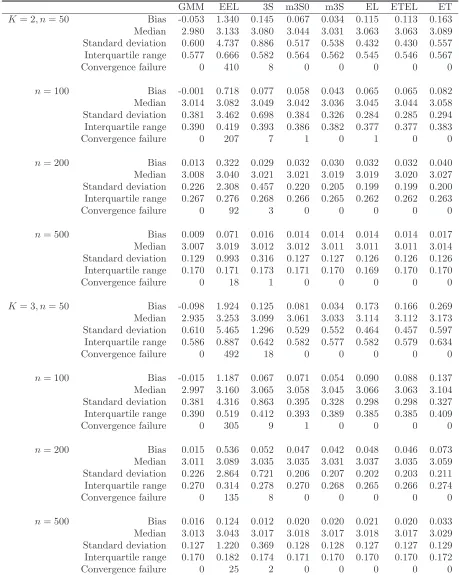
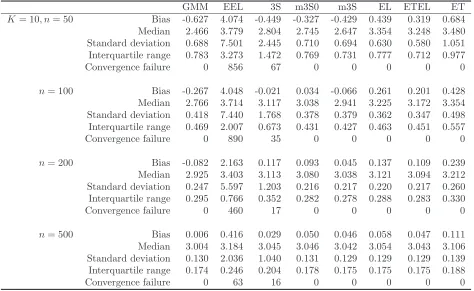
Table 1 displays the simulated median, bias, standard deviations, interquartile range and the
large number of convergence failure for the EEL estimator in particular in small samples and also with
increasing number of moment restrictions. This does not come as a surprise since the continuously
updated GMM of Hansen, Heaton and Yaron (1996) is also known to potentially display several outliers
and this estimator is known to be identical to the EEL estimator. The 3S estimator also displays
some outliers but much more rarely than the EEL estimator. Note that the number of outliers here
increases with smaller sample size and larger number of moment restrictions. We explain the failure
of the EEL and the 3S by the fact that the implied probabilities are not internally guaranteed to
be non negative. This leads to poor estimates of the Jacobian and the variance of the estimating
function and translates into some instability of both estimators. None of the other estimators shows
any systematic case of convergence failure. In that respect and by comparing the 3S estimator to the
m3S0 and m3S estimators we can conclude that the shrinkage of the implied probabilities helps to
increase the computation efficiency of the 3S estimator.
The outliers displayed by the EEL and the 3S estimators make them less efficient and often much
more biased than the other estimators. The m3S0, m3S, EL and ETEL estimators tend to have the
same bias in moderate size samples. The similarity of the simulated bias of the m3S and EL estimators
is a confirmation of our theory. The m3S0 and the m3S estimators even appear to have a smaller bias
for n= 50 and 100 in this design with the m3S outperforming, in general, the m3S0. It is also clear
that the GMM and the ET estimators do not share the same higher order bias as the other estimators
since, even for n= 500, their simulated biases are significantly different. This confirms the theory of
Newey and Smith (2004) namely that the GMM and the ET estimators have sources of higher order
bias different from the EL estimator.
This Monte Carlo experiment does not show a clear evidence of the “no-moment” problem as
outlined by Guggenberger (2008). The large standard deviations of the 3S and EEL estimators in
small samples are down to outliers and seem to match the other estimators’ standard deviations as
the sample size grows. These outliers result from computation issues and their inflating effect on the
standard deviations is confirmed by the interquartile ranges which are of similar magnitude across all
the considered estimators.
Finally, all of these estimators seem sensitive to the number of moment conditions as they display
a larger amount of bias with increasing model size.
√n
-convergence and Gaussianity under misspecification
We illustrate the behaviour of the three-step estimators under global misspecification using Designs C
by inner-outer loops optimizations. The true and pseudo-true parameter values being 0, we consider
the interval [−22.5,22.5] as the parameter set for the estimation purpose. We consider as convergence
failure the occurrence of corner solutions or the cases where either the inner or the outer loop
opti-mization routine fails. The simulated statistics in Table 2 are calculated without the failed samples.
The first-step GMM estimator is calculated with the weighting matrixW = (u|v) with u= (1,0)′ and
v= (0,2/3)′. W is so chosen to reduce the weight on higher moments in the GMM objective function.
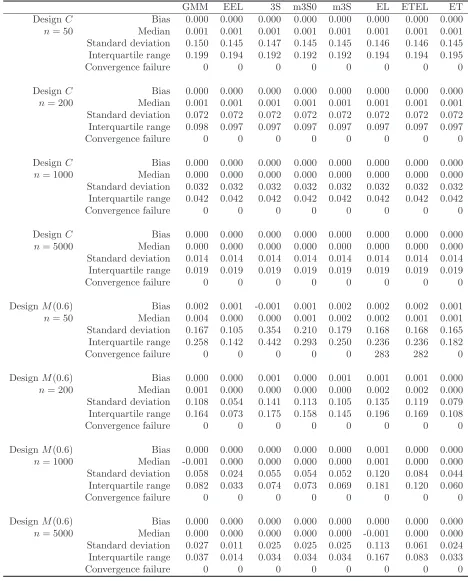
As reported by Table 2, the EL and ETEL estimators fail to converge in 2.83% of the simulated
samples for the design M(0.6) with n = 50 and in 0.01% of the simulated samples for the design
M(0.8) also withn= 50. The failure of the ETEL is clearly related to the failure of its EL step. This
shortcoming highlights some critical issue with the computation of EL in misspecified models.
Table 2 displays the simulated standard errors for all of the estimators. In the correctly specified
model, the simulated standard errors are the same for all of the estimators. This, once again, confirms
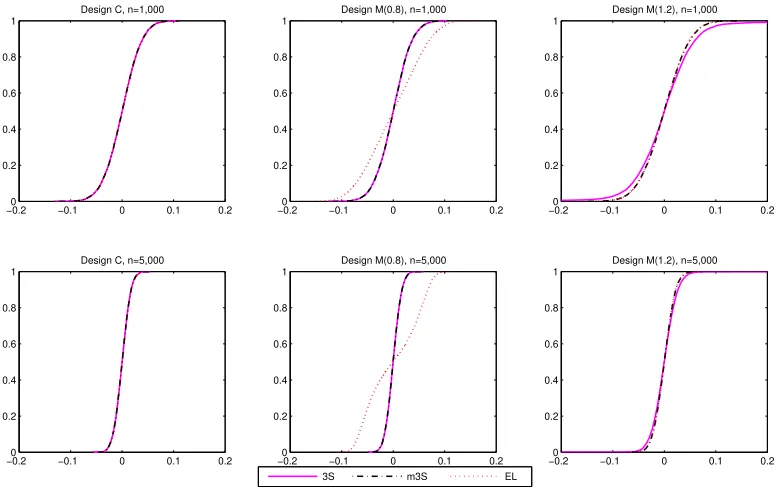
that these estimators have the same asymptotic distribution as predicted by the theory. The cumulative
distribution functions plotted by Figure 2 also confirm this theoretical result.
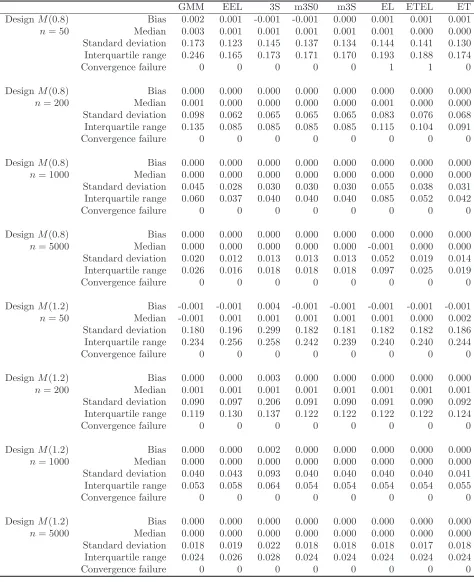
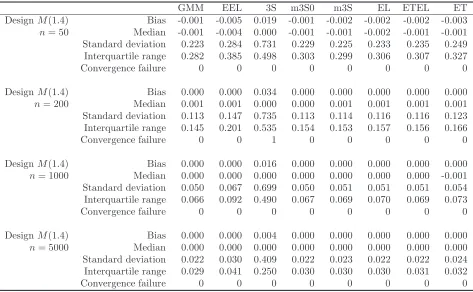
For the misspecified models, from our theory, we expect the simulated standard deviations of the
3S and m3S estimators to shrink by approximately 2 from n= 50 to n= 200 and by approximately
√
5 from n= 1,000 to n= 5,000. From the standard deviations displayed by Table 2 for M(s), s=
0.6,0.8,1.2,1.4, the 3S and m3S estimators have their standard deviations shrinking by approximately
2 from n = 50 to n = 200 and √5 from n = 200 to n = 1,000 and n = 1,000 to n = 5,000 as
expected. This is a confirmation of our theory. Even though we do not study the behaviour of the
EEL estimator in misspecified models, our simulation results suggest that this estimator may stay
√
n-convergent in misspecified models. The same observation is valid for the m3S0 estimator though
no asymptotic theory is available for this estimator in the case of global misspecification and its
asymptotic distribution robust to global misspecification is not known. The √n-convergence of the
GMM estimator in this experiment confirms the results of Hall and Inoue (2003).
The results for ET and ETEL estimators confirm the related literature. Their simulated standard
deviations seem to shrink by pn2/n1 as the sample size grows from n1 to n2. However, it appears
that the design M(0.6) sees the standard deviation of ETEL decrease by a narrower proportion than
expected from n = 1,000 to n = 5,000. This is likely related to some impact of EL which is the
poorest for this design.
The result of Schennach (2007) regarding the EL estimator in globally misspecified models is
confirmed by the designs M(0.6) and M(0.8). The simulated standard deviation of this estimator
2, one can also notice some distortion of the EL estimator as the sample size grows in misspecified
models. It is however worthwhile to mention that the EL behaves seemingly as a √n-convergent
estimator in the misspecified designsM(1.2) andM(1.4).
5
Conclusion
The three-step Euclidean likelihood estimator and its corrected version as proposed by Antoine, Bonnal
and Renault (2007) are computationally appealing and also higher order equivalent to the empirical
likelihood estimator in well specified models as their difference is Op(n−3/2).
This paper studies the 3S and the corrected 3S estimators under global misspecification and shows
that the 3S estimator remains √n-convergent in misspecified models and its asymptotic distribution
robust to global misspecification is derived. As for the corrected 3S estimator, it appears more difficult
to analyze in global misspecification context because of the lack of smoothness in the shrinkage factor.
We propose a slight modification of the shrinkage factor allowing to control its growing rate as it
diverges in the case of global misspecification. We label the resulting estimator themodified three-step Euclidean likelihood (m3S) estimator. We show that the m3S estimator is also higher order equivalent
to the EL estimator in well specified models while staying√n-convergent and asymptotically Gaussian
in globally misspecified models. Its asymptotic distribution robust to misspecification is also proposed.
These properties make the 3S and the m3S estimators very attractive alternative to the exponentially
tilted empirical likelihood (ETEL) estimator proposed by Schennach (2007) since they have the same
enjoyable properties of this latter in addition to being computationally more convenient.
There are some lines of extension of this work that we plan for future research. The empirical
likelihood ratio parameter and specification tests as proposed by Owen (1990) and Qin and Lawless
(1994) are known to outperform their existing alternative such as the Hansen’s (1982) GMM
overi-dentification test. However, these tests are computationally demanding as they depend on the full
derivation of the EL estimator. It could be of some interest to study the properties of these tests when
the three-step and modified three-step Euclidean likelihood estimators are used instead of the EL estimator. A higher order equivalence between the new tests and their original versions may suggest
Figure 1: Simulated cumulative distribution function of the 3S, m3S and EL estimators. Design D.
2 2.5 3 3.5 4 4.5 0 0.2 0.4 0.6 0.8 1 K=2, n=200
2 2.5 3 3.5 4 4.5 0 0.2 0.4 0.6 0.8 1 K=2, n=500
2 2.5 3 3.5 4 4.5 0 0.2 0.4 0.6 0.8 1 K=3, n=200
2 2.5 3 3.5 4 4.5 0 0.2 0.4 0.6 0.8 1 K=3, n=500
3S m3S EL
2 2.5 3 3.5 4 4.5 0 0.2 0.4 0.6 0.8 1 K=10, n=200
2 2.5 3 3.5 4 4.5 0 0.2 0.4 0.6 0.8 1 K=10, n=500
Figure 2: Simulated cumulative distribution function of the 3S, m3S and EL estimators. Well specified vs misspecified models. Designs C and M
−0.20 −0.1 0 0.1 0.2 0.2
0.4 0.6 0.8 1
Design C, n=1,000
−0.20 −0.1 0 0.1 0.2 0.2
0.4 0.6 0.8 1
Design C, n=5,000
−0.20 −0.1 0 0.1 0.2 0.2
0.4 0.6 0.8 1
Design M(0.8), n=1,000
−0.20 −0.1 0 0.1 0.2 0.2
0.4 0.6 0.8 1
Design M(0.8), n=5,000
3S m3S EL
−0.20 −0.1 0 0.1 0.2 0.2
0.4 0.6 0.8 1
Design M(1.2), n=1,000
−0.20 −0.1 0 0.1 0.2 0.2
0.4 0.6 0.8 1
[image:27.612.118.506.435.681.2]Table 1: The simulated bias, median, standard deviation, and interquartile range of the GMM, EEL, 3S, m3S0, m3S, EL, ETEL and ET estimators from Design D
GMM EEL 3S m3S0 m3S EL ETEL ET
K= 2, n= 50 Bias -0.053 1.340 0.145 0.067 0.034 0.115 0.113 0.163 Median 2.980 3.133 3.080 3.044 3.031 3.063 3.063 3.089 Standard deviation 0.600 4.737 0.886 0.517 0.538 0.432 0.430 0.557 Interquartile range 0.577 0.666 0.582 0.564 0.562 0.545 0.546 0.567
Convergence failure 0 410 8 0 0 0 0 0
n= 100 Bias -0.001 0.718 0.077 0.058 0.043 0.065 0.065 0.082 Median 3.014 3.082 3.049 3.042 3.036 3.045 3.044 3.058 Standard deviation 0.381 3.462 0.698 0.384 0.326 0.284 0.285 0.294 Interquartile range 0.390 0.419 0.393 0.386 0.382 0.377 0.377 0.383
Convergence failure 0 207 7 1 0 1 0 0
n= 200 Bias 0.013 0.322 0.029 0.032 0.030 0.032 0.032 0.040 Median 3.008 3.040 3.021 3.021 3.019 3.019 3.020 3.027 Standard deviation 0.226 2.308 0.457 0.220 0.205 0.199 0.199 0.200 Interquartile range 0.267 0.276 0.268 0.266 0.265 0.262 0.262 0.263
Convergence failure 0 92 3 0 0 0 0 0
n= 500 Bias 0.009 0.071 0.016 0.014 0.014 0.014 0.014 0.017 Median 3.007 3.019 3.012 3.012 3.011 3.011 3.011 3.014 Standard deviation 0.129 0.993 0.316 0.127 0.127 0.126 0.126 0.126 Interquartile range 0.170 0.171 0.173 0.171 0.170 0.169 0.170 0.170
Convergence failure 0 18 1 0 0 0 0 0
K= 3, n= 50 Bias -0.098 1.924 0.125 0.081 0.034 0.173 0.166 0.269 Median 2.935 3.253 3.099 3.061 3.033 3.114 3.112 3.173 Standard deviation 0.610 5.465 1.296 0.529 0.552 0.464 0.457 0.597 Interquartile range 0.586 0.887 0.642 0.582 0.577 0.582 0.579 0.634
Convergence failure 0 492 18 0 0 0 0 0
n= 100 Bias -0.015 1.187 0.067 0.071 0.054 0.090 0.088 0.137 Median 2.997 3.160 3.065 3.058 3.045 3.066 3.063 3.104 Standard deviation 0.381 4.316 0.863 0.395 0.328 0.298 0.298 0.327 Interquartile range 0.390 0.519 0.412 0.393 0.389 0.385 0.385 0.409
Convergence failure 0 305 9 1 0 0 0 0
n= 200 Bias 0.015 0.536 0.052 0.047 0.042 0.048 0.046 0.073 Median 3.011 3.089 3.035 3.035 3.031 3.037 3.035 3.059 Standard deviation 0.226 2.864 0.721 0.206 0.207 0.202 0.203 0.211 Interquartile range 0.270 0.314 0.278 0.270 0.268 0.265 0.266 0.274
Convergence failure 0 135 8 0 0 0 0 0
n= 500 Bias 0.016 0.124 0.012 0.020 0.020 0.021 0.020 0.033 Median 3.013 3.043 3.017 3.018 3.017 3.018 3.017 3.029 Standard deviation 0.127 1.220 0.369 0.128 0.128 0.127 0.127 0.129 Interquartile range 0.170 0.182 0.174 0.171 0.170 0.170 0.170 0.172
Table 1 (Continued): The simulated bias, median, standard deviation, and interquartile range of the GMM, EEL, 3S, m3S0, m3S, EL, ETEL and ET estimators from Design D
GMM EEL 3S m3S0 m3S EL ETEL ET
K= 10, n= 50 Bias -0.627 4.074 -0.449 -0.327 -0.429 0.439 0.319 0.684 Median 2.466 3.779 2.804 2.745 2.647 3.354 3.248 3.480 Standard deviation 0.688 7.501 2.445 0.710 0.694 0.630 0.580 1.051 Interquartile range 0.783 3.273 1.472 0.769 0.731 0.777 0.712 0.977
Convergence failure 0 856 67 0 0 0 0 0
n= 100 Bias -0.267 4.048 -0.021 0.034 -0.066 0.261 0.201 0.428 Median 2.766 3.714 3.117 3.038 2.941 3.225 3.172 3.354 Standard deviation 0.418 7.440 1.768 0.378 0.379 0.362 0.347 0.498 Interquartile range 0.469 2.007 0.673 0.431 0.427 0.463 0.451 0.557
Convergence failure 0 890 35 0 0 0 0 0
n= 200 Bias -0.082 2.163 0.117 0.093 0.045 0.137 0.109 0.239 Median 2.925 3.403 3.113 3.080 3.038 3.121 3.094 3.212 Standard deviation 0.247 5.597 1.203 0.216 0.217 0.220 0.217 0.260 Interquartile range 0.295 0.766 0.352 0.282 0.278 0.288 0.283 0.330
Convergence failure 0 460 17 0 0 0 0 0
n= 500 Bias 0.006 0.416 0.029 0.050 0.046 0.058 0.047 0.111 Median 3.004 3.184 3.045 3.046 3.042 3.054 3.043 3.106 Standard deviation 0.130 2.036 1.040 0.131 0.129 0.129 0.129 0.139 Interquartile range 0.174 0.246 0.204 0.178 0.175 0.175 0.175 0.188
[image:29.612.70.544.99.390.2]Table 2: The simulated bias, median, standard deviation, and interquartile range of the GMM, EEL, 3S, m3S0, m3S, EL, ETEL and ET estimators for Designs C and M
GMM EEL 3S m3S0 m3S EL ETEL ET
DesignC Bias 0.000 0.000 0.000 0.000 0.000 0.000 0.000 0.000
n= 50 Median 0.001 0.001 0.001 0.001 0.001 0.001 0.001 0.001 Standard deviation 0.150 0.145 0.147 0.145 0.145 0.146 0.146 0.145 Interquartile range 0.199 0.194 0.192 0.192 0.192 0.194 0.194 0.195
Convergence failure 0 0 0 0 0 0 0 0
DesignC Bias 0.000 0.000 0.000 0.000 0.000 0.000 0.000 0.000
n= 200 Median 0.001 0.001 0.001 0.001 0.001 0.001 0.001 0.001 Standard deviation 0.072 0.072 0.072 0.072 0.072 0.072 0.072 0.072 Interquartile range 0.098 0.097 0.097 0.097 0.097 0.097 0.097 0.097
Convergence failure 0 0 0 0 0 0 0 0
DesignC Bias 0.000 0.000 0.000 0.000 0.000 0.000 0.000 0.000
n= 1000 Median 0.000 0.000 0.000 0.000 0.000 0.000 0.000 0.000 Standard deviation 0.032 0.032 0.032 0.032 0.032 0.032 0.032 0.032 Interquartile range 0.042 0.042 0.042 0.042 0.042 0.042 0.042 0.042
Convergence failure 0 0 0 0 0 0 0 0
DesignC Bias 0.000 0.000 0.000 0.000 0.000 0.000 0.000 0.000
n= 5000 Median 0.000 0.000 0.000 0.000 0.000 0.000 0.000 0.000 Standard deviation 0.014 0.014 0.014 0.014 0.014 0.014 0.014 0.014 Interquartile range 0.019 0.019 0.019 0.019 0.019 0.019 0.019 0.019
Convergence failure 0 0 0 0 0 0 0 0
DesignM(0.6) Bias 0.002 0.001 -0.001 0.001 0.002 0.002 0.002 0.001
n= 50 Median 0.004 0.000 0.000 0.001 0.002 0.002 0.001 0.001 Standard deviation 0.167 0.105 0.354 0.210 0.179 0.168 0.168 0.165 Interquartile range 0.258 0.142 0.442 0.293 0.250 0.236 0.236 0.182
Convergence failure 0 0 0 0 0 283 282 0
DesignM(0.6) Bias 0.000 0.000 0.001 0.000 0.001 0.001 0.001 0.000
n= 200 Median 0.001 0.000 0.000 0.000 0.000 0.002 0.002 0.000 Standard deviation 0.108 0.054 0.141 0.113 0.105 0.135 0.119 0.079 Interquartile range 0.164 0.073 0.175 0.158 0.145 0.196 0.169 0.108
Convergence failure 0 0 0 0 0 0 0 0
DesignM(0.6) Bias 0.000 0.000 0.000 0.000 0.000 0.001 0.000 0.000
n= 1000 Median -0.001 0.000 0.000 0.000 0.000 0.001 0.000 0.000 Standard deviation 0.058 0.024 0.055 0.054 0.052 0.120 0.084 0.044 Interquartile range 0.082 0.033 0.074 0.073 0.069 0.181 0.120 0.060
Convergence failure 0 0 0 0 0 0 0 0
DesignM(0.6) Bias 0.000 0.000 0.000 0.000 0.000 0.000 0.000 0.000
n= 5000 Median 0.000 0.000 0.000 0.000 0.000 -0.001 0.000 0.000 Standard deviation 0.027 0.011 0.025 0.025 0.025 0.113 0.061 0.024 Interquartile range 0.037 0.014 0.034 0.034 0.034 0.167 0.083 0.033