http://dx.doi.org/10.4236/am.2016.71009
Generating Set of the Complete Semigroups
of Binary Relations
Yasha Diasamidze
1, Neset Aydin
2, Ali Erdo
ğ
an
31Shota Rustavelli University, Batumi, Georgia
2Çanakkale Onsekiz Mart University, Çanakkale, Turkey 3Hacettepe University, Ankara, Turkey
Received 16 December 2015; accepted 25 January 2016; published 28 January 2016
Copyright © 2016 by authors and Scientific Research Publishing Inc.
This work is licensed under the Creative Commons Attribution International License (CC BY). http://creativecommons.org/licenses/by/4.0/
Abstract
Difficulties encountered in studying generators of semigroup BX
( )
D of binary relations definedby a complete X-semilattice of unions D arise because of the fact that they are not regular as a rule, which makes their investigation problematic. In this work, for special D, it has been seen that the semigroup BX
( )
D , which are defined by semilattice D, can be generated by the set( )
(
)
{
X}
B= α∈B D V X∗,α =D .
Keywords
Semigroups, Binary Relation, Generated Set, Generators
1. Introduction
Theorem 1. Let D=
{
D Z Z, 1, 2, ,Zm−1}
be some finite X-semilattice of unions and
( ) {
0, 1, 2, , m1}
C D = P P P P−
be the family of sets of pairwise nonintersecting subsets of the set X.
If φ is a mapping of the semilattice D on the family of sets C D
( )
which satisfies the conditionϕ
( )
D =P0
and ϕ
( )
Zi =Pi for any i=1, 2,,m−1 and ˆDZ =D D\ T, then the following equalities are valid:( )
0 1 2 1
0 ˆ
, .
Zi
m
i
T D
D P P P P
Z P
ϕ
T−
∈
= ∪ ∪ ∪ ∪
= ∪
In the sequel these equalities will be called formal.
It is proved that if the elements of the semilattice D are represented in the form 1, then among the parameters
Pi
(
i=0,1, 2,,m−1)
there exist such parameters that cannot be empty sets for D. Such sets Pi(
0< ≤ −i m 1)
are called basis sources, whereas sets Pi
(
0≤ ≤ −j m 1)
which can be empty sets too are called completenesssources.
It is proved that under the mapping ϕ the number of covering elements of the pre-image of a basis source is always equal to one, while under the mapping ϕ the number of covering elements of the pre-image of a com- pleteness source either does not exist or is always greater than one (see [1], Chapter 11). Some positive results in this direction can be found in [2]-[6].
Let P P P0, 1, 2,,Pm−1 be parameters in the formal equalities,
β
∈BX( )
D and{ }
(
)
1
0 \
.
i
m
i
i t P t X D
P t t t
β − β β
′
= ∈ ∈
′ ′ = × ∪ ×
(2)(
)
(
)
1 0
\
i
m
i
i t P
P t X D D
β − β
= ∈
= × ∪ ×
(3)The representation of the binary relation
β
of the form β and β will be called subquasinormal and maximal subquasinormal.If β and β are the subquasinormal and maximal subquasinormal representations of the binary relation
β
, then for the binary relations β and β the following statements are true: a) β β,∈BX( )
D ;b) β⊆β ⊆β;
c) the subquasinormal representation of the binary relation β is quasinormal; d) if
0 1 1
1
0 1 1
,
m
m
P P P
P P P
β
β β −−β
=
then β1 is a mapping of the family of sets C D
( ) {
= P P P0, 1, 2,,Pm−1}
in the X-semilattice of unions{
, 1, 2, , m1}
D= D Z Z Z − .
e) if β2:X D\ →D is a mapping satisfying the condition β2
( )
t′ =t′β for all t′∈X D\ , then{ }
( )
(
)
1
2
0 \
.
i
m
i
i t P t X D
P t t t
β − β β
′
= ∈ ∈
′ ′ = × ∪ ×
2. Results
Proposition 2. Let
α β
, ∈BX( )
D . Then.
α β α β α β = =
Proof. It is easy to see the inclusion α β α β ⊆ ⊆α β holds, since β⊆β ⊆β. If x
(
α β )
y(
x y, ∈X)
, then x z yα β for some z∈X . So, z∉X D\ since z∈xα∈D and(
1(
)
)
0 i
m i
i t P
z
=− P×
∈ tβ y.Then
(
)
k
k t P
z P×
∈ tβ y for some k(
0≤ ≤ −k m 1)
i.e. z∈Pk andk
t P
y∈z
β
⊆
∈ tβ
. For the last conditionfollows that z yβ . We have x z yα β and x
(
α β)
y. Therefore, the inclusion α β α β ⊆ is true. Of this and by inclusion α β α β ⊆ ⊆α β follows that the equality α β α β α β = = holds. Corollary 1. If
α δ β
, , ∈BX( )
D and β δ⊆ ⊆β, then α β α δ α β = = .Proof. We have β δ⊆ ⊆β and α β α δ α β ⊆ ⊆ . Of this follows that α β α δ α β = = since
α β α β = . Let the X-semilattice D=
{
Z Z Z Z D4, 3, 2, 1,}
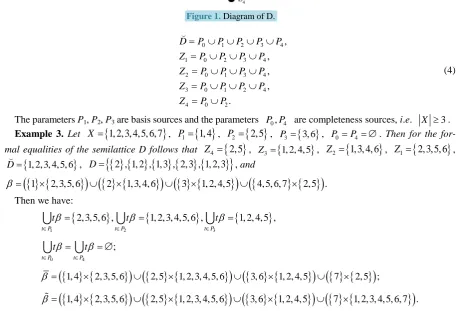
Figure 1.Diagram of D.
0 1 2 3 4
1 0 2 3 4
2 0 1 3 4
3 0 1 2 4
4 0 2
, , , , .
D P P P P P
Z P P P P
Z P P P P
Z P P P P
Z P P
= ∪ ∪ ∪ ∪ = ∪ ∪ ∪
= ∪ ∪ ∪ = ∪ ∪ ∪ = ∪
(4)
The parameters P1, P2, P3 are basis sources and the parameters P P0, 4 are completeness sources, i.e. X ≥3. Example 3. Let X =
{
1, 2,3, 4,5, 6, 7}
, P1={ }
1, 4 , P2={ }
2,5 , P3={ }
3, 6 , P0 =P4 = ∅. Then for the for- mal equalities of the semilattice D follows that Z4={ }
2, 5 , Z3 ={
1, 2, 4, 5}
, Z2 ={
1,3, 4, 6}
, Z1={
2,3,5, 6}
,{
1, 2, 3, 4, 5, 6}
D= , D=
{
{ } { } { } { } {
2 , 1, 2 , 1, 3 , 2, 3 , 1, 2, 3}
}
, and{ } {
}
(
1 2, 3, 5, 6)
(
{ } {
2 1, 3, 4, 6}
)
(
{ } {
3 1, 2, 4, 5}
)
(
{
4, 5, 6, 7} { }
2, 5 .)
β
= × ∪ × ∪ × ∪ ×Then we have:
{
}
{
}
{
}
1 2 3
2, 3, 5, 6 , 1, 2, 3, 4, 5, 6 , 1, 2, 4, 5 ,
t P t P t P
t
β
tβ
tβ
∈ ∈ ∈
= = =
0 4
; t P t P
t
β
tβ
∈ ∈
= = ∅
{ } {
}
(
1, 4 2, 3, 5, 6)
(
{ } {
2, 5 1, 2, 3, 4, 5, 6}
)
(
{ } {
3, 6 1, 2, 4, 5}
)
(
{ } { }
7 2, 5 ;)
β = × ∪ × ∪ × ∪ ×
{ } {
}
(
1, 4 2, 3, 5, 6)
(
{ } {
2, 5 1, 2, 3, 4, 5, 6}
)
(
{ } {
3, 6 1, 2, 4, 5}
)
(
{ } {
7 1, 2, 3, 4, 5, 6, 7 .}
)
β
= × ∪ × ∪ × ∪ ×Theorem 4. Let the X-semilattice D=
{
Z Z Z Z D4, 3, 2, 1,}
of unions given by the diagram of Figure 1,
( )
(
)
{
X | ,}
B= α∈B D V X∗ α =D and X D\ ≥3. Then the set B is generating set of the semigroup BX
( )
D .Proof. It is easy to see that X ≥6 since P P P1, 2, 3∉ ∅
{ }
and X D\ ≥3. Now, letα
be any binary rela- tion of the semigroup BX( )
D ; α α1, 2,,α ∈n B, α α α= 1 2 ⋅⋅⋅ αn and β α α= 2 3 ⋅⋅⋅ αn. Then theequality α α β α β= 1 = 1 (β is subquasinormal representation of a binary relation
β
) is true. By assumptionα
1∈BX( )
D , i.e. the quasinormal representation of a binary relationα
1 have a form(
1) (
1) (
1) (
1) (
1)
1 Y4 Z4 Y3 Z3 Y2 Z2 Y1 Z1 Y0 D .
α α α α α
α = × ∪ × ∪ × ∪ × ∪ ×
Of this follows that
(
) (
) (
) (
) (
)
(
) (
) (
) (
) (
)
1 1 1 1 1
1 1 1 1 1
1 4 4 3 3 2 2 1 1 0
4 4 3 3 2 2 1 1 0 .
Y Z Y Z Y Z Y Z Y D
Y Z Y Z Y Z Y Z Y D
α α α α α
α α α α α
α α β β
β β β β β
= = × ∪ × ∪ × ∪ × ∪ ×
= × ∪ × ∪ × ∪ × ∪ ×
(5)
For the binary relation
α
we consider the following case.a) Let V X
(
∗,α)
=1. Then α =X×T , where T∈D. By element T we consider the following cases: 1. T ≠D. In this case suppose that0 1 2 3 4
1
P P P P P
T T T
β =
∅ ∅
(
) (
) (
) (
) (
)
(
{ }
( )
)
(
1) (
1) (
1) (
1) (
1)
0 1 2 3 4 2
\
1 4 4 3 3 2 2 1 1 0
, ,
t X D
P P T P T P T P t t
Yα Z Yα Z Yα Z Yα Z Yα D
β β
α
′∈
′ ′
= ×∅ ∪ × ∪ × ∪ × ∪ ×∅ ∪ ×
= × ∪ × ∪ × ∪ × ∪ ×
(6)
where 1 1 1 1
{ }
4 , 3 , 2 , 1
Yα Yα Yα Yα ∉ ∅ , then it is easy to see, that α β1, ∈B since V D
(
,α1)
=V D(
,β)
=D. From the formal equality and equalities (6) and (5) we have:(
)
(
)
(
)
(
)
(
)
4 0 2 0 2
3 0 1 2 4 0 1 2 4
2 0 1 3 4 0 1 3 4
1 0 2 3 4 0 2 3 4
0 1 2 3 4 0 1 2 3 4
;
; ; ;
Z P P P P T T
Z P P P P P P P P T T T
Z P P P P P P P P T T T
Z P P P P P P P P T T T
D P P P P P P P P P P
T T
β β β β
β β β β β β
β β β β β β
β β β β β β
β β β β β β β
= ∪ = ∪ = ∅ ∪ =
= ∪ ∪ ∪ = ∪ ∪ ∪ = ∅ ∪ ∪ ∪ ∅ =
= ∪ ∪ ∪ = ∪ ∪ ∪ = ∅ ∪ ∪ ∪ ∅ =
= ∪ ∪ ∪ = ∪ ∪ ∪ = ∅ ∪ ∪ ∪ ∅ =
= ∪ ∪ ∪ ∪ = ∪ ∪ ∪ ∪
= ∅ ∪ ∪ ∪
(
) (
) (
) (
) (
)
(
) (
) (
) (
) (
)
1 1 1 1 1
1 1 1 1 1
1
4 4 3 3 2 2 1 1 0
4 3 2 1 0
;
T T
Y Z Y Z Y Z Y Z Y D
Y T Y T Y T Y T Y T X T
α α α α α
α α α α α
α α β
β β β β β
∪ ∅ = =
= × ∪ × ∪ × ∪ × ∪ ×
= × ∪ × ∪ × ∪ × ∪ × = ×
since 1 1 1 1 1
4 3 2 1 0
Yα ∪Yα ∪Yα ∪Yα ∪Yα =X . 2. T =D. In this case suppose that
0 1 2 3 4
1
1 2 3 4
P P P P P
D Z Z Z Z
β =
and β2 are mapping of the set X D\ in the set D. Then
(
)
(
) (
)
(
)
(
)
(
{ }
( )
)
(
1) (
1) (
1) (
1) (
1)
0 1 1 2 2 3 3 4 4 2
\
1 4 4 3 3 2 2 1 1 0
, ,
t X D
P D P Z P Z P Z P Z t t
Yα Z Yα Z Yα Z Yα Z Yα D
β
β
α
′∈
′ ′
= × ∪ × ∪ × ∪ × ∪ × ∪ ×
= × ∪ × ∪ × ∪ × ∪ ×
(7)
where 1 1 1 1
{ }
4 , 3 , 2 , 1
Yα Yα Yα Yα ∉ ∅ , then it is easy to see, that α β1, ∈B since V D
(
,α1)
=V D(
,β)
=D. From the formal equality and equalities (7) and (5) we have:(
)
(
)
(
)
(
)
(
)
(
1) (
1)
4 0 2 0 2
3 0 1 2 4 0 1 2 4
2 0 1 3 4 0 1 3 4
1 0 2 3 4 0 2 3 4
0 1 2 3 4 0 1 2 3 4
1
4 4 3 3
;
; ; ;
;
Z P P P P D
Z P P P P P P P P D
Z P P P P P P P P D
Z P P P P P P P P D
D P P P P P P P P P P D
Yα Z Yα Z
β β β β
β β β β β β
β β β β β β
β β β β β β
β β β β β β β
α α β
β β
= ∪ = ∪ =
= ∪ ∪ ∪ = ∪ ∪ ∪ =
= ∪ ∪ ∪ = ∪ ∪ ∪ =
= ∪ ∪ ∪ = ∪ ∪ ∪ =
= ∪ ∪ ∪ ∪ = ∪ ∪ ∪ ∪ =
=
= × ∪ × ∪
(
) (
)
(
)
(
) (
) (
) (
) (
)
1 1 1
1 1 1 1 1
2 2 1 1 0
4 3 2 1 0
.
Y Z Y Z Y D
Y D Y D Y D Y D Y D
X D
α α α
α α α α α
β β β
× ∪ × ∪ ×
= × ∪ × ∪ × ∪ × ∪ ×
= ×
b) V X
(
∗,α)
=2. Then(
,)
{
{
4, 1} {
, 4, 3}
,{
4,} {
, 3,} {
, 2,} { }
, 1,}
V X∗
α
∈ Z Z Z Z Z D Z D Z D Z Dsince V X
(
∗,α)
is X-semilattice of unions. For the semilattice of unions V X(
∗,α)
consider the following cases.(
Y4 Z4) (
YT T)
α α
α= × ∪ × . In this case suppose that
0 1 2 3 4
1
4
P P P P P
T Z T
β =
∅ ∅
and β2 are mapping of the set X D\ on the set D\
{
Z T4,}
. Then(
) (
) (
) (
) (
)
(
{ }
( )
)
(
1) (
1) (
1) (
1) (
1)
0 1 2 4 3 4 2
\
1 4 4 3 3 2 2 1 1 0
, ,
t X D
P P T P Z P T P t t
Yα Z Yα Z Yα Z Yα Z Yα D
β β
α
′∈
′ ′
= ×∅ ∪ × ∪ × ∪ × ∪ ×∅ ∪ ×
= × ∪ × ∪ × ∪ × ∪ ×
(8)
where 1 1 1 1
{ }
4 , 3 , 2 , 1
Yα Yα Yα Yα ∉ ∅ , 1
4 4
Yα =Yα and 1 1 1 1
3 2 1 0 0
Yα ∪Yα ∪Yα ∪Yα =Yα, then it is easy to see, that
1, B
α β∈ since V D
(
,α1)
=V D(
,β)
=D. From the formal equality and equalities (8) and (5) we have:(
)
(
)
(
)
(
)
(
)
4 0 2 0 2 4 4
3 0 1 2 4 0 1 2 4
4
2 0 1 3 4 0 1 3 4
1 0 2 3 4 0 2 3 4
4
0 1 2 3 4 0 1 2 3 4
;
;
;
;
Z P P P P Z Z
Z P P P P P P P P
T Z T
Z P P P P P P P P
T T T
Z P P P P P P P P
Z T T
D P P P P P P P P P P
β β β β
β β β β β β
β β β β β β
β β β β β β
β β β β β β β
= ∪ = ∪ = ∅ ∪ = = ∪ ∪ ∪ = ∪ ∪ ∪ = ∅ ∪ ∪ ∪ ∅ =
= ∪ ∪ ∪ = ∪ ∪ ∪ = ∅ ∪ ∪ ∪ ∅ =
= ∪ ∪ ∪ = ∪ ∪ ∪ = ∅ ∪ ∪ ∪ ∅ =
= ∪ ∪ ∪ ∪ = ∪ ∪ ∪ ∪ =
(
) (
) (
) (
) (
)
(
) (
) (
) (
) (
)
(
) (
(
)
)
(
) (
)
1 1 1 1 1
1 1 1 1 1
1 1 1 1 1
4 1
4 4 3 3 2 2 1 1 0
4 4 3 2 1 0
4 4 3 2 1 0 4 4 0
;
.
T Z T T
Y Z Y Z Y Z Y Z Y D
Y Z Y T Y T Y T Y T
Y Z Y Y Y Y T Y Z Y T
α α α α α
α α α α α
α α α α α α α
α α β
β β β β β
∅ ∪ ∪ ∪ ∪ ∅ = =
= × ∪ × ∪ × ∪ × ∪ × = × ∪ × ∪ × ∪ × ∪ ×
= × ∪ ∪ ∪ ∪ × = × ∪ ×
2. Let V X
(
∗,α
)
={ }
T D, , where, T∈{
Z Z Z Z4, 3, 2, 1}
. Then binary relationα
has representation of theform
(
YT T) (
Y0 D)
α α
α
= × ∪ × . In this case suppose that0 1 2 3 4
1
P P P P P
D T D
β =
∅ ∅
and β2 are mapping of the set X D\ on the set D\
{ }
T D, . Then(
)
(
)
(
)
(
)
(
)
(
{ } ( )
)
(
1) (
1) (
1) (
1) (
1)
0 1 2 3 4
\
1 4 4 3 3 2 2 1 1 0
,
,
t X D
P P D P T P D P t f t
Yα Z Yα Z Yα Z Yα Z Yα D
β
α
′∈
′ ′ = ×∅ ∪ × ∪ × ∪ × ∪ ×∅ ∪ ×
= × ∪ × ∪ × ∪ × ∪ ×
(9)
where 1 1 1 1
{ }
4 , 3 , 2 , 1
Yα Yα Yα Yα ∉ ∅ , 1
4 T
Yα =Yα and 1 1 1 1
3 2 1 0 0
Yα ∪Yα ∪Yα ∪Yα =Yα, then it is easy to see, that
1, B
(
)
(
)
(
)
(
)
(
)
4 0 2 0 2
3 0 1 2 4 0 1 2 4
2 0 1 3 4 0 1 3 4
1 0 2 3 4 0 2 3 4
0 1 2 3 4 0 1 2 3 4
;
; ; ;
Z P P P P T T
Z P P P P P P P P D T D
Z P P P P P P P P D D D
Z P P P P P P P P T D D
D P P P P P P P P P P
β β β β
β β β β β β
β β β β β β
β β β β β β
β β β β β β β
= ∪ = ∪ = ∅ ∪ =
= ∪ ∪ ∪ = ∪ ∪ ∪ = ∅ ∪ ∪ ∪ ∅ =
= ∪ ∪ ∪ = ∪ ∪ ∪ = ∅ ∪ ∪ ∪ ∅ =
= ∪ ∪ ∪ = ∪ ∪ ∪ = ∅ ∪ ∪ ∪ ∅ =
= ∪ ∪ ∪ ∪ = ∪ ∪ ∪ ∪
(
) (
) (
) (
)
(
)
(
)
(
) (
) (
) (
)
(
) (
(
)
)
(
)
(
)
1 1 1 1 1
1 1 1 1 1
1 1 1 1 1
1
4 4 3 3 2 2 1 1 0
4 3 2 1 0
4 3 2 1 0 0
;
T .
D T D D
Y Z Y Z Y Z Y Z Y D
Y T Y D Y D Y D Y D
Y T Y Y Y Y D Y T Y D
α α α α α
α α α α α
α α α α α α α
α α β
β β β β β
= ∅ ∪ ∪ ∪ ∪ ∅ = =
= × ∪ × ∪ × ∪ × ∪ ×
= × ∪ × ∪ × ∪ × ∪ ×
= × ∪ ∪ ∪ ∪ × = × ∪ ×
c) V X
(
∗,α)
=3. Then(
,) {
{
4, 1,} {
, 4, 3,} {
, 4, 2,} {
, 1, 2,} {
, 1, 3,} {
, 2, 3,}
}
V X∗α ∈ Z Z D Z Z D Z Z D Z Z D Z Z D Z Z D
since V X
(
∗,α)
is X-semilattice of unions. For the semilattice of unions V X(
∗,α)
consider the following cases.1. Let V X
(
∗,α
)
={
Z Z D4, 1, }
. Then binary relationα
has representation of the form(
Y4 Z4) (
Y1 Z1) (
Y0 D)
α α α
α
= × ∪ × ∪ × . In this case suppose that0 1 2 3 4
1
2 4 1
P P P P P
Z Z Z
β =
∅ ∅
and β2 are mapping of the set X D\ on the set D\
{
Z Z Z4, 2, 1}
. Then(
)
(
) (
)
(
)
(
)
(
{ }
( )
)
(
1) (
1) (
1) (
1)
(
1)
0 1 2 2 4 3 1 4
\
1 4 4 3 3 2 2 1 1 0
, ,
t X D
P P Z P Z P Z P t f t
Yα Z Yα Z Yα Z Yα Z Yα D
β
α
′∈
′ ′
= × ∅ ∪ × ∪ × ∪ × ∪ × ∅ ∪ ×
= × ∪ × ∪ × ∪ × ∪ ×
(10)
where 1 1 1 1
{ }
4 , 3 , 2 , 1
Yα Yα Yα Yα ∉ ∅ , 1
4 4
Yα =Yα, 1
1 1
Yα =Yα and 1 1 1
3 2 0 0
Yα ∪Yα ∪Yα =Yα, then it is easy to see, that
1, B
α β∈ since V D
(
,α1)
=V D(
,β)
=D. From the formal equality and equalities (10) and (5) we have:(
)
(
)
(
)
(
)
(
)
4 0 2 0 2 4 4
3 0 1 2 4 0 1 2 4 2 4
2 0 1 3 4 0 1 3 4 2 1
1 0 2 3 4 0 2 3 4 4 1 1
0 1 2 3 4 0 1 2 3
;
; ; ;
Z P P P P Z Z
Z P P P P P P P P Z Z D
Z P P P P P P P P Z Z D
Z P P P P P P P P Z Z Z
D P P P P P P P P P
β β β β
β β β β β β
β β β β β β
β β β β β β
β β β β β β
= ∪ = ∪ = ∅ ∪ =
= ∪ ∪ ∪ = ∪ ∪ ∪ = ∅ ∪ ∪ ∪ ∅ =
= ∪ ∪ ∪ = ∪ ∪ ∪ = ∅ ∪ ∪ ∪ ∅ =
= ∪ ∪ ∪ = ∪ ∪ ∪ = ∅ ∪ ∪ ∪ ∅ =
= ∪ ∪ ∪ ∪ = ∪ ∪ ∪
(
) (
) (
) (
)
(
)
(
)
(
) (
) (
)
(
)
(
) (
) (
(
)
)
(
) (
)
(
)
1 1 1 1 1
1 1 1 1 1
1 1 1 1 1
4
2 4 1
1
4 4 3 3 2 2 1 1 0
4 4 3 2 1 1 0
4 4 1 1 3 2 0
4 4 1 1 0
;
.
P
Z Z Z D
Y Z Y Z Y Z Y Z Y D
Y Z Y D Y D Y Z Y D
Y Z Y Z Y Y Y D
Y Z Y Z Y D
α α α α α
α α α α α
α α α α α
α α α
β
α α β
β β β β β
∪
= ∅ ∪ ∪ ∪ ∪ ∅ =
=
= × ∪ × ∪ × ∪ × ∪ ×
= × ∪ × ∪ × ∪ × ∪ ×
= × ∪ × ∪ ∪ ∪ ×
= × ∪ × ∪ ×
2. Let V X
(
,α
)
{
Z Z D4, 3,}
∗ =
(
Y4 Z4) (
Y3 Z3) (
Y0 D)
α α α
α
= × ∪ × ∪ × . In this case suppose that0 1 2 3 4
1
3 4 2
P P P P P
Z Z Z
β =
∅ ∅
and β2 are mapping of the set X D\ on the set D\
{
Z Z Z4, 3, 2}
. Then(
) (
)
(
)
(
)
(
)
(
{ }
( )
)
(
1) (
1) (
1) (
1)
(
1)
0 1 3 2 4 3 2 4
\
1 4 4 3 3 2 2 1 1 0
, ,
t X D
P P Z P Z P Z P t f t
Yα Z Yα Z Yα Z Yα Z Yα D
β
α
′∈
′ ′
= × ∅ ∪ × ∪ × ∪ × ∪ × ∅ ∪ ×
= × ∪ × ∪ × ∪ × ∪ ×
(11)
where 1 1 1 1
{ }
4 , 3 , 2 , 1
Yα Yα Yα Yα ∉ ∅ , 1
4 4
Yα =Yα, 1
3 3
Yα =Yα and 1 1 1
2 1 0 0
Yα ∪Yα ∪Yα =Yα, then it is easy to see, that
1, B
α β∈ since V D
(
,α1)
=V D(
,β)
=D. From the formal equality and equalities (11) and (5) we have:(
)
(
)
(
)
(
)
(
)
4 0 2 0 2 4 4
3 0 1 2 4 0 1 2 4
3 4 3
2 0 1 3 4 0 1 3 4
3 2
1 0 2 3 4 0 2 3 4
4 2
0 1 2 3 4 0 1 2 3
;
;
;
;
Z P P P P Z Z
Z P P P P P P P P
Z Z Z
Z P P P P P P P P
Z Z D
Z P P P P P P P P
Z Z D
D P P P P P P P P P
β β β β
β β β β β β
β β β β β β
β β β β β β
β β β β β β
= ∪ = ∪ = ∅ ∪ =
= ∪ ∪ ∪ = ∪ ∪ ∪
= ∅ ∪ ∪ ∪ ∅ =
= ∪ ∪ ∪ = ∪ ∪ ∪
= ∅ ∪ ∪ ∪ ∅ =
= ∪ ∪ ∪ = ∪ ∪ ∪
= ∅ ∪ ∪ ∪ ∅ =
= ∪ ∪ ∪ ∪ = ∪ ∪ ∪
(
) (
) (
) (
) (
)
(
) (
) (
) (
) (
)
(
) (
) (
(
)
)
(
) (
) (
)
1 1 1 1 1
1 1 1 1 1
1 1 1 1 1
4
3 4 2
1
4 4 3 3 2 2 1 1 0
4 4 3 3 2 1 0
4 4 3 3 2 1 0
4 4 3 3 0
;
.
P
Z Z Z D
Y Z Y Z Y Z Y Z Y D
Y Z Y Z Y D Y D Y D
Y Z Y Z Y Y Y D
Y Z Y Z Y D
α α α α α
α α α α α
α α α α α
α α α
β
α α β
β β β β β
∪
= ∅ ∪ ∪ ∪ ∪ ∅ =
=
= × ∪ × ∪ × ∪ × ∪ ×
= × ∪ × ∪ × ∪ × ∪ ×
= × ∪ × ∪ ∪ ∪ ×
= × ∪ × ∪ ×
3. Let V X
(
∗,α
)
={
Z Z D4, 2,}
. Then binary relationα
has representation of the form(
Y4 Z4) (
Y2 Z2) (
Y0 D)
α α α
α
= × ∪ × ∪ × . In this case suppose that0 1 2 3 4
1
2 4 2
P P P P P
Z Z Z
β =
∅ ∅
and β2 are mapping of the set X D\ on the set D\
{
Z Z4, 2}
. Then(
)
(
) (
)
(
)
(
)
(
{ }
( )
)
(
1) (
1) (
1) (
1)
(
1)
0 1 2 2 4 3 2 4
\
1 4 4 3 3 2 2 1 1 0
, ,
t X D
P P Z P Z P Z P t f t
Yα Z Yα Z Yα Z Yα Z Yα D
β
α
′∈
′ ′
= × ∅ ∪ × ∪ × ∪ × ∪ × ∅ ∪ ×
= × ∪ × ∪ × ∪ × ∪ ×
(12)
where 1 1 1 1
{ }
4 , 3 , 2 , 1
Yα Yα Yα Yα ∉ ∅ , 1
4 4
Yα =Yα, 1
2 2
Yα =Yα and 1 1 1
3 1 0 0
Yα ∪Yα ∪Yα =Yα, then it is easy to see, that
, B
(
)
(
)
(
)
(
)
(
)
4 0 2 0 2 4 4
3 0 1 2 4 0 1 2 4 2 4
2 0 1 3 4 0 1 3 4 2 2 2
1 0 2 3 4 0 2 3 4 4 2
0 1 2 3 4 0 1 2 3
;
; ; ;
Z P P P P Z Z
Z P P P P P P P P Z Z D
Z P P P P P P P P Z Z Z
Z P P P P P P P P Z Z D
D P P P P P P P P P
β β β β
β β β β β β
β β β β β β
β β β β β β
β β β β β β
= ∪ = ∪ = ∅ ∪ =
= ∪ ∪ ∪ = ∪ ∪ ∪ = ∅ ∪ ∪ ∪ ∅ =
= ∪ ∪ ∪ = ∪ ∪ ∪ = ∅ ∪ ∪ ∪ ∅ =
= ∪ ∪ ∪ = ∪ ∪ ∪ = ∅ ∪ ∪ ∪ ∅ =
= ∪ ∪ ∪ ∪ = ∪ ∪ ∪
(
) (
) (
) (
)
(
)
(
)
(
) (
)
(
) (
)
(
) (
) (
(
)
)
(
) (
)
(
)
1 1 1 1 1
1 1 1 1 1
1 1 1 1 1
4
2 4 2
1
4 4 3 3 2 2 1 1 0
4 4 3 2 2 1 0
4 4 2 2 3 1 0
4 4 2 2 0
;
.
P
Z Z Z D
Y Z Y Z Y Z Y Z Y D
Y Z Y D Y Z Y D Y D
Y Z Y Z Y Y Y D
Y Z Y Z Y D
α α α α α
α α α α α
α α α α α
α α α
β
α α β
β β β β β
∪
= ∅ ∪ ∪ ∪ ∪ ∅ =
=
= × ∪ × ∪ × ∪ × ∪ ×
= × ∪ × ∪ × ∪ × ∪ ×
= × ∪ × ∪ ∪ ∪ ×
= × ∪ × ∪ ×
4. Let V X
(
∗,α
)
={
Z Z D1, 2, }
. Then binary relationα
has representation of the form(
Y1 Z1) (
Y2 Z2) (
Y0 D)
α α α
α
= × ∪ × ∪ × . In this case suppose that0 1 2 3 4
1
1 2 1
P P P P P
Z Z Z
β =
∅ ∅
and β2 are mapping of the set X D\ on the set D\
{
Z Z2, 1}
. Then(
)
(
) (
)
(
)
(
)
(
{ }
( )
)
(
1) (
1) (
1) (
1)
(
1)
0 1 1 2 2 3 1 4
\
1 4 4 3 3 2 2 1 1 0
, ,
t X D
P P Z P Z P Z P t f t
Yα Z Yα Z Yα Z Yα Z Yα D
β
α
′∈
′ ′
= × ∅ ∪ × ∪ × ∪ × ∪ × ∅ ∪ ×
= × ∪ × ∪ × ∪ × ∪ ×
(13)
where 1 1 1 1
{ }
4 , 3 , 2 , 1
Yα Yα Yα Yα ∉ ∅ , 1
2 1
Yα =Yα, 1
4 2
Yα =Yα and 1 1 1
3 1 0 0
Yα ∪Yα ∪Yα =Yα, then it is easy to see, that
1, B
α β∈ since V D
(
,α1)
=V D(
,β)
=D. From the formal equality and equalities (13) and (5) we have:(
)
(
)
(
)
(
)
(
)
4 0 2 0 2 2 2
3 0 1 2 4 0 1 2 4 1 2
2 0 1 3 4 0 1 3 4 1 1 1
1 0 2 3 4 0 2 3 4 2 1
0 1 2 3 4 0 1 2 3
;
; ; ;
Z P P P P Z Z
Z P P P P P P P P Z Z D
Z P P P P P P P P Z Z Z
Z P P P P P P P P Z Z D
D P P P P P P P P P
β β β β
β β β β β β
β β β β β β
β β β β β β
β β β β β β
= ∪ = ∪ = ∅ ∪ =
= ∪ ∪ ∪ = ∪ ∪ ∪ = ∅ ∪ ∪ ∪ ∅ =
= ∪ ∪ ∪ = ∪ ∪ ∪ = ∅ ∪ ∪ ∪ ∅ =
= ∪ ∪ ∪ = ∪ ∪ ∪ = ∅ ∪ ∪ ∪ ∅ =
= ∪ ∪ ∪ ∪ = ∪ ∪ ∪
(
) (
) (
) (
)
(
)
(
)
(
) (
)
(
) (
)
(
) (
) (
(
)
)
(
) (
)
(
)
1 1 1 1 1
1 1 1 1 1
1 1 1 1 1
4
1 2 1
1
4 4 3 3 2 2 1 1 0
4 2 3 2 1 1 0
2 1 4 2 3 1 0
1 1 2 2 0
;
.
P
Z Z Z D
Y Z Y Z Y Z Y Z Y D
Y Z Y D Y Z Y D Y D
Y Z Y Z Y Y Y D
Y Z Y Z Y D
α α α α α
α α α α α
α α α α α
α α α
β
α α β
β β β β β
∪
= ∅ ∪ ∪ ∪ ∪ ∅ =
=
= × ∪ × ∪ × ∪ × ∪ ×
= × ∪ × ∪ × ∪ × ∪ ×
= × ∪ × ∪ ∪ ∪ ×
= × ∪ × ∪ ×
5. Let V X
(
,α
) {
Z Z D1, 3,}
∗ =
. Then binary relation
α
has representation of the form(
Y1 Z1) (
Y3 Z3) (
Y0 D)
α α α
α
= × ∪ × ∪ × . In this case suppose that0 1 2 3 4
1
3 1 3
P P P P P
Z Z Z
β =
∅ ∅
and β2 are mapping of the set X D\ on the set D\
{
Z Z3, 1}
. Then(
) (
)
(
)
(
)
(
)
(
{ }
( )
)
(
1) (
1) (
1) (
1)
(
1)
0 1 3 2 1 3 3 4
\
1 4 4 3 3 2 2 1 1 0
, ,
t X D
P P Z P Z P Z P t f t
Yα Z Yα Z Yα Z Yα Z Yα D
β
α
′∈
′ ′
= × ∅ ∪ × ∪ × ∪ × ∪ × ∅ ∪ ×
= × ∪ × ∪ × ∪ × ∪ ×
(14)
where 1 1 1 1
{ }
4 , 3 , 2 , 1
Yα Yα Yα Yα ∉ ∅ , 1
4 1
Yα =Yα, 1
2 3
Yα =Yα and 1 1 1
3 1 0 0
Yα ∪Yα ∪Yα =Yα, then it is easy to see, that
1, B
α β∈ since V D
(
,α1)
=V D(
,β)
=D. From the formal equality and equalities (14) and (5) we have:(
)
(
)
(
)
(
)
(
)
4 0 2 0 2 1 1
3 0 1 2 4 0 1 2 4 3 1
2 0 1 3 4 0 1 3 4 3 3 3
1 0 2 3 4 0 2 3 4 1 3
0 1 2 3 4 0 1 2 3
;
; ; ;
Z P P P P Z Z
Z P P P P P P P P Z Z D
Z P P P P P P P P Z Z Z
Z P P P P P P P P Z Z D
D P P P P P P P P P
β β β β
β β β β β β
β β β β β β
β β β β β β
β β β β β β
= ∪ = ∪ = ∅ ∩ =
= ∪ ∪ ∪ = ∪ ∪ ∪ = ∅ ∪ ∪ ∪ ∅ =
= ∪ ∪ ∪ = ∪ ∪ ∪ = ∅ ∪ ∪ ∪ ∅ =
= ∪ ∪ ∪ = ∪ ∪ ∪ = ∅ ∪ ∪ ∪ ∅ =
= ∪ ∪ ∪ ∪ = ∪ ∪ ∪
(
) (
) (
) (
) (
)
(
) (
) (
) (
) (
)
(
) (
) (
(
)
)
(
) (
) (
)
1 1 1 1 1
1 1 1 1 1
1 1 1 1 1
4
3 1 3
1
4 4 3 3 2 2 1 1 0
4 1 3 2 3 1 0
4 1 2 3 3 1 0
1 1 3 3 0
;
.
P
Z Z Z D
Y Z Y Z Y Z Y Z Y D
Y Z Y D Y Z Y D Y D
Y Z Y Z Y Y Y D
Y Z Y Z Y D
α α α α α
α α α α α
α α α α α
α α α
β
α α β
β β β β β
∪
= ∅ ∪ ∪ ∪ ∪ ∅ =
=
= × ∪ × ∪ × ∪ × ∪ ×
= × ∪ × ∪ × ∪ × ∪ ×
= × ∪ × ∪ ∪ ∪ ×
= × ∪ × ∪ ×
6. Let V X
(
,α
) {
Z Z D2, 3,}
∗ =
. Then binary relation
α
has representation of the form(
Y2 Z2) (
Y3 Z3) (
Y0 D)
α α α
α
= × ∪ × ∪ × . In this case suppose that0 1 2 3 4
1
3 2 3
P P P P P
Z Z Z
β =
∅ ∅
and β2 are mapping of the set X D\ on the set D\
{
Z Z3, 2}
. Then(
) (
)
(
)
(
)
(
)
(
{ }
( )
)
(
1) (
1) (
1) (
1)
(
1)
0 1 3 2 2 3 3 4
\
1 4 4 3 3 2 2 1 1 0 ,
t X D
P P Z P Z P Z P t f t
Yα Z Yα Z Yα Z Yα Z Yα D
β
α
′∈
′ ′
= × ∅ ∪ × ∪ × ∪ × ∪ × ∅ ∪ ×
= × ∪ × ∪ × ∪ × ∪ ×
(15)
where 1 1 1 1
{ }
4 , 3 , 2 , 1
Yα Yα Yα Yα ∉ ∅ , 1
4 2
Yα =Yα, 1
2 3
Yα =Yα and 1 1 1
3 1 0 0
Yα ∪Yα ∪Yα =Yα, then it is easy to see, that
1, B
α β∈ since V D
(
,α1)
=V D(
,β)
=D. From the formal equality and equalities (15) and (5) we have:(
)
(
)
(
)
(
)
(
)
4 0 2 0 2 2 2
3 0 1 2 4 0 1 2 4 3 2
2 0 1 3 4 0 1 3 4 3 3 3
1 0 2 3 4 0 2 3 4 2 3
0 1 2 3 4 0 1 2 3
;
; ; ;
Z P P P P Z Z
Z P P P P P P P P Z Z D
Z P P P P P P P P Z Z Z
Z P P P P P P P P Z Z D
D P P P P P P P P P
β β β β
β β β β β β
β β β β β β
β β β β β β
β β β β β β
= ∪ = ∪ = ∅ ∪ =
= ∪ ∪ ∪ = ∪ ∪ ∪ = ∅ ∪ ∪ ∪ ∅ =
= ∪ ∪ ∪ = ∪ ∪ ∪ = ∅ ∪ ∪ ∪ ∅ =
= ∪ ∪ ∪ = ∪ ∪ ∪ = ∅ ∪ ∪ ∪ ∅ =
= ∪ ∪ ∪ ∪ = ∪ ∪ ∪
(
) (
) (
) (
)
(
)
(
)
(
) (
)
(
) (
)
(
) (
) (
(
)
)
(
) (
)
(
)
1 1 1 1 1
1 1 1 1 1
1 1 1 1 1
4
3 2 3
1
4 4 3 3 2 2 1 1 0
4 2 3 2 3 1 0
4 2 2 3 3 1 0
2 2 3 3 0
;
.
P
Z Z Z D
Y Z Y Z Y Z Y Z Y D
Y Z Y D Y Z Y D Y D
Y Z Y Z Y Y Y D
Y Z Y Z Y D
α α α α α
α α α α α
α α α α α
α α α
β
α α β
β β β β β
∪
= ∅ ∪ ∪ ∪ ∪ ∅ =
=
= × ∪ × ∪ × ∪ × ∪ ×
= × ∪ × ∪ × ∪ × ∪ ×
= × ∪ × ∪ ∪ ∪ ×
= × ∪ × ∪ ×
7. Let V X
(
∗,α
)
={
Z Z Z D4, 3, 1,}
. Then binary relationα
has representation of the form(
Y4 Z4) (
Y3 Z3) (
Y1 Z1) (
Y0 D)
α α α α
α
= × ∪ × ∪ × ∪ × . In this case suppose that0 1 2 3 4
1
3 4 1
P P P P P
Z Z Z
β =
∅ ∅
and β2 are mapping of the set X D\ on the set D\
{
Z Z Z4, 3, 1}
. Then(
) (
)
(
)
(
)
(
)
(
{ }
( )
)
(
1) (
1) (
1) (
1)
(
1)
0 1 3 2 4 3 1 4
\
1 4 4 3 3 2 2 1 1 0
, ,
t X D
P P Z P Z P Z P t f t
Yα Z Yα Z Yα Z Yα Z Yα D
β
α
′∈
′ ′
= × ∅ ∪ × ∪ × ∪ × ∪ × ∅ ∪ ×
= × ∪ × ∪ × ∪ × ∪ ×
(16)
where 1 1 1 1
{ }
4 , 3 , 2 , 1
Yα Yα Yα Yα ∉ ∅ , 1
4 4
Yα =Yα, 1
3 3
Yα =Yα, 1
1 1
Yα =Yα and 1 1
2 0 0
Yα ∪Yα =Yα, then it is easy to see, that α β1, ∈B since V D
(
,α1)
=V D(
,β)
=D. From the formal equality and equalities (16) and (5) we have:(
)
(
)
(
)
(
)
(
)
4 0 2 0 2 4 4
3 0 1 2 4 0 1 2 4 3 4 3
2 0 1 3 4 0 1 3 4 3 1
1 0 2 3 4 0 2 3 4 4 1 1
0 1 2 3 4 0 1 2 3
;
; ;
;
Z P P P P Z Z
Z P P P P P P P P Z Z Z
Z P P P P P P P P Z Z D
Z P P P P P P P P Z Z Z
D P P P P P P P P P
β β β β
β β β β β β
β β β β β β
β β β β β β
β β β β β β
= ∪ = ∪ = ∅ ∪ =
= ∪ ∪ ∪ = ∪ ∪ ∪ = ∅ ∪ ∪ ∪ ∅ =
= ∪ ∪ ∪ = ∪ ∪ ∪ = ∅ ∪ ∪ ∪ ∅ =
= ∪ ∪ ∪ = ∪ ∪ ∪ = ∅ ∪ ∪ ∪ ∅ =
= ∪ ∪ ∪ ∪ = ∪ ∪ ∪
(
) (
) (
) (
)
(
)
(
) (
)
(
) (
)
(
)
(
) (
) (
) (
(
)
)
(
) (
) (
)
(
)
1 1 1 1 1
1 1 1 1 1
1 1 1 1 1
4
3 4 1
1
4 4 3 3 2 2 1 1 0
4 4 3 3 2 1 1 0
4 4 3 3 1 1 2 0
4 4 3 3 1 1 0
;
.
P
Z Z Z D
Y Z Y Z Y Z Y Z Y D
Y Z Y Z Y D Y Z Y D
Y Z Y Z Y Z Y Y D
Y Z Y Z Y Z Y D
α α α α α
α α α α α
α α α α α
α α α α
β
α α β
β β β β β
∪
= ∅ ∪ ∪ ∪ ∪ ∅ =
=
= × ∪ × ∪ × ∪ × ∪ ×
= × ∪ × ∪ × ∪ × ∪ ×
= × ∪ × ∪ × ∪ ∪ ×
= × ∪ × ∪ × ∪ ×
References
[1] Diasamidze, Ya. and Makharadze, Sh. (2013) Complete Semigroups of Binary Relations. Cityplace Kriter, Country- Region Turkey, 520 p.
[2] Davedze, M.Kh. (1968) Generating Sets of Some Subsemigroups of the Semigroup of All Binary Relations in a Finite Set. Proc. A. I. Hertzen Leningrad State Polytechn. Inst., 387, 92-100. (In Russian)
[3] Davedze, M.Kh. (1971) A Semigroup Generated by the Set of All Binary Relations in a Finite Set. XIth All-Union Al-gebraic Colloquium, Abstracts of Reports, Kishinev, 193-194. (In Russian)
[4] Davedze, M.Kh. (1968) Generating Sets of the Subsemigroup of All Binary Relations in a Finite Set. Doklady AN BSSR, 12, 765-768. (In Russian)
[5] Givradze, O. (2010) Irreducible Generating Sets of Complete Semigroups of Unions BX
( )
D Defined by Semilattices of Class(
)
2 X, 4
∑
. Proceedings of the International Conference “Modern Algebra and Its Aplications”, Batumi. [6] Givradze, O. (2011) Irreducible Generating Sets of Complete Semigroups of Unions BX( )
D Defined by Semilatticesof Class in Case, When X=D and D Z\ 3 >1