http://dx.doi.org/10.4236/cn.2014.61006
A New Delay-Constrained Multicast Routing Algorithm
Based on Shared Edges
Chunde Yang1,2, Xin Zhao1
1
College of Computer Science and Technology, Chongqing University of Posts and Telecommunication, Chongqing, China
2
Institute of System Theory and Application, Chongqing University of Posts and Telecommunication, Chongqing, China Email:[email protected]
Received November 22, 2013; revised December 22, 2013; accepted December 29, 2013
Copyright © 2014 Chunde Yang, Xin Zhao. This is an open access article distributed under the Creative Commons Attribution Li-cense, which permits unrestricted use, distribution, and reproduction in any medium, provided the original work is properly cited. In accordance of the Creative Commons Attribution License all Copyrights © 2014 are reserved for SCIRP and the owner of the intel-lectual property Chunde Yang, Xin Zhao. All Copyright © 2014 are guarded by law and by SCIRP as a guardian.
ABSTRACT
In this paper, we made a detail analysis for the ESAMPH algorithm, and proposed ESAMPH_D algorithm ac-cording to the insufficient of ESAMPH algorithm. The ESAMPH_D algorithm does not consider those paths that do not satisfy the delay constraint, so we can ensure that all paths be taken into account will meet the limit of delay constraint, then we find the least costly path in order to build a minimum cost multicast tree. Simulation results show that the algorithm is better than ESAMPH algorithm in performance.
KEYWORDS
Multicast Routing Algorithm; Shared Edges; Quality of Service Constraint; Delay Constraint
1. Introduction
Multicasting is a technique of communication that allows transmit information to multiple destination hosts at the same time. With the development of the high-perfor- mance network technology, such as video on demand, teleconferencing, online education and the increasingly widespread use of many other real-time multimedia ap-plications, multicast technology is becoming the key to support these technologies. While the multicast routing algorithm is one of the key technologies to achieve ticast communication, to build a good performance mul-ticast tree often become the best choice for mulmul-ticast routing algorithm. Good multicast routing algorithms are often able to minimize network cost in a short time and meet certain QoS constraints so that we can make use of network resources efficiently. Because real-time multi-media applications’ demand for delay is growing higher, so the research on multicast routing algorithm that not only can meet the end to end delay constraint, but also can optimize the network resources is very important, and it is also a hot research topic [1].
From global point of view, optimize network resources can be seen as optimize a multicast routing tree’s total
of CDKS algorithm on compute time, based on the algo-rithm of ESAMPH, proposed an improved multicast routing algorithm, named ESAMPH_D.
2. Questions and Modeling
Generally, we formalized the network as an empower-ment undirected graph G=
(
V E s M, ; ,)
, in which V is the set of nodes of the graph G, each node represents a host or a router. E is the set of edges in graph G and E represents the number of edges (or links) of the set E. n represents the number of nodes in graph G and n=V . sis the source node, M M(
⊆V)
represents the set of destination nodes. Suppose that ℜ is the set of trees that rooted with s and ended with M , P s vT( )
, represents the path that from the source nodes
to nodev in tree T.
We defines two functions on each edge e e
(
∈E)
, cost function cost e( )
:E→R+ and delay function( )
delay e :E→R+ (R+ represents a positive real num-ber set in these functions). Here, the cost can be seen as the price of use the link or the measure of some resources on network, the delay is the total delay when a packet get through the link, including queuing delay, sending delay and transmission delay.
In the real transmission problems, it often demand to minimum the cost while meet the certain requirements of the delay constraint at the same time. So, we can get the model of the problem like this:
( )
( )
( ),
min cos
s.t delay ,
T
T e T
e P s v
t e
e v M
∈ℜ ∈
∈
< ∆ ∈
∑
∑
Here, ∆ is a positive real number, it presents the end to end delay constraint.
3. Problem Solving Methods
3.1. The Analysis and Improvement on ESAMPH Algorithm
The basic idea of the algorithm of ESAMPH is mainly based on the MPH algorithm that can generated a low cost tree, it choose the node that has more shortest path pass through to reduce the multicast tree cost further. The algorithm calculated the minimum cost path among all multicast nodes at first, for ∀ ∈vi V , if the minimum
cost path which satisfies the delay constraint pass through the node (except the head and the tail node), then ad-justment the metric factor (increase the metric value), find the maximum metric factor and save it. Second, we treat the source node S as the multicast tree T. Third, calculate the minimum cost path from the other nodes
{ }
(
)
(
v vi i∈ −V s)
to multicast tree T. If the minimumcost path include the maximum metric value node, then
we let it divided by an integer (the integer is bigger than one) and then compare, we choose the minimum cost path connect to the tree T after compare. Repeat the steps above, until all of the destination nodes are con-nected to the tree.
As we can see from the process above, the algorithm calculate the minimum cost path among all multicast nodes by using the Dijkstra algorithm at first, so that the path that not satisfy with the delay constraint may also be included, it adds extra space cost. At the same time, it may also leads to that the path is not satisfy with the de-lay constraint when choose the minimum cost path to join in the multicast tree.
According to the insufficient of ESAMPH algorithm, this paper proposed the algorithm named ESAMPH_D, this algorithm can be described briefly as below.
Here we use three sets E, V1 and V2. E represents the set of minimum cost path that satisfy the delay con-straint from each destination node to the other nodes. V1 represents the set of nodes which are included by the path in E. V2 represents the set of nodes that have more shortest path get through.
Step 1. Use the improved Dijkstra algorithm seeking the minimum cost path that satisfy the delay constraint from the destination nodes to the other nodes, add the path into E and add the nodes which are in these paths into V1.
Step 2. For ∀ ∈vi V1, if the minimum cost path get through the node, adjustment the metric factor (increase the metric value), then find the node that has the maxi-mum metric value, to join in the set of V2.
Step 3. Rooted with the source node s and initial multicast tree T.
Step 4. Choose a destination node from set V1, then find all paths from set E which associated with the node that have not joined into the tree but satisfy the de-lay constraint. If none of the paths contains the nodes included in V2, choose the minimum cost path to join into T. Or, we let the cost on this path multiplied by a coefficient λ
(
0< <λ 1)
, then make a comparison, and choose the minimum cost path link to T.Step 5. Repeat the Step 4 until all of the destination nodes are all joined into the spanning tree T.
the performance of the whole tree, it can overcome the shortcoming of the ESAMPH algorithm when choose the next destination node to join into the tree while the cost is the minimum but the delay is not satisfy the delay con-straint.
Here are the pseudo codes for the algorithm ESAMPH_D:
(
)
( )
(
)
(
{ }
)
( )
( )
(
)
1 2 1 1 i 1 1) , ; ,2) Initinalize sets , and 3) For Do
4) If delay , Then
5) ,
6) nodes on ,
7) End If 8) End For
9) If return 10) For v
11) If is on the minimum cost path, Then
12) Increase the metric val
1
i G V E s M
E V V u M
p u v v V u
E E p u v
V V p u v
M V NULL
V Do v ∈ ∈ − ← ← ⊄ ∈
(
)
( )
( )
(
)
(
( )
)
(
)
2 2 1 1 2 ue of 13)14) End If 15) End For
16) Initialize tree with source node 17) While is not Do
18) and
19) If and , Then
20) cos , cos ,
0 1
21) Find the minimum cost path 22)
23) End If 2 i i i i i i v
V V v
T s
V NULL
For v V v M
v V v p u v
t p u v t p u v
p T T p
λ λ ← ∈ ∈ ∈ ∈ = × < < ←
4) End For 25) ReturnT
3.2. The Time and Space Complexity Analysis
Theorem 1. The time complexity of ESAMPH_D is O(mn2).
Proof: Consider n represents the network nodes, s represents the source node, and m represents the destina-tion nodes. The first step of the algorithm is use the im-proved Dijkstra algorithm to find the minimum cost path that satisfy delay constraint from destination nodes to the other nodes, it’s time complexity is O mn
( )
2 . The second step is to calculate the weights for the nodes on each path,the complexity is O n
( )
, and the path like this has(
1)
m m− in total, so the complexity is O mn
( )
2 . The time complexity of the third step is a constant number( )
1O . The fourth step choose the minimum cost path that satisfy the delay constraint to the tree T, we con-sider the times of comparisons: suppose the number of nodes that have added to the tree are i, then we need to decide how to add the number
( )
i+1 node to the tree. The worst cast is that it has(
n m i− +)
nodes added to the tree, there still have(
m i−)
destination nodes are not added, in the selection process, if the relative path contains the node in E, then we must compare(
m i−)
times, Therefore we need to compare(
)(
)
(
)
O n− +m i m i− + −m i times before we find the best path, so, the complexity of Step 4 and Step 5 is:
(
)(
)
(
)
(
)
( )
1 0 1 2 2 0 2 2 2 2 m i m iO n m i m i m i
O nm m i mi ni m i
m n
O O m n
− = − = − + − + − = − − + − + − = =
∑
∑
Because m<n, so the total time complexity of the algorithm is:
( ) ( )
( )
( )
(
)
( )
2 2 2
2 2
2
1
2 1
O mn O mn O O m n
O mn m n
O mn
+ + +
= + +
=
The time complexity of ESAMPH algorithm is O(mn2), so ESAMPH_D is equivalent to ESAMPH in the time complexity.
Theorem 2. The space complexity of ESAMPH_D is lower than (or equal to in worst) the algorithm ESAMPH.
Proof: By analysis of ESAMPH and ESAMPH_D, we can find that the space cost of the algorithm is mainly lies on Step 1 and Step 2, the ESAMPH has to store the paths with m n m∗ + storage locations, while ESAMPH_D just needs m∗ +δ m storage locations, and δ represents the maximum number of paths that satisfy the delay con-straint from one destination node to the other nodes, so,
n
δ ≤ . Above all, the space complexity of ESAMPH_D equals to ESAMPH in worst.
with probability like:
( )
, e ( ),d u v L P u v β α
−
=
[image:4.595.323.525.87.231.2]where d u v
( )
, is the Manhattan distance between nodes u and v, L is the maximum possible distance between two nodes, α and β are in the range(
0,1 and can]
be selected to obtain desired characteristics in the graph. Here, we choose α=0.3 and β =0.3. [image:4.595.68.277.384.531.2]Figure 1 shows the relationship between the multicast tree cost and the number of network nodes: make the number of the destination nodes maintaining 20, then change the number of network nodes from 40 to 100, the increments is 10 each time. We can see that the cost of the multicast tree is lower when using the ESAMPH_D algorithm.
Figure 2 shows the relationship between the multicast tree cost and the number of destination nodes: make the number of the network nodes maintaining 160, then change the number of destination nodes from 20 to 80, the in-crements is 10 each time. We can see that using ESAMPH_D is better than ESAMPH algorithm in gene-rating the multicast tree.
Figure 3 shows the relationship between the multicast
Figure 1. The relationship between the multicast tree cost and the number of network nodes.
Figure 2. The relationship between the multicast tree cost and the number of destination nodes.
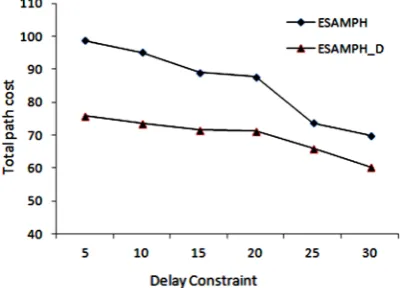
Figure 3. The relationship between the multicast tree cost and the delay constraint.
tree cost and the delay constraint: make the other condi-tions remaining, change the delay constraint from 5 to 30, the increments is 5 each time. We can see that the cost of the multicast tree is lower when using the ESAMPH_D algorithm at the same delay constraint condition.
5. Conclusion
This paper proposed the ESAMPH_D algorithm based on the weak point of ESAMPH algorithm, the improved algorithm did not add any extra cost in space or time when generating the low-cost multicast tree, so it ensur-ing the availability of the algorithm in practical applica-tion.
REFERENCES
[1] Y.-H. Min, “A Survey on Computer Network Routing,”
Chinese Journal of Computers, Vol. 6, 2003.
[2] D. T. Lotarev and A. P. Uzdemir, “Conversion of the Steiner Problem on the Euclidean Plane to the Steiner Problem on Graph,” Automation and Remote Control, Vol. 66, No. 10, 2005, pp. 1603-1613.
http://dx.doi.org/10.1007/s10513-005-0194-y
[3] P. Winter, “Steiner Problem in Networks: A Survey,”
Networks, Vol. 17, No. 2, 1987, pp. 129-167. http://dx.doi.org/10.1109/90.234851
[4] V. P. Kompella, J. C. Pasquale and G. C. Polyzos, “Mul- ticast Routing for Multimedia Communication,” IEEE/ ACM Transaction on Networking, Vol. 1, No. 3, 1993, pp. 286-292. http://dx.doi.org/10.1109/90.234851
[5] M. Parsa, Q. Zhu and J. J. Garcia-Luna-Aceves, “An Iterative Algorithm for Delay-Constrained Minimum Cost Multicasting,” IEEE/ACM Transaction on Networking, Vol. 6, No. 4, 1998, pp. 461-474.
http://dx.doi.org/10.1109/90.720901
[6] Q. Sun and H. Langendorfer, “Efficient Multicast Routing for Delay-Sensitive Applications [EB/OL],” 1995. http://citeseerx.ist.psu.edu/viewdoc/download?doi=10.1.1 .57.4260&rep=rep1&type=pdf
[image:4.595.66.549.425.738.2] [image:4.595.68.286.570.711.2]Routing Algorithm Based on Shared Edges,” Journal of Computer Applications, Vol. 29, No. 11, 2009, pp. 1213- 1215. http://dx.doi.org/10.3724/SP.J.1087.2009.02901
[8] L. Zhou and Y. M. Sun, “A Delay-Constrained Steiner Tree Algorithm Using MPH,” Journal of Computer Re-search and Development, Vol. 45, No. 5, 2008, pp. 810-
816.
[9] B. M. Waxman, “Routing of Multipoint Connections,”
IEEE Journal on Selected Areas in Communications, Vol. 6, No. 9, 1988, pp. 1617-1622.