Dyslexia and cognitive function.
WATKINS, Edwin J.
Available from Sheffield Hallam University Research Archive (SHURA) at:
http://shura.shu.ac.uk/20500/
This document is the author deposited version. You are advised to consult the publisher's version if you wish to cite from it.
Published version
WATKINS, Edwin J. (1980). Dyslexia and cognitive function. Masters, Sheffield Hallam University (United Kingdom)..
Copyright and re-use policy
See http://shura.shu.ac.uk/information.html
TELEPEN
100172621 9
III
Sheffield City Polytechnic Library
REFERENCE ONLY
This book must not be taken from the libraryFines are charged at
50p
per hour
ProQuest Number: 10701147
All rights reserved
INFORMATION TO ALL USERS
The quality of this reproduction is dependent upon the quality of the copy submitted.
In the unlikely event that the author did not send a com plete manuscript and there are missing pages, these will be noted. Also, if material had to be removed,
a note will indicate the deletion.
uest
ProQuest 10701147
Published by ProQuest LLC(2017). Copyright of the Dissertation is held by the Author.
All rights reserved.
This work is protected against unauthorized copying under Title 17, United States Code Microform Edition © ProQuest LLC.
ProQuest LLC.
789 East Eisenhower Parkway P.O. Box 1346
D Y S L E X I A A N D
C O G N I T I V E F U N C T I O N
EDWIN JANES WATKINS
A THESIS SUBMITTED IN PARTIAL FULFILMENT OF
THE REQUIREMENTS FOR
THE DEGREE OF MASTER OF PHILOSOPHY (M. Phil.)
AWARDED BY THE
COUNCIL FOR NATIONAL ACADEMIC AWARDS
DEPARTMENT OF COMMUNICATION STUDIES SHEFFIELD CITY POLYTECHNIC
IN COLLABORATION WITH THE DYSLEXIA UNIT, GRENVILLE COLLEGE,
BIDEFORD
DECLARATION
I)Edwin James Watkins*being a candidate for the degree of
M. Phil.as awarded by the C N A A declare that while
registered as a candidate for the above degree I have, .not
been a registered candidate for another award of the
C N A A or a University. Secondly that none of the material contained in this thesis has been used in any other submission
for any other award. Further, that the contents of this
thesis are the sole work of the author except where an acknowledgement has been made for any assistance received.
E. J. WATKINS
DYSLEXIA AND COGNITIVE FUNCTION
ABSTRACT
The research undertaken investigates the difficulties that dyslexics have with reading and spelling, attempting to explain these from the standpoint of cognitive psychology, using an information processing paradigm. Evidence is produced to support the contention that dyslexics suffer from both a short-term memory deficit and a specific weakness in accessing deeper levels of processing. This manifests itself as a wider limitation in processing all forms of information. As a basis for research, neurological and psychological perspectives are examined and, from a
study of observed symptoms, a classification and definition of dyslexia is offered. The precise differences between dyslexia and general reading retardation are disdussed with specific reference to the significance of short-term memory deficits and by an analysis of the theoretical levels of processing. Haber and Hershenson’s model of information processing is adopted as the frame of reference for the
experimental investigation. This investigation considers the hypothesis that dyslexia is characterized by both a limited capacity in short-term memory, exhibited by reduced channel capacity and a limited access to deeper levels of processing. Three experiments are presented to test this hypothesis:
(1) An investigation into the performance of cross-lateral, dyslexic and control groups on a direct recall task using various forms of tachistoscopically presented information. (2) An investigation into immediate recall of
auditory signals of varying set size under direct recall conditions by three different age groups of dyslexic and control subjects. (3) An investigation into spatial and temporal
factors that influence dyslexic's performance on a memory task.
The results show that dyslexic's performance in all these
DEDICATION
To my parents who gave me an enquiring nature and to my wife Christine and children, Rowena and Lucy, who gave
ACKNOWLEDGEMENTS
I acknowledge my debt to Dr Tim Wheeler, my thesis supervisor, who has encouraged me, by his example, to look further.
I am indebted to Asher Cashdan for his constructive advice and help during this research undertaking, particularly for his advice after reading the drafts of .the manuscript.
I would like to thank the Headmaster of Grenville College, Bideford, D.C.Powell-Price, for his
willingness for this research project to be undertaken and his consideration over the past three years.
Thanks are also due to many pupils who co-operated so patiently.
CONTENTS
Title Page
Declaration 1
Abstract 1 1
Dedication 1 1 1
Acknowledgements 1V
Quote VI1
Preface V11
Chapter 1 . Current themes in dyslexia. -j
Chapter 2. A review of reading and spelling
processes, with particular reference to information processing, levels of processing and dyslexia. 2 9
Chapter 3 Presentation of Haber and Hershenson’s model of human information processing in relation
to experimantal investigation and design. 5-j
Chapter 4. An investigation into the performance of cross-lateral, dyslexic and control groups on a direct recall task using various forms of
tachistoscopically presented information. 23
Chapter 5. An investigation into immediate recall of auditory signals of varying set size under direct recall conditions by three different age groups of
Chapter 6. An investigation into spatial and temporal factors that influence d y s l e x i c ’s performance on a memory task.
Chaper 7. A final discussion of the experimental programme.
148
173
PREFACE
The essential purpose of the research presented here is to look at the phenomena of dyslexia as presented from
the many differing disciplines and to attempt to bring some
semblance of logical ordering to the confusion that has existed. An attempt is made to clarify and evidence is
produced to explain and accommodate this apparent confusion. The central frame of reference contained herein is that of
the exogenous psychological model which has as its major construct an endogenous causality. This frame of reference
is relatively new in that the first researchers adopting this perspective can be traced to the early 1970fs.
Suggestion is made in this thesis that it is
scientifically more reasonable and profitable to use
verifiable psychological constructs in an attempt to impose order on what appears to be contradictory and confusing. One
of the problems is that dyslexia has been considered by many
to be mainly a phenomenon concerned solely with problems in
the use of written language. In this thesis it is suggested that it is more profitable, in terms of understanding and
remediation, to consider the dyslexic phenomenon as a problem which is manifested as a limitation in processing
not just the written word but all forms of information regardless of modality.
It is outside the parameters of the research presented
here to try to explain the problems of dyslexia from the
from a medical and specifically opthalmic standpoint, it soon
became obvious that neurological and psychological standpoints
were more vitally important in the extension of an understanding
of the concept of dyslexia. Consequently this research not
only details the developement of awareness of the symptoms
and syndromes of dyslexia and the ensuing classifications
and definitions offered, but it explores the precise areas
of short-term memory and levels of processing. The reason
for studying this psychological area in particular arises
from recent significant research. The theory that the
dyslexic suffers from a deficit in short-term memory with
consequent theoretically restricted access to increasing
depth of processing levels is the basis for the three
experimental investigations of this thesis.
As a working frame of reference various models of
information processing are discussed and that of Haber and
Hershenson is presented in detail. This model goes further
than the others in offering an explanation of the complex
processes involved in the concept of information processing.
Detailed explanation of the model is a pre-requisite to
full use being made of its structure. Consideration of the
use of the model is thus given, as well as assumptions which
impose a limitation on the model and which beg to be fully
investigated. In the light of contemporary research
evidence, a slightly modified model is offered to formulate
working hypotheses which can be experimentally investigated.
of the model is attempted.
Thus on ths basis of Haber and H e r s h e n s o n ’s model the following experimental investigations are made:
(1) An investigation into the performance of cross-lateral, dyslexic and control
groups on a direct recall task using
various forms of tachistoscopically presented information.
(2) An investigation into immediate recall of auditory signals by dyslexic and control
subjects.
(3) An investigation into spatial and temporal
factors that influence dysl e x i c s ’; performance on a memory task.
As a result of these three experimental investigations
a new model is proposed. This is compatible with the contemporary research reviewed earlier in this thesis and
goes further in explaining the main proposition that dyslexics suffer from a central short-term memory deficit.
From this model a number of important educational
principles arise, specifically strategies of remediation which could aid the dyslexic to achieve his potential in a
CHAPTER 1
CURRENT THEMES IN DYSLEXIA
CONTENTS
1A The need for selectivity: Neurological and psychological perspectives.
IB The problem of definition and some phenomena observed.
1B1 The significance of cerebral dominance.
1C Categorization: symptoms and syndromes.
1C1 The concept of syndrome.
1C2 An index of deficits.
1C3 Psychological taxonomies of symptoms.
ID Specific dyslexia versus general reading retardation.
1D1 Objective measures of the differences between dyslexia and reading retardation.
1D2 Acceptance of dyslexia.
1D3 Terminology.
1D4 Classification.
IE The significance of short-term memory.
IF Conclusion.
1A THE NEED FOR SELECTIVITY : NEUROLOGICAL AND PSYCHOLOGICAL PERSPECTIVES
Although the concept of dyslexia is only 100 years old
there exists sizeable research literature dealing with every
thing from phenomenological to neuropsychological approaches,
with every shade of consideration in between. It is not the
intention of this chapter to duplicate the competent reviews
already extant but, from this spectrum of viewpoints on
dyslexia - neurological, psychological, educational, sociological
- to select two for further study. These are the neurological
and psychological perspectives for they seem to have the
most relevant bearing and provide the necessary background for
the experimental investigations of this thesis. These
investigations are into the significance of short-term memory,
levels of processing and the dyslexic*s cognitive function.
Indeed perhaps in these areas of cerebral function and the
measurement of information processing the two perspectives
profitably meet.
IB THE PROBLEM OF DEFINITION AND SOME PHENOMENA OBSERVED
One can perhaps best illustrate these two perspectives
by looking at the definitions they have historically afforded
and the phenomena observed at the time’. Early research was
grounded in the medical profession and was based almost
exclusively on the neurological perspective. Hinshelwood,
in a major opthalmic study in 1917 said the condition
”A congenital defect occurring in children with other wise normal, undamaged brains, characterized by a disability in learning to read so great that it is manifestly due to a pathological condition and where
the attempts to teach the child by ordinary methods have completely failed”.
He focussed on the concept of congenital word blindness, his
illiterate patient’s difficulty being caused not by defective
vision but
by:-”a grave defect in the visual memory centre ..*... even though the powers of sight, intellect and speech are intact”.
Significantly, this observation contained the germ of the later
psychological concept that the problem could be related to a
defect in short term memory.
Later, researchers concentrated even more on the observable
symptoms of the condition. Orton (1925), a psychiatrist and
neurologist defined it
thus:-"failure in recognition of a printed word even after it has been encountered many times”.
He was the first to propose the concept that the characteristics
of the dyslexic (ambilaterality, reversals, abnormal clumsiness,
difficulty in understanding spoken language, transposition
of letter order in written work) could be caused by:
’’ambiguous occipital dominance, physiological in nature, representing a faulty patterning of brain function”. His term was "Strephosymbolia” (twisting of symbols).
Other researchers of the same period, notably Bachman
(1927) introduced the idea of a maturational lag as the cause
of the problems. From 1930 onwards a growing interest in
reading problems developed and it was perhaps at this period
that the purely neurological perspective moved into the
areas of educational and sociological development. The idea
that "word blindness” was simply a problem of an “organic
constitutional” condition lost ground. Critchley, a
neurologist, writing in 1962 summed up the new directions
of enquiries of the
1930fs:-"Later still, the conception of a congenital word
blindness became qualified by opinions of a different sort. What had hitherto been a medical province or responsibility now became invaded by sociologists and educational psychologists. Backwardness in reading became envisaged more as a problem in sociology than a medical issue".
In later years this movement away from the directly medical
and neurological perspectives continued. The struggle
to discover a definition which incorporated both the
neurological problems and the educational challenge of the
dyslexic child, remained. Critchley, writing now in 1968,
suggested there
was:-”A difficulty in learning to read, which is constitutional, often genetically determined and which is unassociated with general intellectual retardation, primary emotional
instability, or gross physical defects.”
In the same year the World Federation of Neurology presented
this definition that dyslexia
was:-A language disorder in children, who despite conventional classroom experience, fail to attain language skills
of reading, writing and spelling commensurate with their intellectual abilities”.
Consequently, there had been over the years an extension
of the original idea that dyslexia could be considered purely
from the neurological perspective. A broader-based
psychological perspective seemed to be emerging. In 1972,
Klasen reminded us
that:-"Dyslexia is not synonymous as claimed by many with congenital reading disability•originally associated with lesions of the brain. We know today that lesions are by no means ascertainable in all cases. It is
apparent that specific dyslexia is not always congenital".
Attention having been focussed on some observable symptoms
of dyslexia, conflicting theories as to its cause perhaps
prepared the way for the psychologist to study and measure the
phenomenon. The symptoms will be discussed in finer detail
later in this chapter. Suffice it to quote here,
Margaret Newton, who in 1974, spoke of
dyslexia:-"As a primary difficulty consequent upon the
incompatibility between the written language system itself and the intrinsic, developmental skills of an individual’s perceptual/motor system".
It was the psychological area of perception and information
processing which particularly interested Miles (1973)«
His contribution to the understanding of dyslexia has been
profound and will be discussed in the relevant subsequent
sections of this thesis.
Interest in a psychological information processing
paradigm rather than a neurological concept to describe .
dyslexia is currently increasing. It is with this psychological
perspective in view that this present piece of research proceeds.
1B1 THE SIGNIFICANCE OF CEREBRAL DOMINANCE
Early neurological perspectives then, had concentrated
on theories of structural brain defect or a maturational,
functional lag. But interest had developed into the question
of the controls operated by the cerebral hemispheres. Indeed
the first experiment of this thesis (Chapter 4) considers
the question of cross-laterality from an information processing
perspective.
The significance of cerebral dominance had been grasped
by, notably, Orton (1930*s),whose theories suggested that
incomplete cerebral dominance in the two hemispheres of
the brain which serve the visual part of the language function
caused a representational conflict when the dyslexic tried
to build visual and auditory association simultaneously
between letters and shapes. In normal subjects; only the
dominant hemisphere was 1 active*; in the dyslexic child
* engrains* might be formed in the associative tracts of both
hemispheres but 'normally* those in the non-dominant hemisphere
were usually employed. As these non-dominant 'engrams' were
mirror-wise, should there be a lack of clear-cut dominance a
confusion in orientation and sequence would occur - as indeed
it did so frequently among the patients he observed. This
area of research continued until the late I960*s.
Ingram and Reid (1956) cited a group of dyslexics who
had lack of consistent laterality. Similarly De Hirsh,
Jansky and Langford (1966) were leading exponents of the
concept of maturational delay. Maturation, they considered,
was determined by a variety of factor inherited patterns,
e.g. biological growth, emotional, cultural and educational
experience. Synaer et al*s (1967) Rossis(1968) Goldbergs(1972)
findings suggested that a maturational lag inhibited dyslexics*
processing efficiency because the children were not
developmentally ready to acquire the necessary sub-skills
and skills pre-requisite to reading processes. Klasen (1972)
considered that maturational delays were significant in
33.2 per cent of dyslexic reading and spelling problems.
Similarly Harris (1957) quoted a figure of 40 per cent
compared to 18 per cent in his control group. He later
observed (1961) that crossed dominance as well as delayed
development of laterality occurred, up to the age of 9, far
more frequently amongst slow than normal readers. It was
concluded that cerebral maturity and dominance had a direct
correlation. The majority of children pass through this normal
stage and go on to full literacy, the dyslexic child was
characterized by-making errors of reversal and transposition
for so long.
In the same period 1960-61 Ingram and Zangwill considered
that the frequency of retarded speech development, poor or
defective spatial perception and motor clumsiness were
indications of defective cerebral maturation and
ill-lateralization.
Zangwill (1960; 1961) offered three possible explanations
for the reading difficulties of ill-lateralized children, viz:
1. npoorly developed laterality and reading retardation when occurring together may be the effect of an actual cerebral lesion11
2. "in the absence of neurological lateralizing signs, a genetic factor controlling handedness and
cerebral dominance may be involved and associated slow maturation"
3. "those lacking strong and consistent lateral preferences are particularly vulnerable to stress such as that
of minimal birth injury".
Critchley (1962)summed up what had become a controversial area.
"recent studies tend to show that what is important for reading is not which hand or which eye is dominant, but rather whether or not the child has developed
laterality and directionality".
Certainly the majority of researchers appeared to believe
that there was at least an associative positive correlation
between laterality and reading patterns yet the situation was
by no means clear cut, "the causal nature of the relationship
is far from being proven" Klasen (1972).
There were, for instance, many cross laterals who were
not dyslexic. Similarly large scale surveys (Clarke 1970,
\
Rutter (1970) had failed to find any significant relationship
between left handedness or mixed handedness and reading
retardation. There was no positive agreement as to how
laterality as a general trait (if, indeed, it is general)
or even handedness as a specific trait, should be determined,
and as has been noted different tasks or tests can and do
yield different results. Perhaps it is pertinent to cite
Vernon (1957) who did not accept that incomplete lateralization
and lack of maturation could plausibly explain reading failure.
She could see no reason why only reading failure should occur
and other cognitive factors be left unaffected; she expected
some carry over to affect performance more generally, especially
in language faculties, if the defect were due to maturation.
Her doubts would seem to be worthy of further research and
indeed the concept of a maturational lag is considered in
the experimental undertaking of chapter five and six.
Never-the-less, there seemed sufficient research
evidence to show that a relationship appeared to exist
between cerebral dominance, lateralization and reading dis
ability. The neurological,medical, psychological and educational
perspectives may eventually meet - not, one hopes, at intangible
infinity - but at some point where one might coherently
explain the causes, and interpret the symptoms, of the
phenomenon of dyslexia. The remainder of this introductory
chapter will consider the psychological evidence or symptoms
of the phenomenon.
1C CATEGORIZATION : SYMPTOMS AND SYNDROMES
Any deviation from normal functioning in behaviour is
considered to be indicative of an underlying condition of
physical or mental disorder or disturbance. This phenomena
is defined as a symptom or an indication of a 'set1 of
symptoms.
1C1 THE CONCEPT OF SYNDROME
Any disagreement on the specific symptomatology of < dyslexia is undoubtedly related to the absence of appropriate
control groups to assess the extent to which presumed symptoms
are unique. It follows that absolute agreement on the symptoms
is related to what behavioural phenomena can be associated or
correlated with the acceptable use of the term dyslexia, and
this in turn is determined to a great extent by the very
nature of the observations made by researchers in their studies.
Their observations and findings are influenced by definition,
classification and presumed aetiology of the dyslexia.
(See Wheeler and Watkins 1978, 1979 for reviews.)
The major question arising from the above, a question
incidentally that has been asked since the beginning of this
century, is whether dyslexia has a unitary causative factor
for a unitary phenomenon or whether it can be ascribed to a
unitary causative factor which presents a grouping of
discernible dyslexias, or whether a unitary or multiple
dyslexia can be traced to a multiplicity of causal factors.
Attempts to isolate a single factor responsible for reading
problems have come to little avail (Robinson, 1946; Johnson,
1957). As Klasen (1972) remarked.
"There are no indications that reading disability will ever be traced back to a single aetiological factor. The complexity of the reading process itself makes this most unlikely.11
The causes and classification of specific dyslexia as a
syndrome as opposed to a general retardation are discussed
in the final section of this chapter. Meanwhile an examination
of symptoms may lead one towards that end.
What are the recognisable "symptoms11 of the dyslexic?
Broadly speaking^in educational fields^ dyslexia is observed
as failure of the child to acquire a satisfactory level of
reading, spelling and written work in spite of intellectual
ability (in some cases a high degree of intelligence), normal
and natural school experiences, emotional stability and
socio-economic opportunity.
More precisely certain "deficits" make persistent
appearances in the literature about the dyslexic child:
102 AN INDEX OF DEFICITS
1. DIRECTIONAL CONFUSION (LEFT RIGHT)
Orton (1937); Rabinovitch, Drew, De Jong, Ingram and
Withey (1954); Shepherd (1956); Zangwill (1960);
Belmont and Birch (1965); Ginsburg and Hartwick (1971);
Miles and Wheeler (1974).
2. HANDEDNESS AND CEREBRAL DOMINANCE (CROSSED DOMINANCE)
Hildreth (1950); Smith (1950); Bauer and Wepman (1955);
Zangwill (1960); Branch et al (1964); Birch (1964);
Annett (1967) and (1970); Antony (1969); B$ (1972);
Belmont and Dunlop et al (1973), Newton (1970); Naidoo
(1972); Klasen (1972); Bf (1972).
3. SPONTANEOUS WRITING AND SPELLING IMPAIRMENT '
Orton (1928); Rabinovitch et al (1954); Zangwill (1962);
Buchanan (1968); Bannatyne (1971); Miles (1974);
Wheeler (1978).
4. VISUAL PERCEPTION DEFICIENCIES
Howes and Solomon (1957); Broadbent (1958); Lachman (1960);
Benton (1962); Kinsbourne and Hartley (1968); Bakker and
Satz et al (1970); Klasen (1972).
5. NEUROLOGICAL DYSFUNCTION
Orton (1928); Zangwill (1960); Naidoo (1972).
Rabinovitch (1968); Naidoo (1972); Sklar et al (1972);
Francis Williams (1974).
6. MOTOR DYSFUNCTION
Orton (1928); Hildreth (1950); Penfield and Roberts (1959);
Critchley (1962); Harris (1966); Goldberg (1968);
Miles (1974); Newton (1974).
7. FINGER DIFFERENTIATION PROBLEMS
Hildreth (1950); Rabinovitch et al (1954); Kephart (1968);
Naidoo (1961); Critchley (1964); Bannatyne (1968); Klasen (1972)
8. WEAKNESS IN MEMORY STORAGE
Sampson and Spong (1960); Alwitt (1963); Blank and
Bridger (1966); Klatzky and Atkinson (1971); Allik and
Siegel (1974); Miles (1974); Wheeler and Watkins (197 7).
9. FAMILIAL OR INHERITED DISABILITY (GENETIC FACTORS)
Critchley (1962); Keeney (1968); Naidoo (1972);
Francis Williams (1974).
10. DELAYED MATURATION
Bakker and Satz (1970); Vernon (1971); Naidoo (1972).
H . MATERNAL AND NATAL FACTORS
Kawi and Pasamanick (1959); Critchley (1962);
De Hirsch et al (1966); Naidoo (1972); Newton (1974).
12. LANGUAGE DELAYS
Orton (192B); Orton (1937); Schonell (1942); Zangwill (1960);
Gibson (1965); De Hirsch (1966); Moyle (1968); Klasen (1972);
Miles (1974).
13. SEX DIFFERENCES
Donvan (1953); Bannatyne (1966); Money (1962); Prechtl
(1962); Critchley (1964); Rabinovitch (1968); Bornstein
and Sroka (1969); Klasen (1972); Newton (1977).
1C3 PSYCHOLOGICAL TAXONOMIES OF SYMPTOMS
As if confirming such an index the Word Blind Centre’s
Committee laid down certain, working or functionally
orientational criteria for the recognition of dyslexic
children. They were:
Always Present
1. Reading and spelling considerably behind intelligence. 2. Inability to deal with symbols forming letters or words
and weak retention of symbols. 3. Bizarre spelling.
4. Persistent reversal of letters.
Commonly Present
1. Crossed laterality.
2. Bizarre and cramped handwriting.
3. Difficulties with numbers similar to the difficulties with letters.
4. Weakness in copying diagrams.
5. Similar difficulties in other members of the family in the same or earlier generations.
6. Sometimes a secondary emotional disturbance showing itself in physical symptoms which recur frequently and lead to absence from school, which is then blamed for the reading difficulty.
Miles (1973) as has been noted was one of the first
researchers to look specifically at dyslexia from a psychological
information processing paradigm. While concurring with the
symptoms detailed here he made specific reference to the
dyslexic1s deficit in short-term memory as a causal factor.
The overall purpose of the research undertaken in this thesis
is to define, using an information processing paradigm, the
dyslexic*s problems specifically in short-term memory and to
present a model which can account for them.
ID SPECIFIC DYSLEXIA VERSUS GENERAL READING RETARDATION
Having examined some of the neurological and psychological
perspectives and observed the symptoms of dyslexia
-especially those most obvious to the educationalist - perhaps
some indication has to be given of the essential difference
between the concept of specific dyslexia and reading
retardation. At worst the term dyslexia has been used as
an imprecise "umbrella" description of all reading difficulty
or even as a "convenient" impressive "label" to excuse a
lack of intelligence in a child. Wepman (1962) was one
researcher guilty of such a misuse of terminology
viz:-"Dyslexia is used in the present paper to mean any or all degrees of reading impairment from nonreading to
delays in the normal acquisition of reading of sufficient degree that the subject is considered a reading problem."
Obviously the researcher and teacher must not only dispel
such ideas but observe and measure accurately the precise
nature of this specific problem.
1D1 OBJECTIVE MEASURES OF THE DIFFERENCE BETWEEN DYSLEXIA AND READING RETARDATION
A simple "measure", as it were, of this difference is,
that I
-"Dyslexic children are characterized simply by making so many of these mistakes for so long" (Hagger 1968).
In other words one does not "grow out** of dyslexia - although
the problem can be ameliorated by a structured educational
process. Let us now consider some precise differences between
the dyslexic child and the "retarded reader".
1, The dyslexic child will characteristically exhibit a
discrepancy between full scale intelligence score and
performance level in academic subjects - particularly within
the skills of reading and spelling. This is not marked in the
child suffering from general reading retardation who will
in the main, have a low overall intelligence score (Clark 1970;
Rutter et al 1970). The psychometric profile of the dyslexic
child will be markedly ‘saw-toothed* with particular weak
ness in the verbal scale. Coding and digit span will be
areas of specific weakness and it is indeed rare for a dyslexic
child to recall more than four reversed digits (even though
the child*s intelligence may be superior). They invariably
gain better scores on performance items of the W.I.S.C,
whereas the profile of the reading retardate is generally
more even.
2, Attempts to employ normally accepted practices of teaching
reading and spelling result in failure for the dyslexic child.
This is because there are specific functional weaknesses which
identify the dyslexic. Not only is there the major functional
weakness of an I.Q/performance discrepancy mentioned above,
but there is a lack of consistency in the error patterns of
educational performance - while the reading retardates show
a consistency in their mistakes, the dyslexic child shows a
pattern of bizarre spelling and reading error.
3, Dyslexic children form a relatively homogeneous group
exhibiting the functional patterns just mentioned. Reading
retardates form a more heterogeneous group whose causal
factors of reading difficulty include partial sight or hearing,
educational sub-normality, maladjustment, organic brain damage,
disrupted schooling, lack of adequate educational opportunity
and other such factors. Herman (1959) makes the point that
dyslexia is
!-na specific disorder of function and not merely
the chance result of a series of external factors11.
4, The problems of the dyslexic child seem to centre around
a specific weakness in short-term memory - a weakness and
difficulty in apparently gaining access to and from long-term
memory. This whole area and the question of levels of
processing will be investigated and discussed in ensuing
chapters. Supporting evidence also came from the epidemological
study of schoolchildren on the Isle-of-Wight which sought to
ascertain if a pattern of reading difficulties could be
identified. 2,334 nine and ten year old children, were screened.
Rutter et al were interested in three identifiable groups
1. children who were "intellectually retarded" (WISC score
two standard deviations below the mean)
2. children "Backward in reading" (reading attainment 28
months below their.chronological age regardless of IQ), and
3. children "specifically retarded in reading" (28 months
or more below their expected reading level based on mental
age on the Neale Analysis of Reading Ability). 86 (3.7%)
were identified ap being specifically retarded in reading;
155 children (6.6%) were identified as backward readers. Of
this latter group, 76% were also specifically retarded in
reading.
Rutter et al. stated that the "6.6% must be regarded as
a minimal estimate of the reading retarded since 28 months is a
severe degree of backwardness. From the control group it
was found that 2% of the reading retarded children were missed
by the group screening techniques. This would increase the
incidence of specific reading retardation to a possible 5.7%
and reading backwardness to 8.6%."
Perhaps significantly when the children with specific
reading retardation were retested 2 years later, all were
still reading below their chronological age levels. This
finding is not surprising in the light of comments already
made about the need for specialized remediation if these
children are to make progress. Rutter et al — noted that
with the general reading retarded groups their mathematical
ability was also retarded along with other scholastic subjects.
Yet those children identified as suffering from specific
retardation in fact did considerably better both in mathematics
and other school subjects. Indeed, the general consensus is
that the dyslexic child suffers only from a specific reading
and spelling retardation whereas the reading retarded group
suffer from a general retardation.
As if confirming these findings fchen5 the Tizard (1972);
Bullock (1975) and Waraock (1978) reports all acknowledged
the existence of a homogenous group of children who were
identifiable by their specific reading disability and were
often called dyslexic. Warnock stated
"Although there are no agreed criteria for distinguishing those children with severe and long term difficulties in reading, writing and spelling from others who may require remedial teaching in these areas, there are nevertheless children whose disabilities are marked but whose general ability is at least average and for whom distinctive arrangements are necessary7
102 ACCEPTANCE OF DYSLEXIA
Encouragingly the Department of Employment takes seriously
the concept of dyslexia to the extent that they issue a
"Green card" stating that the prospective employee is suffering
from dyslexia. It is a recognizable disability which is
certifiable. The Medical School Officers Handbook devotes
a whole chapter (1975, Chapter 10) to the phenomenon of
dyslexia and gives valuable advice and guidance. The Open
University was one of the first academic institutions officially
to recognize and make provision for the dyslexic candidate.
Today the majority of public examination boards accept and
give special dispensation to dyslexic pupils who take CSE,
*0* and*A1 level exams.
1D3 TERMINOLOGY
Perhaps the proponents and opponents of the term dyslexia
and its many variants have themselves added to the difficulty
in separating the specifically dyslexic child from the
reading retardate. Cruickshank (1968) adequately sums this up:
"If the child diagnosed as dyslexic in Philadelphia moved to Bucks County, ten miles north, he would be called a child with a language disorder. In Montgomery County, Maryland, a few miles south, he would be
called a child with special or specific language problems. In Michigan, he would be called a child with perceptual disturbance. In California he would be called either a child with educational handicaps or neurologically handicapped child. In Florida and New York State, he would be called a brain injured child. In Colorado
the child would be classified as having minimal brain dysfunction."
However, constructive useful attempts have been made to
classify dyslexia as a specific entity and these must be
considered.
1D4 CLASSIFICATION
De Hirsch (1968) indicated the enormous complexity of
starting on a classification system.
"The overall performance of so called dyslexics seems to point to a profound and basic maturational deficit; a deficit so severe that one might speculate that It is rooted in a biological matrix and constitutes a type of cerebral dysfunction"
Yet other researchers have considered this viewpoint of
organic disorder less important than the one which suggests
a functional problem, i.e. lack of emotional readinesvs to read
or a developmental lag (Stone and Church 1957). Useful
classification of dyslexias and other types of dyslexia were
produced by Keeney (1968). Goldberg (1968); Bannatyne (1971)
and Klasen (1972) who all proposed the idea that there were
types of dyslexia perhaps with separate causes.
Only Bannatyne1s model is offered, possibly because it
went further, in as much as it clearly differentiated the
fundamental differences between the reading retardate and
the dyslexic. Of course, it will be observed that the
functional factors that go to make up the separate entities
are not mutually exclusive, there is a point of overlap
which is possibly one of the reasons for the continuing
controversy about what criteria constitute the dyslexic
subject as opposed to the reading retardate.
Ba nn at yn e* s Cl as si fi ca ti on of Ca us es an d Ty pe s of Dy sl ex ia (N ot e : no ne of th es e ca te go ri es is mu tu al ly ex cl us iv e) CO Q) •H4J •H rl •r-| Xcd co *H 60 G •H T3Cd 0 PG cd 0 60 cd G 60 G cd eco •H '-U < cd •H CO
. cd
a < jj G 0 S jj CO . G•f-)
TJcd i—4 cd S cd •Hx aj r—! CO >> p CO w O' M so P TJG -UCO Po 0 CO ?-J 0 > •H G O co
S
cu oP rH
O i-1
O *H
(U rH
O
cd
>> G M o
P cu <u > •HP cd 0 •H
1
OO CO <u CO G cdo P 4J
CU ><u CO 0 •Ho 0 p CO CO •H P 4JO 6 CO 0 •Ho 0 p CO rH 0
X >G cu
CO rH
co X
J-J *H 0 CO "X CO P o O P
More recently Naidoo (1972) in her work at the Word
Blind Centre came to the conclusion that the "concepts of
dyslexia under the specific headings of genetic factors,
maturational lag, neurological dysfunction and cerebral
dominance, need not be mutually exclusive."
Similarly Singleton (1976) felt that hypotheses about
the causation of dyslexia fell more plausibly into four broad
categories, viz:
1. Brain damage
2. Genetic factors
3. Defective lateralization
4. Developmental delay.
Again these categorizations were not mutually exclusive.
The aetiology may be divided into two major categories,
endogenous and exogenous. Klasen (1972) proposed such a
classification of causes and made comment that,
"Our own classification cannot be completely or
absolutely correct ... it is based on the assumption that specific dyslexia constitutes a multi-aetiological syndrome, according to causal relationships and
frequency of occurrence."
Klasen1s classification was as follows:
1. Somatogenetic Dyslexia
a. Functional : neurological disorders in the organization
or functioning of the central nervous system without
evident organic or structural changes (EEG normal
or only slightly and unspecifically changed).
b. Constitutional : inborn weakness without pathogenetic
evidence, at least as far as today's diagnostic
means allow determination.
c. Heredity : familial tendency towards reading and. spelling
disorders of various manifestations in the absence of
other evident causes or pathological signs.
d. Maturational : delayed or arrested development of
the nervous system, especially of its functions, often
accompanied by psychological immaturity in various
areas of growth (especially often observed among
prematurely born children).
e. Traumatic : conclusively diagnosed traumata of the
nervous system, organic changes, birth trauma, etc.
2. Psychogenetic Dyslexia : neurotic conflicts, defences or
reactions, originating in inner psychic or social tensions.
3. Sociogenetic Dyslexia : caused by social milieu, family,
school, culture or similar social institutions and the
limitations they may impose.
Attempts to isolate single deficits or clusters of
deficiency in cortical functioning sufficient to limit
reading skills have in the main yielded little additional
information (Ingram, 1960; Mattis 1975). Perhaps the main
contribution of the type of research undertaken by such
researchers is that it reinforces the idea that a language
deficit is the most fundamental problem in dyslexia (Ingram
and Mason 1965); Debray 1968; Doehring 1968; Ingram et al
1970; Rutter Tizard and Whitmore 1970).
One is again faced with a difficulty of definition.
Is dyslexia a specific term that can be used to describe a
homogeneous grouping of difficulties or is it an overall
general term that can be used to describe a collection or
group of symptoms? The attempts to classify dyslexia, though
useful, were perhaps in some cases too gross, for instance
Johnson and Myklebustfs (1967) distinction between auditory
and visual dyslexia. The Word Blind Centre in its *in depth1
study of dyslexia between 1967 and 1969 had the following to
say
"in view of suggestions made in recent years that there may be sub-groups or types of dyslexia characterized by different patterns of disability, an attempt was made by cluster analysis to distinguish such patterns and to relate them to the various possible aetiological factors".
Naidoo (1972) concluded that statistical analysis revealed
a continuum rather than identifiable sub-types. She stated
"The evidence from this study does not support the existence of clearly defined sub-types of dyslexia".
The search for a "Definitive description" continued then,
with these two alternatives,
viz:-1. that dyslexia was not diagnosable as a clinical entity
and probably did not exist as such,
2. that in place of the single condition previously
hypothesized there were the dyslexias, a group of
disorders centred on reading disability.
Such questions as the authenticity of the specific syndrome
disappeared if the second and alternative hypothesis was
accepted. Indeed there was much evidence to support the
second alternative. .Miles (1961, 1967) made comment "to
justify the term ' dyslexia* a certain cluster of symptoms
must be present together." It also opened avenues for
research rather than dismissing considerable evidence, and
thus provided the opportunity for specific remedial help.
As Houghton (1967) claimed
"utility in the remedial situation is the final criterion of all our theorizing".
IE THE SIGNIFICANCE OF SHORT-TERM MEMORY
The intention of this section is to present selected
information on the dyslexics1 specific problem with short-term
memory and information processing within the framework of
psychological functioning, and to provide a n ■introduction to
this area before referring the reader to a more detailed
consideration of research in Chapter two, which looks
particularly at short-term memory and related areas in some
detail.
Bronner, as long ago as 1917 spoke of the weakness of the
dyslexicfs visual memory but it was not until the 1960's
that interest in short-term memory as a possible fundamental
explanation of dyslexia was posited by Vernon (1966) and
Money (1962). Increasingly, as has already been mentioned
in the preceding sections, research evidence confirmed
that short-term memory and information processing deficits
were to be found in children diagnosed as dyslexic. Indeed,
initial research was instigated by Miles (1973) in this
country and Stanley and Hall (1973) Stanley (1975) Stanley
Kaplan and Hall (1975) in Australia. Until this time, attempts
to find a single underlying factor which allowed the researcher
to describe the dyslexic condition from a particular stand
point and which accommodated the numerous observable symptoms
had come to no avail.
One of the justifiable criticisms of the antagonists was
that the symptoms of the dyslexic child equally * fitted*
the retarded reader and therefore it was not valid to apply
this term to an arbitary grouping of children who could
equally well be classified as reading retardates. Perjoratives
such as "a middle-class syndrome" emerged at this time and
unfortunately, but understandably are still bandied around
today despite the evidence (already enumerated) to substantiate
the term dyslexia.
However, an accurate measure and definition of the
dyslexic child*s problems - and one which adequately
accommodated the main symptoms - was finally offered by
investigation into the specific limitation in short term memory
exhibited by the dyslexic child. The thrust of this type of
investigation (or information processing paradigm) was to
separate accurately the dyslexic child from his non dyslexic
counterpart - the reading retardate.
There is little doubt that the psychological information
processing perspective offers a major contribution to the
understanding and integration of the concept of dyslexia and
it is towards these ends that the following chapters are
dedicated.
1F CONCLUSION
In conclusion it seems apposite to quote Klasen (1972)
who stated,
"Nearly one hundred years of research have done nothing to diminish the significance of the phenomena of
specific dyslexia"
yet it does seem that over the last two decades research has
moved away from a search for specifics and central symptoms
to a broader perspective - that of a multi symptomatology
which accounts for a grouping of behavioural phenomena. It
is towards these ends that this particular piece of research
is undertaken, in an attempt to quantify observable phenomena,
especially the dyslexic*s difficulties of information
processing because of a measurable deficit in short-term
memory. These have been briefly mentioned here and will be
more fully discussed and investigated in the rest of the thesis.
CHAPTER 2
A REVIEW OF READING AND SPELLING PROCESSES, WITH PARTICULAR
REFERENCE TO INFORMATION PROCESSING, LEVELS OF PROCESSING
AND DYSLEXIA.
CONTENTS
2A Dyslexia and information processing: Limitation in short-term memory.
2B Short-term memory and perceptual speed.
2C Reading and Spelling: The interrelationship^ with short-term memory.
2D The Theoretical levels of processings
2A DYSLEXIA AND INFORMATION PROCESSING: LIMITATION IN SHORT-TERM MEMORY
The intention of this section is to consider specific
evidence relating to short-term information processing and
its relevance to dyslexia. The section will refer particularly
to spelling and reading deficits, and to dyslexia seen as a
deficit of any receptive pathway which channels afferent
information via short-term memory. Increasing load and
decreasing time will theoretically lead to a breakdown of
information processing. Initially general evidence will be
reviewed which makes assumptions that a weakness in short
term memory store is characteristic of the dyslexic and as
such might be a specific manifestation.
Following this the concept of processing will be outlined
in a chronological sequence with specific reference made to
the particular areas of weakness from which the dyslexic
suffers in this respect. This will be followed by consideration
of the inherent skills needed both in spelling and reading
from an information processing perspective and will investigate
the factors determining the 'bits' or size of units being
processed. The parameters of short-term information processing
will be investigated. The differences in retention of order
and information have implications for the whole concept of
dyslexia, especially the specific difficulties that dyslexics
have in sequencing both afferent and efferent information and
the ordering of phonemes in spelling. Finally there will be
a brief review of the area of research into short-term
memory since the beginning of the I960*s.
Ever since the early 1960*s interest has increasingly
been shown in the model of short term information processing
and its application to the understanding of the aetiology of
dyslexia. Vernon (1960), Money (1966).
Various factors in the overall "syndrome" of dyslexia
had led a number of researchers (Stanley and Hall, 1973;
Miles and Wheeler 1974; Stanley 1975) to consider that short-*
term memory was "directly implicated". As mentioned in
chapter one, since the beginning of this century several
authorities in the field of dyslexia had indicated a number
of characteristics which went to make up the dyslexic "syndrome",
(Hinshelwood (1895), Morgan (1896), Orton (1928), MacMeeken
(1939)). Among these regularly reported features was one of
directional confusion. The children became muddled when
they had to distinguish between left and right and particularly
in finer, higher order skills like the repeating or spelling
of polysyllabic words - they often left out part, or
repeated syllables and in most cases they reproduced them in
a muddled order.
Various aspects of research into cerebral dominance and
information processing suggested a connection with reading
ability, (Thomas, 1969; Fritzen, 1972; Haber, 1973).
Sperry (1968) thought it necessary for cerebral dominance
to be established for information processing to proceed
successfully in a sequential manner from the right to the
left cerebral hemisphere. If Sperry was correct, the reading
retardation associated with cross laterality would seem,
therefore, to be associated with impaired sequential
/ •
information processing. Other recent advances in research ^
on short-term memory have supported, and added to Sperry’s
work. (Klatzky and Atkinson, 1971; Siegel and Allik, 1973;
Allik and Siegel, 1974; Watkins and Wheeler, 1976; Wheeler,
Watkins and McLaughlin, 1977).
Stanley and Hall (1973) tested dyslexics on a visual
information storage task and concluded that the visual
%
persistence of dyslexic children was greater. Yet Stanley
(1975) concluded that dyslexics had a greater difficulty in
transference from the visual information storage to short
term memory. Stanley, Kaplan and Poole (1975) showed that
dyslexics had inferior short-term memory irrespective of
presentation modality. However, in the previous experiment
and a subsequent one, Stanley and Molloy (1975),using a
different experimental paradigm found there was no significant
difference between dyslexics and controls for brief visual
information storage. The above finding would indicate that
dyslexics have a limited capacity in short-term memory rather
than visual persistence in visual information storage.
Miles and Wheeler (1974) suggested that the main
feature of dyslexia was the inability to retain complex
information over time and that problems over orientation,
when they occured, were a manifestation of this more basic
limitation. Their thesis was that the ’difficulty over
orientation* associated with dyslexia should be seen as a
particular manifestation of a more general limitation; the
more general limitation was the inability to retain a complex
’load* of material over time. It seems reasonable if their
thesis was correct, to vary the complexity of stimulus material
and study the time-intervals over which such material can be
recalled. This is the basis of the ensuing experiments.
2B SHORT-TERM MEMORY AND PERCEPTUAL SPEED
McKeen (1885) showed that the perceptual span
for familiar words in normal subjects was nearly as great
as for single letters exposed for the same duration. Subjects
were able to perceive up to as many as four times the number
of letters if they were organized in a familiar word pattern
rather than if they were arranged in an isolated or unfamiliar
sequence. Similarly Dodge (1905) researched into high speed
perception using a tachistoscope. He found that perception
occurs in reading only during fixation periods, not in the
saccadic jump from one fixation to another. It is "jumpy,
irregular, spasmodic" but is a very accurate leap from one
point to another. It is in this fashion that man normally
samples his visual environment, gaining information about the
Saccades in reading normally proceed from left to right
in a series of "jumps" across the page. Very little is
seen during saccadic movement, information is picked up
between saccades when the eye is still -during fixations.
Very young normal children are able to read three letter
words exposed for only 40 milli seconds, which is too fast
for sequential eye movements to occur.
Rizzo (1939) and Lyle and Goyen (1962) found that there
was a slower performance in perceptual speed with poor
readers than with normal readers. They used a visual sequential
memory task. Geschwind and Howes (1962) used a tachistoscope
to look specifically at dyslexic difficulties. They used
the Zipf measurement of vocabulary but held that the basic
deficits of word blindness were clearly much more delimited
than aphasia and that the deficit was suited to analysis with
experimental methods that had been worked out for normal
subjects. They compared the patients* inability to perceive
written words with the perception of non-verbal visual stimuli.
It appeared that in the case of the dyslexic subject the
ability defined by McKsen was defective. They found that the subjects* inability to see words in contrast to letters was
most marked, unlike the normal person’s relative inability to
see letters in contrast to words. Howes(1961) in a
quantitative analysis looked at this‘Cattell’ effect. He found
that the duration threshold of a written word was in proportion
to the frequency of the word in general linguistic usage.
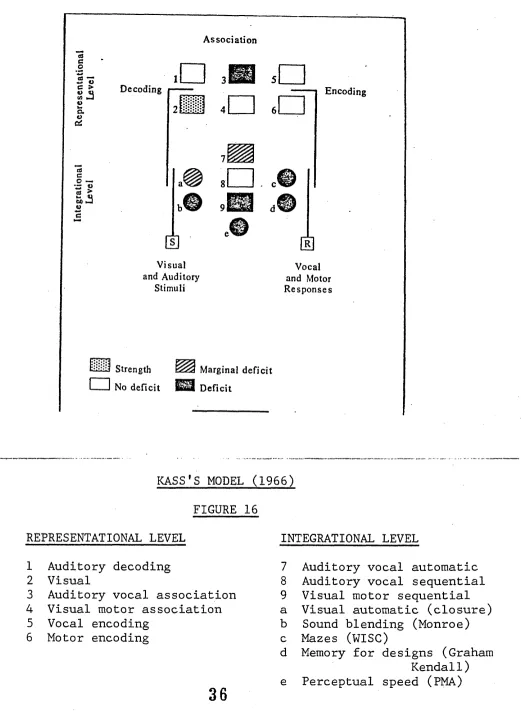
Kass (1966) found that there was a relationship between
difficulty in learning to read and■performance on tests at
the automatic level, including tests of perceptual speed,
closure and visual memory. There was a difference between
the automatic (integrational) and the representational
(symbolic) levels for children who are retarded in reading.
It is at the automatic level rather than the representational
level that these children suffer. Kass found that in many
cases children suffering at the automatic level scored high
at the representational level (ability to interpret pictures).
She considered that this might possibly be a compensational
trait since the child will have had to rely on contextual
clues from the pictures in books rather than the words.
Association <s
c o
w03 —
*- ft) c > ft) ft) 02 ft) u a. a) e: c3 c o — -- ft)cd ^
u ft)
eo i-J
«)
Decoding
Visual and Auditory
Stimuli
Encoding
R Vocal and Motor Responses
Marginal deficit
n
No deficit 123 DeficitKASS'S MODEL (1966)
[image:49.617.38.559.73.784.2]FIGURE 16
REPRESENTATIONAL LEVEL INTEGRATIONAL LEVEL
1 Auditory decoding 7 Auditory vocal automatic
2 Visual 8 Auditory vocal sequential
3 Auditory vocal association 9 Visual motor sequential
4 Visual motor association a Visual automatic (closure)
5 Vocal encoding b Sound blending (Monroe)
6 Motor encoding c Mazes (WISC)