A Divisible Transferable E-Cash in Wireless Distributed
Environment
Israt Jahan
Dept. of Computer Scienceand Engineering Jahangirnagar University Savar, Dhaka, Bangladesh
Anamika Paul Rupa
Dept. of Computer Scienceand Engineering Jahangirnagar University Savar, Dhaka, Bangladesh
Liton Jude Rozario
Dept. of Computer Scienceand Engineering Jahangirnagar University Savar, Dhaka, Bangladesh
ABSTRACT
This paper addresses an elegant and probably unique divisible Wireless E-cash Transfer System in distributed environment. The proposed Wireless E-cash Transfer System solves most of the crucial problem with existing wired e-cash and untraceable e-cash proposals. A distributed computing environment can support multiple platforms, multiple servers and some open networking infrastructure such as Internet. One of such distributed computing architecture is Common Object Request Broker Architecture (CORBA), which is object-oriented, scalable and is based on open specification. We used MICO CORBA and implemented (MIWCO) Wireless CORBA extension for MICO. We had to modify the MICO Core to implement MIWCO. Wireless CORBA architecture has been used in the development and transfer of the e-cash system. In our system we also used LiDIA library for bigint, which is used for security purposes. We used to start Naming Service, Event Service & create Home Location Agent, Access Bridge, Terminal Bridge in implementing the Wireless E-cash Transfer System. The computational complexity of this system is O(n2). We have used binary tree approch to construct a divisible e-cash and at each transfer coin authentication and denomination revelation is checked.
General Terms
Computer security, e-cash, wireless distributer environment.
Keywords
Divisible transferable electronic cash, binary tree, double spending, security, anonymity, blind signature, digital signature, unlinkability, untractability.
1.
INTRODUCTION
Electronic cash is one of the processes that can be used to conduct paperless transactions. Paperless transaction is a term used to describe financial exchanges that do not involve the physical exchange of currency. Instead, monetary value is electronically credited and debited. A divisible cash is a cash that can be used as a whole, or as smaller denomination, until the total value of the pieces used is more than the value of the cash. Tree-based divisible e-cash is widely adopted for divisibility management because it allows a face value to be split into different sizes for spending. Each tree node can be split into or merge from its child nodes for spending at different sub-values of the total face-value. Electronic cash was introduced by Chaum [1]. Chaum used a blind signature to provide “anonymity” and “untraceablility” for electronic cash. Afterwards, Brands in 1993 provides an untraceable electronic cash scheme in wallet with observers [2]. In his paper, he proposed that a coin can be traced only if
double-spending occurs. Song and Korba [3] described how to construct an electronic cash scheme which has both features of “untraceability” and “non-repudiation”. This means it can be ensured that a legal user would never be traced; however, once a dispute happens, a user cannot deny that he had spent the electronic cash. Many variants of e-cash scheme have been proposed for different applications. Okamoto [4] proposed a “divisible” electronic cash scheme, which expresses the amount of money by a tree structure to divide the electronic cash into a minimum unit. In the divisible electronic cash scheme, any remainder money can be continually used [5]. Kim et al. proposed a “fair tracing” protocol to protect customers from suffering illegal tracing by a bank or other parties [6]. Camenish et al. proposed a scheme in which once a user spends one of coins in his wallet twice, all coins in his wallet can be traced [7]. Hou and Tan eliminated the withdrawal phase of the electronic cash system. Fair traceability was also provided in their scheme in case of crimes taking place [8]. Chen et al. proposed a scheme that uses a proxy to reduce the burden of the merchant [9]. Chan et al. bounded each procedure in their divisible cash scheme by tens of exponentiations [10]. Camenish et al. proposed a scheme with lower complexity of wallet size [7]. Previously we proposed an internet based anonymous electronic cash system [11, 12]. Wireless operations permit services, such as long range communications, that are impossible or impractical to implement with the use of wires. Mobile communication and computing devices, like laptops and PDAs with WLAN interface cards or cell phones with PDA functionality have become very popular over the last years and we used these devices to run distributed applications using MIWCO. We implemented wireless e-cash so that we can easily transfer divisible transferable anonymous e-cash [15-20] using handheld devices.
2.
THE BINARY TREE APPROACH TO
REALIZE DIVISIBILITY
Each e-cash of worth wl = 2 l
is associated with a tree of ( 1+l ) levels and wl leaves (Figure1). Each node of the tree represents a certain denomination. The root node 0 is assigned a monetary value of wl , and the value of any other node n0 j 1 j
2 ... j l are assigned a monetary value of 2-l.wl ( jl∈ {0,1} for i=1,2,...,l) . It will be shown by making use of the mentioned tree that for a single e-cash of worth wl , it will be possible for a consumer to engage in several transactions, such that the total sum of the amounts of transactions is less than or equal to wl . This is exactly what unreusability means.
The concept of divisibility and unreusability (no overspending) can be realized by the following two rules:
1. Same node rule: No node can be used more than once.
2. Route node rule: When a node is used, none of the descendant and ancestor nodes of this node can be used.
3.
BACKGROUND TECHNIQUES
We make use of 'disposible authentication' techniques [13] to construct our divisible coin systems. By applying these techniques, we adapt the Schnorr identification scheme[14].
In brief, an user ( U0 ) who has the private key ( x1 , x2 ) calculates his public key m= g1
x1 g2
x2
modp (the order of g1
and g2 is q in Zp * ) and proves to the User ( U1 ) that he knows the private key ( x1 , x2 ) . For that, the user U0 selects randomly ( r1 , r2 ) and calculates β = g1r1 g2r2 modp . Then, U1 returns a challenge message υ , and U0 sends two numbers, ρ = r1 + φx1 modq and σ = r2 + φx2 modq to U1 who verifies that g1ρ g2σ = β mφ.
Here, ( r1 , r2 ) is chosen randomly, and the user U1 obtains no information regarding ( x1 , x2 ) . If the choice of ( r1 , r2) is fixed for two different challenges, υ and υ ' , then the values of the secret ( x1 , x2 ) can be found.In the Payment Protocol of divisible e-cash scheme, binary-tree approach is used.
We view an electronic coin as a public key m (that is blindly signed by the bank). The value used for ( r1 , r2 ) will depend on the node of the binary tree that is being spent. Note that all ( r1 , r2) 's will be randomly correlated, and once decided upon, will be fixed in the bank's signature for a coin, and hence cannot be altered. In this respect, if the same node is spent twice, the same ( r1 , r2 ) value is used, and all information can be recovered.
4.
NOTATION AND ASSUMPTIONS
Let p and q be large primes such that q |( p-1 ) . The notation x ϵR X means that x is uniformly and randomly selected from X . Also let || denote concatenation and let |x| be the length of the binary representation of x. If b is a bit, let b represent the negation of b. Let H : {0,1 }*→{0,1 }2|q|
be a polynomial time computable collision-intractable one way hash function that maps its inputs to Zq . Three generator g , g1 and g2 are chosen from the unique subgroup Gq of the multiplicative group Zp* . In this paper, we denote the root node as n0 and n 0 j1 j2 ....jn denotes descendent nodes.
5.
PROTOCOLS OF A DIVISIBLE
TRANSFERABLE ANONYMOUS-CASH
[image:2.595.55.290.67.242.2]We shall now present the protocols (Fig.2) of our proposed divisible transferable anonymous e-cash. This protocol is divided into five major blocks of computation.
Figure 2: Model of divisible transferable e-cash.
Bank's setup protocol.
Withdrawal of e-cash by user U0 from the bank Withdrawal of coin extension by users U1 .... U n to
receive transferred e-cash .
Coin transfer from user U0 to U1 . Deposit protocol.
Theseprotocols are described in the following:
5.1
Bank's Setup Protocol
transferred cash from other users. The necessary parameters for the bank are as follows:
1. Let p,q,g, g1 , g2 ,H be the system parameters published by the bank where the orders of g, g1 , g2 is q .
2. x and xt are the secret key of Bank. Here, x is used for issuing e-cash and xt is used for issuing coin extension.
3. h= gx , ht = g x t
are the public keys of Bank
5.2
Withdrawal of E-Cash by User U
0from
Bank
The withdrawal protocol is the generation of a Schnorr-signature by the bank on a set of data known only to User.
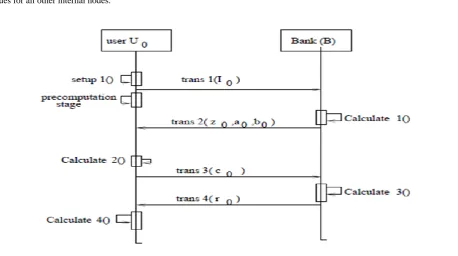
The withdrawal of e-cash by user U0 appears as in figure 3.
Setup1()
1. u0 be U0 's secret key.
2. I0 = g1u
0 be the identity of user U0 .
Precomputation stage
In our scheme divisibility is implemented using a binary tree structure. The root of the tree represents the full value of a coin, and all decendants node of the root denote various sub denominations of the coin. We will first choose random values for the leaves of the tree, and based on these, compute values for all other internal nodes.
1. The user wants to withdraw ω l = 2l
2. The user selects a random value e as a secret seed value.
3. For a leaf node: n 0 j1 j2 .... j v , ji ∈ {0,1}
τ0j1 j2 .... jv =H( e ||0 j1 j2 .... jv )
From a node's τ -value, we define its 2 ' γ ' values of leaf node
τ 0 j1 j2 .... j v = γ 0 j1 j2 .... jv,1 ||γ 0 j 1 j 2 .... j v ,2 γ -values and τ values for internal nodes
τ 0 j1 j2 .... jv 0 = γ 0 j1 j2 .... jv 0,1 ||γ 0 j1 j2 .... jv 0,2 τ 0 j1 j2 .... jv 1 = γ 0 j1 j2 .... jv 1,1 || γ 0 j1 j2 .... jv 1,2
Then its τ value is defined as
τ 0 j1 j2 .... jv =H( H( g1 γ 0 j1 j2 .... jv 0,1
g2 γ 0 j1 j2 .... jv 0,2 modp ) || H( g1 γ 0 j1 j2 .... jv 1,1 g2 γ 0 j1 j2 .... jv 1,2 ))modp ) )
From the above calculations, The τ value for root node, τ0 is obtained.
U0 obtains,
[image:3.595.66.525.356.612.2]T= g1 γ 0,1 g2 γ0,2 modp( note τ0 = γ0,1 || γ0,2 )
Figure 3: Withdrawal of divisible e-cash by user U0
Calculate 1()
1. B subtracts ω l = 2 l
dollars from U0 's account balance. 2. B forms m0 = I0 g2 modp
3. B chooses w0 ∈R Zq * 4. B calculates z0 = m0x modp a0 = g
w0 modp b0 = m0w0 modp
Calculate 2()
1. U0 generates s0 , t0 , v0 ∈R Zq * 2. m0'= g1
u0 s0 g2
s0 modp 3. z0 '= z0 s0 modp 4. a0 '= a0
t0
gv0 modp
5. b0 '= b0 s0 t0 ( m0' )v0 modp 6. c0 '=H( m0 ', z0 ', a0 ', b0 ',T ) 7. c0 = c0'/ t0 modq
Calculate 3()
Bank calculates, r 0 = c0 x+ w0 modq
Calculate 4()
Calculates r0 '= r0 t0 + v0 after verifying that m0 r0 = z c0 b0 modp
g r0 = hc0 a 0 modp
verifies the signature g r 0' ≡ h c0' a
0'( modp ) ( m0' ) r0' ≡ (z0 ') c0 ' b0'( modp ) c0 ' ≡ H( m0 ',T, z0 ', a0 ', b0 ' )
5.3
Bank's Setup Protocol
Every user who wants to receive transferred e-cash, pre-withdraws a zero-valued coin from the bank. This is an off-line coin which has user's -identity encoded in it. Single coin extension is needed for a single e-coin transfer.
So, for each transfer separate coin extensions are needed. In order to withdraw a coin extension the user and the bank perform the same signature generation protocol. However, the bank does not debit user's account. Since, the generating an extension is the same as generating a coin but with a different secret key of bank, the forging a coin extension is as hard as forging a coin.
5.3.1
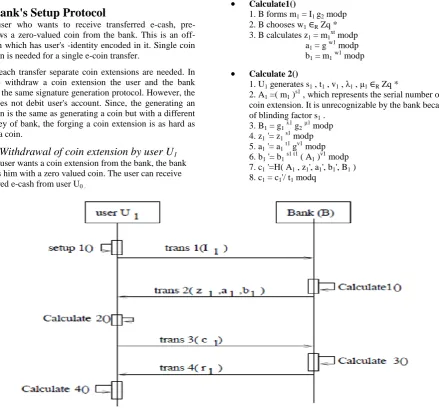
Withdrawal of coin extension by user U
1When a user wants a coin extension from the bank, the bank provides him with a zero valued coin. The user can receive transferred e-cash from user U0 .
Setup1()
1. u1 be U1 's secret key.
2. I1 = g1u1 be the identity of user U1 .
Calculate1()
1. B forms m1 = I1 g2 modp 2. B chooses w1 ∈R Zq * 3. B calculates z1 = m1xt modp a1 = g w1 modp b1 = m1w1 modp
Calculate 2()
1. U1 generates s1 , t1 , v1 , λ1 , μ1∈R Zq *
2. A1 =( m1 )s1 , which represents the serial number of the coin extension. It is unrecognizable by the bank because of blinding factor s1 .
[image:4.595.84.524.114.531.2]3. B1 = g1λ1 g2μ1 modp 4. z1 '= z1 s1 modp 5. a1 '= a1 t1 gv1 modp 6. b1 '= b1 s1 t1 ( A1 )v1 modp 7. c1 '=H( A1 , z1', a1', b1', B1 ) 8. c1 = c1'/ t1 modq
Figure 4: Withdrawal of coin extension by user U1
Calculate 3()
Bank calculates, r1 = c1 xt + w1 modq
Calculate 4()
Calculates r1 '= r1t1 + v1 after verifying that m1r1 = z1 c1 b1 modp
g r1 = ht c1 a1 modp
The user obtains the signature Sign(A1 , B1)={ z1 ', a1 ', b1 ', r1'} verifies the signature
g r 1' ≡ ht c1 '
a1 '( modp ) (A1) r 1' ≡ ( z1 ') c1 ' b1'( modp ) c 1 ' ≡ H( A1, B1 , z1', a1', b1')
5.3.2
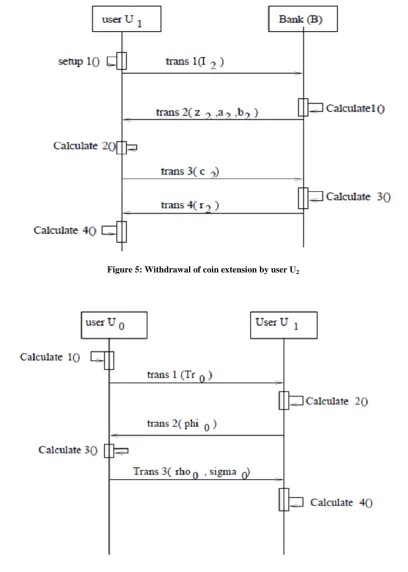
Withdrawal of coin extension by user U
2When a user wants a coin extension from the bank, the bank provides him with a zero valued coin. The user can receive transferred e-cash from user U0 .
The withdrawal of coin extension is shown in figure.5
The description is similar to the coin extension withdrawal protocol of user U1 . But, the obtained signature is Sign( A2, B2)={ z2 ', a2 ', b2 ', r2 '}
5.3.3
Withdrawal of coin extension by user U
nThe description is similar to the coin extension withdrawal protocol of user U 1 . But, the obtained signature is Sign( An , Bn )={ zn ', an ', bn ', rn '}
5.4
Coin transfer protocols of divisible
e-cash between users
cash verifies that the coin bear the bank's signature. During the second phase, the user who transfer the cash reveals information about a certain set of nodes in the coin's binary tree representation depending on the denomination being spent. The user U0 transfers his divisible e-cash to U1 . Then U1 transfer this e-cash to U2 as a single coin. This, cash can be transferred to U3 and to a number of user sequentially. At each time, the encrypted identity of the users are to be embedded in the payment transcript.
5.4.1
The coin transfer protocols of divisible
e-cash between user U
0to U
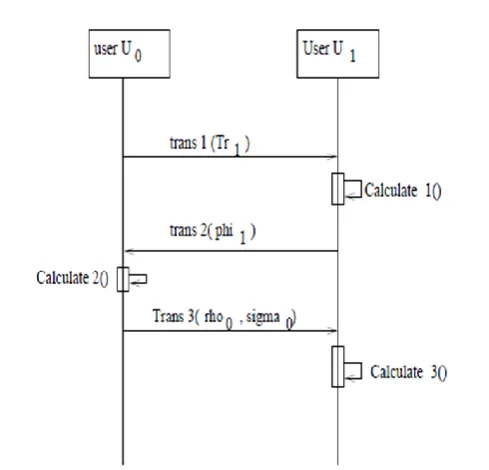
1 [image:5.595.94.503.184.757.2]Suppose, the user U0 wants to transfer his $f (which corresponds his divisible coin ωl 's n 0 j 1 j 2 .... j n node and whose serial number is m0 ') to user U1. When, the user U0 with the divisible e-cash wishes to spend his n0 j1 j2 ... jn node, he sends the unspent node's information and the encrypted values of the spended nodes ( In figure. 8, it is denoted as β ). Using these values user U1 can verify the denomination revelation of the coin.
Figure 5: Withdrawal of coin extension by user U2
Calculate1()
1. The User U0 reveals n 0 j 1 j 2 ....j k 's contribution of its ancestor nodes:
β 0 j1 j2 ,... jk = g1 γ 0 j 1 j 2 .... j k ,1
g2 γ 0 j 1 j 2 .... j k ,2 modp
2. Next, the User U0 reveals:
a k = g1 γ 0 j 1 j 2 ... jk,1 g2 γ 0 j 1 j 2 .... j k,2 modp a k-1 = g1
γ 0 j 1 j 2 .... j k-1,1 g2
γ 0 j 1 j 2 .... j k-1 ,2 modp .
. . a2 = g1
γ 0 j 1 j 2,1 g2
γ 0 j1 j2,2 modp a1 = g1 γ 0 j 1 ,1 g2 γ 0 j1,2 modp
User U0 forms the transcript Tr0 ={ m0 ',T, A0 ,Sign( m0 ',T ), ak , ak-1 ,... a2, a1, β 0 j1 j2 ,... j k }, and sends it to the user U1.
Calculate2()
User U1 calculates
τ 0 j1 j2 .... jk-1 =H( H( ak ) || H( β 0 j1 j2,... jk ) ) From the above value, the user U1 calculates, τ 0 j1 j2 .... jk-1 =( γ 0 j1 j2 .... jk-1,1 ||γ 0 j 1 j 2 .... jk-1 ,2 ) then, calculates,
β 0 j1 j2 ,... j k-1 = g1 γ
0 j1 j2 .... jk-1,1 || g2 γ
0 j1 j2 .... j k-1 ,2 modp τ 0 j1 j2 .... jk-2 =H( H( ak-1 ) ||H( β 0 j1 j2 ,... jk-1 ) )
. . .
τ0 =H( H( a1 ) ||H( β 0 j1 ) ) τ0 =( γ0,1 ||γ0,2 )
Then, the User U1 obtains, T= g1γ0,1 g2γ 0,2
Again, User U1 verifies, the signature c0 ' ≡ H( m0 ',T, z0 ', a0 ', b0 ' ) m0 ' r 0 ' ≡ ( z0 ' ) c0' b0 '( modp ) gr 0 ' ≡ h c0 ' a
0'( modp )
Then calculates, υ0 =H( m0 ',T, I1 ,Date/time ) Then, U1 sends this challenge υ0 (In the figure.8 , we denote it as phi0 ) to user U0 .
calculate3()
σ 0 = γ 0 j1 j2 ... jk ,1 + υ1 s0 modq (In the figure.8, we
denote it as sigma0 )
ρ 0 = γ 0 j1 j2 ... j k ,1 + υ1 u0 s0 modq (In the figure.8, we denote it as rho0 )
Calculate4()
U1 checks g1
ρ0 g2
σ0
= β 0 j1 j2,... jk ( m0 ' ) υ0 modp
5.4.2
Coin transfer from User U
1to User
U
2 If user U1 wants to transfer the same $f which we got from user U0 , the user U1 has to transfer the payment transcript T r1 ={ m 0 ',T, A0 ,Sign( m0 ',T ), a k , a k-1 ,... a2 , a 1 , β 0 j 1 j 2 ,... j k , ρ0 , σ 0 , υ 0 , A1, B1 ,Sign( A1 , B1 )} to the user U2 , in which the identity of user U1 and user U2 are encrypted in it. Calculate1()
User U2 calculates
τ 0 j1 j2 .... jk-1 =H( H( ak ) ||H( β 0 j1 j2 ,... jk ) ) Then, from the above value, U2 calculates τ 0 j1 j2 .... jk-1 =( γ 0 j1 j2 .... jk-1 ,1 ||γ 0 j1 j2 .... jk-1 ,2 ) Then, calculates,
β 0 j1 j2 ... jk-1 = g 1 γ 0 j1 j2 .... j k-1 ,1
g 2 γ 0 j1 j2 .... jk-1 ,2 modp τ 0 j1 j2 .... j k-2 =H( H( ak-1 ) ||H( β 0 j1 j2 ... jk-1 ) ) .
. .
τ0 =H( H( a1 ) ||H( β 0 j1 ) )
τ 0 =( γ 0,1 ||γ 0,2 ) Then, the User U2 obtains, T= g1 γ0,1 g2 γ 0,2
Again, User U2 verifies, the signature c0 ' ≡ H( m0 ',T, z0 ', a0 ', b0 ') m0 ' r0 ' ≡ ( z0 ') c0 ' b0'( modp ) g r0 ' ≡ h c0 ' a0'( modp )
Then calculates, υ1 =H( m0',T, A1 , B1 , I2 , Date/time ) Then, U2 sends this challenge υ1 (In the figure.7, we denote it as phi1) to user U 1
Calculate2()
The User U1 calculates the following
ρ1 = λ1 + υ1 ( u1s1 ) modq (In the figure.9, we denote it as rho1 )
σ1 = μ1 + υ1 s1 modq (In the figure.9, we denote it as sigma1 )
Calculate3()
U2 checks Sign( A1 , B1 ) g1ρ1 g2σ1 = A1υ1 B1
5.5
Deposit Protocol
Suppose the coin generated by user U 0 are transferred to U1 then U2 then to a number of users and at last Un receives this cash and decided to deposit this cash to bank. Then the user Un sends the transcript and the serial number to the bank . If the coin is not deposited previously i.e., it is not double spended then, it is deposited to the account of the user Un.
6.
BACKGROUND TECHNIQUES
In this section, we will discuss the security of our scheme. The incorrect spending of a coin results in the discovery of an user's identity, while same node rule and root route rule are satisfied in our scheme.
6.1
Detection of Double-Spending
[image:6.595.316.561.515.750.2]If the same coin is deposited twice, i.e., the same root of the divisible coin is double spended. Then, the bank has to detect the double spender. The Bank checks A,B, ρ , σ , υ value of the two deposited transcript of the coin . From the dissimilar values of ρ, σ, υ for the same A and B of the two same coins, the double spender is identified.
Figure 8: Detection of double spending (when U2 double spends)
6.1.1
If a user spends an e-cash once and
transfers it again to other users
If a user spends an e-cash to one user, transfers it again to another user, when these two transcripts will be deposited, double spender will be identified. As for example, if U 2 (figure. 10) double spends the same coin to U 3 and U κ . Then, the Bank got two different set of ρ , σ , υ for same A2 and B2 , which are for example, ρ 2 , σ 2 , υ 2 and ρ κ , σ κ , υ κ .Then, the identity of double spender is identified as follows.
g1 ( ρ2 - ρκ ) / ( σ2 - σκ ) = g1 u2 = I2 is the identity of user U2 .
6.1.2
If a user who generates divisible e-cash
incorrectly spends nodes
If user U0 firstly spends his n 0 j1 j 2 ... jl ..jk node first and then again, incorrectly spends his n 0 j1 j2 ... jl node which is situated on the same path of node n 0 j1 j2 ... jl .. jk . Thus, violates the root route rule. Again, from the deposit transcript, from the two different challenges (he obtained when he was transferring the cash to other users), the bank can calculate the identity of user U0. Again, in our binary tree approach, two totally unrelated nodes na and nb do not lie on the same route. The r values of either of them cannot be recovered from their β values, which are of the form g1r n,1g2 r n,2 modp, since that would entail solving for the representation problem, nor can either be computed from the opened τ values of other ancestor nodes since H is one-way. In our scheme, the other two requirements- Unforgeability and Untraceability are also satisfied, which are described below.
6.1.3
Unforgeabilty
Informally speaking, after obtaining ωl e-cash from the bank, the user must not be able to create more than ωl e-cash. It depends on the unforgeabilty of the restrictive blind signature [14] used in our e-cash scheme, which means that after obtaining l blind signatures of the bank, the user must not be able to create more than l signatures. This can prevent illegal users from forging e-cash.
6.1.4
Untraceability
For any polynomial-time non-uniform algorithm Adv (e.g. dishonest bank), after Adv's execution as a bank and shops of the withdrawal and payment protocols with user U0 and U1 , and given a protocol execution transcript by user Ur ( r ∈{0,1} ) , the probability that Adv output r correctly is less than 1/2+1/ mc for all constant c and for all sufficiently large m . This property depends on the Zero-Knowledgeness of the
protocols we used in the payment protocol: the proving the knowledge of a discrete logarithm scheme, the Proving the equality of discrete logarithms scheme and the blindness of the restrictive blind signature.
7.
WIRELESS CORBA
In Wireless CORBA, objects located on a mobile terminal can be accessed when the terminal is switched to different networks and client side becomes unaware of the use of the Wireless CORBA technique [21-27].
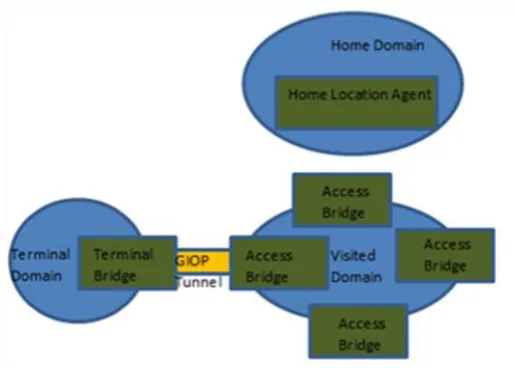
Figure 9: Architecture of Wireless CORBA.
[image:7.595.317.575.384.568.2]7.1
Start the Application
The software has been tested as a distributed system. It has been distributes over two machines, one for the software meant for the mobile device and one for the software running on the fixed network. At first we have to start the Naming Service on both systems in order to allow the wireless components of both systems register themselves at the local Naming Service. Then we have to start the Event Service in both systems to allow the application to send events that will be received by any number of objects. The Home location agent and the Access Bridge should be started on the machine representing fixed network and the Terminal Bridge should be started on the machine representing mobile device. The application can be started when all these Wireless components run.
The Flowchart of Server is given in Figure 10.
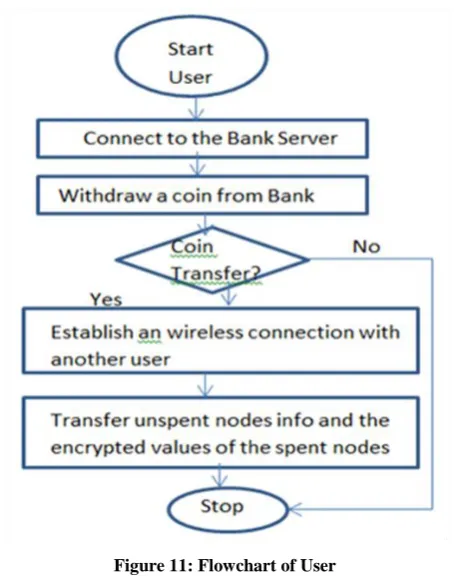
The Flowchart of User/Client is given in figure 11.
a)Server data:: MICO::Server::input_callback (GIOPConn*conn, CORBA::Buffer *inp)
conn: 0x97499f8 inp: 0x9745300
IIOP: incoming data from inet:127.0.0.1:53407
IIOPServer::add_invoke (id=6) void
MICOPOA::POACurrent_impl::set( poa=0x9748bf0,
POAObjectReference=0x9749958, Servnt=0x9749fac)
z0 : 116[...]565
a0 : 174[...]712
b0 : 160[...]933
m0 : 116[...]565
w0: 651[...]527
void MICOPOA::POACurrent_impl::unset()
GIOP: sending Reply to inet:127.0.0.1:53407 for msgid 6 status is 0
Out Data 47 49 4f 50 01 02 01 01 22 06 00 00 06 00 00 00 GIOP...."...
MICO::Server::input_callback (GIOPConn *conn,
CORBA::Buffer *inp)
conn: 0x97499f8 inp: 0x9744cc0
IIOP: incoming data from inet:127.0.0.1:53407
GIOP: incoming Request from inet:127.0.0.1:53407
with msgid 7 IIOPServer::add_invoke (id=7)
void MICOPOA::POACurrent_impl::set
( poa=0x9748bf0, POAObjectReference=0x974ab48, Servant=0x9749fac )
c0 : 16 r: 651[...]543 end calc3
void MICOPOA::POACurrent_impl::unset()
GIOP: sending Reply to inet:127.0.0.1:53407 for msgid 7 status is 0
Out Data 47 49 4f 50 01 02 01 01 42 01 00 00 07 00 00 00 GIOP....B...
b)User data:: If u want to connect with bank for withdrawal of coin then press 1.
1
IIOP: server listening on inet:0.0.0.0:48767 IIOP version 1.2 binding to inet:127.0.1.1:48767
SL3TS: IIOPProxy::make_conn:
inet:anamika-Compaq-Presario-CQ40-Notebook-PC:9876 IIOP: making new GIOP 1.0 connection to inet: anamika-Compaq-Presario-CQ40-Notebook-PC:9876
GIOPCodec::GIOPCodec(): 0x966cbd8
GIOP: Codeset negotiation with inet:127.0.1.1:9876 using GIOP version 1.0 GIOP: sending Request to
inet:127.0.1.1:9876 msgid is 2
IIOPProxy::add_invoke: rec=0x966c7b0, id=0x9668f10, msgid=2)
Out Data 47 49 4f 50 01 00 01 00 58 00 00 00 00 00 00 00 GIOP....X...
IIOP: incoming data from inet:127.0.1.1:9876
GIOP: incoming Reply from inet:127.0.1.1:9876 for msgid 2 status is 0
IIOPProxy::pull_invoke: id=0x9668f10, rec = 0x966c7b0 IIOPProxy::handle_invoke_reply: rec=0x966c7b0) IIOPProxy::del_invoke: rec = 0x966c7b0
MICO::IIOPProxy::exec_invoke_reply (obj=0, *req=0x9668c28, *conn=0x966bce8)
If u want to connect with bank for coin extension then press 1.
1
Looking up Bank 1234...
GIOP: sending Request to inet:127.0.1.1:9876 msgid is 3 IIOPProxy::add_invoke: rec=0x966c7b0, id=0x966cc78, msgid=3)
Out Data 47 49 4f 50 01 00 01 00 41 00 00 00 00 00 00 00 GIOP....A...
IIOP: incoming data from inet:127.0.1.1:9876
GIOP: incoming Reply from inet:127.0.1.1:9876 for msgid
3 status is 0
IIOPProxy::pull_invoke: id=0x966cc78, rec = 0x966c7b0
IIOPProxy::handle_invoke_reply: rec=0x966c7b0)
IIOPProxy::del_invoke: rec = 0x966c7b0
MICO::IIOPProxy::exec_invoke_reply (obj=0,
*req=0xbf90d960,
*conn=0x966bce8) done. before0x966cd38
SL3TS: IIOPProxy::make_conn: inet:127.0.1.1:46849
IIOP: making new GIOP 1.2 connection to
inet:127.0.1.1:46849
GIOPCodec::GIOPCodec(): 0x966d840
GIOP: Codeset negotiation with inet:127.0.1.1:46849 using GIOP version 1.2
normal: ISO 8859-1:1987; Latin Alphabet No. 1
wide: ISO/IEC 10646-1:1993; UTF-16, UCS Transformation Format 16-bit form
GIOP: TCS-C is ISO 8859-1:1987; Latin Alphabet No. 1 GIOP: TCS-W is ISO/IEC 10646-1:1993;
UTF-16, UCS Transformation Format 16-bit form
GIOP: sending Request to inet:127.0.1.1:46849 msgid is 4 IIOPProxy::add_invoke: rec=0x966e2a8, id=0x96695d0, msgid=4)
Out Data 47 49 4f 50 01 02 01 00 4c 00 00 00 04 00 00 00 GIOP....L...
IIOP: incoming data from inet:127.0.1.1:46849
GIOP: incoming Reply from inet:127.0.1.1:46849 for msgid 5 status is 0
IIOPProxy::pull_invoke: id=0x96695d0, rec = 0x966e2a8
IIOPProxy::handle_invoke_reply: rec=0x966e2a8)
IIOPProxy::del_invoke: rec = 0x966e2a8
MICO::IIOPProxy::exec_invoke_reply (obj=0,
*req=0xbf819244, *conn=0x966e0c0)
p :204[...]799
q :113[...]123
g :139[...]852
g1 :249[...]966
g2 :667[...]491
h :139[...]852
ht :194[...]904
p :204[...]799
q :113[...]123
g :139[...]852
g1 :249[...]966
g2 :667[...]491
Staring setup 2 Please enter the secret key of user0:
1
I0 : 249[...]966Enter the amount to withdraw:
100
Enter the height of the tree: 6
T :936[...]543
Staring calculation 1
GIOP: sending Request to inet:127.0.1.1:46849 msgid is 6 IIOPProxy::add_invoke: rec=0x9670ce8, id=0x96b0c60, msgid=6)
Out Data 47 49 4f 50 01 02 01 00 7f 01 00 00 06 00 00 00 GIOP...
IIOP: incoming data from inet:127.0.1.1:46849
GIOP: incoming Reply from inet:127.0.1.1:46849 for msgid 6 status is 0
IIOPProxy::pull_invoke: id=0x96b0c60, rec = 0x9670ce8 IIOPProxy::handle_invoke_reply: rec=0x9670ce8)
IIOPProxy::del_invoke: rec = 0x9670ce8
MICO::IIOPProxy::exec_invoke_reply (obj=0,
*req=0xbf819244, *conn=0x966e0c0)
I0 :249[...]966
z0 :116[...]565
a0 :145[...]548
b0 :187[...]382
m0 :116[...]565
w0 :288[...]001
7.2
Security of Wireless E-cash
There are different types of security measures for wireless communication . Such as:
1. Hide SSID: A simple but ineffective method to attempt to secure a wireless network is to hide the SSID (Service Set Identifier). This provides very little protection against anything but the most casual intrusion efforts.
2. MAC ID filtering: One of the simplest techniques is to only allow access from known, pre-approved MAC addresses. Most wireless access points contain some type of MAC ID Filtering. However, an attacker can simply sniff the MAC address of an authorized client and spoof this addresses.
3. Static IP addressing: Typical wireless access point provide IP addresses to clients via DHCP. Requiring clients to set their own addresses makes it more difficult for a casual or unsophisticated intruder to log onto the network, but provides little protection against a sophisticated attacker.
[image:9.595.318.564.509.748.2]In our system when data is transferred using the GIOP tunneling protocol it is encrypted first then it is transmitted through wireless network. Only keys and calculation parameters are exchanges via open network. No coins are transmitted out or even allowed to get in from the outer world.
Figure 11: Flowchart of User
8.
CONCLUSIONS
This paper introduces a divisible transferable e-cash scheme which can be practically implementable. A prototype of the divisible e-cash protocol is implemented and tested in small scale with CORBA so that it can be easily transferred to mobile devices. The complexity of the system is O(n2) . The design of the divisible e-cash is basically done for mobile devices which has more computational capabilities and able to form a small scale network with bluetooth technology. The proposed e-cash protocol successfully handles both on-line and off-line transaction. The security of all transactions are defended which indicates the use of the e-cash protocol is ready for mass scale. Moreover, the proposed scheme can attach expiration date to coins so that the banking system can manage its databases more efficiently. We presented an off-line e-cash which detect double spenders. However, other crimes are possible, in which coins are not double-spent, such as money laundering and blackmailing. In order for an electronic payment system to be acceptable for users, banks and government, some kind of anonymity control has to be provided. In these kind of systems, it is possible to trace the coins from a specific withdrawal. This will only be possible in cooperation with a trusted third party which has additional information that can be used to link coins and users.
9.
ACKNOWLEDGMENTS
Our thanks to the experts who have contributed towards development of the template.
10.
REFERENCES
[1] D. Chaum, “Blind signatures for untraceable payments,” In Advances in Cryptology: Proceedings of Crypto, vol. volume 82, pp. 199 – 203,1983.
[2] S. Brands, “Untraceable off-line cash in wallets with observers,” Lecture Notes in Computer Science, pp. 302 – 318, 1994.
[3] R. Song and L. Korba. „How to make e-cash with non-repudiation and anonymity,” in conference on
information + technology: Coding and Computing (ITCC‟04), vol. Conference on information Technology:Coding and Computing (ITCC‟04), 2004.
[4] T. Okamoto and K. Ohta, eds., Universal electronic cash, vol. In Advances in Cryptology ¸ Z91, 1998.
[5] T.Okamoto, “An efficient divisible electronic cash scheme,” in Advances in Cryptology,pp.438-451, 1995.
[6] S. J. M. B. G. Kim and K. J. Kim, “Fair tracing based on vss and blind signature without trustees,” in International research center of Information Security (IRIS) Computer Security Symposium, 2003.
[7] S. H. J. Camenisch and A. Lysyanskaya, eds., Compact e-cash, vol. InAdvances in Cryptology Proceedings of Eurocrypt ‟05 of pp. 302-321,(Springer-Verlag), 2005.
[8] X. S. Hou and C. W. Tan, “A new electronic cash model,” in Conferenceon Information Tech-nology: Coding and Computing (ITCC04), vol. Vol.1, 2004.
[9] J. K. J. Y. Y. Chen and C. L. Chen, eds., A novel proxy deposit protocol for e-cash systems, vol. Vol.163 of pp. 869-877, 2005. Proceedings of ELSEVIER Applied mathematics and Computation.
[10] Y. F. A. Chan and Y. Tsiounis, eds., East come-easy go divisible cash, vol. In Advances in Cryp-tology Proceedings of Eurocrypt ‟98 of pp.561 - 575, (Springer-Verlag), 1998.
[11] I. Jahan and M. Z. Rahman, “An internet based anonymous electronic cash system,” (Dhaka , Bangladesh), ICECE, 3rd International Conference on Electrical & Computer Engineering, 28-30 December 2004.
[12] I. Jahan and M. Z. Rahman, “A realistic divisible transferable electronic cash for general use”, Journal of Discrete Mathematical Science and Cryptography, vol. 10 (2007), No. 1, pp. 125-150, 2007.
[13] Okamoto and K.Ohta, Disposible zero-knowldge authentication and their applications to untraceable electronic cash, Proceedings of the Crypto, pp. 324337, 1992.
[14] C.P. Schnorr, Efficiient signature generation by smart cards, Journal of Cryptology, vol. 4, no. 3, pp. 161-174, 1991.
[15] J.X. Zhang, Z.J. Li, H. Guo. Anonymous Transferable Conditional E-Cash. SECURECOMM 2012, Padus, Italy, 3-5 September.
[16] M.Izabachene, B. Libert. Divisible e-cash in the standard model. Pairing 2012, LNCS 7708, Cologne, Germany, 16-18 May 2012, pp. 314-332.
[17] M.Abe, J. Groth, K. Haralambiev, M. Ohkubo. Optimal structure-preserving signatures in asymmetric bilinear groups. CRYPTO 2011, LNCS 6841, California, USA, 14-18 August, pp.649-666.
[19] Cong Wang, Hongxiang Sun, Hua Zhang, Zhengping Jin, “ An Improved Off-Line Electronic Cash Scheme”, Computational and Information Sciences (ICCIS), 2013 Fifth International Conference, pp. 438-441, June 2013.
[20] I. Jahan and M. Z. Rahman, “A realistic divisible transferable electronic cash for general use”, Journal of Discrete Mathematical Science and Cryptography, vol. 10 (2007), No. 1, pp. 125-150, 2007.
[21] C. J. e. a. Black, K, “Wireless access and terminal
mobility in corba,” 2001
[22] “Miwco - wireless corba extendsions for mico,” 2002.
[23] C. J. e. a. Black, K, “Wireless access and terminal mobility in corba,” 2001.
[24] J. A. Tuijn, “Assessment of wireless corba in mobihealth context,” bachelor assignment, University of Twente., Faculty of Electrical Engineering, Mathematics and Computer Science, Department of Computer Science, Application Protocol Systems., July 2004.
[25] OMG, “Telecom wireless corba specification,” 2001.
[26] “Implementing the wireless corba specification,” 2002.