MCMC for integer valued ARMA processes
Peter Neal
∗and T. Subba Rao
University of Manchester
June 7, 2006
Address:
Mathematics Department,
University of Manchester,
Sackville Street,
PO Box 88,
Manchester,
M60 1QD,
UK
E-mail: [email protected]
Abstract
The Classical statistical inference for integer valued time-series has primarily been restricted to
the integer valued autoregressive (INAR) process. Markov chain Monte Carlo (MCMC) methods have
been shown to be a useful tool in many branches of statistics and is particularly well suited to integer
valued time-series where statistical inference is greatly assisted by data augmentation. Thus in the
current work, we outline an efficient MCMC algorithm for a wide class of integer valued
autoregres-sive moving-average (INARMA) processes. Furthermore, we consider noise corrupted integer valued
processes and also models with change points. Finally, in order to assess the MCMC algorithms
inferential and predictive capabilities we use a range of simulated and real data sets.
Keywords: Integer valued time-series, MCMC, count data.
1
Introduction
Integer valued time-series occur in many different situations, and often in the form of count data.
Con-ventional time-series models such as the standard univariate autoregressive moving-average (ARMA)
process with Gaussian errors, assume that the data take values in R. Therefore these standard models
are wholely inappropriate for integer valued time-series, especially for low frequency count data where
continuous approximations of the discrete process are particularly unsuitable (see, for example,
Free-land and McCabe (2004) and McCabe and Martin (2005).) Hence there has been considerable interest
in developing and understanding time-series models which are suitable for integer valued processes, see
McKenzie (2003), for an excellent review of the subject. This has led to the construction of integer
valued ARMA (INARMA) processes, and alternatives such as discrete ARMA (DARMA) processes (see,
McKenzie (2003) for a description of the model). Throughout this paper we shall focus on INARMA
processes, with a full description being given in Section 2.
Whilst INARMA processes have received a certain amount of attention over the last twenty-five years,
they are considerably less well understood and analysed than the standard ARMA processes. In
par-ticular, inference for the model parameters governing the INARMA process has received very limited
attention. Attention has almost exclusively been restricted to INAR(1) processes, both for classical
frequentist inference (see, for example, Franke and Seligmann (1993)) and Bayesian inference (see, for
example, Freeland and McCabe (2004) and McCabe and Martin (2005)). Although recently Jung and
Tremayne (2006) have considered an INAR(2) process. This is due to the complicated form of the
such problems is given in Daviset al. (2000), where a Poisson regression model is used with a standard
ARMA(p,q) time-series forming part of the underlying latent process. Our approach differs radically
from Daviset al. (2000), in that, we define the process directly in terms of a time-series model, namely
the INARMA(p, q) model. To this end MCMC (Markov chain Monte Carlo) greatly assists since MCMC
easily incorporates data augmentation which facilitates inference for such models (see, Gilkset al.(1996),
for a good introduction to the MCMC methodology). Thus we are able to tackle, relatively easily a wide
range of time-series models which is a considerable improvement on classical approaches taken in Franke
and Seligmann (1993), Freeland and McCabe (2004), McCabe and Martin (2005) and Jung and Tremayne
(2006). Note that MCMC has previously been used to tackle a number of time-series problems, see for
example, Troughton and Godsill (1997) and Daniels and Cressie (2001).
In analysis of time series data, we are interested, typically, either in the underlying model parameters or
the predictive capabilities of the model, or both. Therefore the aim of the current work is to establish
a mechanism for conducting inference for both the model parameters and the predictive conditional
distribution for a wide range of INARMA processes and their extensions, via MCMC. MCMC is primarily,
but not exclusively, used for inference in a Bayesian framework, and in this paper we shall take a Bayesian
approach.
In Section 2, the INARMA process is introduced and some extensions of the model are discussed. In
Section 3, the likelihood function for the INARMA process is derived, and this is analysed using an
MCMC algorithm which we give full details of. This leads to analysis of the data in Section 4. Firstly
simulated data and then real life data are used to assess both the capabilities of the MCMC algorithm
and of the model. The first real life data set is Westgren’s gold particle data set (Westgren (1916)) which
has recently been analysed in Jung and Tremayne (2006). The second real life data set concerns the
daily scores achieved by a schizophrenic patient on a test of perceptual speed, McCleary and Hay (1980).
The patient begins receiving a drug during the course of the study and therefore a change point model
is used to assess the affect of the drug on the patient’s test scores. Finally, in Section 5 we make some
2
Models
2.1
Integer-valued ARMA processes
An integer valued time-series {Xt;−∞< t <∞} is called an INARMA(p, q) process, if it is an integer
valued autoregressive moving-average process with orders p and q, respectively. The INARMA(p, q)
process is given by the following difference equation:
Xt=
p
X
i=1
αi◦Xt−i+ q
X
j=1
βj◦Zt−j+Zt, t∈Z, (2.1)
for some generalised, Steutel and van Harn, operatorsαi(1≤i≤p) andβj (1≤j≤q) (see, Steutel and
van Harn (1979) and Latour (1997)) andZt(−∞< t <∞) are independent and identically distributed
according to an arbitrary, but specified, non-negative integer valued random variable Z with E[Z2] <
∞. Furthermore the operators are all assumed to be independent. Whilst INAR(p) (integer-valued
autoregressive) processes are defined and analysed in Latour (1997) for generalised Steutel and van Harn
operators, we shall, for clarity of presentation of the results, restrict attention to binomial operators. The
binomial operator,γ◦, for a non-negative integer-valued random variable,W say, is defined as
γ◦W =
Bin(W, γ) W >0,
0 W = 0.
That is, the operator γ denotes the ‘success’ probability for the binomial distribution. Clearly for a
binomial operator γ, 0 ≤ γ ≤ 1. The binomial operator is chosen because it is the natural choice of
generalised Steutel and van Harn operator in many different situations. (Furthermore, the binomial
operator is the operator considered in Steutel and van Harn (1979).) However, most of the results and
procedures presented here readily extend to more general, generalised Steutel and van Harn operators
with the minimum of fuss.
To ensure that the above INARMA(p, q) process is (second-order) stationary, we require that α =
(α1, α2, . . . , αp) are such that the roots of thep-order polynomial
xp−α1xp
−1−
. . .−αp−1x−αp= 0
are inside the unit circle (see, Latour (1997)). We shall, however, use the stronger, but easier to check
cri-terion thatPp
i=1αi<1, to ensure that the process is stationary. Note the parallels with the requirements
for stationarity of a real-valued ARMA process. We shall also add a constraint forβ= (β1, β2, . . . , βq),
in that, we shall assumePq
time series to be invertible. It is an open question whether this condition is sufficient for the INARMA
process to be invertible.
One natural extension of the INARMA(p, q) process is the inclusion of a noise term, Dt say. Let
{Wt;−∞< t <∞} denote an INARMA(p, q) process with noise, then
Wt=Xt+Dt, t∈Z, (2.2)
where {Xt} is INARMA(p, q) process of the form (2.1) and Dt (−∞ < t < ∞) are independent and
identically distributed non-negative integer-valued random variables. Furthermore, we assume that the
two processes {Xt;−∞< t <∞} and{Dt;−∞< t <∞} are independent. Throughout this paper we
assumeZtandDtare Poisson distributed for succinctness, however, it is straightforward in principle to
consider alternative integer valued distributions.
2.2
Data
We naturally restrict attention to non-negative integer valued time series data, typically this will take the
form of count data. We shall assume that we observe part of the time series and that the data is complete
for the section of the time series observed. However, the methodology outlined in Section 3 can easily be
extended to incorporate missing data, by considering the missing data as extra parameters which are to
be imputed within the model. For the INARMA(p, q) process we assume that the data (observed
time-series) arex = (x1−r, x2−r, . . . , xn) wherer = max{p, q} for somen ≥1. For the INARMA(p, q) with
additive noise, the data comprisesw= (w1−r, w2−r, . . . , wn) for some n≥1. Without loss of generality,
we shall assume thatn > r.
3
Likelihood and MCMC algorithms
3.1
Likelihood of INARMA
(
p, q
)
process
For conciseness, throughout this section we shall assume thatZ ∼P o(λ). Also we assume that the orders
pandqof INARMA(p, q) are known withp, q >0. (The procedure simplifies considerably if eitherp= 0
orq= 0.) Thus, we have an observed time seriesx= (x1−r, x2−r, . . . , xn) wherer= max{p, q}. We are
then interested in inference for the parametersα,β andλwhich are assumed to be unknown. Inference
for them-step ahead predictive distribution,Xpred
In order to facilitate inference for the INARMA(p, q), it is necessary to augment the data as follows. For
t∈Z, we representαi◦Xt−i (1≤i≤p) andβj◦Zt−j (1≤j ≤q) by Yt,i andVt,j, respectively. Thus
fort∈Z, we have that
Zt=Xt−
p
X
i=1
Yt,i− q
X
j=1
Vt,j.
For t ∈ Z, let Yt = (Yt,1, Yt,2, . . . , Yt,p) with Y = (Y1,Y2, . . . ,Yn), let Vt = (Vt,1, Vt,2, . . . , Vt,q)
with V = (V1,V2, . . . ,Vn) and let Zt = (Z1, Z2, . . . , Zt). For t ≥ 1, let yt = (yt,1, yt,2, . . . , yt,p)
and vt = (vt,1, vt,2, . . . , vt,q) with y = (y1,y2, . . . ,yn) and v = (v1,v2, . . . ,vn). For q ≥ 1, let
zIN= (z1−q, z2−q, . . . , z0), thuszINrepresents the initial values ofZ, and fort≥1, letzt= (z1, z2, . . . , zt)
withz0corresponding to the empty set.
Note that given (zIN,zt−1,xt−1,α,β, λ) each of the components (Vt,Yt, Zt) are independent, where
xs= (x1−r, x2−r, . . . , xs) (s≥0). Thus fort≥1,
ft(vt,yt, zt|zIN,zt−1,xt−1,α,β, λ)
= ft(zt|zIN,zt−1,xt−1,α,β, λ)× q Y j=1
ft(vt,j|zIN,zt−1,xt−1,α,β, λ) × ( p Y i=1
ft(yt,i|zIN,zt−1,xt−1,α,β, λ)
)
= λ
zt zt!
e−λ
×
p
Y
i=1 ½µ
xt−i
yt,i

αyt,i
i (1−αi)xt−i
−yt,i
¾ × q Y j=1 ½µ
zt−j
vt,j

βvt,j
j (1−βj)zt−j
−vt,j
¾
. (3.1)
Since by Bayes’ Theorem
ft(vt,yt, zt|xt,zIN,zt−1,xt−1,α,β, λ)
= ft(xt|vt,yt, zt,zIN,zt−1,xt−1,α,β, λ)
ft(xt|zIN,zt−1,xt−1,α,β, λ)
ft(vt,yt, zt|zIN,zt−1,xt−1,α,β, λ), (3.2)
it follows from (3.1) and (3.2) that fort≥1,
ft(vt,yt, zt|x,zIN,zt−1,α,β, λ)
∝ λ
zt zt!
e−λ
×
p
Y
i=1 ½µ
xt−i
yt,i

αyt,i
i (1−αi)xt−i
−yt,i
¾ × q Y j=1 ½µ
zt−j
vt,j

βvt,j
j (1−βj)zt−j
−vt,j
¾
,
subject to the constraints zt+Ppi=1yt,i+Pqj=1vt,j = xt, vt,j ≤ zt−j (1 ≤ j ≤ q) and yt,i ≤ xt−i
(1≤i≤p). Otherwiseft(vt,yt, zt|x,zIN,zt−1,α,β, λ) = 0. Thus,
f(v,y,zn|x,zIN,α,β, λ) = n
Y
t=1
However, the parametersα,β,λandzIN are unknown. Thus in a Bayesian framework it is necessary to
assign priors to each of these parameters. The parametersα,βandλare assigned the following natural,
independent priors;
π(α)∝1; 0≤αi<1 (1≤i≤p),
p
X
i=1
αi<1;
π(β)∝1; 0≤βj<1 (1≤j≤q),
q
X
j=1
βj <1;
π(λ)∼Gam(Aλ, Bλ); for some Aλ, Bλ>0.
Therefore we have uninformative, uniform priors over the permissable parameter values for the parameters
α andβ and a conjugate Gamma prior forλ. For 1−r≤t≤0, we takeπ(zt|λ,x)∼P o(λ) subject to
the constraint thatzt ≤xt sincea prioriZt is Poisson distributed with meanλ, but also by definition
zt≤xt.
Thus, the full joint likelihood of (V,Y,Zn,ZIN,α,β, λ) given the datax, is given by,
f(v,y,zn,zIN,α,β, λ|x) =f(v,y,zn|zIN,α,β, λ,x)π(α)π(β)π(zIN|λ,x)π(λ).
Therefore it follows that
f(v,y,z,zIN,α,β, λ|x) ∝ n
Y
t=1 (
λzt zt!
e−λ
p
Y
i=1
½µx
t−i
yt,i

αyt,i
i (1−αi)xt−i
−yt,i
¾ × q Y j=1 ½µ
zt−j
vt,j

βvt,j
j (1−βj)zt−j
−vt,j
¾
λAλe−Bλλ
r
Y
i=1 ½
λz1−i z1−i!
e−λ
¾ (3.3)
subject to the aforementioned constraints. The following posterior distributions are then readily obtained
from (3.3):
π(αi|v,y,zn,zIN,αi−,β, λ,x)∼Beta
à 1 +
n
X
t=1
yt,i,1 + n
X
t=1
(xt−i−yt,i)
!
(1≤i≤p), (3.4)
whereαi−= (α1, . . . , αi−1, αi+1, . . . αp) and subject to the constraint thatPαk<1;
π(βj|v,y,zn,zIN,α,βj−, λ,x)∼Beta
à 1 +
n
X
t=1
vt,j,1 + n
X
t=1
(zt−j−vt,j)
!
(1≤j ≤q), (3.5)
whereβj−= (β1, . . . , βj−1, βj+1, . . . βq) and subject to the constraint that
P
βl<1; and
π(λ|v,y,zn,zIN,α,β,x)∼Gam
Ã
Aλ+
n
X
t=1−q
zt, Bλ+n+q
!
3.2
MCMC algorithm
We are now in a position to outline the MCMC algorithm.
1. Update α: One component at a time, either in a fixed or random order. We sampleαi using the
following Gibbs/rejection sampling procedure:
(i) Draw a proposed value forαi from the Beta distribution given in (3.4);
(ii) If αi is drawn such that Pαk <1, accept the proposed value of αi, and update the value of
αi. Otherwise repeat step (i).
2. Update β: One component at a time, either in a fixed or random order. We sampleβj using the
following Gibbs/rejection sampling procedure:
(i) Draw a proposed value forβj from the Beta distribution given in (3.5);
(ii) Ifβj is drawn such thatPβl<1, accept the proposed value ofβj, and update the value ofβj.
Otherwise repeat step (i).
3. Update λ: Sampleλfrom its conditional distribution given by (3.6).
4. Update (v,y,zn): One set of components (vt,yt, zt) at a time, either in a fixed or random order.
We use the following independence proposal Metropolis-Hastings procedure:
(i) For 1≤i≤p, drawy′
t,i from Bin(xt−i, αi);
(ii) For 1≤j ≤q, drawv′
t,j from Bin(zt−j, βj);
(iii) Ifxt<Pqj=1v
′
t,j+
Pp
i=1y
′
t,i, then repeat steps (i) and (ii);
(iv) Setz′
t=xt−
³
Pq
j=1v
′
t,j+
Pp
i=1y
′
t,i
´ ;
Thus the proposal distribution for (v′
t,y
′
t, z
′
t) is independent of (vt,yt, zt) and depends only upon
(x,zIN,zt−1,α,β). Therefore let qt(v
′
t,y
′
t, z
′
t|x,zIN,zt−1,α,β) denote the conditional proposal
probability for (v′
t,y
′
t, z
′
t) given (x,zIN,zt−1,α,β).
(v) Calculate the acceptance probability,A, for the move:
A= 1∧f(v
′
,y′
,z′
n|x,zIN,α,β, λ)
f(v,y,zn|x,zIN,α,β, λ)
×qt(vt,yt, zt|x,zIN,zt−1,α,β)
qt(v′t,y
′
t, z
′
t|x,zIN,zt−1,α,β)
(3.7)
Note that for s6=t, (v′
s,y
′
s, z
′
s) = (vs,ys, zs). Thus the proposal distribution has been chosen in
have that
A= 1∧zt!
z′
t!
λzt′−ztB
t,
where Bn= 1 and for 1≤t≤n−1,
Bt=
Qq∧(n−t)
j=1
nz′
t!(zt−vt+j,j)!
zt!(z′t−vt′+j,j)!(1−βj)
z′
t−zt
o
if z′
t≥vt+j,j (1≤j≤q∧(n−t)),
0 otherwise.
Therefore if the move is accepted, set (vt,yt, zt) equal to (v
′
t,y
′
t, z
′
t), otherwise leave (vt,yt, zt)
unchanged.
5. UpdatezIN: One component at a time, either in a fixed or random order. The procedure to update
zt (1−q≤t≤0) is as follows:
(i) Drawz′
tfrom P o(λ);
(ii) Ifz′
t> xt, repeat step (i);
Thus the proposal probability is
q(z′
t|λ,x) =
π(z′
t|λ)
Fλ(xt)
where Fλ(·) denotes the cumulative distribution function of a Poisson random variable with mean
λ.
(iii) Calculate the acceptance probability,A, for the move:
A = 1∧f(v,y,zn|x,z
′
IN,α,β, λ)π(z
′
t|λ)
f(v,y,zn|x,zIN,α,β, λ)π(zt|λ)
×q(zt|λ,x)
q(z′
t|λ,x)
=
1∧Qq
j=1−t
n
z′
t!(zt−vt+j,j)!
zt!(zt′−vt′+j,j)!(1−βj)
z′
t−zt
o
if z′
t≥vt+j,j (1−t≤j ≤q),
0 otherwise.
Thus we have outlined an MCMC algorithm to obtain samples from the posterior distributions of both
the model parameters (α,β, λ) and the augmented data (v,y,zn,zIN). Typically, we restrict attention
to the posterior distribution of the model parametersπ(α,β, λ|x) which is easily obtained from the above
algorithm.
In the analysis of time series data, we are often interested in the predictive capabilities of the model. In a
Bayesian context, we are interested in them-step ahead predictive distribution,Xpredm , that is,π(xpredm |x)
wherexpredm = (xn+1, xn+2, . . . , xn+m). Clearly,
π(xpredm |x) =
Z 1 0 Z 1 0 Z ∞ 0 X k X l
π(xpredm |α,β, λ,zIN=k,zn =l,x)
Thus to obtain samples fromXpredm , the MCMC algorithm can easily be extended as follows.
6. UpdateXpredm : One component at a time, sequentially fromxn+1through toxn+m. For 1≤k≤m,
draw zn+k ∼P o(λ),yn+k,i∼Bin(xn+k−i, αi) (1≤i≤p) andvn+k,j ∼Bin(zn+k−j, βj) (1≤j ≤
q). Then set,
xn+k =zn+k+ p
X
i=1
yn+k,i+ q
X
j=1
vn+k,j.
Thus we have sampled (zn+k, xn+k) from its conditional distribution,
π(zn+k, xn+k|α,β, λ,zn,zIN,x,xpredk−1).
Therefore from step 6 of the algorithm it is trivial to obtain a sample form the posterior, predictive
distribution,Xpredm ,π(xpredm |x).
3.3
INAR
(
p
)
+ Noise
We restrict attention to INAR(p) processes with Poisson noise,Dt∼P o(µ), for ease of exposition. The
major difference from the standard INAR(p) process is that the output x = (x1−p, x2−p, . . . , xn) from
the INAR process is unobserved, thus we augment the data by includingx. Note that givenx, we obtain
d= (d1−p, d2−p, . . . , dn) sincewt=xt+dt.
Suppose thatα,λ,µandxare known. Then, for t≥1,
ft(dt,yt, zt|w,x,α, λ, µ)∝
λzt zt!
e−λµ
dt dt!
e−µ
p
Y
i=1
µx
t−i
yt,i

αyt,i
i (1−αi)xt−i
−yt,i
.
subject to the constraints dt = wt−xt, Ppi=1yt,i+zt = xt and yt,i ≤ xt−i (1 ≤ i ≤ p). Otherwise
f(dt,yt, zt|w,x,α, λ, µ) = 0. Thus
f(d,y,zn|w,x,α, λ, µ) = n
Y
t=1
ft(dt,yt, zt|w,x,α, λ, µ),
Forα and λ we use the same prior as in Section 3.1. However, we now also require a prior for µ. For
conjugacy, we set π(µ)∼Gam(Aµ, Bµ) for someAµ, Bµ>0. Therefore the posterior distribution forµ
is:
π(µ|w,d,x,y,zn,α, λ)∼Gam
Ã
Aµ+
n
X
t=1−p
dt, Bµ+n+p
!
. (3.8)
The MCMC algorithm described in Section 3.2 can easily be adapted to include the noise term. The
q= 0). Thus all that is required is to outline the procedure for updating the parameters (x,d, µ). For
simplicity in exposition, letxn = (x1, x2, . . . , xn) (dn = (d1, d2, . . . , dn)) andxIN = (x1−p, x2−p, . . . , x0)
(dIN = (d1−p, d2−p, . . . , d0)), so that x = (xIN,xn) (d = (dIN,dn)). The following steps should be
appended to the MCMC algorithm in Section 3.2, most naturally after step 5.
1. Updating (xn,dn,zn): One set of components (xt, dt, zt) at a time, either in a fixed or random
order. We use the following independence proposal Metropolis-Hastings procedure:
(i) Drawd′
tfrom P o(µ) and setx
′
t=wt−d
′
t;
(ii) Ifx′
t<
Pp
i=1yt,i, then repeat step (i);
(iii) Setz′
t=x
′
t−
Pp
i=1yt,i;
Note that the proposal distribution for (x′
t, d
′
t, z
′
t) depends only on µ. Therefore we write
q(x′
t, d
′
t, z
′
t|µ) for the proposal probability.
(iv) Calculate the acceptance probability,A, for the move:
A= 1∧f(d
′
,y,z′
n|w,x
′
,α, λ, µ)
f(d,y,zn|w,x,α, λ, µ)
×q(dt, zt, xt|µ)
q(d′
t, z
′
t, x
′
t|µ)
(3.9)
Again the proposal has been chosen such that most of the terms on the right-hand side of (3.9)
cancel, leaving
A= 1∧zt!
z′
t!
λzt′−ztB
t
where Bn= 1 and for 1≤t≤n−1,
Bt=
Qp∧(n−t)
i=1
nx′
t!(xt−yt+i,i)!
xt!(x′t−yt+i,i)!(1−αi)
x′
t−xt
o
ifx′
t≥yt+i,i(1≤i≤p∧(n−t));
0 otherwise.
Therefore if the move is accepted, set (xt, dt, zt) equal to (x
′
t, d
′
t, z
′
t), otherwise leave (xt, dt, zt)
unchanged.
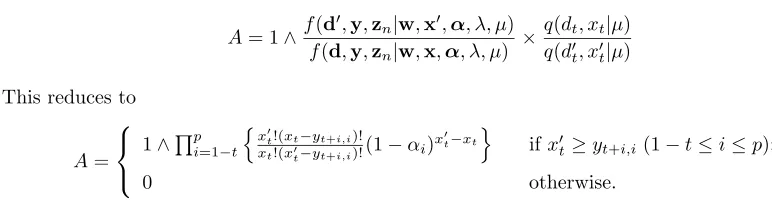
2. Updating (xIN,dIN): One set of components (xt, dt) at a time, either in a fixed or random order.
The procedure is similar to that used for (xn,dn,zn) and is as follows:
(i) Drawd′
tfrom P o(µ) and setx
′
t=wt−d′t;
(ii) Ifx′
t<0, then repeat step (i);
Letq(d′
t, x
′
(iii) Calculate the acceptance probability,A, for the move:
A= 1∧f(d
′
,y,zn|w,x
′
,α, λ, µ)
f(d,y,zn|w,x,α, λ, µ)
×q(dt, xt|µ)
q(d′
t, x
′
t|µ)
This reduces to
A=
1∧Qp
i=1−t
nx′
t!(xt−yt+i,i)!
xt!(x′t−yt+i,i)!(1−αi)
x′
t−xt
o
ifx′
t≥yt+i,i(1−t≤i≤p);
0 otherwise.
Therefore if the move is accepted, set (xt, dt) equal to (x′t, d
′
t), otherwise leave (xt, dt) unchanged.
3. Update µ: Sampleµfrom its conditional distribution given by (3.8).
Then obtaining samples from the posterior predictive distributions ofWpred
m = (Wn+1, Wn+2, . . . , Wn+m)
orXpred
m or both is straightforward, and involves adding the following step to the above MCMC algorithm.
4. Update (xpredm ,wmpred): One pair of components at a time, sequentially from (xn+1, wn+1) through
to (xn+m, wn+m). Then for 1≤k≤m, drawzn+k ∼P o(λ),yn+k,i ∼Bin(xn+k−i, αi) (1≤i≤p)
anddn+k∼P o(µ). Finally, set
(xn+k, wn+k) =
Ã
zn+k+ p
X
i=1
yn+k,i, zn+k+ p
X
i=1
yn+k,i+dn+k
!
.
4
Results
4.1
Simulation study
In order to assess the strengths and weaknesses of the MCMC algorithms outlined in Section 3, we
[image:12.595.96.482.127.228.2]conducted an extensive simulation study. A representative sample from the simulation study is given in
Table 1 along with the true model parameters.
Model n α β λ Noise
AR(3) 500 (0.2,0.3,0.15) − 2 −
M A(3) 500 − (0.2,0.3,0.15) 2 −
ARM A(2,2) 500 (0.4,0.2) (0.4,0.2) 2 −
[image:12.595.155.445.617.709.2]AR(3) + Noise 500 (0.2,0.3,0.15) − 2 P o(1)
For each data set, the MCMC algorithm was run to obtain a sample of size 1000000 following a burn-in
period of 10000 iterations. The burn-in period is essential to ensure that the estimates of the posterior
distribution are unaffected by the choice of starting values of the Markov chain. The priors were chosen
as outlined in Section 3, withπ(λ)∼Gam(1,1) andπ(µ)∼Gam(1,1).
MCMC methods generate dependent samples from the posterior distribution of interest. Therefore it
is essential that a large enough sample is obtained to offset the loss in information (when compared
with an independent and identically distributed sample from the posterior distribution) due to having
a dependent sample. Formal investigation of the performance of the MCMC algorithms, if so desired,
can be done using the integrated autocorrelation function or variance of batch means, see Geyer (1992)
for details. However, visual inspection of the time series plots of the MCMC sample is usually sufficient
to detect that the Markov chain is sampling from its stationary distribution (the posterior distribution).
Also the time series plots allow us to determine how well the Markov chain ismixing, with better mixing
corresponding to less dependence between successive observations of the posterior distribution, and hence,
reduced Monte Carlo error. In Figure 1, time series plots of the first 10000 observations for λfrom the
MCMC sample for each of the four data sets are plotted.
INAR(3)
Observation
lambda
0 2000 6000 10000
1.5
2.0
2.5
3.0
INARMA(2,2)
Observation
lambda
0 2000 6000 10000
1.0
1.5
2.0
2.5
INMA(3)
Observation
lambda
0 2000 6000 10000
1.6
2.0
2.4
INAR(3)+ Noise
Observation
lambda
0 2000 6000 10000
1.0
2.0
[image:13.595.155.432.431.644.2]3.0
Figure 1. Time series plots for the first 10000 observations ofλ, for theIN AR(3),IN M A(3),
IN ARM A(2,2) and IN AR(3) + N oisedata sets, respectively.
performance with respect to the other parameters. The algorithms are shown to perform well for the INAR
and INMA data sets and not so well for the INARMA and INAR + Noise data sets. The performance of
the MCMC algorithm is closely related to the information content contained within the data about the
various parameters. That is, the more informative the data are about the underlying model parameters,
the better the MCMC algorithms performs. Thus the MCMC algorithm performs very well for INAR(p)
processes since the data (x1−p, x2−p, . . . , xn) is very informative about the parameters driving the process.
However, the MCMC algorithm performs as well for the INMA(q) process (or even better in the above
example) since although the key underlying process (z1−q, z2−q, . . . , zn) is unobserved and needs to be
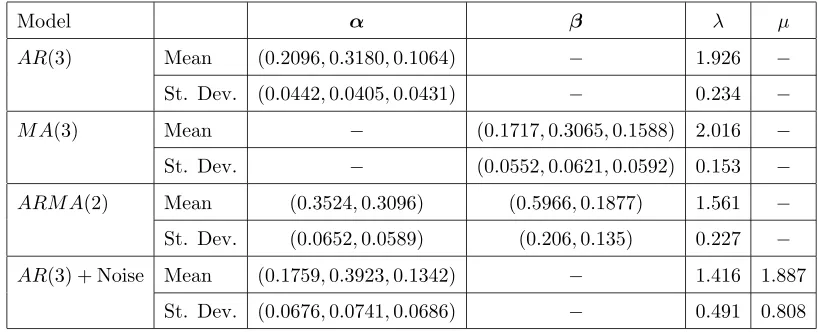
imputed, the data is very informative about (z1−q, z2−q, . . . , zn). This is most clearly seen in Table 2
below which lists the estimated mean and standard deviations of the posterior distributions based on the
samples obtained from the MCMC algorithms.
Model α β λ µ
AR(3) Mean (0.2096,0.3180,0.1064) − 1.926 −
St. Dev. (0.0442,0.0405,0.0431) − 0.234 −
M A(3) Mean − (0.1717,0.3065,0.1588) 2.016 −
St. Dev. − (0.0552,0.0621,0.0592) 0.153 −
ARM A(2) Mean (0.3524,0.3096) (0.5966,0.1877) 1.561 −
St. Dev. (0.0652,0.0589) (0.206,0.135) 0.227 −
AR(3) + Noise Mean (0.1759,0.3923,0.1342) − 1.416 1.887
[image:14.595.93.502.344.510.2]St. Dev. (0.0676,0.0741,0.0686) − 0.491 0.808
Table 2. Estimated mean and standard deviations of parameter posterior distributions.
For the INARMA(2,2) data set, the data are more informative about the AR parameters than the MA
parameters. This is generally the case observed for INARMA(p, q) data sets. This is clearly seen in
the estimated variances of the parameter posterior distributions and also by observing the mixing of the
Markov chain for the AR and MA parameters.
The presence of a noise parameter also affects the MCMC algorithm as one would expect. As in Section
3.3, we have restricted attention to INAR(p) processes with noise. Although the noise and signal processes
are independent, the joint posterior distributions for the parameters of the two processes are dependent.
Therefore the stronger the noise is, the harder it is to detect the parameters of the signal (underlying
4.2
Real life data
The main purpose for introducing the MCMC algorithms in Section 3 was to apply the methodology to
real life data. In this section, we apply the methodology of Section 3 to two real life examples Westgren’s
gold particle data set, see Westgren (1916) and Jung and Tremayne (2006) and a Schizophrenic patients
test scores, see McCleary and Hay (1980).
4.2.1 Westgren’s Gold Particle data set
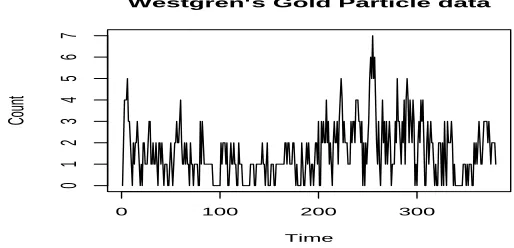
This data set consists of 380 counts of gold particles in a solution at equidistant points in time. The data
was originally published in Westgren (1916) but has recently been analysed in Jung and Tremayne (2006)
using method of moments estimation of an INAR(2) model. Jung and Tremayne (2006) claim that the
INAR(2) is an adequate model for this data basing their analysis on the first 370 observations with the
remaining 10 observations used for predictive purposes. Recent extensions of this paper incorporating
order determination into the MCMC algorithm suggest that the INAR(2) model is indeed the most
suitable INAR model for this data, see Enciso-Moraet al. (2006) for more details.
Westgren’s Gold Particle data
Time
Count
0 100 200 300
0
1
2
3
4
5
6
[image:15.595.157.414.431.555.2]7
Figure 2. Westgren’s gold particle data set.
Our aim here is to compare our approach with Jung and Tremayne (2006). In particular, we fit an
INAR(2) model to the first 370 observations and estimate the model parameters for the INAR(2) model.
We then obtain the (joint-)predictive distribution for the remaining 10 observations. In Jung and
Tremayne (2006) two INAR(2) models are considered; these are the INAR(2)-AA model (Alzaid and
Al-Osh (1990)) and INAR(2)-DL model (Du and Li (1991)). We have focussed upon the Du and Li
The MCMC algorithm was run in order to obtain samples of size 50000 from the posterior parameter
distribution with a burn-in period of 10000 iterations. These samples were then used to simulate 50000
realisations of the data points 371,372, . . . ,380. The estimated posterior means and standard deviations
for the model parameters are given in the table below. These results are comparable with the parameter
estimates and bootstrap standard errors obtained in Jung and Tremayne (2006).
Parameter α1 α2 λ
Mean 0.463 0.187 0.550
[image:16.595.214.383.209.266.2]St. dev. 0.0475 0.0540 0.0719
Table 3. Estimates of INAR(2) parameters for Westgren’s data set.
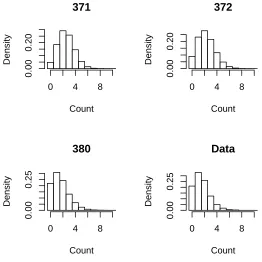
For the (joint-)predictive distribution of the last 10 data points, we obtained identical results to Jung
and Tremayne (2006) for the median predicted values. Below are histograms of the estimated posterior
densities of data points 371, 372 and 380 along with a histogram of the empirical distribution of Westgren’s
data. It is worth noting the close agreement between the predictive distribution for data point 380 and
the empirical distribution of the observed data.
371
Count
Density
0 4 8
0.00
0.20
380
Count
Density
0 4 8
0.00
0.25
372
Count
Density
0 4 8
0.00
0.20
Data
Count
Density
0 4 8
0.00
0.25
Figure 3. Histograms of predictive distributions of data points 371, 372 and 380 and the empirical
[image:16.595.157.419.417.679.2]4.2.2 Schizophrenic patient
The second example concerns the daily observations of the score achieved by a schizophrenic patient
on a test of perceptual speed, see, McCleary and Hay (1980). The data consists of 120 consecutive
daily scores. However, from the 61st day onwards the patient began receiving a powerful tranquilizer
(chloropromazine) that could be expected to reduce perceptual speed. The data are presented in Figure
4.
Schizophrenic patients’ Test scores
Day
Score
0 20 40 60 80 100 120
30
40
50
60
70
80
[image:17.595.160.422.252.383.2]90
Figure 4. A time-series plot of the daily test score achieved by schizophrenic patient.
The data clearly shows a reduction in the patients’ test score after day 61. Therefore we propose to
model the patients’ test score using an INAR(1) process with different parameters (α1, λ) for before and
after receiving chloropromazine. Thus the model we used is:
Xt=
αB
1 ◦Xt−1+Zt ift≤60
αA
1 ◦Xt−1+Zt ift≥61
whereZt(1≤t≤120) are independent and fort≤60,Zt∼P o(λB) and fort≥61,Zt∼P o(λA). Thus
B andAdenotebeforeandaftertreatment, respectively.
Adapting the likelihood and consequently the MCMC algorithm in Section 3 to incorporate a change
point where the parameter values change is trivial especially in this example where the change point is
known. However, the methodology could also be extended to situations where the position and number
of change points is unknown.
The MCMC algorithm was run in order to obtain samples of size 50000 from the posterior parameter
distribution with a burn-in period of 10000 iterations. The main aim in this example is to study the
affects of chloropromazine on the parameters (α1, λ), however, the posterior predictive distribution can
The samples fromαB1 and αA1 produced indistinguishable posterior density plots. Thus suggesting that
the parameterα1is unaffected by the introduction of treatment and that the data should be modelled with
αB
1 =αA1 =α1. Therefore the MCMC algorithm was run as before except that a common,α1parameter,
for both before and after treatment was used. Posterior density plots for the model parameters from the
two algorithms are given in Figure 5.
0.35 0.45 0.55 0.65
0
2
4
6
8
10
12
14
alpha_1
alpha_1
Density
0 10 30
0.00
0.05
0.10
0.15
0.20
0.25
0.30
lambda
lambda
[image:18.595.160.422.224.359.2]Density
Figure 5. Posterior density plots for the INAR(1) parameters for the test score, before treatment (solid
lines) and after treatment (dashed lines) in the case (αA
1 6=αB1) and the corresponding parameters
(dotted lines) in the case (αA
1 =αB1 =α1).
The two MCMC algorithms produce indistinguishable results in terms of posterior means forα1,λB and
λA. Since a common α
1 parameter can be assumed, the reduction in test scores is therefore accounted
for by a reduction in theλparameter. The posterior means ofλBandλAare 34.7 (34.8) and 19.2 (19.3),
respectively, when a commonα1 parameter is used (αB1 6=αA1).
Note that the posterior distribution forα1(α1=αA1 =αB1) is more compact than the individual posterior
distributions for αB
1 and αA1 (αA1 6=αB1). This is since inference for α1 is based on time-series data of
length 120 whereas inference forαB
1 andαA1 time-series data of length 60. This has a knock-on effect of
producing more compact (and peaked) posterior distributions forλB andλAin the case of a commonα
1
parameter.
5
Conclusions
This paper has introduced an efficient MCMC mechanism for conducting inference for INARMA(p, q)
be very tricky using conventional methods but are very straightforward using MCMC. The methodology
introduced here, as previously mentioned, can readily be extended to incorporate noise, change points
and more general, generalised Steutal and van Harn operators. Thus as a consequence this paper only
scratches the surface of the potential applications of MCMC to integer valued time-series.
Some very natural extensions of the current work present themselves. Firstly, developing inference for
INARMA(p, q) processes where the parameters p and q are unknown. This is the subject of ongoing
research where a reversible jump (RJ) MCMC algorithm has successfully been constructed, see
Enciso-Mora et al. (2006) for details. RJMCMC could also prove useful in extensions of Section 4.2.2 where
both the number and location of parameter change points are unknown. Throughout this paper we have
assumed that the time-series under consideration is stationary. However, this is not necessary for the
above methodology and we could easily adapt the MCMC algorithm to allow for, for example, seasonality
or a linear trend. Finally it would be interesting to study multivariate INARMA(p, q) processes. This
should be, in principle at least, a fairly straightforward extension of the MCMC algorithms in Section 3.
All these extensions should be fairly routine using MCMC algorithms but would prove extremely difficult
problems to tackle using more conventional methods.
Acknowledgements
We thank Robert Jung for providing us with Westgren’s gold particle data set. The schizophrenic patient
data set was obtained from the Time Series Data Library:
http://www-personal.buseco.monash.edu.au/∼hyndman/TSDL/
References
Daniels, M. J. andCressie, N. (2001) A hierarchical approach to Covariance function estimation for
Time Series. Journal of Time Series Analysis 22, 253–266.
Davis, R. A., Dunsmuir, W. T. M. and Wang, Y. (2000) On autocorrelation in a Poisson regression
model. Biometrika87, 491–505.
Du, J. andLi, Y. (1991) The integer-valued autoregressive (INAR(p)) model. Journal of Time Series
Enciso-Mora, V., Neal, P. and Subba Rao, T. (2006) Order determination and model selection for
INARMA(p, q) processes. In preparation.
Franke, J. andSeligmann, T. (1993) Conditional maximum likelihood estimates for INAR(1) processes
and their application to modelling epileptic seizure counts. Time Series Analysis. (ed. T. Subba Rao.)
Chapman and Hall. pp. 310–330.
Freeland, R. K. and McCabe, B. P. M. (2004) Forecasting discrete valued low count time series.
International Journal of Forecasting20, 427–434.
Geyer, C.J. (1992) Practical Markov chain Monte Carlo (with discussion). Statistical Science7, 473–511.
Gilks, W. R.,Richardson, S. andSpiegelhalter, D. J. (eds.) (1995)Markov chain Monte Carlo in
Practice. Chapman and Hall.
Jung, R. C. and Tremayne, A. R. (2006) Coherent forecasting in integer time series models. International
Journal of Forecasting22, 223–238.
Latour, A. (1997) The multivariate GINAR(p) process. Advances in Applied Probability29, 228–248.
McCabe, B. P. M. andMartin, G. M. (2005) Bayesian predictions of low count time series. International
Journal of Forecasting22, 315–330.
McCleary, R. and Hay, R. A. (1980) Applied Time Series Analysis for the Social Sciences. Sage
Publications.
McKenzie, E. (2003) Discrete variate time series. Stochastic Processes: Modelling and Simulation. (eds.
D. N. Shanbhag and C. R. Rao.) Elsevier. pp. 573–606.
Steutel, F. W. and van Harn, K. (1979) Discrete analogues of self-decomposability and stability.
Annals of Probability7, 893–899.
Troughton, P. T. and Godsill, S. J. (1997) Bayesian model selection for time series using Markov
chain Monte Carlo. InProc. IEEE International Conference on Acoustics, Speech and Signal Processing
1997, vol. V.3733–3736.
Westgren, A. (1916). Die Ver¨anderungsgeschwindigkeit der lokalen Teilchenkonzentration in kollioden