A Study on Age at Menopause, Menopausal Symptoms
and Problems among Urban Women from Western
Odisha, India
Monika Satpathy
Department of Home Science, Sambalpur University, Odisha, India.
Abstract- The present observational, cross sectional study was carried out in urban women (n=100) from Jharsuguda with the natural body process menopause to evaluate age at menopause and menopausal symptoms in women above the age of 40 belonging to the middle socioeconomic strata from Jharsuguda Western Odisha as well as to evaluate the correlation of age on these symptoms by interviewing regarding their menopausal complaints in the following 40-45(n=39), 45-50(n=36),50-55(n=17),>55(n=8) years age groups. Mean age of menopause was 44.82 and median 45 years. Menopausal symptoms were assessed by a 36-items checklist. The study reveal, varying nature of symptoms with age and vasomotor symptoms being more prevalent with lesser psychological complaints in this region. Such regional studies will help to corroborate data so that health care providers can plan strategies for the middle aged women suffering from these menopausal symptoms.
Index Terms- Age at Menopause, Menopausal Symptoms, Women Health
I. INTRODUCTION
enarche and menopause are the turning point in the life of a woman. “Menopause is a stage of life not a disease”. — Such as diet and physical activity, climate and women’s roles— as factors in women’s experiences with menopause.
Postmenopausal women have to face a lot of problems, both physically and psychologically. They have to cope with these changes and accept their new role in the society and family. Women need health teaching to learn the normal parameters of menopause so they may continue to monitor their own health during this time. The age at which natural menopausal period occurs in between the ages of 40 -55 for women worldwide. In 1990, 25 million women worldwide reached the menopause, this number is expected to double by late 2020.An average growth rate of 2-3.5% in the number of women aged over 50 is projected for the developing regions between 1990&2030. National health authorities should examine the implication of the projected rapid growth in the number of post menopausal women between 1990&2030&should anticipate the provision of relevant health services, education promotion activities to cope with the health needs of women in their post menopausal years. International menopause society, 2004, recent surveys have found that half of all women are not aware that menopause is associated with an increased risk of heart disease.
The average woman is postmenopausal for one third of her life, the incidence of certain conditions (e.g., coronary artery disease, diabetes, breast cancer, cervical cancer, and osteoporosis) increases after menopause. Menopause is an unavoidable change that every women will experience, assuming she reaches middle age and beyond. It is helpful if women are able to learn what to expect and what options are available to assist the transition. Menopause is important phase in a woman’s life which produces physical, psychological as well as social changes. As menopausal health demand priority in Indian scenario due to increase in life expectancy and growing population of menopausal women , large efforts are required to educate and make these women aware of menopause symptoms. This will help in early recognization of symptoms, reduction of discomfort and fear and enable to seek appropriate medical care if necessary. Menopause is the most misunderstood biological and psychological changes that happens to a woman," says Delhi-based Dr Sonia Malik, IMS President. Most of the women are not aware about the menopausal problems and it needs intervention. They assumed that discomforts are due to aging process which may not be correctable. Only by taking rest in between the work only is possible and those who know we are not interested in treating it by spending money. Some menopausal women found it difficult to use pills. So, it is important to bring awareness about menopausal symptoms and its management among menopausal women and get appropriate treatment which should be used by everyone in all the level of economical background.
II. MATERIALANDMETHODS
The present observation cross sectional study included women from Jharsuguda district, Western Odisha. Over a period of 6 months from Septermber 2014 to February 2015 coming from Brajarajnagar town an industrial area of Odisha . Total 100 women were enrolled and were distributed in the following age 40-45 (n=39), 45-50(n=36), 50-55(n=17), >55(n=8). The study was done by interview technique using tested and pre-designed questionnaires . Data were collected on socio-demographic information ,reproductive history and the physical and psychological symptoms experiences by the respondents. Below the age of 40 years or women who did not give the consent were not included in the study. The data was collected, complied and analysed using statistical packages.
III. RESULTS
The study population comprised of menopausal women with 39%,36%,17%,and 8% being enrolled in 40-45 years, 45-50 years, 50-55 years and >55 years age groups respectively. Mean age at menopause was 44.82 years and median was 45 years. Women are belonging from Hindu religion. Out of the total women enrolled in the study 97% were married and 3% were divorced/widowed or single where as 92% were literate and 8%
were illiterates. Out of the total study subjects enrolled in the present study 83% were housewife whereas 17% were working women. Above 50% of women having two children. On inquiry about dietary patterns 69% were non-vegetarian and 31% were vegetarian. The mean age at menarche was 13.82, mean age of marriage was 20.31 and menopause was 44.82 and median values were 14, 20, and 45 respectively.
Table1: Demographic Characteristics
Variables NO %
Age of woman
40-45 39 39
45 -50 36 36
50-55 17 17
>55 8 8
Educational status
Illiterate 08 08
Literate 92 92
Occupation
Working women 17 17
House wife 83 83
Dietary habit
Vegetarian 31 31
Non vegetarian 69 69
Marital status
Married 97 97
Divorce/ Widow/single 3 3
Table2: Menopausal Symptoms (Physical Problems)
Physical Problems F %
Hot flashes 77 77
Very less bleeding 46 46
Excessive bleeding 17 17
Joint pains 60 60
Sleep disturbance 42 42
Body pains 62 62
Cold hands 26 26
Numbness of fingers 28 28
Tingling of fingers 45 45
Difficulty in passing stool 10 10
Feeling of suffocation 32 32
Loose motions 06 06
Dryness of vagina 34 34
Headaches 43 43
Rapid heart beat 43 43
Cold feet 28 26
Increase in weight 69 69
Difficulty in sexual intercourse 17 17
Interest in sex 07 7
The data on prevalence of physical problems of menopause among the respondents of the study shows that more than 60% of women were suffering with common problems of menopause i.e. hot flashes (77%), joint pain (60%), body pain (62%), and increased weight (69%). More than 40% of women reported sleep disturbance, headache (43%), ting tiling of finger (45%), and rapid heartbeat (43%). More than (30%) of women reported dryness of vagina (34%), feelings of suffocation (32%), (46%) women were with less bleeding and (17%) were reported excessive bleeding. (26%) and (28%) respondents were suffer from cold hand and cold feet respectively. Very less women were suffer from difficulty in passing stool i.e. (10%), difficulty in sexual intercourse reported (17%) and very less respondents were shows interest in sex i.e. (7%).
Table3: Menopausal Symptoms (Psychological Problems)
Psychological Problems F %
Irritability 42 42
Forgetfulness 59 59
Loosing control over emotions 27 27
Poor concentration 17 17
Anxiety 42 42
Feeling that something is crawling on 24 24
skin
Worry about body image 75 75
Loosing of faminity (femaleness) 06 06
Confusion 46 46
Fear of loosing loved one’s 17 17
Disinterest to continue the present job 7 7
More interest to go on working 10 10
IV. DISCUSSION
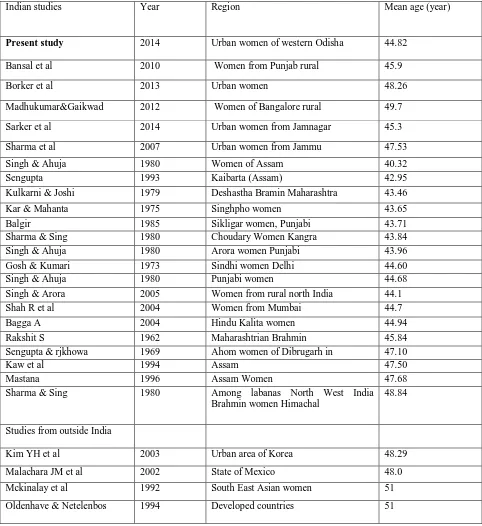
In India currently there is no health programs that caters the post reproductive health needs of women. Different programs are initiated for the reproductive age group and at the same time ignoring those who have passed their reproductive stage. The range of menopausal age in Indian women varies from 40.3 to 48.8 years and in developed countries range is from 48 to 51 years . The mean menopausal age in the present study is 44.8 years. This is almost similar to the study done by Singh and
[image:4.612.65.547.206.732.2]Ahuja (44.6yrs), Shah R et al (44.7 yrs) and Bagga A(44.9 yrs). Different factors like regional and community variation , genetic, environment and nutrition also play an important role in the diversity in attainment of menopause. Most of the respondents considered menopause to be harmful as it has negative impact on their physical and psychological health . Where as it was happily accepted by 20% of women as they getting freedom from menstruation. But the study is contrast with the study done by Kaur that a high proportion (94%) of rural women happily welcome menopause.
Table 4: Mean Age at Menopause
Indian studies Year Region Mean age (year)
Present study 2014 Urban women of western Odisha 44.82
Bansal et al 2010 Women from Punjab rural 45.9
Borker et al 2013 Urban women 48.26
Madhukumar&Gaikwad 2012 Women of Bangalore rural 49.7
Sarker et al 2014 Urban women from Jamnagar 45.3
Sharma et al 2007 Urban women from Jammu 47.53
Singh & Ahuja 1980 Women of Assam 40.32
Sengupta 1993 Kaibarta (Assam) 42.95
Kulkarni & Joshi 1979 Deshastha Bramin Maharashtra 43.46
Kar & Mahanta 1975 Singhpho women 43.65
Balgir 1985 Sikligar women, Punjabi 43.71
Sharma & Sing 1980 Choudary Women Kangra 43.84
Singh & Ahuja 1980 Arora women Punjabi 43.96
Gosh & Kumari 1973 Sindhi women Delhi 44.60
Singh & Ahuja 1980 Punjabi women 44.68
Singh & Arora 2005 Women from rural north India 44.1
Shah R et al 2004 Women from Mumbai 44.7
Bagga A 2004 Hindu Kalita women 44.94
Rakshit S 1962 Maharashtrian Brahmin 45.84
Sengupta & rjkhowa 1969 Ahom women of Dibrugarh in 47.10
Kaw et al 1994 Assam 47.50
Mastana 1996 Assam Women 47.68
Sharma & Sing 1980 Among labanas North West India
Brahmin women Himachal
48.84
Studies from outside India
Kim YH et al 2003 Urban area of Korea 48.29
Malachara JM et al 2002 State of Mexico 48.0
Mckinalay et al 1992 South East Asian women 51
The study also reveals varying nature of menopausal symptoms. The number of symptoms were more in transitional period that is in peri menopause followed by post menopause and pre menopause. Common menopausal symptoms of present study compared with other Indian and abroad studies in table-5 . These variation may be due to the reduction of hormone levels with individual differences.The study reveals varying nature of menopausal symptoms. Some of the vasomotor symptoms like hot flashes, vaginal dryness, rapid heartbeat, feeling suffocation
and numbness of fingers found highest in postmenopausal women. Excessive bleeding, headache, joint pain, sleep disturbance and weight gain were significantly higher in perimenopausal women. The psychological symptoms are prevalent with increasing age which was reported by American women and also in Indian women by Baga. Women were aware only about irregularity of menstruation as a symptom of menopause.
Table5: Most Frequent Menopausal Symptoms
Indian study Year Symptoms
Present study 2014 Hot flushes (77%),sleep problem(42%),Joint pain(60),
Cold hand/feet (27%),Vagina dryness(34%),Weight gain(69%),Headache(43%),Irritability(42%),
Forgetfulness (59%),Anxiety (42%).
Bansal et al 2010 Headache (94.1%), dizzy spells (81.5%), decreased libido (81.5%), sleep disturbance (68.9%) and loss of interest in most things. hot flushes (59.3%), lack of concentration (54.1%), mood changes (49.6%) and night sweats (35.6%).
Madhukumar&Gaikwad 2012 Aching in muscle and joints, feeling tired, poor memory, lower backache and difficulty in sleeping.
Borker et al 2013 Depression, irritability( 90.7%), headache (72.9%), lethargy 65.4%), dysuria (58.9%), forgetfulness (57%), musculoskeletal problems(53.3%), sexual problems (decreased libido, dyspareunia) (31.8%), genital problems (itching, vaginal dryness) (9.3%).
Sarker et al 2014 Joint pain (64%),backache (58%),irritability(56.66%),forgetfulness and sadness(48%) and vasomotor symptoms like hot flushes and night sweats(47.33%).
Sharma et al Jammu 2007 Fatigue & lack of energy (72.93%), Headache (55.9%), Hot flushes, Cold sweats, cold hand and feet 53.86 %, Weight gain (43.13%)
Bagga A,(Pune)
2004
Loss of interest (93%), Pressure/tightness in head(83%) Weight gain (67%), Hot flushes (54%)
Shah,et al (Mumbai)
2004
Muscle and joint pains(37.4%), Insomnia(20.6%),Headache(13.8%)
Singh& Arora(Punjab) 2005 Diminished acuity of vision and hot flushes Outside india
Schnatz et al (USA) 2005 Mood swings (77.9%), Decrease in energy (75.9%), Sleeping problems (73.4%), Memory problems (67.1%)
Kim et al (Korea) 2003 Fatigue, Hot flushes, benumbed hands and feet, Irritability
V. CONCLUSION
According to Hill (1995) the number of postmenopausal women in the world will rise from 467 million in 1990 to 1.2 billion by 2030. Most of the increase in number will occur in developing countries. Sulak (1996) also reports that in the next 20 years, more women will experience perimenopause and menopause than ever before since they comprise the baby boomer generation. Early life expectancy was shorter. Reaching menopause often meant that their life was nearing an end. But this is no longer true. Today women are living longer. Today’s women will live a third of her life after menopause. By educating her, and planning ahead for this time of challenges and opportunities, every woman can make this period as one of the most rewarding and enriching time of her life. The real importance of menopause today lies in the increasing longevity of the 21st century woman. By making wise decisions about menopause and healthy lifestyle, we can make the most of the 20, 30, or more years we have ahead.
ACKNOWLEDGEMENT
It gives me immense pleasure to express my deep sense of gratitude and respect to my guide Dr. (Mrs.) Braja Kishori Mishra, professor in Department of Home Science, Sambalpur University for her kind help and valuable guidance and inspiration, for the preparation of this research paper.
REFERENCES
[1] Bagga A. Age and symptomatology of menopause, A case study. Obstet and Gynecol Today 2004;10:660-6.
[2] Bairy L, Adiga S, Bhat P, Bhat R., Prevalence of menopausal symptoms and quality of life after menopause in women from South India, Aust N Z J Obstet Gynaecol,2009; 49(1):106-110.
[3] Balgir RS. Age at menarche and menopause among sikligars of Punjab. J Indian Medical Asso 1985;83:195-97.
[4] Bansal Priya, Chaudhary Anurag, Soni R.K ,Kaushal Pushapindr, Menopausal problems among rural middle aged women of Punjab,International Journal of Research in Health Sciences, Oct–Dec 2013;1(3): 103
[5] S Puri, V Bhatia, C Mangat. Perceptions Of Menopause And Postmenopausal Bleeding In Women Of Chandigarh, India, The Internet Journal of Family Practice, 2007; 6 (2).
[6] Rashmi Shah,Assessment of Prevalence of Osteoporosis in Adult Population in India (ICMR multicentre study) 2000-2006.
[7] Sagdeo M.M and Arora Dimple, Menopausal symptoms: A comparative Study in Rural and Urban Women, J.K Science, 2011; 13(1).
[8] Sarkar Amrita,Pithadia Pradeep, Goswami Kakoli, Bhavsar Sudip, Makwana Naresh, Yadav sudha, Parmar Dipesh. A study on Health Profile of Post-menopausal Women in Jamnagar district, Gujurat, Journal of Research in Medical and Dental Science , 2014; .2(2) .
[9] Sayed G.H., EL-Nashar I. H., Nasr A.O., EL-Gebaly, Shaaban M. M., The menopausal transition-An Egyptian Perspective, Jr Egyptian Society of Obstetrics and Gynecology, 2000; 25 (7-9).
[10] Sengupta S,Gogoi G , Menarche and menopause among the kaibarta women of dibrugarh. Assam I Assam Sci Soc 1993;113-119.
[11] Shah R, Kalgutkar S , Savardekar L, Chitlang S, Iddya U, Balaiah D . Menopausal symptoms in urban Indian women. Obs & Gynae Today 2004;11(10):667-70.
[12] Sharma N , Singh R, Age at menarche and menopause of Brahmins and choudary females of kangra valley. Proceedings of international symposium on human growth , Patiala- India.1980.
[13] Sharma S, Tandon VR, Mahajan A, Menopausal symptoms in urban women, JKScience, 2007;9(1):13-7.
[14] Silberstein, S. D, Menstrual migraine, Journal of Women's Health and Gender-Based Medicine, 1999; 8 (7).
[15] Singh A , Arora AK. Profile of menopausal women in rural north India. Climacteric 2005;8(2):177-84
[16] Singh L, Ahuja S.Trend of menopause among the women of Punjab. Anthrop Anz 1980;38:297-300.
[17] Suwarna Madhukumar , Vaishali Gaikwad ,Sudeepa D: A Community Based Study on Perceptions about Menopausal Symptoms and Quality of Life of Post Menopausal Women in Bangalore Rural International Journal of Health Sciences & Research ,2012; 2(3).
[18] United Nations (1995) The world’s women, 1995: trends and statistics. (Social Statistics and Indicators, Series K, No.12) New York: United States. [19] Vaghela Kishor, Bhalani Kailesh : Level of Education and Awareness about menopause among women of 40 to 60 years in Bhavnagar & Surat cities of Gujarat ,healthline, 2012; 3( 2) :46.
[20] WHO (1981) Scientific group, research on the menopause. World health organization technical report series 670.
AUTHORS
First Author –Monika Satpathy,M.A/M.Phil,Department of