FEB-MAR, 2015. VOL-II/XVII www.srjis.com Page 2182 NATURE AND COMPLEXITY ANALYSIS TECHNIQUES OF SURROUNDING
SITUATION IN PERVASIVE COMPUTING DEVICES: A REVIEW
Mr. Gurav Yogesh Bhaskarrao
Pervasive systems must offer an open, extensible, and evolving portfolio of services which integrate sensor data from a diverse range of sources. The core challenge is to provide appropriate and consistent adaptive behaviors for these services in the face of huge volumes of sensor data exhibiting varying degrees of precision, accuracy and dynamism. Situation identification is an enabling technology that resolves noisy sensor data and abstracts it into higher-level forms that are interesting to applications. This paper provide a comprehensive analysis of the nature and characteristics of situations, discuss the complexities of situation identification, and review the techniques that are most popularly used in modeling and inferring situations from sensor data. We compare and contrast these techniques, and conclude by identifying some of the open research opportunities in the area.
1. Introduction
―The most profound technologies are those that disappear. They weave themselves into the fabric of everyday life until they are indistinguishable from it,‖ Mark Weiser wrote in
his 1991 Scientific American article, ―The Computer for the 21st Century.‖ To achieve Weiser‘s vision, the computer needs to move to the background of society‘s consciousness, extending people‘s skills to perform complex or difficult tasks without giving additional recognition to a computer‘s presence.,,
Like a well-balanced hammer disappears in the hand
of a builder, the computer needs to act as an extension of human ability. In addition,
computers, sensors, and networks need to pervasively (or ubiquitously) surround users,
allowing for constant, meaningful interaction. To achieve this vision, technology needs to be
utilized in an integrated fashion. However, integrated technology represents more than the
sum of its parts.4
Pervasive computing systems can be classified in two ways: as an infrastructure or
personal system. Infrastructure systems are well suited to create smart environments such as
classrooms that automatically record, index, and publish lectures to the web; conference
rooms that allow presenters to effortlessly present slide-shows, write on an electronic white
FEB-MAR, 2015. VOL-II/XVII www.srjis.com Page 2183 for warming and cooling, while maintaining optimal energy efficiency. Personal systems are
carried and interact with other devices and people on an ad-hoc basis.
There are many applications for pervasive computing technologies, in a wide variety
of fields. Infrastructure systems have been developed to monitor the elderly in specially
designed residences. Not only does this assist elderly caretakers, but also gives residents
more freedom. Wearable computers coupled with a database infrastructure allow warehouse
workers to easily inventory incoming and outgoing goods. Portable devices with wireless
connectivity can offer location-specific information to tourists and residents, for example,
listing all fast-food restaurants within three blocks.
Most challenges of pervasive computing fall into five main classifications: attention,
complexity, privacy, security, and extensibility. Other challenges in pervasive computing
include the way social interaction is changed because of technology,,,, methods for evaluating
pervasive computing applications, development cycle issues,, the semantic Rubicon, costs,
and hardware and software limitations (such as size and weight, energy use, user interface,
and ―disappearing software‖).3
In the study of pervasive systems and their components, there are consistent messages
from public users concerning privacy and security. The advantage of pervasive computing is
that computers are transparently integrated into people‘s lives, but this benefit raises the fear:
what exactly are the computers doing? Research has found that people are generally willing
to accept invasive technologies if the benefits are thought to outweigh the risks. It follows,
then, that in order for a person to make this judgment, they must first fully understand both
benefits and risks. Awareness of benefits and risks is a challenge for developers to show
users, especially since pervasive computing is meant to be transparent in its workings.
Development of real-world applications of pervasive computing requires teams with
diverse backgrounds in the fields of computer science, computer and electrical engineering,
human-computer interaction, and psychology, among others. Before computers will be
spread pervasively throughout environments, transparently integrating themselves as an
extension of human ability, many of technical, psychological, and ethical challenges remain.
However, in applications where user privacy and security are not at high risk, systems are
already being implemented.
2. Overview of situation identification in pervasive computing
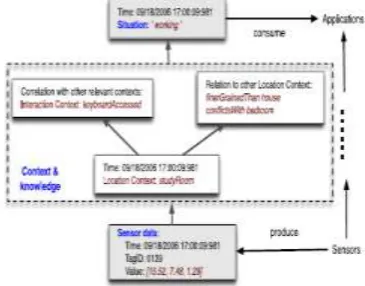
For clarity we shall define some of the terms that will appear frequently later. Sensor
data encompasses raw (or minimally processed) data retrieved from both physical sensors and
FEB-MAR, 2015. VOL-II/XVII www.srjis.com Page 2184 This data is aggregated to form context – the environment in which the system operates,
understood symbolically – which may be further sub-divided into context derived directly
from sensors (primary context) and that inferred and/or derived from several data streams
(secondary context). An important form of secondary context is activities representing small,
higher-level inferences about contextual information, such as the activity of ‗chopping‘
derived by observing motion over time [4]. Finally, a situation is an abstraction of the events
occurring in the real world derived from context and hypotheses about how observed context
relates to factors of interest to designers and applications. Situations typically fuse several
sources of context, as well as domain knowledge, and spatial and temporal models of the
expected behavior of the phenomena being observed.
2.1. Sensors and sensor data
Service provision of a pervasive computing system relies on the perception of an
environment, supported by a range of sensors. Sensing technologies have made significant
progress on designing sensors with smaller size, lighter weight, lower cost, and longer battery
life. Sensors can thus be embedded in an environment and integrated into everyday objects
and onto human bodies. Sensors in pervasive computing can capture a broad range of
information on the following aspects [2]:
Environment: temperature, humidity, barometric pressure, light, and noise level in an
ambient environment and usage of electricity, water, and gas;
Device: state of devices (such as available or busy), functions of devices (such as
printing or photocopying), the size of memory, the resolution of screen, or even
embedded operating systems;
User: location, schedule, motion data like acceleration of different parts of bodies, and
biometrical data like heart rate and blood pressure;
Interaction: interacting with real objects through RFID and object motion sensors [5],
and interacting with devices through virtual sensors like monitoring frequencies of a user
using his keyboard and mouse [6,7].
The diversity of sensors leads to high complexity in interpreting their output, including huge
data volumes, different
modalities, inter-dependence, real-time update, and critical ageing. In dealing with the real
world, these sensors typically produce imperfect data. Noisy sensor data may result in
misunderstanding of a user‘s or an environmental state, which will lead to incorrect
application behavior. These sensors also have their own technical limitations, are prone to
FEB-MAR, 2015. VOL-II/XVII www.srjis.com Page 2185 environmental interference. This leads to the uncertainty issue of sensor data, which can be
out of date, incomplete, imprecise, and contradictory with each other [8]. These features of
pervasive sensor data complicate the process of making themselves immediately
understandable or usable to applications. A pressing challenge is therefore how to use them in
recognizing patterns that could give us a better understanding of human interactions with an
environment [9]. Different sensors produce different types of sensor data, including binary,
continuous numeric, and featured values. The types of data will have an impact on techniques
chosen to analyze them. A binary value is the simplest type of sensor data: true (1) or false
(0). RFID sensors produce a binary reading: an object with an RFID tag is detected by a
reader or not; or a binary-state sensor developed in the University of Amsterdam [10]
produces 1 when it is fired. Continuous numeric values are produced by most sensor types,
including positioning sensors, accelerometers, and all the ambient sensors.
Featured values are typically produced from relatively more sophisticated sensors such as a camera and an eye movement tracker, whose data needs to be characterized into a set of categorical measurements. For example, motion features can be extracted from video streams recorded in cameras, including quantity of motion and contraction index of the body, velocity, acceleration and fluidity [11]. Eye movements captured in electrooculography signals are characterized into two types of features: saccades that are the simultaneous movement of both eyes in the same direction and fixations that are the static states of the eyes during which gaze is held upon a specific location [12]. Table 1 summarizes the commonly used sensors and their types of sensor data.
2.2.1. Features of situations
[image:4.595.208.391.557.700.2]A situation is a subjective concept, whose definition depends on sensors in a current system, which decide available contexts used in a specification; on the environment where the system works, which determines the domain knowledge to be applied (e.g., a spatial map); and on the requirement of applications, which determines what states of affairs are interesting.
FEB-MAR, 2015. VOL-II/XVII www.srjis.com Page 2186 The same sensor data can be interpreted to different situations according to the requirements
of applications. For example, based on the location data for a number of users, we can define
(1) user-centered situations (meeting — the users are gathering in a meeting room), and (2)
location-centered situations (occupied — a room is occupied). A situation is a particular state
that is abstracted from sensor data and is interesting to applications so that certain actions can
be taken when this situation is occurring.
What distinguishes situations from activity, and situation recognition from activity
recognition, is the inclusion in situations of rich temporal and other structural aspects,
including time-of-day — a situation may only happen at a particular time of the day;
duration—it may only last a certain length of time; frequency—it may only happen a certain
times per week, and sequence — different situations may occur in a certain sequence. A
situation can be a simple, abstract state of a certain entity (e.g., a room is occupied), or a
human action taking place in an environment (e.g., working or cooking). A situation can also
be composed of or abstracted from other finer-grained situations; for example, a ‗seminar‘
situation includes the finer situations like ‗presentation‘, ‗questioning‘, and ‗group
discussion‘.
Rich relationships exist between situations, including: Generalization A situation can be
regarded as more general than another situation, if the occurrence of the latter implies that of
the former; for example, a ‗watching TV‘ situation is considered more specific than an ‗entertainment‘ situation, because the conditions inherent in the former situation subsume or
imply the conditions in the latter situation [15].
Composition A situation can be decomposed into a set of smaller situations, which is a
typical composition relation between situations. For example, a ‗cooking‘ situation is
composed of a ‗using stove‘ situation and a ‗retrieving ingredients‘ situation. McCowan et al.
propose a two-layered framework of situations: a group situation (e.g., ‗discussion‘ or
‗presentation‘) is defined as a composition of situations of individual users (e.g., ‗writing‘ or ‗speaking‘) [16]. Dependence A situation depends on another situation if the occurrence of
the former situation is determined by the occurrence of the latter situation. Dependence can
be long- or short-range, as proposed by [17]. Sometimes long-range dependence can be more
useful in inferring high-level situations. For example, a situation ‗going to work‘ may be
better in inferring a situation ‗going home from work‘ than other short-range dependent
situations. Contradiction Two situations can be regarded as mutually exclusive from each
other if they cannot co-occur at the same time in the same place on the same subject; for
FEB-MAR, 2015. VOL-II/XVII www.srjis.com Page 2187 Temporal Sequence A situation may occur before, or after another situation, or interleave
with another situation; for example, ‗taking pill‘ should be performed after ‗having dinner‘
[18].
3. Research topics on situation identification
In pervasive computing, the principal research topics on situation identification involve the
following issues:
Representation how to define logic primitives that are used to construct a situation‘s
logical specification.
Specification how to form a situation‘s logical specification, which can be acquired by
experts or learned from training data;
Reasoning how to infer situations from a large amount of imperfect sensor data; how to reason on situations‘ relationships; and how to maintain the consistency and integrity of
knowledge on situations.
Unlike the well-known situations used in the Natural Language Processing domain,
situations in pervasive computing are highly related to sensor data, domain knowledge on
environments and individual users, and applications. As discussed in the above sections,
sensor data occur in large volumes, in different modalities, and are highly inter-dependent,
dynamic and uncertain. Situations are in a rich structural and temporal relationship, and they
evolve in diffuse boundaries. In addition, the complexity in domain knowledge and
applications makes studying situations a very challenging task. In representation, logical
primitives should be rich enough to capture features in complicated sensor data (e.g.,
acceleration data), domain knowledge (e.g., a spatial map or social network), and different
relationships between situations. Also a pervasive computing system is assumed to be highly
dynamic in the sense that it might introduce new sensors that yield new types of context, so
the logical primitives should be flexibly extensive; that is, new primitives will not cause
modifications or produce ambiguous meanings on existing ones [19]. In specification, it is
difficult for experts to locate relevant contexts to a situation, decide their different
contribution weights (i.e., to what degree the contexts contribute to identifying a situation),
and quantify their uncertainty measurements (i.e., to what degree the input sensor data
validate the contexts). In reasoning, one of the main processes is called situation
identification — deriving a situation by interpreting or fusing several pieces of context in
some way. The performance of reasoning is usually undermined by the complexity of the
FEB-MAR, 2015. VOL-II/XVII www.srjis.com Page 2188 The diversity of applications complicates these issues even more. One of the main
requirements of a pervasive computing system is to deliver correct services to the correct
users at the correct places at the correct time in a correct way. It is assumed that a system
should host a large number of applications that can be finely tuned for different situations.
This requires a situation model to support evolution of situations‘ specifications and to be
able to maintain consistency between original and evolving specifications. These applications
can also have different degrees of significance to the system, user, or environment. Some
applications can only be triggered if a situation is critical and the confidence of identifying
this situation is high; for example in a smart home environment, an application could be to
make the emergency call when the house is in a fire or electrical accident or the occupant
suffers a heart attack. This type of application will be triggered if these hazardous situations
are inferred, even if inferred with a lower confidence relative to other situations. The situation
model must not only be able to handle uncertainty, but also be informative about inference
results; that is, what situations are most likely to happen while what situations are possible or
impossible to happen [20]. This section has introduced the basic elements of information flow
in pervasive computing: sensors, contexts, situations, and applications. It has described the
research on situation identification and the impact of the characteristics of sensors and
applications on this research. In the following, we will provide an overview of the existing
techniques that have been popularly applied in the research on situation identification.
4. Situation identification techniques
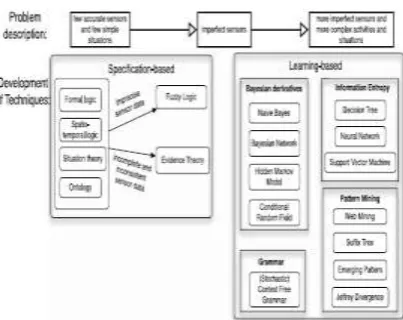
[image:7.595.198.400.549.709.2]Situation identification techniques have been studied extensively in pervasive computing, and here we highlight those techniques we consider to show the most promise. Fig. 2 shows the development of the situation identification techniques and their correlation to the increasing complexity of problem descriptions.
Fig. 2. Development of the main situation identification techniques corresponding to the
FEB-MAR, 2015. VOL-II/XVII www.srjis.com Page 2189 4.1. Specification-based approaches
In the early stages, situation identification research starts when there are a few sensors whose
data are easy to interpret and the relationships between sensor data and situations are easy to
establish. The research consists mainly of specification based approaches that represent
expert knowledge in logic rules and apply reasoning engines to infer proper situations from
current sensor input. These approaches have developed from earlier attempts in first-order
logic [21,22] towards a more formal logic model [20] that aims to support efficient reasoning
while keeping expressive power, to support formal analysis, and to maintain the soundness
and completeness of a logical system. With their powerful representation and reasoning
capabilities, ontologies have been widely applied [23–25,19]. Ontologies can provide a
standard vocabulary of concepts to represent domain knowledge, specifications and semantic
relationships of situations defined in formal logic approaches. They can also provide fully
fledged reasoning engines to reason on them following axioms and constraints specified in
formal logic approaches.
As more and more sensors are deployed in real-world environments for a long term
experiment, the uncertainty of sensor data starts gaining attention. To deal with the
uncertainty, traditional logic-based techniques need to be incorporated with other
probabilistic techniques [26]:
(1)
where certainty is the certainty associated with an inferred situation, n is the number of
conditions that contribute to identification of this situation, wi is the weight on a certain
condition, and μ(xi) is the degree that the condition is satisfied by the current sensor data. The
above general formula uncovers two issues in situation identification. First, the satisfaction of
a condition is not crisply either true or false, which should take into account the imprecision
of sensor data. Fuzzy logic, with its strength in dealing with imprecision, has been applied to
solving this issue [27]. Second, not every condition contributes to identifying a situation to
the same degree, so the problem becomes how to identify the significance of each evidence,
how to resolve conflicting evidence, and how to aggregate evidence. Evidence theories like
FEB-MAR, 2015. VOL-II/XVII www.srjis.com Page 2190 4.2. Learning-based approaches
Moving towards the right hand side of Fig. 2, advances in sensor technologies boost the
deployment of a broad range of sensors, which however undermine the performance of
specification-based approaches. It is less feasible to only use expert knowledge to define
proper specifications of situations from a large number of noisy sensor data. To address this
problem, techniques in machine learning and data mining are borrowed to explore association
relations between sensor data and situations. A large amount of the research has been
conducted in the area of activity recognition in smart environments recently.
A series of Bayesian derivative models are popularly applied, including naïve Bayes [30,31]
and Bayesian networks [32,22] with the strength in encoding causal (dependence)
relationships, and Dynamic Bayesian Networks [33], Hidden Markov Models [34,35] and
Conditional Random Fields [36,10] with the strength in encoding temporal relationships.
Inspired from the language modelling, grammar-based approaches like (stochastic) context
free grammars are applied in representing the complex structural semantics of processes in
hierarchical situations [37–39]. Decision trees [40,5], Neural Networks [41], and Support
Vector Machines [42,43] as another branch in machine learning techniques, which are built
on information entropy, have also been used to classify sensor data into situations based on
features extracted from sensor data.
Even though the above learning techniques have achieved good results in situation
identification, they need a large amount of training data to set up a model and estimate their
model parameters [44]. When training data is precious, researchers are motivated to apply
web mining techniques to uncover the common-sense knowledge between situations and
objects by mining the online documents; that is, what objects are used in a certain human
activity and how significant the object is in identifying this activity [45–47]. Some
unsupervised data mining techniques have been applied as well, including suffix-tree [48,49]
and Jeffrey divergence [50,51].
5. Open research questions
In studying situations, researchers are more and more interested in recognizing interleaved
situations where more than one user are involved or more finer-grained temporally
overlapping situations are involved. Because of the rich structure, hierarchical HMMs are the
most popular technique that is used in identifying such complex situations [9]. However, the
complexity of computation also increases greatly with the complexity of the structure.
Currently, an underlying assumption of situation identification is that situations are
FEB-MAR, 2015. VOL-II/XVII www.srjis.com Page 2191 approaches. When it comes to short, non-repetitive, and unpredictable situations while
significant to applications (like a heart attack), it would be difficult to spot them [154]. For
continuous situations, it is still challenging in mining implicit and noncontiguous temporal
sequences between them and detecting boundaries where situations change.
As a bridge that links sensor data to applications, a situation model should not only be able to
predict situations, but also to provide insights on how a system infers situations, and on how
sensors perform, which is called intelligibility in [155,88]. By analysing formed logical
specifications of situations, developers can learn which sensors are better in recognizing a
certain situation, how users behave or interact with sensors. The ability of users to understand
system decision making in order to develop a mental model of the system is critical to its
acceptance. Therefore, a challenge is to ensure that situation models are sufficiently
informative and transparent to enable intelligibility. Current research has largely focused on
data sets collected in research labs or by environments occupied by researchers. When
real-world environments are used, more complexities appear, such as situation interruption,
multi-tasking, multiple users, and unexpected user behaviour, as described by Logan et al., where
they look at activity monitoring in a smart home. As part of this problem, the research
community will need to examine new measures for evaluating which reasoning techniques
should be used. At present, the focus is on classification accuracies using traditional machine
learning measures; that is obtaining the ‗right‘ answer for as many instances, akin to
classifying static knowledge such as documents. But in pervasive
environments, situations are dynamic, of varied duration, sequential, interleaved; and
application behaviours and transitions need to be smoothed and controlled. For example,
rather than checking the proportion of a situation correctly recognised, it may be more useful
to check whether an activity was detected at all over a period of time; e.g. in a monitored
smart home, did the user prepare breakfast today at all? Boundaries between situations may
be important for health applications [5]; for example, whether a person‘s heart rate has
moved from normal to high within a certain period of time. For the next phase of research,
researchers should examine what real-world complexities need to be addressed, and what
new measures should be considered for evaluation in the future.
One of the challenges in pervasive computing is the requirement to re-create a model of each
new environment in which an application will reside. An activity monitoring application, for
example, may need to cater for different sensors, different user behaviours and so forth when
applied across different homes. With machine learning approaches, training data must be
FEB-MAR, 2015. VOL-II/XVII www.srjis.com Page 2192 problem of how to use annotated training data from one environment to label training data
from another environment. This is an important issue for machine-learning techniques in
order to avoid the costly collection and annotation of data sets for each application
environment.
6. Conclusion
In this paper we have described the state-of-the-art research in situation identification in
pervasive computing. This research is challenged by the complexity of pervasive computing
in terms of highly sensorised environments and contextual applications customized to a
variety of factors. We have discussed different aspects of situation research: representation,
specification, and reasoning, and have elicited the requirements and challenges in each
aspect. Wehave introduced the existing techniques in recognizing situations, and compared
them against the qualitative metrics. Based on the analysis, we suggest a hybrid approach of
specification- and learning-based techniques, where a specification based technique is
responsible for knowledge representation and sharing while a learning-based technique is
responsible for deriving new knowledge and dealing with uncertainty in sensor data. In the
end we also discuss some open research opportunities in the area of situation identification.
References
K. Henricksen, J. Indulska, Developing context-aware pervasive computing applications: models and approach, Pervasive and Mobile Computing 2 (2006) 37–64.
D.J. Cook, S.K. Das, How smart are our environments? an updated look at the state of the art, Pervasive Mobile Computing 3 (2) (2007) 53–73.
P.D. Costa, G. Guizzardi, J.P.A. Almeida, L.F. Pires, M. van Sinderen, Situations in conceptual modeling of context, in: EDOCW’06: Proceedings of the10th IEEE on International Enterprise Distributed Object Computing Conference Workshops, IEEE Computer Society, Hong Kong, China, October 2006, pp. 6–16.
P. Olivier, G. Xu, A. Monk, J. Hoey, Ambient kitchen: designing situated services using a high fidelity prototyping environment, in: PETRA’09: Proceedings of the 2nd International Conference on PErvasive Technologies Related to Assistive Environments, ACM, Corfu, Greece, 2009,pp. 47:1–47:7.
B. Logan, J. Healey, M. Philipose, E.M. Tapia, S.S. Intille, A long-term evaluation of sensing modalities for activity recognition, in: UbiComp’07:Proceedings of the 9th International Conference on Ubiquitous Computing, Springer-Verlag, Innsbruck, Austria, September 2007, pp. 483–500.
M. Mühlenbrock, O. Brdiczka, D. Snowdon, J.-L. Meunier, Learning to detect user activity and availability from a variety of sensor data, in: PERCOM’04:Proceedings of the Second IEEE International Conference on Pervasive Computing and Communications, IEEE Computer Society, Orlando, Florida,March 2004, pp. 13–22.
FEB-MAR, 2015. VOL-II/XVII www.srjis.com Page 2193
K. Henricksen, J. Indulska, Modelling and using imperfect context information, in: Proceedings of PERCOM’04 Workshops, 2004, pp. 33–37.
L. Atallah, G.-Z. Yang, The use of pervasive sensing for behaviour profiling — a survey, Pervasive and Mobile Computing (5) (2009) 447–464.
T. van Kasteren, A. Noulas, G. Englebienne, B. Kröse, Accurate activity recognition in a home setting,
in: UbiComp’08: Proceedings of the 10th
International Conference on Ubiquitous Computing, ACM, Seoul, Korea, September 2008, pp. 1–9.
G. Castellano, S.D. Villalba, A. Camurri, Recognising human emotions from body movement and
gesture dynamics, in: ACII’07: Proceedings of the 2nd
International Conference on Affective Computing and Intelligent Interaction, Springer-Verlag, Berlin, Heidelberg, Lisbon, Portugal, 2007, pp. 71–82.
A. Bulling, J.A. Ward, H. Gellersen, G. Tröster, Robust recognition of reading activity in transit using wearable electrooculography, in: Pervasive’08: Proceedings of the 6th International Conference on Pervasive Computing, Springer-Verlag, Berlin, Heidelberg, 2008, pp. 19–37. J. Ye, S. McKeever, L. Coyle, S. Neely, S. Dobson, Resolving uncertainty in context integration and
abstraction, in: ICPS’08: Proceedings of the International Conference on Pervasive Services, ACM, Sorrento, Italy, July 2008, pp. 131–140.
H.R. Schmidtke, W. Woo, Towards ontology-based formal verification methods for context aware
systems, in: Pervasive’09: Proceedings of the 7th International Conference on Pervasive
Computing, Springer-Verlag, Berlin, Heidelberg, 2009, pp. 309–326.
J. Ye, L. Coyle, S. Dobson, P. Nixon, Using situation lattices to model and reason about context, in: MRC 2007: Proceedings of the Workshop on modeling and reasoning on context (coexist with CONTEXT’07), Roskilde, Denmark, August 2007, pp. 1–12.
I. McCowan, D. Gatica-Perez, S. Bengio, G. Lathoud, M. Barnard, D. Zhang, Automatic analysis of multimodal group actions in meetings, IEEE Transactions on Pattern Analysis and Machine Intelligence 27 (2005) 305–317.
D. Choujaa, N. Dulay, Activity inference through sequence alignment, in: LoCA’09: Proceedings of the 4th International Symposium on Location and Context Awareness, Springer-Verlag, Berlin, Heidelberg, 2009, pp. 19–36.
V.R. Jakkula, A.S. Crandall, D.J. Cook, Knowledge discovery in entity based smart environment resident data using temporal relation based data mining, in: ICDMW’07: Proceedings of the Seventh IEEE International Conference on Data Mining Workshops, IEEE Computer Society, Washington, DC, USA, 2007, pp. 625–630.
J. Ye, L. Coyle, S. Dobson, P. Nixon, Ontology-based models in pervasive computing systems, The Knowledge Engineering Review 22 (04) (2007) 315–347.
S.W. Loke, Incremental awareness and compositionality: a design philosophy for context-aware pervasive systems, Pervasive and Mobile Computing 6 (2) (2010) 239–253.
T. Gu, X.H. Wang, H.K. Pung, D.Q. Zhang, An ontology-based context model in intelligent environments, in: CNDS’04: Proceedings of the Conference on Communication Network and Distributed Systems, January 2004, pp. 270–275.
A. Ranganathan, J. Al-Muhtadi, R.H. Campbell, Reasoning about uncertain contexts in pervasive computing environments, IEEE Pervasive Computing 03 (2) (2004) 62–70.
H. Chen, T. Finin, A. Joshi, An ontology for context-aware pervasive computing environments, Knowledge Engineering Review 18 (3) (2004) 197–207. Special Issue on Ontologies for Distributed Systems.
FEB-MAR, 2015. VOL-II/XVII www.srjis.com Page 2194
T. Strang, C. Linnhoff-Popien, A context modeling survey, in: Proceedings of the Workshop on Advanced Context Modelling, Reasoning and Management as part of UbiComp 2004, Nottingham, England, September 2004.
P. Delir Haghighi, S. Krishnaswamy, A. Zaslavsky, M.M. Gaber, Reasoning about context in uncertain pervasive computing environments, in: EuroSSC’08: Proceedings of the 3rd European Conference on Smart Sensing and Context, Springer-Verlag, Berlin, Heidelberg, 2008, pp. 112–125.
C.B. Anagnostopoulos, Y. Ntarladimas, S. Hadjiefthymiades, Situational computing: an innovative architecture with imprecise reasoning, Journal of System and Software 80 (12) (1993–2014). X. Hong, C. Nugent, M. Mulvenna, S. McClean, B. Scotney, S. Devlin, Evidential fusion of sensor data
for activity recognition in smart homes, Pervasive and Mobile Computing 5 (2009) 236–252. S. Mckeever, J. Ye, L. Coyle, C. Bleakley, S. Dobson, Activity recognition using temporal evidence
theory, Journal of Ambient Intelligence and Smart Environment 2 (3) (2010) 253–269.
D.J. Patterson, L. Liao, D. Fox, H. Kautz, Inferring high-level behavior from low-level sensors, in:
Ubicomp’03: Proceedings of Proceedings of the 5th
International Conference on Ubiquitous Computing, Springer, Berlin, Heidelberg, 2003, pp. 73–89.
E.M. Tapia, S.S. Intille, K. Larson, Activity recognition in the home using simple and ubiquitous sensors, in: Pervasive’04: Proceedings of the international conference on Pervasive Computing, 2004, pp. 158–175.
T. Gu, H.K. Pung, D.Q. Zhang, A Bayesian approach for dealing with uncertain contexts, in: Proceedings of Advances in Pervasive Computing, coexisted with Pervasive’04. Austrian Computer Society, April 2004, pp. 205–210.
T. van Kasteren, B. Krose, Bayesian activity recognition in residence for elders, in: IE’07: Proceedings of the third IET International Conference on Intelligent Environments, September 2007, pp. 209–212.
C. Wojek, K. Nickel, R. Stiefelhagen, Activity recognition and room-level tracking in an office environment, in: MFI’06: Proceedings of 2006 IEE International Conference on Multisensor Fusion and Integration for Intelligent Systems, September 2006, pp. 25–30.
M.K. Hasan, H.A. Rubaiyeat, Y.-K. Lee, S. Lee, A reconfigurable HMM for activity recognition, in: ICACT’08: Proceedings of 10th International Conference on Advanced Communication Technology, Vol. 1, 2008, pp. 843–846.
D.L. Vail, M.M. Veloso, J.D. Lafferty, Conditional random fields for activity recognition, in: AAMAS’07: Proceedings of the 6th International Joint Conference on Autonomous Agents and Multiagent Systems, ACM, New York, NY, USA, 2007, pp. 1–8.
D. Moore, I. Essa, Recognizing multitasked activities from video using stochastic context-free grammar, in: Eighteenth national conference on Artificial intelligence, American Association for Artificial Intelligence, Menlo Park, CA, USA, 2002, pp. 770–776.
M.S. Ryoo, J.K. Aggarwal, Recognition of composite human activities through context-free grammar based representation, in: CVPR’06: Proceedings of the 2006 IEEE Computer Society Conference on Computer Vision and Pattern Recognition, IEEE Computer Society, Washington, DC, USA, 2006, pp. 1709–1718.
P. Turaga, R. Chellappa, V.S. Subrahmanian, O. Udrea, Machine recognition of human activities: a survey, IEEE Transactions on Circuits and Systems for Video Technology 18 (11) (2008) 1473–1488.
FEB-MAR, 2015. VOL-II/XVII www.srjis.com Page 2195
J.-Y. Yang, J.-S. Wang, Y.-P. Chen, Using acceleration measurements for activity recognition: an effective learning algorithm for constructing neural classifiers, Pattern Recognition Letter 29 (16) (2008) 2213–2220.
S.N. Patel, T. Robertson, J.A. Kientz, M.S. Reynolds, G.D. Abowd, At the flick of a switch: detecting and classifying unique electrical events on the residential power line, in: UbiComp’07: Proceedings of the 9th International Conference on Ubiquitous Computing, Springer-Verlag, Berlin, Heidelberg, 2007, pp. 271–288.
T. Kanda, D.F. Glas, M. Shiomi, H. Ishiguro, N. Hagita, Who will be the customer?: a social robot that anticipates people’s behavior from their trajectories, in: UbiComp’08: Proceedings of the 10th International Conference on Ubiquitous Computing, ACM, Seoul, Korea, 2008, pp. 380–389.
G. Thomson, S. Terzis, P. Nixon, Situation determination with reusable situation specifications, in: Proceedings of the Fourth Annual IEEE International Conference on Pervasive Computing and Communications Workshops, 2006, pp. 620–623.
M. Perkowitz, M. Philipose, K. Fishkin, D.J. Patterson, Mining models of human activities from the
web, in: WWW’04: Proceedings of the 13th
International Conference on World Wide Web, ACM, New York, NY, USA, 2004, pp. 573–582.
E.M. Tapia, T. Choudhury, M. Philipose, Building reliable activity models using hierarchical shrinkage and mined ontology, in: Pervasive’06: Proceedings of the 4th International Conference on Pervasive Computing, in: Lecture Notes in Computer Science, vol. 3968, Springer, Dublin, Ireland, May 2006, pp. 17–32.
P. Palmes, H.K. Pung, T. Gu, W. Xue, S. Chen, Object relevance weight pattern mining for activity recognition and segmentation, Pervasive Mobile Computing 6 (1) (2010) 43–57.
R. Hamid, S. Maddi, A. Bobick, I. Essa, Unsupervised analysis of activity sequences using event-motifs, in: VSSN’06: Proceedings of the 4th ACM International Workshop on Video Surveillance and Sensor Networks, ACM, New York, NY, USA, 2006, pp. 71–78.
R. Hamid, S. Maddi, A. Johnson, A. Bobick, I. Essa, C. Isbell, A novel sequence representation for unsupervised analysis of human activities, Artificial Intelligence 173 (14) (2009) 1221–1244. O. Brdiczka, J. Maisonnasse, P. Reignier, J.L. Crowley, Detecting small group activities from
multimodal observations, International Journal of Applied Intelligence 30 (1) (2009) 47–57. O. Brdiczka, J.L. Crowley, P. Reignier, Learning situation models in a smart home, IEEE
Transactions on System, Man and Cybernetics, Part B 39 (1) (2009) 56–63.
T. Gu, H.K. Pung, D.Q. Zhang, A service-oriented middleware for building context-aware services, Journal of Network and Computer Applications 28 (2005) 1–18.
S.W. Loke, Representing and reasoning with situations for context-aware pervasive computing: a logic programming perspective, Knowledge Engineering Review 19 (3) (2004) 213–233. S.W. Loke, Logic programming for context-aware pervasive computing: language support,
characterizing situations, and integration with the web, in: WI’04: Proceedings of 2004 IEEE/WIC/ACM International Conference on Web Intelligence, Beijing, China, September 2004, pp. 44–50.
M. Bhatt, S. Loke, Modelling dynamic spatial systems in the situation calculus, Spatial Cognition and Computation 8 (1&2) (2008) 86–130.
J Ye, S Dobson, S McKeever, Situation identification techniques in pervasive computing: A review ,
Pervasive and Mobile Computing 8 (2012)