Effect Of Silixol Plus On Germination And Growth
Of Rice
Phurailatpa Pooja Sharma and Sahadevan Jawahar*
Department of Agronomy, Faculty of Agriculture, Annamalai University, Annamalainagar, Tamilnadu, India – 608002
DOI: 10.29322/IJSRP.9.12.2019.p9693
http://dx.doi.org/10.29322/IJSRP.9.12.2019.p9693
Abstract- A Seed germination study was conducted at Department of Agronomy, Annamalai University, India during February 2019 to study the effect of silixol plus on germination and growth of rice. The treatments comprised of five levels of silixol plus viz., 0 ppm (T1), 1ppm (T2), 2 ppm (T3), 3 ppm (T4) and 4 ppm (T5) and
were laid out by adopting randomized block design (RBD) with four replications. Among the different levels, seed soaking with Silixol plus @ 2 ppm recorded higher values for seed germination percentage on 3, 5, 7 and 9th day after sowing. The same treatment
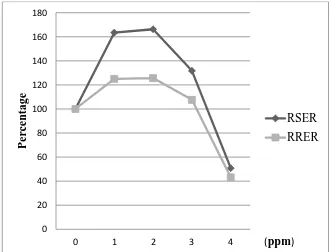
recorded higher values for growth parameters of rice seedling viz., shoot length, root length, vigour index, fresh weight, relative root and shoot elongation rate on 9th day after sowing. This was
followed by silixol plus @ 1 ppm and on par with each other. When the concentration of silixol plus exceed @ 2 ppm, the germination and growth on rice seedlings were gradually decreased, even lesser than control (0 ppm) at Silixol plus @ 4 ppm. Therefore, this study showed seed soaking with silixol plus @ 1 ppm concentration is a viable practice to enhance the germination and growth of rice.
Index Terms- silicon, rice, germination, growth
I. INTRODUCTION
ice is the world's major food crop next to wheat. It has been cultivated in more than 100 countries in an area of 155 m.ha with the production of 596 m.t. India ranks second next to china in term of rice production. In India, it is grown in 44.80 m.ha and contributes 131 m.t food grains to the nation, but the productivity is 2929 kg ha-1. Rice is widely grown in all India's
agro-climate zones. In recent year, rice production in India is started shrinking due to late commencement of monsoon particularly in south India and farmers are moving towards direct dry sowing of rice especially in Cauvery delta region. But direct dry seeded rice recorded lesser productivity due to different biotic and abiotic stresses. Lesser plant population due to poor germination, insect pests, diseases and moisture stress greatly are the prime factors affect the productivity of rice under this condition. Therefore, it is essential to maintain optimum plant population by enhancing the seeds germination and to induce biotic and abiotic resistant to rice
Silicon (Si) is a beneficial element for plant growth and also found effective in resistance of biotic, abiotic stress and elevate the crop productivity (Sommer et al., 2006). Application of Si produces more biomass which helps to improves light interception and photosynthetic efficiency. Malav et al, (2018) reported that addition of silicon strengthens the root canal and supply efficient oxygen to roots and also prevents water loss by evapotranspiration. Enrichment of silicon plant minimized the incidence of various rice pest and diseases (Chandramani et at., 2010 and Jawahar et al.,2019b). Among the cereals, rice is the only one crop accumulates more amount of silicon; an average absorption of silicon by rice is 150-300 kg per hectare and produce high production and productivity. Therefore, from 20th century
silicon has been used in Japan very widely and it has been identified as an agronomically essential element and silicate fertilizers have been applied to paddy soils (Ma et al 2001). Generally, silicon supplemented through traditional silicate fertilizer to crops, where silicon is present in amorphous form. But silicon absorb by the plant from the soil in the plant form of ortho silicic acid, which is not widely investigated on rice. The beneficial role of silicon on rice was earlier documented by Jawahar et al.(2019a) in rice, but its influence on germination behaviour on rice is still studied. Keeping the above fact in mind, this study was conducted to study the effect of silixol plus on germination and growth of rice.
II. MATERIALSANDMETHODS
A germination study on rice due to silicon (silixol plus) was conducted at Department of Agronomy, Annamalai University, India during February 2019. The treatments comprised of five levels of silixol plus viz.,0 ppm (T1),1ppm (T2), 2 ppm (T3), 3 ppm
(T4) and 4 ppm (T5) and were laid out by adopting RBD and
replicated four times.
Silixol Plus: The sample, silixol plus was obtained as a gift sample from Dr.Neeru Jain, Head-Application Research , Privi Life Sciences Pvt.Ltd., Navi Mumbai, India. It contains 0.6 % ortho silicic acid.
Germination and Measurements
International Journal of Scientific and Research Publications, Volume 9, Issue 12, December 2019 742 ISSN 2250-3153
http://dx.doi.org/10.29322/IJSRP.9.12.2019.p9693 www.ijsrp.org
filter paper and moisten with 5ml of distilled water and kept at room temperature. Seed germination was recorded on 3, 5, 7 and 9th after sowing. The growth parameters of seedlings viz., shoot
length, root length; vigour index and fresh weight of individual seedling were recorded on 9th after sowing.
Vigour index was worked out as suggested by Abdul- Baki and Anderson (1970).
Vigour Index = GP x MSH100 Where,
GP = germination percentage MSH = sum of shoot and root length.
Relative elongation rate of shoot and root rate were calculated by using the following equation suggested by Rho and Kil (1986). RSER =Ms
Mcx 100
Where,
RSER = Relative elongation rate of shoot Ms= Mean of shoot length of tested plant Mc= Mean of length of control
RRER=Mr
Mcx100
Where,
RRER= Relative elongation rate of root Mr= Mean of root length of tested plant Mc= Mean of length of control.
Statistical analysis
The data on germination and growth of rice was statistically analyzed and critical difference was calculated at 5 % probability level (Gomez and Gomez, 1994).
III. RESULTSANDDISCUSSION
Effect of Silixol plus on germination of rice.
Seeds soaking with silixol plus greatly influenced the germination of rice on 3, 5, 7 and 9th day after sowing(Table 1).
The germination percentage ranged from 52.33 to 74.99, 68.33 to 93.32, 73.32 to 94.99 and 76.66 to 96.66 per cent on 3,5,7 and 9th
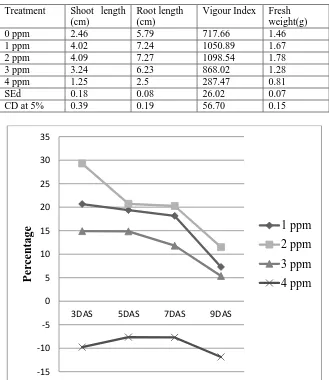
day after sowing, respectively. Among the levels, seeds soaking with silixol @ 2ppm recorded higher germination percentage in all the days of observation. It was 74.99, 93.32,94.99 and 96.66 per cent is increased over 0 ppm on 3,5,7 and 9 days after sowing (Fig.1).This was followed by silixol plus @ 1ppm and were on par with each other. Increased germination percentage due to seed soaking with silicon through silixol plus enhanced the cell
extension through formatting Si-polyphenol complexes and lignin which caused loosening of cell wall which caused higher germination percentage. Nita Babaso Patil et al. (2018) revealed that the concentration of silixol plus exceeds 2ppm, the germination percentage was gradually decreased. It was found that seed soaking with silixol plus @ 4ppm recorded lesser germination percentage than 0 ppm. The lesser germination under silixol plus @ 4 ppm might be due to higher accumulation of silicon on the seed coat increased the cell wall sustainability by forming a hard layer may be delayed the emergence of radical resulted in lesser germination percentage at 4 ppm. This result was accordance with the earlier reports of Sahebi et al. (2015).
Effect of Silixol plus on growth of rice.
The data observed on seedlings growth parameters (Shoot length, root length, vigour index and fresh weight) Table 2. Seed soaking with silixol plus significantly influenced on seedling growth of rice. The shoot length ranges from 1.25 to 4.09 cm and root length ranged from 2.5 to 7.27 cm on 9th day after sowing.
Table 1: Effect of Silixol plus on seed germination of rice.
Table 2: Effect of Silixol plus on growth parameters of rice.
Figure 1: Effect of Silixol plus on per cent increase or decrease of germination percentage over 0 ppm -15
-10 -5 0 5 10 15 20 25 30 35
3DAS 5DAS 7DAS 9DAS
Per
cent
age
1 ppm
2 ppm
3 ppm
4 ppm
Treatment Germination ( % )
3DAS 5DAS 7DAS 9DAS 0 ppm 58.00 73.99 78.99 86.99 1 ppm 69.99 88.33 93.33 93.33 2 ppm 74.99 93.32 94.99 96.66 3 ppm 66.65 84.99 88.32 91.66 4 ppm 52.33 68.33 73.32 76.66 SEd 2.91 2.88 2.61 2.27 CD at 5% 5.16 6.29 5.70 5.94
Treatment Shoot length (cm)
Root length (cm)
[image:3.612.142.471.277.657.2]International Journal of Scientific and Research Publications, Volume 9, Issue 12, December 2019 744 ISSN 2250-3153
[image:4.612.141.472.56.308.2]http://dx.doi.org/10.29322/IJSRP.9.12.2019.p9693 www.ijsrp.org
Figure 2: Effect of Silixol plus on relative elongation rate of shoot and root of rice.
IV. CONCLUSION
In this present research, it can be revealed that application of silicon to the seeds through silixol plus by seeds soaking had a positive role on germination and growth of rice seedlings parameters. Further, seeds soaking silixol plus @ 2 ppm and 1 ppm showed similar effect on rice germination percentage and seedling growth and the response is decreased at higher levels. Hence seeds soaking with silixol plus @ 1ppm can be recommended to enhance the germination and growth of rice.
REFERENCES
[1] AbdulBaki, A.A. & Anderson, J.D. (1970).Viability and leaching of sugars from germinating barley. Crop Science, 10(1), 31-34.
[2] Chandramani,P., Rajendran, R., Muthiah, C. & Chinniah, C.(2010). Organic source induced silica on leaf folder, stem borer and gall midge population and rice yield. J. Biopes., 3(2): 423 427.
[3] Feizi, H., Kamali, M., Jafari, L. & Moghaddam, P. R. (2013). Phytotoxicity and stimulatory impacts of nanosized and bulk titanium dioxide on fennel (Foeniculumvulgare Mill). Chemosphere. 91, 506-511.
[4] Gomez, K. A. & Gomez, A.A.(1994). Statistical produce for Agricultural research, 11th edn. John Wiley & Sons, New York, 68.
[5] Jawahar, S., Sowbika, A., Neru Jain, Suseendran, K. & Kalaiyarasan, C. (2019a). Effect of Ortho silicic acid formulations on growth, yield and economics of low land rice. International Journal of Research and Analytical Reviews , 6(1): 579-590.
[6] Jawahar, S., Neeru Jain, Vinod Kumar, S.R., Kalaiyarasan, C., Arivukkarasu.K., Ramesh. S. & Suseendran, K.(2019b).Effect of silicon sources on silicon uptake and blast incidence in low land rice. Journal of Pharmacognosy and Phytochemistry, 8(3):2275-2278.
[7] Ma, J. F., Miyake, Y. & Takahash, E. (2001).Silicon as a beneficial element for crop plants. In: Silicon in agriculture, Datnoff, E., Synder, G.H. & Komdorfer, G.H.(eds), Elsevier Science, Amsterdam,17-39.
[8] Malav, J. K., Ramani, V.P., Patel. J.K., Pavaya, R.P., Patel, B.B., Patel. M. & Patel.V.R.(2018). Rice yield and available nutrients status of loamy sand soil as influenced by different levels of silicon and nitrogen. Int. J. Curr. Microbiol. App. Sci, 7(2): 619-632.
[9] Patil, N.B., Sharanagouda, H., Doddagoudar, S.R., Ramachandra. C.T. & Ramappa. K.T.(2018). Effect of Rice Husk Silica Nanoparticles on Rice (oryza sativa L.) Seed Quality. Int.J.Curr.Microbiol.App.Sci,7(12): 3232-3244.
[10] Rho, B.J. & kil, B.S. (1986). Influence of phytotoxin from pinus rigida on the selected plants. J. Na Sci Wonkwang Uni,5: 19-27.
[11] Sahebi, M., Hanafi, M.M., Akmar, A., Rafii, M.Y., Azizi,P., Tengoua, F.F., Azwa, N. J. & Shabanimofrad, M. (2015) Importance of silicon and mechanisms of biosilica formation in plants. Bio. Med. Res. Int. 7, 1-16. [12] Sommer, M., Kaczorek,D., Kuzyakov ,Y. & Breuer,J. (2006). Silicon pools
in soils and landscapes- a review. J. Soil Sci. Plant Nut, 169, 310-329.
AUTHORS
First Author – Phurailatpa Pooja Sharma, Department of
Agronomy, Faculty of Agriculture, Annamalai University, Annamalainagar, Tamilnadu, India – 608002
Second Author – Sahadevan Jawahar, Department of
Agronomy, Faculty of Agriculture, Annamalai University, Annamalainagar, Tamilnadu, India – 608002
Corresponding Author Email: [email protected]
0 20 40 60 80 100 120 140 160 180
0 1 2 3 4
Per
cent
age
RSER
RRER
PP