Comparative Study and Analysis of Data Centric Routing
Protocols of Wireless Sensor Network Based on Energy
Consumption
Priyanka Mangla
*, Vasudha Arora
***
M.tech scholar in Computer Science, MRIU, Faridabad **
Asst. Professor, Department of computer science, MRIU, Faridabad
Abstract- A WSN is a specialized wireless network made up of a large number of sensors and at least one base station. Sensor Network are emerging as a new tool for important application in diverse fields like military surveillance, habitat monitoring, weather, home electrical appliances and others. Technically, sensor network nodes are limited in respect to energy supply, computational capacity and communication bandwidth. In order to prolong the lifetime of the sensor nodes, designing efficient routing protocol is very critical. Here, we illustrate the existing routing protocol for wireless sensor network in data centric approach. In this review article, we discuss the architecture of wireless sensor networks. Further, we categorize the routing protocols according to some key factors and summarize their mode of operation. Finally, we provide a evaluation of energy consumption graph of SPIN and comparative study on these two main protocols.
Index Terms- Wireless sensor network, Data Centric Approach,
Directed Diffusion, SPIN, WSN Routing Protocol.
I. INTRODUCTION
sensor is a device that produces a reckonable response to a change in a physical condition, such as temperature, pressure and weight etc. Sensors are used to measure basic physical phenomena including acceleration, shock, vibration, humidity, flow rate, force, magnetic field and wind speed. A wireless sensor network (WSN) is a formation of a number of nodes (even hundred and thousands of them) that communicate with each other to perform sensing process. Normally each node is equipped with a battery to power it up, a main board with a chip and memory that acts as a CPU for the nodes. Each node has sensing capabilities to sense the environment information (temperature, earthquake etc.) and process the information to be sent through the radio links in a network to a destination node. Nodes can be thousands in number and each node is connected to each other to form a communication network.
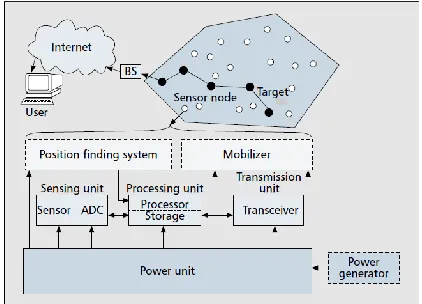
II. ARCHITECTURE OF WIRELESS SENSOR NETWORK A sensor network is a network of many tiny disposable low power devices, called nodes, which are spatially distributed in order to perform an application-oriented global task. Figure 2.1 shows the structural view of a sensor network in which sensor nodes are shown as small circles. Each node typically consists of
[image:1.612.339.550.419.571.2]the four components: sensor unit, central processing unit (CPU), power unit, and communication unit. They are assigned with different tasks. The sensor unit consists of sensor and ADC (Analog to Digital Converter). The sensor unit is responsible for collecting information as the ADC requests, and returning the analog data it sensed. ADC is a translator that tells the CPU what the sensor unit has sensed, and also informs the sensor unit what to do. Communication unit is tasked to receive command or query from and transmit the data from CPU to the outside world. CPU is the most complex unit. Power unit supplies power to sensor unit, processing unit and communication unit. Each node may also consist of the two optional components namely Location finding system and Mobilizer. If the user requires the knowledge of location with high accuracy then the node should pusses Location finding system and Mobilizer may be needed to move sensor nodes when it is required to carry out the assigned tasks [3].
Figure 2.1 the components of sensor node
III. TYPESOFSENSORNETWORKS
There are five types of the wireless sensor network [10]. 1. Terrestrial Wireless sensor network.
2. Underground Wireless sensor network. 3. Underwater Wireless sensor network. 4. Multi-media Wireless sensor network. 5. Mobile Wireless sensor network.
Terrestrial WSNs typically consist of hundreds to thousands of inexpensive sensor nodes deployed in a given region, either in an ad hoc or in a pre-planned manner.
Underground WSNs in which sensor node covered underground, basically it used for detect used to monitor underground situation. And sink node are used for transmit information to the sensor node to the base station.
Underwater WSNs consist of a number of sensor nodes and vehicles deployed underwater. Unlike terrestrial WSNs, underwater sensor nodes are more costly and less dense. Independent underwater vehicles are used for searching or gathering data from sensor nodes. Sensor nodes communicate via acoustic waves in underwater WSN.
Multi-media WSNs are used to monitoring and tracking of events in the form of multimedia. Multi-media WSNs consist of a number of low cost sensor nodes equipped with cameras and microphones. These sensor nodes communicate with each other for data retrieval, process, correlation, and compression over a wireless connection.
Mobile WSNs can start with some initial deployment and nodes can then spread out to gather information. A mobile node can communicate to another mobile node when they are within the range of each other and transfer gathered information.
IV. APPLICATIONS OF WIRELESS SENSOR NETWORK The applications of the sensor network are categorized into various classes such as Environmental monitoring [13], Military applications [5], Security monitoring [10], health care application [5], and home application [10].
1. Environmental monitoring
Natural disasters are becoming more severe. In many events such as landslides and water flooding, they can be warned by a raised alarm within in a specified period. In this research, the advantages of a wireless sensor network are taken to benefit weather monitoring stations. Many sensor stations measure and send parameters through a wireless network server.
2. Military applications
Military applications are very closely related to the concept of wireless sensor networks. In fact, it is very difficult to say for sure whether motes were developed because of military and air defence needs or whether they were invented independently and were subsequently applied to army services.
3. Health care applications
Health science and the health care system can also benefit from the use of wireless sensors. Intel’s research concerns senior citizens and their problems. Cognitive disorders, which perhaps lead to Alzheimer’s, can be monitored and controlled at their early stages, using wireless sensors. Another medical application refers to human vision restoration by retina prosthesis. Sensors are implanted to human organs to support a function and they require the capability to communicate wirelessly with an external computer system, which carries out the advanced processing.
4. Home Application
Many concepts are already designed by researcher and architects, like “Smart Environment: Some are even realized. Let’s see the concept “the intelligent home”: After one day hard work you come back home. At the front door the sensor detects you are opening the door, then the air condition to be turned on. You sit in the sofa lazily. The light on the table and is automatically on because the pressure sensor under the cushion has detected your weight.
5. Security Monitoring
Security monitoring networks are collected of nodes that are placed at fixed locations throughout an environment that continually monitor one or more sensors to detect an anomaly. The immediate and reliable communication of alarm messages is the primary system requirement. If a node were to be disabled or fail, it would represent a security violation that should be reported. For security monitoring applications, the network must be configured so that nodes are responsible for confirming the status of each other.
V. ROUTING PROTOCOLS
The way route is established from source to sink is referred as routing. This route can be modified by preferring the shortest route or the strongest route or deselecting the weaker or longer route. Routing protocols for wireless sensor networks that discussed in this paper is data-centric.
A. Data-Centric Routing Protocols
A large number of sensor nodes are deployed over a region making it incomprehensible to assign a global identifier for each node. This has led to the development of query based routing techniques known as data-centric routing protocols. In query based, the base station sends a query to a certain region in the network whose data it requires. The query is sent to a random sensor node form the base station, and has to be forwarded to the intended region [13]. The sensor nodes in the region aggregate their sensed data and route back to the base station along the reverse path discovered in the previous step.
a. SPIN
SPIN (Sensor Protocols for Information via Negotiation) that disseminates all the information at each node to every node in the network assuming that all nodes in the network are potential BSs. This enables a user to query any node and get the required information immediately. These protocols make use of the property that nodes in close proximity have similar data, and hence there is a need to only distribute the data other nodes do not posses. The SPIN family of protocols uses data negotiation and resource-adaptive algorithms. Nodes running SPIN assign a high-level name to completely describe their collected data (called meta-data) and perform metadata negotiations before any data is transmitted. This ensures that there is no redundant data sent throughout the network. The semantics of the meta-data format is application-specific and not specified in SPIN.
protocol starts when a SPIN node obtains new data it is willing to share. It does so by broadcasting an ADV message containing metadata. If a neighbour is interested in the data, it sends a REQ message for the DATA and the DATA is sent to this neighbour node. The neighbour sensor node then repeats this process with its neighbours. As a result, the entire sensor area will receive a copy of the data.
Figure 5.1 The SPIN Protocol. Node A starts by advertising its data to node B (1). Node B responds by sending a request to node A(2). After receiving the requested data (3), node B then sends out advertisements to its neighbours (4), who in
turn send requests back to B(5,6).
b. Directed Diffusion
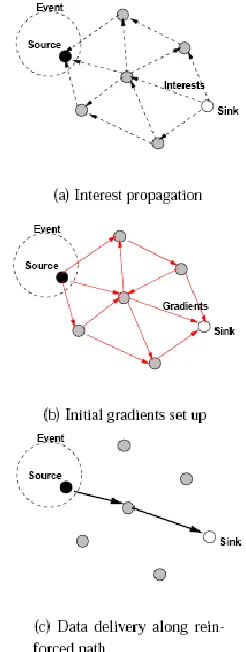
Direct diffusion is a data centric query based and application-aware protocol where data aggregation is carried out at each node in the network. The nodes will not advertise the sensed data until a request is made by the BS, and all the data generated by sensor node is named by attribute-value pairs. The events generated by a single or a group of nodes are the changes in the sensed data. The interest queries are disseminated throughout the sensor network as an interest for named data. This dissemination set up the gradients within the network to draw events.
A gradient is a direction state created in each node that receives an interest. The gradient specifies data rate and the direction in which to send the events. The node within the event region sends the data sensed events back to the BS along multiple gradient paths. For each active task the BS broadcasts interest message periodically. The initial message for setting up the gradients for fetching the data will have a much larger interval. Each node in the network maintains an interest cache that contains information about the interest received. The interest cache stores the information about only one-hop neighbour from which it received the interest. The node which receives the events information from the source attempts to find a matching entry in its interest cache. If a match do not exists then the data message is dropped silently. If there exists a match, the received message is added to the data cache and the data message is sent
to the nodes neighbours. In this way the data message will eventually reach the BS, the BS reinforces one particular neighbour, and that neighbour reinforces one of its upstream neighbours, the reinforcement continues till the source node.
Figure 5.2 A simplified schematic for directed diffusion.
VI. ENERGY CONSUMPTION BY SPIN PROTOCOL Total energy is consumed by SPIN protocol in which one node transmits the m=100 bytes of data it receives to the neighbor node through adopting SPIN protocol. Assuming that both of ADV and REQ messages are L=5 bytes, it needs to consume Et energy to send a byte and Er energy to receive a byte. The network is distributed, no packet losses or queuing delay, and the average number of node’s neighbor is N. Any node in network will forward the m bytes of data it receives to the next hop node.
1) The steps of node B forwards the m byte of data in the SPIN protocol are:
a. Send ADV messages, energy consumption is (N-1) LEt; b. Receive the REQ message from N-1 nodes around it, the energy consumption is L (N-1) Er;
c. Send Data + L bytes of data, consume (m + L) (N-1) Et energy;
[image:3.612.68.271.153.365.2]a. Receive ADV message, consume LEr energy; b. Send REQ message, the energy consumption is LEt; c. Receive m bytes of data, consume (m + L) Er energy;
According to the above description, in SPIN, the minimum energy consumption in process that node B receives the data and forwards the data to the next hop nodes is showed by the formal below:
ESPIN= Et (2NL+mN—m—L) + (NL+m+L) Er (1)
If we consider that Number of nodes N=10 then total energy is consumed by SPIN protocol will be ESPIN=995Et + 155Er. On the basis of equation (1), we assume that Er=xEt to calculate the total energy consumption for transmitting and receiving the data from one node to another node.
VII. COMPARISON ANALYSIS AND RESULTS
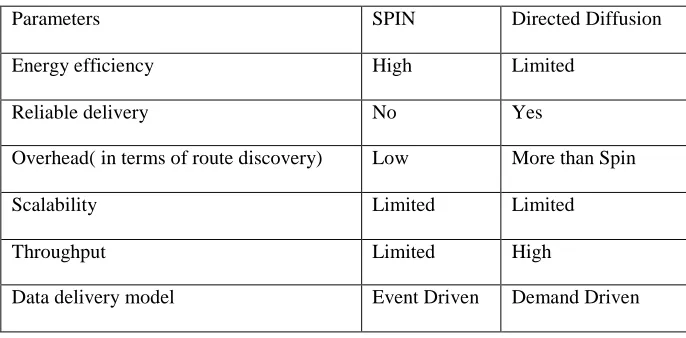
[image:4.612.330.564.60.211.2]Now we compare all the above routing protocols according to their performance depending on different parameters [14] [15]. Table 1 shows the comparison.
Table 1. Comparison of Data centric routing protocols
Parameters SPIN Directed Diffusion
Energy efficiency High Limited
Reliable delivery No Yes
Overhead( in terms of route discovery) Low More than Spin
Scalability Limited Limited
Throughput Limited High
Data delivery model Event Driven Demand Driven
1. Energy consumption
SPIN is designed to operate efficiently and to conserve energy by sending metadata in place of whole data. Meta-data actually increase the energy efficiency of a network drastically because SPIN will start with advertise its interest, then waiting a request from any node before start transmitting data again. From the result, it proves that meta-data negotiation keeps SPIN nodes from sending out even a single redundant data packet in a network [1]. But directed diffusion uses so much energy in comparison of SPIN because it is set the appropriate gradient for the path which enables the node to transmit and receive the appropriate packet or data. The rapid uses of the gradient path also contribute to decrease of energy [1].
2. Reliable delivery
SPIN does not guarantee the delivery of data if the interested nodes are far away from the source node and the nodes in between are not interested in that data. For example, consider the application of intrusion detection where data should be reliably reported over periodic intervals. But Directed diffusion (DD) overcomes the problem of SPIN of reliable delivery. In
DD, when a path between a source and sink fails, a new or alternative path should be identified by reinforcement without any cost for searching for another one.
3. Overhead
In Directed diffusion, we have multiple paths in advance so that in case of failure of a path, one of the alternative paths is chosen. There is of course extra overhead of keeping these alternative paths alive in advance. SPIN reduces the overhead. If any node in SPIN gets the data then it first broadcast the metadata as an ADV message and waits for the request message from the neighbour node.
4. Scalability
SPIN protocol is not scalable because if the sink is not interested in too many events, this could make the sensor nodes around it reduce their energy. But DD is more scalable than SPIN. Hierarchical routing have special advantages related to scalability.
[image:4.612.134.477.314.483.2]The number of integrated sensors increases, the average throughput per sensor node starts decreasing. This is due to the extra messages of advertising in SPIN that decreases somehow the throughput performance and because of low reliable delivery. But Directed diffusion have better throughput in comparison of SPIN because it has good reliable delivery.
6. Data delivery model
SPIN is event model because when a node senses the data from its surroundings then this node broadcast that information to neighbour nodes otherwise not. But directed diffusion is query driven approach because it depends on the On-demand basis.
VIII. CONCLUSION
The past few years have witnessed a lot of attention on routing for wireless sensor networks and introduced unique challenges compared to traditional data routing in wired networks. Routing in sensor networks is a new area of research. Since sensor networks are designed for specific applications, designing efficient routing protocols for sensor networks is very important. In our work, first we have gone through a comprehensive survey of routing techniques in wireless sensor networks. The routing techniques which are discussed in this paper are part of data centric protocols: SPIN and directed diffusion. Since the sensor networks are application specific, we can’t say any particular protocol is better than other. We can compare these protocols with respect to some parameters only. On the basis of SPIN routing protocol, we calculate the total energy consumption when data is transmitted and receiving by a node and by this evaluation we conclude a graph which shows that data transmission takes more energy than data receiving by a node. Future perspectives of this work are focused on total energy consumption by directed diffusion routing protocol and comparison of SPIN and directed diffusion based on energy consumption graph
REFERENCES
[1] A. H. Azni, Madihah Mohd Saudi, Azreen Azman, and Ariff Syah Johari. “Performance Analysis of Routing Protocol for WSN Using Data Centric Approach”. International Journal of Electrical and Computer Engineering. [2] K. Karthikeyan, M.Kavitha.” Comparative Analysis of Data Centric
Routing Protocols for Wireless Sensor Networks”. International Journal of Scientific and Research Publications.
[3] M. L.S. N. S. Lakshmi, S.Gopi Krishna “A Quick over View of Wireless Sensor Networks, Routing Protocols And Security Constraints”. International Journal of Engineering Research and Applications (IJERA) ISSN: 2248-9622
[4] Th. Arampatzis, J. Lygeros, Senior Member, IEEE, and S. Manesis, Member, IEEE “A Survey of Applications of Wireless Sensors and Wireless Sensor Networks” Proceedings of the 13th Mediterranean
Conference on Control and Automation Limassol, Cyprus, June 27-29, 2005
[5] Feng Wang, Student Member, IEEE, and Jiangchuan Liu, Senior Member, IEEE “Networked Wireless Sensor Data Collection:Issues, Challenges, and Approaches” IEEE COMMUNICATIONS SURVEYS & TUTORIALS, VOL. 13, NO. 4, FOURTH QUARTER 2011
[6] Oualid Demigha, Walid-Khaled Hidouci, and Toufik Ahmed “On Energy Efficiency in Collaborative Target Tracking in Wireless Sensor Network: A Review” IEEE COMMUNICATIONS SURVEYS & TUTORIALS, ACCEPTED FOR PUBLICATION
[7] Sanjay Waware, Dr. Nisha Sarwade , Pallavi Gangurde “A Review of Power Efficient Hierarchical Routing Protocols in Wireless Sensor Networks” International Journal of Engineering Research and Applications (IJERA) Vol. 2, Issue 2,Mar-Apr 2012
[8] Poulomi Goswami, Dr.A.D.Jadhav “Evaluating the Performance of Routing Protocols in Wireless Sensor Network” International Journal of Computer Technology and Electronics Engineering (IJCTEE) Volume 2, Issue 3, June 2012
[9] Kiran Maraiya, Kamal Kant, Nitin Gupta “Application based Study on Wireless Sensor Network” International Journal of Computer Applications,Volume 21– No.8, May 2011
[10] XuanTung Hoang and Younghee Lee “An Efficient Scheme for Reducing Overhead in Data-Centric Storage Sensor Networks” IEEE COMMUNICATIONS LETTERS, VOL. 13, NO. 12, DECEMBER 2009 [11] Parminder Kaur, Mrs. Mamta Katiyar “The Energy-Efficient Hierarchical
Routing Protocols for WSN: A Review” International Journal of Advanced Research in Computer Science and Software Engineering, Volume 2, Issue 11, November 2012
[12] Cholatip Yawut+ and Sathapath Kilaso “A Wireless Sensor Network for Weather and Disaster Alarm Systems” International Conference on Information and Electronics EngineeringIPCSIT vol.6 (2011) © (2011) IACSIT Press, Singapore
[13] Kemal Akkaya and Mohamed Younis “A Survey on Routing Protocols for Wireless Sensor Networks” Department of Computer Science and Electrical Engineering University of Maryland, Baltimore County
[14] P.Krishnaveni1, Dr.J.Sutha “Analysis of routing protocols for wireless sensor networks” International Journal of Emerging Technology and Advanced Engineering ISSN 2250-2459, Volume 2, Issue 11, November 2012
[15] Debnath Bhattacharyya , Tai-hoon Kim, and Subhajit Pal “A Comparative Study of Wireless Sensor Networks and Their Routing Protocols” sensors ISSN 1424-8220
[16] Almazaydeh, Eman Abdelfattah, Manal Al- Bzoor, and Amer Al- Rahayfeh “PERFORMANCE EVALUATION OF ROUTING PROTOCOLS IN WIRELESS SENSOR NETWORKS” International Journal of Computer Science and Information Technology, Volume 2, Number 2, April 2010 [17] K. Vinoth Kumar, S.Karthikeyan “Multihop Energy Efficient Reliable and
Fault Tolerant Routing Protocol for Wireless Sensor Networks” International Journal of Emerging Technology and Advanced Engineering, ISSN 2250-2459, ISO 9001:2008 Certified Journal, Volume 3, Issue 2, February 2013
AUTHORS
First Author – Priyanka Mangla, M.tech scholar in Computer
Science, MRIU, Faridabad, Email:[email protected]
Second Author – Vasudha Arora, Asst. Professor, Department