S T U D Y P R O T O C O L
Open Access
Coping with Accident Reactions (CARE)
early intervention programme for
preventing traumatic stress reactions in
young injured children: study protocol for
two randomised controlled trials
Alexandra C. De Young
1*, Ann-Christin Haag
2, Justin A. Kenardy
3, Roy M. Kimble
1and Markus A. Landolt
2,4Abstract
Background:Accidental injury represents the most common type of traumatic event experienced by children under the age of 6 years. Around 10–30 % of young injured children will go on to develop post-traumatic stress disorder (PTSD) and other co-morbid conditions. Parents of injured children are also at risk of PTSD, and this is associated with short- and long-term consequences for their children’s physical and psychological recovery. Despite the significance of this problem, to date, the mental health needs of injured young children have been neglected. One reason for this is due to the uncertainty and considerable debate around how to best provide early psychological intervention to traumatised children and adults. To address these gaps, researchers and psychologists in Australia and Switzerland have developed the Coping with Accident Reactions (CARE) programme, which is a two-session early intervention designed to prevent persistent PTSD reactions in young injured children screened as‘at risk’. Two separate international studies are being conducted to evaluate the effectiveness and feasibility of this programme.
Methods/design:The study design for the two proposed studies will employ a randomised controlled trial design and children (aged 1–6 years) who are screened as at risk for PTSD 1 week after an unintentional injury, and their parents will be randomised to either (1) CARE intervention or (2) treatment as usual. Assessment will be completed at baseline (2 weeks) and 3 and 6 months post-injury.
Discussion:This international collaboration provides an excellent opportunity to test the benefit of screening and providing early intervention to young children in two different countries and settings. It is expected that outcomes from this research will lead to significant original contributions to the scientific evidence base and clinical treatment and recovery of very young injured children.
Trial registration:The Australian study was registered with the Australian New Zealand Clinical Trials Registry (ACTRN12614000325606) on 26 March 2014. The Swiss study was registered with ClinicalTrials.gov (NCT02088814) on 12 March 2014.
Keywords:Young children, Preschoolers, Screening, Early intervention, Prevention, Trauma, Post-traumatic stress disorder, Randomised controlled trial
* Correspondence:[email protected]
1Centre for Children’s Burns and Trauma Research, Centre for Child Health
Research, University of Queensland, Brisbane, Australia
Full list of author information is available at the end of the article
Background
Approximately one in four infants and pre-schoolers is exposed to potentially traumatic events (PTEs) [1]. Young children are dependent on adults to keep their environment safe, as they have few skills to protect themselves and have limited understanding of what is dangerous. As a result, injury (e.g., due to dog bites, burns, falls, road traffic accidents [RTAs]) is a particu-larly common PTE during early childhood [2]. The sub-sequent medical treatment can also be traumatic and at times chronic and repetitive in nature [3, 4]. Due to multiple unique factors related to their stage of devel-opment (e.g., rapid rate of neurobiological develop-ment, limited emotion regulation and communication skills, importance of a protective attachment relation-ship), young children are arguably a high-risk group for experiencing adverse psychological and physiological outcomes following trauma.
Research with young children has documented preva-lence rates between 6.5 % and 29 % for acute stress reac-tions within the first month following an RTA [5] or a burn injury [6] and a post-traumatic stress disorder (PTSD) rate of 10 % 6 months post-burn [3]. Research has also shown that young children can develop depres-sion, separation anxiety disorder, oppositional defiant disorder and specific phobias following a burn, and these disorders are highly co-morbid with PTSD [3]. The ma-jority of children are resilient or experience only transi-ent distress following trauma. However, if left untreated, trauma reactions can follow a chronic and debilitating trajectory for approximately 10–13 % of children [3, 4] and may have serious ramifications for physical recovery [7] and psychosocial and biological development [8].
Parents play an important role in how well young children respond to a traumatic event. Approximately 25–45 % of parents also experience clinically elevated levels of acute stress, PTSD, anxiety and depression within the first 6 months of their young child’s injury [9, 10]. Young children have a limited range of skills to communicate or cope with pain or strong emotions, making them highly dependent on their parents to help them feel safe and secure and to regulate their emo-tions. It is therefore not surprising that researchers have found parental distress to contribute to the devel-opment and maintenance of trauma symptomatology in injured children [10, 11].
The above-mentioned findings provide a strong ration-ale for providing early psychological intervention pro-grammes that prevent or minimise persistent traumatic stress reactions and other psychopathologies for both children and their parents. Early identification of those at risk of poor outcomes is important, considering that very few children who develop PTSD receive access to appropriate psychosocial services. Even when individuals
are offered or directly referred to intervention pro-grammes, uptake and engagement are typically poor, with high rates of early treatment termination [12]. Owing to the common misconception that all young children are resilient to the effects of trauma or misas-sumptions that emotional and behavioural changes are due to stage of development rather than to the trauma, it is even more unlikely that infants and pre-schoolers will receive the necessary intervention for PTSD if it is not identified during routine medical care or follow-up medical appointments. Taken together, it is clear that early identification and interventions for preventing the development of persistent post-traumatic stress symp-toms (PTSS) after childhood trauma are of considerable public health significance.
To date, the majority of research has been focused on treatment of chronic PTSD rather than on early inter-vention, and many unanswered questions remain in both the adult and child literature regarding who should re-ceive early intervention, as well as the optimal time frame, content and length of early intervention [13]. Currently, one of the most debated issues in the treat-ment of PTSD is deciding on what is the optimal time frame for providing interventions. The issue is that we know that the majority of individuals are resilient follow-ing trauma or experience elevated distress durfollow-ing the acute period but recover within the first few months without needing professional help. Psychological debrief-ing is an intervention provided in the immediate after-math of trauma. However, it has created controversy in the trauma literature, as it continues to be widely used despite limited evidence that it is effective at reducing the incidence of PTSD [14]. Of concern is that re-searchers have found that it may interfere with the nat-ural recovery process [14, 15].
Current guidelines therefore recommend a period of
‘watchful waiting’or monitoring and screening for risk before providing formal psychological treatment for PTSD following trauma [16]. Following these recom-mendations, most research attention is now focused on evaluating screen-and-treat or stepped-care models. Currently, systematic reviews of the adult literature provide the most support for multi-session trauma-focused cognitive behavioural therapy (TF-CBT) inter-ventions provided to at-risk individuals within the first 3 months of trauma exposure [13].
interventions provided within 2 weeks post-accidental in-jury were associated with reduced child anxiety symptoms at 1 month [18] and 6 months post-injury [19] and re-duced parental PTSS at 6 months [18]. The authors of a moderator analysis of the randomised controlled trial (RCT) of the basic Internet-based early intervention devel-oped by Cox and colleagues found that the intervention
was most effective when given to children (aged 7–16
years) experiencing high levels of distress soon after the accident [20]. Specifically, children in the intervention group who reported high levels of initial distress experi-enced a large reduction in PTSS, whereas children in the control group demonstrated an exacerbation in PTSS by 6 months. In those in whom initial distress was not ele-vated, there were no significant differences observed be-tween groups. Additionally, support has been found for a single-session early intervention reducing depressive symptoms and behavioural problems in a sub-sample of
preadolescent children (age 7–11 years) involved in
RTAs [21]. Only one study has involved an investiga-tion of a two-session early interveninvestiga-tion with injured children under 6 years of age [22]). Unfortunately, the intervention was not found to be effective at reducing the presence of child PTSD, PTSS or behavioural problems.
On the basis of results of their meta-analysis and re-cent early intervention RCT, Kramer and Landolt [22, 23] recommended that, in future early preventive inter-ventions, a stepped-care approach that targets only
children screened as being at ‘high risk’ for PTSD
should be used. The intervention should be theory-based, include multiple sessions that involve psychoe-ducation (for children where developmentally appropri-ate and for parents), targeted coping skills, parent-child relationship focus and some form of trauma exposure (fo-cused on both the injury and subsequent medical pro-cedures). Methodologically sound RCTs of these interventions are needed and should include a priori power analysis to pre-determine sample size, adequate follow-up assessment using clinical interviews and
psy-chometrically sound measures, blinded assessors,
clearly defined sample populations, appropriate control groups, adequate randomisation and treatment fidelity checks.
To address some of the aforementioned gaps in the lit-erature, researchers and psychologists in Australia and Switzerland have formed an international collaboration to develop the Coping with Accident Reactions (CARE) programme, which is a two-session early intervention designed to prevent persistent trauma reactions in young pre-school-aged children screened as at risk for PTSD following an unintentional injury. The two research groups are conducting two separate RCTs concurrently to evaluate the effectiveness and feasibility of the CARE
early intervention. The following are the specific objec-tives of the RCTs:
1. Examine if the CARE intervention is more effective than treatment as usual (TAU) in preventing child PTSD and reducing PTSS, internalising and externalising behaviour difficulties in young children with accidental injuries
2. Examine if the CARE intervention is more effective than TAU in preventing and reducing the development of parent PTSD
The primary hypothesis is that children in the CARE intervention condition will have significantly lower PTSS severity scores at 3 and 6 months post-accident than children in the TAU group. The following are sec-ondary hypotheses: (1) Parents who receive the CARE intervention will have significantly lower PTSS severity scores at 3 and 6 months post-accident than parents who receive TAU; (2) children in the CARE interven-tion group will have significantly fewer PTSD diagnoses at 3 and 6 months post-accident than children in the TAU group; and (3) children in the CARE intervention group will have significantly fewer internalising and externalising behaviour difficulties than children who receive TAU.
Methods/design
Design and procedures
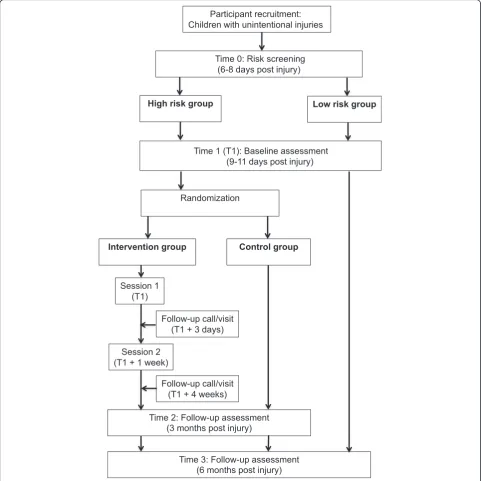
The study design for the two proposed research studies is a two-arm, parallel-group superiority prospective RCT comparing the CARE intervention with TAU. The Con-solidated Standards of Reporting Trials (CONSORT) guidelines for RCTs will be followed, and the study protocol also adheres to the Standard Protocol Items: Recommendations for Interventional Trials (SPIRIT 2013) (see checklist in Additional file 1). The study in-volves five stages (see Fig. 1). Stage 1 participant recruit-ment, will consist of the research team identifying and inviting eligible families to participate in the study and obtaining informed parental consent when the child first presents to hospital. In stage 2, screening,
partici-pating parents will be contacted approximately 6–8
days post-accident to complete the screen. Stage 3, baseline assessment and randomisation, will involve the completion of baseline measures by parents of children
identified as at risk of PTSD approximately 1–3 days
Setting
One RCT is being conducted in Australia at the Lady
Cilento Children’s Hospital (LCCH), Brisbane, and the
other in Switzerland at the University Children’s Hospital, Zurich.
Participants
The inclusion criteria for the two studies vary slightly. Participants are invited to participate in the Australian study if the child (1) requires inpatient or outpatient treatment for an unintentional partial- or full-thickness
burn injury or is admitted to the LCCH for≥6 h
follow-ing an unintentional traumatic injury (e.g., dog bite, RTA, fall) and (2) is aged 1–6 years. Participants meet eligibility criteria for the Switzerland study if the child (1) presents to the University Children’s Hospital for in-patient or outin-patient treatment of an unintentional burn and (2) is aged 1–4 years.
Exclusion criteria for both studies are as follows: (1) Parents’language ability (English in Australia or German in Switzerland) is insufficient to complete measures; (2) child has an initial Glasgow Coma Scale score <12; (3)
[image:4.595.57.539.89.571.2]injury was caused by suspected abuse; (4) child is under the care of child safety; (5) child has a pervasive develop-mental disorder; and/or (6) expected stay in the paediat-ric intensive care unit is longer than 1 week.
Intervention
Theoretical underpinnings of CARE intervention
The Pediatric Psychosocial Preventative Health Model (PPPHM) [24] integrative model of Pediatric Medical Traumatic Stress (PMTS) [25] and the relational PTSD model [26] were used to guide the development of the CARE intervention. The PPPHM model incorporates a biopsychosocial competence-based framework and is adapted from the public health prevention framework of universal, selective and indicated. In this model, universal
represents the majority of families who present to health care settings and appear to be resilient or experiencing dis-tress but coping well. It is recommended that families be provided with general support and information to support their competence, and all children and parents are screened for the presence of risk factors or signs of acute distress.
Targeted(orselective)interventionsare aimed at families in whom signs of acute distress and/or risk factors are evident. It is suggested that early interventions should be aimed at reducing specific symptoms and monitoring distress over time (e.g., through re-screening at key transition times). The minority of families at the top of this model,clinical/ treatment, are those experiencing clinically significant, per-sistent and/or escalating levels of distress and are in need of specialist psychological intervention and support.
The PMTS model describes child and family adjust-ment across three phases after injury and provides rec-ommendations for assessment and intervention. During phase I, peri-trauma, the goal is to modify the subjective experience of PTEs by providing trauma-informed care and to screen for risk. During Phase II, early, ongoing, evolving, the goal is to screen for risk and to prevent or reduce traumatic stress. Finally, the goal of intervention during phase III, longer-term, is to screen and treat sig-nificant traumatic stress.
The relational PTSD model describes the co-occurrence of trauma symptomatology in a young child and the child’s parent [26]. The model proposes that trauma af-fects not only the child but also the parent and that
each member’s symptomatology exacerbates that of the
other through dysfunctional parent-child relationship interaction patterns (i.e., withdrawn/unresponsive/un-available, overprotective/constricting, or re-enacting/ endangering/frightening patterns).
Description of the CARE intervention
The first component of the CARE intervention programme is to provide universal screening to all eligible patients who present to hospital for medical treatment following
a traumatic injury. The second component of CARE is a two-session, manualised, targeted intervention [27] for children showing signs of acute distress (i.e., screened as at risk of PTSD) and is delivered by psy-chologists. The sessions start within the first 2 weeks of the accident (i.e., phase II of the PMTS model) and take
approximately 45–60 minutes to complete. The aim of
the first session is to (1) provide psychoeducation to help parents understand and normalise both their own and their child’s reactions, (2) provide general coping strategies to prevent or manage acute parent and child distress and (3) provide resources to teach parents how to help their child to talk about and create an accurate story about their accident and medical treatment. Re-sources developed for the intervention include the
in-formation bookletsMax the Brave, a storybook about a
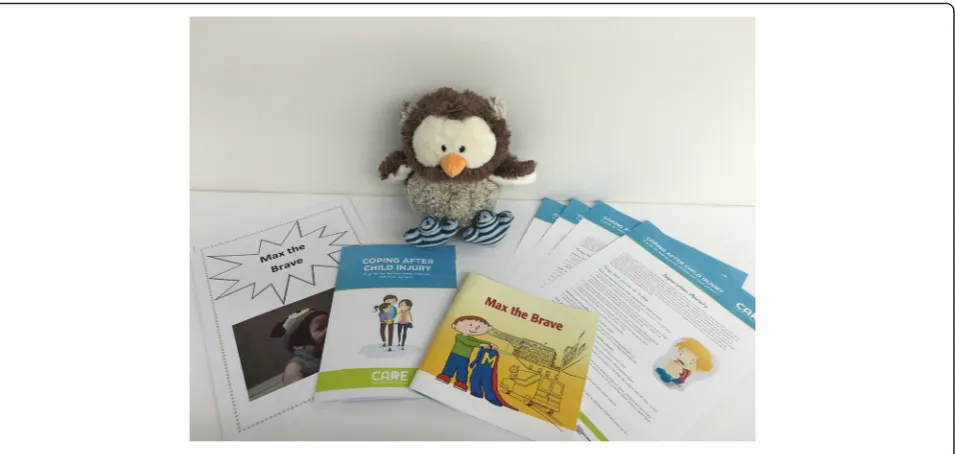
2-year-old boy who goes to hospital after a burn injury; and Lu Lu, an owl toy and a personal storybook tem-plate. Refer to Fig. 2 for a photograph of the English version of the CARE intervention materials.
The aim of the second session (approximately 1 week after session 1 and about 30 minutes in duration) is to (1) monitor child and parent distress levels; (2) educate and normalise how parenting behaviours and the parent-child relationship can change following an accident, help parents identify any unhelpful behaviours (e.g., overpro-tectiveness, excessive guilt, modelling anxious behaviour) and discuss goals for change; and (3) teach parents how to effectively manage their child’s specific presenting problems.
Two brief follow-up sessions (5–15 minutes in
dur-ation) are conducted either in person or over the tele-phone approximately 3 days after session 1 and 6 weeks post-accident to check progress, briefly review coping strategies and provide referral information if needed. Key components of sessions 1 and 2 are outlined in more detail in Table 1.
Treatment as usual
Treatment as usual consists of standard medical care, in-cluding clinical diagnostics and comprehensive, state-of-the-art medical treatment. Depending on the child’s injury, staff members from different disciplines are available for treatment (e.g., surgeons, paediatricians, physical thera-pists, occupational therapist, social workers). Although not routinely provided, psychological support is also avail-able in Switzerland.
Treatment fidelity
of the intervention. Treatment checklists are completed at the end of each session, and adherence will be checked at the completion of the study.
Measures
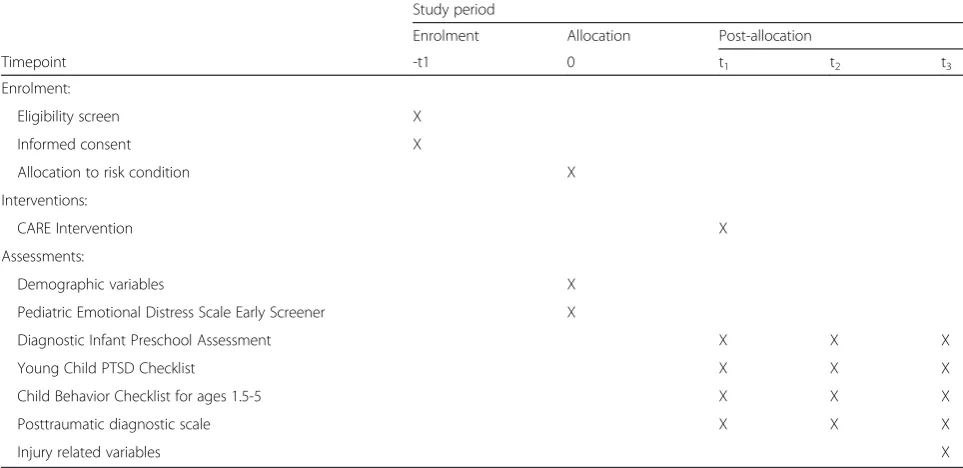
The screening measure will be completed approximately 1 week (6–8 days) after the accident. The clinical
out-come measures will be completed at about 2 weeks (9–
11 days), 3 months and 6 months post-injury (see the recommended SPIRIT flow diagram in Table 2) and were selected on the basis of having demonstrated acceptable psychometric properties and developmental sensitivity.
Screening questionnaire
The Pediatric Emotional Distress Scale-Early Screener (PEDS-ES [28]) is a 21-item caregiver report questionnaire
designed to be used to screen for elevated trauma-related
behaviour in children aged 2–10 years. Caregivers are
required to rate the frequency at which the behaviour has occurred since the trauma on a 4-point Likert scale (0 equal or less often, 1 = a little more often, 2 = much more often, and 3 = very much more often). The PEDS-ES has demonstrated promise as a screening tool for identifying young children (aged 2–6 years) who are at risk of developing PTSD following accidental injury [28]. A score ≥8 indicates that a child is in the at-risk range for developing PTSD.
Primary clinical outcomes
The primary clinical outcome, reduction in PTSS sever-ity scores, will be assessed using the Diagnostic Infant and Preschool Assessment (DIPA). The DIPA [29] is a
[image:6.595.61.539.87.314.2]Fig. 2Image of Coping with Accident Reactions intervention materials
Table 1Summary of key components in each session of the Coping with Accident Reactions intervention
Session 1 (9–11 days post-accident) Session 2 (1 week later)
•Parent’s story about child’s accident and medical treatment
•Psychoeducation on parental distress, promotion of coping skills, and activation of resources to manage own distress
•Psychoeducation on trauma reactions in young children to help understand and normalise the reactions and to identify signs for ongoing problems
•General coping strategies for parents to prevent or manage their child’s distress (All psychoeducation provided orally and in written form.)
•StorybookMax the Brave; help parents talk to their child about accident-related experiences and to show how the character successfully copes with them
•Lu Lu, an owl toy (also introduced inMax the Brave) for child’s comfort and to feel brave in scary situations
•Instructions for creating the personal storybook (e.g., using photographs, drawings, writing, stickers) about the accident and medical treatment to create an accurate understanding and to provide safe exposure to these memories
•Review of child’s presenting symptoms and concerns over the week
•Check parents’distress level and coping ability and provide referral information if necessary
•Check use ofMax the Braveand Lu Lu, encourage parents to continue doing so
•Check if parents are doing the personal storybook correctly, identify any problems and encourage them to continue doing exercises (Book is completed when child’s accident journey has finished.)
•Educate and normalise how parenting behaviours and the parent-child relationship can change following a child’s accident; help them to identify any unhelpful behaviours and discuss goals for change
[image:6.595.58.540.556.732.2]semi-structured diagnostic interview conducted with the primary caregiver of children aged 1–6 years. The DIPA has demonstrated acceptable test-retest reliability [29]. The PTSD module of the DIPA will be used to assess total PTSS severity and impairment in the child.
Secondary clinical outcomes
The PTSD module of the DIPA will be used to provide a PTSD diagnosis. The Young Child PTSD Checklist [30] is a 42-item parent-report questionnaire that assesses criteria of theDiagnostic and Statistical Manual of Men-tal Disorders, Fifth Edition(DSM-5), for PTSD in young children. It will also be used to provide a measure of PTSS severity scores and impairment in the child.
The Child Behavior Checklist for ages 1.5–5 years
(CBCL/1.5-5; [31]) will be used to assess for changes be-tween the intervention and control groups in total prob-lem behaviour scores and internalising and externalising difficulties. The CBCL/1.5-5 is a 100-item parent-report checklist that measures emotional and behavioural func-tioning in children ages 1.5–5 years of age. The CBCL/ 1.5-5 has demonstrated good psychometric properties [31].
The Posttraumatic Diagnostic Scale (PDS; [32]) is a 49-item self-report questionnaire that is used to screen and assess for PTSD in adults. Psychometric evaluation has demonstrated acceptable to excellent internal consistency, good test-retest reliability and acceptable convergent and concurrent validity [33]. The DSM-5 version of the PDS will be used in this
study to provide a measure of PTSD symptom sever-ity ratings and level of impairment in functioning among the parents.
Additional outcomes
Demographic information (e.g., child and parent ages, socio-economic status, family structure), will be obtained by using questions included in the questionnaire booklet completed at the time of screening. Injury- and hospital-related information (e.g., injury severity, length of stay in hospital) will be obtained from the child’s medical rec-ord. The feasibility and acceptability of the intervention will be assessed by looking at (1) participant approach and consent rates, (2) treatment completion, (3) attrition rates, (4) parent satisfaction with the intervention and (5) therapist feedback.
Sample size
[image:7.595.56.538.112.346.2]Published data for a sample of 32 high-risk preschool children (had PTSD 1 month post-burn) who received TAU indicate that their PTSS decreased by an average of three symptoms (from 7 [SD = 2.1] to 4 [SD = 3.3]) over 6 months [3]. We assume that, over the course of 6 months, the number of symptoms in participants in the CARE group will have a mean reduction of five (SD = 3) and the number of symptoms in participants in the TAU groups will have a mean reduction of three (SD = 3). These data are based on the level reported in the recovered high-risk children (i.e., those who no lon-ger met PTSD diagnostic criteria at 6 months) [3].
Table 2Standard Protocol Items: Recommendations for Interventional Trials (SPIRIT 2013) schedule of study recruitment, intervention and assessments
Study period
Enrolment Allocation Post-allocation
Timepoint -t1 0 t1 t2 t3
Enrolment:
Eligibility screen X
Informed consent X
Allocation to risk condition X
Interventions:
CARE Intervention X
Assessments:
Demographic variables X
Pediatric Emotional Distress Scale Early Screener X
Diagnostic Infant Preschool Assessment X X X
Young Child PTSD Checklist X X X
Child Behavior Checklist for ages 1.5-5 X X X
Posttraumatic diagnostic scale X X X
Injury related variables X
0Allocation to the high-risk or low-risk condition occurs via completion of the screener at 6–8 days post- injury.t19–11 days post-injury,t23 months post-injury,
Consequently, we anticipate the mean difference in the number of symptoms between the CARE and TAU groups at 6 months will be two. We assume the SD will
be 3 symptoms and an α-level of 0.05. Using a
two-sided test, a total sample size of 56 children (28 in each treatment group) is required to complete the study with a power of 80 %. This is equivalent to an effect size of 0.75. We anticipate that approximately 25 % of partici-pants will not complete the 6-month interviews; there-fore, we will randomise 76 individual children to get complete primary outcome data for 56 participants.
Randomisation
A computerised random number generator (https:// www.sealedenvelope.com/simple-randomiser/v1/lists) was employed by a researcher not involved in the study to create a randomisation list using blocks of four study participants. Third-party concealment of group alloca-tion was ensured by using a numbered series of opaque, sealed envelopes prepared in advance. Following the baseline assessment, the interviewer opens the sealed en-velope to reveal assignment of the participant to the CARE intervention or to TAU.
Blinding
Randomisation occurs after the baseline assessment; therefore, all interviewers are blinded to treatment condi-tion during the interview. The 3- and 6-month outcome assessments are completed by different psychologists who are blinded to the treatment condition.
Statistical analysis plan
Prior to investigating treatment outcome, the intervention and control groups will be compared for pre-treatment equivalence by using demographic and baseline measures (e.g., sex, age, injury severity, child PTSS, parent PTSS). If significant differences are found (p< 0.001), this will be taken into account by including these variables as covari-ates in outcome analyses. The association between com-pleters and non-comcom-pleters and baseline characteristics will be investigated using Fisher’s exact test and Student’s
ttests. The outcome data will be analysed and reported in terms of statistical significance of differences between groups in change over time, adjusting for the value of the outcome at baseline. To test the association between treat-ment group and outcome, we will do a linear regression, with the main outcome being change over 6 months and the independent variables being treatment group (CARE or TAU), and the baseline score on the outcome under investigation will be included as a co-variable. When appropriate, repeated-measures analyses will be used to compare the two groups with respect to im-provement over time. Generalised estimating equations and generalised linear mixed models will be employed.
For sensitivity analysis, if any systematic differences are found according to assessment completion, we will re-run analyses using 3- and 6-month outcome data im-puted using multiple imputation techniques. Analyses will be conducted on an intention-to-treat basis, with individuals analysed on the basis of the groups to which they were randomised, regardless of the treatment they received. We define statistical significance asp< 0.05.
Dissemination policy
Outcomes will be published in peer-reviewed journals and will also be presented at relevant national and inter-national conferences. Findings will also be disseminated broadly to participants, health care professionals and the public. If the CARE intervention proves to be effective, implementation in other hospitals is planned.
Discussion
Currently, research suggests that early preventive inter-ventions may be beneficial for reducing distress associ-ated with childhood injury. However, further empirical evidence is needed to determine optimal timing, length and content needed for interventions to be effective in preventing the development of persistent PTSD and co-morbid conditions. In particular, despite infants, toddlers and pre-schoolers being a particularly at-risk population, to date, the mental health needs of this group are under-recognised and there is very little evidence available to inform research and clinical practice with this popula-tion. Health service providers need to become better skilled at detection and treatment of post-traumatic stress reactions in young children.
disease and dysfunction across the lifespan. Given the high incidence of paediatric injury worldwide, a suc-cessful early intervention programme for this at-risk population could have significant implications for the social and economic costs associated with medical trauma and beyond.
It is expected that outcomes from this research will make significant original contributions to the clinical treat-ment and recovery of very young, unintentionally injured children, adding to the resource and scientific evidence base. The parallel research studies evaluating this interven-tion in Australia and Switzerland highlight the inter-national significance of this problem and will strengthen the generalisability of our findings. Altogether, the findings will help increase the impact and awareness of this import-ant area internationally.
Trial status
The Australian study commenced recruitment on 3 June 2014 and the Swiss study did so on 1 April 2014. The recruitment for both trials is expected to be completed by the end of 2016 and final assessments by mid-2017.
Additional file
Additional file 1:SPIRIT 2013 checklist: recommended items to address in a clinical trial protocol and related documents. (DOC 256 kb)
Abbreviations
CARE, Coping with Accident Reactions; CBCL, Child Behavior Checklist; CONSORT, Consolidated Standards of Reporting Trials; DIPA, Diagnostic Infant and Preschool Assessment; DSM-5,Diagnostic and Statistical Manual of
Mental Disorders, Fifth Edition; LCCH, Lady Cilento Children’s Hospital; PDS,
Posttraumatic Diagnostic Scale; PEDS-ES, Pediatric Emotional Distress Scale-Early Screener; PMTS, Pediatric Medical Traumatic Stress; PPPHM, Pediatric Psychosocial Preventative Health Model; PTE, potentially traumatic event; PTSD, post-traumatic stress disorder; PTSS, post-traumatic stress symptoms; RCT, randomised controlled trial; RTA, road traffic accident; SPIRIT 2013, Standard Protocol Items: Recommendations for Interventional Trials; TAU, treatment as usual; TF-CBT, trauma-focused cognitive behavioural therapy
Acknowledgements
We acknowledge and thank Professor Michael Scheeringa for his expert advice and helpful feedback during the development of the CARE early intervention.
Funding
ACDY and ML received funding from the Swiss National Science Foundation (SNSF) to support an international short visit for ACDY to travel to Zurich to develop the CARE intervention in collaboration with ML. The Australian study is funded by a Queensland Children’s Medical Research Institute Program Grant received by the Centre for Children’s Burns and Trauma Research. The Swiss study is supported by a grant from the Swiss National Science Foundation (100014_149158). The funding bodies have not played a role in the design of the study and collection, analysis, and interpretation of data or in writing the manuscript.
Authors’contributions
ACDY and ML developed all of the content for the CARE intervention together and formed plans to evaluate the intervention via RCTs. JAK, ACH and RMK provided feedback on intervention content, and ACH facilitated the translation of the intervention resources into German. All authors participated in
the study design. ACDY drafted the manuscript with input from and editing by all authors. All authors read and approved the final manuscript.
Competing interests
The authors declare that they have no competing interests.
Consent for publication
Written informed consent was obtained from the participant for publication of the image in this manuscript. The consent form is held by the authors and is available for review by the Editor-in-Chief of this journal.
Ethics approval and consent to participate
The Australian study has being granted ethics approval by the University of Queensland Human Research Ethics Committee, the Royal Children’s Hospital (Brisbane) Children’s Health Service District Ethics Committee and the Children’s Health Queensland Human Research Ethics Committee. The study methodology was documented in a protocol and registered with the Australian New Zealand Clinical Trials Registry (ACTRN12614000325606) on 26 March 2014 prior to the start of recruitment. The Swiss study has been approved by the Kantonale Ethikkommission Zürich ethics committee and registered at ClinicalTrials.gov (NCT02088814) on 12 March 2014 prior to the start of recruitment. All participants are given verbal and written information about the study and provide signed consent to participate in the research. The information collected about participants is individually identifiable by members of the research team only. Each participant will be allocated a unique numerical code (identification number) such that all stored electronic data (e.g., databases, data files) will contain identifiable data until the completion of the study. All confidential information is stored in locked filing cabinets, and only de-identified data will be presented or published.
Author details
1Centre for Children’s Burns and Trauma Research, Centre for Child Health
Research, University of Queensland, Brisbane, Australia.2Department of
Psychosomatics and Psychiatry and Children’s Research Centre, University Children’s Hospital Zurich, Zurich, Switzerland.3School of Psychology and
Recover Injury Research Centre, University of Queensland, Brisbane, Australia.
4Division of Child and Adolescent Health Psychology, Department of
Psychology, University of Zurich, Zurich, Switzerland.
Received: 12 May 2016 Accepted: 17 June 2016
References
1. Grasso DJ, Ford JD, Briggs-Gowan MJ. Early life trauma exposure and stress sensitivity in young children. J Pediatr Psychol. 2013;38(1):94–103. doi:10. 1093/jpepsy/jss101.
2. Australian Institute of Health and Welfare. A picture of Australia’s children 2009. Cat. no. PHE 112. Canberra: Australian Institute of Health and Welfare; 2009. http://www.aihw.gov.au/WorkArea/DownloadAsset.aspx?id= 6442459928. Accessed 17 Jul 2016.
3. De Young AC, Kenardy JA, Cobham VE, Kimble R. Prevalence, comorbidity and course of trauma reactions in young burn-injured children. J Child Psychol Psychiatry. 2012;53(1):56–63. doi:10.1111/j.1469-7610.2011.02431.x. 4. Graf A, Schiestl C, Landolt MA. Posttraumatic stress and behavior problems
in infants and toddlers with burns. J Pediatr Psychol. 2011;36(8):923–31. doi: 10.1093/jpepsy/jsr021.
5. Meiser-Stedman R, Smith P, Glucksman E, Yule W, Dalgleish T. The posttraumatic stress disorder diagnosis in preschool- and elementary school-age children exposed to motor vehicle accidents. Am J Psychiatry. 2008;165(10):1326–37.
6. Stoddard FJ, Ronfeldt H, Kagan J, Drake JE, Snidman N, Murphy JM, et al. Young burned children: the course of acute stress and physiological and behavioral responses. Am J Psychiatry. 2006;163(6):1084–90.
7. Walburn J, Vedhara K, Hankins M, Rixon L, Weinman J. Psychological stress and wound healing in humans: a systematic review and meta-analysis. J Psychosom Res. 2009;67(3):253–71. doi:10.1016/j.jpsychores.2009.04.002. 8. De Young AC, Kenardy JA, Cobham VE. Trauma in early childhood: a
9. Bakker A, Van Loey NEE, Van der Heijden PGM, Van Son MJM. Acute stress reactions in couples after a burn event to their young child. J Pediatr Psychol. 2012;37(10):1127–35. doi:10.1093/jpepsy/jss083.
10. De Young AC, Hendrikz J, Kenardy JA, Cobham VE, Kimble RM. Prospective evaluation of parent distress following pediatric burns and identification of risk factors for young child and parent posttraumatic stress disorder. J Child Adolesc Psychopharmacol. 2014;24(1):9–17. doi:10.1089/cap.2013.0066. 11. Landolt MA, Ystrom E, Sennhauser FH, Gnehm HE, Vollrath ME. The mutual
prospective influence of child and parental post-traumatic stress symptoms in pediatric patients. J Child Psychol Psychiatry. 2012;53(7):767–74. doi:10. 1111/j.1469-7610.2011.02520.x.
12. Phoenix Australia Centre for Posttraumatic Mental Health. Australian guidelines for the treatment of acute stress disorder & posttraumatic stress disorder. Melbourne: Phoenix Australia Centre for Posttraumatic Mental Health; 2013. https://phoenixaustralia.org/wp-content/uploads/2015/03/ Phoenix-ASD-PTSD-Guidelines.pdf. Accessed 17 Jul 2016.
13. Roberts NP, Kitchiner NJ, Kenardy J, Bisson JI. Systematic review and meta-analysis of multiple-session early interventions following traumatic events. Am J Psychiatry. 2009;166(3):293–301. doi:10.1176/appi.ajp.2008.08040590. 14. Rose S, Bisson J, Churchill R, Wessely S. Psychological debriefing for
preventing post traumatic stress disorder (PTSD). Cochrane Database Syst Rev. 2002;2:CD000560. doi:10.1002/14651858.CD000560.
15. Paterson HM, Whittle K, Kemp RI. Detrimental effects of post-incident debriefing on memory and psychological responses. J Police Crim Psychol. 2014;30(1):27–37. doi:10.1007/s11896-014-9141-6.
16. National Collaborating Centre for Mental Health; National Institute for Clinical Excellence. Post-traumatic stress disorder (PTSD): the management of PTSD in adults and children in primary and secondary care. National Clinical Practice Guideline 26. London: Royal College of Psychiatrists/British Psychological Society; 2005.
17. Berkowitz S, Stover CS, Marans SR. The child and family traumatic stress intervention: secondary prevention for youth at risk of developing PTSD. J Child Psychol Psychiatry. 2011;52(6):676–85. doi:10.1111/j.1469-7610.2010. 02321.x.
18. Kenardy J, Thompson K, Le Brocque R, Olsson K. Information-provision intervention for children and their parents following pediatric accidental injury. Eur Child Adolesc Psychiatry. 2008;17(5):1–10.
19. Cox C, Kenardy J, Hendrikz J. A randomized controlled trial of a web-based early intervention for children and their parents following unintentional injury. J Pediatr Psychol. 2010;35(6):581–92.
20. Kenardy JA, Cox CM, Brown FL. A web-based early intervention can prevent long-term PTS reactions in children with high initial distress following accidental injury. J Trauma Stress. 2015;28(4):366–9. doi:10.1002/jts.22025. 21. Zehnder D, Meuli M, Landolt MA. Effectiveness of a single-session early
psychological intervention for children after road traffic accidents: a randomised controlled trial. Child Adolesc Psychiatry Ment Health. 2010;4:7. doi:10.1186/1753-2000-4-7.
22. Kramer DN, Landolt MA. Characteristics and efficacy of early psychological interventions in children and adolescents after single trauma: A meta-analysis. Eur J Psychotraumatol. 2011;2:7858. doi:10.3402/ejpt.v2i0.7858. 23. Kramer DN, Landolt MA. Early psychological intervention in accidentally
injured children ages 2-16: A randomized controlled trial. Eur J Psychotraumatol. 2014;5. doi:10.3402/ejpt.v5.24402.
24. Kazak AE. Pediatric Psychosocial Preventative Health Model (PPPHM): research, practice, and collaboration in pediatric family systems medicine. Fam Syst Health. 2006;24(4):381–95. doi:10.1037/1091-7527.24.4.381. 25. Kazak AE, Kassam-Adams N, Schneider S, Zelikovsky N, Alderfer MA, Rourke
M. An integrative model of Pediatric Medical Traumatic Stress. J Pediatr Psychol. 2006;31(4):343–55.
26. Scheeringa MS, Zeanah CH. A relational perspective on PTSD in early childhood. J Trauma Stress. 2001;14(4):799–815.
27. De Young AC, Landolt MA. The Coping with Accident Reactions (CARE) intervention: manual. Brisbane and Zurich: University of Queensland and University of Zurich; 2014.
28. Kramer DN, Hertli MB, Landolt MA. Evaluation of an early risk screener for PTSD in preschool children after accidental injury. Pediatrics. 2013;132(4): e945–51. doi:10.1542/peds.2013-0713.
29. Scheeringa MS, Haslett N. The reliability and criterion validity of the Diagnostic Infant and Preschool Assessment: a new diagnostic instrument for young children. Child Psychiatry Hum Dev. 2010;41(3):299–312. doi:10.1007/s10578-009-0169-2.
30. Scheeringa MS. Young Child PTSD Checklist. New Orleans: Tulane University; 2010.
31. Achenbach TM, Rescorla LA. Manual for the ASEBA preschool forms & profiles. Burlington, VT: University of Vermont, Research Center for Children, Youth, & Families; 2000.
32. Foa EB. Posttraumatic Stress Diagnostic Scale: Manual. Minneapolis, MN: Pearson; 1995
33. Foa EB, Cashman L, Jaycox L, Perry K. The validation of a self-report measure of posttraumatic stress disorder: The Posttraumatic Diagnostic Scale. Psychological Assessment. 1997;9(4):445–51.
• We accept pre-submission inquiries
• Our selector tool helps you to find the most relevant journal • We provide round the clock customer support
• Convenient online submission • Thorough peer review
• Inclusion in PubMed and all major indexing services • Maximum visibility for your research
Submit your manuscript at www.biomedcentral.com/submit