OCT-NOV, 2015, VOL. 2/12 www.srjis.com Page 2977 E-LEARNING CONTENT DEVELOPMENT A ROLE IN VIRTUAL CLASS ROOM
J.Thirumaran Ph.D 1 A.Uthiramoorthy 2
1* Principal, Rathinam College of Arts and Science, Coimbatore-21.
2* Asst. Professor, Department of Computer Science, Rathinam College of Arts and Science, Coimbatore-21,
For the past two decades, the e-learning is becoming more popular and vibrant among the learners world-wide. Developing e-learning is more costly than preparing teaching contents and pilot training (faculty training), especially if multimedia or highly interactive methods are used for delivering the course content. However, delivery costs for e-learning (including costs of establishment of the e-learning hardware and software requirements) are considerably lower than those for creating classroom facilities, instructor time, travel time of the students lost towards attending the class room sessions. Creating e-learning materials is a time-consuming process and requires expertise and experience in handling tools. There are various ways of creating e-learning content such as using html pages, videos, images and audio. In this paper, the various ways of creating learning is presented and discusses the design components of e-learning.
Keywords: E-learning, Content Development, multimedia, video, image
c Scholarly Research Journal's is licensed Based on a work at www.srjis.com
OCT-NOV, 2015, VOL. 2/12 www.srjis.com Page 2978 Introduction
Study materials and course contents provided to the students have been designed effectively will create an ambience to achieve the expected outcomes from the students. Effective design of electronic learning materials relies on instructional design processes that reflect the absence of or reduction in face-to-face instruction [Brown 2005]. Moreover, e-learning reaches a wider target audience by engaging learners who have difficulty in attending traditional classroom training because they are
geographically dispersed with limited time and/or resources to travel
busy with work or family commitments which do not allow them to attend courses on specific dates with a fixed schedule
located in conflict and post-conflict areas and restricted in their mobility because of security reasons
limited from participating in classroom sessions because of cultural or religious beliefs
Facing difficulties with real-time communication (e.g. foreign language learners or very shy learners).
E-learning can offer effective instructional methods, such as practising with associated feedback, combining collaboration activities with self-paced study, personalizing learning paths based on learners’ needs and using simulation and games. Further, all learners receive the same quality of instruction because there is no dependence on a specific instructor. In general, an eLearning material will give the learner a little more comfortable room than a general class taught at a single pace. Everyone learns differently, and some people will want to review more material than others. ELearning process will allow learners the opportunity to explore the material at a rate they’re comfortable with. Using visuals, comprehension quizzes, and learning games to reinforce material will lighten the mood and make for a stress-free learning experience.
OCT-NOV, 2015, VOL. 2/12 www.srjis.com Page 2979 designers of e-learning materials can create online resources, appropriate for K-12 and tertiary settings. The six design elements are given below
a. Activity - An activity is one that opens up opportunities for action rather than directs
students down a prescribed pathway.
b. Scenario - The learning agenda is largely institutional, students are encouraged and assisted
by an interesting scenario into which the activities are placed. Scenarios are usually provided by a story, role play, or simulation, within which the activity plays a pivotal role in helping students to contextualize content. The scenario will most likely be fictional; however, there is an assumption that the learning or skill gained through the activity will be transferred to future real world situations. An interesting scenario will make extensive use of humor, imagination, reward, anticipation, or drama to enhance the activity. It will have topics and themes likely to be relevant and interesting to the target audience. It will make the learning activity seem like an obvious or necessary thing to undertake, given the situation presented by the scenario.
c. Feedback - Effective e-learning design will include provision for feedback that amplifies the
learning from the experience, and enables students to increase their level of skill and knowledge. The range of available feedback strategies is vast, including reflective responses to prescribed questions, semi-automated responses by the system to student actions and work, shared comments in online forums and blogs, and personal responses via email, telephone, and post.
d. Delivery - Good educational design relies on appropriate delivery to reach its full potential.
Conditions for defining appropriate or effective delivery are not easily specified because of contextual variations on learning environments.
e. Context - Elements of activity, scenario, and feedback need to take into account the users’
OCT-NOV, 2015, VOL. 2/12 www.srjis.com Page 2980 the broader context within which the learning activity is delivered can influence many elements of e-learning design.
f. Influence - The influence of the e-learning design can be accessed from a number of
perspectives, including the way that it will affect the learner, the ramifications that it will have for the learning (and broader) community into which it will be implemented, and the environmental influence of its development and use. Considerations about the personal influence of the e-learning design might consider the extent of learning that is likely to take place compared to the effort required to produce the resource. They might also consider the potential effect of the content and its presentation on a person’s self-esteem and other psychological states.
1. Content Development Methods
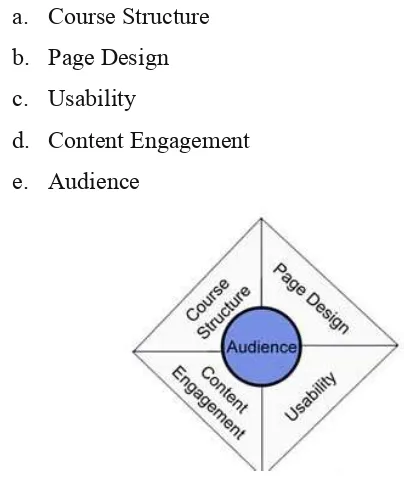
Development of successful e-learning material starts with effective planning. The more in-depth and completing the course plan is, the easier it will be for to deliver the course and identify possible solutions before the problem arise. There are many different elements that contribute to develop excellent e-learning materials as mentioned by Brown (2005). The following five are the major elements of the e-learning content designing comparing to the Brown (2005).
a. Course Structure
b. Page Design
c. Usability
d. Content Engagement
[image:4.612.174.376.423.665.2]e. Audience
OCT-NOV, 2015, VOL. 2/12 www.srjis.com Page 2981 Technology is required to produce and deliver e-learning. Different tools can be used to produce e-learning content, depending on which file formats will be used and the nature of the desired final product. Microsoft PowerPoint or even Word can be sufficient to create simple learning resources like a presentation or a tutorial. However, more sophisticated tools are required if you want to create interactive content. Courseware authoring tools are special-purpose tools that create interactive e-learning content. They add text, graphics and other media, but also provide a framework to organize pages and lessons for reliable navigation. While most of these tools are stand-alone packages that incorporate assessment and quiz capabilities, some integrate those functions from other programs. To create media components, authoring tools need auxiliary software (e.g. Adobe Photoshop for bitmap graphics, Adobe Illustrator for vectoral images or Adobe Flash for animations) and other tools for video and sound creation and compression. Organizations and education institutions increasingly are turning to learning platforms to deliver courses to learners and manage their online activities. A learning platform is a set of interactive online services that provide learners with access to information, tools and resources to support educational delivery and management. They provide access and services to a wide user base through the Internet. Learning platforms are usually referred to as a learning management system (LMS) or a learning content management system (LCMS), terms which often are used interchangeably. There are a variety of learning platforms with different levels of complexity, and despite their differences, they also have many features in common. Their most important features include
learning content management: creation, storage, access to resources;
curriculum mapping and planning: lesson planning, personalized learning paths, assessment;
learner engagement and management: learner information, progress tracking; and
tools and services: forums, messaging system, blogs, group discussions.
HTML Pages
OCT-NOV, 2015, VOL. 2/12 www.srjis.com Page 2982 server or LMS so that students can access them. Perhaps the fastest way of creating an e-learning resource is to provide links to existing web sites and resources into the instructor web site. The pages prepared by the instructor can create the context and the instructions for the students and provide hyperlinks to the resources that already exist on the internet. It is important to realize that these links may become obsolete as web sites often change their addresses or are removed from the web.
Video
With the availability of high-quality digital cameras, cheap recording and storage media and consumer-level software capable of quality editing on the desktop, video has become an affordable option for enhancing e-learning material. Enthusiastic individual trainers can achieve good results, or development teams can prepare quality content on a budget. Adding video to the e-learning materials can really make them engaging and provide an alternative to the “sit and read this…” model that is used so often. Video meets the preferences of those students with a predominantly auditory and visual learning style. A quick minute or two minute video segment can get across as much information as several screens of text. In case of using video make sure it is worth it. Just having a ‘talking head’ may not be the most appropriate use of the technology. Demonstrations and active scenes make best use of the medium. One of the main problems of including video, or movie media as e-learning resources is the size of the files and the time they take to download. There are, however, a few ways to overcome the download problem, the most popular of which is hosting.
Images
Creating a tutorial on how to use a computer or work with specific software may require capturing either images from the screen or making a “movie” of the actions that are performed by the instructor.
Capturing images from the screen
OCT-NOV, 2015, VOL. 2/12 www.srjis.com Page 2983 allows the instructor to select the part of the screen to be captured. The instructor may capture the whole screen, a specific window or an area that they need. Once the image(s) have been captured they can be added to the web learning resources using the privileges available in LMS. Making screen movies
A screen movie captures the motion of the cursor as it moves around the screen, menus selected and buttons clicked. Some software also allows the instructor to create a voice annotation along with the screen movie. The movie file can be saved in a number of formats that can be embedded in a web page and viewed in most modern browsers
Audio
By adding audio to the e-learning resources can add an extra dimension of information and engagement for the students. It is much easier to listen to a piece of information, particularly if it is complex, than to read it on the screen. It also adds a personal and human element to the learning resource. It is mandatory to consider the size of the recording file when making an audio record. Long high quality audio files can be quite large. Making a number of recordings of several minutes is a better strategy than creating one long recording. The file type can also affect the file size. MP3 files are quite small and are played by most browser plug-ins. To reduce files size, choose a recording quality of 11,000 Hz. This is equivalent to a good phone conversation. CD quality is 44,000 Hz and will create very large file sizes. Make sure the recordings are made as mono rather than stereo recordings. This will also reduce the file size and will not be able to hear the recording in stereo when played from a web page. Make sure have a good quality microphone. It does not have to be a broadcast quality microphone but using the inbuilt microphone in a laptop computer will probably give a good quality recording. . Once the audio have been recorded they can be added to the web learning resources using the provisions available in LMS.
Conclusion
OCT-NOV, 2015, VOL. 2/12 www.srjis.com Page 2984 time’. As Open Source Software competes with proprietary software, and as software become easier to use, the costs of developing e-learning are decreasing. The development of e-learning materials becoming easier and quicker for educators and trainers with little knowledge or experience in computing to develop effective e-learning courses. As the software for development of e-learning becomes easier to use, yet more sophisticated, it will become possible to develop e-learning courses that can more readily be tailored to the learner’s particular needs. References
Andrew R. Brown and Bradley D. Voltz, “Elements of Effective e-Learning Design”,
International Review of Research in Open and Distributed Learning, Vol 6, No 1 (2005).
Beatrice Ghirardini, Instructional Designer, FAO, “E-learning methodologies A guide for designing and developing e-learning courses”, Food and Agriculture Organization of the United Nations, 2011, ISBN 978-92-5-107097-0
Dewey, J. (1970). Experience and education. New York: Collier Books.
Frydenberg, J. (2002). Quality standards in e-learning: A matrix of analysis. International Review of Research in Open and Distance Learning, 3(2).
Pacey, A. (1999). Meaning in Technology. Cambridge, MA.: The MIT Press.
Raskin, J. (2000). The Humane Interface: New directions in designing interactive
systems. Reading, MA: Addison Wesley.
Shakar, M., and Neumann, Y. (2003). Differences between Traditional and Distance Education Academic Performances: A meta-analytic approach. International Review of Research in Open and Distance Learning, 4(2).
Young, L. (2003). Bridging Theory and Practice: Developing guidelines to facilitate the design
of computer-based learning environments. Canadian Journal of Learning and
Technology, 23(3).