FEB-MAR, 2016, VOL. 3/14 www.srjis.com Page 3443 INFORMATION TECHNOLOGY USAGE BY INDIAN BANKS IN MARKETING
OPERATIONS
Jyoti Arora1 & R.K. Gautam2 Ph.D. 1
Assistant Professor in Commerce, GGDSD College, Kheri Gurna, Banur 2
Assistant Professor in Management, Punjabi University Regional Centre for Information
Technology and Management, Mohali
Since the time of privatization, liberalization and globalization of banks in India, the Indian
banking sector has been developing constantly taking into consideration the requirements of
different segments of the society. In the present era, the banks have changed their approach from
Conventional Banking to Convenience Banking. Use of information technology in banking
industry is the most important element in Convenience banking. Today, the banks are
consistently engaged in technological innovation of product and process to provide services to
their customers in the more efficient manner. The present paper attempts to study the use of
information technology by the Indian private sector and public sector banks in marketing of their
products.
Introduction
Banking can be seen as the lifeline of any nation and its people. Banks are the financial
institutions that accept deposits and allow credit to the business persons or general public.
Banking is the basic premise of financial, industrial and agricultural improvement of an
economy. The most important function of banking is to provide services to the depositors and
Scholarly Research Journal's is licensed Based on a work at www.srjis.com
FEB-MAR, 2016, VOL. 3/14 www.srjis.com Page 3444 borrowers (Bell and Murphy, 1968). In the current scenario of economic planning, agriculture,
industry and trade, advancement of the banks and the banking framework is viewed as a pivotal
need. All business and industrial activities are all around sewed with the bankers. Banks assume
an imperative part in initiating the economic development of the nation.
The Indian banking sector had experienced a noteworthy strategy shifts at the outset of the
1990s. The period from 1992 to 1997 set the foundations for reform in the banking system
(Rangarajan, 1998). The new model of financial reforms is commonly known as the
Liberalisation, Privatisation and Globalisation policy. The main idea behind the introduction of
this model was to make the Indian economy the fastest growing economy in the world with the
potential that would facilitate it to match up with the leading economies of the world. The series
of reforms that took place with regard to financial service industries aimed at stimulating the
economy of the country to a more proficient level.
The new private sector banks first made their emergence after the regulations permitting
them were issued in January 1993. These banks had access to the state-of-the-art technology,
which in turn helped them to save on workforce cost and provide better services to the
customers. Introduction of technology in the operations of banking sector has also affected the
employees’ productivity in a positive manner, (B. Janki, 2002). The public sector banks in India
faced new challenges because of gradual up-gradation of skills, technology, restructuring and
re-engineering processes attempted by the foreign and private sector banks. It was becoming
extremely difficult for the public sector banks to compete with the new private sector banks and
the foreign banks. The slow-moving public sector banks were forced to adopt a fast track
approach in order to satisfy its customers. These banks were constrained to acquire the financial
muscles to compete with the private sector and foreign banks. The competition created by the
new private sector banks by the innovation with the technology, new business practices and the
new products had undoubtedly re-energized the Indian banking sector as a whole (Mohan,
2004).
Advancement in technology is set to cause a major move in the working of banks
(Avasthi & Sharma, 2000-01). It has not only offered them some help in acquiring updates with
their internal working but also engaged them to give better customer services. Front workplaces
in bank branches have gone into considerable and across the board change with introduction of
FEB-MAR, 2016, VOL. 3/14 www.srjis.com Page 3445 cash deposits, withdrawals, cheque collection, balance enquiry etc. Internet banking and
e-banking have opened new pathway in “Convenience Banking” i.e. easy access e-banking. Further
more, internet banking has prompted lessening in transaction costs for banks. Technological
course of action has also made the flow of information much speedier and more exact.
Now-a-days, the use of Information technology is persistent in marketing of their
products by the banks. For many simple transactions like withdrawal of money, checking
balance in accounts and on-line purchasing etc., the use of information technology has become a
custom. Many banks have expanded their internet presence with the improved websites that mark
the facilities to open new accounts, download forms and process loan applications etc.. With the
availability of internet, customer service is provided around the clock by the banks. The
customers can obtain any required information through the web-site of the banks. They feel more
comfortable using the Internet to seek advice and gather the product related information rather
than physically visiting the branch for the same.
Emerging Technological Trends in Banking
In the current scenario, the banks are employing the latest technology in making available
the services to their customers and providing information to them without any loss of time. To
compete effectively with the competitors, Indian banks are undertaking various technology
driven innovative activities. The following are the emerging trends in the use of information
technology by Indian banks for marketing of their products:
Internet banking
Mobile banking
Social networking
Blogging
Search engine links
Pay per click marketing and
Use of other techniques of internet marketing.
Review of Literature
Singh (1985) opined that the banks need to improve the technical and functional quality of
service. While the technical quality can be improved by adopting updated and innovative
technology, the functional quality can be improved by adopting customer oriented business
FEB-MAR, 2016, VOL. 3/14 www.srjis.com Page 3446 Morris, et. al. (1994) investigated the increasing role of marketing in the firm in the present era
of changing customer-organisation relationship. He observed that in the present scenario, the
change in technology also has an impact on the marketing strategy interface. The use of
technology in marketing was found to be important for brining the customer close to the
company.
Quinn, J.B. (1996) identified that there is a positive correlation between the use of information
technology to simplify the work and customer satisfaction. In the service sector, technology is
being used to homogenize services by reducing the interaction of customers with the employees.
The banks are encouraging the use of modern technologies to add to the services they offer and
to increase customer loyalty and market share. The use of information technology results in cost
reduction which ultimately leads to customer satisfaction by way of price reduction.
Srirojanant and Thirkell (1998) studied the nature of relationship marketing in Indian Banking
Sector through technology. They stated that internet is a tool which is extensively used and it
satisfies the needs of the customers in a more effective and efficient manner than the traditional
marketing tools. Internet is far reaching and it connects the customers at different places with an
organization. It results in a higher degree of interaction and promote better relations with the
customers.
Kandampully (2002) studied the part of technology, innovation, network and knowledge in the
growth of services. Technology encourages and support the upkeep of networks with customers
and accomplices inside and outside the firm. The network of relationships renders the firms’
capability "indistinct" in nature. This amorphous knowledge represents the genuine resources in
a service firm which ultimately provides the creative potential for innovation which is
additionally called center competency.
Mohan and Ray (2004) expressed that following the reforms in 1992, competition in the Indian
banking sector has increased manifold. The private sector banks have re-energized the Indian
banking sector as a whole. The new products are being introduced persistently and there has
likewise been the improvement in consumer service. The effect of innovation, new technology,
better technical know-how resulting upon foreign collaboration and focused product targeting
dovetailed to specific segments have contributed towards significant development of Indian
FEB-MAR, 2016, VOL. 3/14 www.srjis.com Page 3447 Uppal R. K. (2008) stated that in the post liberalization, privatization and globalization era,
transformation in Indian banks is taking place because the banks are stepping towards e-banking
from traditional banking. The paper analyzed the quality of e-banking services in the changing
environment and it was concluded that most of the customers of e-banks are satisfied with the
different e-channels and their services.
Padhy and Swar (2009) contemplated the service quality and customer satisfaction among
Private, Public and foreign banks with respect to five variables of service quality viz. tangibility,
reliability, responsiveness, assurance and empathy in the state of Orissa. He found that foreign
banks are at the top followed by private sector banks and public sector banks. He expressed that
technology, innovation has an impact in differentiating the three groups of banks as far as the
consumer perception of service quality are concerned.
Jain Yogesh (2013) stated that the use of technology in India has undergone swift revolution.
The last two decades have seen a variety of changes in the method of services offered by banks.
He identified that the banks are using information technology mainly under two different
avenues. These avenues are communication and connectivity and the business process. Today,
banks have adopted technology to offer services to their customers in a more effective manner.
This enables the banks to maintain more personal and intimate relationship with customers.
Vimala (2015) opined that the banking is becoming more complex and banks which do not use
technology to provide services to the customers and tap the potential customers will face loses.
At the end, technology is the pivot element and differentiator in providing the competitive edge
to a bank. There is a tremendous scope for introducing the innovation with the aid of technology.
Accordingly, the banks have introduced web-based services i.e. internet banking for marketing
of products in a better way.
Significance of the Study
The use of Information Technology in all spheres of financial and banking sectors is
increasing consistently. The revolution in information technology has enabled the banking sector
to go beyond its traditional role. The banks are increasingly interconnecting their computer
systems not only across branches in a city but also to other geographic locations. The customers
have become more techno- adroit. They have high expectations and have become additionally
FEB-MAR, 2016, VOL. 3/14 www.srjis.com Page 3448 Reserve Bank of India has formulated many policies on adoption of information technology in
the overall working of the commercial banks in India, yet there is a great need to focus more on
this aspect. The present study will help to know the use of technology by Indian public sector
and private sector banks in marketing of their loan products
Objectives of the Study
The objective of the paper is to study the use of information technology such as mobile
banking, internet banking and sms banking in marketing of loan products by the selected private
and public banks.
Research Methodology
The universe of the study is the banks operating in the states of Punjab, Haryana and
Union Territory of Chandigarh. The study include 10 leading banks out of which 5 are from
public sector (SBI, PNB, OBC, UCO Bank and Corporation Bank), and 5 from private sector
(ICICI Bank Ltd., HDFC Bank Ltd., AXIS Bank, The Federal Bank Ltd. and ING Vysya Bank
Ltd). The officials of 10 leading banks were contacted for the purpose of the study.
A sample of 500 officials were selected from the above banks. The sample scheme
comprised of 250 officials from each sector bank. The data collection was be done from
respondents who are presently handling banking services through structured questionnaire. An
effort was made to make the sample more representative. Chi-square statistic is used to test the
various hypothesis.
Hypothesis
The following null hypothesis have been framed for the purpose of the study:
Ho1: There is no statistical significant difference in the use of information technology in
marketing of loan products by the public sector banks.
Ho2: There is no statistical significant difference in the use of information technology in
marketing of loan products by the private sector banks.
Ho3: There is no statistical significant difference in the use of information technology in
marketing of loan products by the public sector and private sector banks.
Discussion and Analysis
A questionnaire containing a number of statements was developed to know the impact of
information technology on the marketing of loan products by the private sector and public sector
FEB-MAR, 2016, VOL. 3/14 www.srjis.com Page 3449 statements on five-point Likert scale. Since the data is non-parametric in nature, chi-square test is
applied to test the null hypothesis. The test has been applied to check the level of significance at
assumed value of 0.01. The null hypothesis is rejected for the statements with less than 0.01
p-value and are accepted for statements with more than 0.01 p-p-value.
[image:7.612.67.550.214.727.2]The analysis of the data gave the following findings:
Table 1 Chi-square table for use of information technology in marketing among public
sector banks
Public Bank
PNB SBI OBC UCO Cooperative
Bank F value P value Mea n
SD Mea
n
SD Mea
n
SD Mea
n
SD Mea
n
DS
Internet or mobile banking is
useful in
marketing bank products.
3.94 0.2
4 3.82
0.3
9 2.54
0.8
6 3.28
0.9
7 2.28
0.6
4 60.19
0.00* *
Your bank
has a
facebook account to stay in touch
with the
customers.
2.08 0.2
7 2.20
0.4
0 2.08
0.2
7 2.32
0.7
4 3.52
0.7
9 63.07
0.00* *
You send
regular updates of new
products and schemes on the e-mail addresses of your
customers.
4.66 0.6
3 3.82
0.4
4 2.52
0.8
4 3.32
0.9
6 2.20
0.6
1 95.76
0.00* *
You use pay
per click
marketing for getting your offer in
front of
potential new clients.
4.70 0.5
8 3.84
0.4
2 3.94
0.2
4 3.68
0.7
4 2.36
0.7 8 104.2 0 0.00* * More detailed contents is
4.70 0.5
8 3.84
0.4
2 3.94
0.2
4 3.68
0.7
4 2.46
0.7
9 93.75
FEB-MAR, 2016, VOL. 3/14 www.srjis.com Page 3450 provided to
search engines by
your bank
than competitors. You advertise your product by networking with influential bloggers.
4.88 0.4
8 4.60
0.8
1 4.18
0.5
6 3.82
0.8
7 2.58
1.0
1 67.33
0.00* *
You have
built links
for your
website through the search engines.
3.76 0.4
3 3.08
0.2
7 3.66
0.4
8 3.14
0.3
5 3.18
0.3
9 33.48
0.00* *
You send
regular updates regarding new
products and offers on the
mobile of
the customer.
3.94 0.6
5 3.48
0.5
0 3.50
0.5
1 3.58
0.5
4 3.84
0.6
5 6.64
0.00* *
[image:8.612.80.539.100.478.2]** p<0.01 level of significance
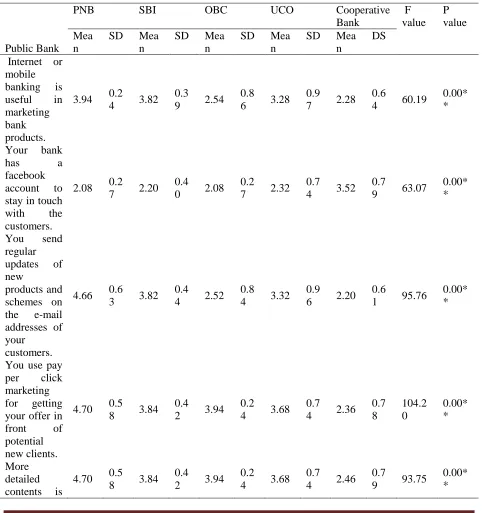
Table 1 depicts that the p value in all the above factors related to use of information technology
in marketing of loan product by the above 5 banks is less than 0.01 i.e. the level of significance,
so our null hypothesis (Ho1) is not accepted. Thus there is a significant difference in the
information technology used by the above 5 public sector banks in terms of mobile banking,
social networking, blogging, search engine links and use of other techniques of internet
marketing. Among the public sector banks, Punjab National Bank is leading in terms of
marketing of loans through internet banking, mobile banking and other techniques of internet
marketing. SBI is also a pioneer in marketing through social networking. OBC, UCO Bank and
Co-operative Banks are doing averagely well in use of information technology for marketing but
still they are lagging behind PNB and SBI which are the market leaders not only in terms of
FEB-MAR, 2016, VOL. 3/14 www.srjis.com Page 3451 Table 2 Chi-square table for use of information technology in marketing among public
sector banks
ICICI HDFC AXIX ING Vyasa
Federal Bank
F value
P value
Mean SD Mean SD Mean SD Mean SD Mean SD
Internet or
mobile banking
is useful in
marketing bank products.
4.82 0.56 4.88 0.33 1.32 0.84 3.88 0.33 3.88 0.33 387.34 0.00**
Your bank has a facebook account to stay in touch with the customers.
4.06 0.42 4.10 0.30 2.30 0.65 2.14 0.35 3.86 0.40 248.05 0.00**
You send
regular updates of new products and schemes on
the e-mail
addresses of
your customers.
4.92 0.27 4.88 0.33 2.24 0.59 3.88 0.33 3.90 0.30 404.49 0.00**
You use pay per click marketing for getting your offer in front of
potential new
clients.
4.98 0.14 4.12 0.33 1.80 1.36 3.84 0.37 3.74 0.63 136.04 0.00**
More detailed
contents is
provided to
search engines
by your bank than
competitors.
4.92 0.27 4.90 0.30 1.60 1.16 3.82 0.39 3.80 0.61 224.69 0.00**
You advertise
your product by networking with influential bloggers.
4.94 0.24 4.02 0.32 2.14 0.45 4.84 0.37 4.70 0.65 371.07 0.00**
You have built links for your website through
the search
engines.
4.06 0.31 4.04 0.35 2.54 0.97 3.02 0.43 3.84 0.37 78.72 0.00**
You send
regular updates
regarding new
products and
offers on the mobile of the customer.
FEB-MAR, 2016, VOL. 3/14 www.srjis.com Page 3452 ** p<0.01 level of significance
Table 2 depicts that the p value in all the above factors related to use of information technology
in marketing of loan product by the above 5 banks is less than 0.01 i.e. the level of significance,
so our null hypothesis (H02) is not accepted. Thus, there is a significant difference in the
information technology used by the 5 selected private sector banks in terms of mobile banking,
social networking, blogging, search engine links and use of other techniques of internet
marketing.
Among the private sector banks, HDFC bank is leading in terms of marketing of loans
through internet banking, mobile banking and social networking. ICICI bank is a leader in
sending regular updates of its new products to the potential customers through e-mails. This bank
is also adopting the other techniques of internet marketing like blogging, search engine links and
pay per click marketing etc. more efficiently than its competitors. Though AXIS Bank, Federal
Bank and ING Vyasa banks are also using information technology innovatively for marketing of
[image:10.612.94.527.400.719.2]their products but they have not reached upto the optimum level of its usage.
Table 3 Comparison of private sector and public sector banks for use of information
technology in marketing
Public Private
t value df P value
Mean SD Mean SD
Internet or mobile banking is useful in marketing bank products.
3.17 0.95 3.76 1.39 -5.48 498 0.00**
Your bank has a facebook account to stay in touch with the customers.
2.44 0.77 3.29 0.99 -10.77 498 0.00**
You send regular updates of new products and schemes on the e-mail addresses of your customers.
3.30 1.14 3.96 1.05 -6.75 498 0.00**
You use pay per click marketing for getting your offer in front of potential new clients.
3.70 0.96 3.70 1.26 0.08 498 0.94
More detailed contents is provided to search engines by your bank than competitors.
3.72 0.93 3.81 1.37 -0.80 498 0.42
You advertise your product
by networking with
influential bloggers.
4.01 1.11 4.13 1.13 -1.16 498 0.25
You have built links for your
FEB-MAR, 2016, VOL. 3/14 www.srjis.com Page 3453 engines.
You send regular updates regarding new products and offers on the mobile of the customer.
3.67 0.60 2.46 0.88 17.96 498 0.00**
** p<0.01 level of significance
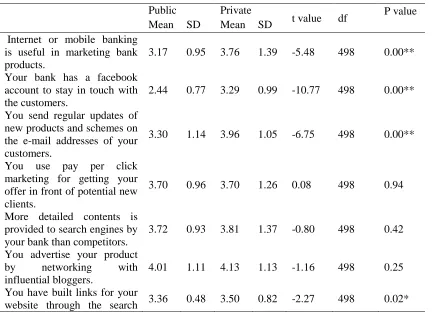
From the above table, we can conclude that there is a significant difference in the use of internet
and mobile banking by the selected private and public sector banks. Private sector banks are
more internet savvy and like to keep their customers and employees updated through the use of
information technology. On the contrary for the factors like per click marketing, blogging and
use of search engines, there is no significant difference between the public and private sector
banks.
Conclusion
The paper has analyzed theoretically as well as empirically the use of information technology in
marketing of loan products by banks. From the results driven by applying chi-square test, it was
found that both the private sector and public sector banks are intensively using the modern
technology for the purpose of marketing of their products. However, it can be said that the
private sector banks are taking a lead in adopting information technology for marketing and
public sector banks are following them. In the times to come, technology will cross all
limitations and energize world-wide banking business. The banks would need to embrace the
best technique to make a client - driven operation model.
References:
Avasthi G P M (2000-01), “Information Technology in Banking: Challenges for Regulators”,
Prajnan, Vol. XXIX, No. 4, pp. 3 – 17.
B. Janki (2002): “Unleashing Employee Productivity: Need for a Paradigm Shift”, Indian
Banking Association Bulletin XXIV (3); March 7 - 9.
Bell, F.W. and N.B. Murphy (1968), “Costs in commercial banking: a quantitative analysis of
bank behaviour and its relation to bank regulation”, Research Report No.41, Federal
Reserve Bank of Boston.
Jain Yogesh (2013), “Mobile Banking: A Study On Adoption & Challenges In Southern
FEB-MAR, 2016, VOL. 3/14 www.srjis.com Page 3454 Kandampully, J. (2002), “Innovation as the core competency of a service organization: the role
of technology, knowledge and networks”, European Journal of Innovation Management,
5 (1), pp 18-26.
Morris, M. H., J. Brunyee, and M. Page. (1998), “Relationship marketing in practice: Myths and
realities”, Industrial Marketing Management, 27 (4): 359–71.
Padhy, P., & Swar, B. (2009), “A study on Customer Satisfaction & Service Gaps in Selected
Private, Public & Foreign Banks”, In 3rd IIMA Conference on Marketing Paradigms for
Emerging Economies, Indian Institute of Management.
Quinn, J. B. (1996), “The productivity paradox is false: Information technology improves service
performance”, Advances in services marketing and management 5, (pp. 71-84).
Ram Mohan, T.T. and Ray, S.C. (2004), “Productivity growth and efficiency in Indian banking: a comparison of public, private, and foreign banks”, Economics Working Paper 2004-27,
Department of Economics, University of Connecticut, Storrs, CT.
Rangarajan, C. (1998), “Indian Economy – Essays on Money and Finance”, UBS Publisher’s
Distributors Ltd.
Singh J.D. (1985), “Bank Marketing in India: The State of the Art”, International Journal of
Bank Marketing (UK), 3 (2) pp 48-63.
Srirojanant, S., & Thirkell, P. C. (1998), “Relationship Marketing and its Synergy with
Web-based Technologies”, Journal of Market-Focused Management, 3(1), 23-46.
Uppal, R. K. (2008), “Customer Perception of E-Banking Services of Indian Banks: Some Survey
Evidence”, The ICFAI Journal of Bank Management, 7(1): 63-74
V. Vimala (2015), “The Impact of Information Technology Adoption on the Customers of Bank of
India, Bangalore Urban – An Evaluative Study”, IOSR Journal of Business and